Jeffrey Goldberg writes: The other day I was talking to a senior Obama administration official about the foreign leader who seems to frustrate the White House and the State Department the most. “The thing about Bibi is, he’s a chickenshit,” this official said, referring to the Israeli prime minister, Benjamin Netanyahu, by his nickname.
This comment is representative of the gloves-off manner in which American and Israeli officials now talk about each other behind closed doors, and is yet another sign that relations between the Obama and Netanyahu governments have moved toward a full-blown crisis. The relationship between these two administrations— dual guarantors of the putatively “unbreakable” bond between the U.S. and Israel—is now the worst it’s ever been, and it stands to get significantly worse after the November midterm elections. By next year, the Obama administration may actually withdraw diplomatic cover for Israel at the United Nations, but even before that, both sides are expecting a showdown over Iran, should an agreement be reached about the future of its nuclear program.
The fault for this breakdown in relations can be assigned in good part to the junior partner in the relationship, Netanyahu, and in particular, to the behavior of his cabinet. Netanyahu has told several people I’ve spoken to in recent days that he has “written off” the Obama administration, and plans to speak directly to Congress and to the American people should an Iran nuclear deal be reached. For their part, Obama administration officials express, in the words of one official, a “red-hot anger” at Netanyahu for pursuing settlement policies on the West Bank, and building policies in Jerusalem, that they believe have fatally undermined Secretary of State John Kerry’s peace process.
Over the years, Obama administration officials have described Netanyahu to me as recalcitrant, myopic, reactionary, obtuse, blustering, pompous, and “Aspergery.” (These are verbatim descriptions; I keep a running list.) But I had not previously heard Netanyahu described as a “chickenshit.” [Continue reading…]
Category Archives: Issues
Kurdish women in Kobane are fighting for the rights of women everywhere
Meysa Abdo, the commander of the YPG Kurdish resistance in Kobane (she is also known by the nom de guerre Narin Afrin) writes: Since Sept. 15, we, the people of the Syrian town of Kobani, have been fighting, outnumbered and outgunned, against an all-out assault by the army of the Islamic State, also known as ISIS.
Yet despite a campaign that has intensified in the past month, including the deployment of United States-made tanks and armored vehicles, the Islamic State has not been able to break the resistance of Kobani’s fighters.
We are defending a democratic, secular society of Kurds, Arabs, Muslims and Christians who all face an imminent massacre.
Kobani’s resistance has mobilized our entire society, and many of its leaders, including myself, are women. Those of us on the front lines are well aware of the Islamic State’s treatment of women. We expect women around the world to help us, because we are fighting for the rights of women everywhere. We do not expect them to come to join our fight here (though we would be proud if any did). But we do ask women to promote our case and to raise awareness of our situation in their own countries, and to pressure their governments to help us.
We are thankful to the coalition for its intensified airstrikes against Islamic State positions, which have been instrumental in limiting the ability of our enemies to use tanks and heavy artillery. But we had been fighting without any logistical assistance from the outside world until the limited coalition airdrops of weapons and supplies on Oct. 20. Airdrops of supplies should continue, so that we do not run out of ammunition.
None of that changes the reality that our weapons still cannot match those of the Islamic State. [Continue reading…]
How the Left abandoned the Kurds by getting stuck up its anti-imperialist cul-de-sac
Yasin Sunca writes: One can simply put hundreds of reasons as to why the left has to oppose and react against the ISIS and what they have been doing to innocent people throughout last two years. However, those who are supposed to speak out against the ISIS, primarily the left wing parties and organisations, have simply failed to come up with a comprehensive approach, are even devoid of understanding what is going on exactly and, unfortunately for them, are stuck in the orthodox interpretation of socialism against imperialism. They have once again stuck to the marginal track to blame their respective governments as imperialist, which in fact, means almost nothing, either for the government or for the society.
In the specific case of the ongoing resistance of the Kurds in Rojava (Syrian Kurdistan) the Popular Protection Units (YPG) have been resisting against both the brutal attacks of the jihadists and the military aggressions of the Syrian regime. The Kurds have not opted for cooperation either with the regime or the mainstream opposition groups due to very convincing and understandable reasons. The regime has been oppressing the Kurds, among others, for a very long time and therefore, it was impossible for the Kurds to go along with the regime politically. However, facing political and military difficulties in the context of the ongoing war, the regime decided to focus on the strategic areas in their war with the opposition groups and intelligibly, have not carried out heavy military offensives against the Kurdish self-declared cantons, compared to other regions of the country. Furthermore, the declaration of the Kurdish cantons in Rojava would pose certain problems to Turkey which has been amongst the most vocally critical countries of the Syrian regime. Thus, we can talk about a political convergence between the regime and the Kurds rather than a strategically motivated agreement. Besides, the Kurds could not have cooperated with the mainline Syrian opposition because of two core issues. The first, the Arab opposition have not recognised any collective rights of the Kurds and postponed all Kurdish demands to a probable post-Assad period. The second, the Arab opposition did not have a clear agenda for the future of Syria. The question such as whether it would be a new dictatorship or a democracy has not a clear and convincing answer and the Kurds remained sceptical about the will of the opposition in relation to democratisation.
Taking all this background into account, the Kurds opted for a third line policy and started to build their cantons with a new democratic understanding, inclusive of all the different factions of the population. The Kurdish cantons have never carried out any offensives against any group unless a military attack was the case. The current resistance of the Kobane canton is due to the brutal attack of the jihadist ISIS and it is a war of self-defence. The Kurds are carrying out a socialist experiment in the Middle-East, one of the most challenging regions of the world, and the international left is equally responsible for the protection of this emerging socialist hope. This experiment needs the unconditional support of the socialists of the world and internationalist solidarity. (For those who are interested in the new model in Rojava here is an article, available online: http://roarmag.org/2014/07/rojava-autonomy-syrian-kurds/)
However, the left wing parties and groups in Europe are far from understanding what is going on exactly in Kurdistan and in Kobane, nor do they have any plans to understand the ideological background of the Rojava Cantons. They have to admit that they were unable to understand the third line policy and, just like the mainstream media have been doing, positioned the Kurds together with the Assad regime despite the fact that the Kurds clearly declaring and practically manifesting a billion times that they are an opposition group. They kept on blaming the Kurds to be the proxy of the regime. Besides, some other groups adopted a restrictive approach and claimed that if the Kurds are not with Bashar al-Assad then they have to be with the opposition. Yet one should remind people of the fact that being against the regime doesn’t automatically mean accepting all analyses and projections of the mainline opposition in Syria. Moreover, the mainline opposition in Syria is also supported by “imperialists” against the regime. So, the Kurds clearly understood the right place to stand was a third line. [Continue reading…]
‘Rehana is alive and well… ISIS fanatics have NOT beheaded her’
'#Rehana is alive. #ISIS did NOT behead her': Fighter escaped #Kobane, her friends tell me http://t.co/PqMUuM0EgS pic.twitter.com/v5zOQxD1Nx
— John Hall (@JohnMatthewHall) October 28, 2014
The Daily Mail reports: The female Kurdish fighter who became a poster girl for the Kobane resistance before allegedly being beheaded by Islamic State militants is actually alive and well, it was claimed today.
The woman, known by the pseudonym Rehana, was celebrated as a symbol of hope for the besieged Syrian border city after an image of her making a peace sign was retweeted over 5,000 times.
That picture was followed days later by a gruesome photograph of an ISIS terrorist holding the severed head of a young woman, sparking rumours that Rehana had been savagely murdered.
This is one of those moments when it remains to be seen whether the collective intelligence of the users of social media will be able to rise to the occasion.
That Rehana is alive — if this is true — is of course good news. But the photos of an ISIS fighter holding aloft the head of a Kurdish young woman fighter were most likely authentic — that young woman simply happened not to be one who had previously been turned into a “poster girl.”
Let’s not forget that the life as the unknown soldier is worth no less than that of the social-media celebrity.
Peshmerga on route to Kobane
Rudaw reports: Peshmerga from the Kurdistan Region of Iraq will arrive in Kobane in the early hours of Wednesday to help defenders of the Syrian border town fight off an Islamic State assault that has lasted more than 40 days, according to informed sources.
Part of the 150-strong Peshmerga artillery force were flying from Erbil to Turkey, from where they will cross to Kobane. Others will travel by road, accompanying trucks, guns, and other heavy weapons with which they hope to help defeat the ISIS siege.
The deployment of the Kurdish soldiers comes after being delayed for two days of negotiations with Turkey, through whose territory they must pass to reach Kobane, which lies just across the Turkish frontier.
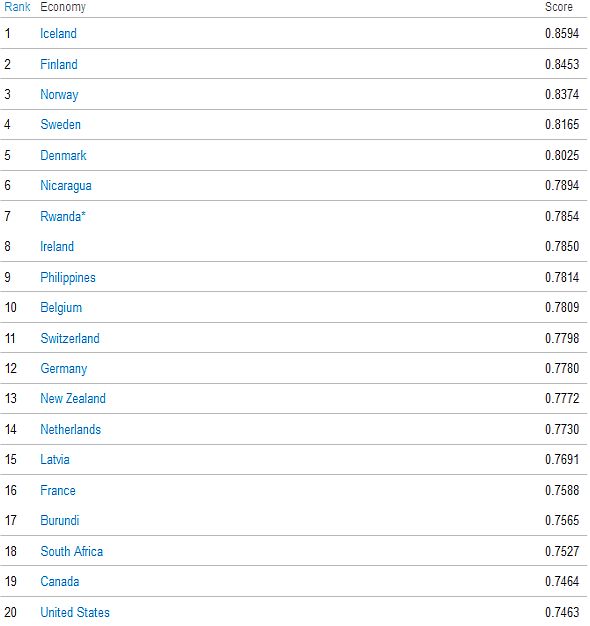
The Global Gender Gap Report 2014
Global Gender Gap Index 2014. The highest possible score is 1 (equality) and the lowest possible score is 0 (inequality). Click on the table below to see all 142 rankings.
How Israel is turning Gaza into a super-max prison
Jonathan Cook writes: It is astonishing that the reconstruction of Gaza, bombed into the Stone Age according to the explicit goals of an Israeli military doctrine known as “Dahiya”, has tentatively only just begun two months after the end of the fighting.
According to the United Nations, 100,000 homes have been destroyed or damaged, leaving 600,000 Palestinians – nearly one in three of Gaza’s population – homeless or in urgent need of humanitarian help.
Roads, schools and the electricity plant to power water and sewerage systems are in ruins. The cold and wet of winter are approaching. Aid agency Oxfam warns that at the current rate of progress it may take 50 years to rebuild Gaza.
Where else in the world apart from the Palestinian territories would the international community stand by idly as so many people suffer – and not from a random act of God but willed by fellow humans? [Continue reading…]
Where else?
How about Lebanon, buckling under the strain of supporting 1.5 million Syrian refugees and where 200,000 children are being forced to work in a situation “perilously close to slave labour.”
I point this out not to diminish concern about the plight of Palestinians in Gaza, but because among pro-Palestinian activists in the West, a myopic fixation on those who have suffered at the hands of Israelis has often come with an apparent indifference towards those whose misery was precipitated by the brutal rule of one of Israel’s next door neighbors.
How much concern there is about those who suffer sometimes appears to depend on who caused the suffering.
Nobel Peace Prize winners push Obama for release of torture report
Time reports: Twelve winners of the Nobel Peace Prize asked President Barack Obama late Sunday to make sure that a Senate report on the Central Intelligence Agency’s use of harsh interrogation tactics is released so the U.S. can put an end to a practice condemned by many as torture.
The release of the report, which is the most detailed account of the CIA’s interrogation practices in the wake of the Sept. 11, 2001 terrorist attacks, would be an opportunity for the U.S. and the world to come to terms with interrogation techniques that went too far, the laureates said in an open letter and petition. The release of the report by the Senate Select Committee on Intelligence has stalled as the Obama Administration the CIA, and lawmakers clashed over how much of it should be redacted.
American leaders have “eroded the very freedoms and rights that generations of their young gave their lives to defend” by engaging in and justifying torture, the peace prize winners said. The letter was published on TheCommunity.com, a project spearheaded by Peace Prize winner and international peacemaker José Ramos-Horta.
ISIS promotes hostage John Cantlie as its embedded reporter in Kobane
The Washington Post reports: In a remarkable new video released by the Islamic State militants, British hostage John Cantlie gives a tour of the Syrian city of Kobane and denounces Western coverage of the fighting in the city.
(Note: Our video team believes the first segment of may have been doctored.)
Cantlie, a photographer and journalist who was taken hostage in late 2012, has appeared in a number of propaganda videos for the Islamic State in recent months, usually in an orange jumpsuit in front of a plain black screen. However, the new video, released Monday via social media accounts linked to the Islamic State, appears markedly more professional than the previous ones. Notably, it appears to show Cantlie walking outside and animatedly discussing recent events.
The video also takes aim at a different target: Although previous videos appeared designed to criticize Western military action against the Islamic State, this time the main target appears to be Western media and their coverage of the situation in Kobane, where the Islamic State has battled for control against Kurdish militias. [Continue reading…]
#ISIS uses outdated footage for its propaganda video on Kobane. There's no Turkish flag over there since 15th of Oct. pic.twitter.com/bLq06W27v1
— Amed News Agency (@AJANSAMED) October 27, 2014
Similarities between ISIS and Assad regime rhetoric is striking. Cantlie says jihadists are "just mopping up" in Kobane; "it's nearly over."
— DavidKenner (@DavidKenner) October 27, 2014
The Kurdish vision of Democratic Confederalism
In the preface to Democratic Confederalism, published in English in 2011, the imprisoned PKK leader, Abdullah Ocalan, writes: For more than thirty years the Kurdistan Workers’ Party (PKK) has been struggling for the legitimate rights of the Kurdish people. Our struggle, our fight for liberation turned the Kurdish question into an international issue which affected the entire Middle East and brought a solution of the Kurdish question within reach.
When the PKK was formed in the 1970s the international ideological and political climate was characterized by the bipolar world of the Cold War and the conflict between the socialist and the capitalist camps. The PKK was inspired at that time by the rise of decolonialization movements all over the world. In this context we tried to find our own way in agreement with the particular situation in our homeland. The PKK never regarded the Kurdish question as a mere problem of ethnicity or nationhood.
Rather, we believed, it was the project of liberating the society and democratizing it. These aims increasingly determined our actions since the 1990s.
We also recognized a causal link between the Kurdish question and the global domination of the modern capitalist system. Without questioning and challenging this link a solution would not be possible. Otherwise we would only become involved in new dependencies.
So far, with a view to issues of ethnicity and nationhood like the Kurdish question, which have their roots deep in history and at the foundations of society, there seemed to be only one viable solution: the creation of a nation-state, which was the paradigm of the capitalist modernity at that time.
We did not believe, however, that any ready-made political blueprints would be able to sustainably improve the situation of the people in the Middle East. Had it not been nationalism and nation-states which had created so many problems in the Middle East?
Let us therefore take a closer look at the historical background of this paradigm and see whether we can map a solution that avoids the trap of nationalism and fits the situation of the Middle East better. [Continue reading…]
Inside Kobane
In this video, the squeaking in the background that sounds like birds chirping is actually coming from a rusty swing. The distant sounds of laughter and conversation from women — perhaps the same people on the swing, enjoying one of the recreations of childhood as daily life continues inside a war zone.
Finally video from INSIDE #Kobane. Turkey border sealed off, I cant get in. But asked local journo to film this story http://t.co/4y7dcaKlte
— Jenan Moussa (@jenanmoussa) October 27, 2014
How congressional hawks plan to kill Obama’s Iran deal
Trita Parsi writes: Negotiations with Iran over the future of its nuclear program have not even concluded yet some members of Congress are preparing to manufacture a political crisis over a deal. Their beef? President Barack Obama may initially bypass Congress and suspend sanctions imposed on Iran to make a deal possible and only later ask lawmakers to end them permanently when it is determined that Iran has complied fully with its obligations under the deal.
Of course, many of the lawmakers complaining about the potential presidential end run voted to give him the right to waive sanctions when they passed sanctions legislation in 2010 and 2011. And, of course, only Congress can lift the sanctions permanently, so there wouldn’t be any circumventing to begin with.
So what’s really going on?
It’s very simple: If you prefer war with Iran over a deal with Iran – even one that would prevent it from building a bomb — your best and possibly last opportunity to kill the deal is immediately after the nuclear talks have concluded. That’s when distrust of Iran’s intentions will remain pervasive and when its commitment to carry out its side of the deal will still have to be demonstrated. Former House Majority Leader Eric Cantor pursued this tactic in January after an interim agreement was reached in November last year. [Continue reading…]
How a Turkish leftist gave his life to save Kurdish Kobane
Al Jazeera: Suphi Nejat Agirnasli lived a scholar’s life on an island in the Sea of Marmara, a short ferry ride from the center of Istanbul. He was translating a multivolume encyclopedia of psychology from German into Turkish. He often worked in the living room, in sweatpants, looking out at the water.
“He told me that he didn’t want to grow up. He didn’t want to go to the adult world,” said his close friend Omer, a student who asked to be identified by only his first name.
But in August, Agirnasli cleaned out his room and vanished, leaving no indication of his destination. Two weeks ago, the news came that the 30-year-old died after joining Kurdish forces defending the besieged Syrian town of Kobane from Islamic State in Iraq and the Levant (ISIL).
Images from that brief final chapter of his life contrast with earlier photographs of the scholar hunched over his papers. In a portrait taken during his weeks with the Kurdish militia, Agirnasli stands straight, looking directly into the camera, a smile on his unshaven face. He is dressed in fatigues. In a video posted online, he states his name, birthdate and parents’ names. He holds a gun. Explosions can be heard in the background.
In the widening crisis emanating from Syria, Agirnasli’s profile stands out among the hundreds of men and women from Turkey — most of them ethnic Kurds — fighting in Kobane and the other parts of Syria.
Most of the estimated 15,000 volunteer foreign fighters who have been flooding into that theater of war are joining ISIL and other armed groups. But Agirnasli was fighting against them, making him one of the few non-Kurds, perhaps a few dozen men and women, who have taken up arms against ISIL.
“I think it will remain a small phenomenon in terms of fighters who are going across, but you’re seeing the fault lines played out inside Turkey coming from the Syrian conflict,” said Aaron Stein, a Geneva-based associate fellow with the defense think tank Royal United Services Institute. “It’s the militant left who are going to fight for the communist revolution and see the PYD as on the front lines against Islamism.” The PYD, or Democratic Union Party, is a Syrian Kurdish political party whose armed wing has been leading the battle against ISIL in Kobane. [Continue reading…]
Kurds fear ISIS use of chemical weapon in Kobane
The Guardian reports: Kurds battling Islamic State militants for control of Kobani fear the extremist group may have used an unidentified chemical weapon, according to officials and one of the few doctors still working in the besieged Syrian town.
Patients with blisters, burning eyes and breathing difficulties turned up at a clinic after a blast was heard on Tuesday evening, Dr Walat Omar said. He described the symptoms as abnormal and said he could not identify their cause, but suspected a chemical weapon.
“After a loud explosion [on Tuesday night], we received some patients with abnormal symptoms. They reported a bad smell which produced some kind of allergic reaction,” Omar said in a telephone interview that was periodically disrupted by heavy explosions. [Continue reading…]
For Iraq’s Sunnis, sectarian militias pose an extra threat
Sarah Margon writes: The traffic on the road to Tuz Khurmato, a town about an hour south of Kirkuk, was light on a recent morning when we set out to meet senior officials from the Kurdish security forces, the pesh merga. Their fortified bases, lean-tos flying various Shiite militia flags and makeshift camps for displaced families dotted the side of the highway. Official Iraqi security forces were nowhere to be seen, even at checkpoints.
Inside a dusty office at the pesh merga base, a field commander relayed what he had seen during recent weeks of fighting. “They don’t respect human rights, they arrest anyone,” he said. “They kill, they behead, they burn houses.” He was referring not to the Islamic State but to the government-backed Shiite militias alongside whom the pesh merga are fighting the Sunni extremist group in an uneasy marriage of convenience.
The lines between Shiite militias and official security forces have been blurred for years. But with the Iraqi army’s near-total collapse this summer, their strength has increased. Politicians, security force personnel and civilians alike have told Human Rights Watch that these militias “control security” throughout much of Iraq, a point only reinforced by the recent appointment of Mohammed Ghabban, a Shiite politician with strong links to the Badr Brigade, a notorious militia, as Iraq’s interior minister.
In certain parts of Iraq under siege by the Islamic State, the militias continued the fight even after U.S.-led coalition airstrikes shifted to other targets. They did this primarily by attacking Sunnis who didn’t flee the Islamic State advance, considering any remaining families “collaborators,” and ransacking, burning and even demolishing scores of Sunni villages. In some cases, they traveled from village to village in U.S. Army-issued Humvees, which were probably obtained from the Iraqi government. [Continue reading…]
Lebanon tells Syrian refugees ‘to return’ or go elsewhere
BBC News reports: Lebanon cannot accept any more refugees from war-torn Syria, Information Minister Ramzi Jreij has said.
He also urged existing refugees “to return to their countries, or go to other countries”.
Although he said those in exceptional circumstances could be accepted, the decision could deny refuge to tens of thousands of Syrians.
Lebanon has taken 1.1 million Syrians despite having a total population of just over four million.
A spokesperson for the United Nations High Commissioner for Refugees (UNHCR) told the BBC that Lebanon’s decision “is not a surprise”.
“We can understand, we sit here responding to this enormous weight of refugees that is draining this community like nothing we have ever seen before,” she added. [Continue reading…]
How America’s top military leader dragged Obama back into Iraq
Mark Perry writes: Apart from an occasional Thursday afternoon meeting between Barack Obama and Defense Secretary Chuck Hagel at the White House, Gen. Martin Dempsey — the chairman of the Joint Chiefs of Staff — rarely has opportunities to get face time with the president. So when he does, he presses his advantage. One of the few times this happened was during the early evening hours of Aug. 6, when Dempsey joined Obama in his limousine at the State Department, where the president had been attending a session of the U.S.-Africa Leaders Summit. The ride to the White House allowed Dempsey his first one-on-one with Obama in several weeks. As the two sat across from each other in the presidential limousine, Dempsey turned to his commander-in-chief.
“We have a crisis in Iraq, Mr. President,” Dempsey said, according to a senior Pentagon official who spoke with the chairman about his discussion with Obama that same day. “ISIS is a real threat,” he added, using an alternative acronym for the military group the Islamic State in Iraq and the Levant, or ISIL. The senior Pentagon official with whom I spoke, and who paraphrased the Obama-Dempsey exchange, added that “Dempsey really leaned into him” on the crisis, saying it demanded “immediate attention.”
By that point, ISIL had overrun Mosul, a city of one million people in northern Iraq, seized stockpiles of heavy weapons from the hapless Iraqi military and was attacking thousands of ethnic Yazidis who had fled the conflict. According to the senior Pentagon official, the president listened carefully as Dempsey outlined the militants’ rapid military gains in western Iraq and warned that ISIL fighters were threatening Baghdad. “It’s that bad?” Obama asked, according to this person’s account. Dempsey was blunt. “Yes, sir,” he said, “it is.” (The White House, asked to characterize the president’s reaction, declined to comment.) [Continue reading…]
FBI warns news outlets that group affiliated with ISIS is targeting journalists
The Washington Post reports: The FBI on Thursday warned news organizations that it had recently obtained “credible information” indicating that members of an Islamic State-affiliated group have been “tasked with kidnapping journalists” in the region and taking them to Syria.
The bureau noted that supporters of the terrorist group have called on members to retaliate against the United States and its allies for airstrikes in Iraq and Syria and have identified journalists as “desirable targets.”
The warning was released as a rare intelligence bulletin to news outlets so they could take security precautions. [Continue reading…]