Harald Welzer writes: The municipal utility company in the city of Potsdam is currently wooing new customers with a special “BabyBonus” offer. The slogan reads, “We value little energy robbers! Welcome to the world!” Every newborn receives a credit of 500 kilowatt hours of electricity, allowing him or her to revel from the start in a world where everything, especially energy, will always be available in abundance. These babies may later find they’re in for a surprise.
When the United Nations Climate Change Conference wrapped up in Warsaw the weekend before last, it did, despite what most observers and disappointed NGO representatives believe, yield a result. It just wasn’t officially announced: the termination of the at-least symbolic general agreement that urgent action must be taken to counter global warming. In other words, climate change has been definitively removed from the global policy agenda.
The intense concern over climate change triggered by Intergovernmental Panel on Climate Change reports in 2007 and widely popularized by Al Gore’s movie, “An Inconvenient Truth” — a concern that led even Angela Merkel to make an appearance in the Arctic as the “climate chancellor,” decked out in a red all-weather jacket — actually dissipated a while ago, but no one wanted to say so out loud.
The United States’ lack of interest in an international treaty is dressed up by its argument that gas extracted by fracking is more climate-friendly than coal, while in Japan, the Fukushima disaster and resulting phase-out of nuclear power has provided those responsible with an excellent argument for why the country now needs to burn more coal in order to stay economically competitive. Hannelore Kraft, governor of the German state of North Rhine-Westphalia, feels much the same way about her own state. And Australia, Canada, Poland and Russia have never really grasped why global warming should stop anyone from burning everything the oil rigs, mines and pipelines have to offer in the first place.
To put it another way: The primacy of economics has prevailed. It no longer seems to matter how we’re supposed to get through the rest of this century if the world grows warmer by three, four or five degrees Celsius. National economies require an ever-growing dose of energy if their business models are to continue functioning, and, in the face of this logic, all scientific objections to the contrary are just as powerless as the climate protest movements, which are, in any case, marginal. [Continue reading…]
Category Archives: Issues
With Iran, Obama can end America’s long war for the Middle East
Andrew J. Bacevich writes: What Jimmy Carter began, Barack Obama is ending. Washington is bringing down the curtain on its 30-plus-year military effort to pull the Islamic world into conformity with American interests and expectations. It’s about time.
Back in 1980, when his promulgation of the Carter Doctrine launched that effort, Carter acted with only a vague understanding of what might follow. Yet circumstance — the overthrow of the shah in Iran, the Soviet invasion of Afghanistan — compelled him to act. Or more accurately, the domestic political uproar triggered by those events compelled the president, facing a tough reelection campaign, to make a show of doing something. What ensued was the long-term militarization of U.S. policy throughout the region.
Now, without fanfare, President Obama is effectively revoking Carter’s doctrine. The U.S. military presence in the region is receding. When Obama posited in his second inaugural address that “enduring security and lasting peace do not require perpetual war,” he was not only recycling a platitude; he was also acknowledging the folly and futility of the enterprise in which U.S. forces had been engaged. Having consumed vast quantities of blood and treasure while giving Americans little to show in return, that enterprise is now ending.
Like Carter in 1980, Obama finds himself with few alternatives. At home, widespread anger, angst and mortification obliged Carter to begin girding the nation to fight for the greater Middle East. To his successors, Carter bequeathed a Pentagon preoccupied with ramping up its ability to flex its muscles anywhere from Egypt to Pakistan. The bequest proved a mixed blessing, fostering the illusion that military muscle, dexterously employed, might put things right. Today, widespread disenchantment with the resulting wars and quasi-wars prohibits Obama from starting new ones.
Successive military disappointments, not all of Obama’s making, have curbed his prerogatives as commander in chief. Rather than being the decider, he ratifies decisions effectively made elsewhere. In calling off a threatened U.S. attack on Syria, for example, the president was acknowledging what opinion polls and Congress (not to mention the British Parliament) had already made plain: Support for any further military adventures to liberate or pacify Muslims has evaporated. Americans still profess to love the troops. But they’ve lost their appetite for war. [Continue reading…]
WikiLeaks’ Sarah Harrison: ‘How can you take Pierre Omidyar seriously?
The Guardian reports: The WikiLeaks staffer and Snowden collaborator Sarah Harrison has criticised Pierre Omidyar, the eBay founder who is setting up a new journalism venture with Glenn Greenwald, Laura Poitras and Jeremy Scahill, for his involvement in the 2010 financial blockade against WikiLeaks.
In her first interview since leaving Moscow for Berlin last month, Harrison told German news weekly Stern: “How can you take something seriously when the person behind this platform went along with the financial boycott against WikiLeaks?”
Harrison was referring to the decision in December 2010 by PayPal, which is owned by eBay, to suspend WikiLeaks’ donation account and freeze its assets after pressure from the US government. The company’s boycott, combined with similar action taken by Visa and Mastercard, left WikiLeaks facing a funding crisis.
“His excuse is probably that there is nothing he could have done at the time,” Harrison continued. “Well, he is on the board of directors. He can’t shake off responsibility that easily. He didn’t even comment on it. He could have said something like: ‘we were forced to do this, but I am against it’.”
Harrison joined WikiLeaks from the Bureau of Investigative Journalism, and worked with the organisation on the Afghan war logs and leaked cables projects. She now works on the WikiLeaks legal defence team, although she has no legal qualifications, and was catapulted to fame when she accompanied Edward Snowden, the NSA whistleblower, on his flight from Hong Kong to Russia in June 2013.
Referring to Omidyar’s plans to set up a new media organisation, in which the former Guardian writer Greenwald – who wrote a number of stories from the Snowden revelations – will play a central part, Harrison said: “If you set up a new media organisation which claims to do everything for press freedom, but you are part of a blockade against another media organisation, then that’s hard for us to take it seriously. But I hope that they stick to their promises”. [Continue reading…]
The Zionists afraid of free speech
This week, the New America Foundation hosted a discussion on the newly published, Goliath: Life and Loathing in Greater Israel, with its author Max Blumenthal. James Fallows writes:
I’ve been involved with New America since its beginning in the 1990s, initially as chairman of its board and still as a board member. New America puts on well over 100 events each year — in DC, New York, California, and elsewhere. To the best of my knowledge, this latest session was the only time we’ve been under public or private pressure to rescind an invitation for someone to speak. There could have been other cases, but I don’t know of any.
The event in question featured Max Blumenthal, who was being interviewed about his book on Israel, Goliath, by Peter Bergen, the well-known writer on war-and-terrorism topics. (Bergen is also a New America fellow; the latest of his many books is Man Hunt, about the bin Laden raid.) In the week before the event, items like this one in Commentary had said that New America should not provide a platform for what it claimed was destroy-Israel hate speech. Some members of the board got personal email pitches to the same effect.
I wasn’t involved in inviting Max Blumenthal, but having read his book before the session and now having heard him speak, I am glad that New America and its president, Anne-Marie Slaughter, stood by their invitation. That was the right call on general free-speech principles, and also because this book should be discussed and read. [Extra disclosures: Both Slaughter and Bergen are long-time friends of mine, as well as colleagues via the Atlantic, New America, and elsewhere. My wife and I have also been friends of Max Blumenthal’s parents for many years.]
The case against Goliath, summarized here, is that it is so anti-Israel as to represent not journalism or reasonable critique but bigoted propaganda; plus, that in being so anti-Israel it is effectively anti-Semitic. With a few seconds of online search, you can track down the now-extensive back and forth. The furor has certainly helped publicize the book, but to me those claims about it seem flat mischaracterizations. Goliath is a particular kind of exposé-minded, documentary-broadside journalism whose place we generally recognize and respect.
The purpose of this book is not to provide some judicious “Zionism at the crossroads” overview of the pluses and minuses of modern Israel. That is not the kind of writer Max Blumenthal is. His previous book, Republican Gomorrah, was about the rise of the Tea Party and related extremist sentiment within the GOP. In that book he wasn’t interested in weighing the conservative critique of big government or teachers’ unions or Medicaid. That’s Brookings’s job. Instead his purpose was to document the extreme voices — the birthers, the neo-secessionists, the gun and militia activists, those consumed by hatred of Barack Obama — who were then providing so much of the oomph within Republican politics.
That book was effective not because Blumenthal said he disagreed with these people. Of course he did, but so what? Its power came simply from showing, at length and in their own words, how they talked and what they planned to do. As Blumenthal pointed out in this week’s New America session, that earlier book argued, a year before the Tea Party’s surge victories in the 2010 mid-terms: these people are coming, and they are taking the party with them. His account wasn’t “balanced” or at all subtle, but it was right.
His ambition in Goliath is similar. He has found a group of people he identifies as extremists in Israel — extreme in their belief that Arabs have no place in their society, extreme in their hostility especially to recent non-Jewish African refugees, extreme in their seeming rejection of the liberal-democratic vision of Israel’s future. He says: these people are coming, and they’re taking Israeli politics with them. As he put it in a recent interview with Salon, the book is “an unvarnished view of Israel at its most extreme.” Again, the power of his book is not that Blumenthal disagrees with these groups. Obviously he does. It comes from what he shows. [Continue reading…]
Among those eulogising Mandela are people who once damned him as a terrorist and supported apartheid
Chris McGreal writes: Nelson Mandela Square sits at the entrance to the glitziest shopping mall in what is reputed to be the wealthiest square kilometre in Africa. Towering over the cafes around the northern Johannesburg piazza, as if guarding the diamond jewellers and designer clothes shops within, is a six metre tall, 2.5 ton statue of the great man dancing.
The mall’s owners say the statue is intended to honour Mandela and his country’s hard-won democracy and most of the shoppers milling around it would probably see it that way. But the great totem always seemed to me to be mocking the new South Africa.
Many of the same prosperous whites who gaze on the giant Mandela from plush cafes and pour out their love and admiration for his sacrifice in saving South Africans from themselves can also regularly be heard bemoaning the state of the country he bequeathed. They worship the man but despair of the legacy of his handiwork in the levels of crime, corruption, authoritarianism and “falling standards” under democratic government.
Not all whites, but a good number of them. And they feel free to do this because when they look at Mandela they see absolution. Their praise of his willingness to forgive comes with the understanding that they too are forgiven and absolved of the past. Freed of responsibility for how South Africa came to be what it is, they head back to the pool and congratulate themselves on their luck in embracing the world’s greatest modern statesman. Bring up past responsibilities and you face being accused of failing to understand Mandela’s message. [Continue reading…]
Nelson Mandela and the Anti-Apartheid Movement
Peter Hain writes: “Ah, Peter, return of the prodigal son!” Nelson Mandela beamed, welcoming me to his Johannesburg home in February 2000.
Although on an official government visit, in a sense I was also being welcomed to my “home” – to South Africa, the panoramic, sunshine country of my childhood, as the first-ever British minister for Africa to be born on that continent.
Almost to the day, 10 years before, many of us had watched, tears welling up, as he had walked to freedom after 27 years in prison. And a long time before that – in March 1966 – I was a teenager aboard an ocean liner steaming out of Cape Town, past Robben Island where Mandela and his fellow leaders of the African National Congress were jailed. My anti-apartheid activist parents had been forced to leave their beloved country and the “island from hell” disappeared in the stormy mist as we headed for exile in Britain.
People forget how tough it was then, how hard the struggle was to be for decades afterwards. The resistance had been closed down, leaders such as Mandela imprisoned, tortured, banned or forced underground.
Within a few years, Mandela had almost been forgotten. British diplomats dismissed the ANC and Mandela as a busted flush. The white racist police state seemed omnipotent.
But in Britain, the Anti-Apartheid Movement (AAM) had kept the flame of freedom flickering. Soon it was lit by our militant protests, which stopped white South African rugby and cricket tours in 1969-70. The country had been forced into global sporting isolation.
On Robben Island, brutal white warders, all fanatical rugby fans, vented their fury on Mandela and his comrades at the ostracism of the mighty Springboks, unwittingly communicating a morale-boosting message through the news blackout. [Continue reading…]
The specter of global domination
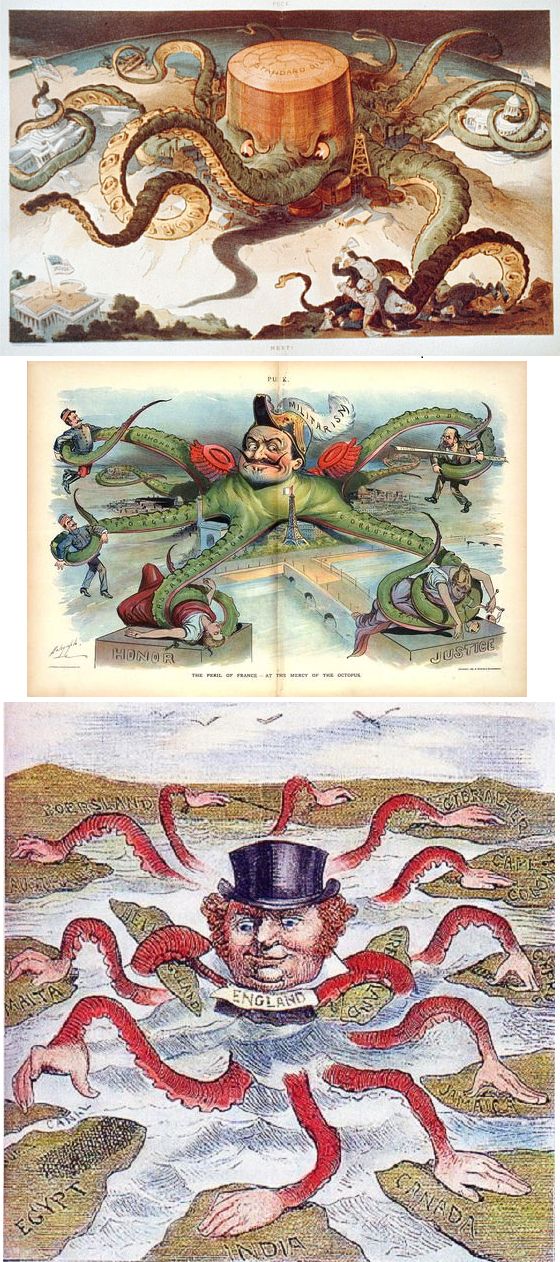
When Ian Flemming created the fictional SPECTRE (SPecial Executive for Counter-intelligence, Terrorism, Revenge and Extortion), a terrorist organisation aimed at world domination, he chose a familiar icon — the octopus — long favored by those who want to evoke images of evil. Its tentacles represent strength, stealth, ugliness, vast reach, and ruthlessness.
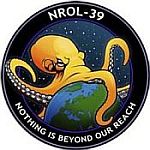
For the National Reconnaissance Office (NRO), which chose a world-grasping octopus and the slogan “Nothing is Beyond Our Reach” to adorn its latest spy satellite that launched from California on Thursday, the octopus represents “a versatile, adaptable, and highly intelligent creature.”
That’s an accurate description of an octopus as a creature but not of an octopus as a symbol.
While the mission of NROL-39 is classified, it is believed to be a remnant of the Future Imagery Architecture, a program which was described in the New York Times in 2007 as “perhaps the most spectacular and expensive failure in the 50-year history of American spy satellite projects.”

In a recent interview with the BBC, Glenn Greenwald said:
The goal of the United States government and the UK government, its closest surveillance ally, is to eliminate all privacy globally, by which I mean, to make every form of electronic communication by and between all human beings, collected, stored, analyzed, and monitored by the U.S. and its four English-speaking Five Eyes partners in the surveillance world.
One can view NROL-39 and its choice of symbols as yet another example of this relentless drive towards global domination in surveillance that Greenwald describes, or, one can apply a bit of analysis in a more fruitful, realistic but perhaps less hyperbolic direction.
As news reports appeared showing the NRO’s poor choice of imagery, I expect that inside the Pentagon and across the intelligence community, there was no shortage of individuals who smacked their own foreheads as they wondered: who could be so clueless? U.S. intelligence already has a massive image problem. It just got worse.
As a defense establishment agency, I’m sure the NRO does not have an artist-in-residence who is given a free hand to design and deploy a spy satellite logo of their choice. On the contrary, like any other government bureaucracy, the NRO no doubt has a careful review process through which draft designs are viewed and approved or rejected. So it’s very unlikely that when NROL-39 blasted into orbit, the global dominating octopus on its side lacked any of the sign-offs in the stages of authorization required by the agency. In other words, government officials across multiple ranks of seniority saw the logo and said: “Looks good to me.”
What the octopus logo reveals says much less about the ability of the intelligence agencies to control the world than it says about the competence and judgement of the people in charge.
The NRO is run by Betty J. Sapp and she isn’t a rocket scientist — business management is supposedly her expertise.
When those aspects of an intelligence agency’s work that are on public display evince this level of cluelessness, there’s no reason to imagine that under a cloak of secrecy it operations are more efficient.
We probably have less reason to be worried about our freedoms being curtailed than we have reason to be angry about the vast waste of resources all incurred in the name of national security.

Do antivirus companies whitelist NSA malware?
Mathew J. Schwartz writes: Dear antivirus vendors: Are you aiding and abetting National Security Agency (NSA) spying?
That’s the subject of an open letter, sent in October to leading antivirus vendors, from 25 different privacy information security experts and organizations. The letter asks the vendors to detail whether they’ve ever detected state-sponsored malware or received a government request to whitelist state-sponsored malware, and how they would respond to any such requests in the future.
The letter, sent from Dutch digital rights foundation Bits of Freedom, requested that the firms respond by November 15. “Please let us know if you feel that you cannot, or cannot fully, answer any of the above questions because of legal constraints imposed upon you by any government,” it said.
“Since we learned that the NSA has surreptitiously weakened Internet security so it could more easily eavesdrop, we’ve been wondering if it’s done anything to antivirus products,” letter signatory Bruce Schneier, chief security technology officer of BT, said in a blog post. “Given that it engages in offensive cyberattacks — and launches cyberweapons like Stuxnet and Flame — it’s reasonable to assume that it’s asked antivirus companies to ignore its malware. We know that antivirus companies have previously done this for corporate malware.”
As of two weeks ago, however, only six security vendors — ESET, F-Secure, Kaspersky Lab, Norman Shark, Panda, and Trend Micro — had responded to the request for information. [Continue reading…]
Mandela stood up against American power
Peter Beinart writes: Now that he’s dead, and can cause no more trouble, Nelson Mandela is being mourned across the ideological spectrum as a saint. But not long ago, in Washington’s highest circles, he was considered an enemy of the United States. Unless we remember why, we won’t truly honor his legacy.
In the 1980s, Ronald Reagan placed Mandela’s African National Congress on America’s official list of “terrorist” groups. In 1985, then-Congressman Dick Cheney voted against a resolution urging that he be released from jail. In 2004, after Mandela criticized the Iraq War, an article in National Review said his “vicious anti-Americanism and support for Saddam Hussein should come as no surprise, given his longstanding dedication to communism and praise for terrorists.” As late as 2008, the ANC remained on America’s terrorism watch list, thus requiring the 89-year-old Mandela to receive a special waiver from the secretary of State to visit the U.S.
From their perspective, Mandela’s critics were right to distrust him. They called him a “terrorist” because he had waged armed resistance to apartheid. They called him a “communist” because the Soviet Union was the ANC’s chief external benefactor and the South African Communist Party was among its closest domestic allies. More fundamentally, what Mandela’s American detractors understood is that he considered himself an opponent, not an ally, of American power. And that’s exactly what Mandela’s American admirers must remember now. [Continue reading…]
Mandela was never a revolutionary, always a radical
Gary Younge writes: A fitting way to commemorate Nelson Mandela is to describe his arrival in the townships during the first democratic elections in 1994. The crowds travelled up to 100 miles in cattle trucks or minibuses to get to places that apartheid had deliberately made remote and barren. Then they waited for hours, in a ramshackle stadium with little shade. Despite being punctual in his personal life, Mandela on the campaign trail was always late: a victim of overambitious scheduling and inefficient minders.
Finally, the crowds saw his cavalcade throw up dust in the distance, and they began to sing the campaign song Sekunjalo Ke Nako (Now is the Time). Everyone started to dance, ululations and cheers growing in intensity. Many of those present had not seen Mandela even on TV, and knew his face only from posters and newspaper pictures. Flags and placards hoisted above heads created a ripple at first, then a wave of excitement on a sea of black, gold and green.
The rush of energy did not subside until Mandela had taken the stage half an hour later. By then the crowd had got what it came for – proximity, a sighting, to be present in history. For hours after the rally, people walking home from the stadium punched the air and shouted “amandla” (“power”) at passing cars.
The problem with personifying a national, political aspiration, as Mandela did, is that it becomes difficult to see where the man starts and the movement ends. [Continue reading…]
Desmond Tutu on Nelson Mandela: ‘Prison became a crucible’
Desmond Tutu writes: For 27 years, I knew Nelson Mandela by reputation only. I had seen him once, in the early 1950s, when he came to my teacher-training college to judge a debating contest. The next time I saw him was in 1990.
When he came out of prison, many people feared he would turn out to have feet of clay. The idea that he might live up to his reputation seemed too good to be true. A whisper went around that some in the ANC said he was a lot more useful in jail than outside.
When he did come out, the most extraordinary thing happened. Even though many in the white community in South Africa were still dismissing him as a terrorist, he tried to understand their position. His gestures communicated more eloquently than words. For example, he invited his white jailer as a VIP guest to his inauguration as president, and he invited the prosecutor in the Rivonia trial to lunch.
What incredible acts of magnanimity these were. His prosecutor had been quite zealous in pushing for the death penalty. Mandela also invited the widows of the Afrikaner political leaders to come to the president’s residence. Betsie Verwoerd, whose husband, HF Verwoerd, was assassinated in 1966, was unable to come because she was unwell. She lived in Oranje, where Afrikaners congregated to live, exclusively. And Mandela dropped everything and went to have tea with her, there, in that place.
He had an incredible empathy. During the negotiations that led up to the first free elections, the concessions he was willing to make were amazing. Chief Buthelezi wanted this, that and the other, and at every single point Madiba would say: yes, that’s OK. He was upset that many in the ANC said Inkatha was not a genuine liberation movement. He even said that he was ready to promise Buthelezi a senior cabinet position, which was not something he had discussed with his colleagues. He did this to ensure that the country did not descend into a bloodbath. [Continue reading…]
Nelson Mandela: a leader above all others
In an editorial, The Guardian says: When Helen Suzman went to see Nelson Mandela on Robben Island in 1967, the first prisoner she encountered was a man called Eddie Daniels, who told her: “Yes, we know who you are. Don’t waste time talking to us. Go and talk to Mandela at the end of the row. He’s our leader.” Daniels’s absolute certainty struck Suzman very forcibly. Although Daniels did not spell it out, she learned later that the prison administration had tried to arrange her tour so that she would not reach Mandela’s cell before her limited time on Robben ran out.
She took the advice, made her way to Mandela’s cell, and found there a quietly eloquent and direct man of imposing physique and great natural authority. Eddie Daniels was of course right: Mandela was indeed the leader, not only of the detainees in the island prison, but of the South African liberation movement as a whole. He had mentors and partners, some in detention with him, some in exile, and some enduring a harassed and persecuted life in South Africa itself, and he had rivals inside and outside the African National Congress.
But he was indubitably the man who came, above all others, to symbolise the struggle of the ANC, from the time when it seemed to have collapsed under the assaults of the apartheid state, to the time of its final successes, when that same state found itself pleading with the ANC to enter a new era in which the structures of oppression would be liquidated.
Yet this leadership, even if we define it as moral rather than practical, remains ultimately something of a mystery. Mandela was not able, during 27 years in prison, to exercise sustained operational control or to take a regular part in ANC decision-making, except toward the very end, when he negotiated with FW de Klerk.
Before he went to jail, his record was of brave failure rather than of significant victory. His attempts, during his early years, to wage, along with others, a legal and non-violent campaign for black rights were stymied by a government which was not only unresponsive but positively preferred to push the ANC into clandestine activity so that it could fragment and criminalise the movement. His reluctant conversion to the military path ended abruptly when he was arrested within days of returning to South Africa to pursue the armed struggle. As a civil rights leader, he was ineffective. As a short-lived guerrilla leader, he was an amateur. And when, released from prison, he became the first president of the new South Africa, he was often inattentive, he discarded his once radical views on the economy, and, arguably, he endorsed the wrong man as his successor. To set against that, he insisted on respect for the judgments of the South African Constitutional Court even when they upset the ANC’s plans, and he refused to support the death penalty.
Mandela was far from alone among 20th-century liberation leaders in achieving stature in prison. [Continue reading…]
Nelson Mandela: we are blessed to have shared our lifetime with a colossus
Justice Malala writes: Nelson Mandela, global hero, died on Thursday night. We had steeled ourselves for it in the months of his hospitalisation over the past year and half. Yet, we are in shock.
We mourn him. We mourn him because in his 95 years, Nelson Rolihlahla Mandela has taught us how to live.
He taught us to strive for what is good and right, even as we ourselves stumble; to strain for perfection, even as we are caught up in our own flawed lives; to put the poor and downtrodden at the centre of our endeavours, even as we reach for the good life.
As he lay in hospital for months this year, Mandela taught us yet another lesson: just as we have been blessed with the gift of his presence, so too must we accept his inevitable departure. It is the most terrible of Biblical injunctions to perceive, but today it is stark: there is a time to live, and a time to die. Today we face the heartbreaking reality of the latter.
Over the past six months the news coming out of Pretoria had been the gravest it had ever been: the presidency had used the word “critical”; the family was sombre and mournful even as it was divided. The man whose walk to freedom was so long, so painful, so inspirational, was well on in his last journey.
Outside the hospital, passersby stopped and stared at the massed international and local media. “He is old. He must go,” said one to me as, like so many other journalists, we waited outside the hospital for word. It is a refrain that was heard often, at the hospital and elsewhere, even as far away as his home in Qunu. We could not bear to think of Mandela, a man who endured so much in pursuit of all our freedom, being in pain.
The heartbreaking reality, as one of our great poets, Chris van Wyk, once put it, is that it was time to go home, now. It is time to go home. [Continue reading…]
Nelson Mandela: Freedom fighter — 1918-2013
In June, Gary Younge wrote: Shortly before Nelson Mandela stepped down as president of South Africa in 1999, racial anxiety was a lucrative business. At the public library in the affluent area of Sandton, I attended a session at which an emigration consultant, John Gambarana, warned a hundred-strong, mostly white audience of the chaos and mayhem to come. Holding up a book by broadcaster Lester Venter called When Mandela Goes, he told them, “People, this book is a wake-up call. The bad news is [when Mandela leaves] the pawpaw’s really going to hit the fan. The good news is the fan probably won’t be working.”
And so it was that, even in the eyes of those who made a living peddling fear, less than a decade after his release from prison, Mandela had been transformed from terrorist boogeyman to national savior.
White South Africa has come to embrace him in much the same way that most white Americans came to accept Martin Luther King Jr.: grudgingly and gratefully, retrospectively, selectively, without grace but with considerable guile. By the time they realized that their dislike of him was spent and futile, he had created a world in which admiring him was in their own self-interest. Because, in short, they had no choice.
As the last apartheid leader, F.W. de Klerk—who had lost the election to Mandela—told me that same year, “The same mistakes that we made were still being made in the United States and the ex-colonies. Then we carried them on for around twenty years longer.” There are myriad differences between apartheid South Africa and America under segregation. But on that point, if little else, de Klerk was absolutely right. Neither the benefits of integration nor the urgency with which it was demanded were obvious to most Americans during King’s time. A month before the March on Washington in 1963, 54 percent of whites thought the Kennedy administration was “pushing racial integration too fast.” [Continue reading…]
Snowden and Greenwald: The men who leaked the secrets
Janet Reitman writes: Early one morning last December, Glenn Greenwald opened his laptop, scanned through his e-mail, and made a decision that almost cost him the story of his life. A columnist and blogger with a large and devoted following, Greenwald receives hundreds of e-mails every day, many from readers who claim to have “great stuff.” Occasionally these claims turn out to be credible; most of the time they’re cranks. There are some that seem promising but also require serious vetting. This takes time, and Greenwald, who starts each morning deluged with messages, has almost none. “My inbox is the enemy,” he told me recently.
And so it was that on December 1st, 2012, Greenwald received a note from a person asking for his public encryption, or PGP, key so he could send him an e-mail securely. Greenwald didn’t have one, which he now acknowledges was fairly inexcusable given that he wrote almost daily about national-security issues, and had likely been on the government’s radar for some time over his vocal support of Bradley Manning and WikiLeaks. “I didn’t really know what PGP was,” he admits. “I had no idea how to install it or how to use it.” It seemed time-consuming and complicated, and Greenwald, who was working on a book about how the media control political discourse, while also writing his column for The Guardian, had more pressing things to do.
“It felt Anonymous-ish to me,” Greenwald says. “It was this cryptic ‘I and others have things you would be interested in. . . .’ He never sent me neon lights – it was much more ambiguous than that.”
So he ignored the note. Soon after, the source sent Greenwald a step-by-step tutorial on encryption. Then he sent him a video Greenwald describes as “Encryption for Journalists,” which “walked me through the process like I was a complete idiot.”
And yet, Greenwald still didn’t bother learning security protocols. [Continue reading…]
NSA is tracking mobile phone location on so many people it can’t handle the data storage
Mike Masnick writes: We all know that Senators Ron Wyden and Mark Udall have been hinting strongly about the NSA tracking people’s location via mobile phone location data. Since the Snowden documents started getting reported on, Wyden especially had ramped up his hints that mobile phone location data still undisclosed would be the real shocker. Back in October, it was revealed that the NSA had done a “pilot program” in the US to track people’s locations via their mobile phones, but stopped the program and never used the data. In response to that, Senator Wyden hinted that there was much more to come:
“After years of stonewalling on whether the government has ever tracked or planned to track the location of law-abiding Americans through their cellphones, once again, the intelligence leadership has decided to leave most of the real story secret — even when the truth would not compromise national security,” Mr. Wyden said.
It would appear that “the real story secret” has started to come out via some new Snowden documents reported on in the Washington Post by Bart Gellman and Ashkan Soltani. Basically, while the NSA may not be spying on the location of Americans in the US via their mobile phones, they appear to be collecting location data of pretty much anyone all over the rest of the world to the tune of 5 billion records a day — so much info that the NSA was having trouble storing it all (now you know what some of the Bluffdale datacenter in Utah is for).
The NSA cannot know in advance which tiny fraction of 1 percent of the records it may need, so it collects and keeps as many as it can — 27 terabytes, by one account, or more than double the text content of the Library of Congress’s print collection.
The location programs have brought in such volumes of information, according to a May 2012 internal NSA briefing, that they are “outpacing our ability to ingest, process and store” data. In the ensuing year and a half, the NSA has been transitioning to a processing system that provided it with greater capacity.
The NSA defends the program by saying that it uses the location data to find “unknown associates of known intelligence targets.” Basically, it’s tracking where everyone goes, just in case people end up spending time with people the NSA deems as being terrorists. However, that also means that the NSA has an astounding amount of really personal data on where pretty much everyone goes outside of the US, including who they meet with. The ability to abuse that data should be rather obvious. From that data, you can not only determine private business meetings, but you can figure out what doctors people go to, if they’re cheating on their spouse, etc. And, given last week’s revelations that the NSA has no qualms (at all) about using data on non-terrorists to embarrass them for the sake of embarrassing them, it’s not difficult to see how the NSA might do the same over information gleaned from this vast trough of location information. [Continue reading…]
NSA tracking cellphone locations worldwide
The Washington Post reports: The National Security Agency is gathering nearly 5 billion records a day on the whereabouts of cellphones around the world, according to top-secret documents and interviews with U.S. intelligence officials, enabling the agency to track the movements of individuals — and map their relationships — in ways that would have been previously unimaginable.
The records feed a vast database that stores information about the locations of at least hundreds of millions of devices, according to the officials and the documents, which were provided by former NSA contractor Edward Snowden. New projects created to analyze that data have provided the intelligence community with what amounts to a mass surveillance tool. [Continue reading…]
How the NSA is tracking people right now (infographic)
Andrea Peterson writes: In conversations with The Washington Post over Barton Gellman and Ashkan Soltani’s recent story on cellphone location tracking, an intelligence agency lawyer told Gellman, “obviously there is no Fourth Amendment expectation in communications metadata.” But some experts say it’s far from obvious that the 1979 Supreme Court case on which the administration bases this view gives the government unfettered power to scoop up Americans’ cellphone location data. [Continue reading…]
Microsoft to encrypt data in its services in bid to prevent snooping
The Washington Post reports: Microsoft plans to encrypt data flowing through all of its communication, productivity and other services as it seeks to reassure users in the United States and beyond that it will guard their personal information from snooping governments, the company announced Wednesday night.
The encryption initiative, approved by company executives last week, comes as many of the nation’s top technology firms scramble to protect their reputations after months of revelations about how the National Security Agency and its foreign counterparts have siphoned off massive amounts of user information, including e-mails, video chats, address books and more.
“The goal is clear: We want to be sure that governments use legal processes rather than brute force to access user data,” Brad Smith, Microsoft’s general counsel, said in an interview. [Continue reading…]