Category Archives: Issues

Top-secret document reveals NSA propaganda operations designed to discredit ‘radicalizers’

The Huffington Post reports: The National Security Agency has been gathering records of online sexual activity and evidence of visits to pornographic websites as part of a proposed plan to harm the reputations of those whom the agency believes are radicalizing others through incendiary speeches, according to a top-secret NSA document. The document, provided by NSA whistleblower Edward Snowden, identifies six targets, all Muslims, as “exemplars” of how “personal vulnerabilities” can be learned through electronic surveillance, and then exploited to undermine a target’s credibility, reputation and authority.

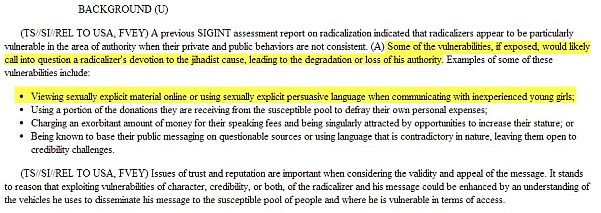
The NSA document, dated Oct. 3, 2012, repeatedly refers to the power of charges of hypocrisy to undermine such a messenger. “A previous SIGINT” — or signals intelligence, the interception of communications — “assessment report on radicalization indicated that radicalizers appear to be particularly vulnerable in the area of authority when their private and public behaviors are not consistent,” the document argues.

Among the vulnerabilities listed by the NSA that can be effectively exploited are “viewing sexually explicit material online” and “using sexually explicit persuasive language when communicating with inexperienced young girls.”

nsa-doc

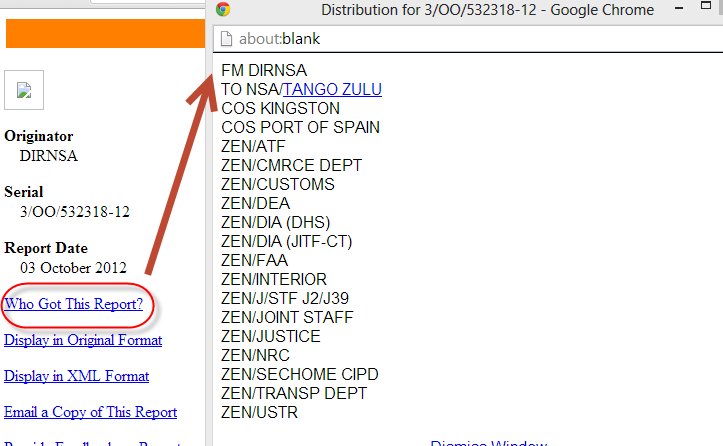
The Director of the National Security Agency — described as “DIRNSA” — is listed as the “originator” of the document. Beyond the NSA itself, the listed recipients include officials with the Departments of Justice and Commerce and the Drug Enforcement Administration. [Continue reading…]
Facebooktwittermail

Pope attacks ‘tyranny’ of capitalism

Reuters reports: Pope Francis attacked unfettered capitalism as “a new tyranny” and beseeched global leaders to fight poverty and growing inequality, in a document on Tuesday setting out a platform for his papacy and calling for a renewal of the Catholic Church.

The 84-page document, known as an apostolic exhortation, was the first major work he has authored alone as pope and makes official many views he has aired in sermons and remarks since he became the first non-European pontiff in 1,300 years in March.

In it, Francis went further than previous comments criticizing the global economic system, attacking the “idolatry of money”, and urged politicians to “attack the structural causes of inequality” and strive to provide work, healthcare and education to all citizens.

He also called on rich people to share their wealth. “Just as the commandment ‘Thou shalt not kill’ sets a clear limit in order to safeguard the value of human life, today we also have to say ‘thou shalt not’ to an economy of exclusion and inequality. Such an economy kills,” Francis wrote in the document issued on Tuesday. [Continue reading…]

Facebooktwittermail

NSA may have hit Internet companies at a weak spot

The New York Times reports: The recent revelation that the National Security Agency was able to eavesdrop on the communications of Google and Yahoo users without breaking into either company’s data centers sounded like something pulled from a Robert Ludlum spy thriller.

How on earth, the companies asked, did the N.S.A. get their data without their knowing about it?

The most likely answer is a modern spin on a century-old eavesdropping tradition.

People knowledgeable about Google and Yahoo’s infrastructure say they believe that government spies bypassed the big Internet companies and hit them at a weak spot — the fiber-optic cables that connect data centers around the world and are owned by companies like Verizon Communications, the BT Group, the Vodafone Group and Level 3 Communications. In particular, fingers have been pointed at Level 3, the world’s largest so-called Internet backbone provider, whose cables are used by Google and Yahoo.

The Internet companies’ data centers are locked down with full-time security and state-of-the-art surveillance, including heat sensors and iris scanners. But between the data centers — on Level 3’s fiber-optic cables that connected those massive computer farms — information was unencrypted and an easier target for government intercept efforts, according to three people with knowledge of Google’s and Yahoo’s systems who spoke on the condition of anonymity. [Continue reading…]

Facebooktwittermail

End the NSA dragnet now

Senators Ron Wyden, Mark Udall, and Martin Heinrich write: The framers of the Constitution declared that government officials had no power to seize the records of individual Americans without evidence of wrongdoing, and they embedded this principle in the Fourth Amendment. The bulk collection of Americans’ telephone records — so-called metadata — by the National Security Agency is, in our view, a clear case of a general warrant that violates the spirit of the framers’ intentions. This intrusive program was authorized under a secret legal process by the Foreign Intelligence Surveillance Court, so for years American citizens did not have the knowledge needed to challenge the infringement of their privacy rights.

Our first priority is to keep Americans safe from the threat of terrorism. If government agencies identify a suspected terrorist, they should absolutely go to the relevant phone companies to get that person’s phone records. But this can be done without collecting the records of millions of law-abiding Americans. We recall Benjamin Franklin’s famous admonition that those who would give up essential liberty in the pursuit of temporary safety will lose both and deserve neither.

The usefulness of the bulk collection program has been greatly exaggerated. We have yet to see any proof that it provides real, unique value in protecting national security. In spite of our repeated requests, the N.S.A. has not provided evidence of any instance when the agency used this program to review phone records that could not have been obtained using a regular court order or emergency authorization.

Despite this, the surveillance reform bill recently ratified by the Senate Intelligence Committee would explicitly permit the government to engage in dragnet collection as long as there were rules about when officials could look at these phone records. It would also give intelligence agencies wide latitude to conduct warrantless searches for Americans’ phone calls and emails.

This is not the true reform that poll after poll has shown the American people want. It is preserving business as usual. [Continue reading…]

Facebooktwittermail

Toxic lakes may emerge from Alberta’s tar-sand projects

Bloomberg News reports: Canada is blessed with 3 million lakes, more than any country on Earth — and it may soon start manufacturing new ones. They’re just not the kind that will attract anglers or tourists.

The oil sands industry is in the throes of a major expansion, powered by C$20 billion ($19 billion) a year in investments. Companies including Syncrude Canada Ltd., Royal Dutch Shell Plc and Exxon Mobil Corp. affiliate Imperial Oil Ltd. are running out of room to store the contaminated water that is a byproduct of the process used to turn bitumen — a highly viscous form of petroleum — into diesel and other fuels.

By 2022 they will be producing so much of the stuff that a month’s output of wastewater could turn an area the size of New York’s Central Park into a toxic reservoir 11 feet (3.4 meters) deep, according to the Pembina Institute, a nonprofit in Calgary that promotes sustainable energy.

To tackle the problem, energy companies have drawn up plans that would transform northern Alberta into the largest man-made lake district on Earth. [Continue reading…]

Facebooktwittermail

Nuclear deal a win-win for U.S., Iran and even Israel

Barbara Slavin writes: The ink was not dry on the historic Geneva nuclear accord with Iran before Israeli Prime Minister Benjamin Netanyahu denounced it as a “historic mistake” that would allow Iran to cheat and get closer to nuclear weapons.

Netanyahu may have been doing Iran a favor. By criticizing the deal so harshly, he will make it easier for Iranian officials to assert to their hardliners that the agreement, which pauses Iran’s nuclear advances and rolls back some of the program in return for modest sanctions relief, was a victory for the Islamic Republic.

In the zero-sum politics of the Middle East, what’s good for your enemy is invariably considered bad for you. Yet the deal announced early Sunday European time has much that is useful for Iran, the United States, the international community writ large and yes, Israel too. [Continue reading…]

Facebooktwittermail

Khamenei has to play to both sides

On Monday, Meir Javedanfar wrote: The Iranian supreme leader Ayatollah Khamenei probably got little sleep last night.

As the man with the final word on Iran’s nuclear program, his decision and blessing would have been needed by Iran’s nuclear negotiation team for every major decision taken during last night’s negotiations with the P5+1.

The agreement was finally signed at 3 A.M. in Geneva — which is 5:30 A.M. in Tehran. This is probably when Iran’s most powerful man could finally get some rest.

The agreement with the West is unlikely to go down well with Iran’s ultra conservatives. For years Ayatollah Khamenei, backed by his conservative supporters, advocated a policy of “resistance” over Iran’s nuclear program. This policy entailed continuing the program without conceding during nuclear negotiations. This was witnessed during the negotiation sessions between the P5+1 and Khamenei’s former top negotiator (and preferred presidential candidate) Saeed Jalili. In line with instructions from his boss the supreme leader, Jalili did not show any compromise. Instead, he emphasized Iran’s rights and how Iran had been wronged in its dealings with the West.

The pressure of sanctions meant that the supreme leader had to go against his former policy of “resistance” and adopt a new policy which was evident in the nuclear negotiations. Khamenei called his new policy “heroic flexibility.” We saw its implementation last night in Geneva. [Continue reading…]

Facebooktwittermail

Here’s why Wall Street has a hard time being ethical

Chris Arnade writes: My first year on Wall Street, 1993, I was paid 14 times more than I earned the prior year and three times more than my father’s best year. For that money, I helped my company create financial products that were disguised to look simple, but which required complex math to properly understand. That first year I was roundly applauded by my bosses, who told me I was clever, and to my surprise they gave me $20,000 bonus beyond my salary.

The products were sold to many investors, many who didn’t fully understand what they were buying, most of them what we called “clueless Japanese.” The profits to my company were huge – hundreds of millions of dollars huge. The main product that made my firm great money for close to five years was was called, in typically dense finance jargon, a YIF, or a Yield Indexed Forward.

Eventually, investors got wise, realizing what they had bought was complex, loaded with hidden leverage, and became most dangerous during moments of distress.

I never did meet the buyers; that was someone else’s job. I stayed behind the spreadsheets. My job was to try to extract as much value as possible through math and clever trading. Japan would send us faxes of documents from our competitors. Many were selling far weirder products and doing it in far larger volume than we were. The conversation with our Japanese customers would end with them urging us on: “We can’t fall behind.”

When I did ask, rather naively, if this was all kosher, I would be assured multiple times that multiple lawyers and multiple managers had approved the sales. [Continue reading…]

Facebooktwittermail

Britain warns Israel: Don’t undermine Iran nuclear deal

Reuters reports: Israel should avoid taking any action that would undermine the interim nuclear agreement reached between Iran and world powers at the weekend, Britain’s Foreign Secretary William Hague said on Monday.

Urging world leaders to give the interim deal a chance, Hague said it was important to try to understand those who opposed the agreement. But he urged Israel and others to confine their criticism to rhetoric.

“We would discourage anybody in the world, including Israel, from taking any steps that would undermine this agreement and we will make that very clear to all concerned,” Hague told parliament.

Facebooktwittermail

Syria seen as most dire refugee crisis in a generation

The New York Times reports: As the boom of shelling resounded along Turkey’s border with Syria here on a recent afternoon, Zakaria Deeb had nowhere left to run.

He had traveled 100 miles to Kilis with his family, chasing a false rumor that refugees would be allowed into a Turkish-run camp in the city, about 50 miles north of the Syrian city Aleppo. Instead, along with hundreds of other Syrians, the Deebs were now squatting in a gravel-strewn field across from the camp, sleeping under plastic sheets hanging from the branch of a cypress tree.

Nearly three years of bloody civil war in Syria have created what the United Nations, governments and international humanitarian organizations describe as the most challenging refugee crisis in a generation — bigger than the one unleashed by the Rwandan genocide and laden with the sectarianism of the Balkan wars. With no end in sight in the conflict and with large parts of Syria already destroyed, governments and organizations are quietly preparing for the refugee crisis to last years.

The Deebs fled their home a year ago because of fighting between Syrian rebels and government forces. Recent clashes between Kurdish fighters and the Al Qaeda-linked Islamic State of Iraq and Syria, or ISIS, pushed them into Turkey. Now, just on the other side of the border here, ISIS fighters were battling yet another rebel group, the Northern Storm.

“We expected the revolution to be over quickly, like in Libya and Egypt, but it’s been nearly three years already, and God knows when this war will end,” Mr. Deeb, 31, said, peering at the plumes of white smoke rising inside Syria. Children shrieked as another large mortar shell exploded across the border.

A stray bullet from Syria had landed inside the camp in the morning, wounding a 5-year-old girl in the foot. “If this camp is full, we’re willing to go to any camp inside Turkey,” he said. “We don’t want to go back to Syria.”

Syrians have been pouring out of their country in recent months, fleeing an increasingly violent and murky conflict that is pitting scores of armed groups against one another as much as against the government. Numbering just 300,000 one year ago, the refugees now total 2.1 million, and the United Nations predicts their numbers could swell to 3.5 million by the end of the year. [Continue reading…]

Facebooktwittermail

Memo to Glenn Greenwald: Secrecy is not the root of all evil

AP and Al-Monitor concealed their knowledge of secret talks between the U.S. and Iran.

The mere fact that Glenn Greenwald regards this as Tweet-worthy seems to imply that he sees something nefarious in the Associated Press and Al-Monitor colluding with government officials by failing to disclose what they had learned at the time of discovery.

I guess for a transparency zealot this kind of collusion would have to be problematic, but let’s get real.

Wherein lies the greater public service: making all information public at the earliest opportunity even if that disclosure might sabotage diplomacy? Or, in recognizing that there are times when forging an agreement absolutely depends on confidentiality so that negotiations can proceed without interference from parties that oppose the existence of such negotiations?

All I can say is: thank goodness AP and Al-Monitor kept quiet. They did the right thing.

Moreover, let’s be honest. Greenwald himself has been sitting on stories for months for reasons that I doubt will ever be made public. The process through which the Snowden revelations have trickled out has not been a model of transparency.

Facebooktwittermail

Have the neocons made an unprecedented advance in nuclear weapons design?

It’s generally understood that the construction of a nuclear weapon using uranium requires highly enriched uranium — enriched to 80% or greater.

Daniel Pipes writes:

[T]he American goal for the accord was that the Iranians not “advance their program” of building a uranium nuclear bomb (and perhaps a plutonium bomb too); the apparent deal exactly permits such advancement, plus sanctions relief to Tehran worth about US$9 billion.

Under the terms of the agreement, Iran will not be able to enrich uranium above 5% and its stockpile of 20% enriched uranium will be divided in two with half being available for the production of medical isotopes and the other half diluted down to 5%. There will be no remaining stockpile with the potential to be enriched to a level required for bomb making, yet Pipes asserts that such an advance remains possible.

Has he discovered something that no one else in the world knows about: how to make a nuclear weapon with low-enriched uranium?

The NSA better keep a close eye on Pipes. He could become the next A.Q. Khan.

Facebooktwittermail

The last thing the world needs is Congress thwarting historic U.S.-Iran nuclear deal

Lawrence Wilkerson and Kate Gould write: The nuclear deal that the US just struck with Iran is nothing short of historic. This agreement is a victory for everyone who wants to prevent a nuclear-armed Iran and a catastrophic war.

The deal is one of the many triumphs that have resulted from the great American tradition of negotiating with adversaries to advance US interests. President Kennedy’s talks with Premier Khrushchev delivered the world from the brink of nuclear war. Ten years later, President Nixon’s visit to Mao’s China revolutionized the US role in Asia, and the world. A decade later, President Reagan’s diplomatic engagement of President Gorbachev achieved historic nuclear arms reductions.

UN weapons inspectors are now on track to peacefully disarm Syria of its chemical weapons because Washington was willing to engage the Syrian regime through diplomacy with Moscow, rather than through Tomahawk cruise missiles. And under the deal reached in Geneva this weekend, Iran will stop advancing its nuclear program for the first time in nearly a decade.

Iran’s nuclear program will now be under an expanded inspections regime to help ensure that Iran’s nuclear program is used for purely peaceful purposes. In exchange, Iran will receive modest sanctions relief.

Make no mistake: this is a good deal, and it should be protected so that our diplomats have the space to negotiate a final agreement to prevent war and a nuclear-armed Iran once and for all.

That is why former secretary of state Madeleine Albright and former national security advisors Zbigniew Brzezinski and Brent Scowcroft have already endorsed the deal. These three most pre-eminent national security officials have cautioned Congress against pushing for new sanctions that could sabotage the tremendous progress that our diplomats have achieved. [Continue reading…]

Facebooktwittermail

For Iran, peaceful diplomacy has delivered what sabre-rattling could not

Simon Jenkins writes: Good news so far on Iran. Western intervention in the Muslim world at the start of the 21st century has seemed nothing but the orchestration of failure. Yesterday’s Geneva agreement on Iran’s nuclear capacity hints at a chance that the onward march of nuclear armaments might be halted. Coming on top of the Syrian chemical weapons deal, diplomacy appears hesitantly ascendant.

The stumbling blocks remain what they always were: the opposition of Iran’s hardliners, and of their opposite numbers in Israel and the US Congress. Those blocks have always existed. What is exciting about Geneva is that they have, for the moment, been circumvented. Diplomacy’s “confidence-building measures” are to be given their head. One of the world’s great countries, Iran at least might be re-admitted to the community of nations.

There was always too much fantasy posturing in the west’s Iran policy. It was never possible to stop an Iranian nuclear arsenal by confrontation. There are too many arms salesmen around, too much money and too much Iranian pride for that. Only by Iran’s politics opening up to change, freeing its democracy and allowing its people to feel safe, would its leaders dare foreswear these weapons.

The west never had the power to conquer Iran or bomb it into submission. A military strike would merely speed an arms race and drive that country back into the embrace of its fundamentalists. Only soft power was ever going to de-escalate the conflict. [Continue reading…]

Facebooktwittermail

Why the agreement with Iran is a good deal

Jeffrey Lewis writes: Seven thoughts about the Iran deal, in no particular order.

First, let’s be clear that the package agreed to in Geneva is an interim deal — a six-month slowdown in Iran’s nuclear programs in exchange for a largely temporary easing of sanctions. The Geneva agreement will ultimately be judged on whether the parties can agree to something more comprehensive before it’s all said and done. The document does outline some of the parameters of a final deal, but they are general in nature.

Rouhani wanted some early sanctions relief to show that he could bring home the bacon — I know, that’s a terrible analogy for a Muslim country — to a populace that is economically hurting. The West didn’t want to negotiate with the Iranians while they were installing more centrifuges, new centrifuges, and equipment at the Arak nuclear reactor. The deal largely accomplishes both tasks.

Second, the Iranians gave the West pretty much everything one might have asked for — the Iranians will continue to enrich to less than 5 percent using only existing IR-1 centrifuges and limit manufacturing to replace damaged machines. Iran was never going to make a prostration before the Great Satan like Libya did in 2003, when Qaddafi agreed to give up all his weapons of mass destruction — especially having seen how that worked out for old Muammar. The restrictions on the Iranian program are, frankly, more than could have been hoped for. Thank you, France. If we can’t ease sanctions in exchange for these sorts of concessions, one really must ask what the point of pressuring Iran is.

Third, the usual suspects will complain that we’ve given away too much in terms of sanctions relief, but there are three things to keep in mind. (1) Much of the sanctions relief is temporary. If the Iranians collapse the deal, there will be plenty of takers for imposing tougher sanctions. (2) It isn’t clear to me that the sanctions regime is indefinitely sustainable. The Iranians have had quite a bit of luck challenging sanctions in European courts, and Washington doesn’t have quite the same pull in Moscow and Beijing these days. Sanctions have always been a wasting asset. It makes sense to get something for them now. (3) Moreover, if the Iranian economy starts to recover, that might be a good thing. There is a whole field of research into something called “prospect theory” that more or less boils down to a profound insight into the irrationality of human beings: we tend to fear losses more than we value gains, even if they are numerically the same. This is why your favorite basketball team waits too long to trade that promising draft pick who’ll never be more than a rotation player. If the Iranian economy starts to recover, that will probably increase the pressure on Rouhani to make a deal, not decrease it. [Continue reading…]

Facebooktwittermail

Saudi Arabia welcomes Iran nuclear agreement

Al Jazeera reports: Saudi Arabia has said an interim deal on Iran’s nuclear programme could be a step towards a comprehensive solution – and hoped it could lead to the removal of WMD from the Middle East.

“The government of the kingdom sees that if there was goodwill, this agreement could represent a preliminary step towards a comprehensive solution to the Iranian nuclear programme,” the cabinet said in a statement.

It said the deal could eventually lead “to the removal of weapons of mass destruction, especially nuclear weapons, from the Middle East and the Arab Gulf region”.

Facebooktwittermail

Google mulled ditching U.S. after NSA scandal

CNBC reports: Google, the giant of the Internet, thought about moving its servers out of the U.S. after the NSA debacle, said Eric Schmidt, the company’s chairman, on Friday at the Paley International Council Summit in New York.

“Actually, we thought about that and there are many, many reasons why it’s impossible for Google to leave the United States, although it’s attractive,” Schmidt said.

“But the reason it’s an interesting idea is because American firms are subject to these rules, the [Foreign Intelligence Surveillance Act] rules, Patriot Act and so forth, and this government surveillance is really a problem.”

Facebooktwittermail