Category Archives: Issues

Spying known at top levels of admininistration, intelligence officials say

The New York Times reports: The nation’s top spymaster said on Tuesday that the White House had long been aware in general terms of the National Security Agency’s overseas eavesdropping, stoutly defending the agency’s intelligence-gathering methods and suggesting possible divisions within the Obama administration.

The official, James R. Clapper Jr., the director of national intelligence, testified before the House Intelligence Committee that the N.S.A. had kept senior officials in the National Security Council informed of surveillance it was conducting in foreign countries. He did not specifically say whether President Obama was told of these spying efforts, but he appeared to challenge assertions in recent days that the White House had been in the dark about some of the agency’s practices.

Mr. Clapper and the agency’s director, Gen. Keith B. Alexander, vigorously rejected suggestions that the agency was a rogue institution, trawling for information on ordinary citizens and leaders of America’s closest allies, without the knowledge of its Washington overseers.

Their testimony came amid mounting questions about how the N.S.A. collects information overseas, with Republicans and Democrats calling for a congressional review, lawmakers introducing a bill that would curb its activities and Mr. Obama poised to impose his own constraints, particularly on monitoring the leaders of friendly nations. At the same time, current and former American intelligence officials say there is a growing sense of anger with the White House for what they see as attempts by the administration to pin the blame for the controversy squarely on them.

General Alexander said news media reports that the N.S.A. had vacuumed up tens of millions of telephone calls in France, Italy and Spain were “completely false.” That data, he said, is at least partly collected by the intelligence services of those countries and provided to the N.S.A.

Still, both he and Mr. Clapper said that spying on foreign leaders — even those of allies — was a basic tenet of intelligence tradecraft and had gone on for decades. European countries, Mr. Clapper said, routinely seek to listen in on the conversations of American leaders. [Continue reading…]


Facebooktwittermail

Obama orders curbs on NSA spying on UN headquarters

Reuters reports: President Barack Obama recently ordered the National Security Agency to curtail eavesdropping on the United Nations headquarters in New York as part of a review of U.S. electronic surveillance, according to a U.S. official familiar with the decision.

Obama’s order is the latest known move by the White House to limit the NSA’s vast intelligence collection, in the wake of protests by allies, including German Chancellor Angela Merkel, over U.S. spying on foreign heads of state.

The full extent of U.S. eavesdropping on the United Nations is not publicly known, nor is it clear whether the United States has stopped all monitoring of diplomats assigned to the U.N. in New York or elsewhere around the world.

“The United States is not conducting electronic surveillance targeting the United Nations headquarters in New York,” said a senior Obama administration official, who spoke on condition of anonymity.

The official did not address past surveillance of the world body. Such programs are highly classified, although some details have been leaked by former NSA contractor Edward Snowden. [Continue reading…]

Facebooktwittermail

How science is calling for a global revolution

Naomi Klein writes: In December 2012, a pink-haired complex systems researcher named Brad Werner made his way through the throng of 24,000 earth and space scientists at the Fall Meeting of the American Geophysical Union, held annually in San Francisco. This year’s conference had some big-name participants, from Ed Stone of Nasa’s Voyager project, explaining a new milestone on the path to interstellar space, to the film-maker James Cameron, discussing his adventures in deep-sea submersibles.

But it was Werner’s own session that was attracting much of the buzz. It was titled “Is Earth F**ked?” (full title: “Is Earth F**ked? Dynamical Futility of Global Environmental Management and Possibilities for Sustainability via Direct Action Activism”).

Standing at the front of the conference room, the geophysicist from the University of California, San Diego walked the crowd through the advanced computer model he was using to answer that question. He talked about system boundaries, perturbations, dissipation, attractors, bifurcations and a whole bunch of other stuff largely incomprehensible to those of us uninitiated in complex systems theory. But the bottom line was clear enough: global capitalism has made the depletion of resources so rapid, convenient and barrier-free that “earth-human systems” are becoming dangerously unstable in response. When pressed by a journalist for a clear answer on the “are we f**ked” question, Werner set the jargon aside and replied, “More or less.”

There was one dynamic in the model, however, that offered some hope. Werner termed it “resistance” – movements of “people or groups of people” who “adopt a certain set of dynamics that does not fit within the capitalist culture”. According to the abstract for his presentation, this includes “environmental direct action, resistance taken from outside the dominant culture, as in protests, blockades and sabotage by indigenous peoples, workers, anarchists and other activist groups”. [Continue reading…]

Facebooktwittermail

Max Blumenthal offers unfiltered view into Israel’s commitment to ethnic supremacy

Max Blumenthal talks about his new book, Goliath: Life and Loathing in Greater Israel:

Rania Khalek: Challenging the pro-Israel narrative, as your book does, isn’t the most lucrative career move for an American journalist. With that in mind, why did you write this book?

Max Blumenthal: I was following a really successful book called Republican Gomorrah that got me on MSNBC, Air America [and] NPR, and I had a big liberal Democrat-oriented audience who were eager for my analysis of the radical right. I could’ve leveraged that into another book deal about Republican racism, made loads of money and sold tons of books. But this isn’t why I’m in journalism. I don’t look at journalism as a career. I look at it both as a profession and a craft and also as a means for exposing injustice. I’ve been watching the increasing violence and racism of Israeli society for most of my adult life, especially in their treatment of Palestinians. Having been born in 1977, I came of age during the First Intifada and then watched during the Second Intifada as Israel destroyed the Jenin Refugee camp. And then the Second Lebanon invasion happened. Israel basically carpet-bombed southern Lebanon, turning one-quarter of the country into refugees. Then there was Operation Cast Lead, the three-week assault on the besieged Gaza Strip that left 1,400 dead. It was so hard to watch, and it occurred after Barack Obama had been elected, someone I was deeply skeptical of. During the slaughter, I went to midtown New York and filmed a few hundred Jewish-Americans celebrating the attack. They were dancing a hora line outside the Israeli consulate and offering very clearly genocidal statements about the need to eradicate the cancer in Gaza. I put this online as a video, and it went viral. Before long, I was contacted by all kinds of people from across the Middle East who are directly affected by the Israel-Palestine crisis, inviting me to come there to see the situation on the ground. I agreed, and I put a lot of my book advance into the first extended reporting trip there in May 2009. That’s what led to me getting the deal to write Goliath and to spending the last four to five years of my life writing about this situation. It definitely changed my life in a lot of ways that I never expected, and I don’t think I’ll ever be able to see things the same way again.

RK: Goliath came out October 1. What has the reception been like so far, compared with that for Republican Gomorrah?

MB: Pro-Israel partisans in the US typically get hysterical about books like this because the real Israel is really impossible for them to grapple with. It shatters the dream castle Israel that goes to the heart of their identity as tribalistic, secular American Jews. I really believe that they are determined to ignore this book for as long as they can. It may take me going on national TV with one of those foam giant fingers and twerking on Abe Foxman for them to pay attention.

The other more obvious and salient reason why I’m not getting the same mainstream attention I got with Republican Gomorrah is because people like Rachel Maddow and Terry Gross, who can really move books, are simply afraid of the Israel issue and what it can do to their careers and the kind of pushback they’ll get from pro-Israel partisans behind the scenes. What we’re seeing is cowardice at the top of a hollow media establishment that extends into public radio. I think if shows like “Fresh Air” were to host me about Goliath, the response would be massive and mostly positive because I’m presenting the facts on the ground. Even people who don’t agree with my conclusions about what should happen in Israel-Palestine are hungry for this kind of information. [Continue reading…]

Facebooktwittermail

Obama may ban spying on heads of allied states — including Israel?

The New York Times reports: President Obama is poised to order the National Security Agency to stop eavesdropping on the leaders of American allies, administration and Congressional officials said Monday, responding to a deepening diplomatic crisis over reports that the agency had for years targeted the cellphone of Chancellor Angela Merkel of Germany.

The White House informed a leading Democratic lawmaker, Senator Dianne Feinstein of California, of its plans, which grew out of a broader internal review of intelligence-gathering methods, prompted by the leak of N.S.A. documents by a former contractor, Edward J. Snowden.

In a statement on Monday, Senator Feinstein, chairwoman of the Senate Intelligence Committee, said, “I do not believe the United States should be collecting phone calls or emails of friendly presidents and prime ministers.” Ms. Feinstein, who has been a stalwart defender of the administration’s surveillance policies, said her committee would begin a “major review of all intelligence collection programs.”

The White House said Monday evening that no final decision had been made on the monitoring of friendly foreign leaders. But the disclosure that it is moving to prohibit it marks a landmark shift for the N.S.A., which has had nearly unfettered powers to collect data on tens of millions of people around the world, from ordinary citizens to heads of state, including the leaders of Brazil and Mexico.

It is also likely to prompt a fierce debate on what constitutes an American ally. [Continue reading…]

The 2013 ‘black budget’ for the U.S. intelligence community, provided to the Washington Post by Edward Snowden and published at the end of August, states that although overall the budget was declining it was being increased in specific areas:

“[W]e are investing in target surveillance and offensive CI [counterintelligence] against key targets, such as China, Russia, Iran, Israel, Pakistan, and Cuba.”

Monitoring the communications of the leaders of Israel, a country that has repeatedly made explicit threats that it might trigger another major conflict in the Middle East, would appear to serve the interests of both the U.S. and most of its allies.

Facebooktwittermail

Alexander did not ‘discuss’ Merkel surveillance with Obama, but was he briefed?

I think the main thing I want to emphasize is I don’t have an interest and the people at the NSA don’t have an interest in doing anything other than making sure that where we can prevent a terrorist attack, where we can get information ahead of time, that we’re able to carry out that critical task. We do not have an interest in doing anything other than that. — President Obama, August 9, 2013.

A report in the German newspaper Bild cites NSA sources claiming that in 2010, Gen. Keith Alexander briefed President Obama on the targeting of Chancellor Angela Merkel’s cellphone.

The NSA has responded with a statement saying:

[General] Alexander did not discuss with President Obama in 2010 an alleged foreign intelligence operation involving German Chancellor Merkel, nor has he ever discussed alleged operations involving Chancellor Merkel.

That sounds very much like a non-denial denial.

Given that as it was widely reported in the English-language press that Obama had been “briefed” on the surveillance, an unambiguous denial from the NSA would have simply said that Obama had not been briefed on this matter. He had not been briefed by Alexander or anyone else in the intelligence community.

A briefing involves nothing more than the exchange of information. Whether that exchange provokes discussion is another matter. Every U.S. president will be briefed on matters every single day during which he is a passive recipient of information.

That Obama presents the appearance of being a disengaged president, is well documented.

If Alexander presented Obama with a list of heads of state currently under U.S. surveillance — a list including Merkel’s name and/or position — and Obama scanned the list, noting who was being spied on and for how long, but this information provoked neither comments nor questions from the president, then he could certainly have been briefed while having no discussion.

Officials choose their words very carefully precisely because they are afraid of accused of lying. That they might at the same time be engaged in an effort to be deceptive is another matter, since in response to the suggestion that a statement might be misleading, they can always plead ignorance or regret or blame the press. Sorry if that wasn’t clear. Sorry if there’s a misunderstanding. You misinterpreted my statement.

The charade of a press briefing won’t, however, alleviate the credibility issue that Obama now has with Merkel. In her eyes the U.S. president must now appear to be either a liar, incompetent, or both.

Facebooktwittermail

What did the president know and when did he know it?

I haven’t evolved in my assessment of the actual [surveillance] programs. I consistently have said that when I came into office I evaluated them. — President Obama, August 2013.

The Wall Street Journal reports: The National Security Agency ended a program used to spy on German Chancellor Angela Merkel and a number of other world leaders after an internal Obama administration review started this summer revealed to the White House the existence of the operation, U.S. officials said.

Officials said the internal review turned up NSA monitoring of some 35 world leaders, in the U.S. government’s first public acknowledgment that it tapped the phones of world leaders. European leaders have joined international outrage over revelations of U.S. surveillance of Ms. Merkel’s phone and of NSA’s monitoring of telephone call data in France.

The White House cut off some monitoring programs after learning of them, including the one tracking Ms. Merkel and some other world leaders, a senior U.S. official said. Other programs have been slated for termination but haven’t been phased out completely yet, officials said.

The account suggests President Barack Obama went nearly five years without knowing his own spies were bugging the phones of world leaders. Officials said the NSA has so many eavesdropping operations under way that it wouldn’t have been practical to brief him on all of them.

They added that the president was briefed on and approved of broader intelligence-collection “priorities,” but that those below him make decisions about specific intelligence targets.

The senior U.S. official said that the current practice has been for these types of surveillance decisions to be made at the agency level. “These decisions are made at NSA,” the official said. “The president doesn’t sign off on this stuff.” That protocol now is under review, the official added.

Facebooktwittermail

Could Merkel have been spied on without Obama’s approval?

Der Spiegel reports: Among the politically decisive questions is whether the spying was authorized from the top: from the US president. If the data is accurate, the operation was authorized under former President George W. Bush and his NSA chief, Michael Hayden. But it would have had to be repeatedly approved, including after Obama took office and up to the present time. Is it conceivable that the NSA made the German chancellor a surveillance target without the president’s knowledge?

The White House and the US intelligence agencies periodically put together a list of priorities. Listed by country and theme, the result is a matrix of global surveillance: What are the intelligence targets in various countries? How important is this reconnaissance? The list is called the “National Intelligence Priorities Framework” and is “presidentially approved.”

One category in this list is “Leadership Intentions,” the goals and objectives of a country’s political leadership. The intentions of China’s leadership are of high interest to the US government. They are marked with a “1” on a scale of 1 to 5. Mexico and Brazil each receive a “3” in this category.

Germany appears on this list as well. The US intelligence agencies are mainly interested in the country’s economic stability and foreign policy objectives (both “3”), as well as in its advanced weapons systems and a few other sub-items, all of which are marked “4.” The “Leadership Intention” field is empty. So based on the list, it wouldn’t appear that Merkel should be monitored.

Former NSA employee Thomas Drake does not see this as a contradiction. “After the attacks of September 11, 2001, Germany became intelligence target number one in Europe,” he says. The US government did not trust Germany, because some of the Sept. 11 suicide pilots had lived in Hamburg. Evidence suggests that the NSA recorded Merkel once and then became intoxicated with success, says Drake. “It has always been the NSA’s motto to conduct as much surveillance as possible,” he adds.

Facebooktwittermail

Don’t underestimate Germany’s reaction to NSA surveillance

True partnership and true progress requires constant work and sustained sacrifice. They require sharing the burdens of development and diplomacy; of progress and peace. They require allies who will listen to each other, learn from each other and, most of all, trust each other. — Sen. Barack Obama, Berlin, July 2008.

Both among commentators and across America in general, there is a commonplace reaction to foreign anger provoked by offensive American actions: it is dismissive.

What are they getting worked up about? Aren’t they being hypocritical? What do they expect?

The pervasive attitude is one of indifference and beneath that an assumption that as much as others might protest, everyone ultimately bows to American might.

When Chancellor Merkel challenged President Obama on the issue of NSA surveillance, 62 percent of Germans approved of her harsh reaction, but an additional 25 percent felt she had not been harsh enough.

That’s German bluster, many Americans might now think.

But this outrage has the potential of being translated into a tangible, economic effect: opposition to a trans-Atlantic free-trade agreement.

Since the latest revelations came out, some 58 percent of Germans say they support breaking off ongoing talks, while just 28 percent are against it. “We should put the negotiations for a free-trade agreement with the US on ice until the accusations against the NSA have been clarified,” says Bavarian Economy Minister Ilse Aigner, a member of the Christian Social Union, the Bavarian sister party to Merkel’s Christian Democrats.

Facebooktwittermail

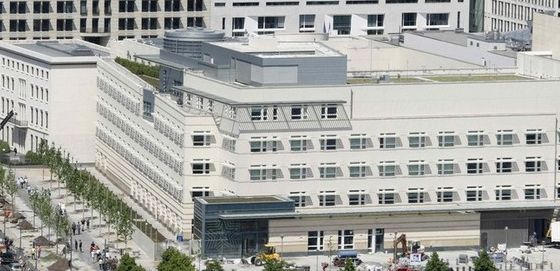
The U.S. embassy rooftop from which the NSA spies on the German government

window-like indentations on the roof of the US Embassy

Window-like indentations on the roof of the US Embassy are not glazed but rather veneered with 'dielectric' material and are painted to blend into the surrounding masonry. This material is permeable even by weak radio signals. Interception technology is allegedly located behind these radio-transparent screens.

Der Spiegel reports: A “top secret” classified NSA document from the year 2010 shows that a unit known as the “Special Collection Service” (SCS) is operational in Berlin, among other locations. It is an elite corps run in concert by the US intelligence agencies NSA and CIA.

The secret list reveals that its agents are active worldwide in around 80 locations, 19 of which are in Europe — cities such as Paris, Madrid, Rome, Prague and Geneva. The SCS maintains two bases in Germany, one in Berlin and another in Frankfurt. That alone is unusual. But in addition, both German bases are equipped at the highest level and staffed with active personnel.

The SCS teams predominantly work undercover in shielded areas of the American Embassy and Consulate, where they are officially accredited as diplomats and as such enjoy special privileges. Under diplomatic protection, they are able to look and listen unhindered. They just can’t get caught.

Wiretapping from an embassy is illegal in nearly every country. But that is precisely the task of the SCS, as is evidenced by another secret document. According to the document, the SCS operates its own sophisticated listening devices with which they can intercept virtually every popular method of communication: cellular signals, wireless networks and satellite communication.

The necessary equipment is usually installed on the upper floors of the embassy buildings or on rooftops where the technology is covered with screens or Potemkin-like structures that protect it from prying eyes.

That is apparently the case in Berlin, as well. SPIEGEL asked British investigative journalist Duncan Campbell to appraise the setup at the embassy. In 1976, Campbell uncovered the existence of the British intelligence service GCHQ. In his so-called “Echelon Report” in 1999, he described for the European Parliament the existence of the global surveillance network of the same name.

Campbell refers to window-like indentations on the roof of the US Embassy. They are not glazed but rather veneered with “dielectric” material and are painted to blend into the surrounding masonry. This material is permeable even by weak radio signals. The interception technology is located behind these radio-transparent screens, says Campbell. The offices of SCS agents would most likely be located in the same windowless attic.

This would correspond to internal NSA documents seen by SPIEGEL. They show, for example, an SCS office in another US embassy — a small windowless room full of cables with a work station of “signal processing racks” containing dozens of plug-in units for “signal analysis.”

On Friday, author and NSA expert James Bamford also visited SPIEGEL’s Berlin bureau, which is located on Pariser Platz diagonally opposite the US Embassy. “To me, it looks like NSA eavesdropping equipment is hidden behind there,” he said. “The covering seems to be made of the same material that the agency uses to shield larger systems.”

The Berlin-based security expert Andy Müller Maguhn was also consulted. “The location is ideal for intercepting mobile communications in Berlin’s government district,” he says, “be it technical surveillance of communication between cellphones and wireless cell towers or radio links that connect radio towers to the network.”

Apparently, SCS agents use the same technology all over the world. They can intercept cellphone signals while simultaneously locating people of interest. One antenna system used by the SCS is known by the affable code name “Einstein.”

When contacted by SPIEGEL, the NSA declined to comment on the matter.

Facebooktwittermail

The targeting of Chancellor Angela Merkel’s cellphone

Der Spiegel reports: There are strong indications that it was the SCS [the Special Collection Service jointly operated by the NSA and CIA] that targeted Chancellor Angela Merkel’s cellphone. This is suggested by a document that apparently comes from an NSA database in which the agency records its targets. This document, which SPIEGEL has seen, is what set the cellphone scandal in motion.

The document contains Merkel’s cellphone number. An inquiry to her team revealed that it is the number the chancellor uses mainly to communicate with party members, ministers and confidants, often by text message. The number is, in the language of the NSA, a “Selector Value.” The next two fields determine the format (“raw phone number”) and the “Subscriber,” identified as “GE Chancellor Merkel.”

In the next field, labeled “Ropi,” the NSA defines who is interested in the German chancellor: It is the department S2C32. “S” stands for “Signals Intelligence Directorate,” the NSA umbrella term for signal reconnaissance. “2” is the agency’s department for procurement and evaluation. C32 is the unit responsible for Europe, the “European States Branch.” So the order apparently came down from Europe specialists in charge of signal reconnaissance.

The time stamp is noteworthy. The order was transferred to the “National Sigint Requirements List,” the list of national intelligence targets, in 2002. That was the year Germany held closely watched parliamentary elections and Merkel battled Edmund Stoiber of Bavaria’s Christian Social Union to become the conservatives’ chancellor candidate. It was also the year the Iraq crisis began heating up. The document also lists status: “A” for active. This status was apparently valid a few weeks before President Obama’s Berlin visit in June 2013.

Finally, the document defines the units tasked with implementing the order: the “Target Office of Primary Interest”: “F666E.” “F6” is the NSA’s internal name for the global surveillance unit, the “Special Collection Service.”

Thus, the NSA would have targeted Merkel’s cellphone for more than a decade, first when she was just party chair, as well as later when she’d become chancellor. The record does not indicate what form of surveillance has taken place. Were all of her conversations recorded or just connection data? Were her movements also being recorded?

Facebooktwittermail

NSA oversight dismissed as ‘illusory’ as anger intensifies in Europe and beyond

The Guardian reports: The Obama administration’s international surveillance crisis deepened on Monday as representatives from a Latin American human rights panel told US diplomats that oversight of the programs was “illusory”.

Members of the Inter-American Commission on Human Rights, an arm of the Organization of American States, expressed frustration and dissatisfaction with the National Security Agency’s mass surveillance of foreign nationals – something the agency argues is both central to its existence and necessary to prevent terrorism.

“With a program of this scope, it’s obvious that any form of control becomes illusory when there’s hundreds of millions of communications that become monitored and surveilled,” said Felipe Gonzales, a commissioner and Chilean national.

“This is of concern to us because maybe the Inter-American Committee on Human Rights may become a target as well of surveillance,” said Rodrigo Escobar Gil, a commissioner and Colombian citizen.

Frank La Rue, the United Nations special rapporteur on the right to freedom of opinion and expression, told the commission that the right to privacy was “inextricably linked” to free expression.

“What is not permissible from a human rights point of view is that those that hold political power or those that are in security agencies or, even less, those in intelligence agencies decide by themselves, for themselves, what the scope of these surveillance activities are, or who will be targeted, or who will be blanked surveilled,” La Rue said.

While the US sent four representatives to the hearing, they offered no defence, rebuttal or elaboration about bulk surveillance, saying the October government shutdown prevented them from adequate preparation. “We are here to listen,” said deputy permanent representative Lawrence Gumbiner, who pledged to submit written responses within 30 days. [Continue reading…]

Facebooktwittermail

Spain warns U.S. of breakdown in trust after new NSA revelations

The Guardian reports: The Spanish government has warned the US that revelations of widespread spying by the National Security Agency could, if confirmed, “lead to a breakdown in the traditional trust” between the two countries.

The diplomatic row followed a report in Spain’s El Mundo newspaper on Monday, based on a leaked NSA document, claiming that the US had intercepted 60.5m phone calls in Spain between 10 December 2012 and 8 January this year.

In the latest revelations from the documents leaked by the US whistleblower Edward Snowden, El Mundo published an NSA graphic, entitled “Spain – last 30 days”, showing the daily flow of phone calls within Spain. On one day alone – 11 December 2012 – the NSA reportedly intercepted more than 3.5m phone calls. It appears that although the content of the calls was not monitored the serial and phone numbers of the handsets used, the locations, sim cards and the duration of the calls were. Emails and other social media were also monitored.

The White House has so far declined to comment on the El Mundo report. Spain, however, expressed its concern. José Manuel García Margallo, Spain’s foreign minister, warned of a breakdown in trust between Madrid and Washington at a press conference in Warsaw, where he was on an official visit. [Continue reading…]

Facebooktwittermail

NSA disclosures put U.S. on defense

Politico reports: The NSA spying controversy is quickly transforming from a domestic headache for the Obama administration into a global public relations fiasco for the United States government.

After months of public and congressional debate over the National Security Agency’s collection of details on U.S. telephone calls, a series of reports about alleged spying on foreign countries and their leaders has unleashed an angry global reaction that appears likely to swamp the debate about gathering of metadata within American borders.

While prospects for a legislative or judicial curtailment of the U.S. call-tracking program are doubtful, damage from public revelations about NSA’s global surveillance is already evident and seems to be growing.

Citing the snooping disclosed by former NSA contractor Edward Snowden, Brazil’s president canceled a state visit to the U.S. set for this week. Leaders in France and Italy and Germany have lodged heated protests with Washington, with the Germans announcing plans to dispatch a delegation to Washington to discuss the issue. Boeing airplane sales are in jeopardy. And the European Union is threatening to slap restrictions on U.S. technology firms that profit from tens of millions of users on the Continent.

“Europe is talking about this. Some people in Europe are upset and may take steps to block us,” former Rep. Jane Harman (D-Calif.) said in a telephone interview from Rome on Friday. “The reaction of retail politicians is to mirror the upset of the people who elected them.”

“Confidence between countries and confidence between governments are important and sometime decisive and there’s almost no confidence between the United States of America and Europe” now, former German intelligence chief Hansjörg Geiger said. “I’m quite convinced there will be an impact…. It will be a real impact and not only the [intelligence] services will have some turbulence.”

Some analysts see immediate trouble for U.S.-European arrangements to share information about airline passengers, financial transactions and more.

“The bigger problems are not in Berlin or Paris, but in the future out of Brussels,” said Michael Leiter, former head of the National Counterterrorism Center. “At the EU, I expect them to be very, very resistant to any increase — and to have problems even with maintenance — of some of the information sharing we have now…..All of this complicates those discussions exponentially.”

For the average person, American or from elsewhere, the knowledge that their own communications are subject to NSA surveillance is likely to be a matter of relatively little concern. Even if they vehimently object to such collection as a matter of principle, they also are likely to feel reasonably confident that for all intents and purposes, this data gets lost almost as rapidly as it gets collected. It instantly becomes buried in vast databases where it will almost certainly never receive further scrutiny. Not only is the collection process unjustifiably intrusive, but it also seems grossly wasteful.

In response to this week’s revelations, Glenn Greenwald wrote:

[N]ote how leaders such as Chancellor Angela Merkel reacted with basic indifference when it was revealed months ago that the NSA was bulk-spying on all German citizens, but suddenly found her indignation only when it turned out that she personally was also targeted. That reaction gives potent insight into the true mindset of many western leaders.

No doubt our political leaders are guilty of all kinds of hypocrisy, but in this case, surveillance of heads of state can hardly be put on a par with surveillance of ordinary citizens.

When the NSA was monitoring Merkel’s communications, it’s reasonable to assume that the monitoring went far beyond recording. They were not getting tossed into a database where they might reside until the day there was some justification to examine them. Much more likely, they were subject to daily analysis.

The NSA might be listening to everyone, but it focuses its attention on far fewer, including as we now know, some of America’s closest allies.

Facebooktwittermail

Japan rejected NSA request for aid in tapping fiber-optic cables in 2011

Kyodo News International reports: The U.S. National Security Agency sounded out the Japanese government around 2011 for cooperation in wiretapping fiber-optic cables carrying phone and Internet data across the Asia-Pacific region, sources familiar with the matter said Saturday.

The agency’s overture was apparently aimed at gathering information on Beijing given that Japan is at the heart of optical cables that connect various parts of the region. But Japan rejected the request, citing legal restrictions and shortage of personnel in the tapping operations, the sources said.

The sources said the agency asked Japan if it could intercept personal information such as Internet and phone call data when communication data pass through Japan via cables connecting Japan, China and other parts of the region.

Facebooktwittermail

The information-gathering paradox

The New York Times reports: Consumer trust is a vital currency for every big Internet company, which helps to explain why the giants of Silicon Valley have gone to great lengths in recent months to show how hard they are fighting back against government surveillance. Companies have released transparency reports, many for the first time, enumerating how many times law enforcement agencies demand user data; their executives have issued blistering statements; and several firms, including Facebook and Google, have filed lawsuits in a bid to reveal more about secret government orders.

All the while, though, a central contradiction has become ever harder to conceal. The Internet industry, having nudged consumers to share heaps of information about themselves, has built a trove of personal data for government agencies to mine — erecting, perhaps unintentionally, what Alessandro Acquisti, a Carnegie Mellon University behavioral economist, calls “the de facto infrastructure of surveillance.”

Nearly five months after Edward J. Snowden, the former National Security Agency contractor, went public with classified documents detailing the agency’s widespread spying, the Internet industry has only sharpened its efforts to track users online, which it considers essential to profitability. Behaviorally targeted advertising is the principal revenue source for a host of online companies.

Earlier this month Google announced plans to feature users’ names, photos and posts to promote products in Web ads. Facebook recently expanded its search offerings and made it harder to hide from strangers trying to find you. Meanwhile, digital advertising networks are developing sophisticated new ways to track consumers on cellphones, gleaning intimate insights into who you are and what you like. And Twitter, which recently announced plans for a public offering, has partnered with a company that tracks whether ads on Twitter can influence what you buy offline.

Commercial surveillance has been booming in recent months. “It’s certainly striking to hear the companies’ use of fiery rhetoric to criticize mass collection of bulk data since they themselves are engaging in mass collection of bulk data,” said Woodrow Hartzog, who teaches privacy law at Samford University in Birmingham, Ala. “The N.S.A. targeting has done nothing to dampen the appetite of private entities for information.” [Continue reading…]

Facebooktwittermail

The decline of Wikipedia

Tom Simonite writes: The sixth most widely used website in the world is not run anything like the others in the top 10. It is not operated by a sophisticated corporation but by a leaderless collection of volunteers who generally work under pseudonyms and habitually bicker with each other. It rarely tries new things in the hope of luring visitors; in fact, it has changed little in a decade. And yet every month 10 billion pages are viewed on the English version of Wikipedia alone. When a major news event takes place, such as the Boston Marathon bombings, complex, widely sourced entries spring up within hours and evolve by the minute. Because there is no other free information source like it, many online services rely on Wikipedia. Look something up on Google or ask Siri a question on your iPhone, and you’ll often get back tidbits of information pulled from the encyclopedia and delivered as straight-up facts.

Yet Wikipedia and its stated ambition to “compile the sum of all human knowledge” are in trouble. The volunteer workforce that built the project’s flagship, the English-language Wikipedia — and must defend it against vandalism, hoaxes, and manipulation — has shrunk by more than a third since 2007 and is still shrinking. Those participants left seem incapable of fixing the flaws that keep Wikipedia from becoming a high-quality encyclopedia by any standard, including the project’s own. Among the significant problems that aren’t getting resolved is the site’s skewed coverage: its entries on Pokemon and female porn stars are comprehensive, but its pages on female novelists or places in sub-Saharan Africa are sketchy. Authoritative entries remain elusive. Of the 1,000 articles that the project’s own volunteers have tagged as forming the core of a good encyclopedia, most don’t earn even Wikipedia’s own middle-­ranking quality scores.

The main source of those problems is not mysterious. The loose collective running the site today, estimated to be 90 percent male, operates a crushing bureaucracy with an often abrasive atmosphere that deters newcomers who might increase participation in Wikipedia and broaden its coverage. [Continue reading…]

Facebooktwittermail