Category Archives: Issues

In Syria, NGOs make up for lack of investigative journalism

The New York Times reports: What to believe? That’s a key question in the diplomatic duel over Syria, as Russia continues to dispute evidence in a United Nations inspectors’ report that points to the Syrian government’s complicity in the Aug. 21 chemical attack on the Damascus suburb of Ghouta.

The Russians, who insist the attack was a “provocation” by Syrian rebels, dismiss the findings of the U.N. experts as “biased.” Instead they cite the report of a Lebanese-born nun who, from a hotel room in Geneva, did her own analysis of videos of the scene at Ghouta and declared them fake.

So goes another chapter in a continuing information war that has made reporting on the bloody, multisided conflict in Syria such a nightmare for journalists, and such a difficult story for their readers.

Not only has Syria become ever more dangerous for reporters — 16 foreign and 60 Syrian journalists are currently detained, kidnapped or missing in Syria, according to Reporters Without Borders — but fewer newspapers around the world have the budgets to send correspondents abroad, let alone to war zones.

Finding out the truth, and figuring out whom to believe, has become even more treacherous in a world awash in YouTube videos, tweets and rumors spread by the Internet. Sorting out the facts from the fake adds new burdens and risks to the business of gathering news.

Into this breach have stepped various human rights and other nongovernmental organizations now filling the gaps left by the these shifts and twists of the media world.

Six days before the publication of the U.N. report, Human Rights Watch released its own investigation of the Aug. 21 attack that also found evidence “strongly” suggesting that the government of President Bashar al-Assad was responsible.

Not for the first time, this kind of independent report made front-page news in the world’s newspapers, which, for the most part, were unable to confirm the facts on the ground with their own reporting.

“The NGOs are doing more and more of the investigative work that journalists don’t do — either because the media they work for is understaffed, underfunded or uninterested,” said Alfred de Montesquiou, a prize-winning war reporter for the French weekly magazine Paris Match. Reached on assignment in the Central African Republic, he cited both Human Rights Watch and Amnesty International for their work in Syria, breaking or confirming major stories, and identifying key players.

It’s a role that these organizations are ready to assume, even as they defend their main purpose, which is to be advocates for victims not only of war but of injustice, abuse or discrimination around the world.

“We do feel that as journalism has ebbed, we have a responsibility to flow,” said Carroll Bogert, deputy executive director for external relations at Human Rights Watch headquarters in New York.

Human Rights Watch works in 90 countries with a staff of about 400 people based in 60 locations, many of them, not surprisingly, ex-journalists. Its budget, all privately raised, has shot up to a current $70 million from about $13 million in 1998 — when Ms. Bogert, a former foreign correspondent for Newsweek, joined.

With these resources, Human Rights Watch continues to turn out the kind of in-depth reports, each one exhaustively vetted by lawyers, editors and experts, that are increasingly hard to find in newspapers.

But there’s a difference.

“We don’t just stop at the water’s edge of journalism,” Ms. Bogert said. “We investigate, we expose and we push for change. We are advocates.”

That last role sets human rights researchers apart from journalists but not, Ms. Bogert insisted, at the expense of their credibility.

“We don’t go into the field with a narrative,” she said. “We go with open notebooks, and open minds.”

Some nongovernmental agencies have already evolved into journalistic-type multimedia, multiplatform operations, with videos, Twitter accounts, maps, graphs, satellite imagery and staff experts in areas from health to weapons. The New York Times credited forensic work by Human Rights Watch analysts in a pivotal story that traced the trajectory of rockets used in the Aug. 21 attack.

In Syria, where it has a long history chronicling complaints of human rights abuses by the government of Mr. Assad, Human Rights Watch has the same security concerns as journalists. That means it does much its work from afar, sifting through testimony, checking back with trusted sources and authenticating videos, many of which end up being discarded.

“The reason we have impact is that we have a trusted brand,” Ms. Bogert said. “What we publish has to meet rigorous standards.”

The news release used to be the classic way for NGOs to get out their message, but that, too, is changing. Human Rights Watch, for instance, has opened space on its Web site for “dispatches” written by its researchers, offering brief and quick reactions to news events. For instance, a critical response to the Op-Ed article in The New York Times this month by President Vladimir V. Putin of Russia was posted on the Web site within nine hours, getting 40,000 hits. This past week, a detailed rebuttal of Russia’s position on the Ghouta attack, written by Ms. Bogert, ran in the Moscow newspaper Vedomosti.

“Is it journalism?” Ms. Bogert asked. “I don’t know, but it is information that people need, and that people are using.”

Ms. Bogert insisted that Human Rights Watch had no intention of taking the place of foreign correspondents who remain their essential partners. “We are not dancing on the grave of journalism,” she said, “but it is a fact that there are fewer traditional journalists working for established papers. That’s not good for us, that’s not good for them, but we are among those information providers who are filling the gap.”


Facebooktwittermail

FBI has been using drones since 2006, watchdog agency says

The Los Angeles Times reports: Operating with almost no public notice, the FBI has spent more than $3 million to operate a fleet of small drone aircraft in domestic investigations, according to a report released Thursday by a federal watchdog agency.

The unmanned surveillance planes have helped FBI agents storm barricaded buildings, track criminal suspects and examine crime scenes since 2006, longer than previously known, according to the 35-page inspector general’s audit of drones used by the Justice Department.

The FBI unmanned planes weigh less than 55 pounds each and are unarmed, the report said. The FBI declined requests to discuss its drone operations Thursday.

In June, Robert S. Mueller III, then director of the FBI, acknowledged the existence of the drone program for the first time during congressional testimony.

Mueller, who retired Sept. 4, said the bureau was in the “initial stages” of writing privacy policies so agencies flying the unmanned aircraft would avoid improper surveillance of Americans. “We’re exploring not only the use but also the necessary guidelines for that use,” he said.

But the auditors determined that the FBI had not addressed the danger of violating privacy rights, and recommended that the deputy attorney general’s office consider writing new guidelines to curb improper surveillance by law enforcement drones. [Continue reading…]

Facebooktwittermail

Rouhani’s U.N. charm offensive

Barbara Slavin reports: In his speech to the UN General Assembly on Sept. 24, Rouhani protected his flank against domestic hard-liners by bemoaning efforts by unnamed nations to divide the world into a “superior us and inferior others,” to oppress the Palestinians and kill “innocent civilians” with drones. After a meandering start, however, the speech pivoted to promising that Iran would “act responsibly” and “seek to resolve problems, not create them.”

On Sept. 25, he addressed media executives in the morning and former US officials and proliferation experts in the evening — the latter a group of about 40 that included former National Security Adviser Brent Scowcroft, former nuclear negotiators Robert Einhorn and Gary Samore and former Ambassadors Bill Luers, Frank Wisner and William Miller.

“He’s a serious fellow and demonstrated tremendous self-confidence,” Gary Sick, a White House National Security Council staffer during the 1979-81 hostage crisis, told Al-Monitor. Yet, Sick said that when he pressed Rouhani at the Sept. 25 dinner on whether Iran was ready to try again for a “grand bargain” similar to a proposal made in 2003 that the United States rebuffed, Rouhani answered, “‘We need to take this a step at a time,’ not in one leap,” Sick said.

On the morning of Sept. 26, Rouhani told a UN meeting on disarmament that Iran wanted a world without nuclear weapons and that Israel — which is believed to have at least 100 nuclear weapons — should join the Nuclear Non-Proliferation Treaty as Iran did under the shah. Since Israel does not admit it has nuclear weapons, that appears to be quite a stretch.

At night, Rouhani massaged an audience of about 300 — think tankers with a sprinkling of journalists and a few unusual guests of the Iranian mission to the UN including sports promoter Don King. Rouhani began by saying that he was addressing the group as a “colleague,” because prior to becoming president, he headed the Center for Strategic Research, a government-affiliated think tank.

But his comments were mostly platitudes about avoiding a “lose-lose approach” to world problems, asserting Iran’s right to play “a major role at the global level,” and focusing on the future, or as he put it, turning the “turbulent past into a beacon lighting the path forward.”

Asked by Al-Monitor if he would permit the United States to open an interests section in Tehran to process visas for Iranians, he talked instead about the importance of encouraging more academic and other exchanges with the United States. “Initial steps would have to be taken by the people,” he said, without explaining how that could be facilitated.

On the Holocaust — an issue that came up in almost every meeting with Americans Rouhani held this week — he said that Iran condemned “the crimes by the Nazis in World War II.” He added, “Many people were killed including a group of Jewish people.” One might argue that 6 million people are hardly just a “group,” but Rouhani had already gone about as far as he apparently felt he could in trying to overcome memories of Ahmadinejad’s chronic Holocaust denial without upsetting his right flank at home.

Asked if Iran would support a two-state solution for Israel and Palestine, Rouhani repeated a formula first introduced by former reformist President Mohammad Khatami, by saying, “Whatever the people of Palestine accept, we shall accept as well.” But he did not give details, so it was not clear whether by “people of Palestine,” he also meant millions of Palestinian refugees living outside the West Bank and Gaza — a non-starter for Israel. [Continue reading…]

Facebooktwittermail

President Obama’s remarks on his phone call with Iranian President Rouhani

Just now I spoke on the phone with President Rouhani of the Islamic Republic of Iran. The two of us discussed our ongoing efforts to reach an agreement over Iran’s nuclear program. I reiterated to President Rouhani what I said in New York. While there will surely be important obstacles to moving forward and success is by no means guaranteed, I believe we can reach a comprehensive solution.

I’ve directed Secretary Kerry to continue pursuing this diplomatic effort with the Iranian government. We had constructive discussions yesterday in New York with our partners, the European Union, the United Kingdom, France, Germany, Russia and China, together with the Iranian foreign minister. Going forward, President Rouhani and I have directed our teams to continue working expeditiously, in cooperation with the P-5 plus one, to pursue an agreement. And throughout this process, we’ll stay in close touch with our friends and allies in the region, including Israel.

Now, we’re mindful of all the challenges ahead. The very fact that this was the first communication between an American and Iranian president since 1979 underscores the deep mistrust between our countries, but it also indicates the prospect of moving beyond that difficult history.

I do believe that there is a basis for resolution. Iran’s supreme leader has issued a fatwa against the development of nuclear weapons. President Rouhani has indicated that Iran will never develop nuclear weapons. I’ve made clear that we respect the right of the Iranian people to access peaceful nuclear energy in the context of Iran meeting its obligations.

So the test will be meaningful, transparent and verifiable actions, which can also bring relief from the comprehensive international sanctions that are currently in place.

Resolving this issue, obviously, could also serve as a major step forward in a new relationship between the United States and the Islamic Republic of Iran, one based on mutual interest and mutual respect. It would also help facilitate a better relationship between Iran and the international community as well as others in the region, one that would help the Iranian people fulfill their extraordinary potential but also help us address other concerns that could bring greater peace and stability in the Middle East.

A path to a meaningful agreement will be difficult. And at this point both sides have significant concerns that will have to be overcome. But I believe we’ve got a responsibility to pursue diplomacy and that we have a unique opportunity to make progress with the new leadership in Tehran.

I also communicated to President Rouhani my deep respect for the Iranian people.

Now, as I said before, this comes on the same day that we can accomplish a major diplomatic breakthrough on Syria as the United Nations Security Council will vote on a resolution that would require the Assad regime to put its chemical weapons under international control so they can ultimately be destroyed. This binding resolution will ensure that the Assad regime must keep its commitments or face consequences. We’ll have to be vigilant about following through, but this could be a significant victory for the international community and demonstrate how strong diplomacy can allow us to secure our country and pursue a better world. [Washington Post]

Facebooktwittermail

Obama speaks to president of Iran in first talk since 1979

The New York Times reports: The long-fractured relationship between the United States and Iran took a significant turn on Friday when President Obama and President Hassan Rouhani became the first leaders of their countries to speak since the rupture of the Tehran hostage crisis more than three decades ago.

In a hurriedly arranged telephone call, Mr. Obama reached Mr. Rouhani as the Iranian leader was headed to the airport to leave New York after a whirlwind news media and diplomatic blitz. The two agreed to accelerate talks aimed at defusing the dispute over Iran’s nuclear program and afterward expressed optimism at the prospect of a rapprochement that would transform the Middle East.

“Resolving this issue, obviously, could also serve as a major step forward in a new relationship between the United States and the Islamic Republic of Iran, one based on mutual interests and mutual respect,” Mr. Obama, referring to Tehran’s nuclear program, told reporters at the White House after the 15-minute phone call. “It would also help facilitate a better relationship between Iran and the international community, as well as others in the region.”

On Twitter after the call, Mr. Rouhani wrote, “In regards to nuclear issue, with political will, there is a way to rapidly solve the matter.” He added that he told Mr. Obama, “We’re hopeful about what we will see from” the United States and other major powers “in coming weeks and months.”

The conversation was the first between Iranian and American leaders since 1979 when President Jimmy Carter spoke by telephone with Shah Mohammed Reza Pahlavi shortly before the shah left the country, according to Iran experts. [Continue reading…]

Facebooktwittermail

Rouhani recognized the holocaust, within his limitations

The Jewish Iranian-Israeli commentator, Meir Javedanfar, writes: At last, Rouhani mentioned the holocaust.

In his recent interview with Christianne Amanpour he stated:

“I am not a historian and when it comes to speaking of the dimensions of the Holocaust it is the historians that should reflect,”.

Note the word “dimensions”. He is saying the holocaust did happen, but he is leaving it to the historians to decide its full extent.

Now we could say he is disputing the numbers. Thats a valid argument.

Yet, he did go on to say:

“Whatever criminality they committed against the Jews we condemn”.

So he is not saying that six millions were not killed. He is saying whatever the numbers, which could be six million or less, was a crime.

The next frustrating question is: why doesn’t he just put an end to this discussion by saying “Yes, six million were killed in the holocaust”. Because now others could say that by leaving out the exact numbers he is still disputing the holocaust.

The answer, which much like the question is also frustrating is that Rouhani works for a holocaust denier, called Ayatollah Khamenei. In Rouhani’s case what happens in Vegas doesn’t stay in Vegas. In Iran the supreme leader and his allies are listening to and analyzing every word he utters at the UN.

Vegas is nice, but you always have to go back home to face the music. Rouhani did not want to gamble too much while he was away, as he has a boss to go back to in Tehran.

Which is also why in my opinion he refused to meet with the Americans, even though Obama was reportedly ready to do this.

To conclude, in my opinion, within the limitations that Rouhani faces from Khamenei & Co at home, and based on my understanding of nuances of double talk which is quite prevalent in Iranian politics, Rouhani recognized that the holocaust happened. On this question, he pushed the envelope as far as it could go, without endangering his position with Khamenei, who to him is far more important than Netanyahu or Obama.

However not everyone in the world is interested in understanding his limitations, or the nuances of Iranian political parlance. There are many people who lost their loved ones in the terrible tragedy that is the holocaust, and to them, the full, open recognition of that tragedy is far more important than the limitation which Rouhani faces. So the discussions are likely to continue.

Facebooktwittermail

Climate change will hit poor countries hardest, study shows

The Guardian reports: Low-income countries will remain on the frontline of human-induced climate change over the next century, experiencing gradual sea-level rises, stronger cyclones, warmer days and nights, more unpredictable rains, and larger and longer heatwaves, according to the most thorough assessment of the issue yet.

The last major UN assessment, in 2007, predicted runaway temperature rises of 6C or more by the end of the century. That is now thought unlikely by scientists, but average land and sea temperatures are expected to continue rising throughout this century, possibly reaching 4C above present levels – enough to devastate crops and make life in many cities unbearably hot.

As temperatures climb and oceans warm, tropical and subtropical regions will face sharp changes in annual rainfall, says the Intergovernmental Panel on Climate Change (IPCC) report, released on Thursday in Stockholm before online publication on 30 September.

East Africa can expect to experience increased short rains, while west Africa should expect heavier monsoons. Burma, Bangladesh and India can expect stronger cyclones; elsewhere in southern Asia, heavier summer rains are anticipated. Indonesia may receive less rainfall between July and October, but the coastal regions around the south China Sea and Gulf of Thailand can expect increased rainfall extremes when cyclones hit land. [Continue reading…]

Facebooktwittermail

Why has geoengineering been legitimised by the IPCC?

Jack Stilgoe writes: Today marked an important punctuation mark in story of humanity’s attempts to get to grips with climate change. The Intergovernmental Panel on Climate Change published its summary for policymakers (pdf here). Climate sceptic journalists and interest groups will be making the most of the tiniest surprises and variations in the climate scientists’ new representation of the state of their art. But the evidence is largely unsurprising. For all the talk of a ‘hiatus’ in warming, the IPCC continue to fly their one big fact: more greenhouse gases means more warming.

The big surprise comes in the final paragraph, with a mention of geoengineering. In the scientific world, a final paragraph is often the place to put caveats and suggestions for further research. In the political world, a final paragraph is a coda, a big finish, the place for a triumphant, standing-ovation-inducing summary. The IPCC tries to straddle both worlds. The addition of the word ‘geoengineering’ to the most important report on climate change for six years, counts as a big surprise.

There are many reasons to be worried about geoengineering. The idea is old. Countless inventions have been proposed as a technological fix to climate change. But scientists have only recently taken it seriously. Their previous reticence was largely due to a concern that talking about easy solutions to climate change would wobble the consensus on the need for emissions cut that had been painstakingly built over decades. Geoengineering was taboo – too seductive, too dangerous and too uncertain. It is now moving towards the mainstream of climate science. As the number of geoengineering studies published shoots up, it is now acceptable to discuss it in polite scientific company.

There is an argument that the taboo has already been broken and that, like sex education, it therefore has to be discussed. Those of us interested in geoengineering were expecting it to appear in one or two of the main reports when they are published in the coming months. To bring it up front is to give it premature legitimacy. [Continue reading…]

Clive Hamilton writes: Momentum is gathering to respond to global warming using geoengineering instead of, or in addition to, carbon abatement policies. Last week Russia proposed adding support for research into methods such as sulphate aerosol spraying and ocean iron fertilization to the Intergovernmental Panel on Climate Change’s (IPCC) Summary for Policy Makers, a move that would have given geoengineering – efforts to alter the Earth’s natural systems to slow or reverse global warming – a powerful stamp of legitimacy.

Russia’s move failed, but it only means a delay of six months because the third part of the IPCC’s report, due out in April, will for the first time carry an assessment of climate engineering as a policy response.

A network of geoengineering researchers, some with links to entrepreneurs and large corporations, is pushing ahead and taking out patents. And research programs are now underway in the United States, China, Germany, Britain and Russia. [Continue reading…]

Note to commenters: Geoengineering is a serious issue not to be confused with crackpot conspiracy theories about chemtrails. Spare me any comments on the latter.

Facebooktwittermail

Climate panel says upper limit on emissions is nearing

The New York Times reports: For the first time, the world’s top climate scientists on Friday formally embraced an upper limit on greenhouse gases while warning that it is likely to be exceeded within decades if emissions continue at a brisk pace, underscoring the profound challenge humanity faces in bringing global warming under control.

A panel of experts appointed by the United Nations, unveiling its latest assessment of climate research, reinforced its earlier conclusions that global warming is real, that it is caused primarily if not exclusively by human emissions, and that it is likely to get substantially worse unless efforts to limit those emissions are rapidly accelerated.

“Human influence has been detected in warming of the atmosphere and the ocean, in changes in the global water cycle, in reductions in snow and ice, in global mean sea level rise, and in changes in some climate extremes,” the report said. “It is extremely likely that human influence has been the dominant cause of the observed warming since the mid-20th century.”

Going well beyond its four previous analyses of the emissions problem, the Intergovernmental Panel on Climate Change endorsed a “carbon budget” for humanity — an upper limit on the amount of the primary greenhouse gas, carbon dioxide, that can be emitted from industrial activities and forest destruction.

To stand the best chance of keeping the planetary warming below an internationally agreed target of 3.6 degrees Fahrenheit above preindustrial levels and thus avoiding the most dangerous effects of climate change, the panel found, only about 1 trillion tons of carbon can be burned and the resulting gas spewed into the atmosphere.

Just over half that amount has already been emitted since the beginning of the Industrial Revolution, and at current rates of energy consumption, the trillionth ton will be released around 2040, according to calculations by Myles R. Allen, a scientist at the University of Oxford and one of the authors of the new report. More than 3 trillion tons of carbon are still left in the ground as fossil fuels. [Continue reading…]

The Guardian notes some of the key points from the IPCC report:

• Atmospheric concentrations of carbon dioxide, methane and nitrous oxide are now at levels “unprecedented in at least the last 800,000 years.”

• Since the 1950’s it’s “extremely likely” that human activities have been the dominant cause of the temperature rise.

• Concentrations of CO2 and other greenhouse gases in the atmosphere have increased to levels that are unprecedented in at least 800,000 years. The burning of fossil fuels is the main reason behind a 40% increase in C02 concentrations since the industrial revolution.

• Global temperatures are likely to rise by 0.3C to 4.8C, by the end of the century depending on how much governments control carbon emissions.

• Sea levels are expected to rise a further 26-82cm by the end of the century.

• The oceans have acidified as they have absorbed about a third of the carbon dioxide emitted.

Facebooktwittermail

What Iran’s president said, is said to have said and says he said

Robert Mackey writes: In an interview with Charlie Rose of CBS News broadcast on Thursday, Iran’s new president, Hassan Rouhani, rejected accusations that he had not clearly acknowledged the historical reality of the Holocaust in remarks to CNN earlier this week.

According to the simultaneous translation of Mr. Rouhani’s remarks from Persian into English, he replied:

In principle, we and I condemn the massacre carried out by the Nazis in World War II. I’ll also add that many groups were killed by the Nazis in the course of the war, Jews in specific, but there were also Christians, there were Muslims. So in principle, I’ll tell you that my government, I condemn massacre — the killing of people or any group. I’ll tell you that when an innocent person is killed, we never go about asking or inquiring whether they were Jewish or Christian or Muslim. That’s not our way or our creed. We simply say that we condemn any killing, any massacre, and therefore we condemn the massacre of the Jewish people by the Nazis, as we also condemn the other massacres that took place in the course of the war.

“Why would I want to deny it?” Mr. Rouhani asked rhetorically. “Given that we live in the Middle East,” he added, “we feel the impact of what took place in World War II today in our region.”

The president argued — as his predecessor Mahmoud Ahmadinejad had in far more inflammatory language — that the Palestinian people had been forced to pay for the crimes of the Nazis when the state of Israel was established as a Jewish homeland in the Middle East after the German genocide in Europe. “We think that it’s time to really separate that event from what’s happening to a group of people now in the Middle East who’ve lost their homes, who have been discriminated against, who have gone through some of the worst kinds of torture that no one — even the Jewish people — would want to see.”

While Mr. Rouhani made broadly similar remarks in his response to a question about his predecessor’s Holocaust denial from CNN’s Christiane Amanpour a day earlier, a conservative Iranian news agency — known for its, at times, comically staunch support of Mr. Ahmadinejad — injected a note of uncertainty by pointing out that the simultaneous translation in that broadcast was inexact. [Continue reading…]

M.J. Rosenberg — who lost relatives in the Holocaust — writes: It’s starting again. The “bomb Iran” crowd are again complaining that President Rouhani is a Holocaust denier like his deranged predecessor.

As Ha’aretz reports, Prime Minister Netanyahu is worried that Rouhani might totally abandon “denial” and leave him with no propaganda points to use for his war-mongering. Top Israeli journalist Chemi Shalev writes that the Holocaust is Netanyahu’s “only ace in the hole” to use against Rouhani who is clearly moving toward compromise on the nuclear issue. Meanwhile Netanyahu looks like the warmonger he is.

I wish Rouhani would just drop the ugly and offensive quibbling about the Holocaust. All he needs to do is speak the truth: the Holocaust happened; 6,000,000 Jews were killed along with millions of others; and the mass killing constituted a crime against humanity.

Period. End of controversy. Friends of both truth and peace celebrate: the war lobby gnashes its teeth.

But Rouhani resists that kind of formulation, although he does condemn the Holocaust.

So what?

If Rouhani is prepared to negotiate over nuclear weapons, why do we care what he says about the Holocaust (it would be different if he acknowledged it and endorsed it). The government of Turkey, our NATO ally, denies the Armenian genocide and Turkey perpetrated it. Japan, our closest friend in Asia, still denies the Rape of Nanking and all the other war crimes Japan committed in China in the 1930′s. Congress forced the Smithsonian Institute to eviscerate its exhibit on the nuclear bombing of Hiroshima and Nagasaki for hinting that there might have been alternatives to using nuclear weapons. There are dozens of more examples, and (unlike Iran’s) these denials all come from the nations that committed the crimes. [Continue reading…]

Facebooktwittermail

U.S. judge allows lawsuit accusing Google of wiretapping emails

Reuters reports: A federal judge on Thursday refused to dismiss most of a lawsuit against Google Inc over allegations the company improperly scanned the content of customers’ emails in order to place ads.

U.S. District Judge Lucy Koh in San Jose, California ruled that the proposed class action lawsuit against Google can proceed. She rejected Google’s argument that its users had consented to having their email read for the purposes of targeted advertising.

“We’re disappointed in this decision and are considering our options,” Google spokesman Matt Kallman said in an email.

Litigation brought by nine plaintiffs, some Gmail users, some not, was consolidated before Koh earlier this year. The plaintiffs maintain Google violated several laws, including federal anti-wiretapping statutes by systematically crossing the “creepy line” to read private email messages in order to profit, according to court documents.

Facebooktwittermail

Seymour Hersh on Obama, NSA and the ‘pathetic’ American media

The Guardian: Seymour Hersh has got some extreme ideas on how to fix journalism – close down the news bureaus of NBC and ABC, sack 90% of editors in publishing and get back to the fundamental job of journalists which, he says, is to be an outsider.

It doesn’t take much to fire up Hersh, the investigative journalist who has been the nemesis of US presidents since the 1960s and who was once described by the Republican party as “the closest thing American journalism has to a terrorist”.

He is angry about the timidity of journalists in America, their failure to challenge the White House and be an unpopular messenger of truth.

Don’t even get him started on the New York Times which, he says, spends “so much more time carrying water for Obama than I ever thought they would” – or the death of Osama bin Laden. “Nothing’s been done about that story, it’s one big lie, not one word of it is true,” he says of the dramatic US Navy Seals raid in 2011.

The Obama administration lies systematically, he claims, yet none of the leviathans of American media, the TV networks or big print titles, challenge him.

“It’s pathetic, they are more than obsequious, they are afraid to pick on this guy [Obama],” he declares in an interview with MediaGuardian.

He isn’t even sure if the recent revelations about the depth and breadth of surveillance by the National Security Agency will have a lasting effect. [Continue reading…]

Facebooktwittermail

The sociopaths on Wall Street

Robert Benmosche

Robert Benmosche

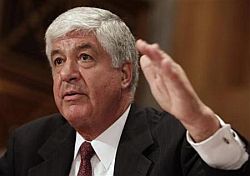
Paul Krugman writes: Robert Benmosche, the chief executive of the American International Group, said something stupid the other day. And we should be glad, because his comments help highlight an important but rarely discussed cost of extreme income inequality — namely, the rise of a small but powerful group of what can only be called sociopaths.

For those who don’t recall, A.I.G. is a giant insurance company that played a crucial role in creating the global economic crisis, exploiting loopholes in financial regulation to sell vast numbers of debt guarantees that it had no way to honor. Five years ago, U.S. authorities, fearing that A.I.G.’s collapse might destabilize the whole financial system, stepped in with a huge bailout. But even the policy makers felt ill used — for example, Ben Bernanke, the chairman of the Federal Reserve, later testified that no other episode in the crisis made him so angry.

And it got worse. For a time, A.I.G. was essentially a ward of the federal government, which owned the bulk of its stock, yet it continued paying large executive bonuses. There was, understandably, much public furor.

So here’s what Mr. Benmosche did in an interview with The Wall Street Journal: He compared the uproar over bonuses to lynchings in the Deep South — the real kind, involving murder — and declared that the bonus backlash was “just as bad and just as wrong.”

You may find it incredible that anyone would, even for an instant, consider this comparison appropriate. But there have actually been a series of stories like this. In 2010, for example, there was a comparable outburst from Stephen Schwarzman, the chairman of the Blackstone Group, one of the world’s largest private-equity firms. Speaking about proposals to close the carried-interest loophole — which allows executives at firms like Blackstone to pay only 15 percent taxes on much of their income — Mr. Schwarzman declared, “It’s a war; it’s like when Hitler invaded Poland in 1939.”

And you know that such publicly reported statements don’t come out of nowhere. Stuff like this is surely what the Masters of the Universe say to each other all the time, to nods of agreement and approval. It’s just that sometimes they forget that they’re not supposed to say such things where the rabble might learn about it. [Continue reading…]

Facebooktwittermail

U.S. and Iran officials make diplomatic history

Barbara Slavin reports: The United States and Iran made diplomatic history Thursday as Secretary of State John Kerry and Iranian Foreign Minister Mohammad Javad Zarif talked for a half hour on the sidelines of a multilateral meeting on Iran’s nuclear program.

The meeting, which Zarif described as “more than a chat,” took place at the United Nations, and marked the highest-level and most-substantive encounter between officials of the two sides since the 1979 Islamic Revolution.

Zarif made the announcement at a gathering of think tankers and journalists addressed by Iranian President Hassan Rouhani. The comments upstaged the president, who, when asked his reaction, told his interlocutor, Josette Sheeran, president of the Asia Society, “You ask for the first step. They [Kerry and Zarif] took it.”

Afterward, Zarif told Al-Monitor: “I’m optimistic. I have to be. Political leaders need to be optimistic about the future and make every commitment to go forward for the cause of peace. This was a good beginning. I sense that Secretary Kerry and President [Barack] Obama want to resolve this.”

The only previous meeting between a US Secretary of State and an Iranian foreign minister since the 1979 revolution took place in 2001 between Colin Powell and Kamal Kharrazi at a UN meeting about Afghanistan, but it was only a handshake and an exchange of courtesies. Condoleezza Rice, Powell’s successor, made several attempts at such encounters but came up short. [Continue reading…]

Facebooktwittermail

Rouhani says nuclear deal can be reached in ‘months not years’

David Ignatius interviewed Iranian President Hassan Rouhani and noted these hightlights:

  • Rouhani stressed that he is “fully empowered to finalize the nuclear talks” by Iran’s supreme leader, Ali Khamenei, a claim confirmed by Western intelligence reports. Analysts say Khamenei was surprised and rebuffed by the popular wave of support for Rouhani’s moderate policies and has given him a chance to cut a deal.
  • The Iranian president wants to move very quickly to resolve the nuclear issue, through negotiations. Rouhani said his “choice” would be a three-month timetable, and that six months would still be “good,” but this should be a matter of “months, not years.” The speedy timeline may reflect the pressure of sanctions on the Iranian economy or Rouhani’s fear of a political backlash from conservative rivals. Whatever the reason, the time is short.
  • Rouhani said he was prepared to offer extensive “transparency” measures to reassure the West that Iran doesn’t intend to build a bomb. He likened these measures to what Iran allowed from 2003 to 2005, when he was the country’s chief negotiator, including acceptance of intrusive “additional protocols” from the International Atomic Energy Agency, as well as inspections to assess what the IAEA calls “possible military dimensions.”
  • He didn’t discuss the level of uranium enrichment that Iran would adopt as part of a deal. But a knowledgeable Iranian source said this week that he might be willing to cap enrichment at 5 percent and limit Iran’s stockpile of enriched material; those moves would seek to address U.S. and Israeli worries about a future “breakout” capability.
  • Rouhani said Iran wants to join a new round of Geneva negotiations for a political transition in Syria so long as there are no preconditions on Iranian participation. The Obama administration has tentatively decided to offer Iran a seat at these talks, reasoning that a stable political transition would be impossible if the Iranians weren’t a co-guarantor. He said that, in terms of a future government in Damascus, Iran would let Syrians decide at the ballot box; that’s the standard Iranian formula.
  • He stressed his desire to first resolve the nuclear issue, where he has the most expertise and authority from Khamenei. After that, he said, the United States and Iran can discuss broader issues of normalization. “Once the nuclear file is settled, we can turn to other issues,” he said. “We need a beginning point.”
Facebooktwittermail