Category Archives: Issues

Israel’s increasing sense of isolation

Joanna Paraszczuk reports: A sense of isolation prevails in Israel’s media on Wednesday — reflected in both news reporting and opinion pieces — following Prime Minister Binyamin Netanyahu’s Tuesday speech to the UN General Assembly.

Populist outlet Ynet and Channel 2 focus on comments made by Defense Minister Moshe Ya’alon on Wednesday morning. Ya’alon spoke out in support of Netanyahu’s stance on Iran, saying that the Prime Minister had “drawn an accurate picture” of Israel’s stance on Iran and President Hassan Rouhani.

“In the UN, the Prime Minister described an accurate reality about how we see the Iranian threat, which is ongoing, even though President Rouhani spoke sweetly and Western officials prefer not to face reality with open eyes,” Ya’alon told reporters during a tour of the Golan Heights.

The Defense Minister echoed Netanyahu’s words, saying that Iran posed a terror threat in the region and beyond, “Iran carries out terror in Afghanistan, it trains and arms Hezbollah, it tries to smuggle weapons into Gaza, it is investing in infrastructure of terrorism in South America and Asia and its centrifuges continue to turn. That is why we say you have to stop the Iranian nuclear program by all means.”

Channel 2 also carries comments from Security Cabinet member and Minister Silvan Shalom, who warned that Israel stands alone.

“We are quite alone in facing the Iranian threat to destroy us,” Shalom said, adding that Rouhani is no different from his predecessor, Mahmoud Ahmadinejad:

“Israel is trying to remove the mask from Rouhani’s face, he speaks sweetly and in a different way from Ahmadinejad, but he did not really no different from him. His aim is to gain more time to build a nuclear bomb, which would be an eternal insurance certificate for the ayatollahs’ regime,” Shalom added. [Continue reading…]

Setting aside for now the fact that Iran’s leaders persist in denying that the Islamic republic’s nuclear program is geared towards weapons production, Shalom’s characterization of the implications of a nuclear-armed Iran is quite revealing.

Having referred to “the Iranian threat to destroy us,” he then suggests that nuclear weapons would serve as an “eternal insurance certificate for the ayatollahs’ regime” — acknowledging that such weapons would serve Iran in exactly the same way that they serve all other nuclear powers: as the ultimate deterrent. Shalom clearly doesn’t share the view promoted by Alan Dershowitz and other members of the rabid wing of the Israel lobby: that Iran is a “suicide nation” willing to see itself destroyed by a retaliatory nuclear strike from Israel.

Moreover, to suggest that Iran’s rulers would want or need nuclear insurance is to acknowledge that an ad hoc coalition of regional powers — preeminently Israel and Saudi Arabia — remain reluctant to abandon their dreams of bringing about regime change in Tehran.

At the same time as engaging in last week’s whirlwind of diplomatic outreach, Hassan Rouhani made it very clear that he has a relatively small window of opportunity to make real progress as he faces pressure from a new axis of extremism revealing the common interests of Israel, Saudi Arabia, Iran’s Revolutionary Guard, and the Assad regime, all of whom for their own reasons feel deeply threatened by the possibility of Iranian-U.S. rapprochement.


Facebooktwittermail

Iran president’s phone call with Obama stirs hardline suspicions

Reuters reports: Iranian President Hassan Rouhani’s historic phone call with U.S. President Barack Obama is likely to provoke resistance from powerful hardliners in the Islamic Republic who have built their support on enmity with the West.

The first thing Rouhani did on his return to Tehran at the weekend was to state that he had acted within guidelines set by Supreme Leader Ayatollah Ali Khamenei when he took part in the highest-level contact between Iran and the United States in three decades.

The brief mobile phone conversation led many to speculate that since the election of the moderate Rouhani relations between Washington and Tehran, in the deep freeze since the U.S. embassy hostage crisis, may be about to improve.

Rouhani’s invocation of Khamenei, the man at the top of Iran’s complex political system, looked like a bid to ward off a backlash from hardline power centres and their supporters, some of whom were already lying in wait to throw eggs at the president’s motorcade.

The demonstrators’ chants of “Death to America” were, however, likely to be only the opening shots of a campaign against Rouhani by a conservative political and military establishment opposed to the West in general and to the United States and Israel in particular.

Such is the mistrust between Iran and the United States that a big sticking point of negotiations over Tehran’s disputed nuclear programme has been who should make the first move. [Continue reading…]

Facebooktwittermail

Tunisia’s government falls, Arab democracy is born

Noah Feldman writes: If you blinked, you missed it, but the democratically elected Islamist government of an Arab country just promised to resign peacefully, with no threat of a coup d’etat in sight.

Tunisia is still a long way from political stability. Yet once again, the nation that started the Arab Spring is showing the rest of the region how it’s supposed to be done. Reasonable people facing deep disagreements are negotiating and power-sharing their way to the Holy Grail of legitimate constitutional democracy.

Start with the deal. Ennahda, the Islamic democratic party that formed a government after Tunisia’s free elections in 2011, didn’t agree to step down for nothing. In exchange for agreeing to resign in favor of a caretaker government of nonpartisan technocrats, Ennahda got the opposition to agree to ratify a draft constitution that has been painstakingly drafted and debated over the last year and a half.

Under the rules of the road, adopted after the old regime fell in January 2011, the constituent assembly can approve the constitution if two-thirds of its members vote in favor. That structure put a premium on consensus, the political value most valued by Tunisian political culture. It also put Ennahda in a tough position during the drafting process: Its slight coalition majority in the assembly gave it almost no leverage, because it needed lots of opposition votes to get to two-thirds. The only alternative was to go to the public, which might have approved the constitution by a bare majority. But that would have violated the goal of consensus, and Ennahda consistently refused to treat it as an option. [Continue reading…]

Facebooktwittermail

Iraq sliding towards civil war

Time reports: Early Monday morning, more than a dozen car bombs ripped through mostly Shi‘ite neighborhoods in Baghdad, killing at least 50 people and leaving dozens lying bloodied in the streets. The worst attack that day was in heavily Shi‘ite Sadr City, where a man parked a white car near an area where day laborers gather; a bomb inside erupted, killing seven people and wounding 16.

Such reports have become commonplace over the past few months, as violence in Iraq has escalated to levels unfathomable in almost any other country, and by any metric — death tolls, frequency, geographic distribution — it’s becoming worse. For decades, the Baath Party of toppled dictator Saddam Hussein, composed mostly of secular Sunnis, ruled Iraq’s majority Shi‘ite population and ruthlessly kept a lid on sectarian tensions. After the 2003 U.S.-led invasion overturned the Saddam regime, Shi‘ites controlled the new government. This year, violence in Iraq has been largely the result of a Sunni bombing campaign aimed at the Shi‘ite-dominated political status quo. The civil war in neighboring Syria — itself a volatile, sectarian conflict — has spilled across the border, and Sunni jihadi factions are operating in both countries. Now, four months before the next parliamentary elections, Iraq increasingly appears to be spiraling toward a civil war.

Since 2006, when Iraq then under U.S. occupation convulsed in sectarian bloodshed, violence has been driven mainly by internal divisions, and after the withdrawal of U.S. troops in 2011, the Shi‘ite-dominated government led by Prime Minister Nouri al-Maliki has been unable to stop the killing. “The struggle for power is not conducted along neat Shia versus Sunni or Islamist versus secular dividing lines,” a May report by British think tank Chatham House explained. “However, issues of identity, rights and interests have often found sectarian expression in periods of upheaval and transition.”

It’s spreading as well. Until this weekend, much of the violence has occurred in Baghdad and its environs, largely sparing Iraqi Kurdistan, an autonomous region in the north. For most of the past decade, Iraq’s Kurdish region has been immune to the bloodshed. When American troops occupied Iraq, no American soldiers were killed there. But this weekend, as the results of the region’s parliamentary elections were announced, suicide bombers in the Kurdish capital Erbil attacked a building housing the Kurdish security forces, setting off gunfights in the streets. According to the regional government, six attackers and six members of the security forces were killed.

Iraq’s tumultuous year began when the Shi‘ite-dominated government’s security forces raided the home of Sunni Finance Minister Rafia al-Issawi, touching off antigovernment protests in several provinces. In April, security forces clashed with protesters and Sunni gunmen in the northern city of Hawija, leaving dozens of mostly Sunnis dead. More than 700 people were killed in April alone.

Attacks then picked up in the spring and summer. According to the U.N. Assistance Mission for Iraq, more than 1,000 Iraqis were killed in July, the deadliest month in the country since sectarian violence peaked in 2006 and ’07. More than 800 were killed in August, and the U.N. estimates that nearly 1,000 were killed in September. Since the April protests began, more than 5,000 Iraqis have been killed in the violence. [Continue reading…]

Facebooktwittermail

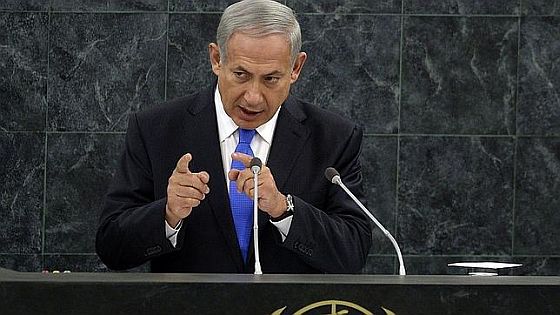
Netanyahu’s ‘The Speech that Never Was’

netanyahu-un

After Benjamin Netanyahu had delivered a speech at the U.N. which surprised no one, Chemi Shalev wrote:

In the streets and avenues leading up to the UN building on the East River, it was already clear the ball has long been over: the barricades were gone, the policemen were relaxed, the satellite trucks had moved elsewhere, the tension and anticipation of the first few days, when Rohani was in town, had all but dissipated. Inside the hall only a fraction of the fatigued foreign diplomats remained to hear Netanyahu, the last head of the state on the agenda, and even they seemed mainly anxious to go home and get back to their normal lives.

The situation in the media, where Netanyahu hopes to make an impact, wasn’t much better. A few hours after the US government had shut down many of its operations, with news networks anxiously breaking to their reporters in the Rose Garden where President Obama was set to make a statement; it was hard to drum up too much interest, not to mention excitement and buzz, over Netanyahu’s strident speech at the UN.

Because in the end, the Israeli prime minister gave the speech that everyone expected him to make, and, much to the media’s disappointment, he didn’t even bother this time to come up with an eye-catching gimmick for visuals.

Barak Ravid writes: One by one, Netanyahu’s donors, associates and supporters flocked in to watch. Casino magnate and owner of the Hebrew daily Yisrael Hayom, Sheldon Adelson, was followed by American-Jewish attorney Alan Dershowitz, former advisor Dore Gold, family friend Zeev Rubinstein and others. Last to enter was Sara Netanyahu, who took her place near the podium. When Netanyahu made his entrance, in front of a half-empty, drowsy hall, his friends, advisors, supporters and entourage all rose to their feet and applauded for several minutes.

Still, the fans the in stands hardly helped. The prime minister’s address resembled a game of the Israeli national soccer team. After weeks of aggressive marketing, spins, headlines and high expectations, the result was disappointing. We hoped to make it to the World Cup, but will have to do with the League Cup.

Netanyahu’s speech was tired, bothersome and boring. In contrast to the Iranian President Hassan Rohani’s sophisticated PR campaign, which led to his taking the UN by storm, Netanyahu sounded like an old, scratchy vinyl record. Not only did he fail to come up with a new effect that would call world attention to the Iranian nuclear threat, such as last year’s cartoon, the prime minister failed to offer any new pertinent information.

The New York Times reported: Mr. Netanyahu dismissed any thought of allowing Iran to enrich uranium to even a low level, insisting that the only way to assure it would never build a nuclear weapon was a complete dismantlement of its capability to enrich nuclear fuel. He exhorted the West to intensify economic sanctions on Iran instead of easing them, as Mr. Rouhani has demanded.

“I wish I could believe Rouhani, but I don’t,” Mr. Netanyahu told the General Assembly, where Iran’s seats were vacant. “Because facts are stubborn things.”

He said the international response to Iran’s entreaties for sanctions relief should be “distrust, dismantle and verify,” and he repeated his warnings that Israel reserved the right to preemptively strike Iran’s nuclear facilities if it deemed the Iranians were close to producing nuclear weapons.

Mohammad Khazaee, Iran’s ambassador to the United Nations, said afterward that his country had found Mr. Netanyahu’s speech inflammatory, rejected the notion that Iran was building a nuclear arsenal, and asserted its right to self-defense.

“The Israeli Prime Minister better not even think about attacking Iran let alone planning for that,” the Iranian ambassador said. He capped his remarks by saying that Iran’s “smile policy” was better than “lying.”

Hours before Mr. Netanyahu spoke, Iranian diplomats sought to make a pre-emptive strike of their own, calling him a persistent liar and warning President Obama not to allow the Israelis to subvert the positive spirit cultivated by Mr. Rouhani in his visit to the United Nations.

Facebooktwittermail

Iranian media splits over diplomatic outreach

Tehran Bureau reports: Hossein Shariatmadari, the chief editor of Iran’s leading hardline newspaper, appears to be in quite a quandary. Long Kayhan’s primary editorial writer, he kept silent for weeks as Iran’s new president, Hassan Rouhani, and his diplomatic team made a series of statements and gestures indicating their willingness to engage in substantive negotiations with the United States and its western allies. Then came the historic telephone exchange last week between Rouhani and Barack Obama, the first direct contact between the presidents of the Islamic republic of Iran and the United States since the 1979 revolution and the takeover of the US embassy in Tehran. On Sunday, Shariatmadari, faced with a choice between continued silence and condemnation, picked the latter.

“The last act of the New York trip, which should be considered most disheartening, and the largest advantage that our nation’s respectful president handed [our] opponent, was the phone conversation of his with the president of the US”, he said of Rouhani’s visit to address the UN General Assembly.

Rather than deal with the content of the conversation, Shariatmadari focused on the announcement by US national security advisor Susan Rice that the Iranian delegation had requested the call. “Based on what analysis and interpretation did his eminence, Mr Rouhani, and the meritorious entourage feel it necessary to trust the Americans and then present the United States’ trust-building efforts in such expansive and loud propaganda as one of the fruits of the New York trip? Furthermore, what kind of a ‘trust-building step’ is this, which neither side is willing to take responsibility for [initiating]?”

“Just take a look at the volume of reviews, analyses, and reports published by the American media, and by American and Zionist officials to see how they reframe the aforementioned telephone conversation in terms of the ‘capitulation of Islamic Iran’ and its weakness and despair due to the strain of the sanctions”, he wrote, without naming any specific media outlets.

Discussing the Kayhan editorial, a senior editor at an Iranian reformist publication told Tehran Bureau, “Shariatmadari is considered an icon in the principlist media realm. For about 20 years, his has been the first and last words among right-wing publications, and his first and last words have always been that under no circumstances should we negotiate with the United States.

“Undoubtedly, Rouhani did not converse with Obama without the consent of [supreme leader Ayatollah Ali] Khamenei. This has put Shariatmadari in a frightful predicament.”

The depth of that predicament was brought into clearer focus when the state-controlled Islamic Republic of Iran Broadcasting, long a source of hardline views essentially identical to Kayhan’s, offered a very different perspective on the presidential phone call to its millions of viewers. In its Channel One news programming on Saturday, IRIB presented wall-to-wall coverage of Rouhani and his youthful entourage’s return to Iran. Even as it censored out any coverage of the protesters, including Basij militia members, who chanted anti-Rouhani slogans at the airport, the network’s reporters roamed the streets of Tehran asking apparently typical citizens for their opinions of the 15-minute conversation between Iran’s president and that of the nation which for years it had called “the Great Satan”.

Every single one of the people whose interviews were aired welcomed the event. [Continue reading…]

Facebooktwittermail

Iran opens its fist

Gary Sick writes: He came to New York. He saw almost everyone. Hassan Rouhani, Iran’s new president, may not have conquered, but at least he seems to have persuaded John Kerry and Barack Obama that his proposals for negotiating an end to the US-Iran conflict deserve to be taken seriously. When President Obama picked up his phone in the Oval Office on Friday to bid farewell to President Rouhani with the Persian phrase Khodahafez (“God be with you”), there was the sense that a tectonic shift between Washington and Tehran was taking place.

The Rouhani blitz was regarded by many cynics as nothing but a charm offensive. Of course, in one sense that is what it was. Rouhani dominated the media, with half a dozen one-on-one interviews, a well written and conciliatory op-ed in the Washington Post, a seemingly endless series of meetings with curated groups of journalists, scholars, former US government officials, business executives, and a throng of his fellow Iranians, many of whom had taken refuge in the United States from the regime he represents. He spoke to the UN General Assembly (the ostensible purpose of his visit), to the Non-Aligned Movement (which Iran chairs), and to a collection of some two hundred members of the Asia Society and the Council on Foreign Relations at a midtown hotel.

I watched him in the two meetings that I attended and in most of his televised appearances. Rouhani is a man of considerable gravitas. He is serious, businesslike, and fully in command of his brief. Except for the formal speeches, he spoke without notes and responded directly and thoughtfully to the many questions directed at him. He spoke in Persian, except for an occasional English phrase, but he listened to his English-speaking audience without simultaneous translation, and his responses indicated that he grasped not only the words but also the nuances. Rouhani is a cleric, and he wears the robes and turban appropriate to his status. But he prefers to be addressed as Doctor Rouhani, in recognition of his PhD in law from Glasgow Caledonian University. Addressing members of New York think tanks, he reminded them that until recently he was one of them, running the Center for Strategic Research in Tehran. That, however, is only a small part of his résumé.

He was national security adviser to presidents Rafsanjani and Khatami, and he has been the personal representative of the Supreme Leader, Ayatollah Ali Khamenei, for nearly a quarter of a century. In those capacities, and other senior posts, he has been associated with virtually every security and foreign policy decision made by the Islamic Republic of Iran since at least the end of the Iran-Iraq war in the late 1980s. Rouhani’s close ties to Khamenei were on display as he prepared to depart for the United States. Khamenei appeared before the leadership of the powerful and conservative Revolutionary Guards Corps to remind them politely but firmly that their proper concern was national security, not politics. Since the Revolutionary Guards played a major part in undermining both of Rouhani’s predecessors, this was a unique and unequivocal demonstration of solidarity. It does not, however, guarantee indefinite support for Rouhani’s initiatives. The Guards and the senior clerical establishment will look for results and weigh their own interests. Thus far, Rouhani, with the help of the Leader, has stayed ahead of his domestic and foreign opposition, but in New York he and his associates gave every indication of being men in a hurry. [Continue reading…]

Facebooktwittermail

The Guardian’s global ambitions

Ken Auletta writes: At eight-thirty on the morning of June 21st, Alan Rusbridger, the unflappable editor of the Guardian, Britain’s liberal daily, was in his office, absorbing a lecture from Jeremy Heywood, the Cabinet Secretary to Prime Minister David Cameron. Accompanying Heywood was Craig Oliver, Cameron’s director of communications. The deputy editor, Paul Johnson, joined them in Rusbridger’s office, overlooking the Regent’s Canal, which runs behind King’s Cross station, in North London. According to Rusbridger, Heywood told him, in a steely voice, “The Prime Minister, the Deputy Prime Minister, the Foreign Secretary, the Attorney General, and others in government are extremely concerned about what you’re doing.”

Since June 5th, the Guardian had been publishing top-secret digital files provided by Edward Snowden, a former contract employee of the National Security Agency. In a series of articles, the paper revealed that the N.S.A., in the name of combatting terrorism, had monitored millions of phone calls and e-mails as well as the private deliberations of allied governments. It also revealed, again relying on Snowden’s documents, that, four years earlier, the Government Communications Headquarters (G.C.H.Q.), Britain’s counterpart to the N.S.A., had eavesdropped on the communications of other nations attending the G20 summit, in London.

Such articles have become a trademark of the Guardian. In 2009, it published the first in a torrent of stories revealing how Rupert Murdoch’s British tabloids had bribed the police and hacked into the phones of celebrities, politicians, and the Royal Family. In 2010, the Guardian published a trove of WikiLeaks documents that disclosed confidential conversations among diplomats of the United States, Britain, and other governments, and exposed atrocities that were committed in Iraq and Afghanistan; in August, Bradley (now Chelsea) Manning, a private in the U.S. Army, was sentenced to up to thirty-five years in prison for his role in the leak.

Now Rusbridger was poised to publish a story about how the G.C.H.Q. not only collected vast quantities of e-mails, Facebook posts, phone calls, and Internet histories but shared these with the N.S.A. Heywood had learned about the most recent revelation when Guardian reporters called British authorities for comment; he warned Rusbridger that the Guardian was in possession of stolen government documents. “We want them back,” he said. Unlike the U.S., Britain has no First Amendment to guard the press against government censorship. Rusbridger worried that the government would get a court injunction to block the Guardian from publishing not only the G.C.H.Q. story but also future national-security stories. “By publishing this, you’re jeopardizing not only national security but our ability to catch pedophiles, drug dealers, child sex rings,” Heywood said. “You’re an editor, but you have a responsibility as a citizen as well.” (Cameron’s office did not respond to requests for comment.)

Rusbridger replied that the files contained information that citizens in a democracy deserved to know, and he assured Heywood that he had scrubbed the documents so that no undercover officials were identified or put at risk. He had also taken steps to insure the story’s publication. Days earlier, Rusbridger had sent a Federal Express package containing a thumbnail drive of selected Snowden documents to an intermediary in the U.S. The person was to pass on the package to Paul Steiger, the former editor of the Wall Street Journal and the founding editor of the online, nonprofit news site ProPublica; if the Guardian was muzzled, Steiger would publish the documents on ProPublica. Besides, Rusbridger reminded Heywood, the government’s reach was limited: Glenn Greenwald, the Guardian blogger and columnist with whom Snowden had shared the documents, lived in Brazil, and was edited by Janine Gibson, a Guardian editor in New York.

“It was a little like watching two Queen’s Counsel barristers in a head-to-head struggle, two very polished performers engaging each other,” Johnson, the deputy editor, said. The Guardian has a reputation as a leftish publication that enjoys poking the establishment; its critics object that it allows commentary to occasionally slip into its headlines and news stories. Rusbridger, who is fifty-nine, has been its editor for eighteen years. He wears square, black-framed glasses and has a mop of dark hair that sprawls across his head and over his ears. He could pass for a librarian. “His physical appearance doesn’t tell you how tough he is,” Nick Davies, the investigative reporter whose byline dominated the Murdoch and WikiLeaks stories, said.

After an hour, Rusbridger ushered Heywood and Oliver out with a thank-you. He had taken what he considered a cautious approach to publishing the Snowden revelations. He consulted Guardian lawyers. He called Davies back from vacation and summoned the longtime investigations editor, David Leigh, out of retirement for advice and to help analyze the documents. He sought the opinion of two associates: the centrist Guardian columnist Simon Jenkins and the liberal Observer columnist Henry Porter. “He doesn’t buckle,” Porter, who is a close friend, said. “He’s extremely calm. He could easily head up any of the three intelligence agencies here.” [Continue reading…]

Facebooktwittermail

The DEA thinks you have ‘no constitutionally protected privacy interest’ in your confidential prescription records

ACLU Speech, Privacy & Technology Project: The Drug Enforcement Administration thinks people have “no constitutionally protected privacy interest” in their confidential prescription records, according to a brief filed last month in federal court. That disconcerting statement comes in response to an ACLU lawsuit challenging the DEA’s practice of obtaining private medical information without a warrant. The ACLU has just filed its response brief, explaining to the court why the DEA’s position is both startling and wrong.

We represent four patients and a physician in Oregon whose confidential prescription records are contained in a state database that tracks prescriptions for certain drugs. The database, called the Oregon Prescription Drug Monitoring Program (PDMP), was intended to be a public health tool to help physicians avoid drug overdoses and abuse in their patients. Despite a state law requiring law enforcement to obtain a probable cause warrant from a judge before requesting records from the PDMP, the DEA has been requesting records using administrative subpoenas, which do not involve judicial authorization or probable cause. Our clients object to the DEA’s warrantless access to the PDMP because their prescription records reveal deeply private information about their health and medical history, including their gender identity (two of our clients are transgender men taking testosterone as part of their transition from female to male sex) and mental illness (one client takes medication to treat anxiety and post-traumatic stress disorders).

In July, we explained to the court why people have a “reasonable expectation of privacy” in their confidential prescription records and the medical information those records reveal. (Under the Fourth Amendment, if there is a reasonable expectation of privacy in an item or location, law enforcement can generally conduct a search only if it first obtains a warrant). In support of our arguments, we submitted sworn declarations from medical privacy experts, including a scholar of medical ethics and a physician who explained that maintaining the confidentiality of doctor-patient communications is vital to the successful practice of medicine, and an authority on the history of medical ethics who explained that principles of medical confidentiality were well established at the time of the writing of the Fourth Amendment and would have been relied on by the Amendment’s framers.

In its latest brief, the DEA ignores these points and instead argues that the mere fact that our clients’ prescription records are held in a database maintained by a third party—the State of Oregon—means that they have somehow given up their privacy interest in the records. [Continue reading…]

Facebooktwittermail

Israel puts ‘Iranian spy’ on display but has yet to charge him after 20 days of detention

Ali Mansouri, an Iranian-born Belgian citizen also known as Alex Mans, was arrested by Israel’s internal security services Shin Bet on September 11. His possession of a couple of nondescript photographs in which the U.S. embassy in Tel Aviv can be seen, has been presented as evidence that he was engaged in espionage. (Anyone who wants to find better photos of the embassy just has to use Google.)

The fact that after 20 days in detention (during the first nine of which Mansouri was prevented from consulting a lawyer) investigators don’t appear to have found sufficient evidence to put him on trial, might explain why he has yet to be charged.

At the same time, Israeli authorities were shameless in trying to exploit the political value of holding an Iranian in handcuffs as he was put on display for the press today.

Reuters reports: A man arrested on suspicion of being an Iranian spy appeared in an Israeli court on Monday and some Israeli analysts questioned the timing of the affair, suggesting it was being showcased as part of efforts to discredit Tehran’s new opening to Washington.

As Prime Minister Benjamin Netanyahu flew on Sunday to the United States for a visit focused on Iran’s nuclear program, Israel’s Shin Bet security service announced that Ali Mansouri had been arrested on September 11 on suspicion of spying for the Iranian Revolutionary Guards.

It said Mansouri, a 55-year-old Iranian-Belgian national, had photographed the U.S. Embassy in Tel Aviv and intended to establish business ties in Israel as a cover for espionage.

An Israeli official told reporters on Netanyahu’s flight that Mansouri’s picture-taking outside the embassy – whose exterior can be seen in numerous images on the Internet – was an attempt “to collect intelligence for a possible terror attack”.

That allegation was challenged by Mansouri’s lawyer, Michal Okabi, after a hearing on Monday in a court in the Tel Aviv suburb of Petah Tikva in which the suspect, who did not speak, was ordered held for eight more days.

“The apocalyptic picture that the Shin Bet is painting is a lot more complicated and the attempt to claim that our client came here in order to carry out attacks in Israel is far from reality and without foundation,” Okabi told reporters.

Some Israeli media commentators questioned the timing of the news, released in a Shin Bet statement that included photographs it said he had taken outside the beachfront mission and at Tel Aviv’s Ben-Gurion airport. No formal charges have been filed.

Asked by Reuters whether the decision to publicize Mansouri’s arrest was influenced by Netanyahu’s U.S. trip, the Shin Bet declined to comment.

Facebooktwittermail

Netanyahu’s Iran dilemma

Larry Derfner writes: By all appearances, Israel’s Prime Minister Benjamin Netanyahu arrived in New York Sunday in a state of near desperation over Iran. By his reckoning, the Iranians are now within arm’s reach — a few months or even just weeks short — of having a stockpile of enriched uranium that, if re-enriched, would be enough for a nuclear bomb. Reports in Israeli media even quote an unnamed government official claiming that Iran already has a bomb. And Netanyahu — who addresses the U.N. General Assembly Tuesday a day after visiting the White House — believes the Obama administration is falling for an Iranian ruse fronted by President Hassan Rouhani to get the West to drop sanctions in return for a deceitful demonstration of nuclear innocence.

But if the Israeli leader is feeling desperate, don’t expect him to show it in his U.N. speech; that, after all, is what his opponents expect. There will likely be no over-the-top gimmicks this time, no cartoon bomb audio-visuals. Neither should anyone wait for explicit, drawn-out analogies to the Holocaust. Instead, Netanyahu is likely to speak very quietly and starkly as he lays out his case that it’s too late to slow Iran’s advance to nuclear capability, that the only remaining choice for the world’s leaders is to force Iran to relinquish its capability to build nuclear weapons, or live with a nuclear-armed regime in Tehran.

Netanyahu’s dilemma is this: Not only does he have no trust in Tehran’s peaceful declarations, he is not confident that the U.S. and Europe are willing to escalate a confrontation in order to force Iran to give up its enriched uranium and dismantle its key nuclear facilities. It is not sufficient for Netanyahu for Iran to accept caps on its enrichment levels, because it’s nuclear infrastructure puts it within “a turn of the screwdriver” of weaponization if it followed North Korea’s example and broke out of the Non-Proliferation Treaty.

The Israeli leader believes the only acceptable scenario is for Iran to be presented with the choice of either dismantling its nuclear program or being bombed to ruins — and that’s not a likely outcome of renewed negotiations between the West and Iran, which are focused on limiting but not entirely eliminating Iran’s capacity to enrich uranium. [Continue reading…]

Facebooktwittermail

Iran hawks gear up

Mitchell Plitnick writes: Not everyone shares the optimism surrounding the recent communication between Presidents Barack Obama and Hassan Rouhani. From Israel, Saudi Arabia, the Gulf Monarchies and, of course, Washington, DC, voices of war are in a panic that tensions between the U.S. and Iran might be reduced by some means other than further devastation of the Islamic Republic.

The concern that Iran might emerge with a better relationship with the United States is quite vexing for the Gulf rulers and for Israel. For some years now, the drive to isolate Iran has focused almost entirely on the nuclear issue. In fact, regionally, much of the concern has been the ascendancy of Iran as a regional player more broadly, with revolutionary rhetoric that challenges the dominance of Saudi Arabia and the Gulf States. Since the destruction, by George W. Bush’s invasion of Iraq, of the dual containment policy, the issue for these parties has been how to contain Iran and its regional influence.

Iran has been cast as an “aggressor nation,” and this has been sold by illustrating Iran’s support for Hezbollah and other militant groups, its often bombastic rhetoric, and for the past decade, Iran’s ducking from some of its responsibilities to the International Atomic Energy Agency (IAEA). What gets left out is that Iran has never initiated an attack on another nation, its threats to “wipe Israel off the map” are factually known as (just not in mainstream discourse) to be a de-contextualized mistranslation of former President Mahmoud Ahmadinejad’s words, and even Iran’s failures with the IAEA have been part of a back and forth exchange, where they refuse or neglect to comply with some things in response to what they see as US-led unfair sanctions or restrictions. That doesn’t mean Iran has not caused some of these problems itself, it has. Lack of transparency on nuclear issues tends to raise the hackles of one’s enemies. But all this has hardly been the one-way street that’s been portrayed. [Continue reading…]

Facebooktwittermail

For scientists in a democracy, to dissent is to be reasonable

George Monbiot writes: It’s as clear and chilling a statement of intent as you’re likely to read. Scientists should be “the voice of reason, rather than dissent, in the public arena”. Vladimir Putin? Kim Jong-un? No, Professor Ian Boyd, chief scientific adviser at the UK’s Department for Environment.

Boyd’s doctrine is a neat distillation of government policy in Britain, Canada and Australia. These governments have suppressed or misrepresented inconvenient findings on climate change, pollution, pesticides, fisheries and wildlife. They have shut down programmes that produce unwelcome findings and sought to muzzle scientists. This is a modern version of Soviet Lysenkoism: crushing academic dissent on behalf of bad science and corporate power.

Writing in an online journal, Boyd argued that if scientists speak freely, they create conflict between themselves and policymakers, leading to a “chronically deep-seated mistrust of scientists that can undermine the delicate foundation upon which science builds relevance”. This, in turn, “could set back the cause of science in government”. So they should avoid “suggesting that policies are either right or wrong”. If they must speak out, they should do so through “embedded advisers (such as myself), and by being the voice of reason, rather than dissent, in the public arena”.

Shut up, speak through me, don’t dissent – or your behaviour will ensure that science becomes irrelevant. Note that the conflicts between science and policy are caused by scientists, rather than by politicians ignoring or abusing the evidence. Or by chief scientific advisers. [Continue reading…]

Facebooktwittermail

Netanyahu’s fight against Middle East peace

Daniel Levy writes: On Monday, Sept. 30, U.S. President Barack Obama will welcome Israeli Prime Minister Benjamin Netanyahu to the White House for the first time in 18 months. Much has changed in the intervening period — both leaders have been re-elected, Obama has made his first visit as president to Israel, Israeli-Palestinian peace talks have been relaunched, and that rather pragmatic-sounding Hasan Rouhani chap has been elected president in Iran.

In what might be called an anti-“Asia pivot” speech, Obama announced to the U.N. General Assembly this week that the United States is engaged in the Middle East “for the long haul” and that “in the near term, America’s diplomatic efforts will focus on two particular issues: Iran’s pursuit of nuclear weapons and the Arab-Israeli conflict.”

That message will be viewed as a mixed bag in Jerusalem, which is keen for a greater American footprint in the region but is less enthusiastic about the idea of peacemaking with the Palestinians and deal-making with the Iranians taking top billing. For that reason, the upcoming White House meeting will likely find the two leaders back on familiar terrain, more focused on testing each other’s underlying intentions than on working together as close allies.

The U.S. president is something of an open book, but Netanyahu’s approach requires a little more interpretation and context. Too much of that analysis has been consistently wrong, and thankfully so. If prominent Netanyahu watchers had gotten it right, we would be marking the second or third anniversaries of Israeli bombing campaigns against Iran.

Netanyahu is indeed back in threatening mode. His latest rhetorical flourish is to quote Hillel’s ancient maxim “If I am not for myself, who will be for me?” — an upgrade of his previous refrain regarding Israel’s “right to defend itself by itself.” That language is being widely interpreted by Israeli commentators as a reaffirmation of Israel’s willingness to strike Iran alone if Netanyahu’s red lines on Iran’s nuclear program are deemed to have been crossed.

This debate has taken on a new urgency given the diplomatic opening seemingly created by the election of Rouhani. It is no secret that Netanyahu has been dragged out of his comfort zone by the possibility of a U.S.-Iran rapprochement. Former President Mahmoud Ahmadinejad’s aggressive and insulting behavior made him a convenient adversary for Israel; Rouhani and his diplomatic team, notably polished Foreign Minister Javad Zarif, present a challenge of a very different order of magnitude. [Continue reading…]

Facebooktwittermail

Israel releases ‘Iranian spy’ story as Netanyahu heads to Washington

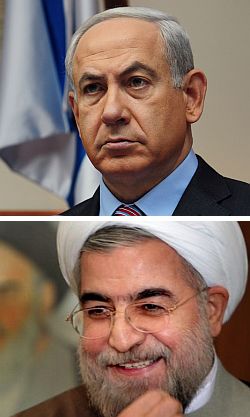
netanyahu-rouhaniOn September 11, Israel’s secret police (Shin Bet) arrested a Belgian windows and roofing salesman who is alleged to be an “Iranian agent … sent to Israel to set up a base for Iranian intelligence and terrorism networks”.
The Israeli government delayed releasing information about the arrest until Prime Minister Benjamin Netanyahu set off for Washington on his mission to counter the “the onslaught of smiles” that Americans have been subjected to over the last few days.

Reasons the Israelis give for regarding Ali Mansouri with suspicion, include:

  • The fact that when he became a Belgium citizen in 2006, he changed his name to Alex Mans. Were it not for the fact that the father of Israel’s prime minister shed his Polish identity when he migrated to Palestine, Bibi might now be generally known as Benjamin Mileikowsky. As millions of Americans can attest, the adoption of a new name in a new homeland is far from unusual.
  • Mans was found in possession of photos of the U.S. embassy in Tel Aviv. Much more detailed photos can be found on Google Maps.
  • “Iran offered him a million dollars in exchange for his activities.” But did he take a dime?

Mans left Iran the year after the revolution and has spent most of his adult life living in Turkey and Belgium.

The Jerusalem Post reports:

Public defense lawyers representing Mansouri said that their client is a Belgian businessman who is not motivated by any pro-Iranian agenda.

The attorneys, Michael Orkavi and Anat Yaari, said their client had been denied access to a lawyer for nine days. They added that a more complex picture exists than the one being presented by security forces, and that the full details would emerge in court after Mansouri is charged.

Mans’ cover as a ‘salesman’ seems quite convincing. But maybe that’s because he’s just a salesman. The only thing he’s definitely ‘guilty’ of is having been born in Iran.

Facebooktwittermail

Ret. Gen. Boykin promotes End Times view of war in Syria

Mother Jones: Lt. Gen. Jerry Boykin, a top executive at the influential Family Research Council, has joined the chorus of religious conservatives touting the Syrian conflict as a prelude to Armageddon. On Wednesday, Boykin appeared on Prophetic Perspectives on Current Events, a talk show hosted by dominionist preacher Rick Joyner (see the video above). The pair discussed a passage in Isaiah 17, which predicts Damascus will be reduced to “a ruinous heap.”

“One of the scriptures that has never been fulfilled and has to be fulfilled before this age can end is that Damascus will be destroyed, never inhabited again,” Joyner explained. “What in the world could cause a city to be destroyed and never inhabited again?” Boykin didn’t hesitate. “One of the ways Damascus could be destroyed, never to be re-occupied, would be through a chemical attack,” he replied. ” So let’s just take a scenario: The Free Syrian Army takes Damascus and Bashar al-Assad is in a desperate mode now…. What would be his final act? Well it may very well be to unload all his chemical weapons on the population center there in Damascus. Destroy the city and destroy it in a way that he just kills maybe millions of people. But the byproduct is that he has residue there that could make Damascus uninhabitable and for a very long time.”

This is not the first time Boykin has embraced the notion that war in the Middle East will lay waste to the Syrian capital—and pave the way for Jesus’s return. He recently wrote an endorsement for Damascus Countdown, a fictionalized account of the looming biblical conflict by best-selling author Joel Rosenberg. And he has spoken at several of Ronseberg’s annual Epicenter Conferences, which explore the Middle East’s role in biblical prophesy.

Facebooktwittermail

A mysterious fire transformed North America’s greatest city in 1170

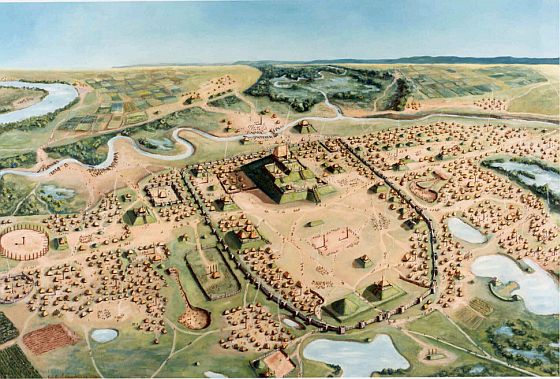
Cahokia

Annalee Newitz writes: One thousand years ago, in the place where St. Louis, Missouri now stands, there was once a great civilization whose city center was ringed with enormous earthen pyramids, vast farmlands, and wealthy suburbs. For hundreds of years it was the biggest city in North America. Then a mysterious fire changed everything.

The city that once existed in St. Louis’ current footprint is known today as Cahokia, and its creators are commonly called the Mound Builders because of the 120 or so enormous mounds they left behind. Shaped much like the stone pyramids of the Maya civilization to the south, these mounds rose up hundreds of feet, and were often built on top of tombs. At their summits were ceremonial buildings made from wood and thatch. Unfortunately, many of these magnificent creations were destroyed in the nineteenth century when St. Louis was built. Below, you can see one of the only remaining pyramids, known as Monk’s Mound.

The first evidence of a settlement in the Cahokia area is from the year 600 CE, at a time when the Maya civilization would have been at its peak. But it wasn’t until after the largest cities of the Maya began to fall in the 1000s that Cahokia came into its own. It’s estimated that the city center held as many as 15,000 people (making it comparable in size to European cities of the same era), and reached the height of its productivity between roughly 1000-1300 CE. [Continue reading…]

Facebooktwittermail