Category Archives: Issues

Video: James Hansen on nuclear power

Hansen’s analysis is (at least to me) quite persuasive. One point where I think it’s questionable is in his assessment of the impact of anti-nuclear lobbying. He fails to mention that opposition to continued research in nuclear technology also serves the interests of the fossil fuel industry and that governments which have moved away from nuclear power are probably acting more in the interests of the oil industry than they are responding to pressure from environmentalists. Environmentalist have leverage neither in terms of money nor votes, so who are the politicians going to listen to?

Facebooktwittermail

Leaked Pakistani report confirms high civilian death toll in CIA drone strikes

The Bureau of Investigative Journalism: A secret document obtained by the Bureau reveals for the first time the Pakistan government’s internal assessment of dozens of drone strikes, and shows scores of civilian casualties.

The United States has consistently claimed only a tiny number of non-combatants have been killed in drone attacks in Pakistan – despite research by the Bureau and others suggesting that over 400 civilians may have died in the nine-year campaign.

The internal document shows Pakistani officials too found that CIA drone strikes were killing a significant number of civilians – and have been aware of those deaths for many years.

Of 746 people listed as killed in the drone strikes outlined in the document, at least 147 of the dead are clearly stated to be civilian victims, 94 of those are said to be children. [Continue reading…]

Facebooktwittermail

Our coming food crisis

Gary Paul Nabhan writes: This summer the tiny town of Furnace Creek, Calif., may once again grace the nation’s front pages. Situated in Death Valley, it last made news in 1913, when it set the record for the world’s hottest recorded temperature, at 134 degrees. With the heat wave currently blanketing the Western states, and given that the mercury there has already reached 130 degrees, the news media is awash in speculation that Furnace Creek could soon break its own mark.

Such speculation, though, misses the real concern posed by the heat wave, which covers an area larger than New England. The problem isn’t spiking temperatures, but a new reality in which long stretches of triple-digit days are common — threatening not only the lives of the millions of people who live there, but also a cornerstone of the American food supply.

People living outside the region seldom recognize its immense contribution to American agriculture: roughly 40 percent of the net farm income for the country normally comes from the 17 Western states; cattle and sheep production make up a significant part of that, as do salad greens, dry beans, onions, melons, hops, barley, wheat and citrus fruits. The current heat wave will undeniably diminish both the quality and quantity of these foods.

The most vulnerable crops are those that were already in flower and fruit when temperatures surged, from apricots and barley to wheat and zucchini. Idaho farmers have documented how their potato yields have been knocked back because their heat-stressed plants are not developing their normal number of tubers. Across much of the region, temperatures on the surface of food and forage crops hit 105 degrees, at least 10 degrees higher than the threshold for most temperate-zone crops. [Continue reading…]

Facebooktwittermail

Climate change: some reasons for our failures

Robert Manne writes: Twenty five years ago, scientists with an interest in the climate were moving towards a consensual understanding, that primarily through the burning of fossil fuels human beings were responsible for potentially catastrophic global warming. At present, at least 97% of climate scientists have reached that conclusion.

Through voluntary international cooperation, the Montreal Protocol of 1992 went a long way to solving the problem of the hole in the ozone layer. Using it as their model for the solution to the even more daunting problem of global warming, in 1997 most nations of the earth signed the Kyoto Protocol. It was eventually ratified by almost all advanced economies being asked to commit to greenhouse gas emission targets.

The one exception was the United States. And yet, since Kyoto, greenhouse gas emissions have risen very steeply. The level of carbon dioxide in the atmosphere — 280 parts per million before the industrial revolution — is now 400 parts per million. The conference which was supposed to find a replacement for Kyoto — Copenhagen in 2009 — was a comprehensive failure. There is at present no reason to suppose that the next major international conference on which hopes now rest — Paris in 2015 — will succeed.

Virtually no one any longer believes that temperature will be able to be contained to the internationally recognised tipping point of two degrees Celsius above temperature levels at the time of the industrial revolution. Many climate scientists fear a temperature rise of four or five degrees Celsius by century’s end.

We know that if we continue to use fossil fuels as our primary energy source, the conditions of life on the earth for our own species and for others will be damaged perhaps beyond repair. And yet, eyes wide shut the nations of the earth are doing very little to avert the impending, entirely foreseeable catastrophe. [Continue reading…]

Facebooktwittermail

The Way of the Knife: The CIA, a Secret Army, and a War at the Ends of the Earth

Joshua Hersh writes: When the calls home stopped in November of 2011, friends assumed the worst for Jude Kenan Mohammad. A few years earlier, the young Pakistani-American born in North Carolina had come under the sway of a radicalized Islamic preacher, who taught him about violent jihad and urged him to seek out his roots in Pakistan. Soon, Mohammad departed for Pakistan’s tribal lands where, apart from some calls to family on the holidays, he all but disappeared.

In May, the White House finally acknowledged what many back in North Carolina had long come to believe: Mohammad had been killed by an American drone strike one and a half years earlier. There had been no trial, no public presentation of evidence. He would have been twenty-three years old.

Mohammad’s death was just one small piece of a decade-old, shadowy war started in the years following the September 11 attacks by President George W. Bush and expanded with unwavering intensity by his successor, Barack Obama. Waged high in the skies above rural Pakistan and Yemen, and in the back alleys of Somalia and Afghanistan, it is a war that has received virtually no scrutiny from the public, even as it summarily takes the lives of thousands of individuals, many of them innocent civilians—and a few, like Mohammad, American citizens.

A slew of new books seek to cast light on the private meeting rooms and hidden bunkers from which this covert war has been conducted, among them Jeremy Scahill’s Dirty Wars: The World is a Battlefield; Daniel Klaidman’s Kill or Capture: The War on Terror and the Soul of the Obama Presidency; and Mark Mazzetti’s The Way of the Knife: The CIA, a Secret Army, and a War at the Ends of the Earth. Mazzetti’s is the most richly illustrative of the internal tensions and often careless decision making of America’s leaders in the last decade—and the least burdened by outrage.

The result, from the veteran New York Times national security reporter, is an even-handed tale of this era that will likely leave the reader outraged nonetheless. [Continue reading…]

Facebooktwittermail

Obama’s global expansion of drone operations

The Washington Post reports: The steel-gray U.S. Air Force Predator drone plunged from the sky, shattering on mountainous terrain near the Iraq-Turkey border. For Kurdish guerrillas hiding nearby, it was an unexpected gift from the propaganda gods.

Fighters from the Kurdistan Workers’ Party, or PKK, filmed the charred wreckage on Sept. 18 and posted a video on YouTube. A narrator bragged unconvincingly that the group had shot down the drone. But for anyone who might doubt that the flying robot was really American, the video zoomed in on mangled parts stamped in English and bearing the label of the manufacturer, San Diego-based General Atomics.

For a brief moment, the crash drew back the curtain on Operation Nomad Shadow, a secretive U.S. military surveillance program. Since November 2011, the U.S. Air Force has been flying unarmed drones from Incirlik Air Base in Turkey in an attempt to suppress a long-simmering regional conflict. The camera-equipped Predators hover above the rugged border with Iraq and beam high-resolution imagery to the Turkish armed forces, helping them pursue PKK rebels as they slip back and forth across the mountains.

As the Obama administration dials back the number of drone attacks in Afghanistan, Pakistan and Yemen, the U.S. military is shifting its huge fleet of unmanned aircraft to other hot spots around the world. This next phase of drone warfare is focused more on spying than killing and will extend the Pentagon’s robust surveillance networks far beyond traditional, declared combat zones.

Over the past decade, the Pentagon has amassed more than 400 Predators, Reapers, Hunters, Gray Eagles and other high-altitude drones that have revolutionized counterterrorism operations. Some of the unmanned aircraft will return home with U.S. troops when they leave Afghanistan. But many of the drones will redeploy to fresh frontiers, where they will spy on a melange of armed groups, drug runners, pirates and other targets that worry U.S. officials.

Elsewhere in the Middle East, the U.S. Air Force has drone hubs in Qatar and the United Arab Emirates to conduct reconnaissance over the Persian Gulf. Twice since November, Iran has scrambled fighter jets to approach or fire on U.S. Predator drones that edged close to Iranian airspace.

In Africa, the U.S. Air Force began flying unarmed drones over the Sahara five months ago to track al-Qaeda fighters and rebels in northern Mali. The Pentagon has also set up drone bases in Ethiopia, Djibouti and Seychelles. Even so, the commander of U.S. forces in Africa told Congress in February that he needed a 15-fold increase in surveillance, reconnaissance and intelligence-gathering on the continent. [Continue reading…]

Facebooktwittermail

Israel to free ‘heavyweight’ Palestinian prisoners

The Guardian reports: Israel has said it will release “heavyweight” Palestinian prisoners as part of an agreement to enter preliminary talks in Washington, with the aim of an eventual resumption of long-stalled peace negotiations.

Hours after the US secretary of state, John Kerry, announced that the two sides in the conflict had agreed to discuss terms for negotiations, Yuval Steiniz, Israel’s minister for international relations, said a prisoner release would be carried out in stages.

“I don’t want to give numbers but there will be heavyweight prisoners who have been in jail for tens of years,” he told Israel Radio. The release of long-serving prisoners has been a key Palestinian demand.

But Steinitz said Israel would balk at agreeing on the pre-1967 border as the parameter for territorial negotiations. “There is no chance we will agree to enter any negotiations that begin with defining territorial borders or concessions by Israel, nor a [settlement] construction freeze,” he said.

Kerry’s announcement of progress in his four-month mission to revive the Middle East peace process was delivered in Amman on Friday night after four months of intensive diplomacy. It received mixed interpretations. [Continue reading…]

Facebooktwittermail

Žižek vs. Chomsky

Peter Thompson writes: In the great spat between King Kong Chomsky and Tyrannosaurus Žižek people are often asked which side they are on. Or maybe they are not, because until now these two great beasts have been roaring and knocking down trees without anyone outside leftist discourse hearing them fall. But maybe we should think who we would cheer on, because this is a debate about something very important – namely the relationship between theory, ideology and reality.

Noam Chomsky, the professional contrarian, has accused Slavoj Žižek, the professional heretic, of posturing in the place of theory. This is an accusation often levelled at Žižek from within the Anglo-Saxon empirical tradition. Even those like Chomsky who are on the proto-anarchist left of this tradition like to maintain that their theories are empirically verifiable and rooted in reality.

Žižek has countered with the side-swipe that nobody had been so empirically wrong throughout his life as Chomsky. He brought up Chomsky’s supposed support for the Khmer Rouge in the 1970s and Chomsky’s later self-justification that there hadn’t been empirical evidence at the time of the crimes of the Khmer Rouge. It has all got rather heated and intemperate, but then, debates on the left are like that. More time is spent ripping flesh out of each other than it is trying to find a common cause against an apparently invisible and impregnable enemy. But terms have to be defined, ground has to be laid out. [Continue reading…]

Facebooktwittermail

The most (and least) culturally diverse countries in the world

Pew Research Center: Looking for a real multicultural experience? Head to Chad in north-central Africa where 8.6 million residents belong to more than 100 ethnic groups or to Togo, home to 37 tribal groups that speak one of 39 languages and share little in the way of a common culture or history.

But if you find a kaleidoscope of cultures distracting, then consider a visit to Argentina, Haiti or the isolated Comoros islands off the southeast coast of Africa. They rank among the least culturally diverse countries in the world.

This multicultural map of the world is based on an analysis of data reported in a new study of cultural diversity and economic development by researcher Erkan Gören of the University of Oldenberg in Germany.

Facebooktwittermail

A boy killed by his own government. The Obama administration still refuses to explain why

Abdulrahman al-Aulaqi, a sixteen-year-old American citizen killed by a U.S. military strike in Yemen, October 14, 2011.

Nasser al-Awlaki writes: I learned that my 16-year-old grandson, Abdulrahman — a United States citizen — had been killed by an American drone strike from news reports the morning after he died.

The missile killed him, his teenage cousin and at least five other civilians on Oct. 14, 2011, while the boys were eating dinner at an open-air restaurant in southern Yemen.

I visited the site later, once I was able to bear the pain of seeing where he sat in his final moments. Local residents told me his body was blown to pieces. They showed me the grave where they buried his remains. I stood over it, asking why my grandchild was dead.

Nearly two years later, I still have no answers. The United States government has refused to explain why Abdulrahman was killed. It was not until May of this year that the Obama administration, in a supposed effort to be more transparent, publicly acknowledged what the world already knew — that it was responsible for his death.

The attorney general, Eric H. Holder Jr., said only that Abdulrahman was not “specifically targeted,” raising more questions than he answered.

My grandson was killed by his own government. The Obama administration must answer for its actions and be held accountable. On Friday, I will petition a federal court in Washington to require the government to do just that. [Continue reading…]

Facebooktwittermail

Senate and CIA spar over secret report on torture

The New York Times reports: The chairwoman of the Senate Intelligence Committee says she is planning a push to declassify hundreds of pages of a secret committee report that accuses the Central Intelligence Agency of misleading Congress and the White House about the agency’s detention and interrogation program, which is now defunct.

The 6,000-page report, which took years to complete and cost more than $40 million, is the only detailed account to date of a program that set off a national debate about torture. The report has been the subject of a fierce partisan fight and a vigorous effort by the C.I.A. to challenge its conclusions, and last month, the agency’s director, John O. Brennan, delivered a lengthy rebuttal to the report to committee leaders.

But the committee’s chairwoman, Senator Dianne Feinstein, Democrat of California, said in a statement this week that the report was on “firm ground” and that she planned to ask the White House and C.I.A. to declassify its 300-page executive summary after “making any factual changes to our report that are warranted after the C.I.A.’s response.”

The committee’s top Republican, Senator Saxby Chambliss of Georgia, said he believed the report was deeply flawed and agreed with the intelligence agency’s critique. But he said he believed that a summary of the report could be made public, as long as it was accompanied by a summary of the agency’s response and a dissenting statement from committee Republicans.

The clash over the report is, at its core, a fight over who writes the history of what is perhaps the most bitterly disputed part of the American government’s response to the Sept. 11, 2001, terrorist attacks. More than four years have passed since the C.I.A. closed its secret prisons, and nearly a decade since agency interrogators subjected Qaeda detainees to the most brutal interrogation methods, including the near-drowning technique known as waterboarding. [Continue reading…]

Facebooktwittermail

Helen Thomas 1920-2013

Helen Thomas died today at the age of 92.

Bloomberg reports: In 2012, Palestinian leaders gave Thomas an award for her career. According to an account in the Washington Report on Middle East Affairs, a magazine critical of U.S. foreign policy in the region, Thomas told supporters at the Virginia home of Maen Areikat, the top Palestinian envoy to the U.S., that she accepted the honor “on behalf of brave supporters of Palestinians who have taken an unpopular stand despite the personal and professional costs.”

In 2010, Thomas described the way she was betrayed by the White House press corps — many of whose members will today be stepping up to offer their vacuous words of praise.

Facebooktwittermail

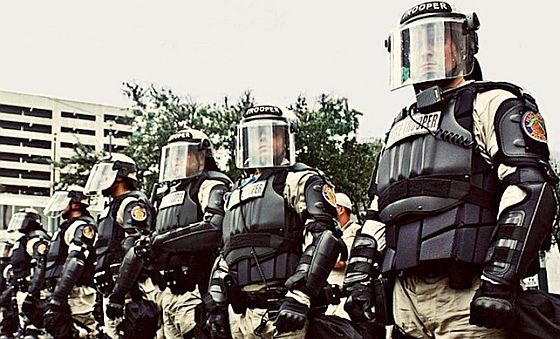
Rise of America’s warrior cops

Radley Balko writes: On Jan. 4 of last year, a local narcotics strike force conducted a raid on the Ogden, Utah, home of Matthew David Stewart at 8:40 p.m. The 12 officers were acting on a tip from Mr. Stewart’s former girlfriend, who said that he was growing marijuana in his basement. Mr. Stewart awoke, naked, to the sound of a battering ram taking down his door. Thinking that he was being invaded by criminals, as he later claimed, he grabbed his 9-millimeter Beretta pistol.

The police say that they knocked and identified themselves, though Mr. Stewart and his neighbors said they heard no such announcement. Mr. Stewart fired 31 rounds, the police more than 250. Six of the officers were wounded, and Officer Jared Francom was killed. Mr. Stewart himself was shot twice before he was arrested. He was charged with several crimes, including the murder of Officer Francom.

The police found 16 small marijuana plants in Mr. Stewart’s basement. There was no evidence that Mr. Stewart, a U.S. military veteran with no prior criminal record, was selling marijuana. Mr. Stewart’s father said that his son suffered from post-traumatic stress disorder and may have smoked the marijuana to self-medicate.

Early this year, the Ogden city council heard complaints from dozens of citizens about the way drug warrants are served in the city. As for Mr. Stewart, his trial was scheduled for next April, and prosecutors were seeking the death penalty. But after losing a hearing last May on the legality of the search warrant, Mr. Stewart hanged himself in his jail cell.

The police tactics at issue in the Stewart case are no anomaly. Since the 1960s, in response to a range of perceived threats, law-enforcement agencies across the U.S., at every level of government, have been blurring the line between police officer and soldier. Driven by martial rhetoric and the availability of military-style equipment—from bayonets and M-16 rifles to armored personnel carriers—American police forces have often adopted a mind-set previously reserved for the battlefield. The war on drugs and, more recently, post-9/11 antiterrorism efforts have created a new figure on the U.S. scene: the warrior cop—armed to the teeth, ready to deal harshly with targeted wrongdoers, and a growing threat to familiar American liberties. [Continue reading…]

Facebooktwittermail

Attention, shoppers: store is tracking your cell

The New York Times reports: Like dozens of other brick-and-mortar retailers, Nordstrom wanted to learn more about its customers — how many came through the doors, how many were repeat visitors — the kind of information that e-commerce sites like Amazon have in spades. So last fall the company started testing new technology that allowed it to track customers’ movements by following the Wi-Fi signals from their smartphones.

But when Nordstrom posted a sign telling customers it was tracking them, shoppers were unnerved.

“We did hear some complaints,” said Tara Darrow, a spokeswoman for the store. Nordstrom ended the experiment in May, she said, in part because of the comments.

Nordstrom’s experiment is part of a movement by retailers to gather data about in-store shoppers’ behavior and moods, using video surveillance and signals from their cellphones and apps to learn information as varied as their sex, how many minutes they spend in the candy aisle and how long they look at merchandise before buying it.

All sorts of retailers — including national chains, like Family Dollar, Cabela’s and Mothercare, a British company, and specialty stores like Benetton and Warby Parker — are testing these technologies and using them to decide on matters like changing store layouts and offering customized coupons.

But while consumers seem to have no problem with cookies, profiles and other online tools that let e-commerce sites know who they are and how they shop, some bristle at the physical version, at a time when government surveillance — of telephone calls, Internet activity and Postal Service deliveries — is front and center because of the leaks by Edward J. Snowden. [Continue reading…]

Facebooktwittermail

When it comes to Israel, EU no longer willing to act like a sucker

Alan Philps writes: On Sunday, the Israeli journalist Gideon Levy published a startling article. As a patriotic Israeli, he wrote in Haaretz newspaper, he had no choice but to declare himself in favour of an economic boycott of his own country until it withdrew from the occupied territories. Given the prospects of “another round of deep stalemate” – a reference to US secretary of state John Kerry’s best efforts to rekindle Israeli-Palestinian peace talks – only sanctions would make Israel change.

Mr Levy is a maverick in Israeli journalism, a lone figure trying to stand in the way of the juggernaut of the Israeli state as it settles ever more Palestinian land. His article was greeted with a shrug, perhaps barely even that.

Two days later, it emerged that the European Union, after many years of dithering, had decided that it would not support any settler projects in the occupied territories. None of its grants, prizes or other sorts of funding would be available to settler entities or institutions, and Israel would have to formally accept this condition in applying for funds.

This news was not greeted with a shrug. One Israeli official called it an “earthquake”. Prime minister Benjamin Netanyahu issued a defiant statement that Israel would never accept foreign “dictates” on its borders. There were dark hints about the “unhelpful” timing of the move: Yair Lapid, the finance minister, said it would “sabotage” the Kerry mission by encouraging the Palestinians to believe that Israel could be subject to outside pressure.

The move is of little financial significance, but deeply symbolic. The “green line” marking the border between internationally recognised Israel and the occupied territory has long disappeared from Israeli maps. The road network already knits the Jewish settlements seamlessly with major Israeli towns.

The 28 member states of the European Union are not going to change those facts on the ground, and the decision does not immediately affect Israel’s $40 billion trade with the EU. But it does mark a belated stiffening of the European backbone. [Continue reading…]

Facebooktwittermail

Fugitive former CIA officer arrested in Panama

Edward Snowden is accused of breaking the law, but Robert Seldon Lady, the former CIA chief in Milan, was convicted of kidnapping and given a nine-year prison sentence.

In 2003, Lady initially claimed diplomatic immunity but after that was rejected by an Italian judge in 2005 and he has been on the run ever since. It’s now reported that he ended up in Panama where he was arrested yesterday.

Panama and Italy don’t have an extradition treaty and so it remains to be seen whether Lady will be able to continue evading his prison sentence.

President Obama has zero tolerance for whistleblowers but he still thinks kidnapping is cool, so in this particular case it doesn’t look like the U.S. government will show any interest in justice.

Washington casts a friendly eye on those who commit crimes at its request, but anyone who dares to expose the government’s criminality will be made to suffer the consequences.

Facebooktwittermail

Netanyahu’s crying wolf on Iran

Gary Sick writes: Israeli Prime Minister Benjamin Netanyahu is not a subtle man. When he has an objective in mind, he is not above resorting to hyperbole, exaggeration, or apocalyptic scenarios to make his point. He has been crying wolf nearly as long as he has been in politics. For a very good reason: It works. And it works. And it works.

Unlike the boy in the story who lost credibility when he sounded the alarm one time too many, each new iteration by Mr. Netanyahu is greeted with nods of grave concern. The latest edition of this long-running show was his appearance on “Face the Nation” on Sunday.

More than 20 years ago, Mr. Netanyahu solemnly informed us that, unless someone intervened, Iran would have a nuclear weapon within five years. That was one of the origins of the “three to five year” mantra. Almost every year since the early 1990s, senior political figures, intelligence specialists and respected commentators have assured us that Iran would surely have a nuclear weapon in three to five years, sometimes less, unless Iran were forced to stop its mad dash for the bomb.

It is not hard to understand the logic of this assertion. Israel itself managed to develop a nuclear weapons capability in absolute secrecy in only a few years. It was not alone. South Africa, India, even poor Pakistan with virtually no heavy industrial base, managed to develop nuclear weapons in secret within a decade or so of the decision to launch a determined program. By most accounts, Iran decided to restart its nuclear program — started under the shah and interrupted by the Iranian revolution — in the mid-1980s, nearly 30 years ago. [Continue reading…]

Facebooktwittermail

Over 100 House members sign letter supporting U.S. diplomacy with Iran

Laura Rozen reports: Some 118 House members have signed onto a bipartisan letter calling on President Obama to try to advance opportunities for a diplomatic resolution with Iran in the wake of the election of Hassan Rouhani last month.

The letter, being circulated by Representatives David Price (D-North Carolina) and Charles Dent (R-Pennsylvania), is the biggest ever pro-Iran diplomacy letter from the Hill, those supporting the initiative said.

A spokesperson for Rep. Price’s office said the letter would close for signatures Thursday night and he expected it to be sent to the White House on Friday. It had 118 signatures as of Thursday afternoon, he said, 14 of them Republican.

Facebooktwittermail