
Category Archives: Issues

Damn Rolling Stone — for what?

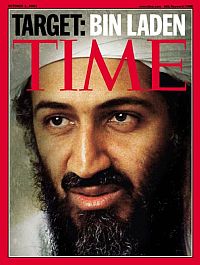
Shortly after 9/11, Osama bin Laden appeared on the cover of Time magazine. What later became an iconic image — the embodiment of evil, global terrorist #1, the face of Islamic extremism, or however else Americans came to view this face — did at the time show a man with an indisputable look of serenity.

Since the icons of terrorism were at that juncture still in the process of being manufactured, America’s first glimpses of Public Enemy Number One portrayed — dare I say it — a rather Christ-like figure.

Even though this was still a nation very much in shock, the appearance of a flattering image of the prime suspect behind the attacks was apparently something that America could handle.

Twelve years later and Rolling Stone’s use of a flattering image of Dzhokhar Tsarnaev is now supposedly beyond the pale.

Michelle Malkin, outraged that the magazine’s choice of cover image shows that its “editors are as muddle headed as ever about our war with Islam,” suggests that Rolling Stone is telling America’s youth that Tsarnaev “is just like you!

And she’s probably right — not on the issue of her war with Islam, but on the idea that Tsarnaev should be seen as an American youth.

He’s just turned 19, he’s a U.S. citizen, he likes hip hop, he’s smoked a lot of weed and he obviously thinks it’s cool to look cool.

This isn’t a land of saints and to belong to the ranks of American youth does not preclude the possibility of doing some awful things before even reaching adulthood. Does ‘cool’ connote any particular virtues? Not that I’ve noticed.

If there’s one thing worth highlighting more than anything else about Tsarnaev, it is precisely his normality. He doesn’t seem to have been unhinged like James Eagan Holmes, Jared Lee Loughner, or Adam Lanza.

Is it disturbing that an ordinary American kid could be involved in a bombing that killed three people and injured many more? Sure.

But that doesn’t mean we now have to plunge into denial and pretend that he wasn’t really an American kid or that there are horns concealed under his locks of hair or that his name or religion makes him foreign.

Osama bin Laden had some Christ-like features and Dzhokhar Tsarnaev looks a bit like Jim Morrison.

Maybe the problem isn’t the images — it’s the simplistic ideas we have about terrorism.

Facebooktwittermail

Global opposition to U.S. drone strikes

Pew Research Global Attitudes Project: In most of the nations polled, there continues to be extensive opposition to the American drone campaign against extremist leaders and organizations. In 31 nations, at least half disapprove of the U.S. conducting drone missile strikes targeting extremists in places such as Pakistan, Yemen and Somalia. At least three-in-four hold this view in 15 countries from all corners of the world, including nations from the Middle East, Europe, Latin America and Asia.

The only three countries where majorities support the drone campaign are Israel (64% approve), Kenya (56%), and the U.S. itself (61%). In the U.S., Republicans (69% approve) are especially likely to endorse this policy, although most independents (60%) and Democrats (59%) also approve.

Opinions on this issue are essentially divided in Australia, Canada and Germany. German support for U.S. drone attacks has actually risen slightly since last year – today, 45% approve, compared with 38% in 2012. Although most in France still oppose the drone strikes, support has also increased there, rising from 37% last year to 45% now. [Continue reading…]

Facebooktwittermail

Afghanistan: What Pakistan wants

Anatol Lieven writes: To understand Pakistan’s position in the conundrum of Afghanistan’s future, it is necessary to understand that in certain respects, Pakistan and Afghanistan have long blended into each other, via the population of around 35 million Pashtuns that straddles both sides of the border between them (a border drawn by the British which Afghanistan has never recognized). Pashtuns have always regarded themselves as the core of Afghanistan, where they form a plurality of the population (Afghan is indeed simply the old Farsi word for Pashtun); yet around two thirds of Pashtuns actually live in Pakistan, where they form the backbone of the present Islamist revolt against the state.

In the 1980s, the US encouraged this merger of Afghan and Pakistani Pashtun sentiment in order to strengthen support of Pakistani Pashtuns for the Afghan Mujahedin. In the 2000s, this came back to haunt America, since most Pakistani Pashtuns with whom I have spoken over the years regard the Taliban fight against the US and its Afghan allies in very much the same light that they regarded the Mujahedin fight against the USSR and its Afghan allies. [Continue reading…]

Facebooktwittermail

From Tom Paine to Glenn Greenwald, we need partisan journalism

Jack Shafer writes: I would sooner engage you in a week-long debate over which taxonomical subdivision the duck-billed platypus belongs to then spend a moment arguing whether Glenn Greenwald is a journalist or not, or whether an activist can be a journalist, or whether a journalist can be an activist, or how suspicious we should be of partisans in the newsroom.

It’s not that those arguments aren’t worthy of time — just not mine. I’d rather judge a work of journalism directly than run the author’s mental drippings through a gas chromatograph to detect whether his molecules hang left or right or cling to the center. In other words, I care less about where a journalist is coming from than to where his journalism takes me.

Greenwald’s collaborations with source Edward Snowden, which resulted in Page One scoops in the Guardian about the National Security Agency, caused such a rip in the time-space-journalism continuum that the question soon went from whether Greenwald’s lefty style of journalism could be trusted to whether he belonged in a jail cell. Last month, New York Times business journalist Andrew Ross Sorkin called for the arrest of Greenwald (he later apologized) and Meet the Press host David Gregory asked with a straight face if he shouldn’t “be charged with a crime.” NBC’s Chuck Todd and the Washington Post‘s Walter Pincus and Paul Farhi also asked if Greenwald hadn’t shape-shifted himself to some non-journalistic precinct with his work.

The reactions by Sorkin, Gregory, Todd, Pincus, Farhi, and others betray — dare I say it? — a sad devotion to the corporatist ideal of what journalism can be and — I don’t have any problem saying it — a painful lack of historical understanding of American journalism. [Continue reading…]

Facebooktwittermail

New EU ‘territorial clause’ causes ‘earthquake’ inside Israel (updated)

Haaretz reports: The European Union has published a guideline for all 28 member states forbidding any funding, cooperation, awarding of scholarships, research funds or prizes to anyone residing in the Jewish settlements in the West Bank and East Jerusalem. The regulation, which goes into effect on Friday, requires that any agreement or contract signed by an EU country with Israel include a clause stating that the settlements are not part of the State of Israel and therefore are not part of the agreement.

A senior Israeli official, speaking on condition of anonymity, described the new ruling, which was published on June 30, as an “earthquake.”

“This is the first time such an official, explicit guideline has been published by the European Union bodies,” the senior official said. “Until today there were understandings and quiet agreements that the Union does not work beyond the Green Line [the pre-1967-war border]; now this has become a formal, binding policy.”

The official noted that the significance of the regulation is both practical and political: From now on, if the Israeli government wants to sign agreements with the European Union or one of its member states, it will have to recognize in writing that the West Bank settlements are not part of Israel.

In the Prime Minister’s Office and Foreign Ministry there is great tension and anxiety over the new regulation and its implications for Israeli-EU relations. The efforts of Prime Minister Benjamin Netanyahu and Deputy Foreign Minister Ze’ev Elkin to stop the move have all failed. Senior EU officials say they would like to hold talks with Israel concerning the new guideline, but since it will go into effect by the end of this week, the chance of its being amended is extremely slim.

“We will have to decide what to do from this day forward,” a senior Israeli official said. “We are not ready to sign on this clause in our agreements with the European Union. We can say this to the Europeans, but the result could be a halt to all cooperation in economics, science, culture, sports and academia. This would cause severe damage to Israel.” [Continue reading…]

Update: It turns out that these guidelines are not binding on EU member states, they will not be applied to all entities in the occupied territories and they do not go into effect until 2014. More details when I have them.

Facebooktwittermail

Who says crime doesn’t pay? Glaxo makes $1.5 billion pushing drugs with sex in China — risks $10 million fine

Bloomberg News reports: GlaxoSmithKline Plc’s sales in China jumped 20 percent to about 1 billion pounds ($1.5 billion) last year, almost quadruple the pace of growth across its emerging markets. Police say bribes and sexual favors spurred the gain.

The drugmaker now faces allegations of economic crimes involving 3 billion yuan ($489 million) of spurious travel and meeting expenses, and trade in sexual favors, the Public Security Ministry said yesterday. The allegations are “shameful” and would be a breach of the company’s systems and values, Glaxo said in a statement.

Prior to a police probe that began last month, Glaxo embarked on a strategy that tripled its Chinese sales force to more than 4,000 people in three years as the U.K.’s largest drugmaker sought a bigger share of the market. As that expansion was ramping up, Chief Executive Officer Andrew Witty told analysts on a February 2010 conference call that controlling Glaxo’s operations in China was “not a trivial proposition.”

Bribes paid to hospitals, doctors and health officials contributed to the resulting gains in revenue, according to the ministry, which controls China’s police. If found guilty, Glaxo could be ordered to pay a penalty of $5 million to $10 million, according to estimates by Kepler Capital Markets based on fines paid in China for similar violations. [Continue reading…]

Facebooktwittermail

In the battle for our crops, superweeds are winning

Grist reports: Biotech crops, which represent almost all the corn, soy, and cotton grown in the U.S., have finally met their match. And it’s not (only) the millions of consumers demanding labels on food that contains genetically modified crops, or GMOs. As NPR reports, biotech’s super-nemesis is legions of weeds and bugs that have grown immune to the herbicides and pesticides that many of these crops require.

Generally speaking, GMO crops fall into two categories: Some are designed to be resistant to pesticides like Roundup, Monsanto’s all-purpose weed killer. This allows farmers to douse fields with Roundup, killing everything but the corn, soy, or cotton (most commonly) that they’re trying to grow. Other GMO crops actually exude chemicals such as Bt, a “natural” pesticide that kills many of the most damaging bugs.

The technology may or may not be deserving of the World Food Prize but it’s certainly been a huge business success. At least it has been — until the weeds and bugs that these crops are engineered to withstand find ways to kill the crops anyway.

We at Grist have been tracking the scourge of superweeds and superbugs for years now. And whatever the merits of a debate over pros and cons of biotech, the facts on the ground suggest the underdogspests are winning.

It’s fair to say that the story is no longer about the rise of superweeds and superbugs. It’s now about their dominance. [Continue reading…]

Facebooktwittermail

The world returns to the barricades

Pankaj Mishra writes: Historians examining our era will marvel at the proliferation of street protests around the world. Blessed with hindsight, they will probably not struggle as much as we do to grasp their broader meaning — one that goes beyond specific provocations in each case (an increase in bus fares in Brazil, or the destruction of a landmark in Turkey).

On the face of it, protests against the creeping authoritarianism of Turkey’s Prime Minister Recep Tayyip Erdogan have next to nothing in common with demonstrations in India, where a quasi-Gandhian activist proclaimed a “second freedom struggle,” or Egypt’s Tahrir Square, site of a “second revolution” against the elected government of Mohamed Mursi.

The Turks appear to have even less in common with the tens of thousands of Israelis calling for “social justice” in Tel Aviv’s Habima Square, or the hundreds of thousands of Japanese who, after the nuclear catastrophe at Fukushima, turned out, in their country’s biggest demonstrations since the late 1960s, to protest against an incompetent and mendacious government.

Local grievances and socioeconomic variations must not be suppressed in our eagerness to find broad patterns. Protesters in Greece and Spain live in nations that are being steadily impoverished. Those in India, Israel and Turkey belong to countries that have enjoyed high economic growth in recent years. [Continue reading…]

Facebooktwittermail

Massive ice sheets melting ‘at rate of 300bn tonnes a year’, climate satellite shows

The Independent reports: A satellite that measures gravity fluctuations on Earth due to changes in the massive ice sheets of Greenland and Antarctica has detected a rapid acceleration in the melting of glacier ice over the past decade, which could have a dramatic impact on sea levels around the world.

The sheets are losing around 300 billion tonnes of ice a year, the research indicates.

However, scientists have warned that the measurements gathered since 2002 by the Gravity Recovery and Climate Experiment (Grace) flying in space are still too short-term for accurate predictions of how much ice will be lost in the coming decades, and therefore how rapidly sea levels will rise.

“In the course of the mission, it has become apparent that ice sheets are losing substantial amounts of ice – about 300 billion tonnes a year – and that the rate at which these losses occurs is increasing,” said Bert Wouters of Bristol University’s Glaciology Centre.

“Compared to the first few years of the Grace mission, the ice sheets’ contribution to sea-level rise has almost doubled in recent years,” added Dr Wouters, the lead author of the study published in the Earth sciences journal Nature Geoscience. [Continue reading…]

Facebooktwittermail

Israel increases pressure on the U.S. to threaten Iran

The New York Times reports: Prime Minister Benjamin Netanyahu ramped up pressure on the White House on Sunday to put the buildup of Iran’s nuclear program ahead of other crises in the Middle East, complaining of a lack of urgency on the issue and saying that the Obama administration must demonstrate “by action” to Iran’s newly elected president that “the military option which is on the table is truly on the table.”

Speaking via satellite on the CBS News program “Face the Nation,” Mr. Netanyahu expressed concern that Iran was pursuing “alternate routes” to a nuclear weapons capability, including a plutonium bomb, even while stopping just short of the specific enriched-uranium levels he had set in a speech at the United Nations last year as a “red line” for military action.

He also reiterated his familiar demands that Iran must be forced to stop all enrichment of nuclear material, ship its current stockpile out of the country and shut down a deep underground enrichment site, called Fordo, that Israeli military officials acknowledge they probably do not have the ability to destroy.

Mr. Netanyahu said those demands “should be backed up with ratcheted sanctions,” adding, “They have to know you’ll be prepared to take military action; that’s the only thing that will get their attention.” [Continue reading…]

Facebooktwittermail

Obama’s secret kill list — ‘the disposition matrix’

The Guardian reports: When Bilal Berjawi spoke to his wife for the last time, he had no way of being certain that he was about to die. But he should have had his suspicions.

A short, dumpy Londoner who was not, in the words of some who knew him, one of the world’s greatest thinkers, Berjawi had been fighting for months in Somalia with al-Shabaab, the Islamist militant group. His wife was 4,400 miles away, at home in west London. In June 2011, Berjawi had almost been killed in a US drone strike on an al-Shabaab camp on the coast. After that he became wary of telephones. But in January last year, when his wife went into labour and was admitted to St Mary’s hospital in Paddington, he decided to risk a quick phone conversation.

A few hours after the call ended Berjawi was targeted in a fresh drone strike. Perhaps the telephone contact triggered alerts all the way from Camp Lemmonier, the US military’s enormous home-from-home at Djibouti, to the National Security Agency‘s headquarters in Maryland. Perhaps a few screens also lit up at GCHQ in Cheltenham? This time the drone attack was successful, from the US perspective, and al-Shabaab issued a terse statement: “The martyr received what he wished for and what he went out for.”

The following month, Berjawi’s former next-door neighbour, who was also in Somalia, was similarly “martyred”. Like Berjawi, Mohamed Sakr had just turned 27 when he was killed in an air strike.

Four months later, the FBI in Manhattan announced that a third man from London, a Vietnamese-born convert to Islam, had been charged with a series of terrorism offences, and that if convicted he would face a mandatory 40-year sentence. This man was promptly arrested by Scotland Yard and is now fighting extradition to the US. And a few weeks after that, another of Berjawi’s mates from London was detained after travelling from Somalia to Djibouti, where he was interrogated for months by US intelligence officers before being hooded and put aboard an aircraft. When 23-year-old Mahdi Hashi next saw daylight, he was being led into a courtroom in Brooklyn.

That these four men had something in common is clear enough: they were all Muslims, all accused of terrorism offences, and all British (or they were British: curiously, all of them unexpectedly lost their British citizenship just as they were about to become unstuck). There is, however, a common theme that is less obvious: it appears that all of them had found their way on to the “disposition matrix”. [Continue reading…]

Facebooktwittermail

The Israeli patriot’s final refuge: boycott

Gideon Levy writes: Anyone who really fears for the future of the country needs to be in favor at this point of boycotting it economically.

A contradiction in terms? We have considered the alternatives. A boycott is the least of all evils, and it could produce historic benefits. It is the least violent of the options and the one least likely to result in bloodshed. It would be painful like the others, but the others would be worse.

On the assumption that the current status quo cannot continue forever, it is the most reasonable option to convince Israel to change. Its effectiveness has already been proven. More and more Israelis have become concerned recently about the threat of the boycott. When Justice Minister Tzipi Livni warns about it spreading and calls as a result for the diplomatic deadlock to be broken, she provides proof of the need for a boycott. She and others are therefore joining the boycott, divestment and sanction movement. Welcome to the club.

The change won’t come from within. That has been clear for a long time. As long as Israelis don’t pay a price for the occupation, or at least don’t make the connection between cause and effect, they have no incentive to bring it to an end. And why should the average resident of Tel Aviv be bothered by what is happening in the West Bank city of Jenin or Rafah in the Gaza Strip? Those places are far away and not particularly interesting. As long as the arrogance and self-victimization continue among the Chosen People, the most chosen in the world, always the only victim, the world’s explicit stance won’t change a thing. [Continue reading…]

Facebooktwittermail

Spare us your intellectual Disneylands

Rami G. Khouri writes: Egypt continues to mesmerize, and it seems for many people around the world, to mystify as well, at least to judge by the wild and definitive assertions we hear daily about the consequences of developments in Egypt: Islamism is dead in the Arab world. Pluralism is dead. Democracy has failed in Egypt. Qatar is fading. Saudi Arabia rules the region. The Turkish and Iranian leaderships have lost. Egypt will suffer either civil war or a democratic resurgence. Arab Christians have no future in the region. And many other such statements that are asserted with the illusory confidence of absolute fact. This is comical for revealing the ignorance of most analysts who make such statements, and insulting for revealing a subtle new form of Orientalist thinking that manifests itself in two ways: One assumes that Arabs and their political cultures can only be black or white – democracy or military rule, and nothing in between; and another assumes that the future of 350 million Arabs will be definitively set for decades by developments this week, or the next month at most, disregarding both the force of human agency and the powerful corrective measures that come with time.

The most offensive aspect of so much of the international, especially American, commentary on Egypt is its absolutist nature that assumes three things that I believe are wrong assumptions: That current events in a short span of time will define Egypt for many years; that the people of Egypt essentially only face two choices, namely the Muslim Brotherhood or the armed forces; and that loyalists of both parties will clash and one of them will win, with no space in between for subtleties or nuances or groups of citizens engaging each other to craft a new political culture that is neither absolutist nor autocratic.

Much of the analysis about Egypt these days misses how life, ideology, identity and politics actually operate across the Middle East, which is basically through a process of constant negotiations of identities and authorities by a wide range of citizens who often are not formalized in clear organizations, and for the most part do not have websites, or Twitter and Facebook accounts. If Egypt teaches us anything for now it is that dozens of different groups of citizens will continue to engage each other in political battle until they agree on the outlines of a national governance system that they can all accept as legitimate and appropriate for their country. [Continue reading…]

Facebooktwittermail

In Iraq, the bomb-detecting device that didn’t work, except to make money

Bloomberg BusinessWeek reports: Few of the tales of graft and theft that emerged from the Iraq War—U.S. troops being sold $45 six-packs of soda or entire pallets of vacuum-sealed U.S. currency disappearing into the night—can match that of James McCormick, whose exploits were so preposterous they would seem purely comic if it weren’t for their lethal consequences. The ADE 651, and similar devices sold by McCormick over the decade or so he spent in the explosives-detection business, owe their existence to Wade Quattlebaum, president of Quadro in Harleyville, S.C. At the beginning of the 1990s, Quattlebaum—a sometime car dealer, commercial diver, and treasure hunter whose formal education ended in high school—began promoting a new detection technology he called the Quadro Tracker Positive Molecular Locator, which he claimed could help law enforcement agencies find everything from contraband to missing persons. Quattlebaum said he originally invented the device to find lost balls on the golf course but had since refined it to locate marijuana, cocaine, heroin, gunpowder, and dynamite by detecting the individual “molecular frequency” of each substance.

The Tracker consisted of a handheld unit, with an antenna mounted on a plastic handgrip, and a belt-mounted box slightly smaller than a VHS cassette, built to contain “carbo-crystallized” software cards programmed, Quattlebaum said, with the specific frequency of whatever the user wished to find. No batteries were necessary. The Tracker was powered by the static electricity created by the operator’s own body; when it found what it was looking for, the antenna automatically turned to point at its quarry. Prices for the device varied from $395 for a basic model to $8,000 for one capable of locating individual human beings, which required a Polaroid photograph of the person to be loaded into the programming box. Quadro’s golf ball-finding variant, the Gopher, was available by mail order for just $69.

That Quattlebaum’s gizmo operated independently of any known scientific principles didn’t hurt sales. By the end of 1995, distributors across the U.S. had sold about 1,000 Quadro Trackers to customers including police departments in Georgia and Illinois and school districts in Kansas and Florida. When Ronald Kelly, the agent in charge of the Federal Bureau of Investigation’s office in Beaumont, Tex., learned that a local narcotics task force had bought one, he attended a demonstration in which a Tracker was used to find a brick of cocaine. He wasn’t impressed. “I paid reasonable attention in eighth grade science,” Kelly says now. “I pronounced this bulls—.” [Continue reading…]

Facebooktwittermail

The information we give away

Lindsey Bever writes: Most of us pay little attention to what information we give away or who we give it to. It’s what filmmaker Cullen Hoback explores in his documentary Terms and Conditions May Apply, which is making its theatrical debut this weekend. Hoback investigates how our private data, which we “agree” to share, is then used by governments and corporations.

On one level, many of us broadcast our own photos and videos, reveal our relationship statuses, religions and political preferences, and post our job histories. These kinds of personal details are widely shared – and released under our control. However, there’s another level of sharing when we become active participants, engaging with social media sites that encourage us to “check in” at various hotspots or connect with other users via our location. We give the power to watch and manage our information to someone else, and prove we’re OK with that.

We obsessively check Facebook and Twitter, share photos on Instagram and Snapchat, and message via Google+ Hangouts and Path. It has become a normal – and somewhat preferred – form of communication among Gen-Yers. But far too many social media apps now go a step further and help others pinpoint where we are – on a map, with a time stamp. [Continue reading…]

Facebooktwittermail

Solitary confinement: America’s institutionalized system of torture

Wired reports: In the largest prison protest in California’s history, nearly 30,000 inmates have gone on hunger strike. Their main grievance: the state’s use of solitary confinement, in which prisoners are held for years or decades with almost no social contact and the barest of sensory stimuli.

The human brain is ill-adapted to such conditions, and activists and some psychologists equate it to torture. Solitary confinement isn’t merely uncomfortable, they say, but such an anathema to human needs that it often drives prisoners mad.

In isolation, people become anxious and angry, prone to hallucinations and wild mood swings, and unable to control their impulses. The problems are even worse in people predisposed to mental illness, and can wreak long-lasting changes in prisoners’ minds.

“What we’ve found is that a series of symptoms occur almost universally. They are so common that it’s something of a syndrome,” said psychiatrist Terry Kupers of the Wright Institute, a prominent critic of solitary confinement. “I’m afraid we’re talking about permanent damage.”

California holds some 4,500 inmates in solitary confinement, making it emblematic of the United States as a whole: More than 80,000 U.S. prisoners are housed this way, more than in any other democratic nation. [Continue reading…]

Facebooktwittermail

Video: Malala Yousafzai’s address to the UN

Al Jazeera reports: Malala Yousafzai, the Pakistani girl shot by the Taliban for advocating education for girls, marked her 16th birthday with an impressive speech at the United Nations, where she said education could change the world.

Wearing a pink head scarf, Malala told UN Secretary-General Ban Ki-moon and nearly 1,000 students from around the world attending a Youth Assembly at UN headquarters in New York that education was the only way to improve lives.

“Let us pick up our books and pens. They are our most powerful weapons. One child, one teacher, one pen and one book can change the world. Education is the only solution,” she said.

“The terrorists thought that they would change my aims and stop my ambitions but nothing changed in my life, except this: weakness, fear and hopelessness died. Strength, power and courage was born.”

The UN has declared her birthday, July 12, as “Malala Day”.

Facebooktwittermail

Senators tell Obama to stop violating international law at Guantanamo

In a letter sent to President Obama on Wednesday, Senators Dianne Feinstein and Dick Durbin said: We write to urge you to use your Presidential authority to end the unnecessary force-feedings of detainees at the Guantanamo Bay detention facility.

Earlier this week, U.S. District Court for the District of Columbia Judge Gladys Kessler also expressed concern about the force-feeding of Guantanamo Bay detainees. The Court denied detainee Jihad Dhiab’s motion for a preliminary injunction to stop force-feeding due to lack of jurisdiction, but in her order, Judge Kessler noted that Dhiab has set out in great detail in his court filings “what appears to be a consensus that force-feeding of prisoners violates Article 7 of the International Covenant on Civil and Political Rights (ICCPR) which prohibits torture or cruel, inhumane, and degrading treatment.” The United States has ratified the ICCPR and is obligated to comply with its provisions. Judge Kessler also wrote, “it is perfectly clear from the statements of detainees, as well as the statements from the [medical] organizations just cited, that force-feeding is a painful, humiliating, and degrading process.” (emphasis added).

The judge concluded by correctly pointing out that you, as Commander in Chief, have the authority to intercede on behalf of Dhiab, and other similarly-situated detainees at Guantanamo. The court wrote: “Article II, Section 2 of the Constitution provides that ‘[t]he President shall be the Commander in Chief of the Army and Navy of the United States. …’ It would seem to follow, therefore, that the President of the United States, as Commander-in-Chief, has the authority—and power—to directly address the issue of force-feeding of the detainees at Guantanamo Bay.”

Furthermore, on May 23, 2013, in your national security speech at the National Defense University you raised the issue of force-feeding and asked “Is this who we are? Is that something our Founders foresaw? Is that the America we want to leave our children?” (emphasis added). We don’t believe it is. And we agree with your comment in the speech that “[o]ur sense of justice is stronger than that.” [Continue reading…]

Facebooktwittermail
