Category Archives: Issues

Fallout from ‘Untouchables’ documentary: Another Wall Street whistleblower gets reamed

Matt Taibbi writes: A great many people around the county were rightfully shocked and horrified by the recent excellent and hard-hitting PBS documentary, The Untouchables, which looked at the problem of high-ranking Wall Street crooks going unpunished in the wake of the financial crisis. The PBS piece certainly rattled some cages, particularly in Washington, in a way that few media efforts succeed in doing. (Scroll to the end of this post to watch the full documentary.)

Now, two very interesting and upsetting footnotes to that groundbreaking documentary have emerged in the last weeks.

The first involves one of the people interviewed for the story, a former high-ranking executive from Countrywide financial who turned whistleblower named Michael Winston. You can see Michael’s segment of The Untouchables at around the 4:20 mark of the piece. The story Winston told during the documentary is essentially an eyewitness account of the beginning of the financial crisis.

When I spoke to him last week, Winston was still as amazed and repulsed by what he saw at Angelo Mozilo’s crooked subprime mortgage company as he was when he worked there. Winston, who had worked for years at high-level positions at companies like Motorola and Lockheed before joining Countrywide in the 2000s, described a moment in his first months at the company, when he rolled into the parking lot at the company headquarters.

“There was a guy there, a well-dressed guy, standing next to a car that had a vanity plate,” he said. “And the plate read, ‘FUND’EM.'”

Winston, curious, asked the guy what the plate meant. The man laughed and said, “That’s Angelo Mozilo’s growth strategy for 2006.” Here’s how Winston described the rest of the story to PBS – i.e. what happened when he asked the man to elaborate:

“What if the person doesn’t have a job?”

“Fund ’em,” the – the guy said.

And I said, “What if he has no income?”

“Fund ’em.”

“What if he has no assets?” And he said, “Fund ’em.”

Later on, Winston would hear that the company’s unofficial policy was that if a loan applicant could “fog a mirror,” he would be given a loan.

This kind of information is absolutely crucial to understanding what caused the subprime crisis. There are people out there still willing to argue that the government somehow “forced the banks to lend” to unworthy applicants. In reality, it was unscrupulous companies like Countrywide that were cranking out loans en masse, knowing that these loans would be unloaded down the line, first to banks and then to sucker investors like pension funds and foreign trade unions, almost as soon as they were created.

Winston was a witness to all of this. Eventually, he would be asked by the firm to present false information to the Moody’s ratings agency, which was about to give Countrywide a negative rating because of some trouble the company was having in working a smooth succession from one set of company leaders to another.

When Winston refused, he was essentially stripped of his normal responsibilities and had his corporate budget slashed. When Bank of America took over the company, Winston’s job was terminated. He sued, and in one of the few positive outcomes for any white-collar whistleblower anywhere in the post-financial-crisis universe, won a $3.8 million wrongful termination suit against Bank of America last February.

Well, just weeks after the PBS documentary aired, the Court of Appeals in the state of California suddenly took an interest in Winston’s case. Normally, a court of appeals can only overturn a jury verdict in a case like this if there is a legal error. It’s not supposed to relitigate the factual evidence.

Yet this is exactly what happened: [Continue reading…]

Facebooktwittermail

Why the Democrats are so much worse on Israel than the GOP

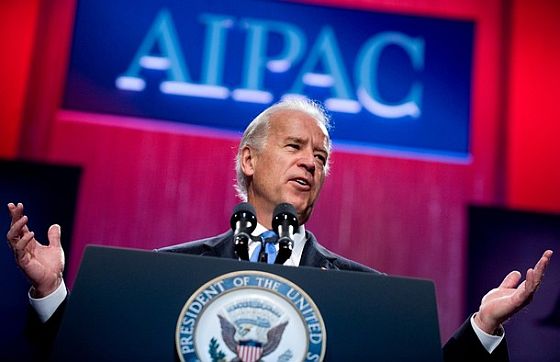
M.J. Rosenberg writes: It’s hard to watch the AIPAC conference for more than a few minutes at a time. For me, the worst part is the pandering (and lying) by Democratic politicians eager to raise money for their next campaign.

So far, Joe Biden has been the worst. He is heavily funded by the Adler family of Miami Beach (he even brought President Obama to their home for a fundraiser), one of the big AIPAC families. Here is Biden talking about how the head of the Adler klan and another AIPAC mogul gave him his “formal education” on the Middle East. (Not to mention all that money.)

And, of course, Biden (like John Kerry) knows better than his AIPAC speeches indicate. I have talked to him about Israel and Palestine. He can name the top Palestinian leaders in Fatah and Hamas and tell you the differences between their respective positions. He believes Israel needs to end the occupation and talk to Hamas. He would not dare say it publicly, although he has said it so often privately that it is amazing the media never reports it.

But Biden does what he thinks he has to because, for politicians like him (that is, pretty much all politicians), nothing is more important than keeping donors happy. Call him a hypocrite but he cries all the way to the bank.

The Republicans are different. Supporting the occupation and threatening war with Iran come naturally to them. They don’t need lobby money for their campaigns and they don’t get Jewish votes anyway. (This is not to say that they don’t like Sheldon Adelson’s money, just that as the pro-business party, they don’t need it). They support Netanyahu because they believe that the west needs to crush the Muslim world. They do not feign Islamophobia. It’s them. [Continue reading…]

Facebooktwittermail

Americans need guns to protect their guns

David Altheide writes: The future of guns in our society may be better understood if we knew more about what they mean to people and why people buy them.

Fear is a major factor for many firearm purchases. Recent trends in gun sales suggest that many citizens are becoming more fearful: Gallup poll data suggest that Americans are more fearful, at near-record high levels, about big government, compared to big business or big labor. This fear overlays the long-term public fear of crime and terrorism.

Reactions to mass killings, particularly the shooting of first-graders at Sandy Hook school in Newtown, Connecticut, sparked a national debate about gun control. But that, in turn, has heightened fear about government’s role in regulating assault weapons, especially popular semi-automatic models like the AK-47 and AR-15 that are bought and sold throughout both the US and the world.

Public reaction to the latest assault weapon massacre is disturbing in view of worldwide trends. Studies show that price increases for semi-automatic assault weapons reflect public moods and fears about social instability. According to author James Barr, in many countries, “The Kalashnikov index is effectively a futures market for violence.” More than 80m AK-47s circulate between countries in predictable patterns that are associated with social instability.

The cost of this weapon doubled and tripled in Iraq and Afghanistan just before the US invasions of those countries. Afghan arms merchants are selling the model favored by Osama bin Laden for $2,000, while Syrians are paying more than $2,100. Demand and prices fall only when citizens believe that things are settling down.

I’d be a bit wary about the idea of viewing the rise or fall of gun prices as a universally reliable index of social stability.

Each time there’s a new rush to buy assault weapons across America, it seems to happen for the same reason: buyers are afraid these weapons are going to get banned.

And even though fear of government is very much a part of American DNA, among those for whom this fear calls them to go out and buy more guns, I see little evidence that it serves as a driving force for broader political action — beyond perhaps attending an occasional Tea Party meeting or paying annual dues to the NRA.

In other words, as vexed as many Americans might be about the power of Big Government, so long as gun control doesn’t go further than a few cosmetic reforms like reducing permitted magazine sizes, then Americans who are afraid of having their guns taken away will remain quite content with the status quo. Indeed, sustaining the fear that gun ownership is under threat, ironically has the effect of legitimizing gun ownership.

The result is this utterly circular reality: that the freedom so many gun owners care more about protecting than any other freedom is the freedom to own a gun.

The government can assassinate U.S. citizens, monitor all electronic communications, use taxpayer money to bail out banks, fight wars without authorization of Congress, serve the interests of corporations above those of the electorate, and all of this will provoke little more than some idle grumbling.

Do anything else — just don’t take away our guns. Try and take away our guns and we’ll start another revolution!

I have my doubts. I don’t think there’s any prospect of an administration that would actually attempt to institute serious gun control — and even if it did, legislation would never get through Congress. But neither do I think in the unlikely event that such gun control was implemented would it provoke a revolution.

However fiercely independent Americans may once have been, that fierceness has given way to a more pervasive docility.

Facebooktwittermail

The way the U.S. is teaching the world to use drones

Paul J. Saunders considers the lessons that states around the world must currently be drawing from Washington’s approach to the use of drones.

Thus far, the principal lesson may well be that drones can be extremely effective in killing your opponents, wherever they are, without risking your own troops and without sending soldiers or law enforcement personnel across another country’s borders. It seems less likely that others will adopt U.S.-style legal standards and oversight procedures, or that they will always ask other governments before sending drones into their airspace.

Based on their actions, it is almost as if Obama administration officials believe that the United States and its allies will have a long-term monopoly on drones. How else can one explain their exuberant confidence in launching drone attacks? However, the administration’s dramatic expansion in drone strikes — and their apparent effectiveness — will only further shorten Washington’s reign as the drone capital of the world by increasing the incentives to others eager to develop, refine or buy the technology.

Have Obama administration officials given any thought to what the world might look like when armed drones are more widespread and when Americans or U.S. allies and partners could become targets? To an outsider, there is little evidence of this kind of thinking in the administration’s use of drones.

This is a serious problem. According to an unclassified July 2012 report by the Government Accountability Office, at least 76 countries already have acquired unmanned aerial vehicles, known as UAVs or drones; the report also states that “countries of concern” are attempting to acquire advanced UAVs from foreign suppliers as well as seeking illegal access to U.S. technology. And a 2012 special report by the United Kingdom’s Guardian newspaper indicated that China has 10 or more models, though not all are armed. Other sources identify additional varieties in China. At least 50 countries are trying to build 900 different types of drones, the GAO writes.

More generally, the administration’s expanding use of drones is a powerful endorsement of not only the technology, but of the practice of targeted killing as an instrument of foreign and security policy. Having provided this powerful impetus, the United States should not be surprised if others — with differing legal standards and more creative efforts at self-justification — seize upon it once they have the necessary capabilities. According to the GAO, this is already happening — in government-speak, “while only a limited number of countries have fielded lethal or weaponized UAVs, this threat is anticipated to grow.” From this perspective, it is ironic that a president so critical of his predecessor’s unilateralism would practice it himself—particularly in a manner that other governments will find much easier to emulate than the Bush administration’s larger-scale use of force.

Facebooktwittermail

Katharine Gun: Ten years on what happened to the woman who revealed dirty tricks on the UN Iraq war vote?

Martin Bright reports: Ten years ago, a young Mandarin specialist at GCHQ, the government’s surveillance centre in Cheltenham, did something extraordinary. Katharine Gun, a shy and studious 28-year-old who spent her days listening in to obscure Chinese intercepts, decided to tell the world about a secret plan by the US government to spy on the United Nations.

She had received an email in her inbox asking her and her colleagues to help in a vast intelligence “surge” designed to secure a UN resolution to send troops into Iraq. She was horrified and leaked the email to the Observer. As a result of the story the paper published 10 years ago this weekend, she was arrested, lost her job and faced trial under the Official Secrets Act.

The memo from Frank Koza, chief of staff at the “regional targets” section of the National Security Agency, GCHQ’s sister organisation in the US, remains shocking in its implications for British sovereignty. Koza was in effect issuing a direct order to the employees of a UK security agency to gather “the whole gamut of information that could give US policymakers an edge in obtaining results favourable to US goals or to head off surprises”. This included a particular focus on the “swing nations” on the security council, Angola, Cameroon, Chile, Bulgaria and Guinea, “as well as extra focus on Pakistan UN matters”.

The story went around the world and the leak electrified the international debate during the weeks of diplomatic deadlock. Most directly, it bolstered opposition to the US position from Chilean and Mexican diplomats weary of American “dirty tricks”. The same countries demanded immediate answers from the British government about its involvement in the spying. With the operation blown, the chances of George W Bush and Tony Blair getting the consensus for a direct UN mandate for war were now near zero.

For the Observer too, it was a story full of risks. The paper had taken the controversial decision to back intervention in Iraq. Yet here was a story that had the capacity to derail the war altogether. It remains entirely to the credit of Roger Alton, at the time the paper’s editor, that he stuck with the story, despite its potential implications.

Gun had hoped the leak would prick the conscience of the British public, large sections of which were already taking to the streets in opposition to the war. Surely, she thought, when people realised that the UK was being asked to collaborate in an operation to find out personal information that could be used to blackmail UN delegates, they would be outraged and the UK government would halt its slide into war. She failed.

A decade on, sitting in a cafe in Cheltenham, not far from GCHQ, I asked her if she still stood by what she had done. “Still no regrets,” she said. “But the more I think about what happened, the more angry and frustrated I get about the fact that nobody acted on intelligence. The more we find out that in fact the million-person march was a real cause of worry for Downing Street and for Blair personally, it makes you think we were so close and yet so far.” [Continue reading…]

Facebooktwittermail

We are fighting for all Palestinians

Samer Issawi is now on the 216th day of hunger strike.

Samer Issawi writes: My story is no different from that of many other Palestinian young people who were born and have lived their whole lives under Israeli occupation. At 17, I was arrested for the first time, and jailed for two years. I was arrested again in my early 20s, at the height of the second intifada in Ramallah, during an Israeli invasion of numerous cities in the West Bank – what Israel called Operation Defensive Shield. I was sentenced to 30 years in prison on charges relating to my resistance to the occupation.

I am not the first member of my family to be jailed on my people’s long march towards freedom. My grandfather, a founding member of the PLO, was sentenced to death by the British Mandate authorities, whose laws are used by Israel to this day to oppress my people; he escaped hours before he was due to be executed. My brother, Fadi, was killed in 1994, aged just 16, by Israeli forces during a demonstration in the West Bank following the Ibrahimi mosque massacre in Hebron. Medhat, another brother, has served 19 years in prison. My other brothers, Firas, Ra’afat and Shadi were each imprisoned for five to 11 years. My sister, Shireen, has been arrested numerous times and has served a year in prison. My brother’s home has been destroyed. My mother’s water and electricity have been cut off. My family, along with the people of my beloved city Jerusalem, are continuously harassed and attacked, but they continue to defend Palestinian rights and prisoners.

After almost 10 years in prison, I was released in the Egypt-sponsored deal between Israel and Hamas to release the Israeli soldier Gilad Shalit in exchange for Palestinian prisoners. However, on 7 July 2012, I was arrested again near Hizma, an area within the municipality of Jerusalem, on charges of violating the terms of my release (that I should not leave Jerusalem). Others who were released as part of that deal were also arrested, some with no declared reason. Accordingly, I began a hunger strike on 1 August to protest against my illegal imprisonment and Israel’s violation of the agreement.

My health has deteriorated greatly, but I will continue my hunger strike until victory or martyrdom. This is my last remaining stone to throw at the tyrants and jailers in the face of the racist occupation that humiliates our people. [Continue reading…]

Facebooktwittermail

Israel’s idea of ‘two states’ is based on expulsion of Arabs

Ben White writes: The slogan “two states for two peoples” has long been used by those who support the creation of a Palestinian state alongside Israel. Ironically, however, such a framework risks cementing Israeli apartheid and Jewish privilege, evoking the same sorts of arguments put forward by defenders of South Africa’s historical regime of systematic discrimination.

There are three problems with the “two states for two peoples” formulation. Firstly, the meaning of a Palestinian “state” has changed to the point that it is problematic to even use the term. Support for Palestinian statehood – at least rhetorically – has become the shared position of everyone from Tony Blair to Netanyahu, via Ariel Sharon. Some Israel advocacy groups (the slightly smarter ones) even campaign on this basis.

So what’s going on here, when someone like Netanyahu can boast to Congress how he has “publicly committed to a solution of two states for two peoples”? Well note the wording of the Israeli government’s position when Ehud Olmert was prime minister and Tzipi Livni was foreign minister.

“The government will strive to shape the permanent borders of the state of Israel as a Jewish state, with a Jewish majority.”

In other words, the question of borders is not so much about land, as it is about demographics. Another example is Yitzhak Rabin. When Shimon Peres lauded the legacy of the assassinated prime minister in November 2011, he claimed that “[Rabin’s] diplomatic path has been accepted and is now held by the majority, a solution of two states for two peoples”.

But what did Rabin mean by this? Shortly before he was killed in 1995, the then-PM told the Knesset that he envisaged a “Palestinian entity … which is less than a state”. Rabin’s “permanent solution” included Jerusalem as Israel’s “united capital” (including the illegal settlements such as Ma’ale Adumim), annexation of colony blocs, the “establishment of blocs of settlements in Judea and Samaria”, and a border “in the broadest meaning of that term” down the Jordan Valley. This is a road map to walled-in reservations, not statehood – and it’s remarkably similar to Netanyahu’s own vision. [Continue reading…]

Facebooktwittermail

Why online civility matters

Dominique Brossard and Dietram A. Scheufele write: In the beginning, the technology gods created the Internet and saw that it was good. Here, at last, was a public sphere with unlimited potential for reasoned debate and the thoughtful exchange of ideas, an enlightening conversational bridge across the many geographic, social, cultural, ideological and economic boundaries that ordinarily separate us in life, a way to pay bills without a stamp.

Then someone invented “reader comments” and paradise was lost.

The Web, it should be said, is still a marvelous place for public debate. But when it comes to reading and understanding news stories online — like this one, for example — the medium can have a surprisingly potent effect on the message. Comments from some readers, our research shows, can significantly distort what other readers think was reported in the first place.

But here, it’s not the content of the comments that matters. It’s the tone.

In a study published online last month in The Journal of Computer-Mediated Communication, we and three colleagues report on an experiment designed to measure what one might call “the nasty effect.”

We asked 1,183 participants to carefully read a news post on a fictitious blog, explaining the potential risks and benefits of a new technology product called nanosilver. These infinitesimal silver particles, tinier than 100-billionths of a meter in any dimension, have several potential benefits (like antibacterial properties) and risks (like water contamination), the online article reported.

Then we had participants read comments on the post, supposedly from other readers, and respond to questions regarding the content of the article itself.

Half of our sample was exposed to civil reader comments and the other half to rude ones — though the actual content, length and intensity of the comments, which varied from being supportive of the new technology to being wary of the risks, were consistent across both groups. The only difference was that the rude ones contained epithets or curse words, as in: “If you don’t see the benefits of using nanotechnology in these kinds of products, you’re an idiot” and “You’re stupid if you’re not thinking of the risks for the fish and other plants and animals in water tainted with silver.”

The results were both surprising and disturbing. Uncivil comments not only polarized readers, but they often changed a participant’s interpretation of the news story itself. [Continue reading…]

Facebooktwittermail

The Holocaust just got more shocking

The New York Times reports: Thirteen years ago, researchers at the United States Holocaust Memorial Museum began the grim task of documenting all the ghettos, slave labor sites, concentration camps and killing factories that the Nazis set up throughout Europe.

What they have found so far has shocked even scholars steeped in the history of the Holocaust.

The researchers have cataloged some 42,500 Nazi ghettos and camps throughout Europe, spanning German-controlled areas from France to Russia and Germany itself, during Hitler’s reign of brutality from 1933 to 1945.

The figure is so staggering that even fellow Holocaust scholars had to make sure they had heard it correctly when the lead researchers previewed their findings at an academic forum in late January at the German Historical Institute in Washington.

“The numbers are so much higher than what we originally thought,” Hartmut Berghoff, director of the institute, said in an interview after learning of the new data.

“We knew before how horrible life in the camps and ghettos was,” he said, “but the numbers are unbelievable.”

The documented camps include not only “killing centers” but also thousands of forced labor camps, where prisoners manufactured war supplies; prisoner-of-war camps; sites euphemistically named “care” centers, where pregnant women were forced to have abortions or their babies were killed after birth; and brothels, where women were coerced into having sex with German military personnel.

Auschwitz and a handful of other concentration camps have come to symbolize the Nazi killing machine in the public consciousness. Likewise, the Nazi system for imprisoning Jewish families in hometown ghettos has become associated with a single site — the Warsaw Ghetto, famous for the 1943 uprising. But these sites, infamous though they are, represent only a minuscule fraction of the entire German network, the new research makes painfully clear. [Continue reading…]

Facebooktwittermail

Zionism = Jewish rule = racism

Turkish Prime Minister Recep Tayyip Erdogan, in a speech on Wednesday at the UN’s Alliance of Civilizations forum said:

Unfortunately the modern world has not passed the test when it comes to Syria. In the last two years, we have seen close to 70,000 people lose their lives, and every single day we see innocent children, women, civilians, killed. And the fact that the world has not reacted to this situation seriously injures the sense of justice. In the same way, rising racism in Europe is a serious, problematic area, vis-à-vis the Alliance of Civilizations project.

In addition to indifference vis-à-vis the Muslim countries, we also see harsh, offending, insulting behavior towards Muslims who live in countries other than their own, and this continues to be an unconscionable act that has been ongoing around the world. We should be striving to better understand the beliefs of others but instead we see that people act based on prejudice and exclude others and despise them. And that is why it is necessary that we must consider — just like Zionism or anti-Semitism or fascism — Islamophobia as a crime against humanity.

Not surprisingly, the only part of that statement that has drawn attention is to equate Zionism with fascism. That’s a claim that never goes down well.

Max Fisher writes:

Does condemning Zionism make you anti-Semitic? Not in Erdogan’s mind, it seems. That’s not a question for me to parse, but it’s worth noting that a lot of people seem to perceive any condemnation of Zionism as a condemnation of, if not all Jews, then certainly the ones living in Israel.

Not a question to parse? Meaning, that’s not territory into which a humble blogger at the Washington Post wants to venture. But let’s be clear, this really isn’t such a perilous issue that it can’t be clarified with a few facts.

Firstly, it might come as news to Fisher and some others, but a significant proportion of Jewish Israelis are not Zionists. Neither of course are the 20% of Israel’s population who are not Jewish.

But what is Zionism? The neatest definition I’ve heard came from an American rabbi at J Street: Zionism means having a country where Jews are “in charge.” (The rabbi describing Zionism this way seemed to think it perfectly reasonable that many Jews would want to live in a country run by Jews.) Liberal Zionists like to characterize this as a form of self-determination — a desire for Jews not to be ruled over by non-Jews. But this skirts around the utterly obvious and inevitable consequence of Jewish rule: that it involves non-Jews be ruled over by Jews. In other words, it is the practice of Jewish supremacy.

Zionists never tire of warning about “demographic threats.” In the simplest terms, the demographic threat would become insurmountable if Jews became a minority in the territory controlled by the state of Israel. Still, the demographic threat looms large even before that point is reached.

What this concern with a demographic threat makes clear is that Zionism is untenable in a state where Jews and non-Jews are treated as equals.

Demography hinges on numbers. How large does the Jewish majority need to be to sustain a Jewish state, and how many of them need to be Zionists?

Does Zionism’s intrinsic refusal to treat human beings as equals, constitute a crime against humanity? I’m not sure because that’s a technical term with a legal application. What should be beyond debate is that Zionism is a form a racism.

Yet Zionism enjoys a unique status: anyone who criticizes it gets swiftly vilified by the Western political and media establishment and few people even have the courage to question its meaning.

Facebooktwittermail

Senators press resolution to green-light Israeli attack on Iran

Ali Gharib reports: A joint resolution set to be introduced by Sens. Lindsey Graham (SC) and Robert Menendez (NJ), a Republican and Democrat, respectively, declares U.S. support for an Israeli military strike against Iran’s nuclear program. The resolution, which expresses the sense of the Congress, will be supported by the thousands of delegates to the American Israeli Public Affairs Committee annual conference that will stream through the Capitol this weekend. With prominent liberal Democrats already signing on, AIPAC’s lobbying heft will likely propel a bill that, in Congressional sentiment at least, commits the U.S. to active support of a potential Israeli attack that experts think could have consequences as grave as further destabilization in the region, adverse global economic consequences, and even a hardening of Iranian resolve to get a weapon.

According to a copy obtained by Open Zion, the resolution, while affirming increasingly harsh sanctions, also “urges that, if the Government of Israel is compelled to take military action in self-defense, the United States Government should stand with Israel and provide diplomatic, military, and economic support to the Government of Israel in its defense of its territory, people, and existence.” Tempering some fears about the bill, the authors added that the resolution shouldn’t “be construed as an authorization for the use of force or a declaration of war” by the U.S. Though the caveat will surely placate some members of Congress, it seems potentially at odds with a pledge of “military… support” in the event of an attack — language that, though unlikely for now, if actuated into policy could suggest the U.S. would be dragged into a war based on an Israeli decision to strike.

“Initiating a war is the gravest step any nation can take,” said Columbia University professor Gary Sick, an Iran expert and former White House official. “This legislation would effectively entrust that decision to a regional state. Such a decision is an American sovereign responsibility. It cannot be outsourced.” [Continue reading…]

Facebooktwittermail

Will AIPAC get Israel aid exempted from sequestration?

M.J. Rosenberg writes: Douglas Bloomfield, who served as AIPAC’s chief lobbyist for more than a decade, reports this week that the lobby intends to insist that the United States not include Israel’s $3 billion grants package in the sequester that goes into effect today. Writing in the New York Jewish Week, Bloomfield says:

At a time when sequestration is about to take a big bite out of the Pentagon budget, the American Israel Public Affairs Committee (AIPAC) will be sending thousands of its citizen lobbyists to Capitol Hill next week to make sure Israel is exempted from any spending cuts. This could prove a very risky strategy at a time when millions of Americans will be feeling the bite of the sequestration debacle, from the defense budget to the school lunch program. But not aid to Israel, which will be untouched if AIPAC gets its way.

At one time I wouldn’t have believed AIPAC would dare try something this bold. That is because traditionally AIPAC has been very cautious about not seeming to take actions that suggested putting Israel’s interests over America’s. Demanding that Israel be exempt from cuts that virtually every American will feel seems so counterproductive as to almost be suicidal for the lobbying powerhouse. [Continue reading…]

Facebooktwittermail

How Israel lets Christian pseudo-archeologists pillage the West Bank

Dylan Bergeson reports: A line of rental cars crawled up the side of ribbed sandstone formations, mounded high like giant termite nests. In the distance, the city lights of modern Jericho twinkled on the northern horizon. In this haunted landscape where the West Bank meets the Jordan River, the Dead Sea Scrolls — the oldest-known biblical record — remained hidden for millennia.

The discovery of the scrolls 50 years ago galvanized a resurgent evangelical movement, many of whose members heralded the creation of Israel as evidence of the coming rapture. Since then, the Holy Land has attracted a long succession of academic zealots seeking to tether stories in the Bible to the archaeological record.

For Randall Price, a mid-50’s, sun-reddened pastor from Texas with a neat side part and a booming voice, archaeology is both a scientific and a devotional endeavor. “This was the area where great men of God were tested,” he said. “When you’re excavating there it puts you in touch, physically, with the reality of those events.” Price has spent the last ten years searching for remains of an ascetic Jewish priesthood whom he believes settled in the desert wilderness of Qumran to await the coming of the Messiah and the End of Days. These remains, he said, could provide unprecedented evidence of a biblical text.

At first blush, Price seems like an unlikely candidate to head excavations amid one of the bitterest land disputes in the modern world. Though he never actually received a degree in archaeology, he built a global network around his brand of Near East biblical scholarship with an apocalyptic bent. He has written extensively for the website RaptureReady.com, given lectures suggesting that Iran is fulfilling the role of Antichrist, and has openly called for the United States to declare war on Islam.

Price says his own work underwrites Israeli precedence in some Palestinian land. “Despite the fact that Qumran is probably on the map as the Palestinians’, the fact is we’re unearthing ancient Jewish heritage,” he said. “There’s nothing here that speaks to any other people.”

Price’s politics are unlikely to disrupt his access to the Qumran plateau, however. Located in the West Bank, permits to excavate around Qumran are not issued by the Palestinian Authority, but rather by Israel’s Civil Administration. It’s a bizarre arrangement, which critics say allows Israeli officials and religious pseudo-scientists to cooperate in raiding cultural treasures. [Continue reading…]

Facebooktwittermail

Woodward hysteria

Since Bob Woodward has managed to make himself the center of attention in Washington this week (yet again), I might as well say it — just in case anyone wondered: No, he’s no relation of mine.

Glenn Greenwald writes: Earlier this month, the Pentagon announced that it would deploy “only” one aircraft carrier in the Persian Gulf, rather than the customary two. This move, said the Pentagon, was in preparation for the so-called “sequestration”, scheduled to take effect this week, that mandates spending cuts for all agencies, including the Pentagon. This aircraft carrier announcement was all part of the White House’s campaign to scare the public into believing that sequestration, which Democrats blame on Republicans, will result in serious harm to national security. Shortly before this cut was announced, then-defense Secretary Leon Panetta said:

“With another trigger for sequestration approaching on March 1st, the Department of Defense is facing the most serious readiness crisis in over a decade . . . . Make no mistake, if these cuts happen there will be a serious disruption in defense programs and a sharp decline in military readiness.”

That the Obama administration might actually honor the budget cuts mandated by a law enacted by Congress and signed by Obama infuriates Bob Woodward, Washington’s most celebrated journalist. He appeared this week on the “Morning Joe” program to excoriate Obama for withholding a second aircraft carrier in the Gulf, saying:

“Can you imagine Ronald Reagan sitting there and saying ‘Oh, by the way, I can’t do this because of some budget document?’ Or George W Bush saying, ‘You know, I’m not going to invade Iraq because I can’t get the aircraft carriers I need’ or even Bill Clinton saying, ‘You know, I’m not going to attack Saddam Hussein’s intelligence headquarters,’ as he did when Clinton was president, because of some budget document.

“Under the Constitution, the president is commander-in-chief and employs the force. And so we now have the president going out because of this piece of paper and this agreement, I can’t do what I need to do to protect the country. That’s a kind of madness that I haven’t seen in a long time.”

As Brian Beutler points out: “the obscure type of budget document Woodward’s referring to is called a duly enacted law — passed by Congress, signed by the President — and the only ways around it are for Congress to change it. . . . or for Obama to break it.” But that’s exactly what Woodward is demanding: that Obama trumpet his status as Commander-in-Chief in order to simply ignore – i.e. break – the law, just like those wonderful men before him would have done. Woodward derides the law as some petty, trivial annoyance (“this piece of paper”) and thus mocks Obama’s weakness for the crime of suggesting that the law is something he actually has to obey.

How ironic that this comes from the reporter endlessly heralded for having brought down Richard Nixon’s presidency on the ground that Nixon believed himself above the law. Nixon’s hallmark proclamation – “When the President does it, that means it is not illegal” – is also apparently Bob Woodward’s. [Continue reading…]

Facebooktwittermail

British nationals stripped of citizenship then killed by U.S. drones

The Bureau of Investigative Journalism: The [British] government has secretly ramped up a controversial programme that strips people of their British citizenship on national security grounds – two of whom have been subsequently killed by US drone attacks.

An investigation by the Bureau of Investigative Journalism and published in The Independent has established that since 2010 the Home Secretary Theresa May has revoked the passports of 16 individuals many of whom are alleged to have had links to militant or terrorist groups.

Critics of the programme warn that it also allows ministers to ‘wash their hands’ of British nationals suspected of terrorism who could be subject to torture and illegal detention abroad.

They add that it also allows those stripped of their citizenship to be killed or ‘rendered’ without any onus on the British government to intervene.

At least five of those deprived of their UK nationality by the Coalition government were born in Britain, and one man had lived in the country for almost 50 years.

Those affected have their passports cancelled, and lose their right to enter the UK – making it very difficult to appeal the Home Secretary’s decision.

Last night the Liberal Democrat’s deputy leader Simon Hughes said he was writing to the Home Secretary to call for an urgent review into how the law was being implemented.

The leading human rights lawyer Gareth Peirce said the present situation ‘smacked of medieval exile, just as cruel and just as arbitrary’.

Ian Macdonald QC, president of the Immigration Law Practitioners’ Association, described the citizenship orders as ‘sinister’.

‘They’re using executive powers and I think they’re using them quite wrongly,’ he said.

‘It’s not open government, it’s closed, and it needs to be exposed because in my view it’s a real overriding of open government and the rule of law.’ [Continue reading…]

Facebooktwittermail

How private prisons game the immigration system

Lee Fang reports: Thirty years ago in January, Corrections Corporation of America (CCA), now the biggest operator of private prisons in the world, opened its first prison, a federal immigrant detention center in Houston, Texas. Three Decades of Service to America, a page on the company’s website, features a video interview with the company’s founders looking back on that first contract. “We saw this big ol’ sign, ‘Olympic Motel,’ made an offer to lease the motel for four months,” recalls Don Hutto, who chuckles with fellow co-founder Tom Beasley, the former chairman of the Tennessee Republican Party, as they remember hastily converting the building and staffing it with family members. The night of Super Bowl Sunday, “we got our first day’s pay for eighty-seven undocumented aliens,” says Hutto, who even fingerprinted the inmates himself.

Three years after the company’s first contract in 1983, according to Southern Changes magazine, the company spent some $100,000 lobbying the state of Tennessee to secure a correctional facility privatization bill, which helped propel the business to financial success. Last year, the company brought in $1.7 billion in revenues, about a quarter of which came from contracts with the Immigration and Customs Enforcement (ICE) and federal Bureau of Prisons to incarcerate non-citizens in the United States.

For a company that began and later thrived by imprisoning immigrants, the federal immigration policy overhaul expected this year presents both opportunities and challenges.

On the one hand, a pathway to citizenship and legal reforms sought by advocates could reduce the number of immigrants detained by CCA and its competitors in the private prison industry. “Private prison corporations have an enormous stake in immigration reform,” says Bob Libal, a prison reform advocate with Grassroots Leadership. “A reform that provides a timely pathway to citizenship without further criminalizing migration would be a huge hit to the industry,” he says.

On the other hand, Libal observed that a bill with increased security measures “could be very profitable” for the industry. Legislators and the Obama administration could adopt a plan that mirrors Republican proposals for an “enforcement first” approach, which include increased police powers, new mandatory detention and sentencing laws, further militarization of the border and proposals for more prisons and detention officers. [Continue reading…]

Facebooktwittermail

Hypocrisy redefined for the age of global warming

Fracking Mother © Northern Light . Douglas Yates Photography

'Fracking Mother' © Northern Light . Douglas Yates Photography

Bill McKibben writes: The list of reasons for not acting on climate change is long and ever-shifting. First it was “there’s no problem”; then it was “the problem’s so large there’s no hope.” There’s “China burns stuff too,” and “it would hurt the economy,” and, of course, “it would hurt the economy.” The excuses are getting tired, though. Post Sandy (which hurt the economy to the tune of $100 billion) and the drought ($150 billion), 74 percent of Americans have decided they’re very concerned about climate change and want something to happen.

But still, there’s one reason that never goes away, one evergreen excuse not to act: “you’re a hypocrite.” I’ve heard it ten thousand times myself—how can you complain about climate change and drive a car/have a house/turn on a light/raise a child? This past fall, as I headed across the country on a bus tour to push for divestment from fossil fuels, local newspapers covered each stop. I could predict, with great confidence, what the first online comment from a reader following each account would be: “Do these morons not know that their bus takes gasoline?” In fact, our bus took biodiesel—as we headed down the East Coast, one job was watching the web app that showed the nearest station pumping the good stuff. But it didn’t matter, because the next comment would be: “Don’t these morons know that the plastic fittings on their bus, and the tires, and the seats are all made from fossil fuels?”

Actually, I do know—even a moron like me. I’m fully aware that we’re embedded in the world that fossil fuel has made, that from the moment I wake up, almost every action I take somehow burns coal and gas and oil. I’ve done my best, at my house, to curtail it: we’ve got solar electricity, and solar hot water, and my new car runs on electricity—I can plug it into the roof and thus into the sun. But I try not to confuse myself into thinking that’s helping all that much: it took energy to make the car, and to make everything else that streams into my life. I’m still using far more than any responsible share of the world’s vital stuff.

And, in a sense, that’s the point. If those of us who are trying really hard are still fully enmeshed in the fossil fuel system, it makes it even clearer that what needs to change are not individuals but precisely that system. We simply can’t move fast enough, one by one, to make any real difference in how the atmosphere comes out. [Continue reading…]

Facebooktwittermail