Category Archives: Issues

Palestine says Israel ‘torture’ killed inmate

Al Jazeera reports: The Palestinian government is alleging that a Palestinian man who died in Israeli custody was tortured to death, dismissing claims that his death was due to a heart attack.

Arafat Jaradat’s autopsy showed torture resulting from fractures in his body and skull while his heart was in good condition, said Issa Qaraqaa, the minister in charge of prisoner affairs, citing a Palestinian doctor who took part in the autopsy.

“These results prove Israel killed him,” Qaraqaa told a news conference on Sunday.

Jaradat died on Saturday in an Israeli jail from what prison authorities initially said appeared to have been a cardiac arrest.

The 30-year-old man from Sair near Hebron in the occupied West Bank was arrested last Monday for alleged involvement in a November 2012 stone-throwing incident that injured an Israeli, according to Israel’s Shin Bet domestic intelligence service.

The death of Jaradat set off more clashes between Israeli troops and Palestinian stone-throwers in several areas of the West Bank on Sunday.

Facebooktwittermail

Israeli licence to Cheney-linked energy firm on Golan Heights raises eyebrows

IPS reports: In a potential new source of contention between President Barack Obama and Israeli Prime Minister Benjamin Netanyahu, Israel has reportedly granted a U.S. energy firm with heavyweight political connections to explore for oil and gas in the occupied Golan Heights.

The company is a local subsidiary of New Jersey-based Genie Energy Ltd. The Strategic Advisory Board of another subsidiary, Genie Oil and Gas, includes former Vice President Dick Cheney, media magnate Rupert Murdoch, and former Republican Rep. Jim Courter.

It also includes several prominent investment managers, such as Jacob Rothschild, chairman of the J. Rothschild group, and Michael Steinhardt, a major contributor to Jewish and Zionist causes, notably Birthright Israel, a multi-million-dollar programme to bring young Diaspora Jews to Israel.

The granting of the licence by Israel’s Ministry of Energy and Water Resources, which was initially reported by Dow Jones Thursday, comes amidst continuing civil war in Syria, which has demanded the return of the Heights since Israel took them in the 1967 Arab-Israeli War.

It also comes a month before Obama is scheduled to make his first visit to Israel as president.

Some analysts here compared the move to previous announcements by the Netanyahu government of new settlement construction on the West Bank or East Jerusalem — either on the eve of or during meetings with top U.S. officials – that have clearly contributed to thinly veiled tensions that exist between the two leaders.
[Continue reading…]

Facebooktwittermail

Why America reserves the right to start a nuclear war

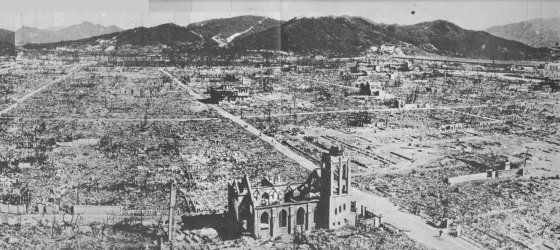
Hiroshima, August, 1945

John Arquilla writes: In 1945, Harry Truman ordered the first atomic bombing of another country; today, Barack Obama reserves the right to mount the world’s next nuclear strike — as have all American presidents since Truman. It is very odd that senior U.S. foreign policy officials, who have devoted most of the past seven decades to trying to control the spread of nuclear weapons, still want Washington to be able to use them first in a pinch. Even President Obama, a supporter of the abolition of all nuclear weapons, wants to be able to fire the first nuclear shot. No wonder North Korea, Iran, and others view efforts to get them to renounce their proliferation programs with much skepticism.

To be sure, the American ardor for atomic weapons has cooled since the famous Fortune magazine survey of December 1945, in which 22 percent of the public expressed the view that far more than “just” two nukes should have been dropped on Japan. Yet even as enthusiasm for inflicting massive destruction on others waned, there was still considerable fascination with these weapons in government and the military. Indeed, the idea of waging preventive nuclear war on Soviet Russia or communist China — that is, hitting them before they had nukes of their own — was closely considered for years, finally being rejected by Dwight Eisenhower in 1954.

This was the same year, however, that he articulated a doctrine of “massive retaliation” for any sort of act of aggression. Thus an incursion by some aggressor’s conventional forces was now theoretically subject to a nuclear riposte. The idea was that this threat would keep the peace around the world. It didn’t. Instead, a spate of irregular wars and acts of terrorism arose and, as Thomas Schelling put it in his classic Arms and Influence, the massive retaliation policy “was in decline almost from its enunciation.” [Continue reading…]

Facebooktwittermail

No, North Korea did not just test an Iranian nuke

Jeffrey Lewis writes: When I last traveled to Seoul, I took in a ballgame. (I am now a fierce partisan of the Doosan Bears.) I headed to the ballpark, anticipating the perfect marriage of Korean and American culture: kimchi dogs!

As it turns out, South Koreans eat fried chicken at baseball games. Who knew? For reasons I cannot fathom, it has never occurred to anyone to smother a hot dog in spicy kimchi, despite the fact that this is fusion cuisine’s answer to peanut butter and jelly. The moral of this little tale is that just because two things ought to go great together, the real world sometimes disappoints.

Which brings us to nuclear cooperation between North Korea and Iran. There have been any number of stories in recent days detailing the allegedly close and continuing cooperation between nuclear weaponeers in both countries. A casual reader perusing the Sunday Times, Jerusalem Post, Kyodo News, and Chosun Ilbo might very well conclude that North Korea’s nuclear test was as good as an Iranian one. “Why Iran already has the bomb,” was the provocative title of an article in Tablet.

But, like kimchi dogs, it’s an obvious idea that doesn’t seem to have a basis in fact.

Many of the people pushing the “Iranian test” hypothesis are simply trying to hijack a Northeast Asian crisis for their own preferred policy in the Middle East, which usually involves bombing the crap out of Iran. Others are probably just fascinated by the idea of an international rogues gallery of scientists holed up in a fortress of doom, testing nuclear weapons. (Imagine Mohsen Fakhrizadeh asking Dr. No how he lost his hands, with Ri Je-son rolling his eyes at having to hear that story one more time.)

Few of these authors, however, seem to have thought very carefully about either the status of Iran’s nuclear program or the purpose of testing nuclear weapons in general. A careful consideration of both, however, helps illustrate why the reality is probably a lot less exciting than the headlines. [Continue reading…]

Facebooktwittermail

The British Empire was built on a mountain of skulls

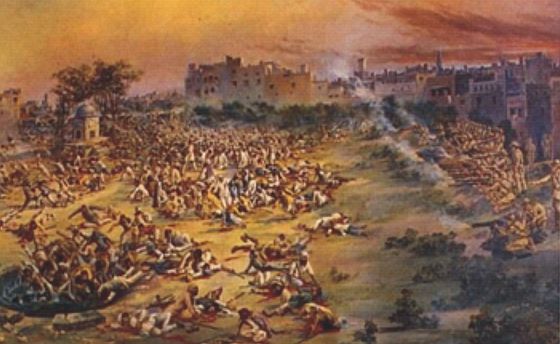
William Dalrymple writes: On 13 April 1919 a large group of Punjabis protesting against British rule gathered in the Jallianwala Bagh in Amritsar. They were incensed at the arrest of two of their leaders, and for 24 hours the city had been consumed by riots. At five in the afternoon, General Reginald Dyer marched into Jallianwala Bagh with 140 troops, most of them Gurkhas, but with a few Sikhs and Baluchis as well. Having blocked the exits, they fired into the peaceful and unresisting crowds until they had exhausted all their ammunition. Official estimates put the casualties at 379 killed and 1,200 injured. Popular estimates put the casualties as much as 10 times higher.

The massacre was a major turning point for the Indian freedom struggle and, along with Gandhi’s Salt March 11 years later in 1930, was one of the two forces that gave India’s march towards independence its unstoppable momentum. For a generation of Anglophile Indians brought up on British propaganda that British rule was just and uncorrupt, and that it had replaced centuries of arbitrary tyranny at the hands of brutal Muslim invaders, Jallianwala Bagh was a moment of revelation. Rabindranath Tagore immediately gave back his knighthood. The Nehrus were radicalised overnight. Gandhi lost his faith – intact until that point – in British justice, and wrote that he had “underrated the forces of evil” in the British empire.

But Jallianwala Bagh was by no means the worst atrocity committed by the British in India. Following the British conquest of Bengal in 1757, the province was left devastated by war and high taxation, then stricken by famine. According to Edmund Burke, the women of Bengal suffered mass rape at the hands of East India Company tax collectors. Certainly the wealth of Bengal rapidly drained into British bank accounts, while its prosperous weavers and artisans were coerced “like so many slaves” by their new British masters, and the markets flooded with British products.

More horrific still were the actions of the British army sent into Afghanistan in 1842 to take revenge for the massacre of troops during the retreat from Kabul earlier in the year. All the villages in its path were looted and torched and the women were raped. When the army got to Kabul the city was deliberately consigned to the flames. [Continue reading…]

Facebooktwittermail

Hollywood can no longer shield itself from the Occupation

Lisa Goldman writes: For years, Paul Newman and his blue eyes shaped America’s perception of Israel.

Newman starred in Exodus, a 1960 Hollywood blockbuster set in 1947, the final year of the British mandate in Palestine. The film depicts Ari Ben Canaan, played by Newman, as an idealized sabra hero-warrior — tough, brave, handsome, taciturn, and a lady-killer. Ben Canaan, a leader in the Haganah, the preeminent Jewish paramilitary organization of the time, fought with the British during World War II; but now he is fighting against their policy of limiting the immigration of Jewish refugees from the scorched remains of Hitler’s Europe. The film takes its name from the SS Exodus, a leaky boat packed with Holocaust survivors that the British ultimately sent back to Europe. It goes on to recount the story of the establishment of the State of Israel in a mythical narrative, entirely from the Zionist point of view.

A few years later, Kirk Douglas starred in Cast a Giant Shadow, a fictionalized account of Col. David “Mickey” Marcus, an assimilated Jewish-American who fought with the U.S. Army in Europe during World War Two, where he saw Dachau. Recruited by Haganah representatives in New York, Marcus agrees to train and command units of the nascent Israel Defense Forces during the 1948 War of Independence. Naturally, the blond, assimilated American Jew falls in love with an olive-skinned, raven-haired female Israeli warrior who knows how to handle a weapon. The film’s a classic, so I don’t suppose I’ll be guilty of spoiling the end by revealing that Marcus is killed. But of course he lives on as a legend, etc.

Hollywood churned out one more film about heroic Israelis. Raid on Entebbe, released in 1977, stars Charles Bronson as the commander of an elite military unit tasked with rescuing Jewish and Israeli passengers on an Air France flight hijacked by terrorists. The film may have continued the tradition of the heroic sabra warrior, but stylistically it was a mediocre made-for-television production with a clunky script and wooden acting.

Since then, however, the image of the heroic Israeli valiantly fighting for survival has faded from the silver screen. Hollywood movies about Jews have focused on the Holocaust. Meanwhile, Israel’s domestic films — the stories that Israelis tell about themselves — have long been much more self-critical. [Continue reading…]

Facebooktwittermail

Israel is an apartheid state, says former Israeli ambassador to South Africa

The Times of Israel reports: As long as there is no Palestinian state and Israel rules over the West Bank, Israel is a de facto apartheid state, a former top Foreign Ministry official said Wednesday, using a highly contentious term usually employed only by radical anti-Israel activists.

Alon Liel, a former Foreign Ministry director-general and ex-ambassador to South Africa, also called on President Barack Obama to stay home if he didn’t intend to warn Israelis about the dangers of an approaching “apartheid cliff.”

“In the situation that exists today, until a Palestinian state is created, we are actually one state. This joint state — in the hope that the status quo is temporary — is an apartheid state,” Liel said at a Jerusalem conference about whether Israel is or could become an apartheid state.

“As someone who knows the original apartheid well, and also knows the State of Israel quite well – I was born here, grew up here, served and fought for it for 30 years — someone like me knows that Zionism isn’t apartheid and the State of Israel that I grew up in wasn’t an apartheid state,” Liel emphasized.

“I’m here today because I came to the conclusion that the occupation of the West Bank as it exists today is a sort of Israeli apartheid,” said Liel. “The occupation became a hump on the back of Zionism; it has now become the hump of the State of Israel.”

There is a real danger of Israel’s occupation of the West Bank becoming an integral part of the state, he said. “When that happens, when the West Bank and [Israel in the pre-1967 lines] become one, and the Palestinian residents of the West Bank will not have citizenship — we’re apartheid,” he said.

Facebooktwittermail

Documents reveal how U.S. let Israel off the hook over ‘execution’ of American Furkan Dogan

Alex Kane reports: In May 2010, 18-year-old American citizen Furkan Dogan was shot at point-blank range by Israeli naval commandos as he was standing on the deck of a ship and filming the violent raid on the flotilla to Gaza. It took three days for the U.S. to contact his family–and that was after the U.S. made repeated inquiries to the government of Israel for information about his death.

That information was recently revealed by the Center for Constitutional Rights after obtaining documents that have now been published as a result of Freedom of Information Act requests to the U.S. government. The documents reveal new details on the U.S. government’s actions in the aftermath of the flotilla.

In the immediate aftermath of the flotilla raid, Ahmet Dogan, the father of Furkan, desperately called U.S. officials to inquire about the whereabouts of his son, who was a passenger on the flotilla trying to break the blockade of Gaza. Ahmet did not know where his son was, but was extremely worried after he saw news reports stating that the Israeli military had violently raided the ship in international waters and killed 9 passengers in the early morning hours of May 31, 2010. On June 3, 2010, Ahmet Dogan identified his son’s body as being amongst the dead after he saw his son’s body riddled with bullets in Turkey.

That same day, e-mail messages between U.S. officials in Istanbul and Washington concerning the death of Furkan Dogan were being sent back and forth. [Continue reading…]

Facebooktwittermail

The riddle of the Israel lobby

Uri Avnery writes: One of the most interesting and prolonged private debates I have had in my life was with the brilliant Dr. Nahum Goldmann. The subject: American peace initiatives.

It was an unequal debate, of course. Goldmann was my elder by 28 years. While I was a mere editor of an Israeli news magazine, he was an international figure, President of the World Zionist Organization and the World Jewish Congress.

In the mid ’50s, when I was looking for a personality who could possibly contest David Ben-Gurion’s stranglehold on the prime minister’s office, I thought of Goldmann. He had the necessary stature and was liked by moderate Zionists. No less important, he had a clear set of opinions. From the first day of the State of Israel, he had proposed that Israel become a “Middle Eastern Switzerland”, neutral between the US and the Soviet Union. For him, peace with the Arabs was absolutely essential for the future of Israel.

I visited him in a luxury suite in Jerusalem’s classy Kind David hotel. He was wearing a silken dressing gown, and when I made my offer, he responded: “Look, Uri, I like the good life. Luxury hotels, good food and beautiful women. If I challenged Ben-Gurion, all these would disappear. His people would vilify me as they do you. Why would I risk all that?”

We also started a discussion that ended only with his death, some 27 years later. He was convinced that the US wanted peace between us and the Arabs, and that a major American peace effort was just around the corner. This was not simply an abstract hope. He assured me that he had just met with the highest policy-makers and had it from the highest authority. Straight from the American horse’s mouth, so to say.

Goldman was also an inveterate name-dropper. He regularly met with most major American, Soviet and other political personalities, and never failed to mention this in his conversation. So, being assured by the incumbent US presidents, ministers and ambassadors that the US was just about to impose peace on Israelis and Arabs, he told me just you wait. You’ll see.

This belief in an American Imposed Peace has haunted the Israeli peace movement for decades. In advance of the coming visit of President Obama to Israel next month, it is raising its weary head once more. [Continue reading…]

Facebooktwittermail

Who said it: Sen. Hagel or the Shin Bet?

Foreign Policy: As he’s been considered for secretary of defense, one of the most persistent criticisms leveled at Chuck Hagel has been that he has been too critical of Israel. His critiques of Israel pale in comparison to those made by Avraham Shalom, Yaakov Peri, Carmi Gillon, and Avi Dichter, former heads of the Israeli intelligence service Shin Bet, interviewed in the new documentary The Gatekeepers. Both Hagel and the former directors of the Shin Bet have voiced some tough love on the subject of Israel’s relationship with the Palestinians and broader Arab world. We’ve picked some quotes from each. Can you guess who said it, Chuck Hagel or a former head of the Shin Bet?

1. “I know about plenty of junctures since 1967 when in my view…we should have reached an agreement and ran away from [Palestine].” [Answer — continue reading…]

Facebooktwittermail

I don’t not talk to anyone

Rachel Shabi writes: On Wednesday, George Galloway walked out of a meeting because it turned out he was going to be debating an Israeli. “I was misinformed” he said. “I don’t debate with Israelis. I don’t recognise Israel.” Later, he clarified the tactic on Twitter: “Israel: simple, No recognition No normalisation. Just Boycott, divestment, sanctions.”

Galloway is not alone in holding such sentiments – but as a tactic in support of Palestinians, it’s a dead end. Primarily, that’s because the Boycott, Divestment and Sanctions (BDS) movement doesn’t call for the avoidance of people purely on the basis of nationality. Thanks to Galloway, its national committee has just issued a statement, to clear up this particular fallacy.

Whatever your views on BDS – and there are many – Galloway’s move is plainly an own goal (assuming his goal is to support Palestinians, rather than generate publicity for himself). One reason that many left-leaning Jews don’t join the BDS movement is precisely because the boycott is perceived to be about rage against people, rather than an effective political tool. What’s the best way to cement that belief? Announce you’re avoiding Israelis as part of your commitment to BDS. Cue a flood of “told you sos” from those who say its all about punishing Israelis just for being who they are. [Continue reading…]

There’s a big difference between concluding that talking is fruitless, and refusing to talk.

Refusing to talk, prejudges the outcome and it attaches more significance to the act of communication than its content.

What talking can do is open a door into a creative space. It opens the possibility of arriving somewhere new.

Talking engages the plasticity of the human mind.

Rigid minds are always in conflict with the world because the world is always changing. So, even if we find ourselves up against the rigidity of others, it at least serves our own interests to keep our own minds flexible and explore the malleability of our own thought.

Facebooktwittermail

The Washington Post’s dubious story on Iran ‘centrifuge’ magnets

Yousaf Butt at Bulletin of the Atomic Scientists writes: Last week, the Washington Post reported that “purchase orders obtained by nuclear researchers show an attempt by Iranian agents to buy 100,000 … ring-shaped magnets” and that such “highly specialized magnets used in centrifuge machines … [are] a sign that the country may be planning a major expansion of its nuclear program.” As evidence, the Post’s Joby Warrick cited a report authored by David Albright of the Institute for Science and International Security (ISIS); dated Feb. 13, the report says that an Iranian firm, Jahan Tech Rooyan Pars Co., made an inquiry “posted on a Chinese commercial website … to buy 100,000 ring magnets.” As Warrick goes on to explain: “it is unclear whether the attempt succeeded.”

There are serious deficiencies in both the Washington Post story and the assertions in the ISIS report. Given that issues of war and peace may hang on the veracity of such claims, the assertions warrant careful scrutiny.

The magnets in question have many uses besides centrifuges and are not only, as Warrick describes them, “highly specialized magnets used in centrifuge machines.” Such ceramic ring magnets are everyday items and have been used in loudspeakers, for example, for more than half a century. The ISIS report neglects to explain the many other applications for such ceramic ring magnets and jumps to the conclusion that the inquiry is surely related to Iran’s nuclear program. Why ISIS does not offer alternate and more plausible applications of these unspecialized magnets is a puzzle. Such magnets are used in a variety of electronic equipment. For instance, one vendor outlines some of the various possible uses in speakers, direct current brushless motors, and magnetic resonance imaging equipment.

This is not the first time ring magnets have surfaced in allegations related to centrifuge applications. Almost exactly a decade ago, as the United States was preparing to invade Iraq, then-director of the International Atomic Energy Agency Mohamed ElBaradei said that reports regarding similar ring magnets in Iraq were unrelated to centrifuges: [Continue reading…]

Facebooktwittermail

Bob Dole urges Hagel confirmation as defense secretary

Yahoo News: Add Bob Dole—former senator, former presidential candidate, grievously wounded in World War II—to the list of Republican heavy-hitters urging the Senate to confirm the embattled Chuck Hagel as defense secretary.

“Hagel’s wisdom and courage make him uniquely qualified to be Secretary of Defense and lead the men and women of our armed forces,” Dole said in a statement released by the White House. “Chuck Hagel will be an exceptional leader at an important time.”

Hagel, a decorated Vietnam War veteran and Republican former senator from Nebraska, already had the support of five former secretaries of defense from Republican and Democratic administrations—Bob Gates, Bill Cohen, William Perry, Harold Brown and Melvin Laird. He also enjoyed the support of former Senate Armed Services Committee chairmen Sam Nunn (D-Georgia) and John Warner (R- Virginia).

While it’s not clear what pull Dole retains with his former colleagues, Democrats already appear to have lined up the 60 votes needed to break through another Republican filibuster and definitely have the 51 needed to confirm Hagel as Leon Panetta’s successor. Republican Sen. Richard Shelby announced earlier Thursday that he would support Hagel.

Facebooktwittermail

Israel heading toward apartheid, say many Israelis

The Washington Post‘s Jennifer Ruben quotes the Free Beacon, which quotes an email which says that in a speech delivered at Rutgers University in 2010, Chuck Hagel “basically said that Israel … was risking becoming an apartheid state if it didn’t allow the Palestinians to form a state.”

“Does this fundamentally shift the playing field?” asks Ruben.

No. It just means Hagel was echoing several former Israeli prime ministers and many other Israelis.

“If the day comes when the two-state solution collapses, and we face a South African-style struggle for equal voting rights (also for the Palestinians in the territories), then, as soon as that happens, the State of Israel is finished.” Israel’s Prime Minister Ehud Olmert speaking to Haaretz, November, 2007.

“The simple truth is, if there is one state” including Israel, the West Bank and Gaza, “it will have to be either binational or undemocratic. … if this bloc of millions of Palestinians cannot vote, that will be an apartheid state.” Defense Minister and former Prime Minister Ehud Barak, April, 2010.

“Jewish self-righteousness is taken for granted among ourselves to such an extent that we fail to see what’s right in front of our eyes. It’s simply inconceivable that the ultimate victims, the Jews, can carry out evil deeds. Nevertheless, the state of Israel practises its own, quite violent, form of Apartheid with the native Palestinian population.” Shulamit Aloni, Minister for Education under Yitzhak Rabin, January, 2007.

“[In 1967] We enthusiastically chose to become a colonial society, ignoring international treaties, expropriating lands, transferring settlers from Israel to the occupied territories, engaging in theft and finding justification for all these activities. Passionately desiring to keep the occupied territories, we developed two judicial systems: one – progressive, liberal – in Israel; and the other – cruel, injurious – in the occupied territories. In effect, we established an apartheid regime in the occupied territories immediately following their capture. That oppressive regime exists to this day.” Michael Ben-Yair, Israel’s attorney general from 1993-96, March, 2002.

“Israel must decide quickly what sort of environment it wants to live in because the current model, which has some apartheid characteristics, is not compatible with Jewish principles.” Ami Ayalon, former Israeli admiral and former Labour member of Israeli Knesset, December, 2000.

“These dots are growing evidence of the lack of the spirit of freedom and the emergence of apartheid and fascism. If you look at each dot separately you might miss the bigger picture. Like a child watching a military brigade march, and after seeing the battalions, the batteries and the companies, asking: ‘And when is the brigade finally coming?’ the answer is that while he watched the marching of the battalions, batteries and companies, he was actually watching the brigade. So is the situation in Israel. You do not have to ask where the apartheid is. These events, which are accepted with silence and indifference, together create a picture of a terrible reality.” Yediot’s legal affairs editor, Judge (ret.) Boaz Okon, June, 2010.

“The historical background of the Israeli apartheid state-in-the-making that is emerging before our eyes should be sought in 1967. It is part of a process that has been going on for about 44 years: What started as rule over another people has gradually ripened – especially since the latter part of the 1970s – into a colonialism that is nurturing a regime of oppression and discrimination with regard to the Palestinian population. It is robbing that population of its land and of its basic civil rights, and is encouraging a minority group (the settlers ) to develop a crude, violent attitude toward the Arabs in the territories. This was exactly the reality that, after many years, led to the establishment of the apartheid state in South Africa.” Prof. Daniel Blatman, Holocaust researcher and head of the Institute for Contemporary Jewry, Hebrew University of Jerusalem, April, 2011.

“As it is today, it is an Apartheid state, a full apartheid in the occupied territories and a growing apartheid in Israel – and if this goes on, it will be full apartheid throughout the country, incontestably.” Uri Avnery, Israeli peace activist, November, 2012.

“The spokesmen of the dovish camp [in Israel] tell us horror stories about a future binational state. But the binational state is already here. It has a rigid apartheid legal system, as the High Court of Justice fades away.

“The system preserving this apartheid is more ruthless than that seen in South Africa, where the black were a labor force and could therefore also make a living. It is equipped with the lie of being ‘temporary’.” Yitzhak Laor, November 2009.

“Israel’s apartheid movement is coming out of the woodwork and is taking on a formal, legal shape. It is moving from voluntary apartheid, which hides its ugliness through justifications of ‘cultural differences’ and ‘historic neglect’ which only requires a little funding and a couple of more sewage pipes to make everything right – to a purposeful, open, obligatory apartheid, which no longer requires any justification.” Zvi Bar’el, October, 2010.

Facebooktwittermail

The multi-billion dollar drone market

National Geographic: The U.S. has deployed more than 11,000 military drones, up from fewer than 200 in 2002. They carry out a wide variety of missions while saving money and American lives. Within a generation they could replace most manned military aircraft, says John Pike, a defense expert at the think tank GlobalSecurity.org. Pike suspects that the F-35 Lightning II, now under development by Lockheed Martin, might be “the last fighter with an ejector seat, and might get converted into a drone itself.”

At least 50 other countries have drones, and some, notably China, Israel, and Iran, have their own manufacturers. Aviation firms — as well as university and government researchers — are designing a flock of next-generation aircraft, ranging in size from robotic moths and hummingbirds to Boeing’s Phantom Eye, a hydrogen-fueled behemoth with a 150-foot wingspan that can cruise at 65,000 feet for up to four days.

More than a thousand companies, from tiny start-ups like Miser’s [described at the beginning of this article] to major defense contractors, are now in the drone business—and some are trying to steer drones into the civilian world. Predators already help Customs and Border Protection agents spot smugglers and illegal immigrants sneaking into the U.S. NASA-operated Global Hawks record atmospheric data and peer into hurricanes. Drones have helped scientists gather data on volcanoes in Costa Rica, archaeological sites in Russia and Peru, and flooding in North Dakota.

So far only a dozen police departments, including ones in Miami and Seattle, have applied to the FAA for permits to fly drones. But drone advocates — who generally prefer the term UAV, for unmanned aerial vehicle — say all 18,000 law enforcement agencies in the U.S. are potential customers. They hope UAVs will soon become essential too for agriculture (checking and spraying crops, finding lost cattle), journalism (scoping out public events or celebrity backyards), weather forecasting, traffic control. “The sky’s the limit, pun intended,” says Bill Borgia, an engineer at Lockheed Martin. “Once we get UAVs in the hands of potential users, they’ll think of lots of cool applications.”

The biggest obstacle, advocates say, is current FAA rules, which tightly restrict drone flights by private companies and government agencies (though not by individual hobbyists). Even with an FAA permit, operators can’t fly UAVs above 400 feet or near airports or other zones with heavy air traffic, and they must maintain visual contact with the drones. All that may change, though, under the new law, which requires the FAA to allow the “safe integration” of UAVs into U.S. airspace.

If the FAA relaxes its rules, says Mark Brown, the civilian market for drones — and especially small, low-cost, tactical drones — could soon dwarf military sales, which in 2011 totaled more than three billion dollars. [Continue reading…]

Facebooktwittermail

Bill Maher: ‘The Israelis are controlling our government’

It might not be Saturday Night Live, but when the well-known and popular host of an HBO talk show, Bill Maher, can say, “the Israelis are controlling our government,” and win a round of applause, it’s clear that truth-telling on the dysfunctional relationship between Israel and the United States is going mainstream. Maher wasn’t taking a wild shot in the dark. He knew his comment would be well received.

For others who still hold back, it’s not that they are unaware about what kinds of views would resonate with ordinary left-leaning younger Americans. It’s a question of whether media figures in the spotlight are willing to catch negative attention in corporate board rooms. Unlike the networks, HBO isn’t beholden to advertisers, so that obviously gives Maher some extra latitude.

The responses of Maher’s panelists were telling. The Daily Caller‘s Jamie Weinstein, clearly aware that he faced an unfriendly audience, seemed to have put himself in a curious position. He was faulting Hagel for saying that the State Department is Israeli-controlled — by implication, other branches of government (e.g. Congress) could more reasonably be described that way. The Democratic Donna Brazile assumed responsibility for changing the subject, while Jon Meacham turned his back on Maher to make it clear there was no way he would get drawn into a discussion on Israel.

Facebooktwittermail

Tesco’s electronically monitored workers

The Independent reports: Tesco workers are being made to wear electronic armbands that managers can use to grade how hard they are working. [British-based Tesco is the world’s second-largest retailer after Walmart.]

A former staff member has claimed employees are given marks based on how efficiently they work in a bid to improve productivity and can be called in front of management if they take unscheduled toilet breaks.

The armbands are worn by warehouse staff and forklift drivers, who use them to scan the stock they collect from supermarket distribution points and send it out for delivery. Tesco said the armbands are used to improve efficiency and save its staff from having to carry around pens and paper to keep track of deliveries. But the device is also being used to keep an eye on employees’ work rates, the ex-staff member said.

The former employee said the device provided an order to collect from the warehouse and a set amount of time to complete it. If workers met that target, they were awarded a 100 per cent score, but that would rise to 200 per cent if they worked twice as quickly. The score would fall if they did not meet the target.

If, however, workers did not log a break when they went to the toilet, the score would be “surprisingly lower”, according to the former staff member, who did not want to be named but worked in an Irish branch of Tesco. He said that some would be called before management if they were not deemed to be working hard enough. “The guys who made the scores were sweating buckets and throwing stuff around the place,” he said. He said the devices put staff under huge pressure and many of his colleagues using them in Ireland were eastern Europeans, with limited English.

Facebooktwittermail