Category Archives: Issues

Ron Paul panders to evangelicals on Jerusalem?

Business Insider reports: Republican presidential hopeful Ron Paul revealed this week that he would support moving the U.S. Embassy in Israel to Jerusalem, a surprising position that contradicts conventional wisdom about Paul’s stance toward the Jewish state.

Paul first made this position known Wednesday night, during a private meeting with evangelical leaders interested in helping the Texas Congressman reach out to the conservative Christian community.

According to a transcript of the meeting obtained by Business Insider, the leaders started off the meeting by asking Paul whether he would sign an Executive Order to move the U.S. Embassy in Israel from Tel Aviv to Jerusalem, a major policy objective for Israeli hardliners and many leaders in the Christian Right.

“The real issue here is not what America wants, but what does Israel want,” Paul told evangelical leaders, according to a transcript of the meeting obtained by Business Insider. “If Israel wants their capital to be Jerusalem, then the United States should honor that.”

“How would we like it if some other nation said ‘We decided to recognize New York City as your capital instead, so we will build our embassy there?'” he added.

Even Paul’s senior campaign aides were surprised by his response.

“We were floored,” senior advisor Doug Wead told Business Insider. “It sounds like pure Ron Paul, but it still caught us off guard…If someone would have asked him that in a national debate, I suppose it would have popped right out, but nobody did!”

Wead added that Paul’s position “makes sense after the fact,” noting that the candidate has frequently emphasized Israel’s sovereignty.

With Rick Santorum out of the GOP contest is Paul now making a bid for the Christian evangelical vote or simply displaying his ignorance about the Middle East conflict, or both?

Facebooktwittermail

Iranian dissident opposes sanctions on Tehran

The New York Times reports: Shirin Ebadi, the Iranian human rights lawyer and Nobel Peace Prize laureate, has no affinity for the authorities in Iran, who she fears would have her arrested or worse if she returned home. But she has found herself standing with them in opposition to the onerous nuclear sanctions imposed on her country.

As representatives of Iran and six world powers prepared to resume negotiations on Iran’s uranium enrichment activities this weekend in Istanbul, Ms. Ebadi said that the sanctions imposed by the United States and the European Union were misdirected.

Although meant to pressure the Iranian government to compromise on its nuclear program, “the very stringent sanctions have really been a tremendous blow to people,” Ms. Ebadi said in a telephone interview. “The people need these sanctions to be removed for a sustainable life.”

The sanctions have contributed to acute shortages of foreign goods there, rising inflation and unemployment and a sharply devalued currency. Further deprivations loom, especially if a European Union ban on Iranian oil sales goes ahead as planned in less than three months.

Facebooktwittermail

Israel terrified of peaceful criticism, forces airlines to cancel activists’ tickets

The Guardian reports: Israel has forced low-cost airline Jet2.com to cancel the tickets of three women from Manchester intending to travel to Bethlehem via Tel Aviv this weekend for a gathering of pro-Palestinian activists.

Jet2.com informed the women by email that the airline would refuse to carry them and no refund would be paid. The move follows pressure on airlines from Israel to ban known activists.

One of the women, retired nurse Norma Turner, said Jet2.com had caved in to pressure. “It never crossed my mind that Israel could stop people with British passports leaving British airports,” she told the Guardian.

Israel has promised to deny entry to hundreds of activists due to arrive at Tel Aviv airport on Sunday en route to the West Bank for a week of educational and cultural activities.

Up to 2,000 mainly European sympathisers plan to board planes in what has been dubbed a “flytilla” in reference to previous attempts to breach the blockade of Gaza by flotillas of boats.

Jet2.com’s decision followed a similar move by the German carrier Lufthansa, which cancelled the tickets of dozens of activists on Thursday, saying it was complying with Israel’s demand not to fly certain passengers to Tel Aviv. Other airlines are expected to follow suit.

In an email sent to the three women, Jet2.com said it had been obliged to provide the Israeli authorities passengers’ names, dates of birth, passport numbers and nationalities.

“As a result of providing that information, Jet2.com has been informed by the Israeli authorities that you will not be not permitted to enter Israel. Consequently, if Jet2.com carries you to Israel, you will be refused entry and Jet2.com will be liable for both a fine and your return to Manchester,” the email said.

“We regret that, in light of the decision taken by the Israeli authorities, we are unable to accept you for carriage to Israel on this occasion and your booking with Jet2.com has been cancelled.”

The airline apologised and said the cancellation was “totally beyond our control” but said the passengers would not be reimbursed.

The Israeli authorities have warned they will not permit entry to “hostile elements” and “provocateurs”. It distributed “no-fly” lists of known activists to airlines, which were warned that they would be expected to bear the costs of flying activists back to their point of departure.

“The provocateurs will be dealt with in a determined and quick way,” Israel’s public security minister, Yitzhak Aharonovitch, said this week. “If they arrive in Israel they will be identified, removed from the plane, their entry into Israel will be prevented and they will be moved to a detention facility until they are flown out of Israel.”

Hundreds of police will be deployed to Ben Gurion airport from Saturday night and flights carrying activists will be diverted to a smaller terminal, where security forces and immigration officials will check and question passengers.

Facebooktwittermail

How the U.S. is silencing critics of drone warfare

Murtaza Hussain writes: Shahzad Akbar, a Pakistani lawyer and co-founder of the Pakistan based legal advocacy organization Foundation for Fundamental Rights (FFR) has been campaigning for the past several years on behalf of civilians who have been killed and maimed as part of the CIA’s covert drone warfare program in NW Pakistan’s Khyber Pakhtunkhwa province. The drone campaign, which continues to be conducted without oversight and accountability, is documented to have taken a horrendous toll on the civilian population of these regions, the magnitude of which has only come to light through the efforts of grassroots activists such as Akbar.

The London based Bureau of Investigative Journalism has documented more than 160 cases of children who have been killed by CIA-operated Predator drones among over 800 confirmed civilian deaths. These are individuals with no connection to militancy whose lives have been ended by a clandestine program under which there is no known reprimand for inflicting civilian casualties. The free hand given to the CIA to kill in Northwest Pakistan has created a culture of near impunity where innocent civilians can be killed wantonly without fear of censure. Among the poorest and most disenfranchised people in Pakistan, those who live in Khyber Pakhtunkhwa have little to no means of obtaining redress for harm which has been caused to them and lack the ability to even raise awareness of their plight. It is in this light that legal campaigners such as Akbar have taken it upon themselves to bring attention to those killed in the CIA campaign and to win some measure of legal protection for those innocent civilians who continue to be targeted. As Akbar described the conditions of the disenfranchised rural people whom he campaigns for; “People are scared….I’ve interviewed some neighbors whose next-door house was hit, and I could feel what they’re feeling, because they’re feeling this imminent threat. And they are actually feeling helpless at the same time, because they have no other place to relocate, because a lot of them have no skills, no education, so they cannot relocate in any other part of Pakistan.”

Akbar is a lawyer and his effort to obtain justice for dead and wounded Pakistani civilians is an absolutely legal, civil society campaign to see that those responsible are held accountable for abuses, and that innocent civilians whose lives have been destroyed see some legal redress. In this context it is reasonable to assume that if there is nothing illegal or otherwise unsavoury going on, the CIA and U.S. government should have no objection to Akbar’s work and should allow him to continue unimpeded. Akbar is far from an anti-American figure and in fact is a former consultant for USAID in Pakistan, who has in the past helped assist the FBI investigate terrorism cases in the country. However, the U.S. government has not embraced his efforts to provide oversight to the CIA drone program and in fact is actively moving to silence him. Invited to speak at the International Drone Summit in D.C this month, Akbar has been forced to cancel his speaking engagement as the U.S. government has refused to grant him a visa. Attempting to speak on his work at Columbia University law school last year, he found himself in the same situation as U.S. officials denied his visa specifically to prevent him from sharing his findings directly with the U.S. public. [Continue reading…]

Facebooktwittermail

Sleepful protests continue to grow

Allison Kilkenny writes: Much to the surprise of many observing Occupy Wall Street’s newest tactic, “sleepful protests,” in which activists camp on sidewalks by Wall Street, the NYPD allowed protesters to sleep in the area around the financial district for a fourth straight night yesterday.

“SleepOWS” now has a Twitter account (so you know it’s official), @sleeponwallst, that posted this morning: “81 indignant sleeping across Wall St, Nassau, Broad. Happy Friday!”

If this latest count is accurate, it means the movement is gradually growing (seventy-five people slept around Wall Street on Tuesday), and New York magazine hypothesized those numbers could swell further as the weather continues to warm and sleeping outside is no longer such an arduous task. (photo by @johnknefel)

“Finally here we are, in the belly of the beast,” said one overnighter.

For those of us who have covered the NYPD’s oftentimes brutal treatment of OWS protesters, this new friendly approach to the movement borders on the surreal.

“I just saw a rank and file NYPD officer flash a quick peace sign at Occupiers bedding down by the stock exchange,” Guardian journalist Ryan Devereaux tweeted last night.

Of course, the NYPD’s new approach to Occupy may have less to do with a collective change of heart and more to do with a mix of bad PR and recognition of legal boundaries.

Facebooktwittermail

Why trees matter

Jim Robbins writes: Trees are on the front lines of our changing climate. And when the oldest trees in the world suddenly start dying, it’s time to pay attention.

North America’s ancient alpine bristlecone forests are falling victim to a voracious beetle and an Asian fungus. In Texas, a prolonged drought killed more than five million urban shade trees last year and an additional half-billion trees in parks and forests. In the Amazon, two severe droughts have killed billions more.

The common factor has been hotter, drier weather.

We have underestimated the importance of trees. They are not merely pleasant sources of shade but a potentially major answer to some of our most pressing environmental problems. We take them for granted, but they are a near miracle. In a bit of natural alchemy called photosynthesis, for example, trees turn one of the seemingly most insubstantial things of all — sunlight — into food for insects, wildlife and people, and use it to create shade, beauty and wood for fuel, furniture and homes.

For all of that, the unbroken forest that once covered much of the continent is now shot through with holes.

Humans have cut down the biggest and best trees and left the runts behind. What does that mean for the genetic fitness of our forests? No one knows for sure, for trees and forests are poorly understood on almost all levels. “It’s embarrassing how little we know,” one eminent redwood researcher told me.

What we do know, however, suggests that what trees do is essential though often not obvious. Decades ago, Katsuhiko Matsunaga, a marine chemist at Hokkaido University in Japan, discovered that when tree leaves decompose, they leach acids into the ocean that help fertilize plankton. When plankton thrive, so does the rest of the food chain. In a campaign called Forests Are Lovers of the Sea, fishermen have replanted forests along coasts and rivers to bring back fish and oyster stocks. And they have returned. [Continue reading…]

Facebooktwittermail

How Facebook is poisoning human relationships

Stephen Marche writes: Yvette Vickers, a former Playboy playmate and B-movie star, best known for her role in Attack of the 50 Foot Woman, would have been 83 last August, but nobody knows exactly how old she was when she died. According to the Los Angeles coroner’s report, she lay dead for the better part of a year before a neighbor and fellow actress, a woman named Susan Savage, noticed cobwebs and yellowing letters in her mailbox, reached through a broken window to unlock the door, and pushed her way through the piles of junk mail and mounds of clothing that barricaded the house. Upstairs, she found Vickers’s body, mummified, near a heater that was still running. Her computer was on too, its glow permeating the empty space.

The Los Angeles Times posted a story headlined “Mummified Body of Former Playboy Playmate Yvette Vickers Found in Her Benedict Canyon Home,” which quickly went viral. Within two weeks, by Technorati’s count, Vickers’s lonesome death was already the subject of 16,057 Facebook posts and 881 tweets. She had long been a horror-movie icon, a symbol of Hollywood’s capacity to exploit our most basic fears in the silliest ways; now she was an icon of a new and different kind of horror: our growing fear of loneliness. Certainly she received much more attention in death than she did in the final years of her life. With no children, no religious group, and no immediate social circle of any kind, she had begun, as an elderly woman, to look elsewhere for companionship. Savage later told Los Angeles magazine that she had searched Vickers’s phone bills for clues about the life that led to such an end. In the months before her grotesque death, Vickers had made calls not to friends or family but to distant fans who had found her through fan conventions and Internet sites.

Vickers’s web of connections had grown broader but shallower, as has happened for many of us. We are living in an isolation that would have been unimaginable to our ancestors, and yet we have never been more accessible. Over the past three decades, technology has delivered to us a world in which we need not be out of contact for a fraction of a moment. In 2010, at a cost of $300 million, 800 miles of fiber-optic cable was laid between the Chicago Mercantile Exchange and the New York Stock Exchange to shave three milliseconds off trading times. Yet within this world of instant and absolute communication, unbounded by limits of time or space, we suffer from unprecedented alienation. We have never been more detached from one another, or lonelier. In a world consumed by ever more novel modes of socializing, we have less and less actual society. We live in an accelerating contradiction: the more connected we become, the lonelier we are. We were promised a global village; instead we inhabit the drab cul-de-sacs and endless freeways of a vast suburb of information.

At the forefront of all this unexpectedly lonely interactivity is Facebook, with 845 million users and $3.7 billion in revenue last year. The company hopes to raise $5 billion in an initial public offering later this spring, which will make it by far the largest Internet IPO in history. Some recent estimates put the company’s potential value at $100 billion, which would make it larger than the global coffee industry — one addiction preparing to surpass the other. Facebook’s scale and reach are hard to comprehend: last summer, Facebook became, by some counts, the first Web site to receive 1 trillion page views in a month. In the last three months of 2011, users generated an average of 2.7 billion “likes” and comments every day. On whatever scale you care to judge Facebook — as a company, as a culture, as a country — it is vast beyond imagination.

Despite its immense popularity, or more likely because of it, Facebook has, from the beginning, been under something of a cloud of suspicion. The depiction of Mark Zuckerberg, in The Social Network, as a bastard with symptoms of Asperger’s syndrome, was nonsense. But it felt true. It felt true to Facebook, if not to Zuckerberg. The film’s most indelible scene, the one that may well have earned it an Oscar, was the final, silent shot of an anomic Zuckerberg sending out a friend request to his ex-girlfriend, then waiting and clicking and waiting and clicking — a moment of superconnected loneliness preserved in amber. We have all been in that scene: transfixed by the glare of a screen, hungering for response.

When you sign up for Google+ and set up your Friends circle, the program specifies that you should include only “your real friends, the ones you feel comfortable sharing private details with.” That one little phrase, Your real friends — so quaint, so charmingly mothering — perfectly encapsulates the anxieties that social media have produced: the fears that Facebook is interfering with our real friendships, distancing us from each other, making us lonelier; and that social networking might be spreading the very isolation it seemed designed to conquer. [Continue reading…]

Facebooktwittermail

Iran: We do not want nuclear weapons

Ali Akbar Salehi, foreign minister of the Islamic Republic of Iran, writes: Forty-five years ago, the United States sold my country a research reactor as well as weapons-grade uranium as its fuel. Not long afterward, America agreed to help Iran set up the full nuclear fuel cycle along with atomic power plants. The U.S. argument was that nuclear power would provide for the growing needs of our economy and free our remaining oil reserves for export or conversion to petrochemicals.

That rationale has not changed.

Still, after the Islamic Revolution in our country in 1979, all understandings with the United States in the nuclear field unraveled. Washington even cut off fuel deliveries to the very facility it supplied. To secure fuel from other sources, Iran was forced to modify the reactor to run on uranium enriched to around 20 percent. The Tehran Research Reactor still operates, supplying isotopes used in the medical treatment of 800,000 of my fellow Iranians every year.

But getting to this point was not easy. In 2009, we put forward a request to the International Atomic Energy Agency for fuel for the reactor as its supply was running out, threatening the lives of many Iranians. When we agreed to exchange a major portion of our stock of low-enriched uranium for reactor fuel in 2010 — a proposal by the Obama administration — the response we got from the White House was a push for more U.N. Security Council sanctions.

Again, we did what every government is obliged to do: protect and ensure the well-being of our citizens. Thanks to the grace of God and the hard work of our committed and growing cadre of scientists, we managed to do something we had never done before: enrich uranium to the needed 20 percent and mold it into fuel plates for the reactor. We have never failed when faced with no option but to provide for our own needs.

All relationships — whether between parents and children, spouses or even nation-states — are based on trust. The example of the Tehran Research Reactor vividly illustrates the key issue between Iran and the United States: lack of trust.

We have strongly marked our opposition to weapons of mass destruction on many occasions. Almost seven years ago, Iranian Supreme Leader Ayatollah Ali Khamenei made a binding commitment. He issued a religious edict — a fatwa — forbidding the production, stockpiling and use of nuclear weapons. Our stance against weapons of mass destruction, which is far from new, has been put to the test. When Saddam Hussein attacked us with chemical arms in the 1980s, we did not retaliate with the same means. And when it comes to our nuclear energy program, the IAEA has failed to find any military dimension, despite an unprecedented number of man-hours in intrusive inspections. [Continue reading…]

Facebooktwittermail

Iran’s nuclear programme: legal debate stirs over basis for U.S. or Israeli attack

Chris McGreal reports: Amid the sabre-rattling and bluster over Iran, a furious if little-noticed debate is boiling over the legal basis for a US or Israeli attack on Tehran’s nuclear programme.

The threat of a military strike hangs over this weekend’s talks in Istanbul between the major powers and Iran.

The Israeli leadership says an attack will come within months, not years, if the present diplomatic push fails. The US Congress is not far behind, with the Republican leadership pledging to pass an authorisation for the use of “overwhelming military force” if there are signs Iran is developing a nuclear weapon.

Barack Obama is more cautious, but says the “military option” remains on the table if sanctions fail to persuade Tehran to give up its enriched uranium.

But while intelligence agencies grapple to assess whether Tehran is attempting to develop a nuclear weapon and militaries on both sides of the Atlantic consider the logistics of bombing Iran, legal authorities are confronting the challenge of constructing a legal case for attack, if it comes.

And already there is considerable dispute over the issue.

Alan Dershowitz, the renowned jurist and supporter of Israel, has argued that the US and the Jewish state can invoke a long-standing right under customary international law of “pro-active self-defence” as well as article 51 of the United Nations charter.

Sceptics counter that international law only permits military action in response to an imminent attack, or if one is under way. They say there is no immediate threat because, as the White House has said, there is no evidence Tehran is building a nuclear weapon. [Continue reading…]

Facebooktwittermail

Iran nuclear negotiations remain the best path forward

Matthew Duss writes: Talks between Iran and the five permanent members of the U.N. Security Council plus Germany resume again this weekend, with Tehran giving hints that it may take a more constructive attitude to negotiations than it did during the previous round in 2011. Iranian nuclear officials have suggested that Iran might curtail its 20 percent uranium enrichment program, which would meet almost halfway the expected demands of the United States and its so-called P5+1 negotiating partners.

The United States and its allies reportedly plan to demand the immediate cessation of uranium enrichment to 20 percent, and a closure of the hardened Fordow enrichment plant, possibly in exchange for promises of no further sanctions. If the United States and its international partners are able to achieve these objectives, they will significantly slow Iran’s progress toward having the capacity to produce a nuclear weapon, score a victory for the two-track policy of diplomacy and economic pressure, and provide a template for more fully resolving outstanding issues surrounding Iran’s nuclear program in future talks.

Will that happen? Predicting the future is a fool’s game, but it’s important to recognize that the United States and its partners are going into talks with Iran this weekend in a position of strength that would have been hard to imagine four short years ago. This is in large part thanks to the Obama administration’s hard diplomatic work rebuilding alliances and, importantly, its demonstrated willingness to engage in good faith with the Iranian regime.

Facebooktwittermail

The war on terror is corrupting all it touches

Simon Jenkins writes: On Monday the BBC Panorama programme substantiated an extraordinary allegation that suggested how far the war on terror has descended into legal abyss. The claim was that MI6 rolled the pitch for Tony Blair’s bizarre 2004 hug-in with Libya’s Colonel Gaddafi by apparently arranging for the CIA to kidnap Gaddafi’s opponent in exile, Abdel Hakim Belhaj. He was seized in Bangkok, where he and his wife were en route to Britain. It’s been suggested they were “rendered” via the British colony of Diego Garcia to Tajoura jail in Tripoli. Belhaj spent six years, and his wife four and a half months, at the tender mercies of Gaddafi’s security boss, Moussa Koussa. Belhaj’s pregnant wife was taped like a mummy on a stretcher, and he was systematically tortured. Koussa himself denies any involvement in torture.

With this gift came a covering letter from MI6’s Mark Allen, offering Koussa congratulations on the “safe arrival” of the “air cargo [Belhaj]. This was the least we could do for you and for Libya to demonstrate the remarkable relationship we have built over the years.” Within two weeks Gaddafi was welcoming a fawning Blair in his famous desert tent, and announcing that he would abjure terrorism and set aside his “planned” weapons of mass destruction. The plans were spurious, but the deal allowed Blair to walk tall in Washington at a time when the Iraq invasion was turning sour.

Less spurious were other elements in the strange relationship. It was claimed Britain would not just deliver Belhaj but lift sanctions. Gaddafi would greet BP’s Lord Browne, accompanied by Allen, who switched with full ministerial approval from being an MI6 officer to a £200,000 special adviser to BP. When, three years later, the £15bn deal with BP seemed to falter, it’s claimed Allen pressed his old boss, Jack Straw, to release Libya’s Lockerbie bomber, Abdelbaset al-Megrahi. [Continue reading…]

Facebooktwittermail

Irving Moskowitz, controversial backer of Israeli settlements, gives $1 million to anti-Obama super PAC

Paul Blumenthal writes: Even in the era of unbridled campaign contributions, Irving Moskowitz’s $1 million donation in February to American Crossroads, the Karl Rove-linked super PAC, is eye-catching.

A retired physician who made a fortune purchasing hospitals and running bingo and casino operations in the economically depressed California town of Hawaiian Gardens, Moskowitz is well-known to those who follow the Israel-Palestine conflict. His contributions to far-right Jewish settler groups, questionable archaeological projects and widespread land purchases in East Jerusalem and the West Bank have routinely inflamed the region over the past four decades and, according to many familiar with the conflict, made him a key obstacle to peace in the Middle East.

Now, at age 83, Moskowitz has turned his money on the American political realm in a more prominent fashion than ever before, funding “birther” groups that question the legitimacy of President Barack Obama’s U.S. citizenship and others that stoke fears about the president’s alleged ties to “radical Islam.”

Although he has funded Republican politicians and organizations in the past, his $1 million donation to American Crossroads is his biggest contribution to U.S. electoral politics to date. Moskowitz did not respond to requests for comment from The Huffington Post. American Crossroads told HuffPost that it does not comment on its donors.

Moskowitz’s contribution was made possible by the Supreme Court’s Citizens United ruling and a subsequent lower court decision that freed corporations, unions and individuals to make unlimited contributions to independent electoral efforts.

And it indicates that supporters of Israel’s right to control the West Bank, occupied since the end of the 1967 war, will vigorously oppose President Obama in his campaign for reelection. [Continue reading…]

Facebooktwittermail

Grass compares Israel to Myanmar, East Germany after entry ban

Bloomberg reports: Guenter Grass, the Nobel Prize winning author of “The Tin Drum,” compared the ban on his entering Israel to his treatment by dictatorships in Myanmar and East Germany in an article for the Sueddeutsche Zeitung newspaper.

On April 8, Interior Minister Eli Yishai declared Grass persona non grata and barred him from entering Israel, after Germany’s best-known living writer published a poem calling the nation’s nuclear capacity a threat to world peace.

“I have been denied entry into a country three times,” Grass wrote in the short article, which was pre-released by the Sueddeutsche Zeitung before its publication tomorrow. He compared the wording of Yishai’s ruling to the tone of his ban by Erich Mielke, the minister in charge of East Germany’s Stasi, or secret police.

Grass wrote that the experience would not erase fond memories of his journeys to Israel, a country to which he still felt “irrevocably bound.” He repeated his criticism of Israel. “As a nuclear power of uncontrolled dimensions, the Israeli government acts only on its own authority and heeds no reprimands,” Grass wrote.

Alex Pearlman writes: Grass’ controversial past could explain away Israel’s actions against that German writer in particular. But it isn’t just the poem. Israel has a free speech problem.

In 2010 renowned professor and linguist Noam Chomsky was banned from entry to Israel after an attempt to give a lecture at Bir Zeit University in Ramallah. Norman Finkelstein, also a Jewish professor, was arrested, deported, and banned from Israel for 10 years in 2008. [Here’s a slideshow of more controversial critics of Israel who have been banned from entering the country.]

“The decision to prevent someone from voicing their opinions by arresting and deporting them is typical of a totalitarian regime,” said Oded Peler, a lawyer for Israel’s Association for Civil Rights to the Guardian after Finkelstein’s deportation. “A democratic state, where freedom of expression is the highest principle, does not shut out criticism or ideas just because they are uncomfortable for its authorities to hear. It confronts those ideas in public debate.”

And it isn’t just Israel itself that has a free speech problem — the modus operandi of Israel’s supporters in the US has long been to use all means possible to silence Israel’s critics.

Facebooktwittermail

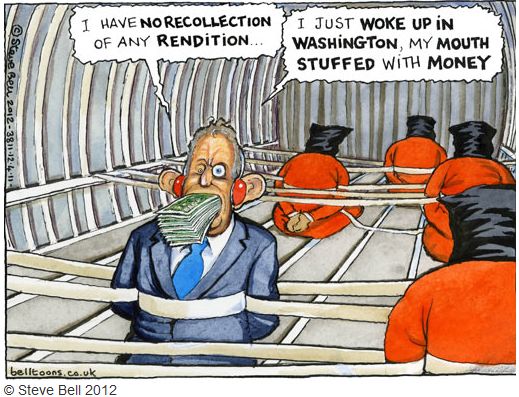
Tony Blair has ‘no recollection’ of Libyan dissident’s rendition

The Guardian reports: Tony Blair, prime minister at the time MI6 rendered Abdel Hakim Belhaj, a prominent Libyan dissident, to the Gaddafi regime in 2004, has said he had “no recollection” of the incident.

But he said he was sure the operation would be investigated “as it should be”.

Interviewed for BBC Radio 4’s World at One programme, Blair added that it should be remembered that “people in the Middle East were also trying to fight terrorism and extremism”. Britain’s co-operation with Libya at the time was important, the former prime minister said.

He referred to comments made by the then foreign secretary, Jack Straw, who said the government had been opposed to unlawful rendition. “As far as I know [the government] kept to that position,” Blair said.

Straw has said: “We were opposed to unlawful rendition. We were opposed to any use of torture. Not only did we not agree with it; we were not complicit in it and nor did we turn a blind eye to it.”

However, Straw has added: “No foreign secretary can know all the details of what its intelligence agencies are doing at any one time.”

Facebooktwittermail