Category Archives: Issues

North America’s dirty oil boom and the threat to the environment and environmentalists

The New York Times reports: The reversal of fortune in America’s energy supplies in recent years holds the promise of abundant and cheaper fuel, and it could have profound effects on what people drive, domestic manufacturing and America’s foreign policy.

Cheaper fuel produced domestically could reduce the cost of shipping and manufacturing, trim heating and cooling bills, improve the auto market and provide tens of thousands of new jobs.

It might also pose new environmental challenges, both predictable and unforeseen, by damping enthusiasm for clean forms of energy and derailing efforts to wean the nation from its wasteful energy habits.

But for Americans battered by rising gasoline prices, frustrated by the dependence on foreign oil, skeptical of the benefits or practicality of renewable fuels and afraid of nuclear power, the appeal of plentiful domestic oil and gas could far outweigh the costs.

Just a few years ago, the dominant theme in discussions about energy was of declining production and the fear of running out of oil. Even today, political tensions in the Middle East, particularly in the Persian Gulf, have fanned fears of supply disruptions that are keeping prices high.

But a new boom in energy production in recent years has upended these expectations in record time. High energy prices led to a wave of successful oil and gas exploration in North America, including in fields that were deemed uneconomical only a few years ago. Using techniques like horizontal drilling and hydraulic fracturing, oil companies are tapping into deeply buried reserves in shale rocks and in the ocean’s depths.

The surge in energy prices, along with a recession and new government rules that tightened fuel-economy standards, led to a sharp cutback in gasoline consumption. This decline in demand in the last five years reversed decades of almost uninterrupted growth that made the United States the world’s top energy consumer, accounting for one in every four barrels of oil burned around the globe.

The North American energy revival is primarily the result of so-called unconventional sources of energy — like shale oil and shale gas across the United States, oil sands in Canada and deepwater production in the Gulf of Mexico. In the last five years, the United States and Canada combined have become the fastest-growing sources of new oil supplies around the world, overtaking producers like Russia and Saudi Arabia.

“The transformation unfolding in North America represents a potentially decisive shift in the history of energy,” Rex W. Tillerson, the chairman and chief executive of Exxon Mobil, who is not usually given to hyperbole, said in a speech in Houston last month.

Ed Morse, head of global commodity research at Citigroup and a longtime energy analyst, says North America has the potential to become a “new Middle East.”

“The reduced vulnerability of North America — and the world market — to oil price spikes also has deep consequences geopolitically, including the reduced strategic importance to the U.S. of changes in oil- and natural gas-producing countries worldwide,” Mr. Morse said in a recent 92-page report called Energy 2020. ”Pressures towards isolationism in the U.S. will likely grow, with consequences for global stability that can only just begin to become understood.”

“The only thing that could stop this is politics — environmentalists getting the upper hand over supply in the U.S., for instance,” the report said. [Continue reading…]


Facebooktwittermail

Growth of income inequality is worse under Obama than Bush

Matt Stoller writes: Yesterday, the President gave a speech in which he demanded that Congress raise taxes on millionaires, as a way to somewhat recalibrate the nation’s wealth distribution. His advisors, like Gene Sperling, are giving speeches talking about the need for manufacturing. A common question in DC is whether this populist pose will help him win the election. Perhaps it will. Perhaps not. Romney is a weak candidate, cartoonishly wealthy and from what I’ve seen, pretty inept. But on policy, there’s a more interesting question.

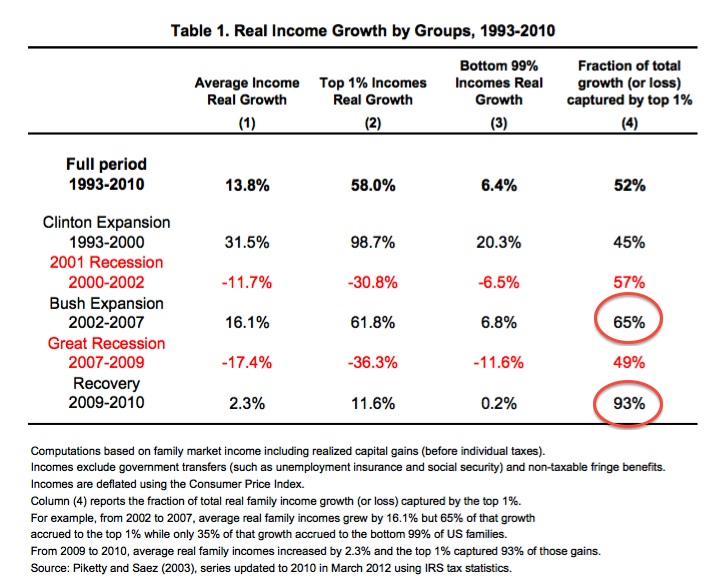
A better puzzle to wrestle with is why President Obama is able to continue to speak as if his administration has not presided over a significant expansion of income redistribution upward. The data on inequality shows that his policies are not incrementally better than those of his predecessor, or that we’re making progress too slowly, as liberal Democrats like to argue. It doesn’t even show that the outcome is the same as Bush’s. No, look at this table, from Emmanuel Saez (h/t Ian Welsh). Check out those two red circles I added.

Yup, under Bush, the 1% captured a disproportionate share of the income gains from the Bush boom of 2002-2007. They got 65 cents of every dollar created in that boom, up 20 cents from when Clinton was President. Under Obama, the 1% got 93 cents of every dollar created in that boom. That’s not only more than under Bush, up 28 cents. In the transition from Bush to Obama, inequality got worse, faster, than under the transition from Clinton to Bush. Obama accelerated the growth of inequality.

Facebooktwittermail

Did MoveOn rip off Occupy?

Natasha Lennard writes: “The 99 Percent Spring” certainly appears like an Occupy Wall Street campaign. The effort — to give nonviolent direct action training and teach-ins on income inequality and Wall Street malfeasance to 100,000 people across the country between April 9 and 12 –- sounds born of a general assembly, from the emphasis on putting “bodies on the line” to the calls to “rise up” in the face of corporate hegemony.

It’s unsurprising then that some media reports described it as Occupy’s new tactic; and although numerous individuals involved in Occupy are taking part in the spring trainings, an Occupy Wall Street initiative this is not. The 99 Percent Spring is spearheaded by MoveOn.org and supported by around 60 progressive nonprofits and major unions, including the AFL-CIO, the Teamsters, Greenpeace, the Working Families Party and Van Jones’ Rebuild the Dream organization.

Inside Occupy’s (now-figurative) camps, cries of “co-optation!” abound. The fear, expressed by numerous Occupy participants I spoke to in different cities, is that the 99 Percent Spring trainings will steer energy away from Occupy spring actions and toward support for the Democrats this coming general election. Many still believe that MoveOn, as a recent CounterPunch article put it, is a “front for the Democratic Party.”

Facebooktwittermail

Goldberg slipping on Grass

The idea that the world can be divided into powers that can be trusted with nuclear weapons and those that can’t is the foundation of the dispute with Iran, but if this idea really carried any weight, why would President Obama be an advocate of global nuclear disarmament?

Admittedly, he’s a half-hearted advocate — he’s presented it as a long-term goal, but a goal without a deadline is just a dream. Disarmament is Obama’s nice idea. But any serious proponent of disarmament recognizes that no one can be trusted with nuclear weapons.

Imagine your Uncle Harry and Aunt Judy come over for dinner. Uncle Harry’s a retired nuclear scientist and quite a handyman. Over dinner Aunt Judy proudly mentions he has just completed a project he’s been laboring over for many years: he’s constructed a suitcase nuclear bomb and it’s in the trunk of their car outside.

You flip out.

“Don’t worry,” Aunt Judy assures you. “Uncle Harry’s totally trustworthy.”

But you don’t care whether Uncle Harry is as trustworthy as Moses. It doesn’t make you any less scared of the bomb.

As for how trustworthy the Israelis are with their arsenal of nuclear bombs, since they won’t even admit they possess any, I’d say they should inspire less confidence than Uncle Harry.

And as for the method and extent of a possible Israeli attack on Iran — whether it would only involve conventional weapons and whether it would just employ aircraft or perhaps also ballistic missiles — I don’t recall anything specific be placed upon or removed from that proverbial table that accommodates all threats. So who’s to say one way or the other whether Günther Grass’s fears about such an attack are overblown? We don’t know.

Jerry Haber writes: Grass’s poem What must be said has been defended and attacked throughout the globe. The poem protests against the German sale of a nuclear submarine to Israel; appeals for international control of the Israel and Iranian nuclear program by an authority accepted by both governments; and, though by a German author, refuses to be silent about Israel’s nuclear power, despite Germany’s past crimes against the Jewish people (and humanity). Grass speaks as a German who does not want to be indirectly responsible for a horrific catastrophe, but rather, as he puts it,  wants to give help to Israelis, Palestinians, and others in the region “and, finally, to ourselves as well.” This part of Grass’s poem, the main part, is eminently reasonable. Only a twisted mind would find it anti-Semitic or even anti-Zionist.

The poem employs, however, rhetoric that is offensive to Iranians and to Israelis.  It calls the Iranian leader a loudmouth who keeps his people under his thumb and pushes them  to organized cheering. It imputes to the Israeli leaders the claim to have a right to a first strike capability that could “snuff out” or “annihilate” the Iranian people by using the nuclear submarine sold it by the Germans.Both claims belong more to the exaggerated bombast of living rooms (and blogs) than to a serious cri de coeur. They demean the poet, and they enable the poem to be easily dismissed by the partisans.

But suppose Grass had been more accurate in his description of the possible consequences of Israel’s attack? Suppose that instead of writing “a strike to snuff out the Iranian people” he had written  “a strike that may kill or maim hundreds of thousands of people”?

According to the Center for the Strategic and International Studies, a strike on the Bushehr Nuclear Reactor alone “will cause the immediate death of thousands of people living in or adjacent to the site, and thousands of subsequent cancer deaths or even up to hundreds of thousands depending on the population density along the contamination plume.”

Criticism of Israel on that score would not only not count as being anti-Semitic; it could even be advanced by those “sympathetic to Israel’s dilemma.” Or so says Bloomberg’s Jeffrey Goldberg:

The morality of a [pre-emptive Israeli] strike, which could cause substantial Iranian casualties, would be questioned even by those sympathetic to Israel’s dilemma.

Goldberg is astounded at the line that Grass did use and considers the poem anti-Semitic. But had Grass’s poem included the more “modest” claim of the possible hundreds of thousands of casualties, rather than the possible annihilation of the Iranian people, would Goldberg have dropped the anti-Semitism charge? In a post accusing Grass of anti-Semitism, Goldberg says that Israel is “contemplating targeting six to eight nuclear sites in Iran for conventional aerial bombardment,” which may be correct,though one retired American general thinks otherwise.  There is, to be sure, a clear difference between the nuclear bombing of conventional sites and the conventional bombing of nuclear sites. But what they share in common is the possible causation of  “substantial Iranian casualties,” to use Goldberg’s phrase. So why is Grass being anti-Semitic when he morally criticizes the consequences of an Israeli strike, whereas Goldberg is not?

If I understand Goldberg correctly, there are two distinctions between Grass’s standing vis-à-vis the moral criticism of Israel, and his own. First,  Grass is a German and a former member of the SS.  So he has to shut up – unless, perhaps, he proves himself to be one of those Germans who are “sympathetic to Israel’s dilemma.”

Second, Goldberg misreads Grass as saying that Israel seeks to annihilate the Iranians. This is nowhere stated or implied by Grass in his poem.  Instead, he says that Israel seeks the right of a preventative first strike which could annihilate the Iranian people. What’s the difference between the two? Well, it’s the difference between saying that Israel attacked Gaza in Operation Cast Lead in a way that could (and, in fact, did) kill fourteen hundred Gazans and between saying that  Israel sought to kill fourteen hundred Gazans.

Why does Goldberg read Grass in this way? He writes

To make yourself believe that Israel is seeking to murder the 74 million people of Iran, you must make yourself believe that the leaders of the Jewish state outstrip Adolf Hitler in genocidal intent.

Goldberg reads Grass as accusing Israel of outdoing Hitler in its evil “genocidal intent” – a reading that is interesting for what it says about Goldberg’s own mind,  but it is more interesting for what it says about the manner in which some Israeli advocates  think about criticism of Israeli military power, to turn one of Goldberg’s felicitous phrases.  What could be more anti-Semitic than accusing Israel of being more genocidal than Hitler? After all, to call for a nuclear embargo on Israel is to imply that Israelis cannot be trusted to act responsibly in the use of nuclear weapons, or in the bombing of nuclear facilities. It is to demean the Israelis, to place them on the same level, if not lower, than the Islamist regime in Iran. It is to claim that like the Iranians the Israelis are not to be trusted with nuclear weapons because we suspect them of genocidal intent. [Continue reading…]

Facebooktwittermail

Bibi’s Etch-a-Sketch candidate

The New York Times reports: The two young men had woefully little in common: one was a wealthy Mormon from Michigan, the other a middle-class Jew from Israel.

But in 1976, the lives of Mitt Romney and Benjamin Netanyahu intersected, briefly but indelibly, in the 16th-floor offices of the Boston Consulting Group, where both had been recruited as corporate advisers. At the most formative time of their careers, they sized each other up during the firm’s weekly brainstorming sessions, absorbing the same profoundly analytical view of the world.

That shared experience decades ago led to a warm friendship, little known to outsiders, that is now rich with political intrigue. Mr. Netanyahu, the prime minister of Israel, is making the case for military action against Iran as Mr. Romney, the likely Republican presidential nominee, is attacking the Obama administration for not supporting Mr. Netanyahu more robustly.

The relationship between Mr. Netanyahu and Mr. Romney — nurtured over meals in Boston, New York and Jerusalem, strengthened by a network of mutual friends and heightened by their conservative ideologies — has resulted in an unusually frank exchange of advice and insights on topics like politics, economics and the Middle East.

When Mr. Romney was the governor of Massachusetts, Mr. Netanyahu offered him firsthand pointers on how to shrink the size of government. When Mr. Netanyahu wanted to encourage pension funds to divest from businesses tied to Iran, Mr. Romney counseled him on which American officials to meet with. And when Mr. Romney first ran for president, Mr. Netanyahu presciently asked him whether he thought Newt Gingrich would ever jump into the race.

Only a few weeks ago, on Super Tuesday, Mr. Netanyahu delivered a personal briefing by telephone to Mr. Romney about the situation in Iran.

“We can almost speak in shorthand,” Mr. Romney said in an interview. “We share common experiences and have a perspective and underpinning which is similar.”

Mr. Netanyahu attributed their “easy communication” to what he called “B.C.G.’s intellectually rigorous boot camp.”

Facebooktwittermail

“Can a Jew be a good Jew and still be opposed to Zionism and to Israel?”

“Can a Jew be a good Jew and still be opposed to Zionism and to Israel?” This was one of the challenging questions posed by Mike Wallace, a Jew himself, to Abba Eban, Israel’s ambassador to the United States in 1958. That was back in the days when there wasn’t just daylight between Israel and the United States, but divisions could openly be discussed.

Meanwhile, don’t forget to enjoy the clean satisfying smoke of Parliament cigarettes.

Check out Noam Sheizaf’s post on the whole interview.

Facebooktwittermail

Deir Yassin: No passing over history

Yousef Munayyer writes: On April 9, 1948, scores of Palestinian civilians were massacred at the village of Deir Yassin through co-operative efforts of Yishuv forces like the Irgun, Lehi and the Haganah.

The Zionist narrative on the events of 1948 and the Nakba – the Arabic word for the depopulation of Palestine – talks about the war as a defensive one where there was no intention on behalf of the Israeli forces to shift the demographics by force. Rather, that narrative tells us, the refugees were created during the hostilities which began when five Arab armies invaded Israel the day after it declared its independence on May 15, 1948.

Too often, people who talk about “making peace” advise that we pass over history and look forward without getting lost in the “dueling narratives” of this period. But peace cannot happen without a rectification of past injustices and we cannot approach this without talking about what these injustices are.

The Zionist narrative will counter, defensively, that any injustices are not the fault of Israel and this is where the issue of “dueling narratives” prevents further discussion.

“The goal of the Zionist movement was to establish a Jewish state in the land of Palestine which had a significant non-Jewish majority of Palestinian Arabs.”

But there are simple, undeniable facts that any two sane people, Zionist or otherwise, should be able to agree on. For example, I think we can all agree that April 9, 1948, occurred before May 15, 1948. This is not a matter perspective, this is chronology.

When you actually look at the history – even versions documented by Israeli historians using official Israeli archival material – what you learn is that a very significant portion of the total refugees were created long before May 15, 1948. Had it not been for the hundreds and thousands of refugees flowing into Arab states and massacres like Deir Yassin, the Arab armies would likely not have been compelled to intervene.

Clearly, indisputable and historically non-controversial chronological facts blow significant holes in the Zionist narrative about cause and effect. But sequence is not the only problem. The other point of contention Zionists hold is that Israeli actions during the war were defensive and not intended to depopulate.

The goal of the Zionist movement was to establish a Jewish state in the land of Palestine which had a significant non-Jewish majority of Palestinian Arabs. Through years of immigration, the Zionists managed to grow from 11 per cent of Palestine’s inhabitants in 1922 to about 30 per cent in 1946.

The Zionist goal, which was unachievable for decades, came to fruition after 18 months of hostilities when Jews suddenly became 85 per cent of the population of the state of Israel. So, the Zionist narrative will have you believe that the Zionist dream of establishing a state with a Jewish majority, which was unachievable without war then, finally achieved during the fog of one, happened completely by accident.

One does not have to be a supporter of Israel or Palestine to accept this explanation – just astoundingly naïve. [Continue reading…]

In The Ethnic Cleansing of Palestine, Ilan Pappe writes: On 9 April 1948, Jewish forces occupied the village of Deir Yassin. It lay on a hill west of Jerusalem, eight hundred metres above sea level and close to the Jewish neighbourhood of Givat Shaul. The old village school serves today as a mental hospital for the western Jewish neighbourhood that expanded over the destroyed village.

As they burst into the village [of Deir Yassin] the Jewish soldiers sprayed the houses with machine-gun fire, killing many of the inhabitants. The remaining villagers were then gathered in one place and murdered in cold blood, their bodies abused while a number of the women were raped ad then killed.
Fahim Zaydan, who was twelve years old at the time, recalled how he saw his family murdered in front of his eyes:

They took us out one after the other; shot an old man and when one of his daughters cried, she was shot too. Then they called my brother Muhammad, and shot him in front us, and when my mother yelled, bending over him – carrying my little sister Hudra in her hands, still breastfeeding her – they shot her too.

Zaydan himself was shot, too, while standing in a row of children the Jewish soldiers had lined up against a wall, which they had then sprayed with bullets, ‘just for the fun of it’, before they left. He was lucky to survive his wounds.

Recent research has brought down the accepted number of people massacred at Deir Yassin from 170 to ninety-three. Of course, apart from the victims of the massacre itself, dozens of others were killed in the fighting, and hence were not included in the official list of victims. However, as the Jewish forces regarded any Palestinian village as an enemy military base, the distinction between massacring people and killing them ‘in battle’ was slight. One only has to be told that thirty babies were among the slaughtered in Deir Yassin to understand why the whole ‘quantitative’ exercise – which the Israelis repeated as recently as April 2002 in the massacre in Jenin – is insignificant. At the time, the Jewish leadership proudly announced a high number of victims so as to make Deir Yassin the epicentre of the catastrophe -a warning to all Palestinians that a similar fate awaited them if they refused to abandon their homes and take flight.

Facebooktwittermail

The Wall, 10 years on: The great Israeli project

It might be the biggest, most expensive and most influential construction project in Israel’s history. To mark the 10th anniversary of its inception, +972 will be publishing in coming days a series of stories about the separation wall and its history, arguments in favor and against its construction, its effects and side effects and an analysis of its possible implications on regional politics in years to come. Chapter one – the Israeli story of the wall.

Haggai Matar writes: Looking at it from here, for just one minute, the whole project of the wall appears to be nothing more than an absurdity. I’m standing at the furthest, deepest part of this massive barrier, in the settlement of Ariel. Located about 20 kilometers east of the green line, less than thirty to the Jordan River, it is the very heart of the West Bank. In front of me I see some olive groves, behind them – the “separation fence” with its electric detection, cameras and barbed wire, and on the other side is the Palestinian village of Marda, the residents of which own these trees. So far, it’s nothing I haven’t seen before.

However, a short walk to either direction leads to an abrupt end to the fence. In one direction it reaches a nearby road, and simply doesn’t continue on the other side, as it does elsewhere. Instead, there is a small area near the road with turned earth, suggesting that construction was planned here but was stopped. Oren, the photographer, tells me he was at a demonstration here against the planned route of the fence five years ago, and that nothing has changed on the terrain since. He takes some pictures, and I think of several other places along the route where the fence or wall simply comes to an end, enabling dozens, hundreds or thousands of Palestinians to cross it on a daily basis. Some are caught by patrols. Others aren’t. Looking at it from here, for just one minute, the whole project of the wall appears to be nothing more than an absurdity.

On April 14, 2002 then Prime Minister Ariel Sharon announced that a separation fence would be built in the West Bank (a matter of terminology: The barrier is part fence, part wall. I will be using the two terms interchangeably). It was the height of the second intifada, which started with mass demonstrations that were murderously repressed by the IDF, and continued with a series of deadly suicide attacks against citizens inside Israel. After the 2002 attack on a Passover dinner in a Netanya hotel, Israel launched operation Defensive Shield, during which some 500 Palestinians were killed, and mass destruction caused to houses and infrastructure across the West Bank. At that point, no planned route or budget existed for Sharon’s fence, announced during the operation. But the project, which was to become probably the largest in Israeli history, was born.

Ten years have passed, and much has changed. The route of the wall was drawn, altered and changed time and time again by both the government and the Supreme Court. Construction went ahead, come to a halt, was restarted and frozen once more – due to political debates on its route, international pressure regarding the annexation of Palestinian lands and lack of funds. Here are a few figures to help get an idea what this project is all about:

The entire route of the wall – between 680-709 kilometers (the first is a Ministry of Defense figure, the second B’Tselem’s). This is more than twice the length of the Green Line, Israel’s recognized border with the West Bank (320 kms).

  • Portions already built- 525 kms
  • Portions inside Palestinian territory – 85 percent
  • Palestinian lands currently on the Israeli side of the wall – 8.5 percent
  • Palestinian lands in on the Israeli side in earlier plans – 17 percent
  • 8-meter-high concrete wall comprises 10 percent of the barrier
  • 2-meter-high electronic fence – 90 percent
  • Total cost so far – over NIS 10 billion ($2.6 billion)
  • Cost of maintenance per year – NIS 1 billion ($260 million)
  • Scheduled end of construction – unknown. Most construction has been stopped.

[Continue reading…]

Facebooktwittermail

Rendition ordeal that raises new questions about secret trials

The Guardian reports: Just when Fatima Bouchar thought it couldn’t get any worse, the Americans forced her to lie on a stretcher and began wrapping tape around her feet. They moved upwards, she says, along her legs, winding the tape around and around, binding her to the stretcher. They taped her stomach, her arms and then her chest. She was bound tight, unable to move.

Bouchar says there were three Americans: two tall, thin men and an equally tall woman. Mostly they were silent. She never saw their faces: they dressed in black and always wore black balaclavas. Bouchar was terrified. They didn’t stop at her chest – she says they also wound the tape around her head, covering her eyes. Then they put a hood and earmuffs on her. She was unable to move, to hear or to see. “My left eye was closed when the tape was applied,” she says, speaking about her ordeal for the first time. “But my right eye was open, and it stayed open throughout the journey. It was agony.” The journey would last around 17 hours.

Bouchar, then aged 30, had become a victim of the process known as extraordinary rendition. She and her husband, Abdel Hakim Belhaj, a Libyan Islamist militant fighting Muammar Gaddafi, had been abducted in Bangkok and were being flown to one of Gaddafi’s prisons in Libya, a country where she had never before set foot. However, Bouchar’s case is different from the countless other renditions that the world has learned about over the past few years, and not just because she was one of the few female victims.

Documents discovered in Tripoli show that the operation was initiated by British intelligence officers, rather than the masked Americans or their superiors in the US. There is also some evidence that the operation may have been linked to a second British-initiated operation, which saw two men detained in Iraq and rendered to Afghanistan. Furthermore, the timing of the operation, and the questions that Bouchar’s husband and a second rendition victim say were subsequently put to them under torture, raise disturbing new questions about the secret court system that considers immigration appeals in terrorist cases in the UK – a system that the government has pledged to extend to civil trials in which the government itself is the defendant.

This year, the Crown Prosecution Service announced police had launched an investigation into the “alleged rendition and alleged ill-treatment” of Bouchar and Belhaj, and a second operation in which a Libyan family of six were flown to one of Gaddafi’s prisons.

It appears inevitable that Scotland Yard’s detectives will want to question the man who was foreign secretary at the time – Jack Straw.

Ten years before Bouchar’s abduction and rendition, many of her husband’s associates had been permitted to settle in Britain. These men were members of al-Jama’a al-Islamiyyah al-Muqatilah fi-Libya, the Libyan Islamic Fighting Group (LIFG), an organisation formed in the early 1990s and dedicated to Gaddafi’s removal. The LIFG was not banned in the UK, and its members appear to have found the country a convenient place to gather and raise funds. There were even reports – officially denied – that MI6 encouraged the LIFG in an unsuccessful attempt on the dictator’s life.

But from 2002 the UK ceased to be such a safe haven for the LIFG. The US and UK governments were beginning to repair their relations with Gaddafi, a rapprochement that would soon see him abandon his WMD programme and open his country’s oil and gas reserves to western corporations.

One Thursday evening in November that year, a 36-year-old LIFG member who was living in London was arrested by armed police as he attempted to board a flight at Heathrow. He was told he was being detained under the Anti-terrorism, Crime and Security Act, a piece of legislation that had been rushed on to the statute books within weeks of 9/11, and which allowed the British government to detain international terrorism suspects without trial. From that moment the man was anonymised, by court order – in part to protect his relatives in Libya – and could be referred to only as “M”.

When M had arrived in the UK as an asylum seeker eight years earlier, he had readily told Special Branch detectives that he was a member of the LIFG. On his arrest at Heathrow he insisted that the organisation had no connection with international terrorism and was concerned only with the removal of Gaddafi. After being detained at Belmarsh high security prison in south-east London, M appealed to the Special Immigration Appeals Commission (SIAC), a tribunal that allows the government to give evidence in secret, unseen by the appellant or the appellant’s lawyers.

In March 2004, M became the first and only person detained under the act to win an appeal at SIAC. The tribunal accepted that there were no links between LIFG and al-Qaida, and criticised the Home Office for its “consistent exaggeration” of M’s alleged links with members of al-Qaida. As the law permitted only “international terrorists” to be detained without trial, and not domestic insurgents, M was set free. A few days after SIAC’s decision, notice was passed to the Home Office and MI5, and Fatima Bouchar and her husband were detained in Bangkok.

Bouchar’s husband made no secret of being a leading member of the LIFG. That year, the couple had left China, where they had been living in exile, and attempted to travel to the UK via Malaysia. When they were detained in Kuala Lumpur and questioned about Belhaj’s false Iraqi passport, an acquaintance went to the British high commission to explain that the couple were attempting to reach London. Shortly after this, they were told that they would be permitted to travel to the UK on a BA flight, despite not having EU passports or UK visas. But when the aircraft stopped off at Bangkok, the pair were detained and taken to a US-run detention facility.

It was known that the CIA had been operating a secret prison in Thailand since 9/11, but its precise location was unknown. Bouchar and Belhaj arrived there within minutes of being detained, suggesting that it was located within the perimeter of Don Muang international airport. They were immediately separated.

Belhaj says he was blindfolded, hooded, forced to wear ear defenders, and hung from hooks in his cell wall for what seemed to be hours. He says he was severely beaten. The ear defenders were removed only for him to be blasted with loud music, he says, or when he was interrogated by his US captors. [Continue reading…]

Facebooktwittermail

How the U.S. uses sexual humiliation as a political tool to control the masses

Naomi Wolf writes: In a five-four ruling this week, the supreme court decided that anyone can be strip-searched upon arrest for any offense, however minor, at any time. This horror show ruling joins two recent horror show laws: the NDAA, which lets anyone be arrested forever at any time, and HR 347, the “trespass bill”, which gives you a 10-year sentence for protesting anywhere near someone with secret service protection. These criminalizations of being human follow, of course, the mini-uprising of the Occupy movement.

Is American strip-searching benign? The man who had brought the initial suit, Albert Florence, described having been told to “turn around. Squat and cough. Spread your cheeks.” He said he felt humiliated: “It made me feel like less of a man.”

In surreal reasoning, justice Anthony Kennedy explained that this ruling is necessary because the 9/11 bomber could have been stopped for speeding. How would strip searching him have prevented the attack? Did justice Kennedy imagine that plans to blow up the twin towers had been concealed in a body cavity? In still more bizarre non-logic, his and the other justices’ decision rests on concerns about weapons and contraband in prison systems. But people under arrest – that is, who are not yet convicted – haven’t been introduced into a prison population.

Our surveillance state shown considerable determination to intrude on citizens sexually. There’s the sexual abuse of prisoners at Bagram – der Spiegel reports that “former inmates report incidents of … various forms of sexual humiliation. In some cases, an interrogator would place his penis along the face of the detainee while he was being questioned. Other inmates were raped with sticks or threatened with anal sex”. There was the stripping of Bradley Manning is solitary confinement. And there’s the policy set up after the story of the “underwear bomber” to grope US travelers genitally or else force them to go through a machine – made by a company, Rapiscan, owned by terror profiteer and former DHA czar Michael Chertoff – with images so vivid that it has been called the “pornoscanner”.

Believe me: you don’t want the state having the power to strip your clothes off. History shows that the use of forced nudity by a state that is descending into fascism is powerfully effective in controlling and subduing populations.

Facebooktwittermail

The U.S. war on drug cartels in Mexico is a deadly failure

Mark Karlin writes: On March 29, 2012, William R. Brownfield, US assistant secretary of state for the Bureau of International Narcotics and Law Enforcement Affairs (in other words, Hillary Clinton’s point person on drug issues), testified before the House Subcommittee on State, Foreign Operations, and Related Programs. His subject was the war on drugs in the Western Hemisphere outside of the United States and Canada. Few, if any, reporters from the US press attended.

Approximately 50,000 or more Mexicans have been killed since Mexican President Felipe Calderon launched a so-called war on drug cartels. (In a recent appearance in Toronto, Defense Secretary Leon Panetta claimed 150,000 people have died in the drug war in Mexico, but the timeline Panetta was referring to was unclear, as was the origin of the figure he cited.) Given that five Juarez police officers were gunned down at a party the night before Brownfield’s testimony, the Spanish-language press, unlike the American media, took an interest in his remarks.

You see, Juarez is kind of a sore spot for Mexicans. In 2010, more than 3,000 homicides took place in the city where killings are committed with general impunity, making it the murder capital of the world that year. Although Juarez’s murder rate has now lowered slightly, the city’s mayor – who lives across the Rio Grande in El Paso, Texas – indignantly denies that Juarez is the deadliest city on earth, even though it almost certainly remains close to being just that. Borderland writer Charles Bowden writes in “Murder City: Ciudad Juarez and the Global Economy’s New Killing Fields“: “The violence is everywhere. It is like the dust in the air, part of life itself.” [Continue reading…]

Facebooktwittermail

The moral bankruptcy of Zionism

Yousef Munayyer writes: Last week, the Israeli central bureau of statistics reported future trends which indicate the proportion of Palestinian Arabs in Israel will increase significantly by 2059.

Well, I have news for those arguing for a two-state solution will rescue a “Jewish and Democratic State.” Not only does the occupation make a liberal Zionist state impossible through the fundamental contradiction between a Jewish state and a democratic one, but to hope for a “democratic” Israel is foolish.

Think about what “democratic” Israel would be like. In order to insure a Jewish majority, the state will have to continue to not only discriminate against the Palestinian citizens in Israel but also continue to treat them as a “demographic threat.”

Numerous Israeli laws discriminate against Palestinian citizens of Israel. Because of a 2003 law, Palestinians like me can’t reside in Israel with their Palestinian spouse from outside of “Israel proper.” This means that if I want to live in Israel, my wife from the West Bank cannot live with me. Yet Jews are exempt from this hardship. These laws exist to prevent what Netanyahu refers to as a “demographic spillover”; the movement of Palestinians into Israel, which would threaten the state’s desired Jewish majority.

In fact, since the establishment of the state, its laws have marginalized the Palestinian minority. From the 1950 Absentee Property Law, which was used to expropriate hundreds of thousands of dunams of Palestinian land and is still being used today, to a series of other legalistic measures, the Israeli state effectively and significantly targeted the Palestinian minority.

Today, there are roughly 1.6 million Palestinian citizens of Israel, just over 20 percent of the population. This proportion would be even higher, perhaps 25 perecent, if not for the extraordinary influx of over one million immigrants to Israel from the former Soviet Union and Ethiopia in the past 20 years—a demographic feat unlikely to be repeated.

In 2003, Benjamin Netanyahu, then Israeli Finance Minister, argued that the “demographic threat” was not from the West Bank and Gaza, but rather from Palestinian citizens of Israel. He stated that 20 percent would be problematic and would have to be managed, but 35 to 40 percent would mean the end of the “Jewish State.” The state perceives that Palestinian wombs threaten its very nature.

Facebooktwittermail

Getting duped by Israel and the American media

I’ve been duped,” declared the popular travel writer Rick Steves after watching the documentary, Peace, Propaganda, and the Promised Land.

His perception of Israel was so radically altered he felt compelled to write at the Huffington Post: “If you are a friend of Israel, you must watch Peace, Propaganda, and the Promised Land.”

The ideologically inclined are likely to read a strong political message in what Steves wrote, but my hunch is that his post was prompted by something else — an everyday concern he has as a travel writer.

Every seasoned traveler knows two things:

1. The most interesting way of experiencing another culture is through deep immersion, and
2. the most common obstacle to that experience is the tourist trade.

As a result, it’s important to get streetwise not so much because foreigners — and especially Americans — are easy targets for one kind of scam or another, but because those who profit from tourism tend to be the least faithful representatives of their own culture. That’s why, as Steves often says, the authentic experience is most often going to be found by going off the beaten track. And this quest for authenticity makes the traveler watch out for false promises.

A good travel writer has little patience for travel guides that paint deceptive pictures — where charming turns out to be tacky or a popular destination turns out to be a tourist trap.

But now, when Steves says he’s been duped, he’s describing a much higher level of misrepresentation. Israel is not the country he took it to be and their is for him a measure of insult in this discovery.

No one takes kindly to being treated like a sucker.

Rick Steves does not have a political axe to grind, but he does have a genuine appreciation of other cultures and an awareness of the degree to which most Americans are ignorant about the rest of the world.

He writes:

On the road, you learn that ethnic underdogs everywhere are waging valiant but seemingly hopeless struggles. When assessing their tactics, I remind myself that every year on this planet many languages go extinct. That means that many heroic, irreplaceable little nations finally lose their struggle and die. There are no headlines—they just get weaker and weaker until that last person who speaks that language dies, and so does one little bit ethnic diversity on our planet.

I was raised so proud of Nathan Hale and Patrick Henry and Ethan Allen—patriotic heroes of America’s Revolutionary War who wished they had more than one life to give for their country. Having traveled, I’ve learned that Patrick Henrys and Nathan Hales are a dime a dozen on this planet—each country has their own version.

I believe the US tends to underestimate the spine of other nations. It’s comforting to think we can simply “shock-and-awe” our enemies into compliance. This is not only untrue…it’s dangerous. Sure, we have the mightiest military in the world. But we don’t have a monopoly on bravery or grit. In fact, in some ways, we might be less feisty than hardscrabble, emerging nations that feel they have to scratch and claw for their very survival.

We’re comfortable, secure, beyond our revolutionary stage…and well into our Redcoat stage. Regardless of our strength and our righteousness, as long as we have a foreign policy stance that requires a military presence in 130 countries, we will be confronting determined adversaries. We must choose our battles carefully. Travel can help us understand that our potential enemies are not cut-and-run mercenaries, but people with spine motivated by passions and beliefs we didn’t even know existed, much less understand.

Growing up in the US, I was told over and over how smart, generous, and free we were. Travel has taught me that the vast majority of humanity is raised with a different view of America. Travelers have a priceless opportunity to see our country through the eyes of other people. I still have the American Dream. But I also respect and celebrate other dreams.

Facebooktwittermail

American manifest destiny and Zionism

I’ve long been struck by the obvious parallels between America and Israel, both of which built their foundations on ethnic cleansing. Cliff Brown explores this theme in the following video: “Two tragedies: American and Israeli injustice”

Brown describes himself on his blog: I am a 61 year old American male who, as a teenager, cheered on the Israelis in the 1967 war.

What changed my views on Israel? I lost my ignorance of both history and current events in the Middle East.

I decided to educate myself instead of forming my views from received wisdom. Though I knew (and know) many Jews, I did not know one Palestinian. I made it my business to discover the truth of the Palestinian situation for myself as can anyone who has access to the Internet.

Facebooktwittermail

Protecting psychologists who harm: The APA’s latest wrong turn

Roy Eidelson writes: Shortly after learning about the American Psychological Association’s (APA) late February announcement of its new Member-Initiated Task Force to Reconcile Policies Related to Psychologists’ Involvement in National Security Settings, I found my thoughts turning to the School of the Americas, Blackwater and perhaps even more surprisingly, the Patagonian toothfish. Those may seem like a strange threesome, but they share one important thing in common. All have undergone a thorough repackaging and renaming in a marketing effort aimed at obscuring – but not altering – some ugly truth.

The School of the Americas in Fort Benning, Georgia, became infamous for training Latin American soldiers who returned home and engaged in repressive campaigns involving rape, torture and murder of political dissidents. To combat its negative image, the school was renamed the Western Hemisphere Institute for Security Cooperation, but the nature of its activities remain largely unchanged. During the Iraq War, Blackwater, a private military company supported by hundreds of millions of dollars in US government contracts, gained international notoriety on many counts, including its use of excessive and often deadly force against Iraqi civilians. The company therefore renamed itself – twice – first as Xe Services and then again as Academi, with essentially the same core businesses. As for the Patagonian toothfish, it’s wrong to blame the fish itself. But in an effort to spur sales, merchants renamed it Chilean sea bass (for similar reasons, the slimehead fish is now known as orange roughy instead).

Sadly, the same repackaging and renaming strategy of illusion and deception characterizes the APA’s latest gambit to both protect and disguise the role of psychologists as purveyors of harm. But to fully understand this new ploy – a so-called “task force” to produce a comprehensive document of all APA ethics policies relevant to psychologists in national security settings – it’s helpful to first review some disturbing history.

There is incontrovertible evidence that in the years following the 9/11 attacks, psychologists served as planners, consultants, researchers and overseers to the abusive and torturous interrogations of prisoners in the US “global war on terror.” Multiple reports of wrongdoing emerged, such as one from the International Committee of the Red Cross describing psychological coercion techniques at Guantanamo Bay as “tantamount to torture.” APA members and others responded with outrage and clamor. It was immediately clear that the world’s largest psychological association needed to engage in a careful and transparent examination of whether professional ethics allow psychologists to serve in aggressive operational roles, such as detention and interrogation activities involving national security detainees. Tragically, however, APA’s leadership decided to take a very different path. They chose to rubberstamp the status quo without any meaningful deliberation whatsoever. [Continue reading…]

Facebooktwittermail

What do Iran sanctions cost you? About 25 cents a gallon, experts say

Christian Science Monitor reports: Twenty-five cents a gallon – that’s about how much some international energy experts say the tough US sanctions on Iran’s oil industry are costing Americans at the pump.

As US consumers cope with gas prices that are approaching an average of $4 a gallon, some international trade experts say the cost of the sanctions the US imposes – as in the case of the Iran measures – is something political leaders should discuss more openly. Instead, they say, most politicians act as if sanctions affect only the country targeted – something these experts say isn’t true.

“The approach is always that the costs are for them and the benefits are for us,” says Bill Reinsch, president of the National Foreign Trade Council (NFTC), a Washington lobbying organization that generally opposes economic sanctions. “The Iran case is interesting,” he adds, “because of the impact of sanctions on our energy sector.”

What sanctions? Top five countries buying oil from Iran.

Energy experts say it’s difficult to pinpoint precisely how much sanctions on Iran are costing consumers as they filter down to the gas pump. But Lucian Pugliaresi, president of the Energy Policy Research Foundation, a Washington nonprofit organization that studies energy economics, says it’s possible to make an estimate.

The sanctions the US and other countries have slapped on Iran’s energy sector and on its central bank (aimed at curtailing its oil exports) are costing Iran about 300,000 barrels a day in exports, Mr. Pugliaresi estimates. When added to other factors affecting the international oil market, that decrease in exports may have added about $10 to the current price of a barrel for crude, he says.

And that $10 increase translates roughly to about a 25-cent increase in the cost of a gallon of gas in the US, Pugliaresi says.

Facebooktwittermail