Category Archives: Issues

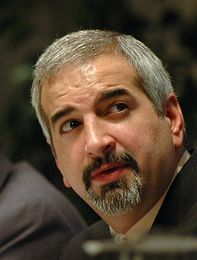
Remembering Anthony Shadid

Quil Lawrence writes: I met Anthony Shadid on a ruined airstrip in western Afghanistan in the winter of 2001-’02. He was sporting a beard and longer hair in those days that made him look a little like a crusading Arab warrior. We spoke briefly and exchanged a few bits of useful news about the place. As I recall his face now, I realize Anthony’s secret: His sincerity was piercing, disarming and infectious.

Over the next decade, I got to watch Anthony’s genuine curiosity overcome the suspicions of refugees, ambassadors and warlords, as he soaked up their stories and rendered them with great generosity of spirit. His writing could inspire kinship between Americans from his native Oklahoma and the terrified people of Baghdad, the demonstrators in Cairo, the rebel fighters in Libya and Syria.

The year after we met in Afghanistan, I saw Anthony in Washington, D.C. — he was just back from a stint in Israel and the Palestinian territories. I asked him how it went, and he replied with unfeigned nonchalance, “Not that good. I got shot.”

Anthony had been reporting in Ramallah in 2002 and took a bullet in the back of his shoulder. He believed it was fired by Israeli Defense Forces. The wound was complicated because Anthony refused to leave Ramallah unless his Palestinian colleague could cross the checkpoint with him. Over the years, Anthony was beaten and abducted while covering the news. He knew he was taking risks. But he also knew (though his unassuming nature would have never let him say it) that he was fulfilling his life’s mission, explaining the Arab world to Americans with a fluency and empathy perhaps no other reporter could match.

Steve Coll writes: Anthony Shadid’s third book, “House of Stone,” is due to be published in several weeks. It is described by the publisher as a “a memoir of home, family and a lost Middle East.” The project, when Shadid talked about it occasionally, was more personal than that sort of subtitle can easily convey. Shadid grew up in Oklahoma, in a family of Lebanese origin. He attended the University of Wisconsin and went into newspaper work. Like many American writers whose families arrived here from somewhere else, he was drawn gradually to the landscape of his family’s origins. “House of Stone” tells the story of Shadid’s efforts to rebuild — and excavate the history of — a family property in Lebanon. When he spoke about that project, and the life he had forged in Lebanon to carry it out, he mentioned a theme that was always present in his newspaper correspondence: that the “zone of crisis” frame that so often surrounded reporting from the Middle East was frustrating and inadequate. The Arab world, like any other, was not best understood by focusing exclusively on its wars and conflicts (although he did not shy away from any of those, or whitewash their ugliness) but through its longer, subtler narratives of family, time, and transition. “House of Stone” is such a narrative.

Shadid, who died on Thursday at the age of forty-three, while covering the conflict in Syria for the Times, apparently of an asthma attack, was, over the last decade or more, the most intrepid, empathetic, fully engaged correspondent working in the Middle East for American audiences. He had many gifts and was an exceptionally graceful, easy, and generous man, but among the qualities that distinguished his work was the sheer commitment of it. When he came to the Washington Post about a decade ago to serve as a correspondent, I was working as an editor at the paper. I asked a standard job interview question about his goals in the years ahead, and he provided one of the most striking, emphatic answers I can recall from countless discussions of that type: He intended to move to the Middle East, to chronicle in every dimension possible the upheavals in Arab societies that would inevitably follow the September 11th attacks, and to do nothing else, professionally. If we, the Post, would facilitate this ambition, he would be grateful, but that was the only job he was interested in or would be for years to come, he said. It is rare for anyone — never mind a writer — to possess such clarity. And Shadid carried out his plan exactly as he said he would, just not for the full measure of years that we would have wished.


Facebooktwittermail

Remembering Anthony Shadid: In Assad’s Syria, there is no imagination

On November 8, 2011, Anthony Shadid wrote: The House of Assad evokes an imperial sense of power, or at least its trappings, with iconography that one scholar described as infused with “laudatory slogans and sempiternal images.”

But my first impression of Rami Makhlouf, President Bashar al-Assad’s cousin and one-time confidante, was of his unassuming quality. Here was a tycoon, a figure as rich as he was loathed, who eschewed formalities and ceremony. I had seen it before, in men like Saad Hariri, a former prime minister in Lebanon, lavished with so much privilege and so much wealth that pretensions become unnecessary. Even his most brazen threats seemed more pleading than menacing, as if I should understand the logic behind them. Don’t the Israelis know that they will suffer if we do; don’t the Europeans; don’t the Americans realize that we are the bulwark before forces that they can’t imagine — Islamists, chaos, wars roiling an already combustible region?

By the end of several hours interviewing Makhlouf in May, it was not pomp, not imagery and not detachment that denoted the imperium. It was the pronouns. The way he used them said much about how power has been exercised in the Arab world and why it has finally begun to crumble.

“We believe there is no continuity without unity,” he told me. “As a person, each one of us knows we cannot continue without staying united together.”

He echoed an Arabic proverb – alaya wa ala aadai’i ya rab.

Translated loosely, it means that we won’t go down alone.

“We will not go out, leave on our boat, go gambling, you know,” he told me at his plush, wood-paneled headquarters in Damascus. “We will sit here. We call it a fight until the end.” He added later: “They should know when we suffer, we will not suffer alone.”

What Makhlouf, a businessman with no title, no official capacity save his membership in the president’s family, suggested was that Syria belonged to them: its property and people, their aspirations and fate, their history and their future. In essence, consciously or not, he gave voice to the sign that has long marked the crossing for visitors across the rocky wadis dividing Lebanon and Syria.

“Assad’s Syria,” it reads. [Continue reading…]

Facebooktwittermail

Remembering Anthony Shadid: In Iraq — A boy who was ‘like a flower’

From Baghdad on March 30, 2003, Anthony Shadid wrote: On a cold, concrete slab, a mosque caretaker washed the body of 14-year-old Arkan Daif for the last time.

With a cotton swab dipped in water, he ran his hand across Daif’s olive corpse, dead for three hours but still glowing with life. He blotted the rose-red shrapnel wounds on the soft skin of Daif’s right arm and right ankle with the poise of practice. Then he scrubbed his face scabbed with blood, left by a cavity torn in the back of Daif’s skull.

The men in the Imam Ali mosque stood somberly waiting to bury a boy who, in the words of his father, was “like a flower.” Haider Kathim, the caretaker, asked: “What’s the sin of the children? What have they done?”

In the rituals of burial, the men and their families tried, futilely, to escape the questions that have enveloped so many lives here in fear and uncertainty. Beyond some neighbors, family, and a visitor, there were no witnesses; the funeral went unnoticed by a government that has eagerly escorted journalists to other wartime tragedies. Instead, Daif and two cousins were buried in the solitude of a dirt-poor, Shiite Muslim neighborhood near the city limits.

The boys were killed at 11 a.m. today when, as another relative recalled, “the sky exploded.” Daif had been digging a trench in front of the family’s concrete shack that could serve as a shelter during the bombing campaign that continues day and night. He had been working with Sabah Hassan, 16, and Jalal Talib, 14. The white-hot shrapnel cut down all three. Seven other boys were wounded.

The explosion left no crater, and residents of the Rahmaniya neighborhood struggled to pinpoint the source of the destruction. Many insisted they saw an airplane. Some suggested Iraqi antiaircraft fire had detonated a cruise missile in the air. Others suggested rounds from antiaircraft guns had fallen back to earth and onto their homes.

Whoever caused the explosion, the residents assigned blame to the United States, insisting that without a war, they would be safe. “Who else could be responsible except the Americans?” asked Mohsin Hattab, a 32-year-old uncle of Daif.

“This war is evil. It’s an unjust war,” said Imad Hussein, a driver and uncle of Hassan. “They have no right to make war against us. Until now, we were sitting in our homes, comfortable and safe.”

As he spoke, the wails of mourners pouring forth from homes drowned out his words. He winced, turning his head to the side. Then he continued. “God will save us,” he said softly.

At the mosque, hours after the blast, Kadhim and another caretaker prepared Daif’s body for burial — before sundown, as is Islamic custom.

Bathed in the soft colors of turquoise tiles, the room was hushed, as the caretakers finished the washing. They wrapped his head, his gaze fixed, with red and yellow plastic. They rolled the corpse in plastic sheeting, fastening it with four pieces of white gauze — one at each end, one around his knees and one around his chest.

Kadhim worked delicately, his gestures an attempt to bring dignity to the corpse. He turned Daif’s body to the side and wrapped it in a white sheet, secured with four more pieces of gauze. Under their breaths, men muttered prayers, breaking the suffocating silence that had descended. They then moved toward the concrete slab and hoisted the limp body into a wood coffin.

“It’s very difficult,” said Kadhim, as the men closed the coffin.

On Friday, he had gone to another mosque, Imam Moussa Kadhim, to help bury dozens killed when a blast ripped through a teeming market in the nearby neighborhood of Shuala. The memories haunted him. He remembered the severed hands and heads that arrived at the Shiite mosque. He recalled bodies, even that of an infant, with gaping holes.

“It was awful and ugly,” he said. “This is the first time I’ve ever seen anything like this.” [Continue reading…]

Facebooktwittermail

New York Times loses an indispensable correspondent

The New York Times reports: Anthony Shadid, a gifted newspaper correspondent whose graceful dispatches for both The New York Times and The Washington Post covered nearly two decades of Middle East conflict and turmoil, died, apparently of an asthma attack, on Thursday while on a reporting assignment in eastern Syria. Tyler Hicks, a Times photographer who was with Mr. Shadid, carried his body across the border to Turkey.

Mr. Shadid, 43, had been reporting inside Syria for a week, gathering information on the Free Syrian Army and other armed elements of the resistance to the government of President Bashar al-Assad, whose military forces have been engaged in a harsh repression of the political opposition in a conflict that is now nearly a year old.

The Syrian government, which tightly controls foreign journalists’ activities in the country, had not been informed of his assignment by The Times.

The exact circumstances of Mr. Shadid’s death and his precise location inside Syria when it happened were not immediately clear.

But Mr. Hicks said that Mr. Shadid, who had asthma and had carried medication with him, began to show symptoms as both of them were preparing to leave Syria on Thursday, and the symptoms escalated into what became a fatal attack. Mr. Hicks telephoned his editors at The Times, and a few hours later he was able to take Mr. Shadid’s body into Turkey.

Jill Abramson, the executive editor, informed the newspaper’s staff Thursday evening in an e-mail. “Anthony died as he lived — determined to bear witness to the transformation sweeping the Middle East and to testify to the suffering of people caught between government oppression and opposition forces,” she wrote.

The assignment in Syria, which Mr. Shadid arranged through a network of smugglers, was fraught with dangers, not the least of which was discovery by the pro-government authorities in Syria. The journey into the country required both Mr. Shadid and Mr. Hicks to travel at night from Turkey to a mountainous border area adjoining Syria’s Idlib Province, where the demarcation line is a barbed-wire fence. Mr. Hicks said they squeezed through the fence’s lower portion by pulling the wires apart, and guides on horseback met them on the other side. It was on that first night, Mr. Hicks said, that Mr. Shadid suffered an initial bout of asthma, apparently set off by an allergy to the horses, but he recovered after resting.

On the way out a week later, however, Mr. Shadid suffered a more severe attack — again apparently set off by proximity to the horses of the guides, Mr. Hicks said, as they were walking toward the border. Short of breath, Mr. Shadid leaned against a rock with both hands.

“I stood next to him and asked if he was O.K., and then he collapsed,” Mr. Hicks said. “He was not conscious and his breathing was very faint and very shallow.” After a few minutes, he said, “I could see he was no longer breathing.”

Mr. Hicks said he administered cardiopulmonary resuscitation for 30 minutes but was unable to revive Mr. Shadid.

The death of Mr. Shadid, an American of Lebanese descent who had a wife and two children, abruptly ended one of the most storied careers in modern American journalism. Fluent in Arabic, with a gifted eye for detail and contextual writing, Mr. Shadid captured dimensions of life in the Middle East that many others failed to see. Those talents won him a Pulitzer Prize for international reporting in 2004 for his coverage of the American invasion of Iraq and the occupation that followed, and a second Pulitzer in 2010, also for his Iraq reporting. He also was a finalist in 2007 for his coverage of Lebanon, and has been nominated by The Times for his coverage of the Arab Spring uprisings that have transfixed the Middle East for the past year.

In December, during a brief break from reporting in the Middle East, Shadid was interviewed by Terry Gross and reflected on the Arab Spring.

Facebooktwittermail

Israelis prepare for war with Iran

Larry Derfner reports: After bombs went off near Israeli embassies in New Delhi and Tbilisi, and a man with an Iranian passport accidentally blew himself up in Bangkok, Israeli Prime Minister Binyamin Netanyahu couldn’t let the opportunity pass. Yediot Aharonot, the country’s most widely read newspaper, reported Wednesday:

An updated list of talking points distributed by the national advocacy desk in the Prime Minister’s Office sought to connect the wave of terror with the international community’s efforts at tightening sanctions on Iran, and also to prepare the ground for a military option to stop Iran’s nuclear program.

According to Yediot, the new talking points read: “Iran and Hizbullah are behind these terror attempts. If this is what Iran is doing now, imagine what it will do if its nuclear arms project reaches the goal.” The tabloid’s story was headlined “Iran’s long arm,” and the subhead read, “Israel to the world: ‘Terror acts show nuclear Iran cannot be allowed.’” The story’s ominous tone meshed perfectly with the talking points.

Israel’s whole body politic – politicians, media, influential public figures and public at large – is now leaning into a war with Iran. Defense Secretary Leon Panetta’s recently reported opinion that Israel would likely strike between April and June is shared, give or take a month or two, by countless others.

The consequences of such an attack range from a bilateral missile war and intensified international terror attacks, to a regional war involving weapons of mass destruction. Israel may not pull the trigger, of course. But at this point, that seems the only realistic working assumption.

Israeli talking points are coming faster and sharper. Iran’s nuclear project is marching toward the “zone of immunity,” says Defense Minister Ehud Barak. “It is our duty to rely on ourselves when we are concerned with a threat to our very existence,” says Netanyahu. Their apparent aim is to create an aura of inevitability around an imminent Israeli strike. Leading the drive, Netanyahu and his one-time army commando unit leader, Barak, want full support at home and no serious opposition from the U.S. if and when they send the jet bombers on their mission. Naturally, they would prefer that the U.S. do the job – inflicting lasting damage on Iran’s nuclear infrastructure could well be beyond Israel’s military capability – but from here, at least, the American military option looks unlikely, certainly within a time frame Israel accepts.

Some skeptics think Netanyahu and Barak may just be engaging in psychological warfare aimed at keeping Western economic pressure on Iran, the goal being to force or scare the Tehran regime into giving up its pursuit of nuclear weapons, which it denies pursuing. But it’s hard to imagine anything short of visibly destroyed hardware on a massive scale that might convince Israel’s leadership that the nuclear threat had been lifted.

Yet while there is skepticism about the leadership team’s true intentions, there is virtually none being expressed here about the wisdom of going to war. The paucity of dissent is remarkable, not to say depressing, in a country that prides itself on being a “vibrant democracy.”

At the end of last week, the media were talking about which towns had good bomb shelters and air raid sirens and which didn’t. The likelihood that Israel would soon be attacking Iran had begun to sink in. An antiwar demonstration was held across the boulevard from the Defense Ministry compound in Tel Aviv. About 25 people showed up. They held signs that read, “Don’t bomb – talk” to the evening rush hour traffic going past. One driver honked. [Continue reading…]

Facebooktwittermail

Can Obama avert war with Iran?

Gareth Porter writes: President Barack Obama has finally begun in recent months to signal to Israel that the United States would not get involved in a war started by Binyamin Netanyahu without US approval. If it is pursued firmly and consistently through 2012, the approach stands a very good chance of averting war altogether. If Obama falters, however, the temptation for Netanyahu to launch an attack on Iran, indulging in what one close Israeli observer calls his “messianism” toward the issue of Iran.

Netanyahu, like every previous Israeli prime minister, understands that an Israeli strike against Iran depends not only on US tolerance, but direct involvement against Iran, at least after the initial attack. In May 2008, his predecessor, Ehud Olmert, had requested the approval of George W Bush for an air attack on Iran, only to be refused by Bush.

Netanyahu apparently feels, however, that he can manipulate right-wing Israeli influence on American politics to make it impossible for Obama to stay out of an Israeli war on Iran. He has defied the Obama administration by refusing to assure Washington that he would consult them before making any decision on war with Iran.

The Obama administration’s warning signal on the danger of an Israeli attack began flashing red after Secretary of Defence Leon Panetta came back empty-handed from a trip to Israel in September.

US officials then came up with a new strategy for pulling Israel back from the precipice of war by letting Netanyahu know that, if the US were denied a full role in coordinating military policy toward Iran, it would not come to Israel’s aid in such a war.

The first step in the strategy came when Panetta was answering questions after a talk at the Saban Centre of Brookings Institution on December 2. He not only expressed clear disapproval of an Israeli attack as counter-productive – something the administration had avoided in 2009 and 2010 – but went on to indicate that the US was concerned that it “could possibly be the target of retaliation from Iran, striking our ships, striking our military bases”.

Without saying so directly, that remark hinted that the US would take steps to avoid that situation, if necessary. It was evidently aimed at planting the seed of doubt in Netanyahu’s mind that Obama would be willing to respond to Iranian retaliation against Israel in the event of an Israeli strike.

Facebooktwittermail

U.S. media pushing for war against Iran

Glenn Greenwald writes: Many have compared the coordinated propaganda campaign now being disseminated about The Iranian Threat to that which preceded the Iraq War, but there is one notable difference. Whereas the American media in 2002 followed the lead of the U.S. government in beating the war drums against Saddam, they now seem even more eager for war against Iran than the U.S. government itself, which actually appears somewhat reluctant. Consider this highly illustrative, one-minute report yesterday from the nightly broadcast of NBC News with Brian Williams, by the network’s Chief Pentagon Correspondent Jim “Mik” Miklaszewski, which packs multiple misleading narratives into one short package:

We’re told that if the U.S. ends up in a war with Iran, then “the U.S. Navy’s Fifth Fleet would be the world’s first line of defense“: because Iran is threatening the entire world, and the U.S. would be defending “the world” from this grave Persian menace. Then there’s the ominous claim that “Iranian leaders have threatened all-out war”: but that’s “if Israel launches air strikes against Iran’s nuclear program,” which would already itself be “all-out war.” The NBC story — which begins with video shots of Iranians in lab coats lurking around complex, James-Bond-villain-like nuclear-ish machines — ends with twenty seconds of scary video footage of Iranian missiles being launched, accompanied with this narration: “U.S. officials warn that Iran’s massive stockpile of ballistic missiles is the more serious threat”; after all, “within just the past few days, Iranian leaders [cue video of a scary, ranting Ahmedinijad] have threatened that if attacked, they would launch those missiles at U.S. targets.”

It’s just remarkable to watch the American media depict Iran as the threatening, aggressive party here. Literally on a daily basis, political and media figures in both the U.S. and Israel openly threaten to attack Iran and debate how the attack should happen with a casualness that most people use to contemplate what to have for lunch. The U.S. has orchestrated devastating and always-escalating sanctions which, by design, are wrecking the Iranian economy, collapsing its currency, and generating serious hardship for its 75 million citizens. The U.S. military has that country almost completely encircled. The U.S. military behemoth, and Israel’s massive nuclear stockpile and sophisticated weaponry, make the Iranian military by comparison look almost as laughable as Saddam’s. Iran’s scientists have been serially murdered on its own soil, their facilities bombarded with sophisticated cyber attacks, and dissident groups devoted to the overthrow of their government (ones even the U.S. designates as Terrorists) have been armed, trained and funded by Israel while leading American politicians openly shill for them in exchange for substantial payments. [Continue reading…]

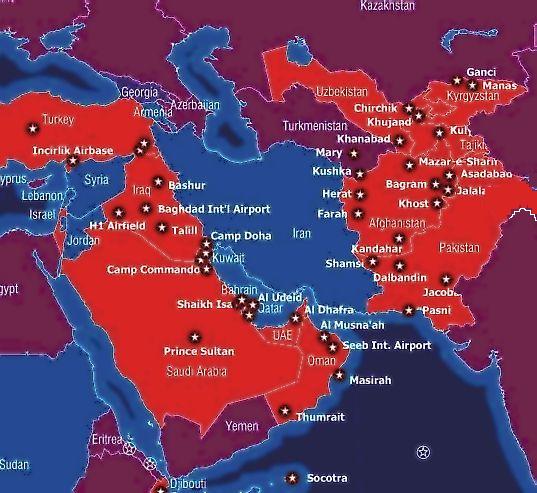
Iran under siege: Each star represents a U.S.-manned beacon of hope -- the only thing that stands between us and Armageddon.

Facebooktwittermail

How secret renditions shed light on MI6’s licence to kill and torture

The Guardian reports: In fiction, James Bond drew quite judiciously upon his licence to kill, bumping off just 38 adversaries in a dozen Ian Fleming novels. In each case, the individual received his or her just deserts.

In real life, MI6 insists its officers do not kill anyone. “Assassination,” its former head Sir Richard Dearlove has said, “is no part of the policy of Her Majesty’s government” and would be entirely contrary to the agency’s ethos.

But there can be circumstances in which MI6 officers do have a licence to kill or commit any other crime, enshrined in a curious and little-known law that was intended to protect British spies from being prosecuted or sued in the UK after committing crimes abroad.

Section 7 of the 1994 Intelligence Services Act offers protection not only to spies involved in bugging or bribery, but also to any who become embroiled in far more serious matters, such as murder, kidnap or torture – as long as their actions have been authorised in writing by a secretary of state.

And as such, the section is certain to come under intense scrutiny in the months ahead, as detectives and human rights lawyers pore over the details of the secret rendition operations that MI6 ran in co-operation with Muammar Gaddafi’s regime in 2004.

Last month Scotland Yard and the Crown Prosecution Service announced that the operations, in which two leading Libyan dissidents were abducted and taken to Tripoli with their families, were to be the subject of a criminal investigation.

A few days later lawyers for both families began civil proceedings against Sir Mark Allen, the former head of counter-terrorism at MI6, accusing him of complicity in their “extraordinary rendition”, torture and inhuman and degrading treatment. Proceedings against the government, MI6 and MI5 are to follow.

The case is based in large part upon a batch of documents discovered in an abandoned Libyan government office last September. These showed that the abductions were plotted with the help of MI6: it was all part of the rapprochement between Gaddafi and the UK and US that saw the dictator abandon his WMD programme and open oil and gas exploration opportunities to western firms.

When a researcher for Human Rights Watch stumbled upon the documents, no attempt was made to deny MI6 involvement in the rendition operations they described.

Instead, Whitehall sources immediately said the operations were part of “ministerially authorised government policy”. The statement was intended as a clear signal that a secretary of state had signed off a “clause 7 authorisation” under the Intelligence Services Act.

Section 7 is entitled Authorisation of Acts outside the British Islands, and says: “If, apart from this section, a person would be liable in the United Kingdom for any act done outside the British Islands, he shall not be so liable if the act is one which is authorised to be done by virtue of an authorisation given by the secretary of state under this section.”

It adds that liable in the United Kingdom “means liable under the criminal or civil law of any part of the United Kingdom”.

The “acts” can take place only overseas and remain illegal both under the laws of the country where they are committed and possibly under international law. But, section 7 says, with the stroke of a pen a secretary of state can rule that no UK law can be brought to bear.

Facebooktwittermail

Video: Is the U.S. occupation of Iraq really over?

Alternate Focus: With the departure of the last American soldier from Iraq, a bloody and expensive adventure ends—not with a bang, but with a whimper. As the Iraq War passes into history, Raed Jarrar, Tom Hayden, Nadia Keilani, and Johan Galtung comment on the lessons learned from this nine-year event, and debate whether the war and occupation are really over.

Facebooktwittermail

Dear Israel Lobby, we give up — please give us an acceptable way of insulting you

Joshua Holland writes: The latest round in the long and nasty debate over Israel, Palestine and our own government’s Mideast policy began with a coordinated campaign — initiated by a former AIPAC staffer and eagerly picked up by the conservative media — to marginalize a handful of progressive bloggers at the Center for American Progress and Media Matters who wrote critically of Israel’s hard-right government and called its enablers in the United States “Israel Firsters.” (I wrote about the dust-up in December.)

The back and forth has continued since then, and it’s now become clear that we need to offer a simple challenge to those who say that such terms are beyond the pale because they bear some vague resemblance to some old “anti-Semitic trope” or another. What, exactly, is an acceptable way of mixing it up with these people? How can we marginalize their malign policy preferences without being smeared as anti-Semites or self-loathing Jews?

America’s political discourse is not a garden party. We’re factionalized, and we throw sharp elbows, especially online, where conservatives call liberals “moonbats,” and accuse them of hating America, and liberals lob back terms like “wingnut,” and accuse their counterparts of being morons.

In the debate over Israel and Palestine – and U.S. policy in the Middle East – one side has been disarmed, their derogatory labels rejected as singularly unacceptable, while their opponents remain free to use the coarsest insults against them with impunity.

The problem stems from the objective fact that there are a group of Americans – disproportionately represented among right-wing Christian evangelicals and older generations of Jewish-Americans – who ally themselves with the Israeli government. They do so regardless of its ideological bent at the moment and deny that the Palestinians have legitimate grievances (sometimes going so far as to deny their existence). They wish away the cruelty of the occupation, pretend that there are only rejectionists on the Palestinian side and Israel only wants peace, claim Israel has never violated international law or trampled on human rights, insist that Israeli Arabs don’t face hostility and discrimination and go around calling everyone who disagrees anti-Semites and terror supporters.

And despite the fact that their views are totally out of sync with most liberal Israelis, and many of the policies they favor, like a military attack on Iran, would likely result in an utter disaster for Israel as well as its neighbors, they insist on calling themselves “pro-Israel.”

People who do not accept these arguments have attempted to characterize the views of this group and to come up with a variety of typically rough-and-tumble labels to apply t it. But all of them have been condemned as entirely out of bounds because, if held up to the light in just the right way, they kind of, sort of resemble some old anti-Semitic stereotype.

Facebooktwittermail

Explosions in Bangkok but no known target

The New York Times reports from Bangkok: A series of explosions rocked a residential neighborhood here on Tuesday, leading Thai authorities to a cache of bombs in a rented house and the capture of two men identified in Thai media reports as Iranians. A third suspect was being sought.

Witnesses said the three men, all of whom appeared to be foreigners, fled a house in the Sukhumvit neighborhood of Bangkok after an explosion in the early afternoon tore off the roof of the house. Two of the men ran immediately from the house, witnesses said; one was later detained at the city’s main international airport. The third man emerged shortly after the first two, seeming disoriented, with his face and ears bloodied, they said. As the third man tried to leave the area, he threw two grenades, one at a taxi and one at approaching police officers. The blast from the second struck him, however, blowing off his legs and injuring several Thais.

As of late Tuesday no evidence had emerged connecting the explosions in Bangkok with the escalating tensions between Iran and Israel. But the Israeli defense minister, Ehud Barak, linked the explosions with the attacks on Israeli Embassy personnel on Monday in the capitals of India and Georgia, which Israel blamed on Iran and on Hezbollah, the Lebanon-based militant group Iran backs.

“The attempted terrorist attack in Bangkok proves once again that Iran and its proxies continue to perpetrate terrorism,” Mr. Barak said. “The recent terror attacks are yet another example of this.” Mr. Barak, who had been in Bangkok for a few hours on Sunday, made his comments Tuesday in Singapore, according to a statement from his office. “Iran and Hezbollah are unrelenting terror elements endangering the stability of the region and the stability of the world,” Mr. Barak added.

It’s a bit soon to talk about the geostrategic implications of whatever happened in Bangkok. Whoever these guys were, they clearly didn’t belong to anyone’s A-team. The only thing they seemed to have to had a talent in was unintentionally blowing themselves up.

Facebooktwittermail

Is this how Newsweek hopes to get raised from the dead?

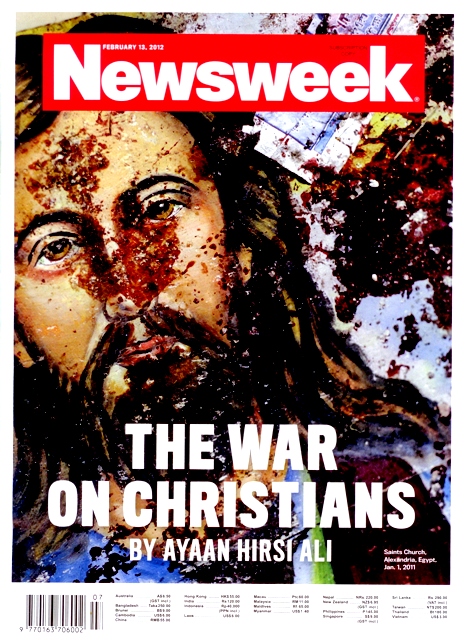
Newsweek’s current cover looks like a promotion for a Glenn Beck special: The War on Christians. No doubt the magazine’s editors thought they could get away with such a provocative headline because the byline lends it a token of authority.

Were this declaration to come from Beck or anyone of his ilk, it would be dismissed by Newsweek’s editors and many of its readers as conservative hysteria, but spouted by a celebrity former Muslim it suddenly demands serious attention. There also comes a side benefit — “The War on Christians” is a conservative mantra, from their lips referring to a war supposedly being fought by President Obama against Christians, so perhaps Newsweek felt like it might be doing some useful and surreptitious rebranding, decoupling Obama from this slur.

At GetReligion.org, Terry Mattingly observes that Newsweek these days is short on news.

As a rule, under super-editor Tina Brown, it has been an at times lively but ultimately confusing mixture of commentary, commentary and more commentary…

And the NEWS in Newsweek? That’s the strange part. The goal of the magazine seems to be to handle serious news topics (mixed with entertainment topics, of course) but in a way that it is impossible to take seriously as journalism. Newsweek is becoming the land of the unattributed fact.

To see this process at work, please read the Ayaan Hirsi Ali cover story discussing “The War on Christians in the Muslim World.” In this case, the cover’s zinger quality is provided by the author’s identity as a Muslim apostate, atheist, militant secularist and defender of old-fashioned human rights — such as religious liberty and free speech. Ali is so liberal that she is now considered, by many, to be a conservative.

In an interview with MSNBC, Newsweek executive editor Justine Rosenthal draws on one of the unattributed “facts” provided by Hirsi Ali: “In Egypt, for example, 200,000 Coptic Christians have fled their homes and very little is being done to stop that sort of violence.”

On what does Hirsi Ali base her claim that 200,000 Copts have fled?

The only reference I can find to this number of Copts fleeing is a Washington Times report in October last year which said:

A report released last month by an Egyptian nongovernmental organization estimated that 93,000 Christians already had fled the country since March, a figure some are predicting could top 200,000 by the end of year.

It would appear that this prediction made by persons unknown got turned into a “fact” by Hirsi Ali and now Newsweek is happy to cite this as a piece of evidence upon which it wants to buttress its cover story.

As for the cover itself, no doubt the magazine’s editorial team found the blood-stained image of Christ an irresistible piece of iconography, but I wonder whether they delved at all into the story behind the photograph.

On New Year’s Day, 2011, the Coptic al-Qiddissin (Saints) Church in Alexandria, where the photo was taken, was the target of a bombing that killed 23 people, Christians and Muslims, while 97 more were injured. The attack was internationally condemned and widely perceived as evidence of sectarian tension. The Interior Ministry blamed “foreign elements,” and the Alexandria governor accused al Qaida of being responsible, yet in a foretaste of the nationwide protests that were to erupt three weeks later, Christians unleashed their rage not at their Muslim neighbors but at the authorities.

Former Interior Minister Habib el-Adly in the U.S.-backed Mubarak government was later accused of having instigated the bombing.

In the following days, fearing that Churches might face similar attacks, Muslims formed human shields in order to defend Copts going to worship.

There’s no question that in Egypt and elsewhere Christians have been the targets of sectarian violence, but what Newsweek is doing is shamelessly promoting the view that Christianity is under attack by Islam. We’re back in the territory of a clash of civilizations — but no mention of another phenomenon: the attacks upon Christians that occur daily in Israel.

How does Hirsi Ali want to see “Christophobia” addressed?

As for what the West can do to help religious minorities in Muslim-majority societies, my answer is that it needs to begin using the billions of dollars in aid it gives to the offending countries as leverage.

It might be hard for the U.S. to apply such leverage since there is only one country to which the U.S. actually gives billions of dollars of aid each year: Israel.

Facebooktwittermail

U.S. government looks to mine social media to combat terrorist attacks, uprisings

The Associated Press reports: The U.S. government is seeking software that can mine social media to predict everything from future terrorist attacks to foreign uprisings, according to requests posted online by federal law enforcement and intelligence agencies.

Hundreds of intelligence analysts already sift overseas Twitter and Facebook posts to track events such as the Arab Spring. But in a formal “request for information” from potential contractors, the FBI recently outlined its desire for a digital tool to scan the entire universe of social media — more data than humans could ever crunch.

The Department of Defense and the Office of the Director of National Intelligence also have solicited the private sector for ways to automate the process of identifying emerging threats and upheavals using the billions of posts people around the world share every day.

“Social media has emerged to be the first instance of communication about a crisis, trumping traditional first responders that included police, firefighters, EMT, and journalists,” the FBI wrote in its request. “Social media is rivaling 911 services in crisis response and reporting.”

The proposals already have raised privacy concerns among advocates who worry that such monitoring efforts could have a chilling effect on users. Ginger McCall, director of the open government project at the Washington, D.C.-based Electronic Privacy Information Center, said the FBI has no business monitoring legitimate free speech without a narrow, targeted law enforcement purpose.

“Any time that you have to worry about the federal government following you around peering over your shoulder listening to what you’re saying, it’s going to affect the way you speak and the way that you act,” McCall said.

Facebooktwittermail

Myth debunked: Palestinian textbooks don’t teach hatred

Daoud Kuttab writes: Apologists for Israel’s continued occupation and control over Palestinian lives have long contended Israel is more interested in peace than the Palestinians. One exaggerated argument, repeatedly put forward to justify military rule, is that Palestinians teach their children to hate Jews.

Politicians in the U.S., especially during election campaigns, find that bashing Palestinians has no downside and yields a vote (and donation) jackpot.

Palestinian textbooks are scrutinized for any hostile reference to Israel — or praise for Palestinian nationalism — and every frame broadcast on Palestinian television stations is analyzed by experts to see if it contains any incitement to violence.

Palestinian-Israeli committees spent hours researching these issues and concluded that there is no textbook glorification of violence or hate. European and bipartisan American committees reached similar conclusions. But the anti-Palestinian attacks never stopped. All the efforts to respond scientifically and comprehensively to the unsubstantiated barrage of attacks failed to change the narrative that anti-Palestinian forces, especially in the United States, were keen on perpetuating.

Facebooktwittermail

Righteous indignation rant of the day

Glenn Greenwald writes: During the Bush years, Guantanamo was the core symbol of right-wing radicalism and what was back then referred to as the “assault on American values and the shredding of our Constitution”: so much so then when Barack Obama ran for President, he featured these issues not as a secondary but as a central plank in his campaign. But now that there is a Democrat in office presiding over Guantanamo and these other polices — rather than a big, bad, scary Republican — all of that has changed, as a new Washington Post/ABC News poll today demonstrates:

The sharpest edges of President Obama’s counterterrorism policy, including the use of drone aircraft to kill suspected terrorists abroad and keeping open the military prison at Guantanamo Bay, Cuba, have broad public support, including from the left wing of the Democratic Party.

A new Washington Post-ABC News poll shows that Obama, who campaigned on a pledge to close the brig at Guantanamo Bay and to change national security policies he criticized as inconsistent with U.S. law and values, has little to fear politically for failing to live up to all of those promises.

The survey shows that 70 percent of respondents approve of Obama’s decision to keep open the prison at Guantanamo Bay. . . . The poll shows that 53 percent of self-identified liberal Democrats — and 67 percent of moderate or conservative Democrats — support keeping Guantanamo Bay open, even though it emerged as a symbol of the post-Sept. 11 national security policies of George W. Bush, which many liberals bitterly opposed.

Repulsive liberal hypocrisy extends far beyond the issue of Guantanamo. A core plank in the Democratic critique of the Bush/Cheney civil liberties assault was the notion that the President could do whatever he wants, in secret and with no checks, to anyone he accuses without trial of being a Terrorist – even including eavesdropping on their communications or detaining them without due process. But President Obama has not only done the same thing, but has gone much farther than mere eavesdropping or detention: he has asserted the power even to kill citizens without due process. As Bush’s own CIA and NSA chief Michael Hayden said this week about the Awlaki assassination: “We needed a court order to eavesdrop on him but we didn’t need a court order to kill him. Isn’t that something?” That is indeed “something,” as is the fact that Bush’s mere due-process-free eavesdropping on and detention of American citizens caused such liberal outrage, while Obama’s due-process-free execution of them has not.

Beyond that, Obama has used drones to kill Muslim children and innocent adults by the hundreds. He has refused to disclose his legal arguments for why he can do this or to justify the attacks in any way. He has even had rescuers and funeral mourners deliberately targeted. As Hayden said: ”Right now, there isn’t a government on the planet that agrees with our legal rationale for these operations, except for Afghanistan and maybe Israel.” But that is all perfectly fine with most American liberals now that their Party’s Leader is doing it:

Fully 77 percent of liberal Democrats endorse the use of drones, meaning that Obama is unlikely to suffer any political consequences as a result of his policy in this election year. Support for drone strikes against suspected terrorists stays high, dropping only somewhat when respondents are asked specifically about targeting American citizens living overseas, as was the case with Anwar al-Awlaki, the Yemeni American killed in September in a drone strike in northern Yemen.

The Post‘s Greg Sargent obtained the breakdown on these questions and wrote today:

The number of those who approve of the drone strikes drops nearly 20 percent when respondents are told that the targets are American citizens. But that 65 percent is still a very big number, given that these policies really should be controversial.

And get this: Depressingly, Democrats approve of the drone strikes on American citizens by 58-33, and even liberals approve of them, 55-35. Those numbers were provided to me by the Post polling team.

It’s hard to imagine that Dems and liberals would approve of such policies in quite these numbers if they had been authored by George W. Bush.

Indeed: is there even a single liberal pundit, blogger or commentator who would have defended George Bush and Dick Cheney if they (rather than Obama) had been secretly targeting American citizens for execution without due process, or slaughtering children, rescuers and funeral attendees with drones, or continuing indefinite detention even a full decade after 9/11? Please. How any of these people can even look in the mirror, behold the oozing, limitless intellectual dishonesty, and not want to smash what they see is truly mystifying to me.

As Greenwald’s regular readers know, he never holds back in screaming his indignation. It’s guaranteed to be a crowd please. But to go on a rant about the hypocrisy of Obama’s supporters and then stall by saying that it is mystifying, seems to me like a cop-out.

That critics of Bush’s counter-terrorism policies would refrain from criticizing Obama as he extends the reach of many of those policies is indeed hypocritical, but where does the hypocrisy come from?

From what I can tell, it is rooted in America’s collective response to 9/11. What the attacks demonstrated was the ease with which Americans can be terrorized. The willingness with which Americans of all political stripes swallowed the terrorism narrative from that day onwards was the license that guaranteed to whoever was in power, the ability to expand government power with minimal challenges so long as this was done in the name of combating terrorism.

Democrats have no more interest in questioning the imputed entities, terrorism and terrorists, than do their Republican counterparts. Why? Because to do so is to lower a barrier whose strength must be maintained if Americans want to persist in avoiding coming to terms with the humiliation of 9/11. Terrorism, we would rather believe, is a mighty force which must be boldly challenged.

The affront to American pride on that day came not from the force of the attacks but from the fact that this country could be brought to its knees by a small bunch of somewhat ordinary young men.

This is not to deny that what those young men did on that day was indeed terrible, inhumane and unjustifiable, but the massive overreaction they provoked revealed the political and social breadth and depth of American cowardice.

It is cowardice that sanctions wars, torture, assassinations, indefinite detention, and the suspension of civil liberties and that cowardice has never been less evident among Democrats than among Republicans.

But here’s one of the biggest ironies: the revival of the truism that one man’s terrorist is another man’s freedom fighter is now coming from Republicans.

After this week’s revelation that Israel is training and deploying terrorists from Mujahideen-e Khalq (MEK) in Iran, Commentary’s Jonathan Tobin responds:

The MEK are allies of convenience and, just like many wartime allies in other conflicts, share only a common enemy with Israel. But however nasty they may be, Israel need not blush about using them. For a democracy at war, the only truly immoral thing to do would be to let totalitarian Islamists like those in Tehran triumph.

Those who look favorably on this particular alliance of convenience also have a convenient solution for the political problem of being seen to support a designated terrorist organization — they argue the designation should simply be removed.

I would go one much larger and more radical step further and argue that the designation “terrorist” has no play in law.

The function of law is to regulate behavior — not ontological status. No one gets convicted of being a murderer. They can only be found guilty of murder, attempted murder, or conspiracy to commit murder. These are all actions — not mere thoughts, intentions, or affiliations.

It’s time that more individuals in this country stood up and expressed a truth that has long been widely understood: terrorism is nothing more than a political technique employed for a psychological effect. If we separate security from politics, all we do is ensure that the political causes for the use of violence will neither be thoroughly examined nor effectively addressed.

Facebooktwittermail

Social fractals and the corruption of America

Charles Hugh Smith writes: Social fractals and social control myths help explain the complete corruption of America.

Correspondent Kathy K. recently elucidated a powerful concept: social fractals. We typically think of fractals–structures that are scale-invariant–as features of Nature or finance. For example, a coastline has the same characteristically ragged appearance from 100 feet, 1,000 feet and 10,000 feet in altitude. It is scale-invariant, i.e. its characteristics remain constant whether it is viewed on a small, medium or large scale.

This is how Kathy described social fractals:

This dishonest, self-serving individual behavior is a fractal of what is happening in our society at large: dishonest and self-serving people are extending and pretending, and their complicity keeps the system going.

The concept of social fractals can be illustrated with a simple example. If the individuals in a family unit are all healthy, thrifty, honest, caring and responsible, then how could that family be dysfunctional, spendthrift, venal and dishonest? It is not possible to aggregate individuals into a family unit and not have that family manifest the self-same characteristics of the individuals. This is the essence of fractals.

If we aggregate healthy, thrifty, honest, caring and responsible families into a community, how can that community not share these same characteristics? And if we aggregate these communities into a nation, how can that nation not exhibit these same characteristics?

If this is so, then how do we explain the complete corruption of America’s financial and political Elites?
What else can you call a nation that passively accepts financial predation, looting, robosigning, etc. by protected cartels as the Status Quo but thoroughly corrupt?

There are three distinct but highly interactive dynamics in America’s social and financial fractals that have led to the nation’s corruption. We can think of these dynamics as feedback loops: positive feedback is self-reinforcing, negative feedback offers restraint and opposition. From Wikipedia:

Negative feedback is used to describe the act of reversing any discrepancy between desired and actual output. A simple and practical example is a thermostat. Biological examples include regulating body temperature and blood glucose levels.

Positive feedback is feedback in which the system responds so as to increase the magnitude of any particular perturbation, resulting in amplification of the original signal instead of stabilization. Any system where there is a net positive feedback will result in a runaway situation.

These dynamics also share certain characteristics of the dialectic method in philosophy, a system of reasoning through arguments and counter-arguments (thesis and antithesis) to reach a synthesis or new understanding. The Socratic method is to show that a given hypothesis leads to a contradiction that forces the withdrawal of the hypothesis as a candidate for truth.

The social fractal element is individual behavior: the actions we choose based on our internal values, emotions, worldview and goals, and our belief in social control myths. [Continue reading…]

Facebooktwittermail