



Michael Hudson writes: For an unforgettable “Groundhog Day” experience, there is nothing better than a trip to Palestine and Israel. We’ve experienced multiple revolutions over the past six decades in information technologies, social mores and political upheavals.
The Soviet empire collapsed, democracy advanced around the globe, Asia began to rise and the West began to decline. It is all quite disorienting. But one thing remains constant: The Arab-Israeli conflict. It just grinds on and on.
For those of us who have been studying it professionally, there is something oddly reassuring about that. For most others not directly involved, it has just become boring. Too bad, because, like a smoldering peat fire, the Palestine problem helps keep the entire Middle East on the boil.
Here are some verbal snapshots from a recent visit to Palestine and Israel.
Getting out of Fortress Israel into the promised land of Palestine is not nearly as difficult as getting back in. Ramallah has become a boom town, far different from the sleepy metropolis it used to be.
“There’s lots of money here,” my taxi driver observed, “but not so much anywhere else in the West Bank.” A lot of that money comes from Western donors to support that sickly enterprise known as the Palestinian Authority. Other money is coming in from the Gulf. Land prices are out of sight.
The Palestinian prime minister, Salam Fayyad, darling of Washington and the World Bank, is building small city that would aspire to be Dubai or Singapore. But Ramallah, like the other main towns of the West Bank, is hemmed in by Israeli checkpoints. And for a Palestinian to get from Ramallah to Bethlehem requires a two-hour (or more, depending on delays at checkpoints) journey down into the Jordan valley and back up again, which could be done via Jerusalem in a half-hour were there no Israeli obstacles.
Arab Jerusalem (the east side including the Old City) is languishing economically and socially because it is now effectively cut off from its natural hinterland – Bethlehem and Hebron to the south, Ramallah, Nablus and Jenin to the north.
If you want to contemplate the possibilities of the two-state solution, there is no better place to do so than on a drive between Ramallah and Nablus. Where is this other state going to be, anyway? I got a ride with a friend who has been making the trip regularly for some years. She said the pace of settlement construction has dramatically increased under Netanyahu’s regime.
At every crossroads there are signs and roads to new Israeli settlements, and on virtually every hilltop there is a new “outpost”. Settlers continue to seize the agricultural lands belonging to Palestinian villages. By any conception of a genuine state, with territorial contiguity, these settlements would have to go. But is there any Israeli government, hawkish or dovish, that could make that happen?
The Daily Telegraph reports: Syrian army defectors attacked an intelligence complex on the edge of the capital Damascus early on Wednesday, following reports the country will boycott today’s Arab League meeting.
Wednesday’s attack was the first such reported assault on a major security facility in the eight-month uprising against Assad, activists said.
Members of the Free Syrian Army fired shoulder-mounted rockets and machineguns at a large Air Force Intelligence complex situated on the northern edge of the capital on the Damascus-Aleppo highway at about 2:30 a.m. (0030 GMT).
A gunfight ensued and helicopters circled the area, the sources said.
Meanwhile the rebel Free Syrian Army announced on Wednesday the creation of a temporary military council with the aim of ousting the regime of President Bashar al-Assad and protecting civilians from his forces.
“Based on the requirements of this phase and the demands of the Syrian revolution, the Free Syrian Army is establishing a temporary military council,” a statement said.
Meg Wade writes: Through our direct actions, our occupations, we have changed the international conversation. Two months ago, the country was talking about the need for austerity, not accountability on Wall Street. Now, because of Occupy Wall Street, walking down the street you will hear people talking about the ethics of bailouts, economic inequality, the crisis of deregulation, social justice and direct democracy.
What’s more, in every circle, these conversations are moving forward and taking on a life of their own. They are not limited to the space of Liberty Square, and by no means do they rely on it.
Just as the direct action and nonviolent resistance of the 1960s focused the national conversation on the immorality of segregation, and created the political space for the passage of the Civil Rights Act, so, too, has Occupy Wall Street focused the conversation on the rogue thievery of Wall Street. We have created the political space for radical change.
We’ve also had more tangible successes. In solidarity with the Move Your Money campaign, more than a half a million people moved at least $4.5bn out of the big casino banks and into responsible local credit unions, leading up to 5 November Bank Transfer Day.
Occupiers working with grassroots groups have forged incredible victories, unimaginable less than two months earlier. Just a few days ago, Occupy Cleveland mobilised in cooperation with Ohio labor unions to overturn Bill 5’s attack on collective bargaining rights. In Boulder, Colorado and Missoula, Montana, occupiers worked with Move to Amend to pass local resolutions calling for a constitutional amendment to reverse Citizens United and eliminate corporate personhood and corporate constitutional rights.
Which leads me to one of our biggest successes: modeling radically inclusive, democratic alternatives to our current system of governance. Nearly every Occupy has found itself plunged into discussions of what it means to speak as “the 99%”, and how to address issues of unchecked sexism, racism and class privilege, some of the longest-running issues Americans face.
Michael Powell writes: The Bank of America lawyer laid down a patented rhetorical move heard in courts across America. Your Honor, this Orange County, N.Y., homeowner — a New York City police officer — didn’t make enough money to qualify for a mortgage modification. He didn’t send us the right documents.
He didn’t, he didn’t, he didn’t, and so we should be allowed to foreclose.
Justice Catherine M. Bartlett of New York State Supreme Court cut off the lawyer. You, she said, are telling me lies.
“Bank of America got a bailout, and this is an outrage, how this man has been treated,” she said. “Hard-working, middle-class Americans are trying to make it, trying to refinance with your bank.”
Either bank officials show up in person, the justice said, or I’m going to order them “here in handcuffs.”
Rage has acquired a cleansing power. Patience as a virtue is a hard sell at the burnt end of a four-year economic collapse. Zuccotti Park shakes, rattles and rolls; television yakkers chat about inequality; and the federal judge Jed Rakoff all but heckled the Securities and Exchange Commission last week for going easy on Citigroup misbehavior.
Then there is Eric T. Schneiderman, New York’s attorney general, caught in Month 5 of a face-off with the White House. President Obama dearly wants to seal a deal in which the nation’s largest banks toss over a few bales of cash — $20 billion to help with foreclosure relief — and the state attorneys general agree not to pursue sprawling and explosive legal cases against the banks.
Mr. Schneiderman and Attorney General Beau Biden of Delaware, joined by a few others, say no. Banks, they say, should disgorge more documents, testify more precisely and prove more completely that they own millions of mortgage notes. These rebel attorneys general want the banks to hand over more than $200 billion, which would enable the government to write down tens of millions of mortgages.
But in the end, their argument is elemental: Wouldn’t the nation benefit from knowing the truth about the behavior of banks and bankers?
Josh Harkinson describes what he witnessed at Zuccotti Part in the early hours this morning: Nobody bothered to stop me as I strode up to the park’s northern entrance and stopped against a wall, a few yards from where police in helmets surrounded the the remaining occupiers.
Next to me, an officer was telling an important-looking guy named Eddie about “the intel we’ve had over the past couple of months” about “the severely mentally retarded, the ones that are real fucked up in the head, and have been violent in the past.” He went on: “They are a little off kilter. They’re off their meds. They haven’t had meds in 30 days.”
“I’m only 24 hours off mine,” Eddie joked.
“It’s good for you, Eddie,” the cop said. “You’ve got to come clean every once in a while.”
As the two men talked, a sweaty-faced man wearing a neon vest over a business suit walked up and started tearing protest signs off the wall.”I couldn’t wait,” he said. “Destroying things never felt so good.”
“Really,” someone said, almost inflecting the word as a question.
“They’re fucking assholes,” the guy in the suit shot back.
Another guy came up to Eddie. “How are we about hooking up the fire hydrants?” he asked. “We talkin’ to somebody?”
“Do it. Do it,” Eddie said over the roar of a garbage truck.
A few yards away, the last occupiers took turns waving a large American flag. Huddled inside the park’s makeshift kitchen, they seemed as diverse as Occupy Wall Street: There was a shaggy punk in a spiky leather jacket. A young girl in a red sweatshirt that read “Unity.” Clean-shaven guys wearing glasses. A shirtless occupier named Ted Hall, who has led an effort to hone the movement’s “visions and goals.” All of them surrounded a smaller group of occupiers who’d chained their necks to a pole.
A white-shirted officer moved in with a bullhorn. “If you don’t leave the park you are subject to arrest. Now is your opportunity to leave the park.”
Nobody budged. As a lone drum pounded, I climbed up on the wall to get a better view.
“Can I help you?” an burly officer asked me, his helpfulness belied by his scowl.
“I’m a reporter,” I told him.
“This is a frozen zone, all right?” he said, using a term I’d never heard before. “Just like them, you have to leave the area. If you do not, you will be subject to arrest.”
By then, riot police were moving in, indiscriminately dousing the peaceful protesters with what looked like pepper spray or some sort of gas. As people yelled and screamed and cried, I tried to stay calm.
“I promise to leave once the arrests are done,” I replied.
“No, you are going to leave now.”
He grabbed my arm and began dragging me off. My shoes skidded across the park’s slimy granite floor. All around me, zip-cuffed occupiers writhed on the ground beneath a fog of chemicals.
“I just want to witness what is going on here,” I yelped.
“You can witness it with the rest of the press,” he said. Which, of course, meant not witnessing it.
“Why are you excluding the press from observing this?” I asked.
“Because this is a frozen zone.”
AFL-CIO chief Richard Trumka circulated this email today: They can take away the tarps and the tents. But they can’t slow down the Occupy Wall Street movement.
There have been police raids on Occupy Wall Street in Oakland, Calif.; Portland, Ore.; Denver; Albany, N.Y.; Burlington, Vt.; and Chapel Hill, N.C. — and now, last night in New York’s Zuccotti Park — orchestrated by politicians acting on behalf of the 1%.
But the 99% is undaunted. Occupy Wall Street’s message already has created a new day. This movement has created a seismic shift in our national debate — from austerity and cuts to jobs, inequality and our broken economic system.
Show your solidarity by attending a Nov. 17 bridge action near you.
And send a message of solidarity to the Occupy Wall Street protesters — which will be delivered by Working America this week.
The Occupy Wall Street movement has been committed to peaceful, nonviolent action from its inception. And it will keep spreading no matter what elected officials tell police to do. But that doesn’t mean these raids are acceptable. In fact, they are inexcusable.
As former Secretary of State Colin Powell put it, these protests are “as American as apple pie.” Americans must be allowed to speak out against pervasive inequality, even if the truth discomfits the 1%…
We are the 99%.
In Solidarity,
Richard L. Trumka
President, AFL-CIO
John Gray writes: The Occupy movements have been attacked for being impractical visionaries. In fact it is the established political classes of the west that are wedded to utopian thinking, while the protesters are recalling us to the actualities of human experience. Based on economic theories that left out human beings, the global free market was supposed to be self-regulating. Now a process of disintegration is under way, in which the structures set up in the post-cold-war period are visibly breaking up.
Anyone with a smattering of history could see that the hubristic capitalism of the past 20 years was programmed to self-destruct. The notion that the world’s disparate societies could be corralled into a worldwide free market was always a dangerous fantasy. Opening up economies throughout the world meant ordinary people were more directly exposed to the gyrations of market forces than they had been for generations. As it overthrew existing patterns of life and robbed large numbers of people of any security they might have achieved, global capitalism was bound to trigger a powerful blowback.
For as long as it was able to engineer an illusion of increasing prosperity, free-market globalisation was politically invulnerable. When the bubble burst, the actual condition of the majority was laid bare. In the US a plantation-style economy has come into being, with debt-servitude for the many coexisting with extremes of volatile wealth for the few. In Europe the muddled dream of a single currency has resulted in social devastation in Greece, mass unemployment in Spain and other countries, and even, for some, reversion to a life based on barter: sucking society into a vortex of debt deflation, austerity policies are driving a kind of reverse economic development. In many countries a settled bourgeois existence – supposedly the basis of popular capitalism – has become an impossible aspiration. Large numbers are edging closer to poverty and a life without hope.
History tells us how perilous this process can be. It has been taken for granted that a sudden collapse of the kind that occurred in the former Soviet Union and more recently Egypt cannot happen in advanced market economies. That assumption may be tested severely in coming years. While totalitarian mass movements of the sort seen in the 30s are not going to return, Europe’s demons have not gone away. Blaming minorities and immigrants is a perennially popular response to economic dislocation, and ethnic nationalism can be hideously destructive. In the US the continuing demise of the middle class could engender a style of politics even more rancorous and unhinged than that prevailing today. A figure such as Father Coughlin, the Depression-era radio demagogue, shows what can be expected as the economy continues its slide. With the rise of trigger-happy politicians like Mitt Romney and the need for Obama to act tough, it would be unwise to rule out the prospect of another major war.
Reza Marashi writes: Iranian foreign minister Ali Akbar Salehi made headlines recently when he said the Islamic Republic would like to have friendly relations with the United States—but not under the current conditions. He added that while U.S. officials express a desire for discussions, U.S. actions don’t always conform to that expression. In the meantime, “negotiations will certainly not have any meaning.”
For their part, American officials accuse the Iranians of a similar inconsistency. As Secretary of State Hillary Clinton put it recently to BBC Persian, “We are prepared to engage, if there is willingness on the other side, and we use sanctions—and the international community supports the use of sanctions—to try to create enough pressure on the regime that they do have to think differently about what they are doing.”
In an increasingly dangerous region where adversaries repeatedly provoke one another, it is important to dig beyond the rhetoric of this increasingly intense confrontation to better understand how the Iranian government views its own geopolitical standing. The thirty-two year absence of direct communication channels between America and Iran has fostered a dangerous cycle of miscalculation, misunderstanding and escalation. Salehi’s remarks reflect an Iranian view—based largely on these misperceptions and miscalculations—that time is on Tehran’s side.
Contrary to popular assumptions in Washington, the Iranian government’s skepticism regarding negotiations is not rooted in an ideological opposition to improving relations with the United States. Rather, Tehran perceives political constraints—both foreign and domestic—that limit Washington’s ability to engage in substantive diplomacy. Therefore, Iranian decision makers appear willing to wait and try again when events seem more propitious.
It is important to understand that Iran does not see itself as weakened by bilateral tensions and regional flux. Thus, hard-liners in Tehran grow more confident from perceived U.S. missteps and strongly oppose any relations with America that would require Iranian acquiescence to the status quo regional order and undermine Tehran’s perceived independence.
Iran’s long-term security calculation sees no downside in rejecting any engagement with Washington that places Iran in the role of compliant U.S. ally. Iranian decision makers see no example in the Middle East of relations with the U.S. based on equal footing. Patron-client relations are the norm, a norm Iran rejects for itself.
Zvi Bar’el reports: It appears that Iranian President Mahmoud Ahmadinejad can rest easy for now, as voices coming from the European Union suggest a military operation is not in the offing. Not only do Syria and China reject such an attack, but on Monday, Germany, France and Turkey added their voices to those objecting to a military option. The United States also does not seem thrilled at the prospect of launching another war in the region.
The European and American plan to impose another dose of sanctions on Iran may be worrisome, but it likely isn’t threatening as long as China, Russia and several of the Gulf states continue regular trade relations with Iran.
The effort to impose restrictions on the export of gasoline to Iran, which can only supply 60 percent of its own demand, is unlikely to come to fruition, as some fear the restrictions would only harm the citizenry and not the regime. Furthermore, the efficacy of such a plan remains doubtful. Iran recently declared that it is capable of producing more gasoline; with a strict rationing program it might well be able to overcome the entire shortage. This would not necessarily mean that Iran could successfully supply its demand for gasoline over the long term, but it would certainly be able to significantly reduce its dependence on foreign imports.
The more ambitious aim of obtaining a UN Security Council resolution to impose international sanctions will have to wait, especially given Russia’s efforts to promote – together with Iran – a new diplomatic plan that is being dubbed “Step by Step.” Under the plan, Iran will begin to respond to the International Atomic Energy Agency’s demands. In exchange for every satisfactory response, the international community would gradually roll back the existing sanctions on Iran.
Iran’s deputy foreign minister visited Moscow last week to discuss this idea with his Russian counterpart, and on Sunday the Russian deputy foreign minister for Middle Eastern affairs, Mikhail Bogdanov, went to Tehran to discuss the joint diplomatic effort with Iranian Foreign Minister Ali Akbar Salehi.
Meanwhile, Iran is adopting a new line of public diplomacy aimed both at Europe and the United States. Yesterday Salehi declared, “Strengthening the ties between Europe and Iran will be very helpful to Europe, since if Turkey joins the European Union, Iran will be a close neighbor of Europe’s.”
Over the weekend Ahmadinejad also said that “The Iranians are a nation of culture and logic, and are not warmongers.” The remarks, made at an event marking the unveiling of ancient artifacts returned by Britain to Iran, received big headlines in the Iranian press.
It is not clear what Ahmadinejad meant by “logic,” yet it notably was Ahmadinejad who initiated the 2010 agreement to deposit Iranian uranium in Turkey. Ahmadinejad is also believed to lead a certain school of thought that maintains it is better to come to an agreement with the West now, as opposed to the views of much of the radical religious leadership, which objects to any agreement.
In the end, Ayatollah Ali Khamenei will be the one to decide whether to promote any new diplomatic options. But the assessment that he still hasn’t given the green light for the production of nuclear weapons seemingly leaves the window of diplomatic opportunity open.
Ahmadinejad also can rest easy about his domestic situation. Yesterday he got some unexpected support from Mohammad Khatami, Iran’s former president, who is considered the leader of the Iranian opposition, and who until now never failed to criticize his rival. Khatami declared that if there were an attack on Iran, all groups – those that want reform and those that don’t – would unite to rebuff the attack.
Khatami defined the Israeli threat as “psychological warfare and a bluff,” but expressed concern that such psychological warfare could persuade the international community that an attack on Iran was possible.
Iranian opposition sources say that the debate over a possible attack on Iran plays directly into Ahmadinejad’s hands, since it boosts his political position not only vis a vis the opposition, but also vis a vis the supreme leader, Khamenei, whose confidants see Ahmadinejad as a political threat.
Tony Karon writes: If Iran’s leaders actually believe their official insistence that last weekend’s blast at the Bid Ganeh Revolutionary Guard Corps missile base was an accident, the event is unlikely to make any difference to regional stability. But if Iran, instead, believes claims — and widely held suspicions in Tehran — that the blast, which killed 17 Iranian guardsmen including a senior commander, was the work of Israel’s Mossad security agency (as reported by my TIME colleagues Karl Vick and Aaron Klein and a growing chorus of innuendo in the Israeli media) the region could be in for a sharp uptick in turbulence.
Iranian analyst Kaveh Afrasiabi notes that officials in Tehran suspect foul play not only in the Bid Ganeh blast, but also in the death under suspicious circumstances in a Dubai hotel of the son of a prominent former Revolutionary Guards commander, and suggests that if these are deemed hostile events, pressure will grow on the Iranian leadership to retaliate.
Iran has over the past couple of years absorbed a series of covert warfare blows directed against its nuclear program — assassinations of its scientists, sabotage of facilities and, most damaging, the Stuxnet computer worm that invaded and hobbled its uranium-enrichment centrifuge system — which Tehran’s leaders believe were largely the work of the Israelis, possibly in conjunction with other Western intelligence agencies. And tensions are rising as Israel threatens military action to stop a program whose potential military dimension was highlighted last week by the IAEA.
Thus far, however, Tehran has declined any significant retaliation for actions it clearly perceives as provocations. Some of the spin in Washington had floated the idea that the recent used car salesman-embassy bombing plot was, in fact, an instance of Iranian retaliation, but there are far too many grounds for skepticism over those allegations to suggest that Iran’s capabilities had been reduced to such buffoonery. A more prudent explanation might be that Iran has until now restrained itself from retaliating for covert actions against its nuclear program, sensing that these might, in fact, be designed to provoke Iranian acts of retaliation that would, in turn, serve as a pretext for a full-blown military attack on Iran and its nuclear facilities.
Max Blumenthal writes: The Friday resignation of chief White House adviser on the Middle East Dennis Ross drew sharply contrasting reactions that reflected the sectarian, pro-Israel agenda his presence in government represented.
AIPAC, the key arm of the Israel lobby, issued a rare statement hailing Ross’s legacy. “In his tireless pursuit of Middle East peace, Ambassador Ross has maintained a deep understanding of the strategic value of the US-Israel relationship and has worked vigorously to prevent Iran from acquiring nuclear weapons.”
Rashid Khalidi, a former negotiator for the PLO who now directs the Middle East Institute of Columbia’s School of International and Public Affairs, had a less positive take on Ross’s legacy.
“Since the Reagan administration, Dennis Ross has played a crucial role in crafting Middle East policies that never served peace, which is today farther away than ever,” Khalidi said. “His efforts, which contributed to the growth in the number of Israeli settlers in the occupied territories, were marked by a litany of failures. It is long overdue for him and the bankrupt policies he represents to be shown the door.”
Despite references to Ross’s pro-Israel leanings by his defenders and detractors, his full impact on the trajectory of US policy towards the Middle East in general and the Arab Israeli conflict in particular remains underrated or under-reported.
Serving in four American administrators and overseeing a long and fruitless process to secure an end to the Israeli-Palestinian conflict, Ross did more than any official to advance Israeli ambitions of expansion at the cost of Palestinian pursuit of statehood and freedom.
Inside the Obama White House, Ross made little effort to conceal his pro-Israel agenda. While serving on the President’s National Security Council, Ross actively sought to obstruct the US from pressing Israel to engage in negotiations on final status issues like borders and refugees, or to apply measures to stop its construction of settlements in occupied East Jerusalem. At the same time, Ross spearheaded Washington’s effort to punish Iran for pursuing nuclear energy capacity, pushing for harsh sanctions against Iran that have proven fruitless. The New York Times described Ross simply as “Israel’s friend in the Obama White House.”
When Ross announced his resignation this week, he chose to do so before the board members of the Jewish People Policy Institute, a Jerusalem-based think tank founded by Israel’s Jewish Agency to develop prescriptions for combating threats to “Jewish demographics” in Israel and abroad. Ross directed the think tank for several years before entering the Obama administration. By the time Ross revealed his plans to retire from government, he had already arranged for a golden parachute with one of the key arms of the Israel lobby. In December, Ross will return to the Washington Institute for Near East Policy (WINEP), a hawkish think tank that he founded in collaboration with AIPAC. After nearly three decades of advancing Israel’s interests from the inside, Ross’s career had come full circle.
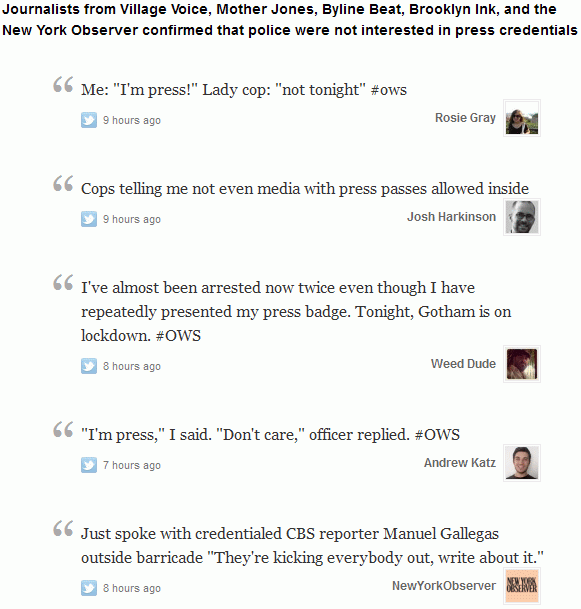
Read Ben Doernberg’s Storify report for more details on journalists being arrested, attacked and in every way possible, prevented from reporting on the operation to evict Occupy Wall Street.

After being evicted from Zuccotti Park, Occupy Wall Street released this statement: We are a global movement that is reclaiming our humanity and our future. We have stepped into a revitalizing civic process, realizing that we cannot fix our crises isolated from one another. We need collective action, and we need civic space. We are creating that civic space.
To occupy is to embody the spirit of liberation that we wish to manifest in our society. It is to exercise our freedom to assemble. We are creating space for community, values, ideas, and a level of meaningful dialogue that is absent in the present discourse.
Liberated space is breaking free of isolation, breaking down the walls that literally and figuratively separate us from one another. It is a new focus on community, trust, love and hope. We occupy to create a vision of equality, liberty and social justice onto the blank paving stones of public parks, in the silent hallways of abandoned schools, banks, and beyond. Public space plays a crucial role in this civic process and encourages open, transparent organizing in our movement. As we have seen in Liberty Square, outdoor space invites people to listen, speak, share, learn, and act.
Last night, billionaire Michael Bloomberg sent a massive police force to evict members of the public from Liberty Square—home of Occupy Wall Street for the past two months. People who were part of a dynamic civic process were beaten and pepper-sprayed, their personal property destroyed.
Supporters of this rapidly growing movement were mobilized in the middle of the night, making phone calls, taking the streets en masse, and planning next steps. Americans and people around the world are appalled at Bloomberg’s treatment of people who peacefully assemble. We are appalled, but not deterred. Liberty Square was dispersed, but its spirit not defeated. Today we are stronger than we were yesterday. Tomorrow we will be stronger still. We are breaking free of the fear that constricts and confines us. We occupy to liberate.
We move forward in the grand tradition of the transformative social movements that have defined American history. We stand on the shoulders of those who have struggled before us, and we pick up where others have left off. We are creating a better society for us all.
Occupy Wall Street has renewed a sense of hope. It has revived a belief in community and awakened a revolutionary spirit too long silenced. Join us as we liberate space and build a movement. 9 a.m. Tuesday morning at Sixth Avenue and Canal we continue.
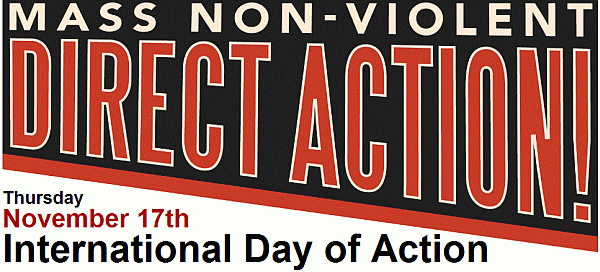

Tactical Briefing #18 from Adbusters: Hey you creatives, artists, environmentalists, workers, moms, dads, students, malcontents, do-gooders and aspiring martyrs in the snow:
The last four months have been hard fought, inspiring and delightfully revolutionary. We brought tents, hunkered down, held our assemblies, and lobbed a meme-bomb that continues to explode the world’s imagination. Many of us have never felt so alive. We have fertilized the future with our revolutionary spirit … and a thousand flowers will surely bloom in the coming Spring.
But as winter approaches an ominous mood could set in … hope thwarted is in danger of turning sour, patience exhausted becoming anger, militant nonviolence losing its allure. It isn’t just the mainstream media that says things could get ugly. What shall we do to keep the magic alive?
Here are a couple of emerging ideas:
STRATEGY #1: We summon our strength, grit our teeth and hang in there through winter … heroically we sleep in the snow … we impress the world with our determination and guts … and when the cops come, we put our bodies on the line and resist them nonviolently with everything we’ve got.
STRATEGY #2: We declare “victory” and throw a party … a festival … a potlatch … a jubilee … a grand gesture to celebrate, commemorate, rejoice in how far we’ve come, the comrades we’ve made, the glorious days ahead. Imagine, on a Saturday yet to be announced, perhaps our movement’s three month anniversary on December 17, in every #OCCUPY in the world, we reclaim the streets for a weekend of triumphant hilarity and joyous revelry.
We dance like we’ve never danced before and invite the world to join us.
Then we clean up, scale back and most of us go indoors while the die-hards hold the camps. We use the winter to brainstorm, network, build momentum so that we may emerge rejuvenated with fresh tactics, philosophies, and a myriad projects ready to rumble next Spring.
Whatever we do, let’s keep our revolutionary spirit alive … let’s never stop living without dead time.
for the wild,
Culture Jammers HQ
The Associated Press reports: Hundreds of police officers in riot gear raided Zuccotti Park early Tuesday, evicting dozens of Occupy Wall Street protesters from what has become the epicenter of the worldwide movement protesting corporate greed and economic inequality.
Hours later, the National Lawyers Guild obtained a court order allowing Occupy Wall Street protesters to return with tents to the park. The guild said the injunction prevents the city from enforcing park rules on Occupy Wall Street protesters.
At a morning news conference at City Hall, Mayor Michael Bloomberg said the city knew about the court order but had not seen it and would go to court to fight it. He said the city wants to protect people’s rights, but if a choice must be made, it will protect public safety.
About 70 people were arrested overnight, including some who chained themselves together, while officers cleared the park so that sanitation crews could clean it.
By 9 a.m., the park was power-washed clean. Police in riot gear still ringed the public space, waiting for orders to reopen it.
The city told protesters at the two-month-old encampment they could come back after the cleaning, but under new tougher rules, including no tents, sleeping bags or tarps, which would effectively put an end to the encampment if enforced.