Category Archives: Issues

NYPD raid Occupy Wall Street


Michael Moore: Dozens of Occupys across US raided this weekend-& now NYC- Planned & coordinated by the Dept. of Homeland Security? Did O give green light?

@C0d3Fr0sty: Guy on local New York TV station “This is not about #occupywallstreet to me, I’m a capitalist. This is about freedom now.”

Occupy Wall Street: Liberty Square (Zuccotti Park), home of Occupy Wall Street for the past two months and birthplace of the 99% movement that has spread across the country and around the world, is presently being evicted by a large police force in full riot gear.

We will reoccupy!
Updates

3:36 a.m. Kitchen tent reported teargassed. Police moving in with zip cuffs.
3:33 a.m. Bulldozers moving in
3:16 a.m. Occupiers linking arms around riot police
3:15 a.m. NYPD destroying personal items. Occupiers prevented from leaving with their possessions.
3:13 a.m. NYPD deploying sound cannon
3:08 a.m. heard on livestream: “they’re bringing in the hoses.”
3:05 a.m. NYPD cutting down trees in Liberty Square
2:55 a.m. NYC council-member Ydanis Rodríguez arrested and bleeding from head.
2:44 a.m. Defiant occupiers barricaded Liberty Square kitchen
2:44 a.m. NYPD destroys OWS Library. 5,000 donated books in dumpster.
2:42 a.m. Brooklyn Bridge confirmed closed
2:38 a.m. 400-500 marching north to Foley Square
2:32 a.m. All subways but R shut down
2:29 a.m. Press helicopters evicted from airspace. NYTimes reporter arrested.
2:22 a.m. Frontpage coverage from New York Times
2:15 a.m. Occupiers who have been dispersed are regrouping at Foley Square
2:10 a.m. Press barred from entering Liberty Square
2:07 a.m. Pepper spray deployed — reports of at least one reporter sprayed
2:03 a.m. Massive Police Presence at Canal and Broadway
1:43 a.m. Helicopters overhead.
1:38 a.m. Unconfirmed reports of snipers on rooftops.
1:34 a.m. CBS News Helicopter Livestream
1:27 a.m. Unconfirmed reports that police are planning to sweep everyone.
1:20 a.m. Subway stops are closed.
1:20 a.m. Brooklyn bridge is closed.
1:20 a.m. Occupiers chanting “This is what a police state looks like.”
1:20 a.m. Police are in riot gear.
1:20 a.m. Police are bringing in bulldozers.

Phone

Call 311 if you’re in the NYC area.
NYPD 1st Precinct: 212.334.0611
NYPD Central Booking: 718.875.6303
NYPD Internal Affairs: 212.487.7350
City Hall: 212.788.3058

Facebooktwittermail

Capitalism is the crisis

Poster by Favianna Rodriguez: “As a woman of color, and as a Latina working predominantly in spaces that affect la Raza, the current moment offers me the opportunity to talk about how Wall Street has affected our families. In case you didn’t see it, Pew Research center recently released a report on how Latino Household Wealth fell by 66% from 2005 to 2009. That means we lost 2/3 of our community’s assets! Now that’s an important reason why Latinos should care about the Occupy movement.”

Download this poster here [PDF].

Facebooktwittermail

Occupy with aloha

“We Are the Many”

Ye come here, gather ’round the stage

The time has come for us to voice our rage

Against the ones who’ve trapped us in a cage

To steal from us the value of our wage

From underneath the vestiture of law

The lobbyists at Washington do gnaw

At liberty, the bureaucrats guffaw

And until they are purged, we won’t withdraw

We’ll occupy the streets

We’ll occupy the courts

We’ll occupy the offices of you

Till you do

The bidding of the many, not the few
Continue reading

Facebooktwittermail

The new progressive movement

Jeffrey Sachs writes: Twice before in American history, powerful corporate interests dominated Washington and brought America to a state of unacceptable inequality, instability and corruption. Both times a social and political movement arose to restore democracy and shared prosperity.

The first age of inequality was the Gilded Age at the end of the 19th century, an era quite like today, when both political parties served the interests of the corporate robber barons. The progressive movement arose after the financial crisis of 1893. In the following decades Theodore Roosevelt and Woodrow Wilson came to power, and the movement pushed through a remarkable era of reform: trust busting, federal income taxation, fair labor standards, the direct election of senators and women’s suffrage.

The second gilded age was the Roaring Twenties. The pro-business administrations of Harding, Coolidge and Hoover once again opened up the floodgates of corruption and financial excess, this time culminating in the Great Depression. And once again the pendulum swung. F.D.R.’s New Deal marked the start of several decades of reduced income inequality, strong trade unions, steep top tax rates and strict financial regulation. After 1981, Reagan began to dismantle each of these core features of the New Deal.

Following our recent financial calamity, a third progressive era is likely to be in the making. This one should aim for three things. The first is a revival of crucial public services, especially education, training, public investment and environmental protection. The second is the end of a climate of impunity that encouraged nearly every Wall Street firm to commit financial fraud. The third is to re-establish the supremacy of people votes over dollar votes in Washington.

None of this will be easy. Vested interests are deeply entrenched, even as Wall Street titans are jailed and their firms pay megafines for fraud. The progressive era took 20 years to correct abuses of the Gilded Age. The New Deal struggled for a decade to overcome the Great Depression, and the expansion of economic justice lasted through the 1960s. The new wave of reform is but a few months old.

The young people in Zuccotti Park and more than 1,000 cities have started America on a path to renewal. The movement, still in its first days, will have to expand in several strategic ways. Activists are needed among shareholders, consumers and students to hold corporations and politicians to account. Shareholders, for example, should pressure companies to get out of politics. Consumers should take their money and purchasing power away from companies that confuse business and political power. The whole range of other actions — shareholder and consumer activism, policy formulation, and running of candidates — will not happen in the park.

The new movement also needs to build a public policy platform. The American people have it absolutely right on the three main points of a new agenda. To put it simply: tax the rich, end the wars and restore honest and effective government for all.

Finally, the new progressive era will need a fresh and gutsy generation of candidates to seek election victories not through wealthy campaign financiers but through free social media. A new generation of politicians will prove that they can win on YouTube, Twitter, Facebook and blog sites, rather than with corporate-financed TV ads. By lowering the cost of political campaigning, the free social media can liberate Washington from the current state of endemic corruption. And the candidates that turn down large campaign checks, political action committees, Super PACs and bundlers will be well positioned to call out their opponents who are on the corporate take.

Those who think that the cold weather will end the protests should think again. A new generation of leaders is just getting started. The new progressive age has begun.

Facebooktwittermail

Putting U.S. foreign aid in perspective

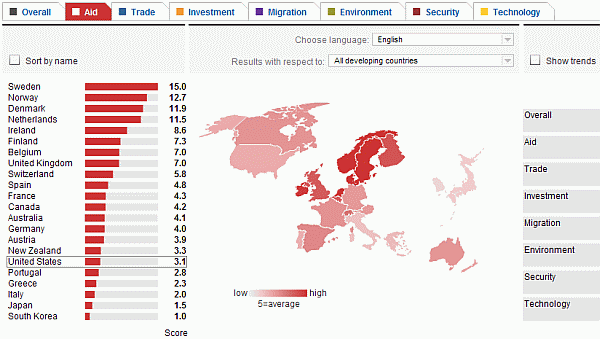
Most Americans vastly overestimate how much the U.S. government spends on foreign aid. In a recent poll, the median answer was that 25% of the federal budget goes to foreign aid. In reality it is about 1%. Along with the idea that the U.S. spends massively overseas is the idea that America gives and the rest of the world takes, but in its most recent rankings, the Centre for Global Development places the U.S. #17.

Click on the image below to explore the CGD’s 2011 Commitment to Development Index.

David Roodman, senior fellow at the Center for Global Development in Washington, DC, introduces the Commitment to Development Index, which ranks wealthy nations by how much they help poorer ones.

The index is not without flaws in some of the reasoning it applies. For instance, in arriving at its overall rankings (which aggregate aid and other components such as security) the position of the U.S. was boosted this year thanks to Obama’s troop surge in Afghanistan. Because the war in Afghanistan has a UN mandate, the CGD dubs it a “peacekeeping” operation!

Facebooktwittermail

Finally, a judge stands up to Wall Street

Matt Taibbi writes: Federal judge Jed Rakoff, a former prosecutor with the U.S. Attorney’s office here in New York, is fast becoming a sort of legal hero of our time. He showed that again yesterday when he shat all over the SEC’s latest dirty settlement with serial fraud offender Citigroup, refusing to let the captured regulatory agency sweep yet another case of high-level criminal malfeasance under the rug.

The SEC had brought an action against Citigroup for misleading investors about the way a certain package of mortgage-backed assets had been chosen. The case is very similar to the notorious Abacus case involving Goldman Sachs, in which Goldman allowed short-selling billionaire John Paulson (who was betting against the package) to pick the assets, then told a pair of European banks that the “designed to fail” package they were buying had been put together independently.

This case was similar, but worse. Here, Citi similarly told investors a package of mortgages had been chosen independently, when in fact Citi itself had chosen the stuff and was betting against the whole pile.

This whole transaction actually combined a number of Goldman-style misdeeds, since the bank both lied to investors and also bet against its own product and its own customers. In the deal, Citi made a $160 million profit, while its customers lost $700 million.

Goldman, in the Abacus case, got fined $550 million. In this worse case, the SEC was trying to settle with Citi for just $285 million. Judge Rakoff balked at the settlement and particularly balked at the SEC’s decision to allow Citi off without any admission of wrongdoing. He also mocked the SEC’s decision to describe the crime as “negligence” instead of intentional fraud, taking the entirely rational position that there’s no way a bank making $160 million ripping off its customers can conceivably be described as an accident.

“Why should the court impose a judgment in a case in which the SEC alleges a serious securities fraud but the defendant neither admits nor denies wrongdoing?” And this: “How can a securities fraud of this nature and magnitude be the result simply of negligence?”

Rakoff of course is right – the settlement is nuts. If you take Citi’s $160 million profit on the deal into consideration, what we’re talking about then is a $125 million fine for causing $700 million in damages. That, and no admission of wrongdoing.

Just imagine a mugger who steals $70 from some lady’s wallet being sentenced to walk free after paying back twelve bucks. Magritte himself could not devise a more surreal take on criminal justice.

Facebooktwittermail

Why aren’t the jobless flocking to Zuccotti Park?

Louis Uchitelle reports: Occupy Wall Street and its numerous iterations across the country could take on a second life, one that spurs the unemployed to finally speak out forcefully on their own behalf. Already there have been isolated outbursts. But for such incidents to spread and take hold, more confidence is required that speaking out would produce results—and confidence is lacking, says Richard Curtin, director of the Thomson Reuters/University of Michigan Surveys of Consumers, a monthly national poll of 500 people.

“People are discouraged,” Curtin says. “They believe that the administration and Congress tried to do a lot to get the economy restarted and nothing happened. So they are gradually embracing the notion that government is incapable of creating jobs.”

The government has, arguably, invited this response by talking about creating jobs without yet doing so—echoing a similar reluctance in the past. Twice since World War II Congress has watered down bills that would have mandated full employment—once in 1946, although the Depression was still fresh in people’s minds, and again in the mid-’70s, in the midst of a severe recession. The bills became law—the second one, finally enacted in 1978, is famously known as the Humphrey-Hawkins Act—but without the provisions that would have required the government to either hire directly or subsidize hiring whenever the unemployment rate rose above a specified level. The laws, in sum, were toothless.

With the election of Ronald Reagan in 1980 and the rise of supply-side economics, the dynamics shifted drastically. Unemployment was no longer seen as a failure of the nation’s employers to generate enough demand for workers. That was and still is the reason, but it faded as an explanation and as a prod to action. Instead, the unemployed are persistently blamed for their own unemployment, which eases pressure on government to help them. If only they acquired enough education and skill, the argument goes—and it is endlessly repeated—they would be hired. Corporate executives, politicians and many prominent economists push this view, and the unemployed, encouraged to blame themselves, keep silent. Or as Richard Sennett, a New York University sociologist, puts it: “People don’t cooperate with each other. They’ve lost the desire to do so and the skill that cooperation requires, so when things fall apart, they react as if it were their individual failure and are passive about it.”

Facebooktwittermail

Israel behind deadly explosion at Iran missile base?

Whether it was the result of an Israeli covert operation, or, as Iran claims, an accident, the latest deadly incident once again highlights the willingness of the United States and Israel to engage in acts of violence that were they instigated by Iran or any other state or non-state actor would simply be called acts of terrorism.

Karl Vick reports: Israeli newspapers on Sunday were thick with innuendo, the front pages of the three largest dailies dominated by variations on the headline “Mysterious Explosion in Iranian Missile Base.” Turn the page, and the mystery is answered with a wink. “Who Is Responsible for Attacks on the Iranian Army?” asks Maariv, and the paper lists without further comment a half-dozen other violent setbacks to Iran’s nuclear and military nexus. For Israeli readers, the coy implication is that their own government was behind Saturday’s massive blast just outside Tehran. It is an assumption a Western intelligence source insists is correct: the Mossad — the Israeli agency charged with covert operations — did it. “Don’t believe the Iranians that it was an accident,” the official tells TIME, adding that other sabotage is being planned to impede the Iranian ability to develop and deliver a nuclear weapon. “There are more bullets in the magazine,” the official says.

The powerful blast or series of blasts — reports described an initial explosion followed by a much larger one — devastated a missile base in the gritty urban sprawl to the west of the Iranian capital. The base housed Shahab missiles, which, at their longest range, can reach Israel. Last week’s report from the International Atomic Energy Agency (IAEA) said Iran had experimented with removing the conventional warhead on the Shahab-3 and replacing it with one that would hold a nuclear device. Iran says the explosion was an accident that came while troops were transferring ammunition out of the depot “toward the appropriate site.” (See why ties between the U.S. and Iran are under threat.)

The explosion killed at least 17 people, including Major General Hassan Moqqadam, described by Iranian state media as a pioneer in Iranian missile development and the Revolutionary Guard commander in charge of “ensuring self-sufficiency” in armaments, a challenging task in light of international sanctions.

Coming the weekend after the release of the unusually critical IAEA report, which laid out page upon page of evidence that Iran is moving toward a nuclear weapon, the blast naturally sharpened concern over Israel’s threat to launch airstrikes on Iran’s nuclear facilities. Half the stories on the Tehran Times website on Sunday referenced the possibility of a military strike, most warning of dire repercussions.

But the incident also argued, maybe even augured, against an outright strike. If Israel — perhaps in concert with Washington and other allies — can continue to inflict damage to the Iranian nuclear effort through covert actions, the need diminishes for overt, incendiary moves like air strikes. The Stuxnet computer worm bollixed Iran’s centrifuges for months, wreaking havoc on the crucial process of uranium enrichment.

And in Sunday’s editions, the Hebrew press coyly listed what Yedioth Ahronoth called “Iran’s Mysterious Mishaps.” The tallies ran from the November 2007 explosion at a missile base south of Tehran to the October 2010 blast at a Shahab facility in southwestern Iran, to the assassinations of three Iranian scientists working in the nuclear program — two last year and one in July.

Meanwhile, Al Jazeera reports:

Barack Obama’s push for consensus over renewed concerns about Iran’s nuclear programme have had a lukewarm response from the Russian and Chinese leaders attending the APEC summit in Hawaii.

The US president had sought support from Dmitry Medvedev and Hu Jintao as he seeks to rein back Iran’s nuclear ambitions, but he got no public endorsement from either of them.

Obama met his counterparts on Sunday on the sidelines of the summit in Honolulu, the capital of his home state, where he discussed a UN nuclear watchdog report that said there was “credible” information that Tehran may have worked on developing nuclear weapons.

Al Jazeera’s Patty Culhane, reporting from Honolulu, said there was “absolutely no consensus” between the leaders on how to deal with Iran following the International Atomic Energy Agency’s report.

“This was President Obama’s first face-to-face meeting with Hu and Medvedev since the IAEA report came out. The US believes that it needs China and Russia to get on board with sanctions and it was fairly clear … that he did not get any reassurances,” she said.

Facebooktwittermail

A new Israel in the making

Gideon Levy writes: One day not long from now we will wake up to a different kind of country, the country that’s now in the making. It won’t look like the country we know, which already has its share of flaws, distortions and ills. And when we become aware of this, it will be too late. At that point, the old Israel will be described in glowing terms, a model of democracy and justice, compared to the new version that is taking shape as we close our eyes to it, day after day, new law after law.

The way of life in the new Israel where we will live and die won’t remind us in the least of the country we’re used to. Even this article won’t be publishable. Only proper opinions will be put into print, the ones approved by the new government-sponsored journalists’ association, whose people will sit in every newsroom so there is no divergence from the accepted chorus of opinion.

Laws and regulations (clearly they will be passed as “emergency” regulations ) will bar publication of anything that could, in the eyes of the authorities, harm the state. A new law will bar defamation of the state, and the newspaper you will hold in your hands will be different. It will only report good news.

Radio and television broadcasts won’t be what you’re familiar with either. No media outlet will be able to go beyond the bounds of the law due to the draconian penalties for running afoul of them. The word “occupation” will be illegal, as will the expression “Palestinian state.” Treasonous journalists will be pilloried or arrested, or at least fired. That day is not long in coming.

In the not too distant future, the urban landscape will look different. What is happening today in Jerusalem will play itself out in the whole country tomorrow, when the likeness of women will be banished from public view. Today Jerusalem, tomorrow the whole country. Separate buses and streets for men and women. Radio and television will only broadcast men singing. At some point, women will be required to cover their heads. Then it will be the men’s turn. They will be barred from appearing clean-shaven or without a head covering. That day is not long in coming.

The cities will be shut down on Shabbat. Not a store or movie theater will be open. Then will come the ban on driving on Shabbat. Non-kosher restaurants will be illegal. Mezuzahs will be required on the doorpost of every room in every home. Couples not registered with the rabbinate will not be allowed to live together, and couples in which only one party is Jewish will be deported immediately. Unmarried couples will be barred from walking arm-in-arm in public.

Once a month all the country’s schoolchildren will make solidarity visits to West Bank settlements. Every lesson will begin with the singing of the national anthem and a salute to the flag. Those who don’t serve in the army will lose their citizenship and be deported.

And the Jewish state will have a Jewish Knesset. First Arabs will be barred from running for parliament in their own parties. Then they won’t be allowed to be elected at all. Until then, MKs who at the beginning of every Knesset session don’t sing the national anthem’s words about the “yearning of the Jewish soul” will be permanently removed.

Arabs will be denied the right to a university education, with the exception of a symbolic quota approved by the Shin Bet security service. It will be illegal to rent to Arabs, other than in their own towns and villages, and the Arabic language will be banned. The poetry of Arab poet Mahmoud Darwish and his Jewish compatriots Aharon Shabtai and Yitzhak Laor will also be banned. Amos Oz, A.B. Yehoshua and David Grossman will have to decide. They, and all the country’s citizens, will be required to declare themselves Zionists to get published.

The West Bank will be annexed, but the Palestinians living there will not be. Left-wing organizations will be made illegal and their leaders arrested. The government will publish a blacklist of those with offensive views who will not be allowed to leave the country or speak to the foreign media. Only someone who murders Jews will be deemed a real murderer, and the statute books will be divided into two parts, one for Jews and one for non-Jews. The death penalty will only apply to Arabs.

Special legislation will give settlers the right to take control of any land in the West Bank, and military censorship will ban any news item that could “harm the strength of the Israel Defense Forces.” The Supreme Court will only serve as a court of appeals and will not consider direct petitions on civil rights violations. Supreme Court justices will be selected by the Knesset and slots on the bench will be reserved for West Bank settlers, rabbis and members of the party in power. Only religious justices will be able to serve as chief justice. Rabbis will have legal immunity similar to what MKs have. Any declaration of war or a peace agreement will need the approval of the Council of Torah Sages.

Actually, you don’t need much imagination to come up with all this. The future is now. The revolution is in progress; just wait for what’s to come.

Facebooktwittermail

Israeli ministers accused of trying to muzzle critics with funding curbs

The Guardian reports: An Israeli cabinet committee has voted to pass legislation backed by the prime minister, Binyamin Netanyahu, that would cut tens of millions of pounds in foreign funding to human rights organisations.

The ministerial committee for legislation passed two bills, one of which limits all funding for non-governmental organisations from foreign bodies, including the United Nations, to 20,000 shekels (£3,300) a year. The other seeks to tax all contributions to NGOs by foreign states. Those who support the bills say many NGOs are political groups working under the guise of human rights to “delegitimise Israel”.

Last week, Matthew Gould, Britain’s ambassador to Israel, added his voice to concerns from international diplomats. Gould met the bill’s sponsor, Likud minister Ophir Akunis, to warn him that the passage of his legislation would reflect very badly on Israel in the international community.

On Sunday, embassy sources in Tel Aviv confirmed they would be monitoring the bill’s progress carefully.

In 2010, the British embassy donated £300,000 to human rights organisations in Israel.

The EU’s ambassador to Israel, Andrew Standley, is also reported to have contacted Netanyahu’s national security adviser, Yaakov Amidror, last Thursday to advise him that approving the bill would threaten Israel’s standing as a democratic state.

Facebooktwittermail

Former Guantanamo chief prosecutor: “A pair of testicles fell off the president after Election Day”

Jason Leopold reports: Morris Davis speaks bluntly about some of President Barack Obama’s policy decisions.

“There’s a pair of testicles somewhere between the Capital Building and the White House that fell off the president after Election Day [2008],” said Davis, an Air Force colonel who spent two years as the chief prosecutor of the Guantanamo Bay prison facility, during an interview at his Washington, DC, office over the summer and in email correspondence over the past several months. “He got his butt kicked. Not just with Guantanamo but with national security in general. I’m sure there are a few areas here and there where there have been ‘change,’ but to me it seems like a third Bush term when it comes to national security.”

Davis is “hugely disappointed” that Obama reneged on a campaign promise to reject military commissions for “war on terror” detainees, which human rights advocates and defense attorneys have condemned as unconstitutional.

The first military commission of the Obama administration got underway earlier this week with the arraignment of Abd Rahim al-Nashiri, the alleged mastermind of the October 2000 bombing of the USS Cole, who is facing terrorism and murder charges, began earlier this week. If convicted, Nashiri, one of three so-called high-value detainees that the Bush administration admitted was subjected to the drowning technique known as waterboarding and other brutal torture methods at CIA black site prisons, could be executed.

Facebooktwittermail

Nuke report unlikely to break the stalemate, could Iran be the new Cuba?

Tony Karon writes: Game changer? Hardly. As the dust settles on this week’s release of the International Atomic Energy Agency’s latest report on Iran, it’s become clear that pre-release hype from Western officials that it would produce a dramatic shift in the international standoff over that country’s nuclear program appears to be wishful thinking. There’s nothing about the report’s contents — all of which had been known to the key players for the past five years — or the fact of its publication that appears likely to shift any of their positions. Instead, it appears to be triggering another round of business as usual: The U.S. and its key Western allies are pressing for new sanctions, unilateral and via the U.N.; Israel is rattling its saber; Russia and China are telling everyone to calm down and resisting any new sanctions; and Iran is keeping its uranium enrichment centrifuges spinning.

Experts parsing with the material say the IAEA’s finding don’t differ substantially with those of the 2007 National Intelligence Estimate which concluded, to the chagrin of the Israelis and other Iran hawks, that Tehran had halted most of its research into weaponization of nuclear material in 2003. The new report does assert — on the basis of a narrower set of sources — that some lower-level apparent weapons research work did, in fact, continue after 2003. But what it calls a “structured program” of weapons research appears to have been mostly halted in 2003.

Still, there’s little question that Iran has used its nuclear program to bring the capability to build nuclear weapons within closer reach. The IAEA has now formally rejected Tehran’s insistence that all of its nuclear work has been for civilian energy production, and has demanded that it account for research work that appears to have no purpose outside of warhead design. But it has hardly confirmed the notion that Iran is racing hell for leather to build nuclear weapons.

A senior Administration official conceded Tuesday that “the IAEA does not assert that Iran has resumed a full-scale nuclear weapons program”, nor does it spell out how much progress has been made in the research effort.

Facebooktwittermail

Egypt’s search for truth

Michael Hanna writes: When the deposed former president Hosni Mubarak was wheeled on a hospital bed into the makeshift Cairo courtroom hastily prepared for his trial, the process of transitional justice in Egypt appeared to have achieved an important symbolic victory. The sight of the former autocrat laid low before a court of law to be held accountable for his actions was undoubtedly an important marker of the fundamental changes that have convulsed Egypt following its eighteen-day uprising and the fall of the Mubarak regime. After numerous court proceedings against former Mubarak advisors and confidants, the start of the trial also appeared to fulfill a central demand of the uprising: that Mubarak and his cronies face justice for their past crimes. Yet, the outsized focus on the former president and the speed with which his trial was initiated also raised troubling questions about the future scope and trajectory of transitional justice efforts, converging with broader worries about the course of Egypt’s transition.

Much like the muddled political transition overseen by Egypt’s Supreme Council of the Armed Forces (SCAF), transitional justice has been characterized by ad hoc decision-making and suffered from a fundamental lack of transparency and popular participation. The outcome of Egypt’s extended struggle for political supremacy—parliamentary elections are due to take place in November 2011 and presidential balloting at a date still to be determined—will shape the depth and scope of transitional justice efforts. Based on the reactionary posture of the SCAF during its tenure as Egypt’s ruling authority, it is a near certainty that transitional justice efforts will remain rudimentary until such time as civilian authority is reinstated. The transition to civilian authority will provide an opportunity to revisit those areas that have been neglected during SCAF’s control. Renewed focus on justice, accountability, and equality before the law would also provide a significant link to the ethos that animated Egypt’s unexpected uprising and direct attention to those lofty goals at a time when prosaic and flawed politics are becoming the central focus of the country’s attention.

Transitional justice will be highly contested within Egyptian society. The goals of these efforts are not simply retributive, although punishment and deterrence through prosecutorial action are certainly important results. Addressing the claims of the former regime’s victims would help in establishing a credible basis for political reconciliation. The creation of an unimpeachable historical record of the excesses and abuses of the Mubarak regime would play a significant role in the difficult long-term task of forming an open and accountable political culture.

The normative value of transitional justice efforts would also have political utility if implemented judiciously, as efforts at increasing accountability for past regime crimes would be an important route to ensuring the supremacy of civilian governance and bolstering the country’s democratic infrastructure. This type of initiative could also play an important part in nurturing judicial independence as a check against future official abuse.

The Egyptian military would likely be much more comfortable with a discrete focus on the excesses of Egypt’s crony-capitalist economy and the violence associated with the repression of the January 25 uprising. The military has played a less pronounced political role in recent years, but a more probing initiative that sought to speak to the systematic crimes of the former regime and its predecessors would more directly implicate the military in light of its central role within Egypt’s authoritarian superstructure. This is particularly the case for earlier periods when Egypt could be described as a military state and society, and the military and its officer corps were implicated directly in day-to-day repression. As such, the military would be averse to broader efforts seeking to document state repression during the time of Gamal Abdel Nasser and Anwar Sadat, in addition to the years of Mubarak’s rule. Demonstrating credibly the repression that has characterized the Egyptian state since the Free Officers’ Movement and the toppling of King Farouk in 1952, however, would have the benefits of reinforcing the imperative to break with the past and lending legitimacy to civilian efforts to limit military interference in governance.

Facebooktwittermail

How the U.S. Justice Department legally hacked my Twitter account

Birgitta Jonsdottir, a member of Iceland’s Parliament, writes: Before my Twitter case, in which the US Department of Justice has demanded that the social media site hands over personal information about my account which it deems necessary to its investigation of WikiLeaks, I didn’t think much about what rights I would be signing off when accepting user agreement in my computer. The text is usually lengthy, in a legal language that most people don’t understand. Very few people read the user agreements, and very few understand their legal implications if someone in the real world would try to use one against them.

Many of us who use the internet – be it to write emails, work or browse its growing landscape: mining for information, connecting with others or using it to organise ourselves in various groups of the like-minded – are not aware of that our behavior online is being monitored. Profiling has become a default with companies such as Google and Facebook. These companies have huge databases recording our every move within their environment, in order to groom advertising to our interests. For them, we are only consumers to push goods at, in order to sell ads through an increasingly sophisticated business model. For them, we are not regarded as citizens with civic rights.

This notion needs to change. No one really knew where we were heading a few years ago: neither we the users, nor the companies harvesting our personal information for profit. Very few of us imagined that governments that claim to be democratic would invade our online privacy with no regard to the fundamental rights we are supposed to have in the real world. We might look to China and other stereotypical totalitarian states and expect them to violate the free flow of information and our digital privacy, but not – surely? – our very own democratically elected governments.

What I have learned about my lack of rights in the last few months is of concern for everyone who uses the internet and calls for actions to raise people’s awareness about their legal rights and ways to improve legal guidelines about digital media, be it locally or globally. The problem – and the dilemma we are facing – is that there are no proper standards, no basic laws in place that deal with the fundamental question: are we to be treated as consumers or citizens online? There is no international charter that says we should have the same civic rights as we have in the offline world.

Facebooktwittermail

The branding of Occupy Wall Street

Justin Elliot reports: Last week, the first Occupy Wall Street TV ad began airing on channels including Fox News and ESPN:

The airtime was paid for through a crowd-sourced funding service, which has raised about $13,000 so far. The ad was created by freelance director David Sauvage, who shot footage on location in Zuccotti Park during the early weeks of the protest. The spot even ran during the O’Reilly Factor on some cable providers one night last week, according to Sauvage.

The ad was not endorsed by the general assembly at Zuccotti Park, the official governing body for Occupy Wall Street in New York; rather, like much of the work around Occupy, it was created as an affinity project by a supporter of the movement.

Sauvage’s bread and butter is corporate commercial work; ironically, his most recent project before the Occupy Wall Street ad was a commercial for the Wall Street Journal.

Facebooktwittermail

Arab League votes to suspend Syria over crackdown

The New York Times reports: The Arab League moved to suspend Syria’s membership on Saturday, accusing the government of President Bashar al-Assad of defying an agreement to stop the violent repression of demonstrators, and it threatened economic and political sanctions if he did not comply.

In acting against Syria, a core member of the Arab League, the group took another bold step beyond what had been a long tradition of avoiding controversy. Alarmed by the region-spanning upheaval of the Arab Spring demonstrations, league delegates said they were trying to head off another factional war like Libya’s, in which the group took the unprecedented step of approving international intervention.

Syria’s formal suspension is to start in four days, offering what senior Arab League officials described as a last chance for Mr. Assad to carry out a peace agreement his government had accepted. The plan called for the Syrian government to halt the violence directed toward civilians, to withdraw all its security forces from civilian areas and to release tens of thousands of political prisoners.

Throughout the meeting, the Syrian ambassador, Youssef Ahmed, kept shouting that the move was illegal because such a decision had to be unanimous, participants said. He later repeated the claim on state television and accused the league of being “subordinate to American and Western agendas.” Nabil el-Araby, the Arab League’s secretary general, pushed the initiative to a vote, with 18 of the league’s 22 members supporting the action, Yemen and Lebanon opposing, Iraq abstaining and Syria not voting at all.

“We are hoping for a daring move from Syria to halt the violence and to begin a real dialogue toward real reform,” said Sheik Hamad bin Jassim bin Jabr al-Thani, the prime minister and foreign minister of Qatar, as well as the current league chairman.

Facebooktwittermail