George Monbiot writes: If wealth was the inevitable result of hard work and enterprise, every woman in Africa would be a millionaire. The claims that the ultra-rich 1% make for themselves – that they are possessed of unique intelligence or creativity or drive – are examples of the self-attribution fallacy. This means crediting yourself with outcomes for which you weren’t responsible. Many of those who are rich today got there because they were able to capture certain jobs. This capture owes less to talent and intelligence than to a combination of the ruthless exploitation of others and accidents of birth, as such jobs are taken disproportionately by people born in certain places and into certain classes.
The findings of the psychologist Daniel Kahneman, winner of a Nobel economics prize, are devastating to the beliefs that financial high-fliers entertain about themselves. He discovered that their apparent success is a cognitive illusion. For example, he studied the results achieved by 25 wealth advisers, across eight years. He found that the consistency of their performance was zero. “The results resembled what you would expect from a dice-rolling contest, not a game of skill.” Those who received the biggest bonuses had simply got lucky.
Such results have been widely replicated. They show that traders and fund managers across Wall Street receive their massive remuneration for doing no better than would a chimpanzee flipping a coin. When Kahneman tried to point this out they blanked him. “The illusion of skill … is deeply ingrained in their culture.”
So much for the financial sector and its super-educated analysts. As for other kinds of business, you tell me. Is your boss possessed of judgement, vision and management skills superior to those of anyone else in the firm, or did he or she get there through bluff, bullshit and bullying?
In a study published by the journal Psychology, Crime and Law, Belinda Board and Katarina Fritzon tested 39 senior managers and chief executives from leading British businesses. They compared the results to the same tests on patients at Broadmoor special hospital, where people who have been convicted of serious crimes are incarcerated. On certain indicators of psychopathy, the bosses’s scores either matched or exceeded those of the patients. In fact on these criteria they beat even the subset of patients who had been diagnosed with psychopathic personality disorders.
The psychopathic traits on which the bosses scored so highly, Board and Fritzon point out, closely resemble the characteristics that companies look for. Those who have these traits often possess great skill in flattering and manipulating powerful people. Egocentricity, a strong sense of entitlement, a readiness to exploit others and a lack of empathy and conscience are also unlikely to damage their prospects in many corporations.
In their book Snakes in Suits, Paul Babiak and Robert Hare point out that as the old corporate bureaucracies have been replaced by flexible, ever-changing structures, and as team players are deemed less valuable than competitive risk-takers, psychopathic traits are more likely to be selected and rewarded. Reading their work, it seems to me that if you have psychopathic tendencies and are born to a poor family you’re likely to go to prison. If you have psychopathic tendencies and are born to a rich family you’re likely to go to business school.
This is not to suggest that all executives are psychopaths. It is to suggest that the economy has been rewarding the wrong skills. As the bosses have shaken off the trade unions and captured both regulators and tax authorities, the distinction between the productive and rentier upper classes has broken down. CEOs now behave like dukes, extracting from their financial estates sums out of all proportion to the work they do or the value they generate, sums that sometimes exhaust the businesses they parasitise. They are no more deserving of the share of wealth they’ve captured than oil sheikhs.
The rest of us are invited, by governments and by fawning interviews in the press, to subscribe to their myth of election: the belief that they are the chosen ones, possessed of superhuman talents. The very rich are often described as wealth creators. But they have preyed upon the earth’s natural wealth and their workers’ labour and creativity, impoverishing both people and planet. Now they have almost bankrupted us. The wealth creators of neoliberal mythology are some of the most effective wealth destroyers the world has ever seen.
Category Archives: Issues
The confidence trick
Daniel Kahneman writes: We are prone to think that the world is more regular and predictable than it really is, because our memory automatically and continuously maintains a story about what is going on, and because the rules of memory tend to make that story as coherent as possible and to suppress alternatives. Fast thinking is not prone to doubt.
The confidence we experience as we make a judgment is not a reasoned evaluation of the probability that it is right. Confidence is a feeling, one determined mostly by the coherence of the story and by the ease with which it comes to mind, even when the evidence for the story is sparse and unreliable. The bias toward coherence favors overconfidence. An individual who expresses high confidence probably has a good story, which may or may not be true…
When a compelling impression of a particular event clashes with general knowledge, the impression commonly prevails… The confidence you will experience in your future judgments will not be diminished by what you just read, even if you believe every word.
I first visited a Wall Street firm in 1984. I was there with my longtime collaborator Amos Tversky, who died in 1996, and our friend Richard Thaler, now a guru of behavioral economics. Our host, a senior investment manager, had invited us to discuss the role of judgment biases in investing. I knew so little about finance at the time that I had no idea what to ask him, but I remember one exchange. “When you sell a stock,” I asked him, “who buys it?” He answered with a wave in the vague direction of the window, indicating that he expected the buyer to be someone else very much like him. That was odd: because most buyers and sellers know that they have the same information as one another, what made one person buy and the other sell? Buyers think the price is too low and likely to rise; sellers think the price is high and likely to drop. The puzzle is why buyers and sellers alike think that the current price is wrong.
Most people in the investment business have read Burton Malkiel’s wonderful book “A Random Walk Down Wall Street.” Malkiel’s central idea is that a stock’s price incorporates all the available knowledge about the value of the company and the best predictions about the future of the stock. If some people believe that the price of a stock will be higher tomorrow, they will buy more of it today. This, in turn, will cause its price to rise. If all assets in a market are correctly priced, no one can expect either to gain or to lose by trading.
We now know, however, that the theory is not quite right. Many individual investors lose consistently by trading, an achievement that a dart-throwing chimp could not match. The first demonstration of this startling conclusion was put forward by Terry Odean, a former student of mine who is now a finance professor at the University of California, Berkeley.
Odean analyzed the trading records of 10,000 brokerage accounts of individual investors over a seven-year period, allowing him to identify all instances in which an investor sold one stock and soon afterward bought another stock. By these actions the investor revealed that he (most of the investors were men) had a definite idea about the future of two stocks: he expected the stock that he bought to do better than the one he sold.
To determine whether those appraisals were well founded, Odean compared the returns of the two stocks over the following year. The results were unequivocally bad. On average, the shares investors sold did better than those they bought, by a very substantial margin: 3.3 percentage points per year, in addition to the significant costs of executing the trades. Some individuals did much better, others did much worse, but the large majority of individual investors would have done better by taking a nap rather than by acting on their ideas. In a paper titled “Trading Is Hazardous to Your Wealth,” Odean and his colleague Brad Barber showed that, on average, the most active traders had the poorest results, while those who traded the least earned the highest returns. In another paper, “Boys Will Be Boys,” they reported that men act on their useless ideas significantly more often than women do, and that as a result women achieve better investment results than men.
Of course, there is always someone on the other side of a transaction; in general, it’s a financial institution or professional investor, ready to take advantage of the mistakes that individual traders make. Further research by Barber and Odean has shed light on these mistakes. Individual investors like to lock in their gains; they sell “winners,” stocks whose prices have gone up, and they hang on to their losers. Unfortunately for them, in the short run going forward recent winners tend to do better than recent losers, so individuals sell the wrong stocks. They also buy the wrong stocks. Individual investors predictably flock to stocks in companies that are in the news. Professional investors are more selective in responding to news. These findings provide some justification for the label of “smart money” that finance professionals apply to themselves.
Although professionals are able to extract a considerable amount of wealth from amateurs, few stock pickers, if any, have the skill needed to beat the market consistently, year after year. The diagnostic for the existence of any skill is the consistency of individual differences in achievement. The logic is simple: if individual differences in any one year are due entirely to luck, the ranking of investors and funds will vary erratically and the year-to-year correlation will be zero. Where there is skill, however, the rankings will be more stable. The persistence of individual differences is the measure by which we confirm the existence of skill among golfers, orthodontists or speedy toll collectors on the turnpike.
Mutual funds are run by highly experienced and hard-working professionals who buy and sell stocks to achieve the best possible results for their clients. Nevertheless, the evidence from more than 50 years of research is conclusive: for a large majority of fund managers, the selection of stocks is more like rolling dice than like playing poker. At least two out of every three mutual funds underperform the overall market in any given year.
More important, the year-to-year correlation among the outcomes of mutual funds is very small, barely different from zero. The funds that were successful in any given year were mostly lucky; they had a good roll of the dice. There is general agreement among researchers that this is true for nearly all stock pickers, whether they know it or not — and most do not. The subjective experience of traders is that they are making sensible, educated guesses in a situation of great uncertainty. In highly efficient markets, however, educated guesses are not more accurate than blind guesses.
Daniel Kahneman is emeritus professor of psychology and of public affairs at Princeton University and a winner of the 2002 Nobel Prize in Economics. This article is adapted from his book “Thinking, Fast and Slow,” out this month from Farrar, Straus & Giroux.
Occupy and the militarisation of policing protest
Ayesha Kazmi writes: In our not-so-distant history, protest in the United States was handled by local law enforcement that treated demonstrations and marches as mere nuisance, mediating and directing as needed. Today, observing the interaction between Occupy movements and law enforcement suggests something different is afoot. Present Occupy protests are now being defined by a bewildering set of law enforcement strategies – and current practices display a worrying new trend.
While riot police are not necessarily an everyday feature at any given protest, the sheer frequency with which we are witnessing their presence on city streets throughout the United States is enough to give average citizens cause for concern; the excessive force being routinely deployed is alarming.
Within the first few days of Occupy Wall Street, protesters began to notice the presence of the NYPD’s Counter Terrorism Unit at Liberty Plaza. Joanne Stocker, who has become a fixture since day one at Wall Street, recalls within the first few days waking up to a Counter Terrorism Unit van, parked on the fringes of Liberty Plaza, which was taking video of her and her friends while they slept.
Protesters at other Occupy encampments give similar accounts. Robin Jacks, a member of Occupy Boston’s media team, relates being photographed multiple times by police. Dustin Slaughter, who has spent time both at Occupy Wall Street and Occupy Philadelphia, attests to the presence of the NYPD Counter Terrorism Unit at Liberty Plaza, saying that the Counter Terrorism Unit have been at Liberty Plaza filming on a regular basis. Slaughter also comments: “Philadelphia Police Homeland Security Units have had a regular presence at the Occupy Philadelphia encampment.”
Protesters are indeed correct to view the law enforcement they encounter at Occupy with a critical eye. The USA Patriot Act, which had its 10-year anniversary last week, gave the US government virtually unchecked powers to spy and track the activity of ordinary Americans without probable cause right after the 9/11 attacks. For that reason, it should come as no surprise that law enforcement agencies – thus empowered – have shown up at various Occupy protests armed with cameras, most certainly, to keep surveillance on protesters who are merely exercising their first amendment rights.
Reports of targeted arrests of informal “leaders” at Wall Street, Chicago and Boston indicate surveillance measures are operating. In Boston and Chicago, reports of extended and humiliating detentions of targeted occupy “leaders”, typically from Direct Action, media, legal and medics groups, are disturbing. Dan Massoglia of the Occupy Chicago media team further reports that arrested individuals were deprived of their phone call, food and water, and that mattresses were removed from cells, while one woman was placed in solitary confinement.
Europe’s glaring democratic deficit
Larry Elliott writes: Financial markets rallied last week when the Greek prime minister, George Papandreou, announced he was dropping plans for a referendum on the terms of his country’s bailout. Bond dealers liked the idea that the government in Athens could soon be headed by Lucas Papademos, a former vice-president of the European Central Bank. Angela Merkel and Nicolas Sarkozy think Papademos is the sort of hard-line technocrat with whom they can do business.
Silvio Berlusconi’s long-predicted departure as Italy’s prime minister will no doubt be greeted in the same way, particularly if he is replaced by a government of national unity headed by another technocrat, Mario Monti. A former Brussels commissioner, he is seen as someone who could be relied upon to push through the European Union’s austerity programme during the next 12 months, watched over by Christine Lagarde’s team of officials from the International Monetary Fund.
From the perspective of the financial markets, this makes perfect sense. Papandreou could no longer be relied upon, and his decision to hold a plebiscite threw Europe into turmoil last week, blighting the Cannes G20 summit. He had to go.
In Italy, Berlusconi is seen as entirely the wrong man to cope with his country’s deepening crisis; bond yields are above 6.5%, a level that eventually resulted in bailouts for Greece, Ireland and Portugal. He, too, has to go in the interests not just of financial and political stability but to prevent the eurozone from imploding.
The European Union has always had problems with democracy, a messy process that can interfere with the grand designs of people at the top who know best. When Ireland voted no to the Nice Treaty, it was told to come up with the right result in a second ballot. The European Central Bank wields immense power, but nobody knows how the unelected members of its governing council vote because no minutes of meetings are published. That said, the latest phase of Europe’s sovereign debt crisis has exposed the quite flagrant contempt for voters, the people who are going to bear the full weight of the austerity programmes being cooked up by the political elites.
Here’s how things work. The real decisions in Europe are now taken by the Frankfurt Group, an unelected cabal made of up eight people: Lagarde; Merkel; Sarkozy; Mario Draghi, the new president of the ECB; José Manuel Barroso, the president of the European Commission; Jean-Claude Juncker, chairman of the Eurogroup; Herman van Rompuy, the president of the European Council; and Olli Rehn, Europe’s economic and monetary affairs commissioner.
This group, which is accountable to no one, calls the shots in Europe. The cabal decides whether Greece should be allowed to hold a referendum and if and when Athens should get the next tranche of its bailout cash. What matters to this group is what the financial markets think not what voters might want. To the extent that governments had any power, it has been removed and placed in the hands of the European Commission, the European Central Bank and the IMF. It is as if the democratic clock has been turned back to the days when France was ruled by the Bourbons.
In the circumstances, it is hardly surprising that electorates have resorted to general strikes and street protests to have their say. Governments come and go but the policies remain the same, creating a glaring democratic deficit. This would be deeply troubling even if it could be shown that the Frankfurt Group’s economic remedies were working, which they are not. Instead, the insistence on ever more austerity is pushing Europe’s weaker countries into an economic death spiral while their voters are being bypassed. That is a dangerous mixture.
Frontline: Syria undercover
Watch Syria Undercover on PBS. See more from FRONTLINE.
Watch The Regime on PBS. See more from FRONTLINE.
Palestinians to launch “Freedom Rides” campaign on Israeli buses
Noam Sheizaf writes: Palestinian activists are increasing their efforts to expose Israel’s segregation policy in the West Bank, as well as violations on their civil and human rights. In a message to the press, the Popular Struggle Committee announced that on November 15, Palestinian activists “will reenact the US Civil Rights Movement’s Freedom Rides to the American South by boarding segregated Israeli public buses in the West Bank to travel to occupied East Jerusalem.”
Palestinians in the West Bank have lived under Israeli military control since 1967. Among other restrictions, they can only vote in elections to the Palestinian Authority, which has very limited power on the ground. They cannot travel out of the West Bank or receive visitors without Israeli permits, and they are tried in military courts, which curtail the rights of defendants. Jews living in the West Bank enjoy full citizenship rights.
The occupation is often portrayed as a diplomatic problem of war and peace between two equal parties, Palestine and Israel. The Freedom Riders campaign is part of an effort to emphasize the nature of the Palestinian problem as a human rights issue.
Visions of slaughter: Jennifer Rubin, Rachel Abrams and the Washington Post
Here’s the post that got this story rolling. It’s written by Rachel Abrams and appears on her blog, Bad Rachel, and is her bloodcurdling response to the release of the Israeli soldier, Gilad Shalit, on October 18:
GILAD!!!!!!!!!!
He’s free and he’s home in the bosom of his family and his country.
Celebrate, Israel, with all the joyous gratitude that fills your hearts, as we all do along with you.
Then round up his captors, the slaughtering, death-worshiping, innocent-butchering, child-sacrificing savages who dip their hands in blood and use women—those who aren’t strapping bombs to their own devils’ spawn and sending them out to meet their seventy-two virgins by taking the lives of the school-bus-riding, heart-drawing, Transformer-doodling, homework-losing children of Others—and their offspring—those who haven’t already been pimped out by their mothers to the murder god—as shields, hiding behind their burkas and cradles like the unmanned animals they are, and throw them not into your prisons, where they can bide until they’re traded by the thousands for another child of Israel, but into the sea, to float there, food for sharks, stargazers, and whatever other oceanic carnivores God has put there for the purpose.
And here’s how the Washington Post got involved: Their right wing, pro-Israel, blogger, Jennifer Rubin, gave Abrams the thumbs up when she retweeted a tweet in which Abrams was promoting her post.
The Post‘s ombudsman Patrick B. Pexton says “Rubin should not have retweeted Abrams’s tweet.”
He concludes: “Rubin is not responsible for the offensive words; Abrams is. But in agreeing with the sentiment, and in spreading it to her 7,000 Twitter followers who know her as a Washington Post blogger, Rubin did damage to The Post and the credibility that keeps it afloat.”
Pexton’s analysis of Abrams’ post is less than exact. He writes:
Abrams’s post is so full of dashes it’s hard to follow, but the subject of her run-on sentence does appear to be “captors” not Palestinians in general. The language is so over the top, though —“child-sacrificing savages,” “devil’s spawn,” “pimped out by their mothers,” “unmanned animals” — it’s easy to how some people might see it as an endorsement of genocide.
The mangled sentence is indeed difficult to decipher, but this call for vengeance is not simply directed at Shalit’s captors — it includes “their offspring.” Presumably Abrams shares the view of many right wing Zionists that the children of terrorists are baby terrorists and thus she hopes for their preemptive slaughter.
Having said all that, some observers may wonder why a blogger like Abrams could garner so much attention. Pexton merely identifies her as “an independent blogger and board member of the conservative Emergency Committee for Israel” — a group so extreme that it has drawn criticism from the pro-Israel American Jewish establishment.
The context the Post‘s ombudsman failed to provide was this:
Her spouse, Elliott Abrams is a veteran of both the Ronald Reagan and George W. Bush administrations who was convicted (and later pardoned) for his role in the Iran-Contra scandal; her mother, Midge Decter, is on the board of the Center for Security Policy and was a founding member of the Project for the New American Century and the Reagan-era Committee for the Free World, which she co-directed with Donald Rumsfeld; her step-father, Norman Podhoretz, is a former editor of the neoconservative flagship magazine Commentary and a widely recognized trailblazer of the neoconservative “tendency” (Norman’s son from another marriage, John Podhoretz, is currently editor of Commentary); and her sister, Ruthie Blum Leibowitz, is a columnist for the conservative Israeli daily, the Jerusalem Post.
Back in 2006, when Elliot Abrams backed an armed uprising in Gaza in an effort to overthrow the democratically elected government, what kind of encouragement was he getting from his wife? Was she also then sharing visions of mass slaughter with President Bush’s Deputy National Security Adviser who at that time was arguably the most influential Middle East policymaker inside the administration?
Syria unleashes assault to take an unbowed city
Anthony Shadid reports: The Syrian government has launched a bloody assault to retake Homs, the country’s third-largest city, facing armed defectors who have prevented the government’s forces from seizing it as they did other restive locales this summer, in what may stand as one of the most violent episodes in an eight-month uprising.
The specter of civil war has long hung over Homs, the most tenacious and determined of cities opposed to President Bashar al-Assad’s rule, where the city’s Sunni Muslim majority has closed ranks behind the revolt. This month, parts of the city have become an urban battlefield, with activists saying government forces have killed 111 people in just five days, opposition groups warning of dire shortages forced by the siege and residents complaining of lawlessness by marauding soldiers and paramilitary fighters.
The strife comes as mediation by the Arab League has apparently collapsed in one of the latest efforts to end what is among the most ferocious crackdowns on the revolts sweeping the Arab world this year. The government has increasingly demonstrated it will continue to try to stanch dissent by force, ignoring the relatively muted protests of the international community.
As important, in a country fraught with fears of a broader civil war, Homs may be emerging as an example to the rest of Syria of the relative success of fighting back against a military that, while still unified, has suffered more defections as fighting persists and more than 3,000 civilians have been killed.
“Homs is a turning point for now,” said an analyst based in Damascus who spoke on the condition of anonymity. “It’s a successful model of self-defense, if you will, at a time when you really can’t expect people to take any more. They’ve seen too many corpses come back, too many people arrested, disappeared or returned after abominable treatment. It’s too much. And everybody seems to be losing control of the street.”
Gender apartheid on the rise in Israel

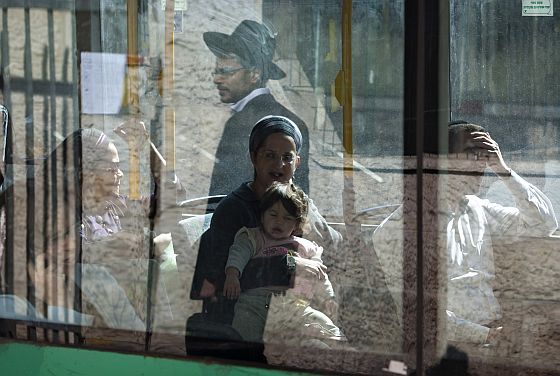
Women required to sit out of men's sight, at the back of the bus.
The Associated Press reports: Posters depicting women have become rare in the streets of Israel’s capital. In some areas women have been shunted onto separate sidewalks, and buses and health clinics have been gender-segregated. The military has considered reassigning some female combat soldiers because religious men don’t want to serve with them.
This is the new reality in parts of 21st-century Israel, where ultra-Orthodox rabbis are trying to contain the encroachment of secular values on their cloistered society through a fierce backlash against the mixing of the sexes in public.
On the surface, Israel’s gender equality bona fides seem strong, with the late Golda Meir as a former prime minister, Tzipi Livni as the current opposition leader, and its women soldiers famed around the world.
Reality is not so shiny. The World Economic Forum recently released an unfavorable image of women’s earning power in Israel, and in 2009, the last year for which data are available, Israeli women earned two-thirds what men did.
The newly enforced separation is felt most strongly in Jerusalem, where ultra-Orthodox Jews are growing in numbers and strength. The phenomenon is starting to be seen elsewhere, though in the Tel Aviv region, Israel’s largest metropolis, secular Jews are the vast majority, and life there resembles most Western cities.
Still, secular Jews there and elsewhere in Israel worry that their lifestyles could be targeted, too, because the ultra-Orthodox population, while still relatively small, is growing significantly. Their high birthrate of about seven children per family is forecast to send their proportion of the population, now estimated at 9 percent, to 15 percent by 2025.
The flotilla and the siege of Gaza
Sarkozy tells truth about Netanyahu but press decide it’s too sensitive to report

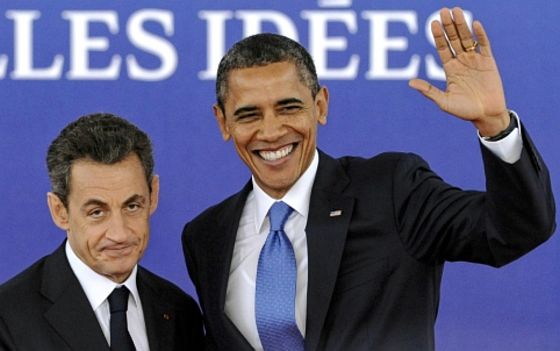
Sarkozy tells Obama, Netanyahu's a liar. Journalists blush.
“Who the fuck does he think he is? Who’s the fucking superpower here?” Bill Clinton said in exasperation about Benjamin Netanyahu after one of the Israeli prime minister’s characteristic displays of arrogance in 1996.
Now we learn that last Thursday at the G20 summit in Cannes, France’s President Nicolas Sarkozy privately described Netanyahu as a “liar” and said “I cannot stand him,” to which President Obama gave the fairly tepid response: “You’re fed up with him, but I have to deal with him every day!”
The exchange was picked up on an open microphone but the press in Cannes who overheard the presidential tête-à-tête agreed that it was too sensitive to report.
Are these journalists or presidential courtiers?
The surprising lack of coverage may be explained by a report alleging that journalists present at the event were requested to sign an agreement to keep mum on the embarrassing comments. A Reuters reporter was among the journalists present and can confirm the veracity of the comments.
A member of the media confirmed Monday that “there were discussions between journalists and they agreed not to publish the comments due to the sensitivity of the issue.”
He added that while it was annoying to have to refrain from publishing the information, the journalists are subject to precise rules of conduct.
Like when they are supposed to curtsy, make full bows, or discreetly look the other way?
Even now, now that the Sarkozy-Obama indiscretion has leaked out, there are several variations of translation of what Obama said.
“You may be sick of him, but me, I have to deal with him every day.” “You’ve had enough of him? I have to deal with him every day!”
These are different ways of translating “Tu en as marre de lui, mais moi, je dois traiter avec lui tous les jours !” That’s how Obama’s words were rendered on ArretSurImages.net.
So even though the press has broken its four day silence, instead of reporting the exact wording — words surely spoken in English — the press is merely repeating what has been reported on the French website — and even though the contents of that report have been confirmed by Reuters.
Watch out for the word sensitivity in any news report. Chances are, what it really refers to is complicity.
Europe’s rising Facebook fascism
The Guardian reports: The far right is on the rise across Europe as a new generation of young, web-based supporters embrace hardline nationalist and anti-immigrant groups, a study [PDF] has revealed ahead of a meeting of politicians and academics in Brussels to examine the phenomenon.
Research by the British thinktank Demos for the first time examines attitudes among supporters of the far right online. Using advertisements on Facebook group pages, they persuaded more than 10,000 followers of 14 parties and street organisations in 11 countries to fill in detailed questionnaires.
The study reveals a continent-wide spread of hardline nationalist sentiment among the young, mainly men. Deeply cynical about their own governments and the EU, their generalised fear about the future is focused on cultural identity, with immigration – particularly a perceived spread of Islamic influence – a concern.
“We’re at a crossroads in European history,” said Emine Bozkurt, a Dutch MEP who heads the anti-racism lobby at the European parliament. “In five years’ time we will either see an increase in the forces of hatred and division in society, including ultra-nationalism, xenophobia, Islamophobia and antisemitism, or we will be able to fight this horrific tendency.”
The report comes just over three months after Anders Breivik, a supporter of hard right groups, shot dead 69 people at youth camp near Oslo. While he was disowned by the parties, police examination of his contacts highlighted the Europe-wide online discussion of anti-immigrant and nationalist ideas.
Data in the study was mainly collected in July and August, before the worsening of the eurozone crisis. The report highlights the prevalence of anti-immigrant feeling, especially suspicion of Muslims. “As antisemitism was a unifying factor for far-right parties in the 1910s, 20s and 30s, Islamophobia has become the unifying factor in the early decades of the 21st century,” said Thomas Klau from the European Council on Foreign Relations, who will speak at Monday’s conference.
How the U.S. is blending law enforcement with warfare
The New York Times reports: Late on a moonless night last March, a plane smuggling nearly half a ton of cocaine touched down at a remote airstrip in Honduras. A heavily armed ground crew was waiting for it — as were Honduran security forces. After a 20-minute firefight, a Honduran officer was wounded and two drug traffickers lay dead.
Several news outlets briefly reported the episode, mentioning that a Honduran official said the United States Drug Enforcement Administration had provided support. But none of the reports included a striking detail: that support consisted of an elite detachment of military-trained D.E.A. special agents who joined in the shootout, according to a person familiar with the episode.
The D.E.A. now has five commando-style squads it has been quietly deploying for the past several years to Western Hemisphere nations — including Haiti, Honduras, the Dominican Republic, Guatemala and Belize — that are battling drug cartels, according to documents and interviews with law enforcement officials.
The program — called FAST, for Foreign-deployed Advisory Support Team — was created during the George W. Bush administration to investigate Taliban-linked drug traffickers in Afghanistan. Beginning in 2008 and continuing under President Obama, it has expanded far beyond the war zone.
“You have got to have special skills and equipment to be able to operate effectively and safely in environments like this,” said Michael A. Braun, a former head of operations for the drug agency who helped design the program. “The D.E.A. is working shoulder-to-shoulder in harm’s way with host-nation counterparts.”
The evolution of the program into a global enforcement arm reflects the United States’ growing reach in combating drug cartels and how policy makers increasingly are blurring the line between law enforcement and military activities, fusing elements of the “war on drugs” with the “war on terrorism.”
Here comes the sun
Paul Krugman writes: These days, mention solar power and you’ll probably hear cries of “Solyndra!” Republicans have tried to make the failed solar panel company both a symbol of government waste — although claims of a major scandal are nonsense — and a stick with which to beat renewable energy.
But Solyndra’s failure was actually caused by technological success: the price of solar panels is dropping fast, and Solyndra couldn’t keep up with the competition. In fact, progress in solar panels has been so dramatic and sustained that, as a blog post at Scientific American put it, “there’s now frequent talk of a ‘Moore’s law’ in solar energy,” with prices adjusted for inflation falling around 7 percent a year.
This has already led to rapid growth in solar installations, but even more change may be just around the corner. If the downward trend continues — and if anything it seems to be accelerating — we’re just a few years from the point at which electricity from solar panels becomes cheaper than electricity generated by burning coal.
And if we priced coal-fired power right, taking into account the huge health and other costs it imposes, it’s likely that we would already have passed that tipping point.
But will our political system delay the energy transformation now within reach?
Let’s face it: a large part of our political class, including essentially the entire G.O.P., is deeply invested in an energy sector dominated by fossil fuels, and actively hostile to alternatives. This political class will do everything it can to ensure subsidies for the extraction and use of fossil fuels, directly with taxpayers’ money and indirectly by letting the industry off the hook for environmental costs, while ridiculing technologies like solar.
So what you need to know is that nothing you hear from these people is true. Fracking is not a dream come true; solar is now cost-effective. Here comes the sun, if we’re willing to let it in.
11-11-11 — Night of a thousand masks
The politics of austerity
Thomas B. Edsall writes: The conservative agenda, in a climate of scarcity, racializes policy making, calling for deep cuts in programs for the poor. The beneficiaries of these programs are disproportionately black and Hispanic. In 2009, according to census data, 50.9 percent of black households, 53.3 percent of Hispanic households and 20.5 percent of white households received some form of means-tested government assistance, including food stamps, Medicaid and public housing.
Less obviously, but just as racially charged, is the assault on public employees. “We can no longer live in a society where the public employees are the haves and taxpayers who foot the bills are the have-nots,” declared Scott Walker, the governor of Wisconsin.
For black Americans, government employment is a crucial means of upward mobility. The federal work force is 18.6 percent African-American, compared with 10.9 percent in the private sector. The percentages of African-Americans are highest in just those agencies that are most actively targeted for cuts by Republicans: the Department of Housing and Urban Development, 38.3 percent; the Equal Employment Opportunity Commission, 42.4 percent; and the Education Department, 36.6 percent.
The politics of austerity are inherently favorable to conservatives and inhospitable to liberals. Congressional trench warfare rewards those most willing to risk all. Republicans demonstrated this in last summer’s debt ceiling fight, deploying the threat of a default on Treasury obligations to force spending cuts.
Conservatives are more willing to inflict harm on adversaries and more readily see conflicts in zero-sum terms — the basic framework of the contemporary debate. Once austerity dominates the agenda, the only question is where the ax falls.
Syrian troops crush opposition in key Homs neighborhood
The Washington Post reports: Syrian troops on Monday routed government opponents in a neighborhood of Homs that had emerged in recent weeks as a center of armed resistance to the regime led by President Bashar al-Assad, dealing what appeared to be a serious setback to the protest movement and to an Arab League peace initiative designed to end the violence.
Homs residents and human rights groups said security forces stormed the Bab al-Amr neighborhood in the small hours of the morning, concluding a six-day assault in which dozens were killed and scores injured, many of them in tank bombardments.
Defected soldiers who had been defending the protest hot spot either fled to the surrounding countryside or were captured or killed, said residents and activists. Syrian troops combed through the neighborhood Monday detaining all the young men they encountered, and government supporters staged a noisy demonstration through the deserted streets.
The assault came as Assad’s government braced for the potential fallout from its failure to abide by the terms of an Arab League-sponsored peace initiative agreed to last Wednesday. Under the deal, Syria was to withdraw troops from cities, allow peaceful protests and release detainees.
Instead, the army launched an offensive in Homs, surrounding Bab al-Amr on the eve of the league’s announcement of the deal in Cairo and bombarding it with tank fire.
The offensive was accompanied by a surge in retaliatory sectarian killings in which hospital workers and human rights groups have said at least 70 people died, illustrating the potential for this religiously mixed city in the heart of Syria to serve as a crucible for a civil war many have feared since the uprising erupted in March.
The Arab world’s intifada
Phyllis Bennis writes: The “Arab spring” may have started in early 2011 when a young Tunisian fruit seller, in a desperate response to disempowerment and despair, immolated himself in the streets of a small town. But its origins link directly to the first Palestinian intifada, the non-violent, society-wide mobilization that transformed Palestine’s national struggle beginning in the late 1980s. Palestinian activists chose “uprising” as the logical English equivalent, but Arabic speakers were clear that intifada didn’t really mean that. It meant something closer to “shake up” or “shaking out”–exactly what Occupy Wall Street has done to the US body politic, and what the Arab spring has set loose in a region long trapped in the morass of US-backed military dictatorships, absolute monarchies, and repressive nationalists.
So when US analysts or European journalists or World Bank bureaucrats ruminate about “when will there be a Palestinian spring?”, it’s generally because they have no historical context, no idea that Palestine’s first intifada spring in many ways set the stage for this Arab spring more than two decades later. For Palestine and Palestinians, the shaking up of the region has provided one of the most comprehensive–and positive–changes in a generation: the end (or at least the beginning of the end) of the era of US-dependent Arab regimes whose commitments to Palestinian liberation were limited to a few dollars and the rhetoric useful for distracting their own populations from state repression, lack of rights and inadequacies of their own lives.
Civil society has risen to become the most important component of the Palestinian national movement–and not only because of the 20 years of failure of the US-controlled “peace process”. It’s also because the most creative and strategic ideas for achieving Palestinian human rights have come from civil society, not from the leadership recognized (or not) by the world’s governments. Beginning with the 2005 call for a global mobilization for BDS (boycott, divestment and sanctions), Palestine’s civil society organizations have been at the centerpiece of the growing international movement to bring non-violent economic pressure to bear on Israel until it ends its violations of international law: ending the occupation of the 1967 territories, ending the legal discrimination against Palestinian citizens of Israel, and recognizing the right of return of Palestinian refugees.