Category Archives: Issues

Why are we being readied for war with Iran?

If you want to start a war with Iran, apparently the lesson from Iraq is not that war is a dumb idea; it’s that the war charge cannot be led by the U.S. administration or a ragtag band of expatriates.

The pretext for war needs to be presented by an international body that is perceived as independent and objective. So, if you want to start a war with Iran, who could present a more compelling justification for war than the International Atomic Energy Agency?

But can the U.S. government rely on the IAEA to fulfill its covertly designated role?

Now that the irritatingly independent Mohamed ElBaradei is out of the way, we know — thanks to Wikileaks — that Washington is much more comfortable with the agency’s new director general, Yukiya Amano, who is “solidly in the U.S. court on every key strategic decision, from high-level personnel appointments to the handling of Iran’s alleged nuclear weapons program.”

The Obama administration, as well as being able to rely on the IAEA to align itself with U.S. goals, can of course always rely on the New York Times to fulfill its role as an informal ministry of information. Just as Izvestia functioned as the “delivered message” of the Soviet government, reporters like David Sanger gladly parrot their administration sources rather than question what they are being told.

[T]he Obama administration, acutely aware of how what happened in Iraq undercut American credibility, is deliberately taking a back seat, eager to make the conclusions entirely the I.A.E.A.’s, even as it continues to press for more international sanctions against Iran. When the director of the agency, Yukia Amano, came to the White House 11 days ago to meet top officials of the National Security Council about the coming report, the administration declined to even confirm he had ever walked into the building.

The final touches are still being put on the report and its critical annex, where some of the investigative details will be laid out, which may be released as early as Wednesday. But already Russia and China have sent a diplomatic protest to Mr. Amano, urging him to not to make details of the evidence public.

“Russia and China are of the opinion that such kind of report will only drive Iran into a corner,” they wrote in the note, which was obtained by The New York Times and is a rare instance of those countries commenting jointly.

Obtained by the New York Times — but from who?

Knowing how a piece of information enters the public domain can be as important as the information itself. If these reporters gave some indication about where the note came from, they would thereby provide a clearer indication about whose agenda is being served by its revelation.

Sources do of course often need to be concealed and over at Arms Control Wonk, Jeffrey Lewis obliges “an observer” by allowing him to remain nameless. Regular readers of ACW will know, however, that this is a blog not only with stellar contributors but also a highly informed readership. This observer writes:

For some reason, everyone and his cousin are suddenly seized the idea that there must be an urgent need to (at a minimum) contemplate whether to bomb Iran. No one can quite say why now, though. As Ari Shavit writes in Ha’aretz, with an impressive combination of eloquence and lack of substance:

For the past decade it has been clear that we are facing an Iranian deadline. Time after time the deadline has been put off. But it is real and it is imminent. Unless an international miracle, or an interior-Iranian miracle takes place, we will reach the crossroads.

‘When we stand at the crossroads we will have two options – prevention or deterrence. To launch a military offensive or to emerge from nuclear ambiguity. One way or another, all chaos will break loose in the Middle East. One way or another, all chaos will break loose in Israel. What was will be no more. A new era will begin.’

But just what technical or political fact has brought the deadline to the crossroads?

Why, exactly, is there an insistence that Iran is racing up to some undefined sharply defined point where its adversaries, Israel included, must either strike preventively or accept an uneasy relationship of mutual (nuclear) deterrence? If Iran is racing, so were Achilles and the Tortoise. It’s more like tiptoeing.

Shavit is now the umpty-teenth commentator, Israeli or otherwise, who apparently cannot imagine that nuclear opacity or ambiguity could apply to states other than Israel.

The drumbeat for war against Iran suggests that not only do Iran’s enemies regard the Islamic state’s acquisition of nuclear weapons as intolerable, but Tehran must be punished simply for its lack of transparency.


Facebooktwittermail

Escalating Israeli settler violence in the West Bank

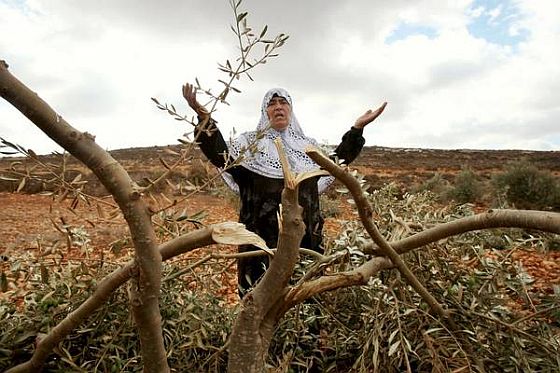
A Palestinian woman gestures next to a damaged olive tree in the village of Qusra in the northern West Bank, Thursday, Oct . 6, 2011

The United Nations Office for the Coordination of Humanitarian Affairs occupied Palestinian territory, says in its latest report [PDF]:

  • The weekly average of settler attacks resulting in Palestinian casualties and property damage has increased by 40% in 2011 compared to 2010, and by over 165% compared to 2009.
  • In 2011, three Palestinians have been killed and 167 injured by Israeli settlers. In addition, one Palestinian has been killed, and 101 others injured, by Israeli soldiers during clashes between Israeli settlers and Palestinians.
  • Eight Israeli settlers have been killed and 30 others injured by Palestinians in 2011, compared to five killed and 43 injured, during the same period in 2010.
  • In 2011, nearly 10,000 Palestinian-owned trees, primarily olive trees, have been damaged or destroyed by Israeli settlers, significantly undermining the livelihoods of hundreds of families.
  • In July 2011, a community of 127 people was displaced en masse due to repeated settler attacks, with some affected families re-locating to Areas A and B.
  • Over 90% of monitored complaints regarding settler violence filed by Palestinians with the Israeli police in recent years have been closed without indictment.
  • OCHA has identified over 80 communities with a combined population of nearly 250,000 Palestinians vulnerable to settler violence, including 76,000 who are at high-risk.

(H/t 972mag.com)

Facebooktwittermail

Unholy alliance: Israel’s right and Europe’s anti-Semites

Israel's ambassador to the UN Ron Prosor accidentally smiles while rubbing shoulders with French ultra-right leader Marine Le Pen.

Adar Primor writes: Marine Le Pen hit the jackpot. She invited about 100 diplomats to a luncheon last week during a visit to UN Headquarters in New York. Four accepted: There were the envoys from Trinidad and Tobago, Armenia and Uruguay, who obviously are of no concern to her at all. But the entrance of the fourth guest, Israeli UN Ambassador Ron Prosor, made the event a sensation and worth her whole trip.

No official American representative agreed to meet with France’s extreme-right leader. Neither did any leader of the Jewish community. She failed in her attempt to stage a photo op at the Holocaust Museum, and skipped the visit. The French ambassador to the UN sent a sharp message that she is persona non grata in the United Nations building. But the Israeli envoy? He shook her hand and spoke of the importance that must be accorded to a wide variety of opinions.

“We flourish on the diversity of ideas,” Prosor said. “We talked about Europe, about other issues and I enjoyed the conversation very much,” Prosor was quoted as saying. Even before he went into the hall where the luncheon was being held, he told shocked reporters that he was a “free man.”

The Foreign Ministry now claims there was a misunderstanding; the ambassador “thought he was attending an event hosted by the French UN delegation. When he realized his error, he skipped the meal and left.” User comments on leading French news websites over the weekend were derisive, including all the French equivalents of LOL and ROFL in response to the explanation.

No one believes it was a coincidence. Prosor is a proven professional. He would certainly want to forget the fact that he became the first representative of the Jewish state to meet with a leader of the National Front. He would probably be happy to smash the camera that documented the smiling encounter. But his mistake did not happen in a vacuum. It has the odor of a symptom. The odor of a very unholy alliance being formed between members of the Israeli right-wing and a number of the most nationalistic and anti-Semitic figures in Europe. Over the past year, among visitors to Israel were the populist Dutch leader Geert Wilders, the Belgian racist Filip Dewinter and the Austrian successor to Jorg Haider, Heinz-Christian Strache.

These politicians, like Le Pen, have exchanged the Jewish demon-enemy for the criminal-immigrant Muslim. But they have not really discarded their ideological DNA. The Israeli seal of approval they seek to get is intended to bring them closer to power. Le Pen herself has decided to leave behind the anti-Semitic scandals of her father, Jean-Marie. She wants to make the National Front a popular and legitimate party.

She is already popular (19 percent in the polls). Legitimate? In two interviews she gave to Haaretz in the past, she attacked President Jacques Chirac for his historic 1995 declaration in which he took, in the name of France, responsibility for Vichy war crimes. She adamantly refused to denounce French fascist crimes and showed that she cannot really disengage from her father, his heritage and her party’s Vichy and anti-Semitic hard core.

It is easy to guess what would happen to an Israeli ambassador if he found himself at an event hosted by the “disgraced” Palestinian Authority President Mahmoud Abbas – or, perish the thought, at a Hamas or Hezbollah event. The earth would tremble. Even tar and feathers would not be enough under such circumstances. But Le Pen is blonde and she has blue eyes. Oh, and she hates Muslims.

Let us hope the incident at the United Nations will not give her votes that will allow her to repeat her father’s sensational results in the 2002 French presidential elections, and go on to a second round in the upcoming French elections.

We must see a complete and public disavowal by Israel to prevent an ostensibly minor incident from becoming an accident of history.

Facebooktwittermail

Welcome to the “augmented revolution”

Nathan Jurgenson writes: Earlier this year, there was a spat that was both silly and superficial over the terms “Twitter” and “Facebook Revolution” to capture protests in the Arab World. On the one hand, those terms offensively reduced a vast political movement to a social networking site. On the other, Malcolm Gladwell’s response — that there was protest before social media, therefore social media had no role — was equally unfulfilling.

Neither view captured the way technology has been utilized in this global wave of dissent. We are witnessing political mobilizations across much of the globe, including the Middle East, North Africa, Asia and South America. Riots and “flash mobs” are increasingly making the news. In the United States the emergence of the Occupy movement shows that technology and our global atmosphere of dissent is the effective merging of the on- and offline worlds. We cannot only focus on one and ignore the other.

It is no historical coincidence that the rise of social media will be forever linked with the global spread of mass mobilizations of people in physical space that we are witnessing right now. Social media is not some space separate from the offline, physical world. Instead, social media should be understood as the effective merging of the digital and physical, the on- and offline, atoms and bits. And the consequences of this are erupting around us.

Occupy Wall Street and the subsequent occupation movements around the United States and increasingly the globe might best be called an augmented revolution. By “augmented,” I am referring to a larger conceptual perspective that views our reality as the byproduct of the enmeshing of the on- and offline. This is opposed to the view that the digital and physical are separate spheres, what I have called “digital dualism.” Research has demonstrated that sites like Facebook have everything to do with the offline. Our offline lives drive whom we are Facebook-friends with and what we post about. And what happens on Facebook influences how we experience life when we are not logged in and staring at some glowing screen (e.g., we are being trained to experience the world always as a potential photo, tweet, status update). Facebook augments our offline lives rather than replaces them. And this is why research shows that Facebook users have more offline contacts, are more civically engaged, and so on.

Facebooktwittermail

The Robin Hood tax — turning a global crisis into a global opportunity

Learn more about the Robin Hood tax.

Robin Hood tax backed by more than 1,000 economists. (Telegraph)

Bill Gates backs Robin Hood tax on bank trades. (Guardian)

IMF report [PDF] says: “In principle, an FTT is no more difficult and, in some respects easier, to administer than other taxes.”

Facebooktwittermail

Mengele in America

Donna Dickenson writes: It’s 1946. On one side of the Atlantic, American lawyers are prosecuting Nazi doctors at Nuremberg for crimes against humanity – so-called “research” carried out on concentration camp prisoners. On the other side of the Atlantic, in Guatemala, the United States Public Health Service (PHS) is deliberately infecting prisoners and mental patients with syphilis in another “experiment” aimed at replacing the ineffective drugs used by soldiers during the war that had just ended.

It sounds too perverse to be true. Yet a special commission appointed by President Barack Obama has just confirmed that the Guatemalan experiments really did take place. Obama has also issued an apology to the people of Guatemala. But why did it take so long to get to this point?

Sixty-three years after the Guatemalan experiments, an American historian, Susan Reverby, was rummaging through archived medical papers from the 1940s. Reverby was completing a final task in her two decades of studying the PHS’s detestable Tuskegee experiments, in which hundreds of African-American men with late-stage syphilis were observed but not treated, even after penicillin was developed. She was examining the papers of Thomas Parran, US surgeon-general from 1936-1948, when the Tuskegee research was already in full swing. So, too, she found, was the previously unknown Guatemalan experiment.

For years, Tuskegee has been a byword for ethical abuses in scientific research – to the extent that President Bill Clinton apologised to its surviving “subjects”. Hard as it may be to believe, as Reverby was to discover, the abuse in Guatemala was even more egregious.

Facebooktwittermail

Israel’s diplomatic bankruptcy

An editorial in The Observer says: Iran’s acquisition of nuclear weapons is seen as a threat for reasons partly of Israel’s own making – foremost its absolute reliance on a policy of military supremacy and deterrence to underpin security. A nuclear-armed Iran would hole that policy below the waterline, making it far more difficult, for instance, to launch the kind of war it waged against Hezbollah in Lebanon in 2006.

Israel’s recent posturing ahead of the IAEA meeting, which included testing a new long-range missile and launching a long-range air strike exercise, is a doubly dangerous game. For while some senior Israeli air force officers are understood to support Netanyahu’s desire to strike Iran sooner rather than later, other independent analysis is far more sceptical of Israel’s ability to cause lasting damage on Iran’s nuclear programme, suggesting that it might require up to a fifth of the country’s operational aircraft to inflict serious harm, which could still fall short of Israel’s desired outcome. Some experts have estimated that even a successful raid on Iran would buy Israel only four years at best while encouraging Iran to redouble its efforts to acquire nuclear weapons.

If that is the short-term analysis, then in the medium term the risks for Israel perhaps would be greater still. With its regional alliances with friendly states quickly unravelling in the fall-out from the Arab Spring, from Israel’s botched attack on the Turkish-flagged MV Mavi Marmara and from its war against Gaza, an attack on the scale required to halt Iran’s nuclear programme is unlikely to improve either its relations with its neighbours or Israel’s security environment.

All of which leads to the question – if the consequences carry such risk for so little benefit, why are Netanyahu and his defence minister, Ehud Barak, pushing the plan?

One possibility is that Netanyahu is determined to impose the terms of the debate about the issues raised by the IAEA report at a time when it is clear that both Russia and China are lukewarm on the prospect of further sanctions against Tehran. If that is Netanyahu’s aim – to use the threat of war to leverage diplomatic effect – it is the behaviour of a tinpot state, not the mature democracy Israel claims to be.

Far more worrying is the notion that Netanyahu, who has long chafed against President Obama’s strictures on settlement building and the peace process, and is said to be obsessed with the issue of Iran, is contemplating an attack having calculated he has sufficient friends in Congress to defy the White House.

Whatever Netanyahu is thinking, he is playing a high-risk game for even higher stakes, betting Israel’s security and international prestige against an uncertain outcome, even by allowing it to be suggested that Israel might strike. After Israel’s failure to defeat Hezbollah in Lebanon in 2006, its failure to break Hamas in Gaza in 2009 – and with the international opprobrium that followed that operation – Israel risks talking itself into a corner where it appears weak if it doesn’t act and perhaps weaker if it does, a country increasingly bereft of any notion of how to manage relations with its neighbours except through the threat of aggression.

Facebooktwittermail

Israeli doctors ‘failing to report torture of Palestinian detainees’

The Guardian reports: Medical professionals in Israel are being accused of failing to document and report injuries caused by the ill-treatment and torture of detainees by security personnel in violation of their ethical code.

A report by two Israeli human rights organisations, the Public Committee Against Torture (PCAT) and Physicians for Human Rights (PHR), claims that medical staff are also failing to report suspicion of torture and ill-treatment, returning detainees to their interrogators and passing medical information to interrogators.

The report, Doctoring the Evidence, Abandoning the Victim, to be published later this month, is based on 100 cases of Palestinian detainees brought to PCAT since 2007. It says: “This report reveals significant evidence arousing the suspicion that many doctors ignore the complaints of their patients; that they allow Israeli Security Agency interrogators to use torture; approve the use of forbidden interrogation methods and the ill-treatment of helpless detainees; and conceal information, thereby allowing total immunity for the torturers.”

Alleged ill-treatment of detainees, some of whose cases are detailed in the 61-page report, includes beatings, being held for long periods in stress positions, hands being tightly tied with plastic cuffs, sleep deprivation and threats. Israel denies torturing or ill-treating prisoners.

Facebooktwittermail

Goodbye, Wells Fargo; hello, credit union

Josh Harkinson writes: Looking back on my 10 years with Wells Fargo, I’ll always remember the time that a banker gave my 18-month-old son a stuffed horse. After my son gleefully embraced it—”Horsie!”—I was told that taking it home would require signing up for a second checking account that I didn’t need. Not to worry, the friendly banker explained: He’d cancel the new account a few weeks later. I thanked him and went home feeling glad to know the guy.

The following month, my wife and I suddenly ran out of money, which seemed impossible given that I’d recently deposited a check. Wells Fargo’s hefty overdraft fees kicked in. I was freaking out, thinking somebody had gone on a shopping spree with our debit card number—until I realized that the check had somehow ended up in the still-active horsie account.

Enter Bank Transfer Day, the Occupy-associated campaign to get people to move their money from large banks into small community credit unions. According to their main trade association, credit unions have signed up 650,000 new customers since the concept was announced on September 29—double their normal rate. But if credit unions really are so much better than big banks, why haven’t even more people switched over? Did the activists know something I didn’t—or were credit unions just peddling their own version of the free horsie?

“This is probably the worst bank on the planet,” a Yelp reviewer writes about the credit union near my apartment, which averages a mediocre three stars. But after reading more, I got a sense that not all credit unions are the same. The San Francisco Fire Credit Union, which supports firefighters but is open to all San Franciscans, averages a perfect five Yelp stars. One Yelper gushes, “I am in love.”

Facebooktwittermail

In Pakistan, drones kill the innocent

Clive Stafford Smith writes: Last Friday, I took part in an unusual meeting in Pakistan’s capital, Islamabad.

The meeting had been organized so that Pashtun tribal elders who lived along the Pakistani-Afghan frontier could meet with Westerners for the first time to offer their perspectives on the shadowy drone war being waged by the Central Intelligence Agency in their region. Twenty men came to air their views; some brought their young sons along to experience this rare interaction with Americans. In all, 60 villagers made the journey.

The meeting was organized as a traditional jirga. In Pashtun culture, a jirga acts as both a parliament and a courtroom: it is the time-honored way in which Pashtuns have tried to establish rules and settle differences amicably with those who they feel have wronged them.

On the night before the meeting, we had a dinner, to break the ice. During the meal, I met a boy named Tariq Aziz. He was 16. As we ate, the stern, bearded faces all around me slowly melted into smiles. Tariq smiled much sooner; he was too young to boast much facial hair, and too young to have learned to hate.

The next day, the jirga lasted several hours. I had a translator, but the gist of each man’s speech was clear. American drones would circle their homes all day before unleashing Hellfire missiles, often in the dark hours between midnight and dawn. Death lurked everywhere around them.

When it was my turn to speak, I mentioned the official American position: that these were precision strikes and no innocent civilian had been killed in 15 months. My comment was met with snorts of derision.

I told the elders that the only way to convince the American people of their suffering was to accumulate physical proof that civilians had been killed. Three of the men, at considerable personal risk, had collected the detritus of half a dozen missiles; they had taken 100 pictures of the carnage.

In one instance, they matched missile fragments with a photograph of a dead child, killed in August 2010 during the C.I.A.’s period of supposed infallibility. This made their grievances much more tangible.

Collecting evidence is a dangerous business. The drones are not the only enemy. The Pakistani military has sealed the area off from journalists, so the truth is hard to come by. One man investigating drone strikes that killed civilians was captured by the Taliban and held for 63 days on suspicion of spying for the United States.

At the end of the day, Tariq stepped forward. He volunteered to gather proof if it would help to protect his family from future harm. We told him to think about it some more before moving forward; if he carried a camera he might attract the hostility of the extremists.

But the militants never had the chance to harm him. On Monday, he was killed by a C.I.A. drone strike, along with his 12-year-old cousin, Waheed Khan. The two of them had been dispatched, with Tariq driving, to pick up their aunt and bring her home to the village of Norak, when their short lives were ended by a Hellfire missile.

My mistake had been to see the drone war in Waziristan in terms of abstract legal theory — as a blatantly illegal invasion of Pakistan’s sovereignty, akin to President Richard M. Nixon’s bombing of Cambodia in 1970.

But now, the issue has suddenly become very real and personal. Tariq was a good kid, and courageous. My warm hand recently touched his in friendship; yet, within three days, his would be cold in death, the rigor mortis inflicted by my government.

And Tariq’s extended family, so recently hoping to be our allies for peace, has now been ripped apart by an American missile — most likely making any effort we make at reconciliation futile.

Facebooktwittermail

Apartheid and the occupation of Palestine

John Dugard writes: This week, the Russell Tribunal on Palestine will consider the question of whether Israel’s practices in the occupied Palestinian territory (OPT) constitute the crime of apartheid within the meaning of the 1973 International Convention on the Suppression and Punishment of the Crime of Apartheid. This Convention, which has been incorporated into the Rome Statute of the International Criminal Court, is not confined to apartheid in South Africa. Instead it criminalises, under international law, practices that resemble apartheid.

The Russell Tribunal was initiated in the 1960s by the philosopher Bertrand Russell to examine war crimes committed during the Vietnam War. It has now been revived to consider Israel’s violations of international law. It is not a judicial tribunal, but a tribunal comprising reputable jurors from different countries, that seeks to examine whether Israel has violated international criminal law and should be held accountable.

In essence, the Russell Tribunal is a court of international public opinion. It will hear evidence in Cape Town on the scope of the 1973 Apartheid Convention, on apartheid as practiced in South Africa, on Israeli practices in the OPT, particularly the West Bank, and on the question whether these practices so closely resemble those of apartheid as to bring them within the prohibitions of the 1973 Apartheid Convention. The Israeli government has been invited to testify before the tribunal, but, at this stage, has not replied to the invitation. Most of the evidence will inevitably, therefore, be critical of Israel.

Israel cannot be held accountable for its actions by any international tribunal as it refuses to accept the jurisdiction of either the International Court of Justice or the International Criminal Court. The Russell Tribunal seeks to remedy this weakness in the international system of justice by providing for accountability by a court of international opinion. It does not seek to obstruct the peace process. On the contrary, it wishes to promote it. But there can be no peace without justice.

Facebooktwittermail

Flotilla controversy within Occupy Wall Street shows Palestine continues to be a fault line

BY BEN LORBER

At about midnight Palestinian time, all was quiet on the Mediterranean Sea. All reports coming from the Tahrir and Saoirse indicated that the two unidentified (possibly Israeli) ships and planes, which had been trailing the humanitarian vessels an hour before, had receded into the distance, and posed no immediate threat. The international activists aboard the Canadian and Irish vessels announced they were heading off to sleep, as journalist Hassan Ghani, aboard the Canadian Tahrir, tweeted that “I remember these feelings a year ago onboard the Mavi Marmara; the tension but also the hope of reaching Gaza the next morning”. Folks eyeing the Twitter-sphere found themselves “praying that this is not the calm before the storm”, and encouraging the 27 crew members to “stay steady in your tracks and strong in your minds”.

In the midst of this calm, the Occupy Wall Street (OWS) movement posted a surprising and exhilarating tweet:

“We support and would like to express #solidarity to #FreedomWaves #Palestine #ows”.

Moments later, the Twitter representative of the Canada Boat to Gaza posted an appreciative response, “We are thrilled to receive the support of #OccupyWallStreet Looks like only the 1% support the Israeli blockade of Gaza.” The Twitter-sphere flared up with expressions of praise and affirmation, proving that the 99% naturally link the struggle for the Occupation of Wall Street with the struggle against the Occupation of Palestine as two facets of a single universal liberation struggle.

Approximately four hours later, however, Occupy Wall Street’s tweet mysteriously disappeared from its home page on Twitter. The Twitter-sphere was instantly taken aback — “didn’t realize #OWS is non-political!!” remarked one tweeter, while another insisted that “If #OWS can not support #FreedomWaves and #Gaza then they should not compare themselves to #ArabSpring or #Tahrir.” The Canada Boat to Gaza, who earlier had nodded in satisfaction, now, shook its head in disappointment, offering, in the face of Occupy Wall Street’s fear of involving itself in the Israel-Palestine conflict, a few words by Desmond Tutu: “If you are neutral in situations of injustice, you have chosen the side of the oppressor.”

Many tweeps asked “Why did @OccupyWallSt delete a tweet showing solidarity with #FreedomWaves?” or “@OccupyWallSt Did you seriously delete the tweet supporting #FreedomWaves WHY?” The closest official answer came from Daniel Sieradski, a new media activist who has been central to the OccupyJudaism activities. Sieradski explained, the “#FreedomWaves tweet was unauthorized, did not have reflect #OWS community consensus and was subsequently deleted.” He added, “#OWS does not have a position on the Israeli-Palestinian conflict,” and “#OWS is a consensus based movement. The GA has never discussed the I/P issue & even if it did, it would never reach consensus.” Sieradski acknowledged he was not speaking as a spokesperson from Occupy Wall Street but he had “heard what happened from people close to it.” I was not able to receive an official explanation from the Occupy Wall Street movement about why tweet being deleted.

As the controversy blazed across Twitter, it opened a space for the 99% to express the obvious connections between the Israeli occupation of Palestine and the global dominance of the 1% — “#OWS is inseparable from #Palestine. 1% funding Israeli settlements and extremist settlers? Priceless.”; “#OWS is inseparable from#Gaza. The 1% diverts resources from the 99% by Israel’s blockading and shelling 100% of Gaza”; “The Tear Gas used in #Oakland is the same tear gas used in#Palestine, when protesters demonstrate non violently”, to cite a few among the myriad examples. Not everyone on twitter was upset however. The tweeter ‘Fatima600’, who had been using this racist name to fire verbal attacks at the flotilla throughout the night, responded, “They are tired of having their movement hijacked!!!!! I love you #OWS!!!!”

Hours later, @OccupyFortWorth expressed its support for Freedom Waves for Gaza — “Our support for #Gaza and #Freedomwaves is limitless. It emanates and echoes from the deepest purest regions of our heart. Love. Solidarity”, asserting, in contrast to #OccupyWallSt’s hesitancy, that “we don’t mind losing followers who are uncritical or unwilling to engage the issues (Or who are reflexively pro-Zionist.)”.

Ben Lorber is an American activist with the International Solidarity Movement in the West Bank and a journalist with the Alternative Information Center in Bethlehem. Visit his blog at freepaly.wordpress.com.

This post originally appeared at Mondoweiss and is reposted here with permission.

Facebooktwittermail

Bill Moyers: ‘They are occupying Wall Street because Wall Street is occupying America

Bill Moyers says: The great American experience in creating a different future together — this “voluntary union for the common good” – has been flummoxed by a growing sense of political impotence — what the historian Lawrence Goodwyn has described as a mass resignation of people who believe “the dogma of democracy” on a superficial public level but who no longer believe it privately. There has been, he writes, a decline in what people think they have a political right to aspire to — a decline of individual self-respect on the part of millions of people.

You can understand why that is. We hold elections, knowing they are unlikely to produce the policies favored by a majority of Americans. We speak, we write, we advocate — and those in power, Democrats and Republicans, liberals and conservatives, turn deaf ears and blind eyes to our deepest aspirations. We petition, we plead, we even pray — yet the Earth that is our commons and should be passed on in good condition to coming generations, continues to be despoiled. We invoke the strain in our national DNA that attests to “life, liberty, and the pursuit of happiness” as the produce of political equality — yet private wealth multiplies even as public goods are beggared.

And the property qualifications for federal office that the framers of the Constitution expressly feared as an unseemly “veneration for wealth” are now openly in force and the common denominator of public office, including for our judges, is a common deference to cash.

So if belief in the “the dogma of democracy” seems only skin deep, there are reasons for it.

During the great prairie revolt that swept the plains a century after the Constitution was ratified, the populist orator Mary Elizabeth Lease explained “Wall Street owns the country. Our laws are the output of a system which clothes rascals in robes and honesty in rags. The parties lie to us, and the political speakers mislead us,” because, she said, “money rules.”

That was 1890. And those agrarian populists were boiling over with anger that the corporations, banks and government were conniving to deprive everyday people of their livelihood. They should see us now.

John Boehner calls on the bankers, holds out his cup, and offers them total obeisance from the House majority if only they will fill it. That’s now the norm, and they get away with it.

Barack Obama criticizes bankers as fat cats, then invites them to dine at a pricy New York restaurant where the tasting menu runs to $195 a person. And that’s the norm. And they get away with it.

As we speak, the president has raised more money from banks, hedge funds, and private equity managers than any Republican candidate, including Mitt Romney. Let’s name it for what it is: democratic deviancy defined downward. Politics today — and there are honorable men and women in it — but politics today is little more than money laundering and the trafficking of power and policy, fewer than six degrees of separation from the spirit and tactics of Tony Soprano.

Why New York’s Zuccotti Park is occupied is no mystery — reporters keep scratching their heads and asking, “Why are you here?” But it’s as clear as the crash of 2008: they are occupying Wall Street because Wall Street has occupied America.

Facebooktwittermail

Occupy demands: Let’s radicalise our analysis

Robert Jensen writes: There’s one question that pundits and politicians keep posing to the Occupy gatherings around the country: What are your demands?

I have a suggestion for a response: We demand that you stop demanding a list of demands.

The demand for demands is an attempt to shoehorn the Occupy gatherings into conventional politics, to force the energy of these gatherings into a form that people in power recognise, so that they can roll out strategies to divert, co-opt, buy off, or – if those tactics fail – squash any challenge to business as usual.

Rather than listing demands, we critics of concentrated wealth and power in the US can dig in and deepen our analysis of the systems that produce that unjust distribution of wealth and power. This is a time for action, but there also is a need for analysis.

Rallying around a common concern about economic injustice is a beginning; understanding the structures and institutions of illegitimate authority is the next step.

We need to recognise that the crises we face are not simply the result of greedy corporate executives or corrupt politicians, but rather of failed systems. The problem is not the specific people who control most of the wealth of the country, or those in government who serve them, but the systems that create those roles.

Most chart the beginning of the external US empire-building phase with the 1898 Spanish-American War and the conquest of the Philippines that continued for some years after. That project went forward in the early 20th century, most notably in Central America, where regular US military incursions made countries safe for investment. If we could get rid of the current gang of thieves and thugs but left the systems in place, we will find that the new boss is going to be the same as the old boss.

My contribution to this process of sharpening analysis comes in lists of three, with lots of alliteration. Whether or not you find my analysis of the key questions compelling, at least it will be easy to remember: Empire, economics, ecology.

Facebooktwittermail