Jesse Eisinger writes: After years of lengthy investigations into collateralized debt obligations, the mortgage securities at the heart of the financial crisis, the S.E.C. has brought civil actions against only two small-time bankers. But compared with the Justice Department, the S.E.C. is the second coming of Eliot Ness. No major investment banker has been brought up on criminal charges stemming from the financial crisis.
To understand why that is so pathetic and — worse — corrupting, we need to briefly review what went on in C.D.O.’s in the years before the crisis. By 2006, legions of Wall Street bankers had turned C.D.O.’s into vehicles for their own personal enrichment, at the expense of their customers.
These bankers brought in savvy (and cynical) investors to buy pieces of the deals that they could not sell. These investors bet against the deals. Worse, they skewed the deals by exercising influence over what securities went into the C.D.O.’s, and they pushed for the worst possible stuff to be included.
The investment banks did not disclose any of this to the investors on the other side of the deals, or if they did, they slipped a vague, legalistic disclosure sentence into the middle of hundreds of pages of dense documentation. In the case brought last week, Citigroup was selling the deal, called Class V Funding III, while its own traders were filling it up with garbage and betting against it.
By the S.E.C.’s own investigations of and settlements with Goldman Sachs, JPMorgan Chase and Citigroup, and by reporting like my ProPublica work with Jake Bernstein and early stories by The Wall Street Journal, we know that these breaches were anything but isolated. This was the Wall Street business model. (Goldman, JPMorgan and Citigroup were all able to settle without admitting or denying anything, which, of course, is part of the problem.)
Neither the Citigroup settlement nor any of the others come close to matching the profits and bonuses that these banks generated in making these deals. And low-level bankers did not, and could not, act alone. They were not rogues, hiding things from their bosses.
Max Blumenthal writes: With the rise of the Occupy Wall Street, a new generation of mostly middle class Americans is learning for the first time about the militarization of their local police forces. And they are learning the hard way, through confrontations with phalanxes of riot cops armed with the latest in “non-lethal” crowd control weaponry. Yesterday’s protests in Oakland, California were the site of perhaps the harshest police violence leveled against the Occupy movement so far. Members of the Oakland Police Department and the California Sheriff’s Department attacked unarmed protesters with teargas canisters, beanbag rounds, percussion grenades, and allegedly with rubber bullets, leaving a number of demonstrators with deep contusions and bloody head wounds. It is not difficult to imagine such scenes becoming commonplace as the Occupy protests intensify across the country.
The police repression on display in Oakland reminded me of tactics I witnessed the Israeli army employ against Palestinian popular struggle demonstrations in occupied West Bank villages like Nabi Saleh, Ni’lin and Bilin. So I was not surprised when I learned that the same company that supplies the Israeli army with teargas rounds and other weapons of mass suppression is selling its dangerous wares to the Oakland police. The company is Defense Technology, a Casper, Wyoming based arms firm that claims to “specialize in less lethal technology” and other “crowd management products.” Defense Tech sells everything from rubber-coated teargas rounds that bounce in order to maximize gas dispersal to 40 millimeter “direct impact” sponge rounds to “specialty impact” 12 gauge rubber bullets.
Defense Tech’s literature concedes that “information is somewhat difficult to obtain” on the damage its weapons can do to the human body. However, company researchers were able to determine that a beanbag round fired from a 12 gauge shotgun exerts the same kinetic impact as a .22 caliber bullet. “The result is blunt trauma with no penetration,” Defense Tech researchers wrote. Wounds suffered yesterday by protesters in Oakland provided vivid confirmation of the conclusion.
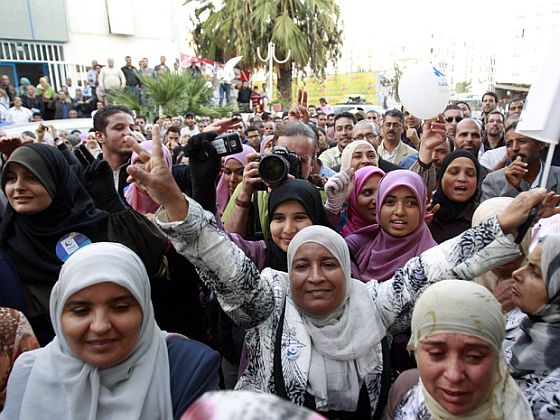
Monica Marks writes: In May, Tunisia passed an extremely progressive parity law, resembling France’s, which required all political parties to make women at least half of their candidates. As a long-repressed party, Ennahda enjoyed more credibility than other groups. It also had a greater number of female candidates to run than any other party, and strongly supported the parity law as a result.
Many Tunisian women developed a political consciousness in reaction to Mr. Ben Ali’s severe oppression of Ennahda in the 1990s. While their husbands, brothers and sons were in jail — often for reasons as simple as attending dawn prayers — these women discovered that they had a personal stake in politics and the strength to stand alone as heads of families. When the party was legalized in March, it found a widespread base of public sympathy and grass-roots support.
As the big winner in Sunday’s elections, Ennahda will send the largest single bloc of female lawmakers to the 217-member constituent assembly. The question now is how Ennahda women will govern. Are they unwitting dupes of Islamic patriarchy, or are they merely feminist activists who happen to wear head scarves?
After interviewing 46 female activists and candidates from Ennahda, I found that many turned to politics after experiencing job discrimination, arrests, or years in prison merely because they chose to wear the head scarf or because their families were suspected of Ennahda sympathies. For some of them, this election is as much about freedom of religious expression as anything else.
“I have a master’s degree in physics but I wasn’t allowed to teach for years because of this,” said a 43-year-old woman named Nesrine, tugging the corner of her floral-print hijab, a veil banned under Mr. Ben Ali but legalized since his departure. According to Mounia Brahim and Farida Labidi, 2 of the 13 members of Ennahda’s Executive Council, the party welcomes strong, critical women in its ranks. “Look at us,” Ms. Brahim said. “We’re doctors, teachers, wives, mothers — sometimes our husbands agree with our politics, sometimes they don’t. But we’re here and we’re active.”
The New York Times reports: Libya’s interim leader said Wednesday that he had asked NATO to prolong its air patrols through December and add military advisers on the ground, despite his official declaration on Sunday of the country’s liberation after the killing of Col. Muammar el-Qaddafi.
“We have asked NATO to stay until the end of the year, and it certainly has the international legitimacy to remain in Libya to protect the civilians from Qaddafi loyalists,” the interim leader, Mustafa Abdel-Jalil, chairman of the National Transitional Council, said in an interview with the pan-Arab news channel Al Jazeera.
“Qaddafi still has supporters in neighboring countries and we fear those loyalists could be launching attacks against us and infiltrating our borders,” he said. “We need technical support and training for our troops on the ground. We also need communications equipment and we need aerial intelligence to monitor our borders.”
Mr. Abdel-Jalil was interviewed while attending a Libya aid conference in Doha, Qatar. He spoke as NATO was preparing within days to formally end its operations in Libya and as the country enters a treacherous new phase in its post-Qaddafi transformation.
CNN reports: Yemeni women defiantly burned their traditional veils Wednesday in protest of President Ali Abdullah Saleh’s brutal crackdown on anti-government demonstrations.
Thousands of women gathered in the capital, Sanaa, said witnesses. They carried banners that read: “Saleh the butcher is killing women and is proud of it” and “Women have no value in the eyes in Ali Saleh.”
They collected their veils and scarves in a huge pile and set it ablaze — an act that is highly symbolic in the conservative Islamic nation, where women use their veils to cover their faces and bodies. It’s the first time in the nine months of Yemen’s uprising that such an event has occurred.
Inspired by Yemeni activist Tawakkol Karman’s Nobel Peace Prize this month, more and more Yemeni women have taken to the streets and escalated their campaign for help from the international community.
More than 60 women were attacked in October alone by the government, said protester Ruqaiah Nasser. Government forces are raiding homes and also killing children, she said.
Adam Gabbatt reports: I’ve just spoken to Keith Shannon, roommate of Scott Olsen, the Iraq veteran who is in hospital after apparently having been hit in the head by a police projectile.
Shannon said doctors told him Olsen has a “skull fracture and swelling of the brain”. A neurosurgeon will assess Olsen later today to determine whether he needs surgery, Shannon said.
Olsen, 24, was in 3rd Battalion, 4th Marines, before leaving the military last year. He had been opposed to the Iraq war even before his first tour to the country, Shannon said. Shannon and Olsen met in November or December 2005, and share an apartment in Daly City, south of San Francisco.
“It’s really hard,” Shannon said. “I really wish I had gone out with him instead of staying home last night.”
Shannon, who is also 24, said he had seen the video footage showing Olsen lying on the floor as a police officer throws an explosive device near him.
“It’s terrible to go over to Iraq twice and come back injured, and then get injured by the police that are supposed to be protecting us,” he said.
Shannon said Olsen was hit in the head by a tear gas canister or smoke canister shot by a police officer. He said Olsen had a curved scar on his forehead consistent with a canister.
Yossi Gurvitz writes: Brigadier General Nitzan Alon, who left the command of the AYOSH (West Bank) Division yesterday, spoke candidly during his replacement ceremony, and called the “price tag” actions by their true name: Jewish terrorism. Alon, who was repeatedly harassed by the settlers, demanded that more be done in the battle against it (Hebrew). One could, of course, ask why didn’t Alon himself (who as the “military commander” in the West Bank wields the combined powers of a British occupying general and a Turkish pasha) commence this battle; why didn’t he order the destruction of the houses of suspected Jewish terrorists as the IDF destroys the houses of the families of Palestinian suspects; why didn’t he put rebellious settlements under curfew, as many Palestinians towns and villages have been so often?
But this is just me being ornery. The questions answer themselves. The apartheid regime Israel created in the West Bank over decades, and the political power of the terrorists and their supporters, prohibits an effective fight against them. The apartheid system, the double legal system – military for the natives, Israeli for the invaders – has been described often enough. Let’s focus on the fact that many prefer to avoid: Jewish terrorism in the territories is directly supported by the Israeli government, and to a large extent is also funded by it.
Stephen Rohde writes: The USA Patriot Act became law ten years ago today. Bearing the awkward name, Uniting and Strengthening America by Providing Appropriate Tools Required to Intercept and Obstruct Terrorism Act, it passed the US Senate by an overwhelming vote of 96-1, with only Sen. Russ Feingold (D-Wisconsin) in dissent, voicing deep concerns about the impact the new law would have on civil liberties and privacy rights.
During the debate over the Patriot Act, Senator Feingold observed that the “founders who wrote our Constitution and Bill of Rights exercised that vigilance even though they had recently fought and won the Revolutionary War. They did not live in comfortable and easy times of hypothetical enemies. They wrote a Constitution of limited powers and an explicit Bill of Rights to protect liberty in times of war, as well as in times of peace.”
He traced the dark periods in our nation’s history when civil liberties took a back seat to what appeared at the time to be the legitimate exigencies of war, including the Alien and Sedition Acts, the suspension of habeas corpus during the Civil War, the internment of Japanese-Americans, German-Americans, and Italian-Americans during World War II, the blacklisting of alleged communist sympathizers during the McCarthy era, and the surveillance and harassment of antiwar protesters, including Dr. Martin Luther King Jr., during the Vietnam War.
Justin Elliot talks to Michael Kazin, professor of history at Georgetown and author of “American Dreamers: How the Left Changed a Nation” about where Occupy Wall Street is heading.
We’re now a month-plus into this. Does Occupy Wall Street remind you of any past movements or does it seem like a fundamentally new type of thing?
This is the first time in a long time, perhaps since the 1930s, that the left — and I think this protest does belong to the left, though a lot of people who are involved in it wouldn’t call themselves that — has focused on economic injustice as a central issue. That is both new and of course harks back to the beginnings of the New Deal. At that time, most activists on the left were primarily targeting economic inequality — in the form of wages, the lack of democracy at work, and resistance by industrial corporations to recognizing unions. What’s obviously different now is that Occupy Wall Street has been put together by people who are proud of being children of the Internet age: with horizontal organization, leaderlessness and consensus decision-making. The main tactic is about hanging out with and learning from one another. There is no sense of how the tactic will lead to either taking political power or having a big share of political power. This movement seems to think from tactic to tactic, rather than tactic to strategy.
Is there precedent for this kind of form and structure?
Many a protest campaign begins this way. The sit-ins at Woolworth lunch counters beginning in February 1960 had an end — desegregation of public facilities — but they weren’t quite sure of where it was going after that. They just thought, “This is a neat tactic that will draw attention.” And it did. That began with four students in Greensboro, N.C. But it soon blossomed, and now their lunch counter is in the Smithsonian. The movement against the Vietnam War also began with very small protests in 1964, and then grew into ones with hundreds of thousands of demonstrators. So protests can grow and become catalysts for larger and more diverse movements.
The two examples you just mentioned had obvious, discrete goals they were trying to accomplish. In contrast, Occupy Wall Street has only a broad theme. Are there precedents for this?
There was Coxey’s Army in 1894, which was the first group to march on Washington. They were mostly unemployed people with a vague demand for public jobs. But they were basically just pissed off about the widespread depression of that era, and they were determined to compel Congress and the president to do something. Like Occupy, they did not have a well-worked-out agenda. Historians disagree about what effect the march had. But it certainly dramatized the situation of the poor and the unemployed, much as Occupy Wall Street is trying to do. People marched from around the country on Washington; they took freight trains, and hitchhiked on wagons, and walked a lot, too. It was very dramatic and the press covered it very widely. But the depression continued until 1897.
What can Occupy learn from history about how to sustain itself beyond the initial burst of interest and energy?
I think protests like this have to progress from tactic to strategy if they are going to endure. They have to either start their own organization — as the sit-in movement started SNCC — or link up with other organizations. The problem with that strategy is that what’s gotten people’s attention is the clever, somewhat novel tactic Occupy is using — and the participatory, very small-d democratic nature of it. The next step will inevitably not be that clever and novel. But for it to go anywhere, the Occupiers have to figure out, to some degree, what kind of demands they want to make. That doesn’t mean they need a 12-point program, but maybe a three-point program. They have to figure out what sort of relationship they want to have with existing groups on the left. But with no leaders and everything run by consensus, how do you make these decisions?
What’s more likely to happen — and I think to some extent already is happening — is that this will become a catalyst for other people to do other kinds of things about economic inequality. I think it’s likely that Occupy Wall Street will be seen as a spark. I think it’s unlikely that people are going to stay in the park for month upon month unless they are homeless. Most people eventually will want to get on with their lives. In the end, a tactic, no matter how successful, is just a tactic.
Micah Sifry writes: Overall interest in the Occupy Wall Street movement appears to be cresting at the moment, with affiliation through the nearly 500 Facebook pages that we’ve been tracking starting to top out and organic interest in the topic also showing signs of calming down on Google search. At the same time, the movement–which deliberately has avoided appointing leaders and spokespeople–continues to expand its networked base. Nearly 250 of those Facebook groups have at least 1,000 members. Another 70 “Occupy X” Twitter accounts also have at least 1000 followers. And in a fascinating development noticed by Shane Castlen, who is tracking all of these metrics on his CollectiveDisorder.com website, while the main Reddit community for OWS now has more than 10,000 members, a number of local Occupy groups are slowly building their own “subreddits” focused on the news and debates occurring around their own encampments. Boston, Los Angeles, Austin, Chicago, DC, Orlando, Philadelphia, Seattle, Richmond, Omana, Columbus, South Dakota and Boise are all active there.
If Tahrir Square inspires the Occupy movement, police forces across America appear to think the most useful lessons on handling popular unrest come from Pearl Roundabout, Bahrain. That means that when ordinary American citizens take a stand and symbolically proclaim: this is our land, the police will sooner or later respond with violence in order to assert the power of the state.
From that perspective, the lesson from Bahrain earlier this year was clear: all necessary force must be used in order to prevent protesters retaining their hold on an occupied public space.
This is being done in the name of public order, yet it appears to be a thinly veiled effort to crush political dissent — even while politicians voice sympathy with the concerns of the protesters. (Let’s not forget that the Bahraini royal family also knew how to make timely PR statements.)
Tools designed to quell riots and provide “non-lethal” means to rein in violent protests — tear gas, pepper spray, batons, and stun grenades — are now being used to suppress non-violent political protest.
This is how the Oakland police decided to assert state power yesterday afternoon and evening:
Tim at Occupy Oakland writes: Around 2am word spread that riot police were massing in around the area where Occupy Oakland has been for more than two weeks. Hundreds of people gathered and began to make non-violent barricades at all the entrances to the plaza.
At about 4:30am, riot police appeared on all corners of the encampment. There were roughly 500 to 700 riot police in total.
The entire plaza was completely barricaded on all sides, with palates, trash cans, chairs, a gigantic christmas wreath, police barricades from a neighboring street
Occupiers began chanting ‘go home’ as they always do when police show up at Occupy Oakland, but it quickly became clear that there was an overwhelming number of police from at least four different jurisdictions.
As people continued to chant and fell back within the barricade, off of the street, the police announced that we would be arrested within the encampment. They said [they’d use force to disperse demonstrators within] five minutes, and within a minute they fired the first rounds of flash-bang grenades and rubber bullets, and then tear gas into the camp, hitting and injuring multiple people. [Continue reading and see photos…]
San Francisco Chronicle reports: Police fired tear gas at least five times Tuesday night into a crowd of several hundred protesters backing the Occupy movement who unsuccessfully tried to retake an encampment outside Oakland City Hall that officers had cleared away more than 12 hours earlier.
Police gave repeated warnings to protesters to disperse from the entrance to Frank Ogawa Plaza at 14th Street and Broadway before firing several tear gas canisters into the crowd at about 7:45 p.m. Police had announced over a loudspeaker that those who refused to leave could be targeted by “chemical agents.”
Protesters scattered in both directions on Broadway as the tear gas canisters and several flash-bang grenades went off. Regrouping, protesters tried to help one another and offered each other eye drops.
One wounded woman, who others said had been hit by one of the canisters, was carried away by two protesters.
One protester, 35-year-old Jerry Smith, said a tear gas canister had rolled to his feet and sprayed him in the face.
“I got the feeling they meant business, but people were not going to be intimidated,” Smith said. “We can do this peacefully, but still not back down.”
Police forcibly dispersed the crowd with tear gas again about 9:30 p.m., when protesters began throwing objects at them. As protesters scattered, police closed off Broadway between 13th and 16th streets.
Minutes later, protesters regrouped at the 15th Street entrance to the plaza. Protesters began throwing objects again. Police responded by firing more tear gas canisters.
The protesters were trying to make good on a vow to retake an encampment that Occupy Oakland activists had inhabited for 15 days, until police evicted them early Tuesday.
The evening protest started around 5 p.m., when about 400 people began marching from the main library at 14th and Madison streets toward the plaza, which police had barricaded and city officials had declared would be closed for at least several days.
Egyptian activists Asmaa Mahfouz and Ahmed Maher visited Zuccotti Park to briefly join Occupy Wall Street on Monday. Thanassis Cambanis writes: People asked about the role of women in the Egyptian uprising, the connections between youth and labor movements, and the importance of social media. Some of the questions were well intended but astonishingly vague: “How do you overthrow a system?” one man asked. Maher politely replied, “It’s easier to overthrow a dictator than an entire system.” He didn’t belabor the point that the Egyptian revolutionaries, so far as they are concerned, have not yet won; they still are fighting their system. Egypt’s military rulers have staged a vicious campaign against Maher’s April 6 movement, accusing them with no evidence of working as American spies and subjecting them to a public inquiry.
The Americans wanted to know how they could help Egypt.
“Get your revolution done. That’s the biggest help you can give us,” Mahfouz said, expressing the hope that America would one day cut off the $1.3 billion yearly payments that sustain Egypt’s military.
She also advised Occupy Wall Street to select its own leaders and craft a simple message “that no one can change.”
On Monday evening at Zuccotti Park, Mahfouz was eager to model the fiery disobedience with which she’s inspired so many Egyptians. “Let’s march!” she said after an hour-long question-and-answer session, grabbing an Egyptian flag and flashing the victory sign with both hands.
A few hundred demonstrators fell in line behind her and Maher, who gamely joined the English chants. The police allowed the march onto Wall Street itself, and at each corner the American leaders consulted an officer about the preferred route. Weary of the somewhat stilted slogans, which lacked the umph and rhythm of Egyptian chants, Mahfouz and Maher taught the crowd the iconic cry of the Arab uprisings: “Al shaab yurid isqat al nizam,” or “The people demand the fall of the regime.” The crowd adopted its own hybrid: “Al shaab yurid isqat Wall Street.”
As they wound back to Zuccotti Park, demonstrators awaited a cue from the police before crossing Broadway. It was too much for Mahfouz. She stopped in the middle of the intersection, stopped traffic, pumped a fist in the air, and demanded the fall of Wall Street. Nervous demonstrators skittered to the sidewalk, leaving Mahfouz with just the cameras and a few dozen stalwarts who seemed willing to accept her invitation to be arrested.
Peter Rothberg writes: More than six weeks into the occupation of Zuccotti Park by a ragtag band of a few hundred anti-corporate activists, Occupy Wall Street has quickly grown into an international movement and potent symbol of popular outrage over the widening gaps between rich and poor and the way that government has been hijacked to transfer wealth upwards to the one percent.
The movement’s message has also gone surprisingly mainstream, as my colleague Katha Pollitt detailed in her latest Nationcolumn explaining the OWS’s appeal and why unlikely suspects like Deepak Chopra and Suze Orman have jumped on the Occupy Wall Street wagon.
After the first week of protests, I wrote a brief guide featuring some tips on how to help the then-burgeoning movement. Now, I’ve updated that primer with new suggestions and specific tips for supporting some of the many regional Occupy actions that have recently been established.
How to Support Occupy Wall Street
1. Go to Liberty Plaza to join those that Occupy Wall Street if you can. This is the epicenter of the movement and the inspiration for what’s happening across the country. Carpools are being arranged va this Facebook group.
2. Send non-perishable food, books, magazines, coffee, tea bags, aspirin, blankets and socks to the UPS Store, c/o Occupy Wall Street, 118A Fulton St, #205, NY, NY 10038.
3. Have pizza delivered to the protestors at Liberty Plaza. Call Majestic Pizza Corp at 212-349-4046 and have your credit card ready.
4. Tell the nation’s mayors to respect the people’s right to free assembly. The eviction of the Liberty Square occupation on Wall Street was averted by massive public protest from those in the square and from others. When you learn that an occupation is threatened, please use this list, courtesy of activist Cryn Johannsen, to find the mayor’s phone number and ask him or her to let the protestors protest.
5. Circulate word of Occupy College’s national series of Teach-ins on November 2nd and 3rd. More than 100 schools have signed on to date.
IRIN reports: Egyptian NGOs hoping for greater freedoms and more space to operate after the fall of Hosni Mubarak’s government say they have encountered just the opposite: an unprecedented clampdown by the post-revolution military rulers.
“Following Egypt’s historic protests calling for basic political freedoms, it is deeply disturbing that the Egyptian military has targeted Egypt’s democracy and human rights community in ways not even dared during Mubarak’s despotic rule,” wrote Stephen McInerney, executive director of the Washington-based Project on Middle East Democracy (POMED).
The first parliamentary elections since Mubarak’s fall are scheduled for 28 November, but NGO leaders say the transitional government led by the Supreme Council of the Armed Forces (SCAF) has mounted a “smear campaign” against them by accusing them of receiving millions of dollars from foreign donors to destabilize the country – going so far as to say the violence on the streets of Cairo during and after the revolution was supported by foreign funding channelled through NGOs.
Many of the local organizations being targeted intended to monitor the upcoming elections, but have been prevented from doing so by the Electoral Commission. SCAF has already banned foreign groups from monitoring the vote.
“This [smear campaign] is yet another episode in the suffering of NGOs in this country,” Maged Adeeb, the chairman of local NGO National Centre for Human Rights, told IRIN. “By accusing us of receiving funds and using them in weakening Egypt’s security, the government creates an unbridgeable gap between us and ordinary citizens.”
In a recent conference in Cairo, Negad Al Borae, a leading civil society activist, said the new government was collaborating with some political powers – namely members of the former ruling party – to destroy the nation’s NGOs.
Tony Karon writes: Tunisia’s election and Libya’s celebration of the overthrow of Col. Muammar Gaddafi won’t have made for a happy weekend among those fevered heads in Washington who believe the West is locked in an existential struggle with political Islam: If anything, the Islamist tones of the Libyan celebrations, coupled with the Islamist victory in the Tunisian polls will have evoked the collapsing dominoes of Vietnam-era anti-communist metaphor.
“We are an Islamic country,” said Mustafa Abdel Jalili, leader of Libya’s Western-backed Transitional National Council in his speech proclaiming his country’s liberation on Saturday. “We take the Islamic religion as the core of our new government. The constitution will be based on our Islamic religion.” As Jalili spoke of lifting a Gaddafi era ban on polygamy and called for an Islamic banking system (which bans charging interest on loans), he was greeted by thunderous chants of “Allahu Akbar” (“God is great”). The character of Libya’s rebellion, at least among those doing the fighting rather than those doing the talking to Western governments, has been far more Islamist than its NATO backers may care to admit. Indeed, conspicuously absent from Jalili’s Benghazi liberation speech was Mahmoud Jibril, the Western-backed interim prime minister forced out at the behest of Islamist and regional militias, who accused him of trying to sideline them.
Jalili’s comments underscore the likelihood that a post-Gaddafi Libya will have a strongly Islamic character. Having emerged from a 42-year secular dictatorship, the smart money says that some version of political Islam will likely trounce any liberal rivals in the race to represent a national vision when a country riven by tribal and regional rivalries goes to the polls eight months from now.
In Tunisia, meanwhile, where some 90% of voters turned out to vote in the Arab rebellion’s first democratic poll, the only question remains whether the Islamist Ennahda party wins an outright majority, or must settle for a plurality of the vote that will requires it to lead a coalition government. Opposition parties had conceded on Monday, even before the count was completed, it was clear that Ennahda had won by far the largest share. The party’s leaders made clear, however, that they intended to seek a coalition.
There’s good reason to suspect that Tunisia’s electoral outcome will be repeated in an Egyptian poll: The main political contest there may turn out to be the one between the Muslim Brotherhood and its more radical Salafist challengers than between the Brotherhood and the secular liberals.
There’s no inherent contradiction between Islam and democracy — the range of political parties in the Muslim world claiming to be guided by Islamic values ranges from Turkey’s moderate, modernizing AK Party to the radical fundamentalist Salafis. Post-Saddam Iraq has been ruled by coalitions led by Shi’ite Islamist parties since its first election in 2005.
Democratically elected governments in the Arab world — most of which are likely to include a strong Islamist component, particularly when emerging from years of secular dictatorship — are highly unlikely to follow U.S. policy on Israel or Iran, but that doesn’t preclude them establishing pragmatic, cooperative relationships with the West. And if Washington’s yardstick for judging Arab political outcomes was the extent of support they yield for its own positions on Israel and Iraq, the U.S. would have to rely exclusively on dictators and monarchs.
Jonathan Steele writes: Having launched what became known as the Arab spring, Tunisia has now led the region by holding a clean election with an enthusiastic turnout and highly encouraging results. The three parties that have come out on top in the most democratic of north African states have no links with the capital city’s upper middle class or those sections of the business community that benefited from the ousted Ben Ali dictatorship. They both have a tradition of struggling for democratic values.
As in post-Mubarak Egypt, there was reason to fear that the old regime would re-emerge in Tunisia with new faces, but this now seems unlikely. The party that has emerged from the poll most strongly is An-Nahda (Renaissance), which suffered massive repression under Ben Ali and has won great respect for its sacrifices. This party of modern democratic Islam campaigned hard on the two issues that concern most Tunisians: corruption and unemployment, particularly youth unemployment.
While several smaller secular parties tried to manipulate Islamophobia – a relatively easy card to play given the official state-controlled media’s demonisation of the Islamists over several decades – their efforts have failed. Voters had their first chance to listen to An-Nahda’s candidates and they were not put off by what they heard. An-Nahda made special efforts to show that it wanted an inclusive government of national unity and would respect all points of view. It also reached out to voters in the more impoverished interior, making it clear it would not be just a party of the Mediterranean coast as Ben Ali’s regime had been.
The Associated Press reports: A moderate, once-banned Islamist party in Tunisia was on track Tuesday to win the largest number of seats in the first elections prompted by the Arab Spring uprisings, according to partial results.
The Tunisian electoral commission said the Ennahda party has won 15 out of 39 domestic seats so far in a 217-member assembly meant to write a new constitution. Together with the results announced Monday from Tunisians living abroad, Ennahda now has 24 out of 57 seats total, or just over 42 percent.
The final results from Sunday’s elections could boost other Islamist parties running in elections in North Africa and the Middle East.
Jillian Schwedler writes: The Arab Spring initiated a jarring series of events in 2011 that illustrate the radical political possibilities of just being present. When the regime won’t listen, when being heard as an individual isn’t really a viable option, simply standing together and being seen can be profoundly political and empowering.
But will just “being there” really bring significant change?
Revolutions never happen overnight. They result from accumulations of dozens, even hundreds of moments, often stretching over a period of years, that make possible the ruptures that emerge when vast numbers of people begin to imagine, and then to demand, an alternative to their living conditions. We have been seeing these moments over the past year, first in the Middle East but then spreading to England, Brazil, Spain, Great Britain, the United States, and elsewhere. In this sense, we are experiencing a revolutionary moment in which the popular perception of what is possible has indisputably shifted in a way unseen on a global scale since 1968.
This moment is revolutionary, even though revolutions are not imminent everywhere. People around the globe are simultaneously imagining alternatives to the conditions under which they live, and they recognise such movements taking place elsewhere and feel a connection, a kinship, with other who are taking to the streets and reclaiming public spaces. For some, the imagined future entails a fundamental change in the structures of government; for others, it entails an alternative to the economic status quo. But for all of them, often for the first time in generations, an alternative future feels possible and tangible rather than fantastical.
Revolutionary moments don’t always foster revolutions, of course. Political revolutions are only possible when the repressive security apparatuses that defend the regime – the army, the police, and other agencies of force – become divided. When armies divide, when some leaders and their troops defect, that is when a revolution becomes possible. But even this does not mean that a revolution will be successful. It can lead to a regime change, even a rapid or peaceful one, but more often it can lead to a bloody, protracted civil war. But for many of the citizens – albeit not for all of them – sustained bloodshed is preferable because it keeps alive the hope that an alternative future is finally within grasp. Witnessing people choose these bloody moments of possibility over the (sometimes bloody) status quo has a dramatic impact. If they can do it-when the obstacles they have successfully overcome were far more daunting than the ones we face – why are we acquiescing to the repressive conditions that limit the possibilities of our own lives?
Although many hope to dismiss its potential, Occupy Wall Street represents just such a revolutionary moment. It is a politics of refusal because of its strong and sustained rejection of a system that dismisses the economic struggles of most of the people on the globe. It is a refusal to feel helpless and powerless in the face of economic policies that favour banks and corporations at the expense of flesh and blood. That refusal has been manifest in the retaking of public spaces, an outpouring of people into places where their frustrations and grievances become visible. Merely standing together in public can be a radical political act because governments around the world seek to control how public spaces are used, preserving them for certain kinds of loyal and conforming citizens. “Undesirables” – the homeless, the punks, skateboarders, graffiti artists, groups of young men, and of course protesters who question the prevailing political and economic policies – must all be cleared from those spaces, sometimes at high costs. Who is welcome? Nuclear families, particularly if they are spending money.