All the way along, there will be Egypt’s traditional electoral mayhem: thugs, intimidation, cash handouts, ballot stuffing, strong-arm local families, clan and mosque. Most people think there is bound to be violence (there always is), and the obfuscation of lawsuits countering close or convoluted results (there always are). If people don’t understand what they are voting for, and if the results are obscured by irregularities, the Egyptian people will have no sense that they have participated in a free and fair election.
In any case, the mandate of the new parliament will be, as far as I can tell, to do one thing only. To elect, choose, or appoint (the mechanism remains totally unclear) within a given six month period, a hundred member constitutional committee that will then have a further six months to draft a new constitution. The new constitution will then be ratified (or maybe not) by national referendum. Subsequently, presidential elections will be held—perhaps some time in 2013.
Whatever shop-assembly version emerges, the Supreme Council of Armed Forces have made it clear they will retain control over the appointment of the Prime Minister and the cabinet as well as control over the budget. Egyptians will not be voting in a new government. The nasty irony may be that if the crowds in Tahrir Square had accepted Mubarak’s proposal to step down in September, they might have elected a new President by now. (How free those elections would be is another question.) Increasingly it has begun to appear that the Supreme Council of Armed Forces wants to stretch a transition out over the longest possible time frame, affording it, inevitably, greater control.
Frank Rich writes: During the death throes of Herbert Hoover’s presidency in June 1932, desperate bands of men traveled to Washington and set up camp within view of the Capitol. The first contingent journeyed all the way from Portland, Oregon, but others soon converged from all over—alone, in groups, with families—until their main Hooverville on the Anacostia River’s fetid mudflats swelled to a population as high as 20,000. The men, World War I veterans who could not find jobs, became known as the Bonus Army—for the modest government bonus they were owed for their service. Under a law passed in 1924, they had been awarded roughly $1,000 each, to be collected in 1945 or at death, whichever came first. But they didn’t want to wait any longer for their pre–New Deal entitlement—especially given that Congress had bailed out big business with the creation of a Reconstruction Finance Corporation earlier in its session. Father Charles Coughlin, the populist “Radio Priest” who became a phenomenon for railing against “greedy bankers and financiers,” framed Washington’s double standard this way: “If the government can pay $2 billion to the bankers and the railroads, why cannot it pay the $2 billion to the soldiers?”
The echoes of our own Great Recession do not end there. Both parties were alarmed by this motley assemblage and its political rallies; the Secret Service infiltrated its ranks to root out radicals. But a good Communist was hard to find. The men were mostly middle-class, patriotic Americans. They kept their improvised hovels clean and maintained small gardens. Even so, good behavior by the Bonus Army did not prevent the U.S. Army’s hotheaded chief of staff, General Douglas MacArthur, from summoning an overwhelming force to evict it from Pennsylvania Avenue late that July. After assaulting the veterans and thousands of onlookers with tear gas, MacArthur’s troops crossed the bridge and burned down the encampment. The general had acted against Hoover’s wishes, but the president expressed satisfaction afterward that the government had dispatched “a mob”—albeit at the cost of killing two of the demonstrators. The public had another take. When graphic newsreels of the riotous mêlée fanned out to the nation’s movie theaters, audiences booed MacArthur and his troops, not the men down on their luck. Even the mining heiress Evalyn Walsh McLean, the owner of the Hope diamond and wife of the proprietor of the Washington Post, professed solidarity with the “mob” that had occupied the nation’s capital.
The Great Depression was then nearly three years old, with FDR still in the wings and some of the worst deprivation and unrest yet to come. Three years after our own crash, we do not have the benefit of historical omniscience to know where 2011 is on the time line of America’s deepest bout of economic distress since that era. (The White House, you may recall, rolled out “recovery summer” sixteen months ago.) We don’t know if our current president will end up being viewed more like Hoover or FDR. We don’t know whether Occupy Wall Street and its proliferating satellites will spiral into larger and more violent confrontations, disperse in cold weather, prove a footnote to our narrative, or be the seeds of something big.
What’s as intriguing as Occupy Wall Street itself is that once again our Establishment, left, right, and center, did not see the wave coming or understand what it meant as it broke. Maybe it’s just human nature and the power of denial, or maybe it’s a stubborn strain of all-American optimism, but at each aftershock since the fall of Lehman Brothers, those at the top have preferred not to see what they didn’t want to see. And so for the first three weeks, the protests were alternately ignored, patronized, dismissed, and insulted by politicians and the mainstream news media as a neo-Woodstock for wannabe collegiate rebels without a cause—and not just in Fox-land. CNN’s new prime-time hopeful, Erin Burnett, ridiculed the protesters as bongo-playing know-nothings; a dispatch in The New Republic called them “an unfocused rabble of ragtag discontents.” Those who did express sympathy for Occupy Wall Street tended to pat it on the head before going on to fault it for being leaderless, disorganized, and inchoate in its agenda.
Despite such dismissals, the movement, abetted by made-for-YouTube confrontations with police, started to connect with the mass public much as the Bonus Army did with a newsreel audience. The week after a Wall Street Journal editorial claimed that “no one seems to care very much” about the “collection of ne’er-do-wells” congregating in Zuccotti Park, the paper released its own poll, in collaboration with NBC News, finding that 37 percent of Americans supported the protesters, 25 percent had no opinion, and just 18 percent opposed them. The approval numbers for Occupy Wall Street published in Time and Reuters were even higher—hitting 54 percent in Time. Apparently some of those dopey kids, staggering under student loans and bereft of job prospects, have lots of parents and friends of all ages who understand exactly what they’re talking about.
Pam Martens writes: Wall Street’s audacity to corrupt knows no bounds and the cooptation of government by the 1 per cent knows no limits. How else to explain $150 million of taxpayer money going to equip a government facility in lower Manhattan where Wall Street firms, serially charged with corruption, get to sit alongside the New York Police Department and spy on law abiding citizens.
According to newly unearthed documents, the planning for this high tech facility on lower Broadway dates back six years. In correspondence from 2005 that rests quietly in the Securities and Exchange Commission’s archives, NYPD Commissioner Raymond Kelly promised Edward Forst, a Goldman Sachs’ Executive Vice President at the time, that the NYPD “is committed to the development and implementation of a comprehensive security plan for Lower Manhattan…One component of the plan will be a centralized coordination center that will provide space for full-time, on site representation from Goldman Sachs and other stakeholders.”
At the time, Goldman Sachs was in the process of extracting concessions from New York City just short of the Mayor’s first born in exchange for constructing its new headquarters building at 200 West Street, adjacent to the World Financial Center and in the general area of where the new World Trade Center complex would be built. According to the 2005 documents, Goldman’s deal included $1.65 billion in Liberty Bonds, up to $160 million in sales tax abatements for construction materials and tenant furnishings, and the deal-breaker requirement that a security plan that gave it a seat at the NYPD’s Coordination Center would be in place by no later than December 31, 2009.
The surveillance plan became known as the Lower Manhattan Security Initiative and the facility was eventually dubbed the Lower Manhattan Security Coordination Center. It operates round-the-clock. Under the imprimatur of the largest police department in the United States, 2,000 private spy cameras owned by Wall Street firms, together with approximately 1,000 more owned by the NYPD, are relaying live video feeds of people on the streets in lower Manhattan to the center. Once at the center, they can be integrated for analysis. At least 700 cameras scour the midtown area and also relay their live feeds into the downtown center where low-wage NYPD, MTA and Port Authority crime stoppers sit alongside high-wage personnel from Wall Street firms that are currently under at least 51 Federal and state corruption probes for mortgage securitization fraud and other matters.
In addition to video analytics which can, for example, track a person based on the color of their hat or jacket, insiders say the NYPD either has or is working on face recognition software which could track individuals based on facial features. The center is also equipped with live feeds from license plate readers.
Heather Gautney asks:Is this what democracy looks like? That’s perhaps the first question prompted by the swirl of tents, signs, news choppers and police motorcycles that have colored the Occupy Wall Street protests. But there are two other questions we should be asking as well. Is democracy even possible in a context of extreme instability and social inequality, in which 1 percent of the population owns and polices the other 99 percent? And who, among our distinguished set of 2012 candidates, really wants to narrow this gap?
Thus far, the Occupy movement is checking “None of the Above” on the ballot box. Since mid-September, it has instead decided to represent itself in the streets. And if you think there aren’t concrete, policy-related demands being made there, have another look: Everything from education to housing, health care, environment, energy and security are up for grabs. All of these institutions are in need of fixing, and all of them are making the list.
These acts of self-representation—or direct democracy—do not compute among mainstream politicians and their pundits. Occupy does not speak the language of party or ideology, and this has not boded well for a system that relies on polls, predictability and reductive thought. Social movements are, by their very nature, complex, organic and indeterminate. They operate at the deepest levels of how we view each other and the world we live in.
This movement is no exception. You can’t reduce this kind of public outcry to dichotomies like liberal and conservative, or Blue and Red. And you certainly can’t dismiss it as fringe and un-American. Occupy is a popular movement, not a Tea Party, and the act of sticking up for yourself is as American as apple pie.
Despite this apparent disconnect, the Occupy movement has received honorable mention at the highest levels of government, though I suspect this has more to do with polls and constituencies than with genuine understanding. After a Time Magazinesurvey revealed that 54 percent of Americans actually support these rabble-rousers, our politicians started to take notice. Occupy is actually more popular among the American people than the U.S. Congress—and that must really hurt.
That 54-percent figure was likely behind flip-flopper Mitt Romney’s overnight change of heart. Just days into October, Romney called the protesters “dangerous” instigators of “class warfare.” A week later, he switched gears and expressed “worry” for the 99 percenters. All the sudden this multi-millionaire, private-sector guru has become a man of the people. Who knew?
Then there’s Barack Obama. The guy we all wanted to love. With his usual charm, he empathized with the Occupy-ers, said not everyone in Corporate America was playing by the rules and, once again, took us on a stroll down Main Street. But in the tug of war between Main Street and Wall Street, Obama has made his loyalties clear. Just take a look at the long list of Wall Street contributors to his campaign. Unfortunately, Mr. President, you are the company you keep.
“The bonus system has gone beyond a means of rewarding talent and is now Wall Street’s primary business,” the newspaper editorial stated, adding: “Institutions take huge gambles because the short-term returns are a rationale for their rich payouts. But even when the consequences of their risky behavior come back to haunt them, they still pay huge bonuses.”
Well thought and well put, but for one thing: If you were looking for bonus excess despite miserable operations, the best recent example I can think of is Gannett, which owns USA Today.
The week before the editorial ran, Craig A. Dubow resigned as Gannett’s chief executive. His short six-year tenure was, by most accounts, a disaster. Gannett’s stock price declined to about $10 a share from a high of $75 the day after he took over; the number of employees at Gannett plummeted to 32,000 from about 52,000, resulting in a remarkable diminution in journalistic boots on the ground at the 82 newspapers the company owns.
Never a standout in journalism performance, the company strip-mined its newspapers in search of earnings, leaving many communities with far less original, serious reporting.
Given that legacy, it was about time Mr. Dubow was shown the door, right? Not in the current world we live in. Not only did Mr. Dubow retire under his own power because of health reasons, he got a mash note from Marjorie Magner, a member of Gannett’s board, who said without irony that “Craig championed our consumers and their ever-changing needs for news and information.”
But the board gave him far more than undeserved plaudits. Mr. Dubow walked out the door with just under $37.1 million in retirement, health and disability benefits. That comes on top of a combined $16 million in salary and bonuses in the last two years.
And in case you thought they were paying up just to get rid of a certain way of doing business — slicing and dicing their way to quarterly profits — Mr. Dubow was replaced by Gracia C. Martore, the company’s president and chief operating officer. She was Mr. Dubow’s steady accomplice in working the cost side of the business, without finding much in the way of new revenue. She has already pocketed millions in bonuses and will now be in line for even more.
Forget about occupying Wall Street; maybe it’s time to start occupying Main Street, a place Gannett has bled dry by offering less and less news while dumping and furloughing journalists in seemingly every quarter.
Fifty-three people, apparent Gaddafi supporters, seem to have been executed at a hotel in Sirte last week, Human Rights Watch said today. The hotel is in an area of the city that was under the control of anti-Gaddafi fighters from Misrata before the killings took place.
Human Rights Watch called on Libya’s National Transitional Council (NTC) to conduct an immediate and transparent investigation into the apparent mass execution and to bring those responsible to justice.
“We found 53 decomposing bodies, apparently Gaddafi supporters, at an abandoned hotel in Sirte, and some had their hands bound behind their backs when they were shot,” said Peter Bouckaert, emergencies director at Human Rights Watch, who investigated the killings. “This requires the immediate attention of the Libyan authorities to investigate what happened and hold accountable those responsible.”
Human Rights Watch saw the badly decomposed remains of the 53 people on October 23, 2011, at the Hotel Mahari in District 2 of Sirte. The bodies were clustered together, apparently where they had been killed, on the grass in the sea-view garden of the hotel.
Vivienne Walt reports: Should Libyans care how Muammar Gaddafi died? As the debate continues over whether rebel fighters executed Gaddafi after capturing him — in violation of international rules of war — the issue has raised stark differences between Libya’s new leaders, who suffered for decades under a suffocating dictatorship, and the views of some of their closest Western allies.
In numerous interviews over the weekend in Tripoli and the eastern city of Benghazi, not a single Libyan — including top officials of the new regime — expressed serious concern that Gaddafi might have been executed after being captured alive. Instead, the general feeling might best be summed up by Colonel Omar Hariri, a war hero, who had been a comrade-in-arms of Gaddafi during their coup in 1969, and who headed this year’s rebel military forces in eastern Libya. As Hariri greeted fighters returning to Benghazi from the front in Gaddafi’s birthplace of Sirt on Saturday, TIME asked him if he was concerned about how Gaddafi had died. “I don’t care, so long as he’s dead,” he said. In a separate interview on Sunday, the interim Finance and Oil Minister Ali Tarhouni — who told TIME he has been asked to be the new interim Prime Minister — said he felt “relieved” that Gaddafi had been killed.
The great majority of Libyans are rejoicing his death too. Libyans have emerged from a very long nightmare, in which two generations lived in terror under Gaddafi’s dictatorship. The details of how he met his end seem irrelevant to most of them. In death, Gaddafi has become an object of ridicule, as though he were just a pathetic old man, rather than their omnipotent ruler. The walls in Benghazi and Tripoli, which for years were plastered with portraits of Gaddafi as the untouchable leader, are filled with graffiti portraying him as a bushy-haired clown. And thousands of people have lined up to view Gaddafi’s bloodied and beaten corpse, which has been laid out since Friday in the cold-storage room of a food market in Misratah, about 150 miles (240 km) east of Tripoli.
The Washington Post reports: Beginning two decades ago, the United States government bankrolled an Egyptian think tank dedicated to economic reform. A different outcome is only now becoming visible in the fallout from Egypt’s Arab Spring.
Formed with a $10 million endowment from the U.S. Agency for International Development, the Egyptian Center for Economic Studies gathered captains of industry in a small circle — with the president’s son Gamal Mubarak at the center. Over time, members of the group would assume top roles in Egypt’s ruling party and government.
Today, Gamal Mubarak and four of those think tank members are in jail, charged with squandering public funds in the sale of public resources, lands and government-run companies as part of a dramatic restructuring. Some have fled the country, pilloried amid the public outrage over insider deals and corruption that toppled President Hosni Mubarak.
“It became a crony capitalism,” Magda Kandil, the think tank’s new executive director, said of the privatization program advocated by its founders. Because of the corruption, the center now estimates, the assets that Egypt has sold off since 1991 have netted only about $10 billion, $90 billion less than their estimated worth.
The privatization saga is a cautionary tale about the power and perils of U.S. foreign aid — most notably the nearly $8 billion that the United States has provided to Egypt since the 1990s to push the country toward economic reforms.
Gamal Mubarak, 47, and the others deny any wrongdoing and are fighting corruption charges filed by the new Egyptian government, saying they have been trumped up to placate street protesters calling for retribution. The defendants also assert that the deals were legal under existing laws.
But the arc of the American-backed privatization effort in Egypt recalls years of questions from critics about the transparency and effectiveness of the more than $70 billion in military and economic assistance [PDF] to that country over the past six decades, the most aid given to any country other than Israel.
Al-Masry Al-Youm reports: The Interior Ministry’s prisons administration on Sunday ordered the admission of blogger and activist Maikel Nabil, who has been on a hunger strike for nearly 60 days, to the mental hospital in Abbasseya, according to security sources.
Nabil, a Coptic Christian, was arrested by military police on 28 March at his home in Cairo. He was later sentenced to three years in prison on charges of spreading false information about Egypt’s military in a case that drew criticism from rights groups around the world.
On Thursday, the European Union urged Egyptian authorities to ensure proper medical care for him and told them to respect international standards in protecting prisoners.
He went on hunger strike on 23 August in protest at his conviction.
His family told rights group Amnesty International this month that the activist’s health had deteriorated and the authorities had prevented him from taking his medication.
Nabil was the first Egyptian since the revolution to be sentenced to a prison term for expressing his opinion.
Jason Leopold reports: Rob Richer, the No. 2 ranking official in the CIA's clandestine service, paid a visit to Glenn Carle's office in December 2002 and presented the veteran CIA operative with an urgent proposal.
"I want you to go on a temporary assignment," Carle recalls Richer telling him. "It's important for the agency, it's important for the country and it's important for you. Will you do it?"
Richer, who resigned from the CIA in 2005 and went to work for the mercenary outfit Blackwater, told Carle that agency operatives had just rendered a "high-value target," an Afghan in his mid-forties named Haji Pacha Wazir, who was purported to be Osama bin Laden's personal banker as well as financier for a number of suspected terrorists. Wazir was being held at a CIA black site prison in Morocco, and the agency needed a clandestine officer who spoke French to take over the interrogation of the detainee.
Carle, formerly the deputy national intelligence officer for transnational threats, who had no prior interrogation experience, agreed, and within 72 hours, he boarded a CIA-chartered jet bound for Morocco.
Carle recounts what unfolded next in his riveting book, "The Interrogator: An Education," which stands as a damning indictment of the CIA's torture and rendition program and the Bush administration's approach to the so-called Global War on Terror.
The New York Times reports: The leader of Libya’s transitional government declared to thousands of revelers in a crowded square here on Sunday that Libya’s revolution had ended, setting the country on the path to elections, and he vowed that the new government would be based on Islamic tenets.
The sea of flag-waving citizens reacted with shouts of “God is great;” minutes earlier, they had sung the bouncy Italianate national anthem used before Col. Muammar el-Qaddafi came to power. The song has been revived to help celebrate the downfall of the dictator, who was killed on Thursday.
Two strands — a new piety and all-purpose, free-wheeling euphoria — dominated the hastily improvised ceremony, which was intended to put a cap on Libya’s bloody upheaval and mark the beginning of the country’s transition to something approaching normalcy. Laws, institutions, civic life — all must be built from scratch after four decades of Colonel Qaddafi’s personality-cult dictatorship. It is a challenge whose immensity many in the crowd acknowledged, even as they expressed relief that it could finally be undertaken.
The transitional government’s leader, Mustafa Abdel-Jalil, stooping humbly to shake hands in the crowd and embracing the elderly relative of a fallen rebel, made clear that personality would have nothing to do with the new order here.
“We are an Islamic country,” Mr. Abdel-Jalil, the chairman of the Transitional National Council, said as the sun descended. “We take the Islamic religion as the core of our new government. The constitution will be based on our Islamic religion.” He also promised that Islamic banks would be established in the new Libya.
The emphasis on Islam in the short speech — he began by thanking God and declaring God “the greatest — appeared to be an answer of sorts to the speculation about how much of a role religion might play here.
And though Mr. Abdel-Jalil’s religion-edged speech was met with enthusiasm, the crowd’s focus was on freedom, and the pride over how the country had acquired it. Several people suggested that Libya had been virtually imprisoned for 42 years, the length of Colonel Qaddafi’s reign.
“It’s a new life. My feelings are just overwhelming now,” said a man holding the Libyan flag — the pre-Qaddafi banner has also been revived — and standing with his 8-year-old son, who was doing the same. “I never pictured this happening,” said the man, Yousef Amar, an electrical engineer. “This is the beginning, like when the flower grows from nothing.”
Two middle-aged women, beaming, expressed astonishment as they stood together in what is now known as Victory Square. “This is the greatest day of our lives,” said one of them, Mneeba Gargoum. “I’ve never felt this way before for our country,” she said. Her friend, Hawa el-Hawaz, chimed in: “We didn’t have hope before this day. Without Qaddafi, Libya is free. We feel like we are in real country now.”
Mr. Abdel-Jalil, sober and precise, waited patiently as the crowd interrupted him to chant, “Hold your head up high, you’re a free Libyan.” He urged a new respect for the law, and in a nod to the complications of a country that has known years of living under a dictator — he himself was a justice minister under Colonel Qaddafi — exhorted his countrymen to pursue “forgiveness, patience and the truth.”
Jason Pack writes: Amid many questions about the future of post-Gaddafi Libya, one fact cannot be ignored: the Libyan revolution of 2011 is dissimilar – in scope, content, and origin – to its sister revolutions in Tunisia and Egypt. Indeed, it has almost no parallels in world history.
Generally, sweeping revolutionary change (France in 1789, Russia in 1917, etc) is carried out by an organised group at the centre of power with a distinct ideology. In Libya, the revolution originated in the periphery and is surprisingly devoid of ideology.
As with the French and the Russian revolutions, this year’s events in Libya have caused extensive social, political, and structural inversions. By comparison, regime change in Tunisia and Egypt is akin to the “regime change” that democratic countries experience every few years when one leadership group is thrown out and replaced by a new one – generally from within the elites. In this process, the middle-level bureaucrats in the civil service, army, foreign service and local politicians are largely unaffected.
Optimists will note that in Egypt and Tunisia constitutional change is also expected – meaning a rebalancing of the roles of president, army, legislature, bureaucracy, and people. Realists will note that although the future constitutions of these countries are likely to weaken the role of the president and eliminate the use of emergency laws, they are unlikely to fundamentally change the connection between the state, citizens and army or to invert the social classes as the French or Russian revolutions did, or as the Libyan one probably will.
Libya’s revolution was unusual in that it was accomplished by many disparate but highly cohesive local movements that eventually liberated the capital by force. In Libya, a diffuse periphery dominates the centre – and it is hard to think of any other historical revolutionary movement where this was the case.
As a result, there is a danger of “regionalist triumphalism” where “a series of local movements each proclaim their centrality to defeating Gaddafi in an attempt to claim a privileged position in the new Libya,” Lisa Anderson, president of the American University of Cairo, suggested in a phone interview.
What united all of these disparate localities was a distaste for Gaddafi and his centralism. Now Gaddafi is gone. A US diplomat described it to me as follows: “The situation on the ground bears an uncanny resemblance to how the different American states joined together out of their distaste for King George. Once he was gone, stitching the states together was highly problematic. In Libya, the situation of building a nation is even more complex because it is lacking in robust state-level institutions.”
Forever the slick salesman, Tony Blair says evolution is better than revolution — which sounds like saying change is good so long as there isn’t too much of it and it doesn’t come too fast. That’s the kind of change he can believe in. Just like a peace process which in the eyes of most observers looks like a rotting corpse, but for Blair it’s just a matter of getting it back on track — a track the clearly leads nowhere.
Reuters reports: Arab pro-democracy uprisings spell more regional instability that could complicate peace efforts between Israel and the Palestinians but also make it necessary to get the process back on track, envoy Tony Blair said on Sunday.
Blair will sit down separately with Israeli and Palestinian officials this week in Jerusalem to try to revive a peace process that broke down more than a year ago because of a dispute over Jewish settlement expansion.
“It is a great thing that people are wanting democracy, but in the short term there is reduced stability in the region so that can pose problems for Israel and the peace process,” said Blair.
“Because of the instability and uncertainty in the region, it’s right that we grip the peace process and put it back on track again.”
“We need strong, clear commitments that both parties will produce comprehensive proposals on borders and security within 90 days,” he said.
Underlining the bleak prospects for a breakthrough, Israel recently unveiled plans for new settlement building including 2,600 homes on land near East Jerusalem, where the Palestinians aim to found their capital.
Al Jazeera reports: Earlier this year, as mass popular uprisings spread through the Middle East and audiences across the world sat transfixed by images of unarmed citizens confronting iron-fisted security forces in the streets of Arab capitals, powerful governments from Russia to the United States were forced to begin accounting for the weapons they had for decades sold to the very rulers they now found themselves abandoning.
In Egypt and Bahrain, protesters held up tear gas canisters stamped “Made in USA”, giving longstanding US support for autocratic Arab regimes a painful physical manifestation.
But the United States has not been the only culprit. Egyptian riot police fired shotgun shells made in Italy, and Libyan special forces wielded Belgian assault rifles. Bulgaria has led weapons sales to Yemen, and Russia likely supplies a huge amount of Syria’s armoury.
According to a report released on Wednesday by London-based human rights organisation Amnesty International, in the five years preceding the Arab Spring, a host of at least 20 governments – including Italy, the United Kingdom, France, Serbia, Switzerland and South Korea – sold more than $2.4 billion worth of small arms, tear gas, armoured vehicles and other security equipment to the the five countries that have faced – and violently combated – popular uprisings: Bahrain, Egypt, Libya, Syria, and Yemen.
Reuters reports: Tunisians turned out in huge numbers to vote in the country’s first free election on Sunday, 10 months after Mohamed Bouazizi set himself on fire in a protest that started the Arab Spring uprisings.
The leader of an Islamist party predicted to win the biggest share of the vote was heckled outside a polling station by people shouting “terrorist,” highlighting tensions between Islamists and secularists being felt across the Arab world.
The suicide of vegetable peddler Bouazizi, prompted by despair over poverty and government repression, provoked mass protests which forced President Zine al-Abidine to flee Tunisia. This in turn inspired uprisings in Egypt, Libya, Yemen, Syria and Bahrain.
Rachid Ghannouchi, leader of the moderately Islamist Ennahda party, took his place in the queue outside a polling station in the El Menzah 6 district of the capital.
“This is an historic day,” he said, accompanied by his wife and daughter, both wearing Islamic headscarves, or hijabs. “Tunisia was born today. The Arab Spring was born today.”
As he emerged from the polling station, about a dozen people shouted at him: “Degage,” French for “Go away,” and “You are a terrorist and an assassin! Go back to London!”
Ghannouchi, who spent 22 years in exile in Britain, has associated his party with the moderate Islamism of Turkish Prime Minister Tayyip Erdogan. He has said he will not try to impose Muslim values on society.
In Tunisia, ideas about Islam, and restrictions on things like alcohol, are more relaxed than in many Arab countries.
“This morning I voted for Ennahda and this evening I am going to drink a few beers,” said Makram, a young man from the working class Ettadamen neighbourhood of Tunis.
Nevertheless, the party’s rise worries secularists who believe their country’s liberal traditions are now under threat.
Larbi Sadiki writes: Islamists define all things political in the Arab world. This applies to extremist Islamism as well as to civic Islamism.
Indeed, October 24, 2011, the day after the election, will be a turning point in the history of Tunisia. The Islamists will resoundingly establish themselves as a key political player in the country’s democratic transition. Thus far Tunisia has been run by Francophile elites favouring secular politics. In this regard, Tunisia will be following in Turkey’s footsteps.
Those who are not versed in Tunisian politics should go and stand in the square opposite the Municipality of Tunis and just absorb the architecture of political Tunisia. This square has no analogue elsewhere in the Arab world.
With the municipality to one’s back, the Sadiki school – founded by reformer Khayr al-Din Pasha – symbolises not only Ottoman connections, but also a reformist agenda begun more than 150 years ago. To the right, stands the Aziza Othman hospital, named after a woman who cultivated the earliest forms of civic networks in Tunisia.
Just opposite the Kasbah, the seat of government and the lush manicured trees shading the squares joining the prime minister’s office and the ministry of finance, the onlooker sees architectural syncretism at its best. Various shapes of domes and minarets – Tunisian and Ottoman – dot the skyline of Tunis, the country’s hub of political power. Some of my pro-democratisation students from the University of Exeter and I brainstormed on how to understand this perennial quest for synthesis in Tunisia.
It is this synthesis which will triumph. The embrace of the Habib Bourguiba Avenue, a mini-Champs Elysees with its open-air cafes, a refuge for all, including the unemployed, and the Medina, the Old City, hints at how Tunisia will vote.
Tunisians champion syncretism, and this is really the crux of Tunisia’s “political culture”. They do not wish to ditch their Arab and Islamic heritage. Nor do they wish to detach from the brighter spots of reformist politics in their history. French and European inputs into the mix of their culture are now deep-rooted and appreciated.
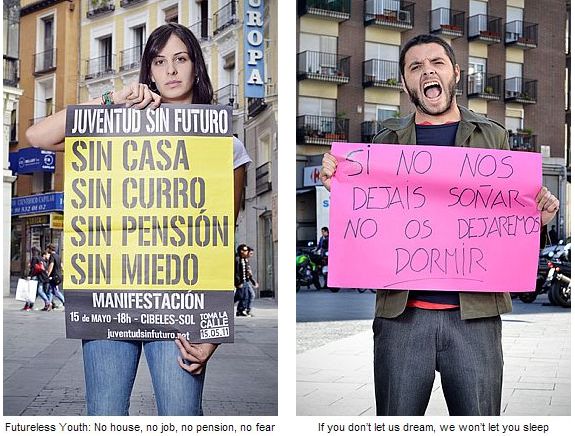
From Frankfurt to Madrid, Wall Street to Athens, people are taking to the streets to rage against greed and inequality. The Guardian records some of their messages:
Reuters reports: Secretary of State Hillary Clinton on Sunday backed a possible U.N. investigation into the death of deposed Libyan leader Muammar Gaddafi and called for the convicted Lockerbie bomber to be jailed again.
There is growing international disquiet about the chaotic scenes surrounding Gaddafi’s apparent summary execution following the fall of his hometown of Sirte on Thursday.
“I would strongly support both a U.N. investigation that has been called for and the investigation that the Transitional National Council said they will conduct,” Clinton told the NBC program “Meet the Press,” referring to Libya’s interim rulers.
“You know, I think it’s important that this new government, this effort to have a democratic Libya, start with the rule of law, start with accountability,” she said.
U.N. Human Rights Commissioner Navi Pillay has called for an investigation into the killing.
Libya’s outgoing prime minister said on Sunday a bullet that hit Muammar Gaddafi’s head may have been fired by one of his own guards during a shootout with government forces in Sirte.
“So I view the investigation on its own merits as important but also as part of a process that will give Libya the best possible chance to navigate toward a stable, secure, democratic future,” Clinton said.
Perhaps the Libyans regard the US as a democratic role model and on that basis assumed that it would be OK and indeed be the American way to administer swift justice to Gaddafi.
If someone like Anwar al-Awlaki could be deemed such an imminent threat to the United States that he could be assassinated and there be no legal justification presented for his killing nor any investigation, should anyone in the Obama administration now wonder why Gaddafi’s captors might have felt similarly empowered to end Gaddafi’s life? After all, Awlaki never killed a single American, whereas Gaddafi was responsible for killing thousands of Libyans.
New Scientist reports: As protests against financial power sweep the world this week, science may have confirmed the protesters’ worst fears. An analysis [PDF] of the relationships between 43,000 transnational corporations has identified a relatively small group of companies, mainly banks, with disproportionate power over the global economy.
The study’s assumptions have attracted some criticism, but complex systems analysts contacted by New Scientist say it is a unique effort to untangle control in the global economy. Pushing the analysis further, they say, could help to identify ways of making global capitalism more stable.
The idea that a few bankers control a large chunk of the global economy might not seem like news to New York’s Occupy Wall Street movement and protesters elsewhere. But the study, by a trio of complex systems theorists at the Swiss Federal Institute of Technology in Zurich, is the first to go beyond ideology to empirically identify such a network of power. It combines the mathematics long used to model natural systems with comprehensive corporate data to map ownership among the world’s transnational corporations (TNCs).
“Reality is so complex, we must move away from dogma, whether it’s conspiracy theories or free-market,” says James Glattfelder. “Our analysis is reality-based.”
Previous studies have found that a few TNCs own large chunks of the world’s economy, but they included only a limited number of companies and omitted indirect ownerships, so could not say how this affected the global economy – whether it made it more or less stable, for instance.
The Zurich team can. From Orbis 2007, a database listing 37 million companies and investors worldwide, they pulled out all 43,060 TNCs and the share ownerships linking them. Then they constructed a model of which companies controlled others through shareholding networks, coupled with each company’s operating revenues, to map the structure of economic power.
The work, to be published in PloS One, revealed a core of 1318 companies with interlocking ownerships (see image). Each of the 1318 had ties to two or more other companies, and on average they were connected to 20. What’s more, although they represented 20 per cent of global operating revenues, the 1318 appeared to collectively own through their shares the majority of the world’s large blue chip and manufacturing firms – the “real” economy – representing a further 60 per cent of global revenues.
When the team further untangled the web of ownership, it found much of it tracked back to a “super-entity” of 147 even more tightly knit companies – all of their ownership was held by other members of the super-entity – that controlled 40 per cent of the total wealth in the network. “In effect, less than 1 per cent of the companies were able to control 40 per cent of the entire network,” says Glattfelder. Most were financial institutions. The top 20 included Barclays Bank, JPMorgan Chase & Co, and The Goldman Sachs Group.
John Driffill of the University of London, a macroeconomics expert, says the value of the analysis is not just to see if a small number of people controls the global economy, but rather its insights into economic stability.
Concentration of power is not good or bad in itself, says the Zurich team, but the core’s tight interconnections could be. As the world learned in 2008, such networks are unstable. “If one [company] suffers distress,” says Glattfelder, “this propagates.”
“It’s disconcerting to see how connected things really are,” agrees George Sugihara of the Scripps Institution of Oceanography in La Jolla, California, a complex systems expert who has advised Deutsche Bank.
The top 25 of the 147 superconnected companies
1. Barclays plc
2. Capital Group Companies Inc
3. FMR Corporation
4. AXA
5. State Street Corporation
6. JP Morgan Chase & Co
7. Legal & General Group plc
8. Vanguard Group Inc
9. UBS AG
10. Merrill Lynch & Co Inc
11. Wellington Management Co LLP
12. Deutsche Bank AG
13. Franklin Resources Inc
14. Credit Suisse Group
15. Walton Enterprises LLC
16. Bank of New York Mellon Corp
17. Natixis
18. Goldman Sachs Group Inc
19. T Rowe Price Group Inc
20. Legg Mason Inc
21. Morgan Stanley
22. Mitsubishi UFJ Financial Group Inc
23. Northern Trust Corporation
24. Société Générale
25. Bank of America Corporation
This website or its third-party tools use cookies, which are necessary to its functioning. By closing this banner, you agree to the use of cookies.