Mike Konczal asks: Could the next step after camping in Zuccotti Park be camping out in homes facing foreclosure?
As people think a bit more critically about what it means to “occupy” contested spaces that blur the public and the private and the boundaries between the 99% and the 1%, and as they also think through what Occupy Wall Street might do next, I would humbly suggest they check out the activism model of Project: No One Leaves. It exists in many places, especially in Massachusetts — check out this Springfield version of it — and grows out of activism pioneered by City Life Vida Urbana. It is similar to activism done by the group New Bottom Line and other foreclosure fighters. Here is PBS NewsHour’s coverage of the movement.
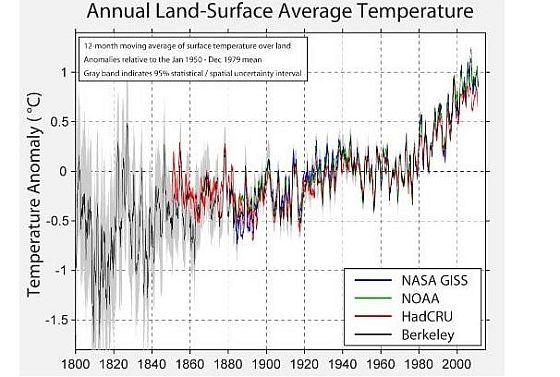
The Washington Post reports: Back in 2010, Richard Muller, a Berkeley physicist and self-proclaimed climate skeptic, decided to launch the Berkeley Earth Surface Temperature (BEST) project to review the temperature data that underpinned global-warming claims. Remember, this was not long after the Climategate affair had erupted, at a time when skeptics were griping that climatologists had based their claims on faulty temperature data.
Muller’s stated aims were simple. He and his team would scour and re-analyze the climate data, putting all their calculations and methods online. Skeptics cheered the effort. “I’m prepared to accept whatever result they produce, even if it proves my premise wrong,” wrote Anthony Watts, a blogger who has criticized the quality of the weather stations in the United Statse that provide temperature data. The Charles G. Koch Foundation even gave Muller’s project $150,000 — and the Koch brothers, recall, are hardly fans of mainstream climate science.
So what are the end results? Muller’s team appears to have confirmed the basic tenets of climate science. Back in March, Muller told the House Science and Technology Committee that, contrary to what he expected, the existing temperature data was “excellent.” He went on: “We see a global warming trend that is very similar to that previously reported by the other groups.” And, today, the BEST team has released a flurry of new papers that confirm that the planet is getting hotter. As the team’s two-page summary flatly concludes, “Global warming is real.”Here’s a chart comparing their findings with existing data:

Anthony Shadid reports: The death of Col. Muammar el-Qaddafi reverberated across Syria on Friday, reviving protests that had begun to stall and focusing attention on a newly organized, unarmed opposition group seeking to challenge the Assad family’s four decades of rule.
With an ordinary name and ambitious task, the Syrian National Council, announced in Istanbul this month, has begun trying to emulate the success of Libya’s opposition leadership, closing ranks in the most concerted attempt yet to forge an alternative to President Bashar al-Assad and courting international support that proved so crucial in Libya.
“The focus of the world will now turn to Syria,” Samir Nachar, an activist from Aleppo and leader of the group, said Friday. “It’s Syria’s turn to receive attention.”
But the challenges before this effort remain vast, many of them the same issues that have beset the uprising in Syria since it began seven months ago. A gulf still separates the opposition in exile and at home, and rivalries and ideological disputes compromise their work. As important, Europe and the United States have proven reluctant to give the council the recognition that they quickly provided the opposition in Libya.
Perhaps most challenging is a debate that has overshadowed many of its discussions — what kind of international intervention it will seek, as unlikely as the prospect may be now, in trying to end Mr. Assad’s rule. Not even activists these days believe that protests alone, however big, are enough to topple the government.
“Libya’s model will be tempting,” said Louay Hussein, a prominent opposition figure in Damascus, the capital, though a critic of the council itself.
Protests erupted across Syria on Friday, and at least anecdotally, activists called them bigger than in past weeks, and just as bloody. Security forces killed at least 24 people. Colonel Qaddafi’s death offered a bloody lesson in an autocrat’s fate, and became a theme on Facebook pages, Twitter and in the demonstrations themselves. “Qaddafi is gone, your turn is coming, Bashar,” one banner read.
Even before it has been conclusively established how Muammar Gaddafi died, a debate has begun about the implications of him having been killed by his captors. A bullet wound to his left temple seems to be widely regarded as conclusive evidence that he was swiftly and illegally executed.
There is however a more obvious explanation for what most likely turned out to be the fatal bullet wound: he shot himself.
The Guardian reports:
Among ordinary Libyans, there were few regrets about the bloody and preemptive manner of Gaddafi’s demise. Most worshippers at Friday prayers in the capital’s Martyrs Square said they were pleased Gaddafi had been killed. But one young woman said: “Some people do care about the rule of law and don’t think it’s right that he should have been assassinated.”
The NTC faces questions from international rights organisations. On Thursday, Jibril claimed that Gaddafi had been killed from a bullet to the head received in crossfire between rebel fighters and his supporters. He was dragged alive on to a truck, but died “when the car was moving”, Jibril said, citing forensic reports.
Gruesome mobile phone footage obtained by the Global Post undermines this account. It records the minutes after Gaddafi’s capture, when his convoy came under Nato and rebel attack. He is dragged out of a tunnel where he had been hiding. Blood is already pouring out of a wound on the left side of his head.
Gaddafi had already declared that he would die in Libya. As he lay in a drain and could hear approaching soldiers he knew the chase was over. At that point, was he simply going to wait to discover his own fate or determine it himself?
What he and most people probably wouldn’t know is that a bullet through the cerebral cortex is not necessarily going to result in instant death since this is not the part of the brain that controls the body’s vital functions.
In the minutes after Gaddafi’s capture, it’s certainly possible that he was shot, but there are two reasons to doubt this is what happened. In such a tight throng, anyone firing such a shot risked shooting someone else, and even though there is now a considerable amount of cell-phone footage showing the way he was man-handled there is, as far as I’m aware, none that actually shows him being shot.
Perhaps there was a momentary lull in all that chaos, everyone put their cell phones in their pockets and then he was shot. Maybe — but I doubt it. Indeed, in this age where there is a universal hunger to capture every historic moment on a cell phone, this seems like one moment that someone — had they the opportunity — was bound to record.
The Guardian reports: Libya’s transitional government will finally declare the country liberated on Sunday following the capture and killing of the ousted dictator Muammar Gaddafi.
Military official Abdel-Rahman Busin said the governing National Transitional Council (NTC) had begun preparations for a liberation ceremony on Sunday in the eastern city of Benghazi, birthplace of the Libyan revolution.
The declaration of liberation comes after Nato announced it would officially end its seven-month operation in Libya on 31 October.
In another step towards transforming the former dictatorship into a democracy, the interim prime minister Mahmoud Jibril said on Saturday that Libyans should be allowed to vote within eight months to elect a national council that would draft a new constitution and form an interim government.
In the meantime, the priority was to remove weapons from the country’s streets and restore stability and order, Jibril said at the World Economic Forum in Jordan.
“The first election should take place within a period of eight months, maximum, to constitute a national congress of Libya, some sort of parliament,” he said.
“This national congress would have two tasks: draft a constitution, on which we would have a referendum, and the second to form an interim government to last until the first presidential elections are held.”
The Nato secretary general, Anders Fogh Rasmussen, said late on Friday that the 31 October end to the alliance’s operation would be confirmed formally next week. Diplomats said Nato air patrols would continue over Libya for the next nine days as a precautionary measure to ensure the stability of the new regime and would be gradually reduced, assuming there were no further outbreaks of violence.
Ian Black reports: Martyrs Square in the heart of Tripoli has seen many celebrations since the revolution in August, but the mood on Friday was different. There was jubilation, certainly, but a sense too that something even more profoundly liberating has taken place.
Libya’s first day without Muammar Gaddafi was one for angry reflection about the past, optimism for the future, and a feeling that the ripples of his violent death will embolden those still fighting tyranny on the other fronts of the Arab spring.
Noon prayers in what used to be called Green Square attracted only a few thousand worshippers who gathered under an unseasonably hot sun. Residents of the capital seemed both elated and exhausted after a night of unfettered joy at Thursday’s news from Sirte about the demise of the man who dominated this country for more than 40 years.
“In the beginning of the revolution we believed that the fall of the tyrant would just take a day or two, then a week or two, and then a month or two,” said Sheikh Hamza Abu Faris, his elegant classical Arabic interrupted by calls of “Allahu Akbar” and salutes to the martyrs that echoed off the ramparts of the Ottoman citadel where the “brother leader” used to harangue the crowds.
“I am happy Gaddafi is dead,” grinned Abdullah Ali, a scrawny teenager hawking cigarettes under the Italianate arcade on the side of the square, where revolutionary memorabilia are displayed on wooden stands.
“It’s a bit strange actually,” admitted Hatem, a driver. “Gaddafi had been there all our lives. He forced people to love him. And now he’s really gone.”
Zakaria Bishti, an IT expert, recently returned home from California to find a different Libya to the one he left 13 years ago. “I can see the difference since the revolution,” he said. “People are happier, they are looking to the future. Now they feel that they will benefit from all the oil we sell, that they can live better lives.”
Businessman Omar Miftah, squatting on the pavement in a white robe as he listened to the sheikh’s sermon, was blunt about the meaning of what had happened: “Without Gaddafi,” he pronounced, “things can only get better.”
People want to be certain of the fate of his son Saif al-Islam and intelligence chief Abdullah Senussi. Still, they are now little more than details.
The New York Times reports: A British private detective at the center of the phone hacking scandal that has shaken Rupert Murdoch’s media empire cited the MI5 file of a close friend of Princes William and Harry in notes he kept on his work for the tabloid The News of the World, according to a suit filed in London.
But the court papers, released to The New York Times, do not clearly indicate whether the detective, Glenn Mulcaire, accessed the highly classified intelligence file directly, was told of its contents or was simply noting its existence.
The documents, dated Sept. 23, accuse Mr. Mulcaire and the now-closed News of the World of invading the privacy of Guy Pelly, a London nightclub owner and a confidant of the princes. The defendants, the suit says, hacked Mr. Pelly’s cellphone, set up an e-mail address in his name and flew him to Las Vegas on false pretenses to trick him into revealing details about his royal friends.
But the most intriguing accusation relates to at least two references to Mr. Pelly’s MI5 profile in Mr. Mulcaire’s detailed records. He kept copious notes covering his conversations with his employers at the tabloid, his sources, his methods and the information he gleaned.
One reference, the suit said, was in an electronic file titled “Project Guy W. Pelly,” which “included his mobile number, his parents’ landline number, his parents’ address and a further reference to the MI5 profile.”
Somewhat ambiguously, the suit states: “It is to be inferred that individuals close to members of the Royal Family have MI5 profiles and that this information was obtained unlawfully by the Defendants.”
Tony Karon writes: President Barack Obama’s announcement on Friday that all 40,000 U.S. troops still in Iraq will leave the country by New Year’s Eve will, inevitably, draw howls of derision from GOP presidential hopefuls — this is, after all, early election season. But the decision to leave Iraq by that date was not actually taken by President Obama — it was taken by President George W. Bush, and by the Iraqi government.
In one of his final acts in office, President Bush in December of 2008 had signed a Status of Forces Agreement (SOFA) with the Iraqi government that set the clock ticking on ending the war he’d launched in March of 2003. The SOFA provided a legal basis for the presence of U.S. forces in Iraq after the United Nations Security Council mandate for the occupation mission expired at the end of 2008. But it required that all U.S. forces be gone from Iraq by January 1, 2012, unless the Iraqi government was willing to negotiate a new agreement that would extend their mandate. And as Middle East historian Juan Cole has noted, “Bush had to sign what the [Iraqi] parliament gave him or face the prospect that U.S. troops would have to leave by 31 December, 2008, something that would have been interpreted as a defeat… Bush and his generals clearly expected, however, that over time Washington would be able to wriggle out of the treaty and would find a way to keep a division or so in Iraq past that deadline.”
But ending the U.S. troop presence in Iraq was an overwhelmingly popular demand among Iraqis, and Prime Minister Nuri al-Maliki appears to have been unwilling to take the political risk of extending it. While he was inclined to see a small number of American soldiers stay behind to continue mentoring Iraqi forces, the likes of Shi’ite cleric Moqtada al-Sadr, on whose support Maliki’s ruling coalition depends, were having none of it. Even the Obama Administration’s plan to keep some 3,000 trainers behind failed because the Iraqis were unwilling to grant them the legal immunity from local prosecution that is common to SOF agreements in most countries where U.S. forces are based.
So, while U.S. commanders would have liked to have kept a division or more behind in Iraq to face any contingencies — and, increasingly, Administration figures had begun citing the challenge of Iran, next door — it was Iraqi democracy that put the kibosh on that goal. The Bush Administration had agreed in 2004 to restore Iraqi sovereignty, and in 2005 put the country’s elected government in charge of shaping its destiny. But President Bush hadn’t anticipated that Iraqi democracy would see pro-U.S. parties sidelined and would, instead, consistently return governments closer to Tehran than they are to Washington. Contra expectations, a democratic Iraq has turned out to be at odds with much of U.S. regional strategy — first and foremost its campaign to isolate Iran.
Ari Berman writes: In September the Committee for a Responsible Federal Budget (CRFB), a bipartisan deficit-hawk group based at the New America Foundation, held a high-profile symposium urging the Congressional “supercommittee” to “go big” and approve a $4 trillion deficit reduction plan over the next decade, which is well beyond its $1.2 trillion mandate. The hearing began with an alarming video of top policy-makers describing the national debt as “the most serious threat that this country has ever had” (Alan Simpson) and “a threat to the whole idea of self-government” (Mitch Daniels). If the debt continues to rise, predicted former New Mexico Senator Pete Domenici, there would be “strikes, riots, who knows what?” A looming fiscal crisis was portrayed as being just around the corner.
The event spotlighted a central paradox in American politics over the past two years: how, in the midst of a massive unemployment crisis—when it’s painfully obvious that not enough jobs are being created and the public overwhelmingly wants policy-makers to focus on creating them—did the deficit emerge as the most pressing issue in the country? And why, when the global evidence clearly indicates that austerity measures will raise unemployment and hinder, not accelerate, growth, do advocates of austerity retain such distinction today?
An explanation can be found in the prominence of an influential and aggressive austerity class—an allegedly centrist coalition of politicians, wonks and pundits who are considered indisputably wise custodians of US economic policy. These “very serious people,” as New York Times columnist Paul Krugman wryly dubs them, have achieved what University of California, Berkeley, economist Brad DeLong calls “intellectual hegemony over the course of the debate in Washington, from 2009 until today.”
Its members include Wall Street titans like Pete Peterson and Robert Rubin; deficit-hawk groups like the CRFB, the Concord Coalition, the Hamilton Project, the Committee for Economic Development, Third Way and the Bipartisan Policy Center; budget wonks like Peter Orszag, Alice Rivlin, David Walker and Douglas Holtz-Eakin; red state Democrats in Congress like Mark Warner and Kent Conrad, the bipartisan “Gang of Six” and what’s left of the Blue Dog Coalition; influential pundits like Tom Friedman and David Brooks of the New York Times, Niall Ferguson and the Washington Post editorial page; and a parade of blue ribbon commissions, most notably Bowles-Simpson, whose members formed the all-star team of the austerity class.
The austerity class testifies frequently before Congress, is quoted constantly in the media by sympathetic journalists and influences policy-makers and elites at the highest levels of power. They manufacture a center-right consensus by determining the parameters of acceptable debate and policy priorities, deciding who is and is not considered a respectable voice on fiscal matters. The “balanced” solutions they advocate are often wildly out of step with public opinion and reputable economic policy, yet their influence endures, thanks to an abundance of money, the ear of the media, the anti-Keynesian bias of supply-side economics and a political system consistently skewed to favor Wall Street over Main Street.
Arthur Delaney writes: Fed up with a long jobless spell, Kian Frederick raged against economic injustice during a protest in New York City.
“We’re tired of blaming the victim,” Frederick said during a speech before she and three others were arrested for blocking the street. “If you’re not in the richest 2 percent, you’re struggling. We have to ask the question, why are corporations, major corporations, sitting on millions and billions of record profits by their own account yet they’re still not hiring? We have to ask the question why our government continues to fight itself and ignore our needs.”
Her speech and arrest happened last November, nearly a year before the Occupy Wall Street protests became an international sensation. Way before many of the occupiers took up the cause of the 99 percent, there were “99ers” — the very long-term jobless. Their protests were smaller, and they got less attention. Now several 99ers and the long-term jobless, including Frederick, have joined the Occupy Wall Street cause.
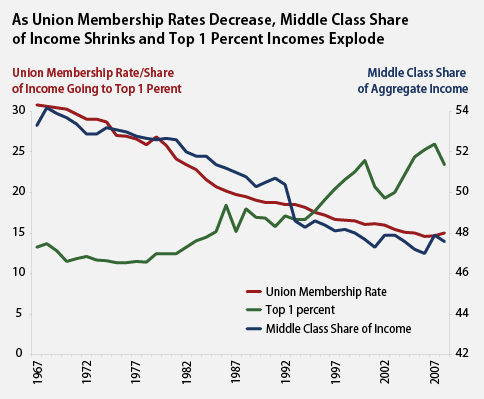
Zaid Jilani writes: This evening, House Majority Leader Eric Cantor (R-VA) will give a speech at the University of Pennsylvania’s Wharton School of Business about how to address income inequality, likely trying to capitalize on the 99 Percent Movement he once derided as unruly “mobs.” Although exactly what policies Cantor will suggest to deal with this social problem are unknown, it’s unlikely that he will touch on one of the chief drivers of American income inequality: the decline of unions.
As CAP’s David Madland and Nick Bunker show in the following chart, the middle class’s share of national income has steadily declined as the percentage of the population in labor unions has fallen. At the same time, the top 1 percent’s share of national income has exploded:

Hamed Aleaziz writes: As the autocratic regime in Syria brutally cracks down on a pro-democracy opposition, it is using technology developed by an American company, Blue Coat Systems, to suppress dissent and block access to the internet, tech experts say.
Two weeks ago, Telecomix, a tech activist group, released information from the Syrian government-run Syria Telecommunications Establishment. The release revealed gigabytes of electronic records, called log files, dating back to late July and early August of this year, and the material indicates that Syria’s government is using Blue Coat’s devices [PDF] to prevent its citizens from accessing social media, video-sharing, and other websites. By using the devices, the Syrian regime can block information about its abuses from getting out of the country and monitor web activity. (Peter Fein, a hacktivist with Telecomix, says the information came from "publicly accessible, completely unsecured servers which were found using traditional network scans.") Selling most US-manufactured goods to Syria has been forbidden by US law since 2004.
Jacob Appelbaum, a tech expert and computer science researcher at the University of Washington who was dubbed "The Most Dangerous Man in Cyberspace" by Rolling Stone, said in an email that "the log files are direct evidence" that Syria is utilizing Blue Coat’s technology. "Every IP address in all of the information released is registered in Syria," Appelbaum added. "Every IP address routes from Syria or from known Syrian equipment with the expected latency of machines run in Syria." Appelbaum believes that the Syrian government uses Blue Coat’s device to monitor citizens’ internet activity, record it for future reference, and then take action against dissidents. "That is to say that it’s a super policeman with a general warrant who spies on every person, records everything about that person and their activities and then it acts as the judge, jury and executioner," he wrote.