Category Archives: Issues

What does Gaddafi’s fall mean for Africa?

Mahmood Mamdani writes:

“Kampala ‘mute’ as Gaddafi falls,” is how the opposition paper summed up the mood of this capital the morning after. Whether they mourn or celebrate, an unmistakable sense of trauma marks the African response to the fall of Gaddafi.

Both in the longevity of his rule and in his style of governance, Gaddafi may have been extreme. But he was not exceptional. The longer they stay in power, the more African presidents seek to personalise power. Their success erodes the institutional basis of the state. The Carribean thinker C L R James once remarked on the contrast between Nyerere and Nkrumah, analysing why the former survived until he resigned but the latter did not: “Dr Julius Nyerere in theory and practice laid the basis of an African state, which Nkrumah failed to do.”

The African strongmen are going the way of Nkrumah, and in extreme cases Gaddafi, not Nyerere. The societies they lead are marked by growing internal divisions. In this, too, they are reminiscent of Libya under Gaddafi more than Egypt under Mubarak or Tunisia under Ben Ali.

Whereas the fall of Mubarak and Ben Ali directed our attention to internal social forces, the fall of Gaddafi has brought a new equation to the forefront: the connection between internal opposition and external governments. Even if those who cheer focus on the former and those who mourn are preoccupied with the latter, none can deny that the change in Tripoli would have been unlikely without a confluence of external intervention and internal revolt.

The conditions making for external intervention in Africa are growing, not diminishing. The continent is today the site of a growing contention between dominant global powers and new challengers. The Chinese role on the continent has grown dramatically. Whether in Sudan and Zimbawe, or in Ethiopia, Kenya and Nigeria, that role is primarily economic, focused on two main activities: building infrastructure and extracting raw materials. For its part, the Indian state is content to support Indian mega-corporations; it has yet to develop a coherent state strategy. But the Indian focus too is mainly economic.

The contrast with Western powers, particularly the US and France, could not be sharper. The cutting edge of Western intervention is military. France’s search for opportunities for military intervention, at first in Tunisia, then Cote d’Ivoire, and then Libya, has been above board and the subject of much discussion. Of greater significance is the growth of Africom, the institutional arm of US military intervention on the African continent.

This is the backdrop against which African strongmen and their respective oppositions today make their choices. Unlike in the Cold War, Africa’s strongmen are weary of choosing sides in the new contention for Africa. Exemplified by President Museveni of Uganda, they seek to gain from multiple partnerships, welcoming the Chinese and the Indians on the economic plane, while at the same time seeking a strategic military presence with the US as it wages its War on Terror on the African continent.

Facebooktwittermail

Algeria’s regime: out on a limb that looks set to fall

Brian Whitaker writes:

With three out of five countries now under new management along the north African coast, the spotlight is turning towards the remaining two: Algeria and Morocco.

In Morocco, where a new constitution was approved in July, the king’s promises of reform may succeed in staving off a mass revolt – at least for the time being. Morocco also recognised the national transitional council (NTC) in Libya with deft timing a week ago, declaring its support for “the legitimate aspirations of the brotherly Libyan people”.

That leaves Algeria out on a limb, increasingly identified with the forces of counter-revolution. Not only has it so far failed to recognise the Libyan NTC, but it is now openly providing refuge for members of the Gaddafi family.

Welcoming the Gaddafis, according to Algeria’s ambassador at the UN, was nothing more than a humanitarian gesture, in line with the traditions of desert hospitality – but we don’t have to look very far to see the politics behind it.

What happened to the Tunisian, Egyptian and Libyan regimes could easily have been the fate of the Algerian regime, too. In January, as the Tunisian uprising gathered pace, Algeria also experienced widespread disturbances – and for very similar reasons. Regular protests were still continuing on a smaller scale at the end of March.

Facebooktwittermail

Libya’s rebels achieved what many thought would be impossible

George Joffe writes:

Given Libya’s dramatic lack of political and administrative experience (the legacy of the baleful perfection of the Jamahiriyah, which punished dissent with death or imprisonment), and the parallel lack of civil society (eliminated over the years for identical reasons), it is almost impossible for Libya to ignore the accumulated experience of the previous regime.

Indeed, Mr Abdel Jalil himself, as president of the Council, is Libya’s former minister of justice and the commander of the East’s military forces. General Younis, who was killed at the end of July, had been the interior minister. Yet General Younis’ death was almost certainly a consequence of a widespread dislike and suspicion of former members of the Gaddafi regime within the insurgent movement.

The issue also highlights the tensions within the Council between different groups: Exiles against former members of the regime, Islamist militias suspicious of the military command, and tensions between the armed forces of the East and those of the West of the country. Mr Abdel Jalil has battled against these trends, it is true, but it is not clear how successful he has been and how coherent and competent the Council will be in handling its new responsibilities. Nonetheless, there are still many question marks about the immediate future that pro-Gaddafi forces may seek to exploit if they manage to regroup.

Yet against these concerns must be set the single staggering fact that, admittedly with NATO’s help but essentially with their own resources, Libya’s people have overthrown the regime that had oppressed them for decades. Unlike Tunisia, the regime was not capable of understanding its own loss of legitimacy and fought unsuccessfully to retain control. Unlike Egypt, there was no army as a national institution which, in the end, was prepared to force the regime to go. NATO’s help was vital in evening out the odds that the insurgents faced, but they were the ones who actually achieved what many thought at the beginning would be impossible.

It could be argued, therefore, that Libya, the country upon which its regional neighbors used to look with a pitying regret, perhaps even contempt, may turn out to be a paradigm of how liberty can and should be won against corrupting and violent dictatorship. In that respect, it finds its place alongside Tunisia as the unexpected and unanticipated examples of radical political change in the Arab world, in which it is North Africa that offers lessons to a Middle East that has been used to precisely the reverse!

Given that achievement, perhaps, the problems faced by the National Transitional Council can now be seen in a proper perspective.

Facebooktwittermail

‘Libyans don’t like people with dark skin, but some are innocent’

Patrick Cockburn reports:

Yassin Bahr, a tall thin Senegalese in torn blue jeans, volubly denies that he was ever a mercenary or fought for Muammar Gaddafi.

Speaking in quick nervous sentences, Mr Bahr tries to convince a suspicious local militia leader in charge of the police station in the Faraj district of Tripoli, that he is a building worker who has been arrested simply because of his colour. “I liked Gaddafi, but I never fought for him,” Mr Bahr says, adding that he had worked in Libya for three years laying tiles.

But the Libyan rebels are hostile to black Africans in general. One of the militiamen, who have been in control of the police station since the police fled, said simply: “Libyan people don’t like people with dark skins, though some of them may be innocent.”

Going by Mr Bahr’s experience, any black African in Libya is open to summary arrest unless he can prove that he was not a member of Colonel Gaddafi’s forces.

Fathi, a building contractor who did not want to give his full name and was temporarily running the police station, wanted to know why Mr Bahr had a special residence permit that an immigrant worker would not normally obtain. “You must have been fighting for Gaddafi to have a permit like this,” he said. Mr Bahr said that three years earlier he had walked through the Sahara and crossed the Libyan border illegally with other West Africans looking for work. They had been picked up by the Libyan police, but he had eventually bribed them to get a residence permit. He had been watching television with nine other African immigrants when they were arrested, though no arms were found in the house.

Racism against black Africans and Libyans with dark skin has long simmered in Libya. Before the war there were estimated to be a million illegal immigrants in the country, which has a population of six million and a workforce of 1.7 million.

In 2000 there were anti-immigrant riots in which dozens of workers from countries like Ghana, Cameroon, Niger, Chad, Nigeria and Burkina Faso were killed. The war has deepened racial hostility. The rebels claim that many of Colonel Gaddafi’s soldiers were black African mercenaries. Amnesty International says these allegations are largely unproven and, from the beginning of the conflict, many of those arrested or, in some cases, executed by the rebels were undocumented labourers caught in the wrong place at the wrong time.

Facebooktwittermail

Military council fails to defuse mounting tales of torture in Egypt

Ahram Online reports:

Soldiers arrive one mid-afternoon to break off a peaceful gathering in Tahrir Square. Days later, several young people recount scary ordeals and horror stories they claim they endured.

Amr, for example, a young Egyptian man who works in the TV and Radio Corporation, entered the Metro Station in Tahrir Square to take the train home around 2pm.

“On the stairs going into the station, three men in civilian clothes arrested me. They took my ID card and broke it into two pieces. They kicked and punched me around and then led me to a personnel carrier nearby,” Amr told El Nadeem Centre for the psychological rehabilitation of victims of violence and torture.

“In the crowded vehicle, soldiers cursed me and hit me all over my body repeatedly until I almost fainted. I found a few young men in the car who were also apparently beaten and we all had trouble breathing because it was inhumanely hot and stuffy in there. They drove us around for two hours until we arrived at the prison,” Amr continued, recounting his story as it appears on the Centre’s website.

“Soldiers welcomed us at the prison gate by hitting us with electric shock batons in sensitive parts of our bodies. They made us crawl on our stomachs into the jail yard while stepping down on us with their boots and lashing at us with their whips,” Amr recalled to El Nadeem.

Ahmed, a journalist, said that soldiers arrested him that same day as he headed towards a mosque near the square to perform his afternoon prayers.

“I told them that I am a journalist. They said they did not give a damn. They took us to a prison. They stripped us and made us crawl naked on the jail’s asphalt. My back is swollen and I might need surgery on my leg,” goes Ahmed’s account to El Nadeem Centre.

Zeinab, a young woman, said that soldiers abused her as she tried to help an elderly woman whom soldiers knocked down after she shouted at soldiers in defence of those being beaten.

“Some soldiers grabbed me, lifted my blouse and started slapping me straight on the flesh. They said that I was more or less a whore,” Zeinab told El Nadeem.

These stories are not of the horror and torture that Egyptians endured in the long years under the draconian rule of ousted president Hosni Mubarak. The peaceful gathering in question did not take place against one of the many facets of Mubarak’s repressive rule.

Moreover, the soldiers accused of brutality and torture were not members of the notorious State Security Intelligence core, which haunted and abused endless numbers of protesters and other ordinary citizens for decades to keep Mubarak safely in power.

The demonstration in question took place on 1 August 2011; seven months after Egyptians ousted Mubarak in a spectacular popular revolution.

Facebooktwittermail

Pro-Assad militia threatens to go on strike

Asharq Al-Awsat reports:

The state of unity exhibited by the Syrian regime since the outbreak of protests more than 5 months may have finally come to an end. Over this period of time, the al-Assad regime has relied on Syrian military forces and the pro-regime “Shabiha” militia to suppress the protests taking place across the country, but both forces have now begun slowly to move out of the Damascus regime’s control. This is a state of affairs that could significantly change the equation on the ground and may lead to a scenario that will result in a quick and indeed surprising end to the Syrian crisis, which has so far claimed 2,200 lives, according to Human Rights groups’ estimates.

The “Shabiha” militia has played a prominent role in silencing the demonstrations taking place in Syria. The Syrian security apparatus hired the “Shabiha” militia to suppress anti-regime protests, and eyewitness reports indicate that “Shabiha” militants have beaten and killed unnamed Syrian demonstrators, as part of the al-Assad regime’s campaign to quell the popular uprising against it.

However the Syrian regime is now running out of funds, particularly after the protests and demonstrations have continued for more than 4 months. This has led to a situation where the al-Assad regime is no longer able to continue paying the “Shabiha” militia. This has reportedly angered members of the pro-regime militia and may even lead to them electing to withdraw from the picture.

The Syrian regime’s trouble finding funds to pay the pro-regime “Shabiha” militia, who have been instrumental in the al-Assad regime’s campaign to quell the popular uprising, represents the first overt indication that the economic sanctions imposed on the Syrian regime by the international community is having an effect. Earlier this week, Syrian Central Bank Governor Adib Mayaleh acknowledged that “we [the people of Syria] will have to tighten our belts” adding that “all [Syrians] will be increasingly affected [by the economic sanctions], and this will create unemployment and poverty.”

This confirms information reported to Asharq Al-Awsat by a well-informed source that the “Shabiha” militia has threatened to go on strike if the Syrian government continues to fail to pay up. The source stressed that this is an extremely urgent issue, particularly as many members of the “Shabiha” militia in Damascus left the capital for Latakia and other Syrian provinces, after the Syrian regime stopped paying them.

Facebooktwittermail

White House guidelines on 9/11 messaging — don’t mention Baghdad

The New York Times in its Izvestia-like role as mouthpiece for the White House, shares some of the guidelines that have been sent to government officials with directions on how they should talk about 9/11, as its tenth anniversary approaches. Goodness knows what any of them might say if they were not provided with clear instructions on how to speak and think.

The documents being reported on have been distributed to hundreds, perhaps thousands of officials. They are referred to as “internal documents” which leads me to doubt that they are even classified as confidential, yet the Times, prissy as ever, didn’t publish the documents — merely quoted from them liberally.

There are two sets of guidelines — one on how American officials should communicate with other Americans and the other on how to talk to everyone else.

[T]he guidelines aimed at foreign audiences … call on American officials to praise overseas partners and their citizens, who have joined the worldwide effort to combat violent extremism.

“As we commemorate the citizens of over 90 countries who perished in the 9/11 attacks, we honor all victims of terrorism, in every nation around the world,” the overseas guidelines state. “We honor and celebrate the resilience of individuals, families, and communities on every continent, whether in New York or Nairobi, Bali or Belfast, Mumbai or Manila, or Lahore or London.”

Bali or Belfast?

There was a much more obvious city beginning with “B” to couple with Bali.

Baghdad.

After all, more innocent civilians have died in terrorist attacks in that city alone in the last decade than in every other location on the planet where attacks have occurred.

Of course the subject of terrorism in Iraq is awkward for Americans since the lines between terrorism and warfare so often became blurred on an American-made battlefield that quickly became a terrorist training ground.

The report notes:

Some senior administration officials involved in the discussions noted that the tone set on this Sept. 11 should be shaped by a recognition that the outpouring of worldwide support for the United States in the weeks after the attacks turned to anger at some American policies adopted in the name of fighting terror — on detention, on interrogation, and the decision to invade Iraq.

So what tangible form does that recognition take?

Everyone should maintain a polite silence about Iraq. Oh… and don’t mention al Qaeda either. With bin Laden dead, al Qaeda is totally passé.

Let’s focus on the future (“present a positive, forward-looking narrative”) while we remember the past.

Facebooktwittermail

New Palestinian strategy document will make it difficult for U.S. to oppose UN vote

Akiva Eldar writes:

Prime Minister Benjamin Netanyahu is probably aware that when it comes to a media event, like a speech at the UN General Assembly, President Shimon Peres doesn’t have to be asked twice to sacrifice himself for the nation. Someone who has been watching the honorable president for decades once told me that Peres is blessed with a unique characteristic: He always knows how to adjust reality according to his needs at the time.

So Peres will easily be able to convince himself that the nation ‏(if not the entire universe‏) is demanding that he travel to New York next month to represent the prime minister at the assembly declaring a Palestinian state. But this time Peres is expected to face opposition from close associates.

“How can Peres promise the world that Netanyahu has accepted the two-state solution based on the 1967 borders when he himself has long since lost his faith in Netanyahu’s intention of reaching such an agreement?” asked one of them. The source adds, “Can the president repeat the words he said in the spring of 2009 at the AIPAC conference in Washington, to the effect that Netanyahu wants to make history and peace is his primary interest?”

It’s true that Netanyahu is making history. On his watch the UN General Assembly is expected to recognize an independent Palestinian state by a huge majority. The wording of the draft, crafted in recent days by the Fatah leadership, is designed to enable even “problematic” countries such as Germany, Italy, the Netherlands and the Czech Republic to climb on board, or at least abstain.

This version will make it difficult for the United States and the Marshall Islands, and even for Israel, to explain their votes against the proposal. Instead of recognizing Palestine within the 1967 borders, it will state that the permanent borders will be determined in negotiations with Israel based on the borders of June 4, 1967. This approach made it possible to enlist the support of leading moderates in Hamas, who claim that recognition of the 1967 borders before the signing of a final-status deal means waiving the claim to the right of return.

Several of those people are signatories to a new strategic position paper, drafted by more than 50 Palestinian government officials, researchers and advisers − members of the Palestine Strategy Group. This is the forum that in 2008 composed a document recommending that the leadership transfer the conflict to the United Nations.

The new document presents the Palestinian strategy both before and after the UN vote.

Among the participants in the group’s workshops over the past year in Jericho, Gaza and Istanbul were Omar Abdel Razek, the former finance minister in the Hamas government in the West Bank, and Nasser al-Shaer, that government’s education minister. Next to them sat senior Fatah officials including associates of Palestinian President Mahmoud Abbas − former Foreign Minister Nabil Shaath and senior adviser Mohammad Shtayyeh. Other signatories are Naser al-Kidwa, a former Palestinian observer at the United Nations, Fatah Deputy Secretary General and Communications Minister Sabri Saydam, and former economics minister and businessman Mazen Sinokrot.

Already in the preface, the authors stress that “strategic unity,” now greatly enhanced by the reconciliation process, is a key condition for putting together an effective strategy. The document’s starting point: Given the Israeli government’s intransigence, the option of settling the conflict via bilateral negotiations − the path pursued by the Palestinian leadership for 20 years − is no longer available.

Most of the document’s authors support the option of an independent Palestinian state within the 1967 borders, with Jerusalem as its capital and a fair arrangement that will fulfill the right of return and the compensation of the Palestinian refugees. The document rejects the possibility of continuing the status quo, maintaining that the endless negotiations provide cover for expanding the settlements and consolidating the occupation. The authors also erase from the agenda the option of a Palestinian state with temporary borders and limited sovereignty, under effective Israeli control.

If the strategy of a diplomatic struggle for Palestinian independence − including sanctions, turning to the International Criminal Court and nonviolent resistance as in Egypt and Tunisia − does not change the situation, the group recommends switching to what the document calls Plan B: dismantling the Palestinian Authority and restoring responsibility for the West Bank’s inhabitants to Israel. The authors are not ignoring the price their public would pay for that, but wonder what honorable option would remain.

If it turns out that this option is unattainable, the authors recommend working toward a model of a binational state or democratic state without distinction between Israel and Palestinian citizens. Another possibility is a confederation between Jordan and the Palestinian state.

The authors recommend explaining to the Israelis that they must forget the plan for unilateral withdrawal from the West Bank, with restrictions on the movement of Palestinians, and the dream of annexing Gaza to Egypt and the West Bank to Jordan.

They hope their neighbors will understand that the realistic alternatives to a genuine negotiated settlement will be far worse for Israel’s security.

Most participants in the workshops rejected an armed struggle against a foreign occupation and especially the use of violence against civilians. But the authors warn that a change in strategy from an attempt to achieve political independence to a conflict like the anti-apartheid struggle in South Africa will play into the hands of extremists in the region.

“Should this happen, not just Israel’s legitimacy will be under threat, but its very existence, ” they conclude. “And this will have been brought about by Israel itself.”

Facebooktwittermail

IDF training Israeli settlers ahead of ‘mass disorder’ expected in September

Haaretz reports:

The IDF has conducted detailed work to determine a “red line” for each settlement in the West Bank, which will determine when soldiers will be ordered to shoot at the feet of Palestinian protesters if the line is crossed. It is also planning to provide settlers with tear gas and stun grenades as part of the defense operation.

The IDF is currently in the process of finalizing its preparations for Operation Summer Seeds, whose purpose is to ready the army for September and the possibility of confrontations with Palestinians following the expected vote in favor of Palestinian statehood at the UN General Assembly.

According to a document acquired by Haaretz, the main working assumption of the defense establishment is that a Palestinian declaration of independence will cause a public uprising “which will mainly include mass disorder.”

The document states the disorder will include “marches toward main junctions, Israeli communities, and education centers; efforts at damaging symbols of [Israeli] government.

Also, there may be more extreme cases like shooting from within the demonstrations or even terrorist incidents. In all the scenarios, there is readiness to deal with incidents near the fences and the borders of the State of Israel.”

As part of its preparations, the IDF is investing a great deal of effort in preparing the settlers for the incidents, with the main concern being confrontations between Israeli settlers and the Palestinians.

Yesterday the army held training sessions for the chief security officers of settlements at a military installation near Shiloh. In recent weeks the IDF has been training the readiness squads of settlements at the Lachish base, which is used as a command training center ahead of September.

The main message the army is issuing is that the demonstrations will be controlled and that the army has sufficient forces in order to deal with every disturbance. In order to be sure, there is also a decision, in principle, to equip the chief security officers of settlements with the means for dispersing demonstrations. These would include tear gas and stun grenades, although that would create a logistical problem as there’s a shortage of means for firing that type of ammunition.

Moreover, as part of the preparations, staff work was performed in which the commander of the platoon responsible for defending each settlement patrolled the area with the chief security officer of the settlement, in order to identify weak points.

The army is establishing two virtual lines for each of the settlements that are near a Palestinian village. The first line, if crossed by Palestinian demonstrators, will be met with tear gas and other means for dispersing crowds.

The second line is a “red line,” and if this one is crossed, the soldiers will be allowed to open fire at the legs of the demonstrators, as is also standard practice if the northern border is crossed.

Facebooktwittermail

Counter-terrorism Inc. — How the US government funds America’s booming security industry

The Los Angeles Times reports:

On the edge of the Nebraska sand hills is Lake McConaughy, a 22-mile-long reservoir that in summer becomes a magnet for Winnebagos, fishermen and kite sailors. But officials here in Keith County, population 8,370, imagined this scene: an Al Qaeda sleeper cell hitching explosives onto a ski boat and plowing into the dam at the head of the lake.

The federal Department of Homeland Security gave the county $42,000 to buy state-of-the-art dive gear, including full-face masks, underwater lights and radios, and a Zodiac boat with side-scan sonar capable of mapping wide areas of the lake floor.

Up on the lonely prairie, Cherry County, population 6,148, got thousands of federal dollars for cattle nose leads, halters and electric prods — in case terrorists decided to mount biological warfare against cows.

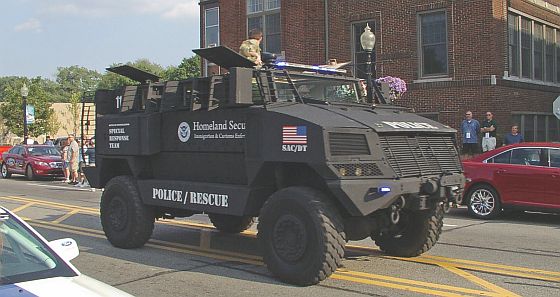
In the Los Angeles suburb of Glendale, where police fear militants might be eyeing DreamWorks Animation or the Disney creative campus, a $205,000 Homeland Security grant bought a 9-ton BearCat armored vehicle, complete with turret. More than 300 BearCats — many acquired with federal money — are now deployed by police across the country; the arrests of methamphetamine dealers and bank robbers these days often look much like a tactical assault on insurgents in Baghdad.

A decade after the Sept. 11, 2001, attacks on the World Trade Center and the Pentagon, federal and state governments are spending about $75 billion a year on domestic security, setting up sophisticated radio networks, upgrading emergency medical response equipment, installing surveillance cameras and bombproof walls, and outfitting airport screeners to detect an ever-evolving list of mobile explosives.

But how effective has that 10-year spending spree been?

“The number of people worldwide who are killed by Muslim-type terrorists, Al Qaeda wannabes, is maybe a few hundred outside of war zones. It’s basically the same number of people who die drowning in the bathtub each year,” said John Mueller, an Ohio State University professor who has written extensively about the balance between threat and expenditures in fighting terrorism.

“So if your chance of being killed by a terrorist in the United States is 1 in 3.5 million, the question is, how much do you want to spend to get that down to 1 in 4.5 million?” he said.

One effect is certain: Homeland Security spending has been a pump-primer for local governments starved by the recession, and has dramatically improved emergency response networks across the country.

An entire industry has sprung up to sell an array of products, including high-tech motion sensors and fully outfitted emergency operations trailers. The market is expected to grow to $31 billion by 2014.

Like the military-industrial complex that became a permanent and powerful part of the American landscape during the Cold War, the vast network of Homeland Security spyware, concrete barricades and high-tech identity screening is here to stay. The Department of Homeland Security, a collection of agencies ranging from border control to airport security sewn quickly together after Sept. 11, is the third-largest Cabinet department and — with almost no lawmaker willing to render the U.S. less prepared for a terrorist attack — one of those least to fall victim to budget cuts.

The expensive and time-consuming screening now routine for passengers at airport boarding gates has detected plenty of knives, loaded guns and other contraband, but it has never identified a terrorist who was about to board a plane. Only 14 Americans have died in about three dozen instances of Islamic extremist terrorist plots targeted at the U.S. outside war zones since 2001 — most of them involving one or two home-grown plotters.

Homeland Security officials say there is no way to compute how many lives might have been lost had the nation’s massive security apparatus not been put into place — had the would-be bombers not been arrested before they struck, or deterred from getting on a plane because it was too hard.

“We know that they study our security measures, we know they’re continuously looking for ways to get around them, and that’s a disincentive for someone to carry out an attack,” said John Cohen, the department’s deputy counter-terrorism coordinator.

“Another way of asking the question is: Has there been a U.S. airplane that has exploded?”

State and local emergency responders have undergone a dramatic transformation with the aid of $32 billion that has been dispensed in Homeland Security grants since 2002, much of it in the early years spent on Hollywood-style tactical gear, often with little connection between risk and outlay.

“After 9/11, it was literally like my mother running out the door with the charge card,” said Al Berndt, assistant director of the Emergency Management Agency in Nebraska, which has received $163.7 million in federal anti-terrorism and emergency aid grants. “What we really needed to be doing is saying, ‘Let’s identify the threat, identify the capability and capacity you already have, and say, OK, what’s the shortfall now, and how do we meet it?’ ”

The spending has been rife with dubious expenditures, including the $557,400 in rescue and communications gear that went to the 1,500 residents of North Pole, Alaska, and a $750,000 anti-terrorism fence — fashioned with 8-foot-high ram-proof wrought iron reinforced with concrete footers — built around a Veterans Affairs hospital in the pastoral hills outside Asheville, N.C.

West Virginia got $3,000 worth of lapel pins and billed the federal government for thousands of dollars in cellphone charges, according to the Center for Investigative Reporting, which compiled a state-by-state accounting of Homeland Security spending. In New York, $3 million was spent on automated public health records to help identify bioterrorism threats, but investigators for the department’s inspector general in 2008 found that employees who used the program weren’t even aware of its potential bioterrorism applications.

Facebooktwittermail

Syrian protesters ‘killed’ after Eid prayers

Al Jazeera reports:

Syrian security forces have shot dead at least seven protesters on the first day of the Muslim Eid al-Fitr holiday, activists say.

Protests erupted in many towns and cities on Tuesday morning, after Muslims performed morning prayers marking the end of Ramadan.

The Local Co-ordination Committees (LCC) activist network said six of the deaths occurred in the southern province of Deraa and one in Homs.

Syrian security forces reportedly also opened fire on protesters in the town of Deir ez-Zor.

LCC said a “huge” protest was formed as worshippers emerged from the al-Omari mosque in Daraa and marched to the town’s cemetery. Muslims traditionally visit graves on the first day of Eid.

Large demonstrations were also reported in cities including Deraa, Idlib, Hama and Homs, and in Damascus suburbs.

A day earlier, security forces killed at least eight people and wounded dozens in raids across the country, according to opposition activists.

Facebooktwittermail

‘Defections’ in Syrian army reported

Reuters reports:

An armored Syrian force surrounded a town near the city of Homs Monday and fired heavy machineguns after the defection of tens of soldiers in the area, activists and residents said.

One woman, 45 year-old Amal Qoraman, was killed and five other people were injured, they said, adding that tens of people were arrested in house to house raids in the town of 40,0000.

Since the demise of Muammar Gaddafi’s rule in Libya, activists and residents have reported increasing defections among Syrian troops, as well as more intense street protests in a five-month-old uprising against President Bashar al Assad.

Syrian authorities have repeatedly denied army defections have been taking place. They have expelled independent media since the uprising began in March.

Activists say there have been desertions in eastern Deir al-Zor province, northwestern Idlib province, the Homs countryside and the outskirts of Damascus, where security forces fought gunbattles with defectors Sunday.

At least 40 light tanks and armored vehicles, and 20 buses of troops and military intelligence members deployed at dawn at the entrance of Rastan, 20 km (12 miles) north of Homs and began firing heavy machineguns at the town, two residents said.

“The tanks deployed at both banks of the highway, which remained open, and fired long bursts from their machineguns at Rastan,” one of the residents, who gave his name as Raed, told Reuters by phone.

He said defections began in the town when it was stormed by tanks three months ago to crush large street protests against Assad in an assault that killed dozens of civilians.

Security forces killed Monday a former officer who had played a key role in coordinating army defections, activists said.

Mostapha Selim Hezbollah, a former air force officer in his 40s’, was shot dead when his car was ambushed near the town of Kfar Nubul in Idlib province, which borders Turkey, they said.

“It was a targeted assassination. A companion who was with him in the car was badly wounded but we managed to get him to a hospital. The attack happened just before ‘iftar’ (breaking of fast). We don’t know yet if it was security police or troops who fired at them,” one of the activists told Reuters by phone.

The Syrian Observatory for Human Rights, which is based in Britain, said five other people were killed earlier in military assaults on several towns in Idlib.

Rastan is traditionally a reservoir of recruits for the mostly Sunni rank-and-file army that is dominated by officers from the Alawite minority sect to which Assad belongs, and effectively commanded by his younger brother Maher.

Troops backed by tanks also entered the town of Qara on the same highway south of the city of Homs, which has been scene of daily protests, killing one resident and arresting tens of people in house to house raids, activists said.

“These armored assaults on outlying areas are designed to crush protests and to contain any defections in the army,” said a Syrian political analyst in Damascus, who did not want to be named because of fear for his safety.

“The regime’s political control on the army had seemed unbreakable, but that is no longer the case, after soldiers saw mosques being stormed, worshippers attacked and minarets shelled,” he said.

Facebooktwittermail

Misrata rebels defy Libya’s new regime

The Guardian reports:

The first cracks in Libya’s rebel coalition have opened, with protests erupting in Misrata against the reported decision of the National Transitional Council (NTC) to appoint a former Gaddafi henchman as security boss of Tripoli.

Media reports said the NTC prime minister, Mahmoud Jibril, is poised to appoint Albarrani Shkal, a former army general, as the capital’s head of security.

Protests erupted in the early hours of the morning in Misrata’s Martyr’s Square, with about 500 protesters shouting that the “blood of the martyrs” would be betrayed by the appointment.

Misrata’s ruling council lodged a formal protest with the NTC, saying that if the appointment were confirmed Misratan rebel units deployed on security duties in Tripoli would refuse to follow NTC orders.

Misratans blame Shkal for commanding units that battered their way into this city in the spring, terrorising and murdering civilians.

NTC sources say Shkal, formerly a key confidant of Muammar Gaddafi, turned rebel informer in May, passing valuable information back to the rebel capital, Benghazi.

But Misratans believe that prior to that, he was operations officer for the 32nd brigade, whose overall commander is Gaddafi’s son Khamis.

The brigade took the leading role in a siege that saw tanks and artillery bombard residential areas of the city, murdering several hundred civilians.

Facebooktwittermail

Libya: Evidence suggests Khamis Brigade killed 45 detainees

Members of the Khamis Brigade, a powerful Gaddafi military force run by Muammar Gaddafi’s son Khamis, appear to have summarily executed detainees in a warehouse near Tripoli on August 23, 2011, Human Rights Watch said today. Within three days the same warehouse was set on fire but the cause is unknown, Human Rights Watch said.

Human Rights Watch inspected the charred skeletal remains of approximately 45 bodies, still smoldering, on August 27. The remains were spread throughout a warehouse in the Khalida Ferjan neighborhood in Salahaddin, south of Tripoli, adjoining the Yarmouk Military Base. At least two additional corpses were seen lying outside, unburned.

“Sadly this is not the first gruesome report of what appears to be the summary execution of detainees in the final days of the Gaddafi government’s control of Tripoli,” said Sarah Leah Whitson, Middle East and North Africa director at Human Rights Watch. “These merciless murders took place in the midst of Ramadan and those responsible should be brought to justice and punished.”

Facebooktwittermail

Gaddafi wanted to be Libya’s only hero

Luke Harding visits Tripoli’s museum, now guarded by two friendly rebels, Naiem and Islam.

Naiem told me how he and other locals liberated the museum on Sunday 21 August – the day the rebels surged into western Tripoli, and a popular insurrection erupted inside it. The Gaddafi soldiers were armed; the locals had no weapons other than a small harpoon used for fishing trips. “Gaddafi was mad. He had hid soldiers in hospitals, museums and schools,” Naiem said. “They left their clothes here and ran away.”

Not all escaped: the rebels captured two of Gaddafi’s soldiers trying to flee. One, Naiem said, admitted he genuinely liked Gaddafi. The other, however, explained that his officers had told him he wasn’t fighting fellow Libyans but was going to war against France, Britain and Nato. “He didn’t know the truth,” Islam said. Both soldiers were now in a rebel prison, their fate unclear in a city without a justice system.

In a room devoted to Sabratha – Libya’s other stunning Roman city – I found a bust of Marcus Aurelius. He had been taken out of his niche and propped carefully against a wall. Nearby was a female bust from a Roman necropolis, her expression dignified and mournful. I discovered more soldiers’ mattresses in a room of Neolithic grinding stones and panels of early Saharan rock art – their primitive strokes recognisable as palm trees.

Upstairs, an entire room had been devoted to the Green Book, Gaddafi’s balmy political treatise. The inscription in English was, predictably, glowing in its praise of Libya’s mysterious and vanished leader. The “charming” Gaddafi led an audacious coup against the “medieval monarchy” of King Idris, it said, and took the bold step in 1973 of nationalising Libya’s oil industry. Gaddafi’s Third Universal Theory was a philosophy superior to both western capitalism and Soviet communism, I learned.

The most intriguing discovery lay in the basement. Here, I found exhibits from the pre-Gaddafi era, carefully stored away, as well as King Idris’s palace furniture, smelling strongly of mothballs. There was a gilded Buddha, water pitchers, and a series of framed prints — a 19th-century French lithograph of the Bosporus, and portraits of Libyan nationalists who fought a century ago against Italian colonial rule. All had been hidden. “We have many heroes in Libya. But Gaddafi wanted to be the only one,” Naiem observed.

Facebooktwittermail

US-Taliban talks were making headway

The Associated Press reports:

Direct U.S. talks with the Taliban had evolved to a substantive negotiation before Afghan officials, nervous that the secret and independent talks would undercut President Hamid Karzai, scuttled them, Afghan and U.S. officials told The Associated Press.

Featured prominently in the talks was the whereabouts and eventual release of U.S. Army Sgt. Bowe Bergdahl of Hailey, Idaho, who was captured more than two years ago in eastern Afghanistan, according to a senior Western diplomat in the region and a childhood friend of the Taliban negotiator, Tayyab Aga.

The U.S. negotiators asked Aga what could be done to gain Bergdahl’s release. The discussion did not get into specifics but Aga discussed the release of Afghan prisoners at Guantanamo Bay, Cuba and in Afghanistan at Bagram Air Field.

Published reports about the clandestine meetings ended the talks abruptly, and sent Aga into hiding.

Collapse of the direct talks between Aga and U.S. officials probably spoiled the best chance yet at reaching Mullah Mohammed Omar, considered the linchpin to ending the Taliban fight against the U.S.-backed government in Afghanistan. The contacts were preliminary but had begun to bear fruit, Afghan and U.S. officials said.

Perhaps most importantly they offered the tantalizing prospect of a brokered agreement between the U.S. and the Taliban — one that would allow the larger reconciliation of the Taliban into Afghanistan political life to move forward. The United States has not committed to any such deal, but the Taliban wants security assurances from Washington.

Facebooktwittermail

The myth of terrorism

The power of language cannot be overstated. Nowhere is this more evident than in the power embedded in the word terrorism — a word which has governed political thought for much of the last decade.

Political acts of violence are older than humanity. Among chimpanzees, for instance, the contest for social power can sometimes be deadly. The killing of an alpha male by socially related chimps is a political act of violence for the purpose of realigning the social order, yet no one would be silly enough to suggest that chimpanzees face a threat from terrorism (even if chimps can indeed terrorize their companions!).

Political acts of violence is a phrase and not a word because it refers to a very broad collection of events that cannot neatly and meaningfully be circumscribed and turned into a thing. Such acts are as diverse in their reasons as they are in their distribution.

But give this amorphous entity a name, terrorism, and suddenly it becomes homogenous. One act of terrorism can be linked to another because they are both, supposedly, the same thing — both performed by the same people: terrorists. The idea that terrorists all share common attributes then reinforces the idea that wherever terrorism takes place we should be united in our response.

Whether it’s an attack in New York or Tel Aviv, Moscow or Mumbai, united we must stand in facing this terrible threat. Political analysis can conveniently be tossed out of the window once we have submitted to the demand that security preempts all other concerns.

Larry Derfner, who until today was a columnist for the rightwing Jerusalem Post, wrote a piece a few days ago in which he made a fine attempt to deconstruct the Israeli myth of Palestinian terrorism, but he made a few mistakes.

Israelis who don’t regard the Irgun and Lehi armed resistance to British rule as terrorism, are in no position to apply the same label to Palestinian resistance to the Israeli occupation. But what Derfner says in this regard in his column, is: “If those who oppose the occupation acknowledged publicly that it justifies Palestinian terrorism, then those who support the occupation would have to explain why it doesn’t. And that’s not easy for a nation that sanctifies the right to self-defense; a nation that elected Irgun leader Menachem Begin and Lehi leader Yitzhak Shamir as prime minister.”

The problem with phrasing his argument this way is that the almost universally accepted dogma these days is that there is no form of terrorism — whether practiced by Palestinians or anyone else — that is justifiable. Not even opponents of the occupation say terrorism is justifiable. On the other hand, what many will acknowledge is that Palestinians, like anyone else living under military occupation, have the right to engage in armed resistance.

Ironically, what inspired Derfner to make his argument was a series of attacks in southern Israel, near Eilat, carried out by gunmen whose identities are in dispute. Some of them have been reported to be Egyptian and not a single Palestinian has been named.

The attacks perfectly illustrate the way in which the label “terrorism” is used to silence those who dare to question the official version of events. But when we don’t actually know who the gunmen were, we can hardly pretend to understand their motives.

If, as many of us suspect, they were salafist militants based in the Sinai whose goal is to establish an Islamic emirate in the largely ungoverned region, their reasons for attacking Israelis might be quite different from those of a Palestinian militant group. At the same time, even if they were Palestinians, we can’t take it as a given that their attack was conceived as yet another strike in the fight against the occupation.

Call a bloody act of political violence an act of terrorism, however, and those of us who insist that we can’t understand what happened if we don’t know who was involved or what motivated them — we will be dismissed as apologists of terrorism or even terrorist sympathizers. Others, buoyed up by their own self-righteousness, anger and indignation will declare that terrorism must be vigorously condemned and tirelessly fought — as though governments are the sole arbiters of the legitimacy of political violence.

Here’s the column blog post, “The awful, necessary truth about Palestinian terror,” that got Derfner fired:

I think a lot of people who realize that the occupation is wrong also realize that the Palestinians have the right to resist it – to use violence against Israelis, even to kill Israelis, especially when Israel is showing zero willingness to end the occupation, which has been the case since the Netanyahu government took over (among other times in the past).

But people don’t want to say this, especially right after a terror attack like this last one that killed eight Israelis near Eilat. And there are lots of good reasons for this reticence, such as: You don’t want to further upset your own countrymen when they are grieving, you don’t want to say or write anything that could be picked up by Israel’s enemies and used as justification for killing more of us. (These are good reasons; fear of being called a traitor, for instance, is a bad reason.)

But I think it’s time to overcome this reticence, even at the cost of enflaming the already enflamed sensitivities of the Israeli public, because this unwillingness to say outright that Palestinians have the right to fight the occupation, especially now, inadvertently helps keep the occupation going.

When we say that the occupation is a terrible injustice to the Palestinians, but then say that Palestinian terror/resistance is a terrible injustice to Israel, we’re saying something that’s patently illogical to anyone but a pacifist, and there aren’t many pacifists left, certainly not in Israel. The logical, non-pacifist mind concludes that both of those statements can’t be true – that if A is hurting B and won’t stop, then B damn sure has the right to hurt A to try to make him stop. But if everybody, not only the Right but the Left, too, is saying that B, the Palestinians, don’t have the right to hurt A, the Israelis, then the logical mind concludes that Israel must not be hurting the Palestinians after all, the occupation must not be so bad, the occupation must not be hurting the Palestinians at all – because if it was, they would have the right to hurt us back, and everybody agrees that they don’t. So when they shoot at us or fire rockets at us, it’s completely unprovoked, which gives us the right, the duty, to bash them and bash them until they stop – and anybody who tries to deny us that right doesn’t have a leg to stand on, so we’re just going to keep right on bashing them. And when the Palestinians complain about the occupation, we Israelis can honestly say we don’t know what they’re talking about.

This, I’m convinced, is how the Left’s ritual condemnations of terror are translated in the Israeli public’s mind – as justification for the occupation and an iron-fist military policy.

But if, on the other hand, we were to say very forthrightly what many of us believe and the rest of us suspect – that the Palestinians, like every nation living under hostile rule, have the right to fight back, that their terrorism, especially in the face of a rejectionist Israeli government, is justified – what effect would that have? A powerful one, I think, because the truth is powerful. If those who oppose the occupation acknowledged publicly that it justifies Palestinian terrorism, then those who support the occupation would have to explain why it doesn’t. And that’s not easy for a nation that sanctifies the right to self-defense; a nation that elected Irgun leader Menachem Begin and Lehi leader Yitzhak Shamir as prime minister.

But while I think the Palestinians have the right to use terrorism against us, I don’t want them to use it, I don’t want to see Israelis killed, and as an Israeli, I would do whatever was necessary to stop a Palestinian, oppressed or not, from killing one of my countrymen. (I also think Palestinian terrorism backfires, it turns people away from them and generates sympathy for Israel and the occupation, so I’m against terrorism on a practical level, too, but that’s besides the point.) The possibility that Israel’s enemies could use my or anybody else’s justification of terror for their campaign is a daunting one; I wouldn’t like to see this column quoted on a pro-Hamas website, and I realize it could happen.

Still, I don’t think Hamas and their allies need any more encouragement, so whatever encouragement they might take from me or any other liberal Zionist is coals to Newcastle. What’s needed very badly, however, is for Israelis to realize that the occupation is hurting the Palestinians terribly, that it’s driving them to try to kill us, that we are compelling them to engage in terrorism, that the blood of Israeli victims is ultimately on our hands, and that it’s up to us to stop provoking our own people’s murder by ending the occupation. And so long as we who oppose the occupation keep pretending that the Palestinians don’t have the right to resist it, we tacitly encourage Israelis to go on blindly killing and dying in defense of an unholy cause.

And by tacitly encouraging Israelis in their blindness, I think we endanger their lives and ours, their country and ours, much more than if we told the truth and got quoted on Hamas websites.

There’s no time for equivocation anymore, if there ever was. The mental and moral paralysis in this country must be broken. Whoever the Palestinians were who killed the eight Israelis near Eilat last week, however vile their ideology was, they were justified to attack. They had the same right to fight for their freedom as any other unfree nation in history ever had. And just like every harsh, unjust government in history bears the blame for the deaths of its own people at the hands of rebels, so Israel, which rules the Palestinians harshly and unjustly, is to blame for those eight Israeli deaths – as well as for every other Israeli death that occurred when this country was offering the Palestinians no other way to freedom.

Writing this is not treason. It is an attempt at patriotism.

Facebooktwittermail