Category Archives: Issues

How the NYPD, with the CIA’s help, became one of the country’s most aggressive domestic intelligence agencies

Mark LeVine writes:

Only two weeks before the 10th anniversary of the September 11, 2001 attacks, the Associated Press has broken a story that reminds us of just how much America has changed during the last decade, and how the government – and as important, some of the country’s most powerful corporations – routinely intrude into the lives of communities and individuals in a manner that would few would have thought imaginable the day before the planes struck the World Trade Center.

After a lengthy investigation, the Associated Press has published a story detailing a highly secretive decade-long relationship between the CIA and the New York Police Department (NYPD), in which the two agencies have worked together in “a massive covert programme to monitor the Muslim communities” living in the New York metropolitan area and surrounding regions.

The program is troubling for a host of reasons. It involves potentially serious violations of federal law, including First Amendment protections. Morever, it bears a strong resemblance to programs launched during the Civil Rights and Vietnam era, which saw techniques, technologies and even personnel from the US military and intelligence communities deployed against citizens within the United States.

When military tactics and strategies drawn from the front lines of war are applied to radically different contexts, the results are rarely beneficial to the health of a democracy.

According to the AP report, “The [NYPD] has dispatched teams of undercover officers, known as ‘rakers,’ into minority neighborhoods as part of a human mapping program, according to officials directly involved in the program. They’ve monitored daily life in bookstores, bars, cafes and nightclubs. Police have also used informants, known as ‘mosque crawlers,’ to monitor sermons, even when there’s no evidence of wrongdoing. NYPD officials have scrutinized imams and gathered intelligence on cab drivers and food cart vendors, jobs often done by Muslims. Many of these operations were built with help from the CIA, which is prohibited from spying on Americans but was instrumental in transforming the NYPD’s intelligence unit.”

Despite such prohibitions on spying on Americans, the NYPD and CIA have built a “partnership that has blurred the bright line between foreign and domestic spying.” The relationship has included a senior, active-duty CIA officer being hired by the NYPD to set up its intelligence programmes and another senior officer working as a “clandestine operative” inside police headquarters, and the CIA training of at least one police detective at the agency’s spy school.

Having watched the World Trade Center fall with my own eyes and then had to cope with a newborn son breathing in the soot and toxin-tainted air for weeks after, it’s hard not to sympathize with the NYPD’s willingness to “push the envelope” of police procedures in order to protect New Yorkers from a similar attack. It’s also hard not to agree with the assessment by NY cops that they can never again rely on the federal government to protect New York and therefore must become an active player in gathering and acting on intelligence that might affect the city’s eight million citizens.

Indeed, the NYPD’s “success” in these operations points out the weakness that still hampers effective intelligence work by the American intelligence community: Most CIA officers are white men who could never blend into a Muslim community; but the NYPD’s 34,000 officers reflect the ethnic and religious mosaic of New York, providing it with a host of Arab and South Asian officers who speak the languages and intimately know the cultures, making it much easier for them, effectively, to spy on their communities.

And it’s clear that this is what the NYPD is doing, having become, in the AP‘s words, “one of the country’s most aggressive domestic intelligence agencies.” Intelligence-read, spy-agencies spy; they aren’t set up primarily to look for evidence of crimes, but to gather intelligence, knowledge that might later be useful do shape policies or influence the behaviour of the groups or communities being surveilled.

Police are supposed to monitor citizens only to the extent there is evidence or sufficient suspicion of criminal activity or its planning. But the AP reports that in many cases members of the unit go out of their way not to have their information, or even their existence, brought to a court of law.

Simply put, if the intelligence that the NYPD intelligence unit is gathering is not useful to the judicial process, then it’s not police work, it’s spying. If Americans think being spied on by their government isn’t such a big deal, they can talk to the millions of Arabs who’ve rebelled in good measures because of decades of such practices, or the citizens of former Communist countries in Eastern Europe. All of these governments also justified spying with the need to “protect” the state and citizens from potentially dangerous people. But it always ends the same way.

Facebooktwittermail

Syrian businessmen signal revulsion with President Assad’s regime

The Guardian reports:

Syrian businessmen are reaching out to western diplomats, expressing revulsion for the Assad regime but also concern at the crippling effect of sanctions.

Diplomats say several businessmen from the merchant elite have approached western embassies to register their unease. “There are many businessmen coming to us to tell us how much they hate the regime,” said one senior western diplomat, speaking on condition of anonymity.

Protesters continue to take to the streets in large numbers but have so far been unable to dislodge those in power, prompting them to look for any splits within the regime’s political, military and economic base. While the international community has targeted the economy with sanctions, protesters have circulated lists of companies to boycott. The US and EU have accompanied their calls for President Basher al-Assad to resign with economic sanctions.

“Business leaders are definitely moving because they are realising the regime may not be around forever,” said Adib Shishakly, a Saudi-based businessman.

Almost six months of protests against Assad have all but wiped out the tourist industry, which accounts for 12% of GDP, while the International Institute of Finance forecasts that the economy will shrink by 3% this year.

Neighbouring countries, including Turkey, have until now called on Bashar al-Assad to reform rather than resign. But in a sign of rising tensions, Turkey’s president, Abdullah Gül, told Anatolia news agency on Sunday that Turkey has lost confidence. His comments came a day after Iran warned the regime to heed protesters’ demands and the Arab League said it would send its leader to Damascus.

Facebooktwittermail

Syrian opposition decides to take up arms against Assad regime

Deutsche Presse-Agentur reports:

The leader of the Revolutionary Council of the Syrian Coordination Committees, Mohammad Rahhal, said in remarks published Sunday that the council took the decision to arm the Syrian revolution.

Since mid-March pro-democracy protests have engulfed most of Syria calling for political and economic reforms as well as for the ousting of Syrian president Bashar Assad.

“We made our decision to arm the revolution which will turn violent very soon because what we are being subjected to today is a global conspiracy that can only be faced by an armed uprising,” he told the London-based As-Sharq al-Awsat newspaper. Circumstances no longer allow dealing peacefully with the regime’s “crimes,” he added. “We will use whatever arms and rocks … We will respond to the people’s calls to arm the revolution,” he said.

“Confronting this monster (the Syrian regime) now requires arms, especially after it has become clear to everyone that the world only supports the Syrian uprising through speeches,” he added. Rahal lashed out some Arab regimes and described them as “cowards.”

Haaretz reports:

Turkish President Abdullah Gul said he has lost confidence in Syria, and that the situation has reached a point where changes would be too little too late, Turkish state-run news agency Anatolian reported on Sunday.

Commenting on the situation in Turkey’s neighbor, Gul told Anatolian in an interview: “We are really very sad. Incidents are said to be ‘finished’ and then another 17 people are dead.”

He continued, asking, “how many will it be today? Clearly we have reached a point where anything would be too little too late. We have lost our confidence.”

Earlier this month Gul, who like other Turkish leaders has piled pressure on Syria to end a violent crackdown on protests, appealed to Syrian President Bashar Assad not to leave reforms until it was too late.

Hürriyet Daily News reports:

Turkey would side with the Syrian people if it has to make a choice between the neighboring country’s government and its citizens, Foreign Minister Ahmet Davutoğlu said late Thursday.

“We would choose the people, because what is permanent for us is the brotherhood of the Syrian and Turkish people. Our side is certain. We are with the Syrian people and we will continue to be,” Davutoğlu said in an interview with the private news channel NTV.

Davutoğlu earlier this month traveled to Damascus to convey a “last warning” to Syrian leader Bashar al-Assad to end the bloodshed. The neglect of this advice by the Syrian regime and its continued military operations against the Syrian people during the holy month of Ramadan have caused deep frustration and anger in Ankara, whose ties with Damascus had flourished in recent years. Turkey has repeatedly called on al-Assad to initiate reforms but has stopped short of calling for his departure.

“There is a vicious cycle, we want Syria to immediately break this cycle,” Davutoğlu told NTV, adding that Turkey was ready for any scenario.

Though he ruled out a foreign military intervention, the minister said Turkey “cannot accept human-rights violations either. Our ‘zero problems with neighbors’ policy does not mean we’ll turn our back to such violations.”

When asked what message he conveyed to al-Assad in Damascus, Davutoğlu said: “[I said] we stood by you against possible interventions by other countries. But now if we have to make a choice between you and [your] people in this current problem of yours, we’ll side with the people. Because what is lasting and what will endure until eternity is the brotherhood of the people of Turkey and Syria.”

Tom Rogan writes:

External pressure is building on President Bashar al-Assad. Along with the EU and US, key regional actors including Jordan, Saudi Arabia and Turkey have taken steps to distance themselves from the faltering Syrian regime. Further, as Meir Javedanfar argues on this site, the Iranian clerical leadership will only support Assad to the degree that this support serves their on-going Islamic revolution.

These states are calibrating their policies towards Syria with an eye on Assad’s potential fall from power and the consequences likely to follow. Hezbollah’s approach under leader Hassan Nasrallah is no different. As David Hirst notes, Nasrallah has made Hezbollah “the most influential political player in Lebanon and probably the most proficient guerrilla organisation in the world”. Nasrallah does not risk jeopardising these successes lightly.

Clearly, because of the major forms of support that Assad provides, Hezbollah has a vested interest in his political survival. This Syrian support includes the provision of material supplies and a relatively safe haven for Hezbollah leaders. Syria also acts as a reliable ally through which supplies of money and weapons can transit from Iran to Lebanon. And, as Randa Slim explains, Assad’s regime provides a legitimating and supportive Arab state to balance Iran. This complements Hezbollah’s intended appearance as a cross-sectarian liberation force, a force struggling not just for Shia Islam but for the subjugated “oppressed” in general.

However, as important as Assad’s support is to Hezbollah, the survival of his regime does not take precedence over Hezbollah’s objectives: the defeat of Israel, the marginalisation of American influence and the creation of a regional arc of Shia theocracies.

Accordingly, Hezbollah’s support for Assad is predicated on its perception of his political survival as both realistically possible and compatible with Hezbollah’s objectives. Hezbollah thus must consider the impact of its stance regarding Assad in the context of political environments in Syria, Lebanon and beyond.

Facebooktwittermail

Gaddafi offers to negotiate with Libya rebels over transfer of power

The Guardian reports:

Colonel Muammar Gaddafi has offered to enter talks with the Libyan rebels over the formation of a transitional government as loyalist fighters are pushed further to the outskirts of Tripoli and rebel forces prepare for an assault on the ousted dictator’s hometown of Sirte.

Moussa Ibrahim, regime spokesman, called the New York office of the Associated Press on Saturday night and said Gaddafi wanted his son Saadi to lead talks with the National Transitional Council. Ibrahim, who was identified only by his voice, has proved one of the despot’s most loyal and vocal allies as the 42-year-old regime crumbles. He said he was still in Tripoli, while Gaddafi – whom the rebels and Nato are desperately trying to capture – remained in Libya.

The offer of negotiations were slapped down quickly by a senior NTC official, who said the rebels would not talk to Gaddafi unless he surrendered.

“No negotiation is taking place with Gaddafi,” said Ali Tarhouni, the rebel official in charge of oil and financial matters. He told Reuters: “If he wants to surrender, then we will negotiate and we will capture him.”

Guma el-Gamaty, the UK co-ordinator of the NTC, said the rebels were “absolutely 100% not” prepared to enter into negotiations with Gaddafi about a transitional government.

He said: “The only negotiation is how to apprehend him, [for him] to tell us where he is and what conditions he wants for his apprehension: whether he wants to be kept in a single cell or shared cell or whether he wants to have his own shower or not, you know. These are the kind of negotitations we are willing to talk about.”

Facebooktwittermail

How Israel takes its revenge on boys who throw stones

The Independent reports:

The boy, small and frail, is struggling to stay awake. His head lolls to the side, at one point slumping on to his chest. “Lift up your head! Lift it up!” shouts one of his interrogators, slapping him. But the boy by now is past caring, for he has been awake for at least 12 hours since he was separated at gunpoint from his parents at two that morning. “I wish you’d let me go,” the boy whimpers, “just so I can get some sleep.”

During the nearly six-hour video, 14-year-old Palestinian Islam Tamimi, exhausted and scared, is steadily broken to the point where he starts to incriminate men from his village and weave fantastic tales that he believes his tormentors want to hear.

This rarely seen footage seen by The Independent offers a glimpse into an Israeli interrogation, almost a rite of passage that hundreds of Palestinian children accused of throwing stones undergo every year.

Israel has robustly defended its record, arguing that the treatment of minors has vastly improved with the creation of a military juvenile court two years ago. But the children who have faced the rough justice of the occupation tell a very different story.

“The problems start long before the child is brought to court, it starts with their arrest,” says Naomi Lalo, an activist with No Legal Frontiers, an Israeli group that monitors the military courts. It is during their interrogation where their “fate is doomed”, she says.

Sameer Shilu, 12, was asleep when the soldiers smashed in the front door of his house one night. He and his older brother emerged bleary-eyed from their bedroom to find six masked soldiers in their living room.

Checking the boy’s name on his father’s identity card, the officer looked “shocked” when he saw he had to arrest a boy, says Sameer’s father, Saher. “I said, ‘He’s too young; why do you want him?’ ‘I don’t know,’ he said”. Blindfolded, and his hands tied painfully behind his back with plastic cords, Sameer was bundled into a Jeep, his father calling out to him not to be afraid. “We cried, all of us,” his father says. “I know my sons; they don’t throw stones.”

In the hours before his interrogation, Sameer was kept blindfolded and handcuffed, and prevented from sleeping. Eventually taken for interrogation without a lawyer or parent present, a man accused him of being in a demonstration, and showed him footage of a boy throwing stones, claiming it was him.

“He said, ‘This is you’, and I said it wasn’t me. Then he asked me, ‘Who are they?’ And I said that I didn’t know,” Sameer says. “At one point, the man started shouting at me, and grabbed me by the collar, and said, ‘I’ll throw you out of the window and beat you with a stick if you don’t confess’.”

Sameer, who protested his innocence, was fortunate; he was released a few hours later. But most children are frightened into signing a confession, cowed by threats of physical violence, or threats against their families, such as the withdrawal of work permits.

When a confession is signed, lawyers usually advise children to accept a plea bargain and serve a fixed jail sentence even if not guilty. Pleading innocent is to invite lengthy court proceedings, during which the child is almost always remanded in prison. Acquittals are rare. “In a military court, you have to know that you’re not looking for justice,” says Gabi Lasky, an Israeli lawyer who has represented many children.

There are many Palestinian children in the West Bank villages in the shadow of Israel’s separation wall and Jewish settlements on Palestinian lands. Where largely non-violent protests have sprung up as a form of resistance, there are children who throw stones, and raids by Israel are common. But lawyers and human rights groups have decried Israel’s arrest policy of targeting children in villages that resist the occupation.

In most cases, children as young as 12 are hauled from their beds at night, handcuffed and blindfolded, deprived of sleep and food, subjected to lengthy interrogations, then forced to sign a confession in Hebrew, a language few of them read.

Israeli rights group B’Tselem concluded that, “the rights of minors are severely violated, that the law almost completely fails to protect their rights, and that the few rights granted by the law are not implemented”.

Israel claims to treat Palestinian minors in the spirit of its own law for juveniles but, in practice, it is rarely the case. For instance, children should not be arrested at night, lawyers and parents should be present during interrogations, and the children must be read their rights. But these are treated as guidelines, rather than a legal requirement, and are frequently flouted. And Israel regards Israeli youngsters as children until 18, while Palestinians are viewed as adults from 16.

Facebooktwittermail

Army vet with PTSD sought the treatment he needed by taking hostages — but got jail instead

Stars and Stripes reports:

“I’m Robert Anthony Quinones, but my friends call me Q,” the former Army sergeant told the ER medic as he pointed a 9 mm handgun at the medic’s head.

“Can I call you Q?” asked the nervous medic, Sgt. Hubert Henson.

“Yeah.”

“OK,” Henson replied. “Well, Q, if you put the gun away, I can take you upstairs to behavioral health to get help.”

Quinones scoffed, instead ordering Henson to carry his three bags: a shaving kit, a duffel stuffed with clothes and books, and a backpack bulging with two assault rifles, a .38-caliber handgun, knives and ammunition.

Fifteen months of carnage in Iraq had left the 29-year-old debilitated by post-traumatic stress disorder. But despite his doctor’s urgent recommendation, the Army failed to send him to a Warrior Transition Unit for help. The best the Department of Veterans Affairs could offer was 10-minute therapy sessions — via videoconference.

So, early on Labor Day morning last year, after topping off a night of drinking with a handful of sleeping pills, Quinones barged into Fort Stewart’s hospital, forced his way to the third-floor psychiatric ward and held three soldiers hostage, demanding better mental health treatment.

“I’ve done it the Army’s way,” Quinones told Henson. “We’re going to do it my way now.”

The standoff ended after two hours without any injuries, but Quinones’ problems were only beginning.

While in custody, Quinones threatened the lives of President Barack Obama and former President Bill Clinton, making his already bleak situation worse. Now he’s sitting in a jail cell awaiting his fate on a litany of federal charges while a court sorts out whether he should be prosecuted or committed.

Quinones’ story is one of an ordinary soldier who went off to war, came home broken, and then went over the edge after the government didn’t do enough to fix him. Even the three soldiers held at the point of Quinones’ guns today express more empathy than animosity for their captor.

To them, what Quinones did that day was the ultimate cry for help.

Facebooktwittermail

Syrian security forces storm Damascus mosque

Al Jazeera reports:

Syrian security forces have reportedly killed one person and wounded several others protesting at a mosque in the capital, Damascus.

Activists said “thousands” of people took to the streets in Kafarsouseh, a western suburb, to protest against President Bashar al-Assad’s rule after early morning prayers on Saturday.

A witness told Al Jazeera that security forces and shabiha [regime thugs] arrived at the scene, using sound bombs and tear gas in an attempt to stop the demonstration.

Protesters threw rocks and the tear gas canisters back at the security forces, the witness said, and security forces responded with gun fire, injuring eight people.

The witness said protesters were then pushed back into the mosque, which was surrounded by shabiha and security forces.

Activists said security forces stormed the mosque, attacking the 80-year-old imam who was later taken to a Damascus hospital. Parts of the interiors was damaged and about 150 people arrested, according to activists.

While the mosque was besieged, crowds gathered to protest in a square adjacent to the mosque. Activists said five people were injured when security forces opened fire and used teargas to disperse the protesters.

Facebooktwittermail

U.S., Israel monitor suspected Syrian WMD

The Wall Street Journal reports:

The U.S. and Israel are closely monitoring Syria’s suspected cache of weapons of mass destruction, fearing that terror groups could take advantage of the revolt against President Bashar al-Assad to obtain blistering agents, nerve gas and long-range missiles, according to officials from both countries.

U.S intelligence services believe Syria’s nonconventional weapons programs include significant stockpiles of mustard gas, VX and Sarin gas and the missile and artillery systems to deliver them.

United Nations investigators also recently concluded that Damascus had been secretly constructing a nuclear reactor with North Korean help before Israeli jets destroyed the site in late 2007. U.S. and U.N. nonproliferation officials continue to worry that Pyongyang may have provided Syria with additional nuclear-related equipment.

“We are very concerned about the status of Syria’s WMD, including chemical weapons,” Israel’s ambassador to the U.S., Michael Oren, said in an interview. “Together with the U.S. administration, we are watching this situation very carefully.”

Israel has historically held concerns about the fall of the Assad regime, which has largely kept the Syria-Israel border quiet for the past 40 years. Still, Prime Minister Benjamin Netanyahu’s government has increasingly voiced support for democratic change in Damascus.

“We see a lot of opportunity emerging from the end of the Assad regime,” Mr. Oren said.

A senior U.S. official said Syria’s suspected chemical weapons arsenal “is of great importance and…under intense study.”

U.S. and Israeli officials won’t disclose exactly how they are keeping tabs on Syrian weaponry. But in the past, the U.S. and Israel have tracked activities at Syrian military installations using satellites and human spies. In 2008, the George W. Bush administration released detailed photographs and other intelligence of a reactor allegedly set to produce weapons-grade plutonium on the Euphrates River in eastern Syria.

Washington’s concerns about Syria mirror in some ways those held about Libya, where U.S. intelligence agencies are trying to help rebels secure mustard gas, shoulder-fired missiles and light arms amassed by Col. Moammar Gadhafi’s regime in recent decades. The Obama administration is concerned these weapons could fall into the hands of militant groups and terrorist organizations operating across North Africa and the Middle East.

Facebooktwittermail

Journalism and the politics of hunger

Dan Hind writes:

There are ways of talking about famine that don’t rely so heavily on emotional appeals and that instead relate the immediacy of human suffering to political and economic structures. News professionals are apt to insist that they have to focus on the emotive and the dramatic if they are to stand any chance of engaging their audiences. But, as Tom Mills of the New Left Project notes, there are grounds for thinking that the professionals have this one wrong. In 2002 Greg Philo summarised three major studies by the Glasgow Media Group that explored UK media coverage and public understanding of the developing world.

Philo noted “a widespread belief in broadcasting that audiences are not interested in factual programming about the developing world”. But though this view was widespread, there was little to support it. The Glasgow Media Group’s studies showed that audiences became much more engaged in stories about conflict in the Third World once they were able to situate what was happening in a broader explanatory context. As long as foreign news stories were presented as a series of disasters far away that had no connection with events at home, people’s interest was weak. Not only that, Philo’s interviewees would often say that the problems were down to the failure of people in poor countries to manage their affairs competently. Once it was pointed out that Western diamond and oil companies were helping to drive conflict in Angola, for example, people became much more engaged. The problems of ordinary people far away became more, not less, interesting as viewers were offered a structural account. Conflict is inexplicable without reference to resources and to the unaccountable financial infrastructure used to hide the spoils. Without an explanation that makes sense audiences will, not unreasonably, look elsewhere.

Like conflicts, famines are not inevitable and they do not happen in isolation from the rest of the world. A drought is a natural event. Mass starvation is not. It is political, insofar as it is the consequence of human decision-making. Under British rule millions of Indians starved to death as a result of food shortages. These famines, the British were sure, could not be avoided. They insisted they were the fault of the lazy and too numerous natives. Since independence the country has prevented famine from returning. Political will, not food, was the crucial thing missing in British India.

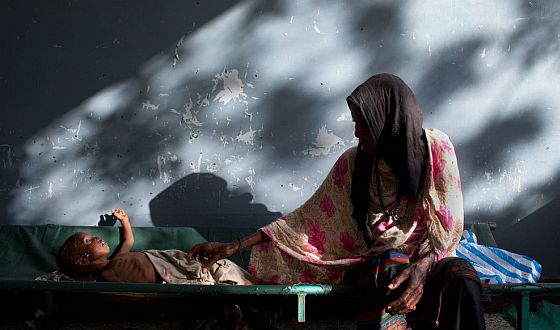
The BBC’s Andrew Harding reports that the current famine in Somalia is taking place in the midst of a longstanding conflict. Al-Shabab, a collection of Islamist groups, rules much of the country while the official government controls only part of the capital city. Though much of the region has experienced drought, the impact on human life has been far greater in Somalia. And the confrontation between various armed groups in Somalia is itself part of a struggle for resources and control throughout the Horn of Africa, in which America and other powers are deeply involved. Adequate coverage of the famine in Somalia, and the pattern of action and inaction that made it possible, must take into account the dynamics of this foreign intervention. And that in turn requires that journalists look steadily at the crackpot logic of the War on Terror.

Facebooktwittermail

Evidence of massacres in Tripoli

The New York Times reports:

As the fighting died down in Tripoli on Friday, the scope and savagery of the violence during the nearly weeklong battle for control of the capital began to come into sharper focus.

Amnesty International said Friday that it had evidence that forces loyal to Col. Muammar el-Qaddafi had killed rebels who had been held in custody in two camps. In one camp, it said, guards killed five detainees held in solitary confinement, and in another they opened the gates, telling the rebels they were free to go, then tossed grenades and fired on the men as they tried to run for freedom.

The report, based on accounts from escaped prisoners, cited no death toll, but said that of the 160 detainees attacked, only 23 were known to have escaped.

On Thursday, there were reports that the bullet-riddled bodies of more than 30 pro-Qaddafi fighters had been found at a military encampment in central Tripoli. At least two were bound with plastic handcuffs, suggesting that they had been executed, and five of the dead were found at a field hospital.

More bodies turned up in the streets on Friday, where occasional volleys of gunfire were heard. Near Colonel Qaddafi’s abandoned citadel, Bab al-Aziziya, rebels began hauling away nine bloated bodies. The face of one was so badly decayed it appeared charred.

Maggots crawled over the torso of another.

“Only a butcher could commit a massacre like this,” said Sami Omar, a rebel.

Six were dumped near a trash receptacle, two left under a stairwell and one thrown in a large ditch, his hands apparently cuffed.

Rebels said Qaddafi loyalists had killed them as they celebrated his fall. But one resident said they were his fighters, slain by rebels.

As he spoke, a rebel approached him, saying he was not authorized to speak.

In a sign of the intensity of the fighting this week in the capital, 40 bodies, many in advanced states of decomposition, were piled up in an abandoned hospital in the Abu Salim neighborhood, until Friday the preserve of the Qaddafi forces. Most of the fighters were darker skinned than most Libyans, a sign, rebels there said, that they may have been recruited from sub-Saharan Africa. The rebels have frequently accused the Qaddafi government of using mercenaries but have not offered convincing proof.

The halls of the hospital were a chaos of beds and unplugged machines, and its floors were painted with blood. A medical technician said that three doctors had been on duty during the fighting in recent days, and that they had been unable to cope.

It was difficult to ascertain the fates of the dead men, who were lying on gurneys nested by maggots in a hospital room and the morgue. The relatives of one victim, Abdul Raouf Al Rashdi, a 33-year-old police officer, said he had been killed by a sniper several days earlier in the Hay Andalus neighborhood.

The Wall Street Journal reports:

Libyan rebels pushed Col. Moammar Gadhafi’s forces out of the last residential neighborhood in Tripoli overnight Friday, but the rebel military gains were overshadowed by rapidly deteriorating living conditions in the capital of about two million people.

The challenges of restoring life to Tripoli grow more daunting by the day. Streets are buried under a mix of trash, waste and, in several places, corpses. Water and electricity have been cut throughout much of the city.

But the rebels’ victory in the Abu Salim neighborhood has made the area safe enough for city residents and journalists to visit its notorious Abu Salim prison for the first time.

A 1996 inmate massacre at the prison has fired up Libya’s opposition for years. A protest on Feb. 15 in Benghazi by families of victims of that massacre, and their lawyers, kicked off the countrywide protests that launched six months of fighting that this week unseated Col. Gadhafi.

The rebels’ national governing body, the National Transitional Council, is just beginning to relocate from its eastern base in Benghazi to Tripoli. Opposition leader Mustafa Abdul Jalil will remain in Benghazi until the capital is deemed secure.

Tripoli was cloaked in darkness Friday night, the first time it has been largely without power since rebels stormed into the capital Sunday. City faucets were dry for a second straight day.

In hospital morgues, bodies are piled on top of each other on available floor space. As rebels claim corpses of their own ranks, bodies of what appear to be pro-Gadhafi fighters are left on the streets in the summer heat. In some places, the smell suffocates whole blocks.

Luke Harding reports:

Libya’s opposition National Transitional Council (NTC) gave its first press conference in Tripoli on Thursday evening. It was a chaotic late-night affair; so far nobody has had much of a chance to sketch out a new political system. On Friday, however, the marchers [in new Libya’s first political march] agreed that after 42 years of dictatorship and iron-fisted personalist rule the country should become a European-style democracy.

“I want to live in a democratic country. It’s the most important thing for me and my children,” Naser al-Shahawi said, emerging from the [Jamal Abdul Nasser] mosque. “This is what the people want. We also want an Islamic country. But I don’t think that democracy is an enemy of Islam.”

The 48-year-old international lawyer said he wasn’t greatly impressed by the NTC – pointing out that several of its leaders “had been with Gaddafi”.

Who, then, did he think could be Libya’s new prime minister? “Maybe me,” he replied. “Now is the first time that anybody can be prime minister, or president.” Then he admitted: “I have never voted in my life.”

Shahawi, who had spent a year and half living in Cardiff, said he was studying for a PhD in international law. Asked what should happen to Gaddafi when justice eventually caught up with him, he was brutally succinct.

“He should die,” he said, then insisted that the former dictator should be tried inside the country, rather than extradited to the international criminal court, where a heap of indictments await.

A group of fighters then expressed their feelings in verbal form: “Fuck you Gaddafi,” they shouted.

Meanwhile, The Guardian reported:

Rebel units were massing for an attack on Sirte, Muammar Gaddafi’s birthplace, on Friday after Nato warplanes conducted intensive bombing raids to weaken one of the last major redoubts controlled by the ousted regime.

On the road to Sirte from Misrata, tanks, heavy artillery and rocket launchers abandoned by fleeing government forces were being assembled for the attack.

Rebels said a British and French special forces team was helping co-ordinate the assault, in which Misrata-based units will push eastwards to meet forces from Benghazi fighting their way westwards.

Facebooktwittermail

Israel’s faux revolutionaries

Israel’s July 14 social justice movement is really like a campaign in support of sunshine. Who’s going to oppose it? The supporters of social injustice?

To the extent that Israelis were inspired by the example of the Egyptian revolution, this seems to have gone no further than sharing in the empowering experience of being among thousands of people who have taken to the streets, joined by a sense of solidarity. But solidarity around what?

The difference between J14 and the Egyptian revolution is the difference between asking for a pay raise or telling your boss, “You’re fired!”

As Ami Kaufman wrote recently, “Although the protesters are demanding ‘social justice,’ what they’re really asking for is ‘more money!’”

Joseph Dana and Max Blumenthal explain how easy it has been for Israelis to call for social justice while ignoring the occupation.

The decision to exclude the occupation from the grievances of the July 14 movement was entirely organic. No hired gun consultant advised movement activists to avoid the hot button issue in order to broaden the appeal of the demonstrations. The mainstream of the Jewish public decided on its own, and without much internal reflection, that social justice could exist alongside a system of ethnic exclusivism. Thus, while the July 14 movement proceeded through cities across Israel bellowing out cries for dignity and rights, Palestinians remained safely tucked away behind an elaborate matrix of control — the Iron Wall. Ten years of separation had not only rendered the Palestinians invisible in a physical sense. It had erased them from the Israeli conscience.

“It’s very strange to see a social justice protest without mentioning occupation,” Gidi Grinstein, a confidant of Defense Minister Ehud Barak, who heads the Reut Institute, a government-linked Israeli think tank remarked. “But most people in Israel don’t even believe there is an occupation anymore. They see the Palestinian Authority in the West Bank, and think there is a functioning government. They hear about the Palestinian statehood resolution at the UN in September, and they think Palestine is a real state. So there is this cognitive dissonance among Israelis.”

For years Israel’s tiny but intensely motivated left-wing tried to mobilize mass protests against the occupation, hoping they could shake Israeli society out of its slumber. But the settlements grew, and the occupation became more and more entrenched. Suddenly, with hundreds of thousands of their compatriots in the streets demonstrating against the most right-wing government in their country’s history, some leftists began conjuring visions of a revolution.

“We have failed to end the occupation by confronting it head on but the boundary-breaking, de-segregating movement could, conceivably, undermine it,” wrote Dimi Reider. Reider claimed the demonstrations could achieve dramatic change because they “may challenge something even deeper than the occupation.” Hagai Mattar, a veteran anti-occupation activist and widely read journalist, echoed Reider’s unbridled enthusiasm. “For the first time in decades, perhaps, we are witnessing the impossible becoming possible,” Mattar wrote on the popular Hebrew website MySay. “What appeared to be a mere fantasy half a year ago… has become a vivid reality.”

Many members of the Israeli left have suffered for their activism. Some have been injured by Israeli soldiers during protests in the West Bank, where they routinely dodge rubber bullets and high-velocity teargas projectiles. Others have served months in prison for refusing to serve in the Israeli Army. With a suite of anti-democratic laws passed by the Knesset, they fear a coming crackdown. But perhaps the greatest source of suffering for Israeli leftists is having been cast out of one of the most tribalistic societies in the world. Many are turned down for housing and employment on the grounds that they refused military service. The very word “leftist,” or smolini, has become an insult in the Hebrew language. Hoping to replace the communal bond their society had denied them, the radical leftists who have not escaped to the squats of Berlin or Barcelona formed a tribe within the tribe.

As the July 14 protests gathered momentum and manpower, members of the radical left bolstered the movement with their tactical experience and fearlessness in the face of police intimidation. On July 23, when hundreds of thousands of protesters took to the streets of Tel Aviv, Israeli police forces arrested 43 demonstrators. Most of them were leftists who attempted to block a major intersection. The most prominent among them was Matar. Normally, the arrests of left-wingers at anti-occupation protests go unreported. In this instance, however, the arrests were broadcast to a national audience during the prime time news. After being released from their jail cells, the demonstrators were greeted by their fellow Israelis not as traitors but as heroic leaders.

“The radical left is no longer an outsider, but forms an important part of the mainstream,” Matar wrote recently in an article celebrating the protests. If this new movement welcomed leftists, and upheld them as its vanguard, how could it not be revolutionary?

Facebooktwittermail

The roots of the Islamophobia network in America

MJ Rosenberg writes:

It has been just about a decade since Islamophobia exploded in this country. That was of moment that the World Trade Center and Pentagon were hit by al Qaeda terrorists. It existed prior to 9/11, but the losses that day and the general terror it inflicted upon this country made many, many Americans much more wary of Arabs and, fairly quickly, fearful of the religion the terrorists professed.

The first sign that 9/11 would be exploited to advance various agendas came from Binyamin Netanyahu, who was quoted in the New York Times as saying the attacks would be good for Israel:

Asked tonight [September 11, 2001] what the attack meant for relations between the United States and Israel, Benjamin Netanyahu, the former prime minister, replied, ”It’s very good.” Then he edited himself: ”Well, not very good, but it will generate immediate sympathy.” He predicted that the attack would ”strengthen the bond between our two peoples, because we’ve experienced terror over so many decades, but the United States has now experienced a massive hemorrhaging of terror.”

Netanyahu subsequently reiterated his views about 9/11, quoted here in Haaretz.

And, of course, ever since 9/11 the “pro-Israel” lobby has successfully used it to build support for right-wing Israeli policies in the United States.

But the lobby isn’t alone.

It is just one of the components of an orchestrated and well-financed effort to make Americans fear and hate Muslims and Arabs.

I have to admit, however, that until I read a report published today by the Center for American Progress (CAP), I had no idea just how orchestrated and well-financed this movement was.

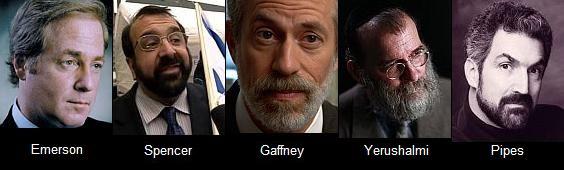
The report, “Fear Inc: The Roots of the Islamophobia Network in America,” demonstrates that a small group of self-proclaimed experts (Frank Gaffney, David Yerushalmi, Daniel Pipes, Robert Spencer, and Steve Emerson) backed by a host of foundations and donors (many of which also fund the lobby) have put Islamophobia on the map.

To put it simply, without these “experts,” their donors, and Fox News (their media mouthpiece) you would never have heard that a Muslim community center (the “Ground Zero Mosque”) was being constructed in New York City. And the center certainly would not have become a major news story. Nor would Republican (and even a few Democratic) candidates for president, Congress, and even village councils be called upon to condemn Islam and “Sharia Law” or face being labeled a supporter of terrorism. Nor would Newt Gingrich, Herman Cain and Rick Santorum have made hatred of American Muslims such an integral part of their campaigns.

Fear, Inc. — The Roots of the Islamophobia Network in America. This report from the Center for American Progress begins:

On July 22, a man planted a bomb in an Oslo government building that killed eight people. A few hours after the explosion, he shot and killed 68 people, mostly teenagers, at a Labor Party youth camp on Norway’s Utoya Island.

By midday, pundits were speculating as to who had perpetrated the greatest massacre in Norwegian history since World War II. Numerous mainstream media outlets, including The New York Times, The Washington Post, and The Atlantic, speculated about an Al Qaeda connection and a “jihadist” motivation behind the attacks. But by the next morning it was clear that the attacker was a 32-year-old, white, blond-haired and blue-eyed Norwegian named Anders Breivik. He was not a Muslim, but rather a self-described Christian conservative.

According to his attorney, Breivik claimed responsibility for his self-described “gruesome but necessary” actions. On July 26, Breivik told the court that violence was “necessary” to save Europe from Marxism and “Muslimization.” In his 1,500-page manifesto, which meticulously details his attack methods and aims to inspire others to extremist violence, Breivik vows “brutal and breathtaking operations which will result in casualties” to fight the alleged “ongoing Islamic Colonization of Europe.”

Breivik’s manifesto contains numerous footnotes and in-text citations to American bloggers and pundits, quoting them as experts on Islam’s “war against the West.” This small group of anti-Muslim organizations and individuals in our nation is obscure to most Americans but wields great influence in shaping the national and international political debate. Their names are heralded within communities that are actively organizing against Islam and targeting Muslims in the United States.

Breivik, for example, cited Robert Spencer, one of the anti-Muslim misinformation scholars we profile in this report, and his blog, Jihad Watch, 162 times in his manifesto. Spencer’s website, which “tracks the attempts of radical Islam to subvert Western culture,” boasts another member of this Islamophobia network in America, David Horowitz, on his Freedom Center website. Pamela Geller, Spencer’s frequent collaborator, and her blog, Atlas Shrugs, was mentioned 12 times.

Geller and Spencer co-founded the organization Stop Islamization of America, a group whose actions and rhetoric the Anti-Defamation League concluded “promotes a conspiratorial anti-Muslim agenda under the guise of fighting radical Islam. The group seeks to rouse public fears by consistently vilifying the Islamic faith and asserting the existence of an Islamic conspiracy to destroy “American values.” Based on Breivik’s sheer number of citations and references to the writings of these individuals, it is clear that he read and relied on the hateful, anti-Muslim ideology of a number of men and women detailed in this report&a select handful of scholars and activists who work together to create and promote misinformation about Muslims.

While these bloggers and pundits were not responsible for Breivik’s deadly attacks, their writings on Islam and multiculturalism appear to have helped create a world view, held by this lone Norwegian gunman, that sees Islam as at war with the West and the West needing to be defended. According to former CIA officer and terrorism consultant Marc Sageman, just as religious extremism “is the infrastructure from which Al Qaeda emerged,” the writings of these anti-Muslim misinformation experts are “the infrastructure from which Breivik emerged.” Sageman adds that their rhetoric “is not cost-free.”

These pundits and bloggers, however, are not the only members of the Islamophobia infrastructure. Breivik’s manifesto also cites think tanks, such as the Center for Security Policy, the Middle East Forum and the Investigative Project on Terrorism—three other organizations we profile in this report. Together, this core group of deeply intertwined individuals and organizations manufacture and exaggerate threats of “creeping Sharia,” Islamic domination of the West, and purported obligatory calls to violence against all non-Muslims by the Quran.

This network of hate is not a new presence in the United States. Indeed, its ability to organize, coordinate, and disseminate its ideology through grassroots organizations increased dramatically over the past 10 years. Furthermore, its ability to influence politicians’ talking points and wedge issues for the upcoming 2012 elections has mainstreamed what was once considered fringe, extremist rhetoric.

And it all starts with the money flowing from a select group of foundations. A small group of foundations and wealthy donors are the lifeblood of the Islamophobia network in America, providing critical funding to a clutch of right-wing think tanks that peddle hate and fear of Muslims and Islam—in the form of books, reports, websites, blogs, and carefully crafted talking points that anti-Islam grassroots organizations and some right-wing religious groups use as propaganda for their constituency.

Some of these foundations and wealthy donors also provide direct funding to anti-Islam grassroots groups. According to our extensive analysis, here are the top seven contributors to promoting Islamophobia in our country:

  • Donors Capital Fund
  • Richard Mellon Scaife foundations
  • Lynde and Harry Bradley Foundation
  • Newton D. & Rochelle F. Becker foundations and charitable trust
  • Russell Berrie Foundation
  • Anchorage Charitable Fund and William Rosenwald Family Fund
  • Fairbrook Foundation

Altogether, these seven charitable groups provided $42.6 million to Islamophobia think tanks between 2001 and 2009—funding that supports the scholars and experts that are the subject of our next chapter as well as some of the grassroots groups that are the subject of Chapter 3 of our report.

And what does this money fund? Well, here’s one of many cases in point: Last July, former Speaker of the House of Representatives Newt Gingrich warned a conservative audience at the American Enterprise Institute that the Islamic practice of Sharia was “a mortal threat to the survival of freedom in the United States and in the world as we know it.” Gingrich went on to claim that “Sharia in its natural form has principles and punishments totally abhorrent to the Western world.”

Sharia, or Muslim religious code, includes practices such as charitable giving, prayer, and honoring one’s parents—precepts virtually identical to those of Christianity and Judaism. But Gingrich and other conservatives promote alarmist notions about a nearly 1,500-year-old religion for a variety of sinister political, financial, and ideological motives. In his remarks that day, Gingrich mimicked the language of conservative analyst Andrew McCarthy, who co-wrote a report calling Sharia “the preeminent totalitarian threat of our time.” Such similarities in language are no accident. Look no further than the organization that released McCarthy’s anti-Sharia report: the aforementioned Center for Security Policy, which is a central hub of the anti-Muslim network and an active promoter of anti- Sharia messaging and anti-Muslim rhetoric.

In fact, CSP is a key source for right-wing politicians, pundits, and grassroots organizations, providing them with a steady stream of reports mischaracterizing Islam and warnings about the dangers of Islam and American Muslims. Operating under the leadership of Frank Gaffney, the organization is funded by a small number of foundations and donors with a deep understanding of how to influence U.S. politics by promoting highly alarming threats to our national security. CSP is joined by other anti-Muslim organizations in this lucrative business, such as Stop Islamization of America and the Society of Americans for National Existence. Many of the leaders of these organizations are well-schooled in the art of getting attention in the press, particularly Fox News, The Wall Street Journal editorial pages, The Washington Times, and a variety of right-wing websites and radio outlets.

Misinformation experts such as Gaffney consult and work with such right-wing grassroots organizations as ACT! for America and the Eagle Forum, as well as religious right groups such as the Faith and Freedom Coalition and American Family Association, to spread their message. Speaking at their conferences, writing on their websites, and appearing on their radio shows, these experts rail against Islam and cast suspicion on American Muslims. Much of their propaganda gets churned into fundraising appeals by grassroots and religious right groups. The money they raise then enters the political process and helps fund ads supporting politicians who echo alarmist warnings and sponsor anti-Muslim attacks.

These efforts recall some of the darkest episodes in American history, in which religious, ethnic, and racial minorities were discriminated against and persecuted. From Catholics, Mormons, Japanese Americans, European immigrants, Jews, and African Americans, the story of America is one of struggle to achieve in practice our founding ideals. Unfortunately, American Muslims and Islam are the latest chapter in a long American struggle against scapegoating based on religion, race, or creed.

Due in part to the relentless efforts of this small group of individuals and organizations, Islam is now the most negatively viewed religion in America. Only 37 percent of Americans have a favorable opinion of Islam: the lowest favorability rating since 2001, according to a 2010 ABC News/Washington Post poll. According to a 2010 Time magazine poll, 28 percent of voters do not believe Muslims should be eligible to sit on the U.S. Supreme Court, and nearly one-third of the country thinks followers of Islam should be barred from running for president.

The terrorist attacks on 9/11 alone did not drive Americans’ perceptions of Muslims and Islam. President George W. Bush reflected the general opinion of the American public at the time when he went to great lengths to make clear that Islam and Muslims are not the enemy. Speaking to a roundtable of Arab and Muslim American leaders at the Afghanistan embassy in 2002, for example, President Bush said, “All Americans must recognize that the face of terror is not the true faith—face of Islam. Islam is a faith that brings comfort to a billion people around the world. It’s a faith that has made brothers and sisters of every race. It’s a faith based upon love, not hate.”

Unfortunately, President Bush’s words were soon eclipsed by an organized escalation of hateful statements about Muslims and Islam from the members of the Islamophobia network profiled in this report. This is as sad as it is dangerous. It is enormously important to understand that alienating the Muslim American community not only threatens our fundamental promise of religious freedom, it also hurts our efforts to combat terrorism. Since 9/11, the Muslim American community has helped security and law enforcement officials prevent more than 40 percent of Al Qaeda terrorist plots threatening America. The largest single source of initial information to authorities about the few Muslim American plots has come from the Muslim American community.

Around the world, there are people killing people in the name of Islam, with which most Muslims disagree. Indeed, in most cases of radicalized neighbors, family members, or friends, the Muslim American community is as baffled, disturbed, and surprised by their appearance as the general public. Treating Muslim American citizens and neighbors as part of the problem, rather than part of the solution, is not only offensive to America’s core values, it is utterly ineffective in combating terrorism and violent extremism.

The White House recently released the national strategy for combating violent extremism, “Empowering Local Partners to Prevent Violent Extremism in the United States.” One of the top focal points of the effort is to “counter al-Qa’ida’s propaganda that the United States is somehow at war with Islam.” Yet orchestrated efforts by the individuals and organizations detailed in this report make it easy for al-Qa’ida to assert that America hates Muslims and that Muslims around the world are persecuted for the simple crime of being Muslims and practicing their religion.

Sadly, the current isolation of American Muslims echoes past witch hunts in our history—from the divisive McCarthyite purges of the 1950s to the sometimes violent anti-immigrant campaigns in the 19th and 20th centuries. New York Mayor Michael Bloomberg has compared the fear-mongering of Muslims with anti-Catholic sentiment of the past. In response to the fabricated “Ground Zero mosque” controversy in New York last summer, Mayor Bloomberg said:

In the 1700s, even as religious freedom took hold in America, Catholics in New York were effectively prohibited from practicing their religion, and priests could be arrested. Largely as a result, the first Catholic parish in New York City was not established until the 1780s, St. Peter’s on Barclay Street, which still stands just one block north of the World Trade Center site, and one block south of the proposed mosque and community center. … We would betray our values and play into our enemies’ hands if we were to treat Muslims differently than anyone else.

This report shines a light on the Islamophobia network of so-called experts, academics, institutions, grassroots organizations, media outlets, and donors who manufacture, produce, distribute, and mainstream an irrational fear of Islam and Muslims. Let us learn the proper lesson from the past, and rise above fear-mongering to public awareness, acceptance, and respect for our fellow Americans. In doing so, let us prevent hatred from infecting and endangering our country again.

In the pages that follow, we profile the small number of funders, organizations, and individuals who have contributed to the discourse on Islamophobia in this country. We begin with the money trail in Chapter 1—our analysis of the funding streams that support anti-Muslim activities. Chapter 2 identifies the intellectual nexus of the Islamophobia network. Chapter 3 highlights the key grassroots players and organizations that help spread the messages of hate. Chapter 4 aggregates the key media amplifiers of Islamophobia. And Chapter 5 brings attention to the elected officials who frequently support the causes of anti- Muslim organizing.

Before we begin, a word about the term “Islamophobia.” We don’t use this term lightly. We define it as an exaggerated fear, hatred, and hostility toward Islam and Muslims that is perpetuated by negative stereotypes resulting in bias, discrimination, and the marginalization and exclusion of Muslims from America’s social, political, and civic life.

It is our view that in order to safeguard our national security and uphold America’s core values, we must return to a fact-based civil discourse regarding the challenges we face as a nation and world. This discourse must be frank and honest, but also consistent with American values of religious liberty, equal justice under the law, and respect for pluralism. A first step toward the goal of honest, civil discourse is to expose—and marginalize—the influence of the individuals and groups who make up the Islamophobia network in America by actively working to divide Americans against one another through misinformation.

Download this report (pdf)

Download individual chapters of the report (pdf):

Video: Ask the Expert: Faiz Shakir on the Group Behind Islamophobia

Facebooktwittermail

The muted impact of the Arab Awakening on Israel

Daniel Levy writes:

After decades of near-hegemonic Israeli strategic supremacy in the Middle East, the ground is shifting. For Israel’s leaders, the Arab Awakening and the removal of Mubarak represents the collapse of a key support structure in the edifice that maintains Israel’s regional posture. That edifice had been fraying for some time. Yet with Israel unwilling or unable to relinquish its control over and occupation of Palestine, it was a system of conflict management that had proven to be remarkably resilient. Undemocratic Egypt was that system’s linchpin. In fact, only an undemocratic Egypt could play this role, indifferent and dismissive as the regime was toward public opinion and able to pursue policies, both at home and abroad, widely perceived as being an affront to Egyptian dignity.

Every country needs a strategy for managing its external relations, especially in the near abroad. Israel’s predicament in this respect is especially challenging. Born as an unusual movement combining religious and historical claims to land with modern aspirations of state-building and communal preservation, Zionism was initially branded by most in the region as a colonial project, a sense that Israel has fed with its expansionist and expulsionist approach to the indigenous population. Unfortunately for Israel, that indigenous population has ethnic and religious ties to a large population throughout the surrounding region. Nevertheless, Israel managed to adapt, pursuing whatever great power or regional alliances were available, making itself useful to the United States as a cold war ally.

Long after it became clear that the Oslo peace process would not deliver Palestinian freedom, rights or sovereignty, the structures established by it and the opportunities they have forged for Israel have endured. They were kept afloat by donor assistance, by the difficulties entailed in dismantling the Palestinian Authority and, crucially, by the stamp of legitimacy that only Egypt could confer. The impact of the Arab Awakening on Israel’s leaders must be understood first and foremost against this backdrop.

But here’s the key statement Levy makes which defined Israel’s view of the region well before the Arab Awakening erupted:

Israel has erected a separation barrier between itself and the Palestinians in the West Bank and Gaza, is proceeding to do the same on the Egyptian border and has long had closed and militarily fortified borders with Lebanon and Syria. Trade with all of its Middle East neighbors, in fact, amounts to less than 5 percent of its total. Israelis rarely visit even those Arab countries it is possible to enter, and the Arab community inside Israel is treated as a fifth column rather than as a bridge to regional relations. Of course, this is a two-way street. Yet when the physical barriers are combined with what is often a striking lack of intellectual, cultural and social curiosity, Israel is in danger of being fundamentally incapable of interpreting developments in its immediate surroundings.

This incapacity is not just an impediment — it actually defines the core of Zionism.

Israel defines itself as a state by its desire to underline the otherness of the non-Jew and emphasize the necessity for Jewish solidarity and self-reliance. On this basis, how would it be possible to foster dynamic and creative relations between Jews and Arabs when the prevailing attitude among Israeli Jews is that they have little or no interest in having any relations with Arabs?

Facebooktwittermail

Revolt without revolution

Slavoj Žižek writes:

Repetition, according to Hegel, plays a crucial role in history: when something happens just once, it may be dismissed as an accident, something that might have been avoided if the situation had been handled differently; but when the same event repeats itself, it is a sign that a deeper historical process is unfolding. When Napoleon lost at Leipzig in 1813, it looked like bad luck; when he lost again at Waterloo, it was clear that his time was over. The same holds for the continuing financial crisis. In September 2008, it was presented by some as an anomaly that could be corrected through better regulations etc; now that signs of a repeated financial meltdown are gathering it is clear that we are dealing with a structural phenomenon.

We are told again and again that we are living through a debt crisis, and that we all have to share the burden and tighten our belts. All, that is, except the (very) rich. The idea of taxing them more is taboo: if we did, the argument runs, the rich would have no incentive to invest, fewer jobs would be created and we would all suffer. The only way to save ourselves from hard times is for the poor to get poorer and the rich to get richer. What should the poor do? What can they do?

Although the riots in the UK were triggered by the suspicious shooting of Mark Duggan, everyone agrees that they express a deeper unease – but of what kind? As with the car burnings in the Paris banlieues in 2005, the UK rioters had no message to deliver. (There is a clear contrast with the massive student demonstrations in November 2010, which also turned to violence. The students were making clear that they rejected the proposed reforms to higher education.) This is why it is difficult to conceive of the UK rioters in Marxist terms, as an instance of the emergence of the revolutionary subject; they fit much better the Hegelian notion of the ‘rabble’, those outside organised social space, who can express their discontent only through ‘irrational’ outbursts of destructive violence – what Hegel called ‘abstract negativity’.

There is an old story about a worker suspected of stealing: every evening, as he leaves the factory, the wheelbarrow he pushes in front of him is carefully inspected. The guards find nothing; it is always empty. Finally, the penny drops: what the worker is stealing are the wheelbarrows themselves. The guards were missing the obvious truth, just as the commentators on the riots have done. We are told that the disintegration of the Communist regimes in the early 1990s signalled the end of ideology: the time of large-scale ideological projects culminating in totalitarian catastrophe was over; we had entered a new era of rational, pragmatic politics. If the commonplace that we live in a post-ideological era is true in any sense, it can be seen in this recent outburst of violence. This was zero-degree protest, a violent action demanding nothing. In their desperate attempt to find meaning in the riots, the sociologists and editorial-writers obfuscated the enigma the riots presented.

The protesters, though underprivileged and de facto socially excluded, weren’t living on the edge of starvation. People in much worse material straits, let alone conditions of physical and ideological oppression, have been able to organise themselves into political forces with clear agendas. The fact that the rioters have no programme is therefore itself a fact to be interpreted: it tells us a great deal about our ideological-political predicament and about the kind of society we inhabit, a society which celebrates choice but in which the only available alternative to enforced democratic consensus is a blind acting out. Opposition to the system can no longer articulate itself in the form of a realistic alternative, or even as a utopian project, but can only take the shape of a meaningless outburst. What is the point of our celebrated freedom of choice when the only choice is between playing by the rules and (self-)destructive violence?

Facebooktwittermail

The Arab Awakening

Rami G. Khouri writes:

When Mohamed Bouazizi set himself on fire in rural Tunisia on December 17, 2010, he set in motion a dynamic that goes far beyond the overthrow of individual dictators. We are witnessing nothing less than the awakening, throughout the Arab world, of several phenomena that are critical for stable statehood: the citizen, the citizenry, legitimacy of authority, a commitment to social justice, genuine politics, national self-determination and, ultimately, true sovereignty. It took hundreds of years for the United States and Western Europe to develop governance and civil society systems that affirmed those principles, even if incompletely or erratically, so we should be realistic in our expectations of how long it will take Arab societies to do so.

The countries where citizens are more actively agitating or fighting for their rights—Libya, Tunisia, Egypt, Syria, Bahrain and Yemen are the most advanced to date—have very different local conditions and forms of governance, with ruling elites displaying a wide range of legitimacy in the eyes of their people. Governments have responded to the challenge in a variety of ways, from the flight of the Tunisian and Egyptian leaderships to violent military repression in Syria, Libya and Bahrain, to the attempt to negotiate limited constitutional transformations in Jordan, Morocco and Oman. A few countries that have not experienced major demonstrations—Algeria and Sudan are the most significant—are likely to experience domestic effervescence in due course. Only the handful of wealthy oil producers (like Saudi Arabia, Kuwait, Qatar and the United Arab Emirates) seem largely exempt, for now, from this wave of citizen demands.

Two words capture every important dimension of the Arab Awakening: “humiliation” and “legitimacy.” They explain why the Arab region is erupting, and what needs to be done to satisfy popular demands. The typical Arab citizen, with few exceptions, has felt humiliated in recent decades by his or her government. Hundreds of millions of Arabs feel they have been denied both their human rights and their citizenship rights, the result of decades of socioeconomic stresses and political deprivations. These include petty and large-scale corruption; police brutality; abuse of power; favoritism; unemployment; poor wages; unequal opportunities; inefficient or nonexistent public services; lack of freedom of expression and association; state control of media, culture and education; and many other dimensions of the modern Arab security state. At the same time, ordinary men and women in countries across the region have seen small groups of families in the ruling elite grow fabulously rich simply because of their connections.

Facebooktwittermail

The dead end of globalisation looms before our youth

Pankaj Mishra writes:

In India, tens of thousands of middle-class people respond to a quasi-Gandhian activist’s call for a second freedom struggle – this time, against the country’s venal “brown masters”, as one protester told the Wall Street Journal. Middle-class Israelis demanding “social justice” turn out for their country’s first major demonstrations in years. In China, the state broadcaster CCTV unprecedentedly joins millions of cyber-critics in blaming a government that placed wealth creation above social welfare for the fatal high-speed train crash in Wenzhou last month.

Add to this the uprisings against kleptocracies in Egypt and Tunisia, the street protests in Greece and Spain earlier this year, and you are looking at a fresh political awakening. The specific contexts may seem very different, ranging from authoritarian China to democratic America (where Warren Buffett, the world’s richest man, publicly denounced a “billionaire-friendly Congress” last fortnight). And the grievances may be diversely phrased. But public anger derives from the same source: extreme and seemingly insurmountable inequality.

As Forbes magazine, that well-known socialist tool, describes it, protesters everywhere are driven by “the conviction that the power structure, corporate and government, work together to screw the broad middle class” (and the working class too, whose distress is not usually examined in Forbes).

Certainly, the strident promoters of globalisation – politicians, big businessmen, and journalists – will have to work much harder now to bamboozle their audiences.

For years now, the mantra of “economic growth” justified government interventions on behalf of big business and investors with generous tax breaks (and, in the west, the rescue of criminally reckless investors and speculators with massive bailouts at the taxpayer’s expense). The fact that a few people get very rich while a majority remains poor seemed of little importance as long as the GDP figures looked impressive.

In heavily populated countries like India, even a small number of people moving into the middle class made for an awe-inspiring spectacle. Helped by an entertainment-obsessed and “patriotic” corporate media, you could easily ignore the bad news – the suicides, for instance, of hundreds of thousands of farmers in the last decade. However, the carefully maintained illusions of globalisation shattered when even its putative beneficiaries – the educated and aspiring classes – began to hurt from high inflation, decreasing access to education and other opportunities for upward mobility.

Facebooktwittermail