



Seumas Milne writes:
The Tory operation to bury the phone-hacking scandal in spin and official inquiries is now in full flow. On his way back from Africa, David Cameron declared it was essential to get the whole business into perspective, echoing Rupert Murdoch’s insistence that his competitors had got up “this hysteria”. Today, the prime minister chided Ed Miliband for “chasing conspiracy theories” and claimed it was really Gordon Brown who had been in the pocket of the global media billionaire.
Meanwhile, News International pundits and others with their own reasons to stem the flood of revelations have been loudly insisting that the political clout of Murdoch’s corporate colossus has been exaggerated. The hyper-regulated BBC is the real media monopoly, they say, and in any case the current fixation with phone hacking has meant no one is discussing bankers’ bonuses and the threat of another financial meltdown. This is a “frenzy that has grown out of control”, the Daily Mail complained.
But the real frenzy isn’t the exposure of the scandal – it’s the scale of corruption, collusion and cover-up between News International, politicians and police that the scandal has revealed. As the cast of hacking victims, blaggers and blackmailers has lengthened, and the details of the incestuous payments and job-swapping between News International, government and Scotland Yard become more complex, it’s easy to lose sight of the bigger picture that is now emerging.
If it were not for the uncovering of this cesspit, the Cameron government would be preparing to nod through the outright takeover of BSkyB by News International, taking its dominance of Britain’s media and political world into Silvio Berlusconi territory. But what has been exposed now goes well beyond the hacking of murder victims and dead soldiers’ families – or even the media itself. The scandal has lifted the lid on how power is really exercised in 21st-century Britain – in which the unreformed City and its bankers play a central part.
Murdoch’s overweening political influence has long been recognised, from well before Tony Blair flew to Australia in 1995 to pay public homage at his corporate court. What has been less well understood is how close-up and personal the pressure exerted by his organisation has been throughout public life. The fear that those who crossed him would be given the full tabloid treatment over their personal misdemeanours, real or imagined, has proved to be a powerful Mafia-like racket.
Roy Greenslade, who was a senior executive at two News International titles, The Sun and the Sunday Times, says that Rupert Murdoch’s testimony in Britain’s House of Commons yesterday, where he essentially plead ignorance about wrongdoing inside News of the World, clashes with Greenslade’s own experience of the way Murdoch oversees the operations of his companies.
At both newspapers, I was close enough to the editors – sometimes standing in as editor myself – to witness how Rupert Murdoch operated. Despite living in the United States, he ensured that he knew everything that happened at his British papers.
In phone calls marked by a mixture of abrupt questions and periods of intimidating silence, he elicited information from his editors and managers about intimate details of both editorial and commercial affairs.
It was impossible to conceive that anyone would lie to Murdoch either by commission or omission. He was street smart. He saw through bluster and he was not above testing the veracity of what he was told by one executive by running it past another.
His cross-referencing of his internal company sources was journalistic. He wanted to hear the minutiae; who had said what to whom? He relished the gossip.
In those days he was already running a giant company, with a Hollywood film studio, a burgeoning US TV network and media outlets across the world. It is fair to say that, by the turn of the millennium, it had grown bigger still, most noticeably due to News Corp’s global pay-TV interests.
It is also undeniable, as his faltering performance yesterday illustrated, that as Murdoch’s company expanded so he grew older. So he may well have been altogether less hands-on in the past decade than he was during the time I worked for him.
Then again, it beggars belief that he didn’t smell a rat in 2006 when the News of the World‘s royal editor Clive Goodman was arrested along with a private investigator, Glenn Mulcaire, who was being paid more than £100,000 a year under a contract with the paper.
That was the moment I would have expected him to ask searching questions of the editor and the chief executive of his News International division in Wapping. Did he really accept the public stance about voicemail interception being confined to a single rogue reporter?
Haaretz reports:
Over 5000 Christians, mainly Evangelicals, gathered this week at the Convention Center in Washington for the annual conference of the organization CUFI, Christians United For Israel.
Prime Minister Benjamin Netanyahu addressed the Christian Zionist conference via satellite, telling them, “When you support Israel, you don’t have to choose between your interests and your values; you get both.”
The prime minister encouraged the conference attendees to not only think of Israel as an ally of the Unites States, but as indistinguishable from it. “Our enemies think that we are you, and that you are us,” added Netanyahu. “And you know something? They are absolutely right.”
Ambassador to the U.S. Michael Oren compared the participants’ support of Israel to British military officer Orde Wingate’s training of Jewish paramilitary units before the establishment of the State of Israel. “We thank you for carrying out this vision,” Oren told the CUFI conference participants.
News commentator Glenn Beck worked the audience into a frenzy, decrying the historical persecution of Jews, insisting that Israel cannot cede control over territories it controls, and calling upon the conference attendees to declare that they, too, are Jewish.
“Jews have been chased out of every corner of this planet,” said Beck. “Enough is enough.” Beck said that new states can be established, but not at the expense of other states, and that Israel is historically the ‘Land of the Jews’, implying that Israel should not relinquish control over the West Bank in order to create a State of Palestine.
Beck repeated a refrain that Netanyahu had introduced earlier, appealing to audience members to self-identify as Israelis and Jews themselves. He exhorted, “When we see Israelis not as part of us, but as us, we can move to the next level as human beings,” adding, “Let us declare ‘I am a Jew,’ they cannot kill all of us”.
The conference attendees learned that Pastor John Hagee, the founder of CUFI, would be joining Beck for his planned rally in Jerusalem in August.
Hagee told the audience, many of whom were waving both Israeli and American flags, “We gathered here with one message: Israel today, Israel tomorrow, and Israel forever.” He added, “President Obama is no friend of Israel”.
“The truth is not what you think that it is – it’s what the Bible says”, Hagee proclaimed. “There are two ways to live your life – the Torah way and the wrong way.”
“If the US Administration forces Israel to divide Jerusalem – God will turn his back to the United States of America. The G-d of Abraham, Isaac and Jacob is watching America,” Hagee continued. “Mister President, go tell Russia and the Chinese what to do.”
“Iran will soon become nuclear. Our President is waiting for Iran to extend a friendly hand, and it’s not going to happen,” Hagee added. “Mister Ahmadinejad, don’t threaten Israel. What you do to the Jewish people, history proves, will be done to you.”
Ron Kampeas reports:
Pro-Israel leaders in the United States, Britain and Australia are warily watching the unfolding of the phone-hacking scandal that is threatening to engulf the media empire of Rupert Murdoch, founder of News Corp.
Murdoch’s sudden massive reversal of fortune — with 10 top former staffers and executives under arrest in Britain for hacking into the phones of public figures and a murdered schoolgirl, and paying off the police and journalists — has supporters of Israel worried that a diminished Murdoch presence may mute the strongly pro-Israel voice of many of the publications he owns.
“His publications and media have proven to be fairer on the issue of Israel than the rest of the media,” said Malcolm Hoenlein, the executive vice-chairman of the Conference of Presidents of Major American Jewish Organizations. “I hope that won’t be impacted.”
Murdoch’s huge stable encompasses broadsheets such as The Wall Street Journal, the Times of London and The Australian, as well as tabloids, most notably The Sun in Britain and the New York Post. It also includes the influential Fox News Channel in the United States and a 39 percent stake in British Sky Broadcasting, or BSkyB, a satellite broadcaster. Murdoch founded the neoconservative flagship The Weekly Standard in 1995, and sold it last year.
Jewish leaders said that Murdoch’s view of Israel’s dealings with the Palestinians and with its Arab neighbors seemed both knowledgeable and sensitive to the Jewish state’s self-perception as beleaguered and isolated.
“My own perspective is simple: We live in a world where there is an ongoing war against the Jews,” Murdoch said last October at an Anti-Defamation League dinner in his honor. “When Americans think of anti-Semitism, we tend to think of the vulgar caricatures and attacks of the first part of the 20th century. Now it seems that the most virulent strains come from the left. Often this new anti-Semitism dresses itself up as legitimate disagreement with Israel.”
Murdoch, 80, has visited Israel multiple times and met with many of its leaders. In 2009 he was honored by the American Jewish Committee.
“In the West, we are used to thinking that Israel cannot survive without the help of Europe and the United States,” he said at the AJC event. “Tonight I say to you, maybe we should start wondering whether we in Europe and the United States can survive if we allow the terrorists to succeed in Israel. “
Leaders of a number of pro-Israel groups declined to comment for this story because of Murdoch’s current difficulties.
Yousef Munayyer writes:
Recent legislation passed in the Israeli Knesset, which many people call the “Anti-BDS” bill, has raised a number of questions about a rising tide of “fascism” in Israel. This language is not only used by Palestinian critics, who have long borne the brunt of Israel’s undemocratic policies. Now, many Israeli and Jewish-American writers can no longer ignore the trend.
If something good has come out of the passage of this legislation, it is two things: First, a growing number of people are recognizing that the Zionist aim – the imposition of an ethnocentric majority by force in a territory where the majority of the native inhabitants are disenfranchised – is fundamentally and inherently undemocratic. Second, the passage of this bill has brought discussion of the Boycott, Divestment and Sanctions (BDS) movement to the foreground.
While increased discussion about BDS will only strengthen the movement, a troubling trend has become apparent in some of the commentaries on BDS written in response to the passage of the “Anti-BDS” bill. This is the assertion that boycotting colonies or settlement goods is acceptable, while boycotting the Israeli state or Israeli products outside of the occupied territories is somehow unacceptable.
For many, this argument may be made with consideration for political strategy and not based on moral underpinnings or clarity. There is undoubtedly a hesitation among some who have embraced BDS as a strategy to extend BDS activities beyond products produced in the colonies and settlements.
This attitude is particularly prevalent among Zionists who recognize the danger the occupation poses for Israel, but do not want to be seen as targeting Israel itself. The BDS tent is growing nonetheless, regardless of what part of the occupation system is targeted. This is clearly threatening to Israel. The greatest evidence of the threat this poses is that the state felt threatened enough by the BDS movement to attempt to stop it through legislative repression.
Jonathan Cook writes:
It was an Arab legislator who made the most telling comment to the Israeli parliament last week as it passed the boycott law, which outlaws calls to boycott Israel or its settlements in the occupied territories. Ahmed Tibi asked: “What is a peace activist or Palestinian allowed to do to oppose the occupation? Is there anything you agree to?”
The boycott law is the latest in a series of ever-more draconian laws being introduced by the far-right. The legislation’s goal is to intimidate those Israeli citizens, Jews and Palestinians, who have yet to bow down before the majority-rule mob.
Look out in the coming days and weeks for a bill to block the work of Israeli human rights organisations trying to protect Palestinians in the occupied territories from abuses by the Israeli army and settlers; and a draft law investing a parliamentary committee, headed by the far-right, with the power to veto appointments to the supreme court. The court is the only, and already enfeebled, bulwark against the right’s absolute ascendancy.
The boycott law, backed by Benjamin Netanyahu’s government, marks a watershed in this legislative assault in two respects.
First, it knocks out the keystone of any democratic system: the right to free speech. The new law makes it illegal for Israelis and Palestinians to advocate a non-violent political programme — boycott — to counter the ever-growing power of the half a million Jewish settlers living on stolen Palestinian land.
As the Israeli commentator Gideon Levy observed, the floodgates are now open: “Tomorrow it will be forbidden to call for an end to the occupation [or for] brotherhood between Jews and Arabs.”
Equally of concern is that the law creates a new type of civil, rather than criminal, offence. The state will not be initiating prosecutions. Instead, the job of enforcing the boycott law is being outsourced to the settlers and their lawyers. Anyone backing a boycott can be sued for compensation by the settlers themselves, who — again uniquely — need not prove they suffered actual harm.
The Guardian reports:
Rupert Murdoch’s News International has been found by a parliamentary committee to have “deliberately” tried to block a Scotland Yard criminal investigation into phone hacking at the News of the World, the Guardian has learned.
The report by MPs from the all-party home affairs committee will be released on Wednesday and its publication has been moved forward in time for today’s statement by prime minister David Cameron on the scandal.
The report’s central finding comes a day after Rupert and James Murdoch testified before the culture, media and sport committee.
The home affairs committee report marks an official damning judgment on News International’s actions.
It finds the company deliberately tried to “thwart” the 2005-6 Metropolitan police investigation into phone hacking carried out by the News of the World.
(H/t Ali Abunimah)
Pankaj Mishra writes:
In 2008 in Beijing I met the Chinese novelist Yu Hua shortly after he had returned from Nepal, where revolutionaries inspired by Mao Zedong had overthrown a monarchy. A young Red Guard during the Cultural Revolution, Yu Hua, like many Chinese of his generation, has extremely complicated views on Mao. Still, he was astonished, he told me, to see Nepalese Maoists singing songs from his Maoist youth – sentiments he never expected to hear again in his lifetime.
otto 20/07 Illustration by OttoIn fact, the success of Nepalese Maoists is only one sign of the “return” of Mao. In central India armed groups proudly calling themselves Maoists control a broad swath of territory, fiercely resisting the Indian government’s attempts to make the region’s resource-rich forests safe for the mining operations that, according to a recent report in Foreign Policy magazine, “major global companies like Toyota and Coca-Cola” now rely on.
And – as though not to be outdone by Mao’s foreign admirers – some Chinese have begun to carefully deploy Mao’s still deeply ambiguous memory in China. Texting Mao’s sayings to mobile phones, broadcasting “Red” songs from state-owned radio and television, and sending college students to the countryside, Bo Xilai, the ambitious communist party chief of the southwestern municipality of Chongqing, is leading an unexpected Mao revival in China.
It was the “return” of Marx, rather than of Mao, that was much heralded in academic and journalistic circles after the financial crisis of 2008. And it is true that Marxist theorists, rather than Marx himself, clearly anticipated the problems of excessive capital accumulation, and saw how eager and opportunistic investors cause wildly uneven development across regions and nations, enriching a few and impoverishing many others. But Mao’s “Sinified” and practical Marxism, which includes a blueprint for armed rebellion, appears to speak more directly to many people in poor countries.
Gary Younge writes:
“Action,” argued philosopher Hannah Arendt, “without a name attached to it is meaningless.” It leaves you with objects without subjects and consequences without causes.
So it is with the resignations that have emerged from the phone-hacking scandal so far. Time and again people with huge salaries and immense power acknowledge they had responsibility, but are careful not to concede accountability, for fear that it will suggest culpability. Nobody claims they were just following orders because apparently there were no orders and no one to give them. It appears what we assumed were extremely hierarchical organisations such as News International and the Metropolitan police apparently operated like anarchist collectives.
So with each new revelation – and not before – those who resign concede that “apparently” something terrible was done on their watch but insist that they knew nothing about it nor did anything related to it. They left not because of any wrongdoing but because the wrongs were being done to them – wait for it – by a hostile media. Then they make a break for it to spend more time with their lawyers.
Rebekah Brooks, former News of the World editor and chief executive of News International, said she left because she was feared her presence was “detracting attention from all [her] honest endeavours to fix the problems of the past”.
Andy Coulson, former News of the World editor and prime-ministerial spokesman, said “when the spokesman needs a spokesman, it’s time to move on”.
John Yates, the senior police officer who took just a few hours to dismiss Guardian allegations that the original hacking investigation had been bungled, framed his resignation not as a matter of public disgrace but public service: “This has the potential to be a significant distraction in my current role as the national lead for counter-terrorism. I was unable to give total commitment to the task of protecting London and the country during this period.”
So we have a narrative with no protagonists. Ignorance is claimed lest malfeasance be inferred; a verdict of incompetence is invited in preference to incrimination.
News Corp condemns hacking. That seems to be the corporate PR directive that has landed on the desk of every one of Rupert Murdoch’s minions in their ongoing effort to save him and themselves.
The latest example of this strategy of damage control comes from Wall Street Journal columnist Bret Stephens under the headline: “News of the World vs. WikiLeaks.”
How does this year’s phone hacking scandal at the now-defunct British tabloid News of the World—owned, I hardly need add, by News Corp., the Journal‘s parent company—compare with last year’s contretemps over the release of classified information by Julian Assange’s WikiLeaks and his partners at the New York Times, the Guardian and other newspapers?
At bottom, they’re largely the same story.
In both cases, secret information, initially obtained by illegal means, was disseminated publicly by news organizations that believed the value of the information superseded the letter of the law, as well as the personal interests of those whom it would most directly affect. In both cases, fundamental questions about the lengths to which a news organization should go in pursuit of a scoop have been raised. In both cases, a dreadful human toll has been exacted: The British parents of murdered 13-year-old Milly Dowler, led to the false hope that their child might be alive because some of her voice mails were deleted after her abduction; Afghan citizens, fearful of Taliban reprisals after being exposed by WikiLeaks as U.S. informants.
Both, in short, are despicable instances of journalistic malpractice, for which some kind of price ought to be paid. So why is one a scandal, replete with arrests, resignations and parliamentary inquests, while the other is merely a controversy, with Mr. Assange’s name mooted in some quarters for a Nobel Peace Prize?
Scandal: “A publicized incident that brings about disgrace or offends the moral sensibilities of society.”
We all know why Bret Stephen’s News Corp paymasters have been hauled in front of a parliamentary committee today to answer questions on the News of the World phone hacking scandal. But the Wikileaks scandal?
The treatment of Bradley Manning is certainly a scandal — but not one that has garnered a great deal of attention in the mainstream media. But Wikileaks efforts to promote transparency in government are neither a scandal, nor indeed do they involve hacking. There is no evidence that either Wikileaks or newspapers publishing documents provided by Wikileaks, broke the law.
The real difference between the Wikileaks story and the exposure of business practices employed by News Corp is the difference between public interest and self interest. For Rupert Murdoch’s empire, as ideological driven as some of its components might seem to be, is ultimately an enterprise with a very simple agenda.
The populism that unites News of the World and Fox News is one in which news entertainers exploit the commercial value of popular sentiment in whatever way can grab the largest market share. Sure, they have a broadly conservative agenda, but their philosophy and business practices boil down to this: they’re only in it for the money.
At Open Democracy, Miri Weingarten writes:
An interesting fact about the Israeli boycott ban has been the fact that the storm of opposition to the bill only came into being at the very last minute or even after the passing of the bill into law on July 11.
Indicative of this phenomenon is the heartfelt elegy to democracy written by Israel’s Knesset speaker MK Reuven (Rubi) Rivlin against the law in Israeli newspaper Haaretz, after it was passed. One of the Likud party’s old guard, a staunch disciple of revisionist Zionist Zeev Zabotinsky, Rivlin cannot be suspected of holding dovish views. But he has expressed shock at the ignorance of the younger members of the Knesset of any concept of democracy or even of the basic principles professed, if not respected, by Zabotinsky – who maintained that freedom of expression was sacrosanct.
Brave words. But at the vote itself Rivlin abstained, as did other self-styled supporters of human rights and individual liberties within the Likud.
It was not only the right wing that could not bring itself to defend freedom of expression in the face of the boycott campaign. In fact, all those members of Israel’s opposition in the Knesset and even outside it who now loudly protest against the law had gone to no great lengths to strike the bill off the Knesset’s table before it was too late. Theirs was not so much an outright refusal to do so, as a decision to choose other, less divisive issues as priorities.
In Europe, too, a marked reticence among diplomats, lawmakers and bureaucrats was recorded whenever this particular bill was mentioned. When other anti-democratic bills were proposed, such as a bill to limit EU or other foreign funding to Israeli human rights groups, the EU spoke out quite clearly; and indeed the version of the funding bill that ultimately passed into law was far less restrictive than the original text. There is no doubt that public attention and censure during the discussion of a bill can play a crucial role in the Knesset’s perceptions of how damaging the law can become in terms of public support as well as international support. In such a situation, silence is acquiescence.
Haaretz reports:
The Israel Navy intercepted the French yacht Dignite-Al Karame on Tuesday after it had refused to stop heading toward the Gaza shore, as per IDF instructions.
Elite troops from Shayetet 13, a naval commando unit, boarded the vessel minutes after IDF Chief of Staff Benny Gantz issued the order to intercept it and took it over quickly with no resistance on the part of the passengers.
When the Karame was some 50 miles away from Gaza, the Israel Navy began trailing the yacht and contacted the passengers on board, demanding they state their final destination and disclose if they are carrying any weapons.
A member of the Greek delegation to Gaza answered the questions and promised that they are not carrying any kind of weapons. He said their destination is the Gaza port.
An Israel Defense Forces official confirmed that the Israel Navy contacted the yacht, and warned it that it is nearing a blockaded area. Defense establishment sources stressed that they would not allow any kind of vessels to dock in the Gaza Strip, so any ship trying to break the blockade would be intercepted.
Following the quick interception of the vessel, the IDF sailed it to the Ashdod port where the passengers will be taken into police custody and handled by Israeli immigration authorities.
The IDF spokesperson stressed that the order to intercept the ship was issued only after the passengers repeatedly refused to answer the demands of the navy and stop sailing toward Gaza. According to the IDF spokesperson, none of the passengers were hurt and IDF soldiers offered the passengers food and beverages following the interception.
Greta Berlin of the Free Gaza Movement said the Dignite-Al Karame had previously declared Alexandria, Egypt, as its destination so it could slip out of Greece, and then changed its route to Gaza, saying it was a legal move.
Defense establishment sources said Sunday they expected no violent resistance from the 10 activists and three crew members aboard the Dignite-Al Karame, so its interception should be swift and smooth.
Meanwhile, The Independent reports:
The Israeli parliament has temporarily suspended an Israeli-Arab politician who participated in the Gaza-bound flotilla last year that was intercepted by Israel in a bungled assault that left nine pro-Palestinian activists dead.
Civil rights groups condemned the controversial sanction against Haneen Zoabi, an MP with the Balad Party. Her suspension came as a lone French yacht tried to run Israel’s blockade of Gaza as the sole representative of a much larger convoy that had hoped to sail weeks ago but has been grounded by the authorities in Greece.
The Los Angeles Times reports:
With fallout from the News of the World phone hacking scandal far from contained, corporate ratings firm Standard & Poor’s on Monday said that it was putting Rupert Murdoch’s News Corp. on its “CreditWatch” list, which could result in a possible credit downgrade.
The move would be costly for a company that has already seen $8 billion in market value evaporate during the two weeks since the scandal first blew up.
News Corp. shares tumbled further Monday, closing at $14.97 a share. That is a 17% decline since July 5 when the scandal began to mushroom.
Losing its BBB+ credit rating would result in higher borrowing costs for News Corp.
Standard & Poor’s attributed its action Monday to “the increased business and reputation risks associated with broadening legal inquiries” and investigations, including one by the FBI, into possible criminal behavior by News Corp. journalists and executives.
“In our opinion this and other recent developments materially increase the reputational, management, litigation, and other risks currently faced by News Corp. and its subsidiaries,” Standard & Poor’s credit analyst Michael Altberg said in his company’s release.
The ratings firm also pointed to a “weakening of the company’s executive bench strength.”
TechCrunch reports:
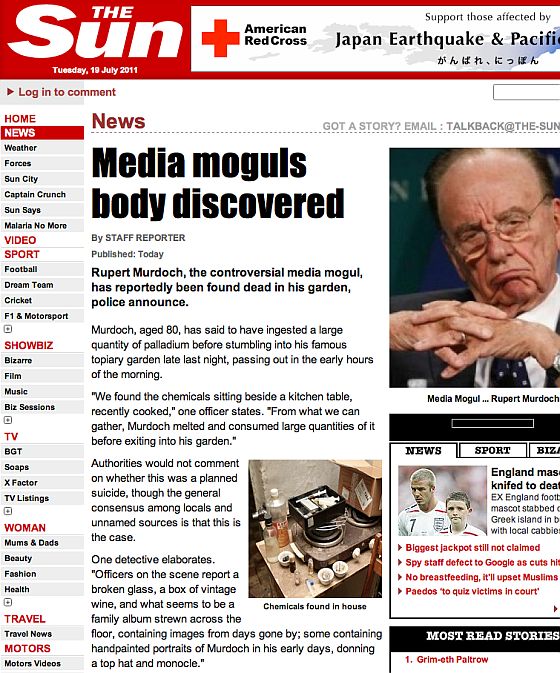
The web site of The Sun newspaper, part of News International which has been embroiled in the phone hacking scandal in the UK, has been hacked, apparently by hacker group Lulzsec, which tweeted “@LulzSec: We have owned Sun/News of the World – that story is simply phase 1 – expect the lulz to flow”.
The hack is a redirect to “http://www.new-times.co.uk/sun/” and contains a (clearly false) story about Rupert Murdoch being found dead. Ironically the domain ‘new-times.co.uk’ is registered to one News International Newspapers Limited.
The ‘story’ begins:
Rupert Murdoch, the controversial media mogul, has reportedly been found dead in his garden, police announce. Murdoch, aged 80, has said to have ingested a large quantity of palladium before stumbling into his famous topiary garden late last night, passing out in the early hours of the morning.”
No doubt this is in reference to the tragic news tonight that a pivotal informer in the phone hacking scandal, Sean Hoare, was tonight found dead in his apartment, though Police are reporting the circumstances as ‘not suspicious’.
