Category Archives: Issues

Norway’s Timothy McVeigh

Huffington Post reports:

The 32-year-old Norwegian man who went on a shooting spree on the island of Utoya has been identified as Anders Behring Breivik, according to multiple reports.

The Daily Mail and Sky News were among those to report the suspect’s name. According to witnesses, the gunman was dressed as a police officer and gunned down young people as they ran for their lives at a youth camp.

Police said Friday evening that they’ve linked the youth camp shooting and Oslo bombing. Breivik is believed to have acted alone.

Norwegian TV2 reports that Breivik belongs to “ring-wing circles” in Oslo. Swedish news site Expressen adds that he has been known to write to right-wing forums in Norway, is a self-described nationalist and has also written a number of posts critical of Islam.

The New York Times now reports that in the bombing and shootings is at least 87 people were killed.

Facebooktwittermail

Syria holds massive rallies to ‘support Homs’

Al Jazeera reports:

Hundreds of thousands of people have taken to the streets across Syria following Friday prayers, activists said, protesting against President Bashar al-Assad and defying an intensified military crackdown on their uprising.

Demonstrations demanding an end to Assad’s rule broke out in the Medan district of Damascus, the besieged city of Homs, Latakia on the coast and the southern city of Deraa.

About 400,000 protesters came out in the eastern province of Deir Ez Zor, on the border with Iraq’s Sunni heartland, activists said.

Anthony Shadid reports from Hama:

As anthems go, this one is fittingly blunt. “Come on Bashar, leave,” it declares to President Bashar al-Assad. And in the weeks since it was heard in protests in this city, the song has become a symbol of the power of the protesters’ message, the confusion in their ranks and the violence of the government in stopping their dissent.

Although no one in Hama seems to agree on who wrote the song, there is near consensus on one point: A young cement layer who sang it in protests was dragged from the Orontes River this month with his throat cut and, according to residents, his vocal cords ripped out. Since his death, boys as young as 6 have offered their rendition in his place. Rippling through the virtual communities that the Internet and revolt have inspired, the song has spread to other cities in Syria, where protesters chant it as their own.

“We’ve all memorized it,” said Ahmed, a 40-year-old trader in Hama who regularly attends protests. “What else can you do if you keep repeating it at demonstrations day after day?”

Tunisia can claim the slogan of the Arab revolts: “The people want to topple the regime.” Egyptians made famous street poetry that reflected their incomparable wit. “Come on Bashar, Leave,” is Syria’s contribution to the pop culture of sedition, the raw street humor that mingles with the furor of revolt and the ferocity of crackdown.

Facebooktwittermail

Proposed law would mandate jail for critics of Saudi king

The New York Times reports:

A proposed Saudi counterterrorism law that would give the Interior Ministry sweeping powers and mandate jail sentences for criticizing the king would effectively squelch political dissent, human rights advocates said on Thursday.

The law would allow prisoners to be held without trial, and trials and appeals to be held secretly, Saudi and international rights advocates said. It would also grant the Interior Ministry broad powers including the ability to tap telephones or search houses without permission from the judiciary.

Saudi activists have long accused the judicial system and the Interior Ministry of a lack of respect for human rights, even when such rights exist legally. The new law, the activists said, would legalize those practices, removing all restraints.

“Every single thing we criticized them about in the past is going to be legitimate,” Bassem Alim, the defense lawyer for a group of men imprisoned in 2007 on terrorism charges, said by telephone. The men were formally charged only last August, and their real crime, Mr. Alim said, was taking rudimentary steps toward forming a political party.

“Ninety-nine percent of the law has nothing to do with terrorism, it has to do with political dissent,” he said.

Facebooktwittermail

Norway’s encounter with terror

Following today’s bombing and shootings in Norway, Bibhu Prasad Routray writes:

In July 2011, Norway brought terror charges against Najm al-Din Faraj Ahmad alias Mullah Krekar, the founder of the outlawed Kurdistan Islamic group of Ansar al-Islam after he threatened former Norwegian asylum minister Erna Solberg. In media interviews Krekar had said that if he is deported to Iraq and killed there, they would face the same fate.

Iraqi born Mulla Krekar had come to Norway as a refugee in the early 1990s and spent years secretly shuttling between Oslo and Kurdistan until his arrest in September 2002. Although terrorism charges were dropped in 2003, he has been officially declared a threat to national security and placed under house arrest awaiting deportation to Iraq. In 2005, Norway issued a deportation order for Mullah Krekar.

The verdict, however, was suspended for fear that the cleric may face execution or torture at home. Krekar had justified the 9/11 attacks saying that the Americans deserved them. The Ansar al-Islam is suspected of having carried out suicide bombings against coalition forces and Iraqi security forces in Iraq.

Facebooktwittermail

Israel’s ‘threat’ to bomb nuclear facilities is central to its Iran strategy

Tony Karon writes:

The reason TIME.com’s intelligence columnist Bob Baer this week found himself cast as the unintended source for “authoritative” claims that Israel is about to bomb Iran, is precisely because what he said had been speculative comments inadvertently played into the game of bluff at the heart of the matter. Bob saw an implicit warning in the unprecedented public comments last month by former Mossad chief Meir Dagan and former Chief of Staff, Gen. Gabi Ashkenazi warning that Israel attacking Iran would be an act of spectacular self-destructive folly — and lamenting that Prime Minister Benjamin Netanyahu and Defense Minister Ehud Barak were both prone to such reckless whims. The likes of Dagan and Ashkenazi don’t bluff, Bob reasoned, and Israeli reports even suggested they may have directly blocked military action by their political masters. By speaking out, they seemed to be explicitly warning the Israeli public that Israel’s elected decision-makers were strategically incompetent, and needed to be reined in by more sober heads.

If these respected securocrats were willing to tempt the wrath of Israel’s government to sound the alarm, they must surely be trying to stop something that was in the works. And Bob’s history as a former CIA operative allowed some media outlets to cast what he insists was simply his analysis of what was being said in public as an authoritative claim that Israel was about to attack Iran.

Such an attack remains highly unlikely in the near term, of course, and Dagan even said as much, indicating that there were no imminent plans for a strike. But the centerpiece of Israel’s Iran strategy has been to cultivate the belief that if sanctions and other pressures fail to force Tehran to yield, Israel will feel compelled to go to take military action, even without U.S. backing. Israel said nothing at all before its 1981 attack on Iraq’s Osirak nuclear reactor, but scarcely a month has passed over the past three or four years without some new report calculated to create the impression that it was planning air strikes in Iran. The main line of criticism of Dagan in the Israeli camp did not challenge the content of what he said — that bombing Iran would be a catastrophic mistake, plunging Israel into a war it couldn’t win but from there would be no exit; instead he was pilloried for giving the game away.

Facebooktwittermail

Poll: Majority of U.S. Jews support Mideast peace plan based on 1967 borders

Haaretz reports:

A J Street poll published Thursday shows that 57% of U.S. Jews back a Middle East peace plan based on 1967 borders with mutually agreed-upon land swaps, while 43% opposed such a move.

According to the poll, 83% of the American Jews support a U.S.-brokered solution to the Israeli-Palestinian conflict, while 70% want the administration to offer a peace plan that proposes set borders and security arrangements.

J Street’s poll, which was conducted in mid-July among 800 American Jews, showed nearly 47% of those polled want the U.S. to vote against recognizing a Palestinian state in the UN, as opposed to 34% who support recognition, and 18% which are hesitant of American recognition.

Facebooktwittermail

James Murdoch misled MPs, say former NoW editor and lawyer

Testimony by James Murdoch about Britain’s phone hacking scandal came under renewed scrutiny on Friday with Prime Minister David Cameron saying Mr. Murdoch still had “questions to answer” and a lawmaker calling for the police to open a new inquiry.

The pressure on Mr. Murdoch built a day after two former executives of News International [Colin Myler and Tom Crone] — the British subsidiary of News Corporation — publicly contradicted evidence he gave on Tuesday to a parliamentary panel seeking to unravel the tangled story of phone hacking at the now defunct Murdoch tabloid, The News of the World.

“Clearly James Murdoch has got questions to answer in Parliament and I’m sure he will do that,” Mr. Cameron said during a visit to an auto plant in the British Midlands. “And clearly News International has got some big issues to deal with and a mess to clear up. That has to be done by the management of that company. In the end the management of the company must be an issue for the shareholders of that company, but the government wants to see this sorted out.”

The Guardian reports:

Colin Myler, editor of the paper until it was shut down two weeks ago, and Tom Crone, the paper’s former head of legal affairs, said they had expressly told Murdoch of an email that would have blown a hole in its defence that only one “rogue reporter” was involved in the phone-hacking scandal.

This contradicts what Murdoch told the committee when questioned on Tuesday.

The existence of the email, known as the “for Neville” email because of its link to the paper’s former chief reporter Neville Thurlbeck, is thought to have been critical in News International’s decision to pay out around £700,000 to Taylor in an out-of-court settlement after he threatened to sue the paper.

James Murdoch is standing by his version of events. A statement issued by News Corporation said: “James Murdoch stands by his testimony to the select committee.”

In their statement, Myler and Crone challenged this: “Just by way of clarification relating to Tuesday’s Culture, Media Select Committee hearing, we would like to point out that James Murdoch’s recollection of what he was told when agreeing to settle the Gordon Taylor litigation was mistaken.

“In fact, we did inform him of the ‘for Neville’ email which had been produced to us by Gordon Taylor’s lawyers.”

Meanwhile, the Wall Street Journal reports:

The U.S. Justice Department is preparing subpoenas as part of preliminary investigations into News Corp. relating to alleged foreign bribery and alleged hacking of voicemail of Sept. 11 victims, according to a government official.

The issuance of such subpoenas, which would broadly seek relevant information from the company, requires approval by senior Justice Department leadership, which hasn’t yet happened, the person said.

The issuance of subpoenas would represent an escalation of scrutiny on the New York-based media company. While the company has sought to isolate the legal problems in the U.K., it has been bracing for increased scrutiny from both the Justice Department and the Securities and Exchange Commission, according to people familiar with the company’s strategy.

The Justice Department has said it is looking into allegations that News Corp.’s now-defunct News of the World weekly in the U.K. paid bribes to British police. It has been unclear whether the Justice Department or the SEC have begun formal probes.

The Federal Bureau of Investigation separately has begun an inquiry into whether News Corp. employees tried to hack into voice mails of Sept. 11 victims, people familiar with the early-stage probe have said.

A person close to News Corp. said the preparation of subpoenas is “a fishing expedition with no evidence to support it.”

Facebooktwittermail

Yemen on the brink of hell

The New York Times reports:

On May 29, a young woman named Bushra al- Maqtari joined a group of several thousand protesters marching down a trash-strewn boulevard in the Yemeni city of Taiz. The Arab world’s democratic uprising was five months old, and patience among the protesters in Taiz — Yemen’s second largest city — was wearing thin. Maqtari had been one of the first and most fearless leaders of the movement. She is a remarkable figure: a 31-year-old university administrator and fiction writer, she is also a childless divorcee who refused, until recently, to wear the abaya, the all-covering gown that is practically mandatory for women in Yemen. Tiny and frail, she has a round, lovely face, with level brows and tranquil brown eyes.

On that afternoon, Maqtari was standing in a crowd gathered around the city’s General Security building — an imposing six-story edifice flanked by guards — when she heard cracking sounds. She looked up and saw that the officers on the building’s roof were not just throwing rocks, as they had in the past. They were firing straight down into the crowd below. Within minutes, at least four people were dead and about 60 were wounded. Maqtari began running back toward “Freedom Square,” the intersection where thousands of protesters had been camped out for months demanding the resignation of Ali Abdullah Saleh, Yemen’s strongman president. Then the real assault began. Armored vehicles, tanks and bulldozers began converging on the protesters’ tent city from all sides. They fired tear gas and water cannons into the square and began shooting protesters at point-blank range. They doused the tents, which extended for hundreds of yards in every direction, with gasoline and lighted them on fire. None of the protesters had weapons. “People were dying all around us, and there was nothing we could do,” Maqtari told me. Some were burned alive. At around 11 p.m., Maqtari fled to her sister’s house, about 200 yards uphill from the square. There, she and other protesters watched as flames engulfed the entire square, raging for several hours. Officers stormed through the local hospital and several field clinics where protesters were being treated, firing tear gas down the corridors, shooting up the ceilings and arresting doctors and nurses. Some thrust their gun butts into patients’ wounds. Others were laughing hysterically, as if they were on drugs, Maqtari and others told me, and shouting into the darkness, “Ali is your god!” The next morning, amid the charred remains of the tents, someone had scrawled a sardonic reversal of the protesters’ chants on a wall. “The regime wants the fall of the people,” it said.

The massacre in Taiz received little attention in the West, blending in with the larger chaos and violence enveloping the Arab world. In Syria, tanks were rolling through the streets of several cities, as months of protest evolved into a bloody national insurrection. In Libya, the civil war was festering into a grim status quo, with NATO airstrikes unable to dislodge Col. Muammar el-Qaddafi from his Tripoli stronghold. Even Egypt and Tunisia seemed endangered, with fresh violence breaking out and their economies in tatters.

Yet the events in Taiz took on a tragic dimension that went beyond the numbers of dead and wounded. Taiz is Yemen’s least tribal city, home to the highest number of educated people, professionals and traders. The city was “the heart of the revolution,” in one popular refrain, and its protesters were less politicized and more rigorously nonviolent than elsewhere in Yemen. The attack on May 29, with its deliberate cruelty and excess, confirmed what many Yemenis feared: that Saleh sees the democratic uprising as a greater threat to his power than Al Qaeda.

Facebooktwittermail

Syrian forces ‘surround Damascus suburb’

Al Jazeera reports:

Troops commanded by Syrian President Bashar al-Assad’s brother have surrounded the Damascus suburb of Harasta, residents say.

The move appears to be part of an ongoing crackdown on urban centres that have experienced protests on a daily basis.

“Hundreds of Fourth Division troops have sealed off all of Harasta’s dozen entrances,” a resident of the large suburb, who works as an engineer and managed to leave Harasta, told the Reuters news agency by telephone.

“They are wearing combat fatigues, helmets, ammunition belts and carrying assault rifles. Water, electricity and phones have been cut.”

Anthony Shadid reports from Hama:

In this city that bears the scars of one of the modern Middle East’s bloodiest episodes, the revolt against President Bashar al-Assad has begun to help Syrians imagine life after dictatorship as it forges new leaders, organizes its own defense and reckons with a grim past in an uncertain experiment that showcases the forces that could end Mr. Assad’s rule.

Dozens of barricades of trash bins, street lamps, bulldozers and sandbags, defended in various states of vigilance, block the feared return of the security forces that surprisingly withdrew last month. Protests begin past midnight, drawing raucous crowds of youths celebrating the simple fact that they can protest. At dusk, distant cries echo off cinder blocks and stone that render a tableau here of jubilation, fear and memory of a crackdown a generation ago whose toll — 10,000, 20,000, more — remains a defiant guess.

“Hama is free,” the protesters chant, “and it will remain free.”

Freedom is a word heard often these days in this city, Syria’s fourth largest, though that freedom could yet prove elusive. Hama rebelled last month, and the government withdrew the soldiers and security forces seemingly to forestall even more bloodshed, ceding space along the Orontes River that is really neither liberated nor subjugated.

In the uncertain interregnum, punctuated by worry that the security forces might return and fear of informers left behind, Hama has emerged in the four-month revolt against Mr. Assad as a turbulent model of what a city in Syria might resemble once four decades of dictatorship end. In skittish streets, there are at least nascent notions of self-determination, as residents seek to speak for themselves and defend a city that they declare theirs.

The sole poster of Mr. Assad in the city hangs from the undamaged headquarters of the ruling Baath Party. Gaggles of residents gather on the curb to debate politics, sing protest songs and retell the traumas of the crackdown in 1982, when the government stormed Hama to end an Islamist uprising. For the first time in memory, clerics and the educated elite in Hama are negotiating with the governor over how to administer the city, in a country long accustomed to a monologue delivered by the ruler to the ruled.

Meanwhile, “Nour Ali” reports from Damascus:

Brute force has been the main weapon of the Syrian regime as it has sought to crush growing protests, killing at least 1,500 people and torturing hundreds more. But Syrians have also been besieged by relentless propaganda.

In a week that has seen at least 40 die and escalating violence in Homs, the country’s third largest city, state radio and private stations owned by regime cronies have been blaring out songs exalting Bashar al-Assad as “Abu Hafez”, suggesting his son Hafez could succeed him, or anointing him president for “all eternity”.

Baseball caps, T-shirts and flags adorned with the president’s face are sold around Damascus. Billboards show him surrounded by pink hearts – in stark contrast to the sterner, more militarised pictures of his father, Hafez, the former president.

Television programmes show residents shopping and driving, portraying calm and order while regime supporters chant that they would shed blood for their leader.

Facebooktwittermail

Problems with logistics, coordination and rivalries hamper Libya’s rebels

C J Chivers reports:

Ahmad Harari, a Libyan rebel fighting to overthrow Col. Muammar el-Qaddafi, recounted how he was almost killed last week.

He was part of a small group of fighters assigned to defend a front-line position in Qawalish, a village in Libya’s arid western highlands. Then Colonel Qaddafi’s military attacked, rushing forward in pickup trucks.

Mr. Harari said he had only 18 cartridges for his rifle, roughly the same amount of ammunition carried by everyone in his group. Within minutes he ran out.

“Every man lost all of his bullets and tried to escape,” he said. A friend was captured, killed and mutilated, he said, but the others managed to get away.

While the Libyan rebels have carved out an enclave in the west, the dearth of ammunition in Mr. Harari’s group points to one of the continuing drains on their military strength — an absence of coordination, even on matters as basic as making sure that ample ammunition is provided to the front-line fighters.

As Libya’s uprising-turned-desert-war enters its sixth month, the rebels in the mountains have assembled into small bands of local fighters. These groups — often named for the towns the fighters come from — have demonstrated both an eagerness to fight and a willingness to work with almost anyone who can help them reach their goal of ousting the Qaddafi family from power.

But coordination between them, as well as logistical help from their higher commands and foreign supporters, has not developed in important ways. In eastern Libya, the rebel authorities talk of making a national army; here in the west, the state of official disorganization makes the prospects for such a force unlikely in the near term.

Meanwhile, The Guardian reports:

Libyan rebels claimed to have made significant advances against Muammar Gaddafi’s forces on Thursday amid signs that the regime is feeling the strain of offensives backed by Nato air power.

Rebels in the western city of Misrata said they had captured the chief of operations of government forces in Zlitan on the first day of their attack.

General Abdul Nabih Zayid was caught late on Wednesday after advancing fighters overran his command post at Souk Talat, a small village on the outskirts of Zlitan, opposition commanders said.

“We have him in custody. He is being well looked after,” said Mohamed Frefr, in charge of detainees for the rebels. “After three days talking with him, we will hand him to the military prison.”

Growing confidence was also expressed by rebel officials from Misrata, who met Nicholas Sarkozy, the French president, and reportedly told him that with help, they could be in Tripoli within days.

Facebooktwittermail

The Murdoch pushback: attacking the press

Ryan Chittum writes:

There have been a number of efforts lately—obnoxious efforts—to say News Corporation’s hacking scandal is some kind of “piling on” by opponents with a “commercial or political agenda.” The implication, not least from Rupert Murdoch’s Wall Street Journal editorial page and his “Fox & Friends” show, being that the level of coverage is unfair, somehow, that the story isn’t that big a deal, or that the scandal hasn’t touched Rupert Murdoch as a CEO or News Corp. as a whole—confined as it was to ”the tabloid excesses of one newspaper.”

Perhaps then it would be a good exercise to run through all the wrongdoing—including rampant, institutionalized criminal activity—that is already in the public record as having been committed in the hacking scandal.

For starters, executives, editors, and reporters at News Corp.’s UK unit have: bribed the police; illegally hacked thousands of people’s phones, including a 13-year-old then-missing murder victim’s; tampered with evidence while the victim was still missing. They interfered with a second murder investigation; misled police and Parliament, repeatedly, when questioned about these activities; knowingly employed an ax-murder suspect who had been convicted and imprisoned for planting cocaine on an innocent woman in a divorce case; paid millions of dollars to victims explicitly in exchange for their silence; paid large sums to former employees after they had been convicted of crimes committed at the behest of News Corporation employees; continued to pay for convicted former employees’ high-powered lawyers.

It has further been revealed that a senior News International executive deleted millions of emails in an “apparent attempt to obstruct Scotland Yard’s inquiry”; hid the contents of a top journalist’s desk after he was arrested; stuffed documents into trash bags and took them away as detectives came into the office to investigate; put the scandal’s lead police investigator, whose inquiry was a bad joke, on the News Corp. payroll with a plum columnist job.

Here’s some of what we know of corrupt activities undertaken by government institutions at News Corp.’s behest or which, at a minimum benefited, News Corp.

The police: stuffed thousands of pages of convicted hacker Glenn Mulcaire’s notes in plastic bags, leaving them unexamined (or at least uncataloged) for years; did so while insisting publicly, and before Parliament, that the scandal was limited to two people and, crucially, that a full investigation had been performed; hired Neil Wallis, who was News of the World’s deputy editor while the crimes were committed, to advise the police on how to handle their own PR problems stemming from the hacking scandal; Wallis ferried information back to News Corp.; the police notified just a handful of people that their phones might have been hacked despite having evidence that in fact thousands had been; concealed their payments to Wallis for a year. Meanwhile, top police officials dined repeatedly with News International executives during the investigation.

Political elites: Conservative Prime Minister David Cameron hired the News of the World editor Andy Coulson, who oversaw a newsroom in which criminal activity was commonplace, to be a top aide, despite warnings that Coulson was personally implicated in the scandal; Labour leader Ed Miliband hired a Murdoch journalist to be top flack, and he promptly told the party to tiptoe around the scandal; regulators came very close to approving a massive TV deal for News Corp. that would have furthered its stranglehold on Britain’s private media, all while the scandal was continuing to worsen.

Phew!

Now that we have all that background, enter The Wall Street Journal’s editorial page, which this week has gone into full-on Murdoch mode, defending its parent company from the ”commercial and ideological motives of our competitor-critics.” It has unleashed no fewer than seven defensive editorials and columns this week, reports Bloomberg News, and it’s only Wednesday.

Facebooktwittermail

Where are the next News Corp whistle-blowers?

Does the death of Sean Hoare suggest that anyone who exposes wrongdoing inside the Murdoch empire is putting their life at risk? I don’t think so.

Hoare’s health had been compromised by alcohol and drug addiction. A few days before he died he got accidentally whacked on the head by a relative carrying a heavy pole as they took down a marquee at a children’s party. Reporters for the New York Times who dined with him in his last days described him as “ailing.”

The police force that ordered Hoare’s autopsy is the Hertfordshire force — not the Metropolitan police where officers accepted bribes from News International. The type of autopsy conducted was one ordinarily used in cases of suspicious death, even though investigators have not identified suspicious circumstances.

But now that News International has pulled the plug on its financial aid for Glenn Mulcaire and the world waits for him to break his silence, if he too suddenly dies then of course both deaths would be massively suspicious. Absent such an extraordinary turn of events, I think the reason other News Corp employees don’t speak out has more to do with fears for their wealth than their health.

In 2009, Fox News anchor Stuart Varney set the standard when it comes to the proposition that anyone on his payroll should dare challenge Emperor Murdoch.

Should we be surprised that a Fox journalist would assume such a supine position in relation to his boss? Only if we imagine News Corp attracts employees who are more interested in practicing journalism than they are in the size of their pay checks.

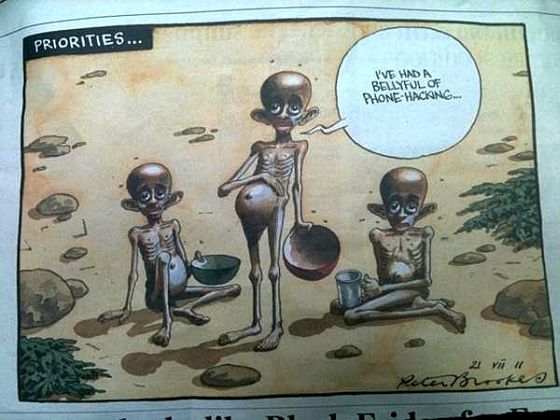
Consider the example of the editors of Murdoch’s Times of London. Today they assumed the posture of having greater concern about starvation in Somalia than they do about the phone hacking story and so they ran this cartoon:

Does the situation in Somalia deserve greater media attention? Of course. But if the Times actually thinks its competitors’ priorities are skewed, how come they couldn’t find space for a single paragraph on Somalia on their own front page?

If a few of Murdoch’s employees are now having sleepless nights wondering whether they should speak out and risk losing their jobs, they must also know that the decision of any whistle-blower is one of the loneliest. Anyone who jumps off the Murdoch ship is unlikely to be quickly offered a lifeline from another.

The corporate media world of which the Murdoch empire is merely one part, does not foster a culture that rewards integrity. Team players are an asset; individuals with an unshackled conscience are risky. Those whose job it is to report, know that there are times when nothing is more highly prized by their employers than their silence.

Facebooktwittermail

Phone hacking: Met police to investigate mobile tracking claims

The Guardian reports:

Scotland Yard has been asked to inspect thousands of files that could reveal whether its officers unlawfully procured mobile phone-tracking data for News of the World reporters.

There were half a million requests by public authorities for communications data in the UK last year – of which almost 144,000 were demands for “traffic” data, which includes location.

A Metropolitan Police Authority (MPA) member has asked the force to investigate allegations that News of the World reporters were able to purchase this data from police for £300 per request.

The claims were made by Sean Hoare, the News of the World whistleblower, days before he was found dead at his home on Monday. His disclosure about the purchase of illicit location data was first made to the New York Times, which said the practice was confirmed by a second source at the tabloid. Police have said Hoare’s death was not suspicious.

Mobile phone location data, which is highly regulated, would give tabloid reporters access to a method of almost total surveillance, arguably even more intrusive than hacking into phone messages.

Facebooktwittermail

News Corp and the hacked Climategate emails: time for an independent investigation

Joe Romm writes:

There have been countless independent investigations into the scientists whose e-mails were hacked in November 2009. And the scientists have been (quietly) vindicated every time (see “The first rule of vindicating climate science is you do not talk about vindicating climate science“).

But we still don’t know who hacked the emails! And now we know that one of the key investigative bodies tasked with tracking down the hackers — Scotland Yard – were compromised at the time.

How were they compromised? Neil Wallis — the former News of the World executive editor — became a “£1,000 a day” consultant to Scotland Yard in October 2009. Last week he became the ninth person arrested in the metastasizing News Corp scandal “on suspicion of conspiring to intercept communications, contrary to section 1(1) Criminal Law Act 1977.”

Certainly Wallis had plenty of motive to join Scotland Yard just to keep an eye on the investigation into the phone-hacking scandal. Indeed, the NY Times reports Wallis “was reporting back to News International while he was working for the police on the hacking case.” But this also suggests how corrupt Wallis was — and how corrupted Scotland Yard was.

In the light of the News Corp phone-hacking scandal, it is clear that Murdoch’s outfit had means, motive, and opportunity for the Climategate email hacking. News Corp certainly has a history of defaming climate scientists and a penchant for hacking.

Facebooktwittermail

LulzSec claims to have News International emails

The Guardian reports:

One of the members of the LulzSec hacking group has claimed on Twitter that the group has got 4GB of emails taken from the Sun and the “royal family” which may be released as soon as lunchtime on Thursday.

The claim follows a hacking attack against News International on Tuesday night during which members of LulzSec apparently broke into computer systems there and redirected readers of the Sun’s website to a faked page claiming News Corp chief executive Rupert Murdoch had been found dead.

Significantly, the group also seems to have broken into the email database at News International.

Some accounts belonging to Anonymous also began tweeting email addresses and passwords for staff at News International, including what seemed to be an email account and password for Rebekah Brooks under her previous married name of Wade while at the Sun.

Facebooktwittermail