Category Archives: Issues

A leading PR firm in the U.S. is working directly for one of Egypt’s top spy services

The Atlantic reports: On a Tuesday night in early May, all the big players in the public relations industry gathered at Cipriani 42nd Street, a lavish restaurant in Manhattan, for the annual “Superior Achievement in Branding Reputation & Engagement” awards. The event, where winners were selected by a panel of industry insiders, was billed by its organizers as a “showcase for the best that public relations has to offer”—it was like the Oscars, but for the titans of PR. #CupFusion, a hashtag designed to build buzz around a new Reese’s Peanut Butter Cup, won a best in show award for Ketchum. Edelman took home a trophy for a Starbucks video campaign focusing on “normal” people doing “extraordinary” things.

The New York-based Weber Shandwick was also a big winner, taking home three trophies: one for North American agency of the year, another for a social-media campaign celebrating a body-positive Barbie Doll, and one more for a science-education program sponsored by Lockheed Martin. One of its campaigns, however, did not attract much notice: a $1.2 million-a-year deal with Egypt’s General Intelligence Service (GIS). The agency, roughly the country’s equivalent of the CIA, is part of a constellation of infamous intelligence services known as the mukhabarat. Perhaps most notorious in the United States for collaborating with the CIA in the torture of suspected al-Qaeda members after 9/11, GIS has been accused of working in secret with Egypt’s domestic intelligence to manipulate elections and suppress internal dissent since the coup that installed Abdel Fattah el-Sisi as president in 2013.

Weber’s contract with the Egyptians is not, in itself, unconventional. But the firm’s decision to do business with a foreign-intelligence service known for torture and repression, one that has been instrumental to Sisi’s crackdown on the Muslim Brotherhood and other groups, is unorthodox. And it comes at a key moment. Four years after Sisi toppled Egypt’s elected government, he’s eager to cement ties with a new U.S. administration that’s willing to overlook his authoritarianism, and at the same time win friends in Congress who oversee Egypt’s massive aid package. In Weber Shandwick, it would appear that the Sisi regime has found a PR firm willing to apply its considerable messaging prowess to the cause of funneling U.S. taxpayer money and goodwill towards the increasingly brutal leadership of the world’s largest Arab country.

Weber and the lobbying firm Cassidy & Associates—a “specialty” firm that’s part of Weber (both are owned by InterPublic Group, a public company)—signed deals with Egypt in late January, eight days after Donald Trump’s inauguration. According to paperwork filed with the Department of Justice, the firms would be reporting directly to General Naser Fahmy of the GIS. They would be promoting Egypt’s “strategic partnership with the United States,” and emphasizing its “leading role in managing regional risks.” The firm, in other words, would be amplifying the Egyptian government’s own message: that arming and backing up an increasingly authoritarian Egypt state is necessary to keep the peace. [Continue reading…]


Facebooktwittermail

What Assad has won

Kamel Daoud writes: The Arab springs are nearly all out of season; everywhere except in Tunisia, they are aging poorly.

In the beginning, after a popular uprising, it was the dictator who fled, by airplane, as did president Zine el-Abidine Ben Ali of Tunisia in early 2011. Now it’s the opposite that is happening: It’s the people who are fleeing, for instance from Syria, by sea and land.

This reversal raises an essential question, both simple and tragic: Can one still call for democracy after the victory of President Bashar al-Assad of Syria, even if that victory turns out to be temporary, as some predict? What does it mean for the peoples of the Maghreb and the Middle East?

For many, the first lesson to be drawn from the Syrian case is obvious: One can’t always win the revolution, or at least not as fast as one would like. So far Assad has come out of the conflict alive, even strengthened — at the cost of the slaughter of half his people. His longevity goes to show that being wrong and facing fierce opposition from dissidents, an army and a large swath of the international community aren’t enough to unseat a dictator.

Assad, by killing so many Syrians, has also killed the dream of democracy for many other Syrians, as well as for plenty of people elsewhere in the Arab world. They can see that a revolutionary often ends up a martyr, a tortured prisoner, a militiaman in the pay of foreign forces or an unwelcome refugee. And neither his children nor his people are the better for it. That’s enough to sow doubt in even the most democratic of minds and the most fervent of revolutionaries.

And so here is the first Assad effect: The perception that democracy is costly — perhaps too costly. [Continue reading…]

Facebooktwittermail

Trump team met with lawyer linked to Kremlin during campaign

The New York Times reports: Two weeks after Donald J. Trump clinched the Republican presidential nomination last year, his eldest son arranged a meeting at Trump Tower in Manhattan with a Russian lawyer who has connections to the Kremlin, according to confidential government records described to The New York Times.

The previously unreported meeting was also attended by Mr. Trump’s campaign chairman at the time, Paul J. Manafort, as well as the president’s son-in-law, Jared Kushner, according to interviews and the documents, which were outlined by people familiar with them.

While President Trump has been dogged by revelations of undisclosed meetings between his associates and Russians, this episode at Trump Tower on June 9, 2016, is the first confirmed private meeting between a Russian national and members of Mr. Trump’s inner circle during the campaign. It is also the first time that his son Donald J. Trump Jr. is known to have been involved in such a meeting.

Representatives of Donald J. Trump Jr. and Mr. Kushner confirmed the meeting after The Times approached them with information about it. In a statement, Donald Jr. described the meeting as primarily about an adoption program. The statement did not address whether the presidential campaign was discussed. [Continue reading…]

Facebooktwittermail

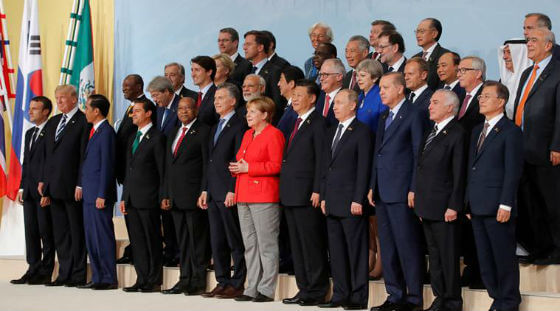
‘Our world has never been so divided,’ says French President Macron at close of G-20 summit at which U.S. isolated itself

The Washington Post reports: President Trump and other world leaders on Saturday emerged from two days of talks unable to resolve key differences on core issues such as climate change and globalization, slapping an exclamation point on a divisive summit that left other nations fearing for the future of global alliances in the Trump era.

The scale of disharmony was remarkable for the annual Group of 20 meeting of world economic powers, a venue better known for sleepy bromides about easy-to-agree-on issues. Even as negotiators made a good-faith effort to bargain toward consensus, European leaders said that a chasm has opened between the United States and the rest of the world.

“Our world has never been so divided,” French President Emmanuel Macron said as the talks broke up. “Centrifugal forces have never been so powerful. Our common goods have never been so threatened.”

The divisions were most bitter on climate change, where 19 leaders formed a unified front against Trump. But even in areas of nominal compromise, such as trade, top European leaders said they have little faith that an agreement forged today could hold tomorrow.

Macron said world leaders found common ground on terrorism but were otherwise split on numerous important topics. He also said there were rising concerns about “authoritarian regimes, and even within the Western world, there are real divisions and uncertainties that didn’t exist just a few short years ago.”

“I will not concede anything in the direction of those who are pushing against multilateralism,” Macron said, without directly referring to Trump. “We need better coordination, more coordination. We need those organizations that were created out of the Second World War. Otherwise, we will be moving back toward narrow-minded nationalism.” [Continue reading…]

Facebooktwittermail

G-20 leaders’ statement on climate change highlights rift with U.S.

The Guardian reports: World leaders have made clear the US’s isolated stance on climate change, with 19 of the G20 countries affirming their commitment to the “irreversible” Paris climate agreement.

After lengthy negotiations that stretched well into Saturday, the final joint statement from the meeting in Hamburg notes Donald Trump’s withdrawal from the Paris deal while stating that the world’s other major economies all still support the international effort to slow dangerous global warming.

The German chancellor, Angela Merkel, said on Saturday she “deplored” the US exit from the agreement and added that she did not share the view of Theresa May, the British prime minister, that Washington could decide to rejoin the pact.

“I think it’s very clear that we could not reach consensus, but the differences were not papered over, they were clearly stated,” Merkel told reporters at the end of the two-day meeting. “It’s absolutely clear it is not a common position.”

The communique reads: “We take note of the decision of the United States of America to withdraw from the Paris agreement,” adding: “The leaders of the other G20 members state that the Paris agreement is irreversible” and “we reaffirm our strong commitment to the Paris agreement”. [Continue reading…]

Facebooktwittermail

Pope Francis warns G-20 against ‘dangerous alliances’ damaging poor, migrants

Reuters reports: Pope Francis warned leaders of the world’s top 20 economies meeting in Hamburg against forming dangerous and distorting alliances that could harm the poor and migrants, in an article in Italian daily la Repubblica on Saturday.

“The G20 worries me, it hits migrants in countries in half of the world and it hits them even more as time goes by,” the Pope was quoted as saying in a conversation with the paper’s founder Eugenio Scalfari.

Francis, the first non-European pope in 1,300 years, said he was afraid of “very dangerous alliances among (foreign) powers that have a distorted vision of the world: America and Russia, China and North Korea, (Vladimir) Putin and (Bashar al-)Assad in the war in Syria.”

He said the greatest danger concerned immigration, with “the poor, the weak, the excluded and the marginalised” juxtaposed with “those who… fear the invasion of migrants”. [Continue reading…]

Facebooktwittermail

Why did sanctions against North Korea’s missile program fail?

By Daniel Salisbury, Middlebury Institute of International Studies at Monterey

North Korea’s successful test of an intercontinental ballistic missile (ICBM), allegedly with the capability to hit Alaska, is the latest in a series of significant advances for the country’s missile program.

North Korea has been seeking to develop long-range missile technology for over 20 years. For much of this period, the international community has been trying to stop that from happening.

My research on how states illegally obtain missile technologies and my experience conducting outreach related to U.N. sanctions give me some insight into the methods North Korea used to make illicit procurements and the limitations in using technology-based sanctions to prevent them.

Continue reading

Facebooktwittermail

The bipartisan fight for quieter oceans

Ed Yong writes: Last night, to celebrate the fourth of July, the air over the U.S. filled with fireworks. The noise they created was extremely loud and, mercifully, brief. But imagine having to listen to even louder explosions once every ten seconds, for days or weeks on end. Starting this fall, that may be the new reality for whales, fish, and other marine life off the eastern seaboard, if the Trump administration’s plans go ahead.

Following the president’s executive order to open the Atlantic to offshore drilling, the National Marine Fisheries Service (NMFS) is set to permit five companies to begin seismic airgun blasting—an old but controversial technique for detecting reserves of oil and gas. Ships will tow an array of 24 to 36 cannons behind them along with streamers of underwater microphones. The cannons create explosions by releasing pressurized gas, while the microphones detect the echoes of these detonations to pinpoint petroleum deposits beneath the ocean floor.

Each airgun produces up to 180 decibels of noise, making them around 1,000 times louder than nearby fireworks. And each will go off five or six times a minute, for months at a time, from the back of slow-moving ships that crisscross 90,000 kilometres of Atlantic waters from New Jersey to Florida. There is clear evidence that noise of this magnitude kills or perturbs marine life at every scale—from titanic whales to tiny plankton. It “poses an unacceptable risk of serious harm to marine life… the full extent of which will not be understood until long after the harm occurs,” said a group of 75 marine scientists in 2015. [Continue reading…]

Facebooktwittermail

Trump handed Putin a stunning victory

Molly K McKew writes: President Donald Trump needed to accomplish two things this week during his visits to Poland and the G-20 Summit in Hamburg. First, he needed to reassure America’s allies that he was committed to collective defense and the core set of values and principles that bind us together. Second, he needed to demonstrate that he understands that the greatest threat to that alliance, those values, and our security is the Kremlin.

Trump delivered neither of these. In very concrete terms, through speech and action, the president signaled a willingness to align the United States with Vladimir Putin’s worldview, and took steps to advance this realignment. He endorsed, nearly in its totality, the narrative the Russian leader has worked so meticulously to construct.

The readout of Trump’s lengthy meeting with Putin included several key points. First, the United States will “move on” from election hacking issues with no accountability or consequences for Russia; in fact, the U.S. will form a “framework” with Russia to cooperate on cybersecurity issues, evaluating weaknesses and assessing potential responses jointly. Second, the two presidents agreed not to meddle in “each other’s” domestic affairs—equating American activities to promote democracy with Russian aggression aimed at undermining it, in an incalculable PR victory for the Kremlin. Third, the announced, limited cease-fire in Syria will be a new basis for cooperation between the U.S. and Russia; Secretary of State Rex Tillerson went so far as to say that the Russian approach in Syria—yielding mass civilian casualties, catastrophic displacement, untold destruction and erased borders—may be “more right” than that of the United States.

Each of these points represents a significant victory for Putin. Each of them will weaken U.S. tools for defending its interests and security from the country that defines itself as America’s “primary adversary.” Trump has ceded the battle space—physical, virtual, moral—to the Kremlin. And the president is going to tell us this is a “win.” [Continue reading…]

Facebooktwittermail

The white nationalist roots of Donald Trump’s Warsaw speech

Jamelle Bouie writes: “The fundamental question of our time is whether the West has the will to survive,” said the president, before posing a series of questions: “Do we have the confidence in our values to defend them at any cost? Do we have enough respect for our citizens to protect our borders? Do we have the desire and the courage to preserve our civilization in the face of those who would subvert and destroy it?”

In the context of terrorism specifically, a deadly threat but not an existential one, this is overheated. But it’s clear Trump has something else in mind: immigration. He’s analogizing Muslim migration to a superpower-directed struggle for ideological conquest. It’s why he mentions “borders,” why he speaks of threats from “the South”—the origin point of Hispanic immigrants to the United States and Muslim refugees to Europe—and why he warns of internal danger.

This isn’t a casual turn. In these lines, you hear the influence of [Steve] Bannon and [Stephen] Miller. The repeated references to Western civilization, defined in cultural and religious terms, recall Bannon’s 2014 presentation to a Vatican conference, in which he praised the “forefathers” of the West for keeping “Islam out of the world.” Likewise, the prosaic warning that unnamed “forces” will sap the West of its will to defend itself recalls Bannon’s frequent references to the Camp of the Saints, an obscure French novel from 1973 that depicts a weak and tolerant Europe unable to defend itself from a flotilla of impoverished Indians depicted as grotesque savages and led by a man who eats human feces.

For as much as parts of Trump’s speech fit comfortably in a larger tradition of presidential rhetoric, these passages are clear allusions to ideas and ideologies with wide currency on the white nationalist right.

Defenders of the Warsaw speech call this reading “hysterical,” denying any ties between Trump’s rhetoric in Poland and white nationalism. But to deny this interpretation of the speech, one has to ignore the substance of Trump’s campaign, the beliefs of his key advisers, and the context of Poland itself and its anti-immigrant, ultranationalist leadership. One has to ignore the ties between Bannon, Miller, and actual white nationalists, and disregard the active circulation of those ideas within the administration. And one has to pretend that there isn’t a larger intellectual heritage that stretches back to the early 20th century, the peak of American nativism, when white supremacist thinkers like Madison Grant and Lothrop Stoddard penned works with language that wouldn’t feel out of place in Trump’s address. [Continue reading…]

Facebooktwittermail

Once dominant, the United States finds itself isolated at G-20

Trump was shunted to the far left and placed under Emmanuel Macron’s close supervision.

The New York Times reports: For years the United States was the dominant force and set the agenda at the annual gathering of the leaders of the world’s largest economies.

But on Friday, when President Trump met with 19 other leaders at the Group of 20 conference, he found the United States isolated on everything from trade to climate change, and faced with the prospect of the group’s issuing a statement on Saturday that lays bare how the United States stands alone.

Chancellor Angela Merkel of Germany, the host of the meeting, opened it by acknowledging the differences between the United States and the rest of the countries. While “compromise can only be found if we accommodate each other’s views,” she said, “we can also say, we differ.”

Ms. Merkel also pointed out that most of the countries supported the Paris accord on climate change, while Mr. Trump has abandoned it. “It will be very interesting to see how we formulate the communiqué tomorrow and make clear that, of course, there are different opinions in this area because the United States of America regrettably” wants to withdraw from the pact, she said.

Mr. Trump seemed to relish his isolation. For him, the critical moment of Friday was his long meeting with the Russian president, Vladimir V. Putin, which seemed to mark the reset in relations that Mr. Trump has been desiring for some time. It also provided Mr. Putin the respect and importance he has long demanded as a global partner to Washington.

Where previous American leaders saw their power as a benevolent force, and were intent on spreading prosperity through open markets and multilateral cooperation, Mr. Trump has portrayed himself as a nationalist, a unilateralist and a protectionist, eager to save American jobs.

What recent events have underscored, though — and especially at the G-20 — is that no nation is today large or powerful enough to impose rules on everyone else. In advancing his views, Mr. Trump has alienated allies and made the United States seem like its own private island. [Continue reading…]

Facebooktwittermail

225 years ago Alexander Hamilton anticipated the rise of Trump and the subversion of American democracy

On August 18, 1792, Alexander Hamilton wrote: The truth unquestionably is, that the only path to a subversion of the republican system of the Country is, by flattering the prejudices of the people, and exciting their jealousies and apprehensions, to throw affairs into confusion, and bring on civil commotion….

When a man unprincipled in private life desperate in his fortune, bold in his temper, possessed of considerable talents, having the advantage of military habits—despotic in his ordinary demeanour—known to have scoffed in private at the principles of liberty—when such a man is seen to mount the hobby horse of popularity—to join in the cry of danger to liberty—to take every opportunity of embarrassing the General Government & bringing it under suspicion—to flatter and fall in with all the non sense of the zealots of the day—It may justly be suspected that his object is to throw things into confusion that he may “ride the storm and direct the whirlwind.” [Continue reading…]

Facebooktwittermail

Angela Merkel uses eyes and hands to try and convince Putin that North Korea fired an ICBM

The determination that North Korea fired an intercontinental ballistic missile (ICBM) this week is based on the extrapolation of its range if aimed on a standard trajectory rather than the very steep trajectory of its actual launch, as illustrated below:


In conversation with Vladamir Putin today, Angela Merkel appears to have had difficulty in pressing home the argument as her eyes tracked the steep trajectory of the missile:


Then she resorted to hand motions:

Facebooktwittermail

Most Americans disagree with Trump admin’s enforcing travel ban against grandparents

Ryan Goodman writes: One of the hotly contested questions in the Travel Ban litigation is the definition of “close family relationships.” The Supreme Court told the administration that it cannot enforce the ban against any foreign national who has a “close familial relationship” with a person in the United States. The plaintiffs including the state of Hawaii have argued that the Supreme Court’s order should be understood to protect grandparents. The Justice Department told the federal court in Hawaii that the plaintiffs’ views of close family relationships “lack any universal or cohesive support.” That is the question the Hawaii federal court refused to decide on Thursday, and tried to kick the issue up to the Supreme Court. So, what to make of the competing views of family structure and where grandparents fit in?

A poll out this week suggests most Americans fundamentally disagree with the administration’s position. The Politico/Morning Consult survey asked the following question and got these results:

“Do you believe each of the following should qualify as a close family relationship for visa applicants from six predominately Muslim countries wishing to enter the United States? Grandparent”

Yes, this should qualify: 67%
No, this should not qualify: 20%

That is not only a huge margin in general. It also holds true across different groups of people who were asked the question. More specifically, the margin held strong such that at least 60% of Americans agreed that grandparents should qualify as a “close family relationship” for the purpose of receiving visas from the six predominately Muslim countries regardless of the respondent’s party identification, religion, gender, age, income, education, or region of the country. Even among people who voted for Donald Trump for president, 61% agreed that grandparents should qualify and 29% thought they should not. [Continue reading…]

Facebooktwittermail

Trump misrepresents intelligence findings on Russian interference in U.S. election

The New York Times reports: President Trump said on Thursday that only “three or four” of the United States’ 17 intelligence agencies had concluded that Russia interfered in the presidential election — a statement that while technically accurate, is misleading and suggests widespread dissent among American intelligence agencies when none has emerged.

The “three or four” agencies referred to by Mr. Trump are the Central Intelligence Agency, the National Security Agency, the F.B.I. and the Office of the Director of National Intelligence, all of which determined that Russia interfered in the election. Their work was compiled into a report, and a declassified version was released on Jan. 6 by the director of national intelligence. It said that all four agencies had “high confidence” that Russian spies had tried to interfere in the election on the orders of President Vladimir V. Putin.

The reason the views of only those four intelligence agencies, not all 17, were included in the assessment is simple: They were the ones tracking and analyzing the Russian campaign. The rest were doing other work.

The intelligence community is a sprawling enterprise that includes military officers who track enemy troop movements, accountants who analyze the finances of Islamist militants and engineers who design spy satellites. There are soldiers, sailors and Marines; tens of thousands of civilian government employees and tens of thousands of private contractors.

Asked about Russia’s election meddling during a news conference on Thursday in Poland, Mr. Trump repeated his familiar refrain that “it could” have been Russia or other countries that interfered in the election, and then appeared to suggest that there was hardly an intelligence community consensus on the matter.

“Let me just start off by saying I heard it was 17 agencies,” he said when asked about the intelligence assessment.

“I said, ‘Boy, that’s a lot.’ Do we even have that many intelligence agencies, right? Let’s check it. And we did some very heavy research,” Mr. Trump continued. “It turned out to be three or four — it wasn’t 17 — and many of your compatriots had to change their reporting, and they had to apologize, and they had to correct.”

Mr. Trump was also correct about inaccurate news reports. Some, including an article in The New York Times, incorrectly reported that all 17 American intelligence agencies had endorsed the assessment.

But there is no evidence that significant uncertainty or dissent exists across the intelligence community, simply because not all 17 were involved in the assessment of Russian interference. [Continue reading…]

Facebooktwittermail

Russians are suspects in nuclear site hackings, sources say

Bloomberg reports: Hackers working for a foreign government recently breached at least a dozen U.S. power plants, including the Wolf Creek nuclear facility in Kansas, according to current and former U.S. officials, sparking concerns the attackers were searching for vulnerabilities in the electrical grid.

The rivals could be positioning themselves to eventually disrupt the nation’s power supply, warned the officials, who noted that a general alert was distributed to utilities a week ago. Adding to those concerns, hackers recently infiltrated an unidentified company that makes control systems for equipment used in the power industry, an attack that officials believe may be related.

The chief suspect is Russia, according to three people familiar with the continuing effort to eject the hackers from the computer networks. One of those networks belongs to an aging nuclear generating facility known as Wolf Creek — owned by Westar Energy Inc., Great Plains Energy Inc. and Kansas Electric Power Cooperative Inc. — on a lake shore near Burlington, Kansas.

The possibility of a Russia connection is particularly worrisome, former and current officials say, because Russian hackers have previously taken down parts of the electrical grid in Ukraine and appear to be testing increasingly advanced tools to disrupt power supplies. [Continue reading…]

Facebooktwittermail

Trump’s warning about ‘Western civilization’ evokes holy war

Walter Shapiro writes: A surprising omission in Donald Trump’s Warsaw foreign policy address was the president’s failure to hail the 17th century Polish king, John III Sobieski. As Steve Bannon and his fellow hard-right history buffs in the White House must know, it was Sobieski who defeated the Turks in 1683 at the gates of Vienna – and saved Central Europe from a Muslim invasion.

The Trump-Bannon worldview depicts Europe and America reeling from a second Muslim invasion. That is what Trump meant as he thundered, “The fundamental question of our time is whether the West has the will to survive … Do we have the desire and the courage to preserve our civilization in the face of those who would subvert and destroy it?”

The Trump advance team is probably high-fiving each other over their collective brilliance in choosing Warsaw as the venue for the president’s apocalyptic message to Europe. The combination of a welcoming right-wing government that shares Trump’s disdain for a free press and the emotional weight of Polish history seemed irresistible. [Continue reading…]

Facebooktwittermail

Jerry Brown to announce a climate summit meeting in California

The New York Times reports: Even before President Trump took office, Gov. Jerry Brown of California let it be known he was ready to do battle over climate change, vowing in December that California would launch its own satellite if Mr. Trump cut funding for federal space missions.

On Thursday evening, Governor Brown will mount a new challenge to the administration on climate change. In a videoconference address to a global citizen festival in Hamburg, Germany, where President Trump and other officials will negotiate wording of a statement on the Paris climate change accord, Governor Brown will issue a sweeping invitation to a global “climate action” summit meeting in San Francisco.

“Look, it’s up to you and it’s up to me and tens of millions of other people to get it together to roll back the forces of carbonization and join together to combat the existential threat of climate change,” Brown will tell the thousands of people expected to attend the festival. In the message, a preview of which was provided by aides, he will invite “entrepreneurs, singers, musicians, mathematicians, professors” and others who represent “the whole world” to the September 2018 conference in San Francisco. [Continue reading…]

Facebooktwittermail