What constitutes the life of a settler? A house on the cheap; a standard of living above the national average; a job usually subsidized by the government; a fierce religious, nationalist, uncompromising conviction on the justness of his cause; a supportive, heavy-handed social environment; a highway system; transportation arrangements; socially enriching activities; and, at times, a life that comes with the risk of danger.
The settler goes to and from his home without seeing anything. He does not see his neighbors, he does not see the danger he exposes his children to, he does not see the moral baggage he carries on his back. He does not want to see all this, and an entire system surrounds him that makes life easy for him despite his blindness.
Some of the highways on which he drives are cleansed of Palestinians; he has never visited the neighboring villages, not one of whose names he would know were it not for traffic signs pointing in their direction. His teachers, functionaries and rabbis sketch out the scenery that is his world, leaving him no shred of doubt: the Arabs are terrorists, all of them are suspicious packages, and the Jews are allowed to do as they wish, for they are the lords of the land, and there is no other but they. [continued…]
By Anne Davies, Sydney Morning Herald, January 2, 2010
Just before Christmas, the US President, Barack Obama, signed into law one of his country’s biggest aid pledges of the year. It was bound not for Africa or any of the many struggling countries on the World Bank’s list.
It was a deal for $US2.77 billion ($3 billion) to go to Israel in 2010 and a total of $US30 billion over the next decade.
Israel is bound by the agreement to use 75 per cent of the aid to buy military hardware made in the US: in the crisis-racked US economy, those military factories are critical to many towns. [continued…]
In early June last year, after Barack Obama gave his Cairo speech, the think tanks in Washington were abuzz as analysts could barely contain their excitement at witnessing the new Democratic president making history.
“The United States does not accept the legitimacy of continued Israeli settlements. This construction violates previous agreements and undermines efforts to achieve peace. It is time for these settlements to stop,” Obama boldly declared in front of a youthful Egyptian audience giddy with hope inspired by the lofty oratory of America’s visionary leader.
When the embodiment of hope, invested with the authority of the White House, spoke, the world listened.
Six months later Obama’s authority seems to mean nothing and his words of hope have been soured by their apparent lack of authenticity.
Now comes the Cairo Declaration.
A few hundred activists whose hope of breaking the siege of Gaza got squashed like a bug under the heals of Egypt’s security forces, have signed a declaration. Will the world pay much attention?
Maybe not. But what the Gaza Freedom March lacks in authority it makes up for with authenticity and this — not political office — is ultimately what gives language its power.
End Israeli Apartheid
Cairo Declaration
January 1, 2010
We, international delegates meeting in Cairo during the Gaza Freedom March 2009 in collective response to an initiative from the South African delegation, state:
In view of:
* Israel’s ongoing collective punishment of Palestinians through the illegal occupation and siege of Gaza;
* the illegal occupation of the West Bank, including East Jerusalem, and the continued construction of the illegal Apartheid Wall and settlements;
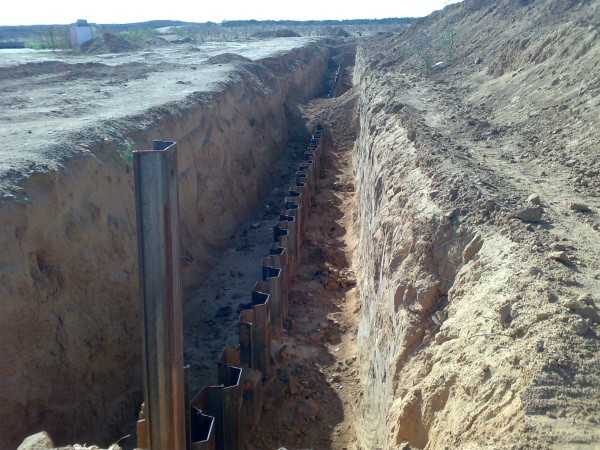
* the new Wall under construction by Egypt and the US which will tighten even further the siege of Gaza;
* the contempt for Palestinian democracy shown by Israel, the US, Canada, the EU and others after the Palestinian elections of 2006;
* the war crimes committed by Israel during the invasion of Gaza one year ago;
* the continuing discrimination and repression faced by Palestinians within Israel;
* and the continuing exile of millions of Palestinian refugees;
* all of which oppressive acts are based ultimately on the Zionist ideology which underpins Israel;
* in the knowledge that our own governments have given Israel direct economic, financial, military and diplomatic support and allowed it to behave with impunity;
* and mindful of the United Nations Declaration on the Rights of Indigenous People (2007)
We reaffirm our commitment to:
Palestinian Self-Determination
Ending the Occupation
Equal Rights for All within historic Palestine
The full Right of Return for Palestinian refugees
We therefore reaffirm our commitment to the United Palestinian call of July 2005 for Boycott, Divestment and Sanctions (BDS) to compel Israel to comply with international law.
To that end, we call for and wish to help initiate a global mass, democratic anti-apartheid movement to work in full consultation with Palestinian civil society to implement the Palestinian call for BDS.
Mindful of the many strong similarities between apartheid Israel and the former apartheid regime in South Africa, we propose:
1) An international speaking tour in the first 6 months of 2010 by Palestinian and South African trade unionists and civil society activists, to be joined by trade unionists and activists committed to this programme within the countries toured, to take mass education on BDS directly to the trade union membership and wider public internationally;
2) Participation in the Israeli Apartheid Week in March 2010;
3) A systematic unified approach to the boycott of Israeli products, involving consumers, workers and their unions in the retail, warehousing, and transportation sectors;
4) Developing the Academic, Cultural and Sports boycott;
5) Campaigns to encourage divestment of trade union and other pension funds from companies directly implicated in the Occupation and/or the Israeli military industries;
6) Legal actions targeting the external recruitment of soldiers to serve in the Israeli military, and the prosecution of Israeli government war criminals; coordination of Citizen’s Arrest Bureaux to identify, campaign and seek to prosecute Israeli war criminals; support for the Goldstone Report and the implementation of its recommendations;
7) Campaigns against charitable status of the Jewish National Fund (JNF).
We appeal to organisations and individuals committed to this declaration to sign it and work with us to make it a reality. Continue reading →
A s a group of Israeli peace activists gathered near the Erez crossing on the northern border of the Gaza Strip, 1200 international activists with the ‘Gaza Freedom March’ held a rally in Cairo to commemorate the one-year anniversary of the Israeli invasion of Gaza. The Cairo march was attacked by Egyptian police, injuring several demonstrators.
After over 1200 international delegates with the ‘Gaza Freedom March’ were denied entry into the Gaza Strip on Wednesday (100 members of the delegation were allowed to enter), the group organized a protest march and rally in Cairo Thursday, which was attacked by Egyptian riot police. [continued…]
There was very little discussion of political ideas, and what Mick offered was pithy and inspiring: We were here because it was “an obscenity in the 21st century” that the people of Gaza did not have the freedom to come and go. The walls had come down in Berlin and South Africa, they must come down here.
A lot of the questions were about violence. The Egyptians had shown little appetite for hurting westerners, but you did not know. And what if you felt uncomfortable with the idea of being arrested or clubbed? “The demonstration is for everyone,” Mick said. “There’s always the option of walking away and saying, enough is enough.” Those who wanted to observe and support could do that. There would not be “a scintilla” of pressure on anyone to do what they did not want to do.
Sitting on the stairwell, I wondered what I was doing there. The jammed space had a romance, an air of the many freedom marches before this; and the word “provocateurs” was redolent of socialist activism. I’m not a radical, but a left/liberal; the doorways for my engagement here was not solidarity with suffering people but good old self interest: my concerns about American militarism in the Middle East and Zionism in Jewish life. And yet here I was; and it occurred to me that certain injustices become so disturbing to some people, to their understanding of history, that they must take a stand, and are willing to make great sacrifices to do so; and in that sense I was also a radical, if a reluctant one. [continued…]
Iranian authorities sent police officers into the streets to deter protests on Friday as Mir Hussein Moussavi, the principal opposition leader, said in a statement that he did not fear giving his life as “a martyr.”
The continuing show of force in the capital and Mr. Moussavi’s declaration, in which he said that even killing him would not end the unrest, were part of a day of charges, countercharges and warnings from both sides, illustrating the deep divisions that have emerged since Iran’s political crisis began six months ago.
The government and its hard-line supporters continued to rely on force, and the threat of force, to quell protests and demand loyalty, while the opposition refused to back down. There was no indication that compromise was on the agenda. [continued…]
An opposition news website is reporting that Iran has imported high-tech armored anti-riot vehicles equipped with water cannons that can douse people with boiling water or teargas.
The U.S.-based Persian-language news website Rahesabz, or Green Path, posted a photograph of what it described as a photograph of two of the trucks arriving at the Iranian port city of Bandar Abbas in the south.
Iran-trucks3 The website said the vehicles were a rush order from their manufacturers in China, Dalian Eagle-Sky, according to the blogger Sohrebestan. [continued…]
Wednesday’s Washington Post contains a rundown of the Obama administration’s current thinking on Iran sanctions. The bottom line: administration officials are increasingly open to sanctions, but want to find ways to target the Revolutionary Guard and other hardline elements within the regime without inflicting needless suffering on the civilian population. For that reason, the administration shows “little apparent interest in legislation racing through Congress that would punish companies that sell refined petroleum to Iran,” whose brunt would be borne by the most vulnerable segments of the populace. (”Look, we need to be honest about this,” neoconservative foreign policy guru Fred Kagan admitted this spring. “Iranians are going to die if we impose additional sanctions.”)
Even these more finely targeted sanctions appear to be more than the Iranian opposition desires. Spencer Ackerman, in his useful discussion of the Green Movement’s position on sanctions, notes that some elements of the opposition have come to view sanctions that specifically target the Revolutionary Guards in a more favorable light, but it appears that most continue to oppose sanctions in any form. (And of course, it appears that virtually no one in the Green Movement supports refined petroleum sanctions, which opposition leaders have repeatedly denounced.) [continued…]
Iran set a one-month deadline Saturday for the West to accept its counterproposal to a U.N.-drafted nuclear plan and warned that otherwise it will produce reactor fuel at a higher level of enrichment on its own.
The warning was a show of defiance and a hardening of Iran’s stance over its nuclear program, which the West fears masks an effort to develop a nuclear weapons capability. Tehran insists its program is only for peaceful purposes, such as electricity production, and says it has no intention of making a bomb.
”We have given them an ultimatum. There is one month left and that is by the end of January,” Foreign Minister Manouchehr Mottaki said, speaking on state television. [continued…]
Both Afghan and Pakistani Taliban groups claimed responsibility for the suicide bombing this week that killed eight Americans — seven of them C.I.A. officers — suggesting that the attack was viewed as a success and could be used to gain recruits and financial support.
The competing claims, made Thursday and Friday, did little to clarify the circumstances of the attack, as each group offered a different account of how the C.I.A. base in Khost Province, in southeastern Afghanistan, had been infiltrated on Wednesday.
The Afghan Taliban said the suicide bomber was a disillusioned Afghan National Army soldier, supporting accounts from NATO officials that the attacker was wearing a uniform over his suicide vest.
The Pakistani Taliban said the attacker was someone the C.I.A. had recruited to work with them, who then offered the militants his services as a double agent. [continued…]
An American intelligence official vowed Thursday that the United States would avenge a suspected terrorist attack on a U.S. base in Afghanistan that resulted in the deaths of seven CIA officers.
Two of those killed were contractors with private security firm Xe, formerly known as Blackwater, a former intelligence official told CNN. The CIA considers contractors to be officers. [continued…]
It was an operation by what are euphemistically called “other government agencies” that was alleged to have killed a number of students in Kunar province on Saturday, causing widespread anger in Afghanistan.
CIA-led night raids such as this have proved controversial before. A UN-commissioned report last year from Philip Alston, director of the New York Centre for Human Rights, claimed that such raids raised issues under humanitarian and international law.
The report criticised the “opaque” use of ultra-secretive CIA units operating alongside irregular Afghan militias such as the Pashai.
Professor Alston complained that many raids were “composed of Afghans but with a handful, at most, of international people directing it” and were “not accountable to any international military authority”.
Such units answer directly to the Pentagon rather than to the Nato command structure, and their operations are often so secretive that even other US forces operating nearby are sometimesmay be unaware of them. [continued…]
Cars breezed by the trimmed green hedges and flowers of Baghdad’s Nisoor Square on Friday, while pedestrians strolled past billboards of smiling men and women promoting national elections. Little trace was left of the September 2007 day when Blackwater security guards opened fire on the crowded intersection, killing 17 civilians.
On Thursday, a judge in a U.S. federal court had thrown out the criminal prosecution of five Blackwater guards involved in the shootings. The consequences of that decision were still being felt Friday by survivors of the attack, politicians and ordinary Iraqis, who expressed feelings of helplessness at the hands of the United States.
The Iraqi government vowed to seek an appeal. Victims and others said they doubted they would ever see justice, convinced the American government considers their blood cheap.
U.S. District Judge Ricardo Urbina ruled that prosecutors of the five security guards had wrongly relied on statements the defendants made to State Department investigators under the promise of immunity. The guards, who were facing counts of manslaughter and firearms violations, maintained they opened fire in response to an attack. Iraqis dispute that. [continued…]
Iraq said Friday that it will file a lawsuit against five Blackwater security guards cleared of manslaughter charges in the 2007 killing of 17 Iraqi civilians, an act a government official called murder.
The Iraqi government also will ask the U.S. Justice Department to appeal a federal judge’s “unfair and unacceptable” dismissal of the charges Thursday, spokesman Ali al-Dabbagh said.
An Iraqi man wounded in the 2007 incident also voiced his anger Friday, saying U.S. District Judge Ricardo Urbina’s dismissal of the charges showed “disregard for Iraqi blood.” [continued…]
On 30 November 2009 Foreign Policy magazine published its ’Top 100 Global Thinkers’ list. We were naturally skeptical since the selection included Dick Cheney, General Petraeus, Larry Summers, Thomas Friedman, Bernard-Henri Lévy, David Kilcullen, Ayaan Hirsi Ali, Salam Fayyad, The Kagan Family (yes, all of them) and Ahmed Rashid among others. We don’t consider any of these people thinkers, let alone having global significance, and we couldn’t help but notice that the main thrust of all their work aligns with the global military and economic agenda of the US government. In response we asked twelve of our writers and editors to nominate their Top 20 global thinkers of 2009. Our criteria included choosing those who inspire critical thinking, as well as those who have been able to buck received wisdom and shape public debate. Always agreeing with their statements and positions was not a requisite, but in all cases our selections involved nominating those who have spurred people to challenge or enhance their own thinking in different ways. The following is our unranked list. [continued…]
After we published our list of 20 Top Global Thinkers, we thought we would be remiss if we did not also honor those media figures and institutions who bring these voices to us in the first place. With the goal of recognizing those individuals and institutions responsible for exemplary reportage and awareness-raising in 2009, we asked our editors and writers to name their choices for the top 20 media figures, be they journalists, publications or publishers. We aggregated these nominations into the following list. Like our 20 Top Global Thinkers, our criteria for choosing media figures included people/publications/publishers who have shown a commitment to challenging power, holding it accountable, highlighting issues pertaining to peace and social justice and producing output that encourages critical thinking and questions conventional wisdom. [continued…]
Here we go again. Another botched terrorist attack, and a much-needed excuse for some agenda-driven American ideologues to demand opening “new fronts” in the “war on terror”, with “profiling” of Muslims at airports expected to be at the core of the airport security review announced yesterday by Gordon Brown. I am sorry, but that thinking is wrong, flawed, and will make matters worse.
Yemen is not a willing home to al-Qaeda – it is victim to an ideology exported from neighbouring Saudi Arabia. In our desire to blame and, eventually, bomb, let us not forget the other Yemen: one of the last bastions of traditional, serene Islam. Yemeni Sufis have been imparting their version of normative Islam for centuries through trade and travel. Hundreds of British Muslims have been studying in Yemen’s pristine Islamic institutions. They have returned to Britain connected to an ancient chain of spiritual knowledge and now lead several Muslim communities with the Sufi spirit of love for humans, dedication to worship, and service to Islam. [continued…]
U.S. President Barack Obama has for the first time publicly accused an offshoot of al-Qaeda over the alleged Christmas Day bomb plot to blow up a US plane.
He said it appeared Yemen-based al-Qaeda in the Arabian Peninsula had armed and trained the accused, 23-year-old Nigerian Umar Farouk Abdulmutallab. [continued…]
Mr Abdulmutallab’s story demonstrates how difficult it is to build a stereotype of the radical Islamist willing to give his life for the jihadist cause.
Students who shared classrooms and accommodation with Mr Abdulmutallab in Yemen and Britain describe a young man who befits the image portrayed in the photograph – smiling, intelligent and good-looking. He was devoutly religious – in the picture he dons a white Muslim skullcap – but did not display outward signs of extremism, they say. Rather, he was quiet and kept to himself – more introvert than fanatic.
Other Africans, from Comoros, Kenya and Somalia, who have been involved in al-Qaeda activities, have come from humbler backgrounds. But Mr Abdulmutallab was born into Nigeria’s elite, and there is little in his African background to suggest he was a terrorist in the making. [continued…]
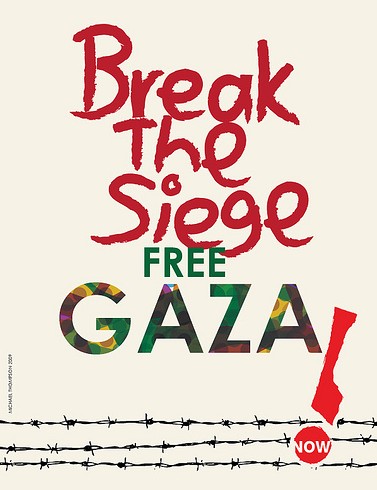
One year has passed since the savage Israeli attack on the Gaza Strip, but for the people there time might as well have stood still.
Since Palestinians in Gaza buried their loved ones – more than 1,400 people, almost 400 of them children – there has been little healing and virtually no reconstruction.
According to international aid agencies, only 41 trucks of building supplies have been allowed into Gaza during the year.
Promises of billions made at a donors’ conference in Egypt last March attended by luminaries of the so-called “international community” and the Middle East peace process industry are unfulfilled, and the Israeli siege, supported by the US, the European Union, Arab states, and tacitly by the Palestinian Authority (PA) in Ramallah, continues. [continued…]
Editor’s Comment — Ali Abunimah, who has just left Cairo after attending the thwarted Gaza Freedom March, adds on his blog:
To talk about the siege of Gaza in the abstract is one thing, but to actually come to Egypt and find that Gaza is harder to visit than a prison is like a bucket of cold water. The Egyptian government may be efficient at few things, but it is highly efficient at maintaining the siege. Buses hired to take all the marchers to Gaza were prevented from showing up. Those who tried to get to Gaza under their own steam were turned back or detained at their hotel in Al Arish. It was very very frustrating. But whatever frustration we felt is one millionth of the frustration of the besieged Palestinian people in Gaza. So perhaps in some way it is better then that we did not get in, because Egypt gave us a small taste of what it serves every day to people in Gaza — and a small taste of what Egyptians face when they challenge their government’s policies.
The question was like an electric shock to the six or so Palestine solidarity activists, including myself, as we were standing inside a classroom at a school in Gaza City.
“Why the Palestinians? Why are we the only ones suffering?” asked a Palestinian girl who was probably about nine or ten-years-old. And then the enormity of what the people of Gaza go through every day hit me.
Most of us were Americans and one was Canadian, and we were delivering some of the $17,000 in school supplies that Jessica Campbell and Julia Hurley, two members of the Gaza Freedom March student delegation, had brought and raised on their own. [continued…]
…there is perhaps no better time than this to review Israel’s 10 Worst Mistakes of the Last 10 Years:
1. The Siege of Gaza – The stated goal of the siege was to undermine Hamas and to goad Gazans into rejecting Hamas rule. The effect of the siege has been to focus and intensify Palestinian anger against Israel, increase Gazans’ dependency on Hamas social welfare arms, enrich Hamas coffers through tunnel taxation and foreign donations, and sap Palestinian support for Fatah, which, through its back-channel encouragement for the siege, is seen as a betrayer and a boot-licker in the eyes of many Palestinians.
2. The Siege of Gaza – The blockade was ostensibly a means to stem the influx of weaponry into Gaza. In practice, with shipments the size of automobiles flowing through the tunnels, the Hamas arsenal has grown ever more sophisticated, now believed to include Iranian-manufactured rockets capable of striking Tel Aviv and Ben-Gurion Airport from the Strip.
3. The Siege of Gaza – In the eyes of the world community, the overwhelming collective punishment – and the relative silence of Israelis in response – has gutted Israeli claims to the moral high ground. It has undercut sympathy for Israelis living within Qassam range. It has kept open the moral wounds of the Gaza War, cramping rebuilding efforts, enshrining universal unemployment, and ensuring agonizing homelessness as the coastal winter gathers full force. Israeli officials have quietly take steps of astounding insensitivity, arbitrarily barring such goods as school supplies.
4. The Siege of Gaza – The siege has been presented in the past as a means of pressing Hamas to release Gilad Shalit. Not only does he remain captive, the terms of a prospective deal appear not to include lifting the siege. The siege has been presented in the past as a means of pressuring Gazans to end rocket fire. But rocket fire only increased after the siege was put in place. Finally, Cast Lead, the Gaza war a year ago, might have been prevented altogether, had Israel adhered more closely to the Egyptian-brokered Hamas-Israel truce agreement of June, 2008, and lifted the siege more completely in response to a drop in rocket fire.
5. The Siege of Gaza – The siege works to the detriment of U.S. support for Israel. In February, Secretary of State Hillary Clinton signaled anger at Israel over obstacles to humanitarian aid entering the strip. The message came soon after Senate Foreign Relations Committee Chairman John Kerry, visiting Gaza, learned that Israel had blocked shipments of pasta, ruling it off the list of permitted humanitarian aid items.
6. The Siege of Gaza – The fact that the siege has failed so completely in achieving its stated aims, reinforces the impression that its real purpose is punitive.
7. The Siege of Gaza – The siege places Israeli officials in jeopardy of being charged with violating the Fourth Geneva Convention and other international codes, as outlined in detail in the Goldstone Report. Referring to the siege, paragraph 1335 of the report states that: “From the facts available to it, the Mission is of the view that some of the actions of the Government of Israel might justify a competent court finding that crimes against humanity have been committed.”
8. The Siege of Gaza – With the siege under the direct aegis of Defense Minister Ehud Barak and his deputy, Matan Vilnai, the moral failings of the siege could prove the coup de grace to an already foundering Labor Party.
9. The Siege of Gaza – The siege threatens to destabilize the rule of Hosni Mubarak in Egypt, posing a potential threat to Israeli-Egyptian peace and Israeli security.
10. The Siege of Gaza – The siege corrupts the moral values of all Israelis, who, whether or not they are aware of what is being done to the people of Gaza, bear ultimate responsibility for all acts being carried out in their name. [continued…]
Iran’s opposition leader on Friday pledged to remain defiant in the face of new threats — including calls by hard-liners for his execution — and said he was ready to sacrifice his life in defense of the people’s right to protest peacefully against the government.
Mir Hossein Mousavi’s remarks come after the worst unrest since the immediate aftermath of the disputed June presidential election. At least eight people died during anti-government protests on Sunday, including Mousavi’s nephew.
In one of his strongest statements to date, Mousavi said he was “ready for martyrdom” — the sacrifice of one’s life for a higher cause — and lashed out at the bloody crackdown the authorities are waging against the opposition. [continued…]
As the deadline for Iran to respond to the international community’s offer regarding its nuclear program passed Thursday, the US has toughened its rhetoric and is looking increasingly to sanctions rather than diplomacy.
That has pleased Israel, which wants strong action against the Islamic Republic as it continues to enrich uranium in defiance of international demands and has rejected US President Barack Obama’s outstretched hand.
The next step, according to Ambassador to the US Michael Oren, should be “imposing crippling sanctions” on the Teheran regime, which is in keeping with the pledge Oren said Obama made to Prime Minister Binyamin Netanyahu in May that the US would end the engagement phase toward Iran if it were unsuccessful by year’s end.
Oren told The Jerusalem Post that “there isn’t an Israeli view and an American view” on the Iranian question, but rather “one view.” [continued…]
Editor’s Comment — Israel is desperate to sustain the myth that Israeli and American interests are indistinguishable from one another, yet Israel’s insistence on pushing for crippling sanctions at this moment exposes the ugly truth: Israel regards the Iranian opposition movement as a threat.
If the Islamic Republic’s regime collapses, Israel will lose its indispensable enemy. An Israel that can no longer drum up support on the basis that it faces a so-called existential threat will find it much harder to cloak its own brutality.
The advance of democracy in Iran means the advance of Israel’s international status as a pariah state. If they could now secretly send advisers to coach Ayatollah Khamenei on how to most effectively suppress the uprising, I have little doubt the Israelis would gladly do so.
In a sign that this was a decade that many people would sooner forget, the 2000s came to an end without finding a name.
For Alan Philips, writing in The National: “The defining characteristic of the past 10 years is how much we have been deceived – by political leaders, economic gurus and indeed by ourselves. It has been a decade of deception.”
Time magazine declared under a headline reading Goodbye (at last) to the Decade from Hell: “Bookended by 9/11 at the start and a financial wipeout at the end, the first 10 years of this century will very likely go down as the most dispiriting and disillusioning decade Americans have lived through in the post-World War II era.” [continued…]
There’s a question we Israelis won’t ask ourselves about the Palestinians, especially not about Gaza. The question is taboo. Not only won’t anyone ask it out loud, but very, very few people will dare ask it in the privacy of their own minds.
However, I think it’s time we start asking it, privately and in public. If we don’t, I think there’s going to be Operation Cast Lead II, then Operation Cast Lead III, and each one is going to be worse than the last, and the consequences for Palestinians and Israelis are going to be unimaginable.
The question we have to ask ourselves is this: If anybody treated us like we’re treating the people in Gaza, what would we do?
We don’t want to go there, do we? And because we don’t, we make it our business not to see, hear or think about how, indeed, we are treating the people in Gaza. [continued…]
Word from Gaza is that 6,000 marched — the maximum allowed by Hamas in absence of international shield — civil society march under Palestinian flag only. Govt felt march route too exposed and too narrow for more to march if Israeli attack was possible. [continued…]
Members of the Gaza Freedom March are being forcibly detained in hotels around town (Lotus, Liala) as well as violently forced into pens in Tahir Square by Egyptian police and additional security forces. Reports of police brutality are flooding a delegate legal hotline faster than the legal support team can answer the calls. The reports span from women being kicked, beaten to the ground and dragged into pens, at least one confirmed account of broken ribs, and many left bloody. The assault is ongoing, legal team and other spokespeople can be reached at the Nile Hotel or by contacting the phone numbers listed above. [continued…]
Today the Gaza Freedom March fragmented slightly when in the face of stern opposition from their fellows about 80 people headed off to Gaza on buses, the rest staying in Cairo.
But wait, weren’t you trying to go to Gaza? Yes, but it has been quite a drama. How to state this clearly…
Over the last week, as the international marchers arrived in Egypt, the Egyptian Foreign Ministry made it very clear that it did not want them going into Gaza, and it would arrest them short of that goal. But these 1400 are not tourists or milquetoasts, they are activists; and they were not going to be stopped by any old Ministry, even the ministry of a police state. Many set out by bus and taxi to the Sinai desert, while the 300 members of the French group camped out in front of the French Embassy across from the Cairo Zoo, demanding to go even as they were ringed by riot police. [continued…]
As anti-government protests — and government repression — flare in Iran, Jewish groups remain focused on the issue of nuclear proliferation there, prioritizing this problem over concern for the country’s opposition movement.
In interviews, Jewish leaders voiced sympathy for the cause of democracy backed by the protesters. But even as the administration is reportedly considering a shift to a strategy of narrow, targeted sanctions toward Iran — in part to take account of the surging protest movement — the Jewish community remains committed to more sweeping sanctions that Iran’s democracy activists decry as harmful to their cause.
The proliferation issue, Jewish activists say, should come first.
“For us, this was always the primary concern, because a nuclear Iran is an existential threat to Israel,” said Meagan Buren, director of research and training at The Israel Project, a pro-Israel group active on the Iranian issue. [continued…]
The mayhem that has swept over Iran in the past few days is once more calling into question the Islamic Republic’s longevity. Recent events are eerily reminiscent of the revolution that displaced the monarchy in 1979: A fragmented, illegitimate state led by cruel yet indecisive men is suddenly confronting an opposition movement that it cannot fully apprehend. It is premature to proclaim the immediate demise of the theocratic regime. Iran may well be entering a prolonged period of chaos and violence. In the aftermath of recent disturbances, however, it is obvious that the lifespan of the Islamic Republic has been considerably shortened.
In retrospect, the regime’s most momentous, and disastrous, decision was its refusal to offer any compromises to an angered nation after the fraudulent presidential election in June. The modest demands of establishment figures such as Ali Akbar Hashemi Rafsanjani, including for the release of political prisoners and restoring popular trust (via measures such as respecting the rule of law and opening up the media), was dismissed by an arrogant regime confident of its power.
Disillusioned elites and protesters who had taken to the streets could have been unified, or their resentment assuaged, by a pledge by Supreme Leader Ayatollah Ali Khamenei for the next election to be free and fair, for government to become more inclusive or for limits to be imposed on President Mahmoud Ahmadinejad’s prerogatives. Today, such concessions would be seen as a sign of weakness and would embolden the opposition. The regime no longer has a political path out of its predicament. Ironically, this was the shah’s dilemma, as he made concessions too late to fortify his power and broaden the social base of his government. [continued…]
On Wednesday, the Islamic Republic of Iran reacted to last Sunday’s violent demonstrations by marshaling supporters in countrywide demonstrations and launching a media offensive against the opposition Green Movement.
At least 37 people were killed Sunday on the deadliest day of rioting since June’s disputed presidential election, which saw hard-line President Mahmoud Ahmadinejad returned to office amid widespread elections of fraud. For the first time, demonstrators switched from nonviolent tactics to engage the police with stones and batons. In response, the police fired tear-gas and bullets.
Government-funded newspapers lashed out Wednesday at the thousands of demonstrators who fought running battles with security forces during Shiite Islam’s major festival, labeling them “apostates” and calling for their “arrest and execution.” [continued…]
Behind the drama unfolding in the streets of Iran, the regime is quietly clamping down on some of the nation’s best students by derailing their academic and professional careers.
On Wednesday, progovernment militia attacked and beat students at a school in northeastern Iran. Since last Sunday’s massive protests nationwide, dozens of university students have been arrested as part of an aggressive policy against what are known as Iran’s “star students.”
In most places, being a star means ranking top of the class, but in Iran it means your name appears on a list of students considered a threat by the intelligence ministry. It also means a partial or complete ban from education.
The term comes from the fact that some students have learned of their status by seeing stars printed next to their names on test results.
Mehrnoush Karimi, a 24-year-old law-school hopeful, found out in August that she was starred. She ranked 55 on this year’s national entrance exam for law schools, out of more than 70,000 test-takers. That score should have guaranteed her a seat at the school of her choice. Instead, the government told her she wouldn’t be attending law school due to her “star” status. [continued…]
A bomber slipped into a U.S. base in eastern Afghanistan on Wednesday and detonated a suicide vest, killing eight CIA officers in one of the deadliest days in the agency’s history, current and former U.S. officials said.
The attack took place at Forward Operating Base Chapman in Khowst province, an area near the border with Pakistan that is a hotbed of insurgent activity. An undisclosed number of civilians were wounded, the officials said. No military personnel with the U.S. or North Atlantic Treaty Organization forces were killed or injured, they said.
A U.S. official who spoke on condition of anonymity said the CIA had a major presence at the base, in part because of its strategic location. [continued…]
In a written statement, the Taliban calls 2009 “a successful year for mujahedeen” and says it is determined to drive coalition forces out of Afghanistan in 2010.
“Last year the guerrilla warfare, frontline war, attacks and road mines against the invaders increased as the enemy began to cry out for reconciliation,” said the statement, obtained by CNN on Wednesday.
“The enemy does not have a constant policy,” the unsigned statement said. “Sometimes they talk about sending more soldiers and other times they speak of an early withdrawal. Their thinking is irrational.” [continued…]
The fact that Obama doesn’t hysterically run around like some sort of frightened chicken with his head cut off every time Al Qaeda sneezes — or swagger to the nearest camera to beat his chest and play the role of protective daddy-cowboy — is one of the things I like best about him. As for Armao’s “point” about how Janet Napolitano probably took it easy because the “boss was away” — and her belief that Terrorists will strike more on holidays if Obama isn’t affixed to his chair in the Oval Office, as though he’s the Supreme Airport Screener: those are so self-evidently dumb it’s hard to believe they found their way even into something written by one of Fred Hiatt’s editorial writers.
What this actually illustrates is that many people are addicted to the excitement and fear of Terrorist melodramas. They crave some of that awesome 9/12 energy, where we overnight became The Greatest Generation and — unified and resolute — rose to the challenge of a Towering, Evil Enemy. Armao is angry and upset because the leader didn’t oblige her need to re-create that high drama by flamboyantly flying back to Washington to create a tense storyline, pick up a bullhorn, stand on some rubble, and personally make her feel “safe.” Maureen Dowd similarly complained today that Obama “appeared chilly in his response to the chilling episode on Flight 253.”
That’s because Obama reacted as though this is exactly what it actually is: a lame, failed attempt to kill people by a fractured band of criminals. It’s not the Cuban Missile Crisis or the attack on Pearl Harbor, as disappointing and unfulfilling as it is to accept that. It merits analysis, investigation and possibly policy changes by the responsible government agencies — not a bright-red-alert, bell-ringing, siren-sounding government-wide emergency that venerates Al Qaeda into a threat so profound that the President can’t even be away from Washington lest they get us all. As always, Al Qaeda’s greatest allies are the ones in the U.S. who tremble with the most fear at the very mention of their name and who quite obviously crave a return of that stimulating, all-consuming, elevating 9/12 glory. [continued…]
Members of an international group gathered in Cairo to protest against the siege of Gaza have rejected an Egyptian offer to allow 100 of them entry into the Palestinian territory.
Organisers of the Gaza Freedom March (GFM), which is comprised of 1,300 people from 42 different countries, declined the offer on Wednesday, saying “we refuse to whitewash the siege of Gaza”. [continued…]
While Egypt is reported to be receiving technical assistance from the United States in constructing an underground steel barrier along Gaza’s southern border, Egypt’s foreign minister, Ahmed Aboul Gheit, told The National: “The Egyptian state and people paid a very high price and paid with their blood for more than 50 years in support of the Palestinians. No one should compare himself with what Egypt did and is still doing for the Palestinians.”
In Beirut, Hizbollah Secretary General Sayyed Hassan Nasrallah urged Egypt to stop building the barrier which could cut off the tunnels that currently provide a lifeline for the Palestinian territory which remains under an Israeli-imposed siege.
The Daily Star reported: “Nasrallah told a crowd of tens of thousands of Lebanese Shiite Muslims marking the Ashura religious ceremony that Egypt should be condemned if it does not halt the wall building. [continued…]
Then Habiba’s elderly husband was badly beaten in a village brawl there was only one place, she said, that she could turn to for help and justice.
Barefoot and weeping, the farmer’s wife, 50, trekked for four hours through Afghanistan’s Hindu Kush mountains to meet the local Taleban commander.
“My feet were bleeding and I cried the whole way but I didn’t care about my safety,” she said. “We are poor people. We know the Government doesn’t help people like us.”
Corruption and incompetence in President Karzai’s Government — particularly at local level — have forced a growing number of people to seek the services of the Taleban.
The shadow government is not limited to justice. In Helmand, in August, Taleban commanders issued printed travel permits on headed notepaper from the “Islamic Emirate of Afghanistan” to let people through checkpoints on the roads in and out of Lashkar Gah, the provincial capital. [continued…]
Egyptian security forces have attempted to prevent dozens of US activists from reaching their embassy in Cairo.
Hoping to ask the American ambassador for help in reaching the Gaza Strip on Tuesday, some 41 American citizens instead found themselves surrounded by riot police.
All those rounded up were members of the Gaza Freedom Marchers organisation, a group planning to travel to Gaza to protest an Egyptian and Israeli blockade of the besieged territory.
However, one activist, Ali Abunimah, a co-founder of The Electronic Intifada website, told Al Jazeera that the US embassy did eventually allow US citizens to enter their embassy in groups of ten.
“We met with a political rep. in the embassy, Greg Legrefo, and talked about the dire situation in Gaza and international complicity for more than hour …. but the bottom line is the US supports the siege of Gaza.
“The US Army Corps of Engineers is even providing technical assistance to build an underground wall [to stop the Gaza tunnel networks from operating].” [continued…]
As we approach the one year anniversary of Israel’s attack on Gaza, we are proud to be able to share with you an exclusive peek at Joe Sacco’s new book Footnotes in Gaza. Rather than focus on the current phase of the conflict, the book deals with an often forgotten, or unknown, event – the massacre of 111 Palestinians by Israeli forces in the Gaza towns of Rafah and Khan Younis in 1956. While these southern Gazan towns are currently in the news as the Gaza Freedom March and Viva Palestina convoy try to enter Rafah from Egypt, Sacco’s book takes us back to 1948 and 1956 to show us how we arrived at the point we are today.
We’ll be posting more on the book in coming weeks, including a more formal review and an interview with Sacco, but as we turn our eyes towards Gaza on this solemn anniversary, let us remember everything that came before it. [continued…]
This website or its third-party tools use cookies, which are necessary to its functioning. By closing this banner, you agree to the use of cookies.






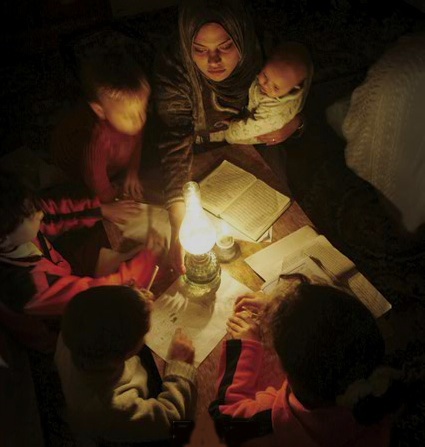 he question was like an electric shock to the six or so Palestine solidarity activists, including myself, as we were standing inside a classroom at a school in Gaza City.
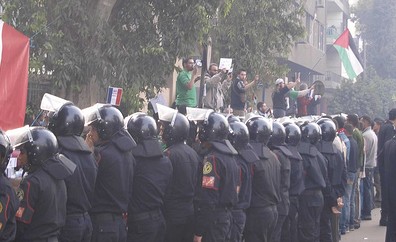 embers of an international group gathered in Cairo to protest against the siege of Gaza have rejected an Egyptian offer to allow 100 of them entry into the Palestinian territory.