Category Archives: Issues

GAZA UPDATE

Gaza: the war of words

Gaza aid convoy to take longer route after hold-up in Egypt

he aid convoy, stranded in Aqaba, Jordan, for five days, on its way to the Gaza Strip, turns back to Syria after Cairo’s refusal to let it cross through its territory.

Members of the convoy, led by British MP George Galloway, were hoping to reach a solution through Turkish mediation and enter Gaza through the Red Sea port of Nuweiba, the most direct route.

“After talks between the Turkish government’s envoy and the Egyptian consulate in Aqaba, we agreed to go to Syria,” Zaher Birawi, spokesman for the convoy, told Agence France-Presse.

“We have told the Egyptians that we were not trying to challenge them and urged them to help us, but they refused,” Birawi said. [continued…]

Editor’s CommentToday’s Zaman says: “Turkish Prime Minister Recep Tayyip Erdoğan said he supports the convoy and urged Egypt to allow the Turkish deputies to enter.” And the Viva Palestina Twitter feed adds: “Seems Turkish pressure means convoy will move to Syria (maybe on the road tonight) and Turkey will fund a chartered ship from Syria for ALL.”

85 year old Holocaust survivor Hedy Epstein begins hunger strike to open Gaza borders

Hedy Epstein, the 85 year old Holocaust survivor and peace activist, announced that she will begin a hunger strike today as a response to the Egyptian government’s refusal to allow the Gaza Freedom March participants into Gaza.
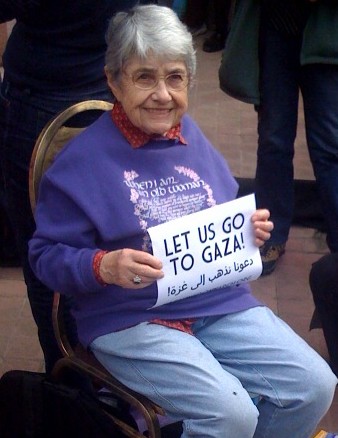
Ms. Epstein was part of a delegation with participants from 43 countries that were to join Palestinians in a non-violent march from Northern Gaza towards the Erez border with Israel calling for the end of the illegal siege. Egypt is preventing the marchers from leaving Cairo, forcing them to search for alternative ways to make their voices heard.

Ms. Epstein will remain outside the UN building at the World Trade Center (Cairo) – 1191 Cornish al-Nil, throughout today, accompanied by other hunger strikers. “It is important to let the besieged Gazan people know they are not alone. I want to tell the people I meet in Gaza that I am a representative of many people in my city and in other places in the US who are outraged at what the US, Israeli and European governments are doing to the Palestinians and that our numbers are growing,” Epstein said. [continued…]
(Photo credit: Ali Abunimah)

Freedom marching in circles while winding our way to Gaza

Yesterday we joined the people of Gaza, the people of all of Palestine, and allies around the world in remembering the anniversary of the inhuman and illegal Israeli attacks that stole the lives of more than 1,400 mothers, fathers, daughters, and sons last December and January. And, in a manner far too appropriately suited to remembering an unfathomably vicious massacre and the preposterous silence of the American and Egyptian governments, we freedom marched in circles throughout the streets of Cairo.

The Egyptian government has revoked the contracts for the buses that would take us one step closer on our journey to Gaza and has forbidden us from leaving Cairo. Military police have torn down our small hand-written cards tied to the Kasr al Nil Bridge, following the Israelis’ lead in trying to disappear the names and numbers of Gaza’s martyrs. Candles meant to float along the Nile in remembrance are still in their boxes, their hundreds of distributors never permitted to board the feluccas (river boats) waiting just beyond overwhelming security forces. We regroup, circle again, and find another path to remembering and reminding, another way through the many checkpoints and the impossible border ahead. [continued…]

A man-made humanitarian disaster

One year after the Zionist entity’s savage assault on the besieged refugee population of the Gaza Strip, a group of 16 international human rights and aid groups released a report documenting the wretched conditions under which the people of Gaza are inexplicably left to suffer.

We hear much of this suffering, but all too often it’s just an afterthought in the heat of political discussion. And for those who have never gone through such conditions, it will be impossible to understand the comprehensive breadth of the restrictions placed upon every facet of daily life in Gaza.

I hardly ever read these reports in full, usually just perusing the conclusions, but reading the detailed facts and figures mentioned in this one (entitled ‘Failing Gaza: No rebuilding, no recovery, no more excuses‘) really drives home the extent of the oppression. [continued…]

One year since Gaza war: no access by the numbers

Despite the fact that a year has passed since the start of the Gaza military operation, the damage caused by three weeks of war and the near total closure preceding it has yet to be repaired. The reason: Israel’s ongoing policy blocking goods from entering the Gaza Strip, including a near total ban on reconstruction materials. [continued…]


Facebooktwittermail

Gaza ceasefire in jeopardy as six Palestinians are shot

Gaza ceasefire in jeopardy as six Palestinians are shot

Israeli troops yesterday shot dead six Palestinians in two separate incidents, as evidence emerged that an increasingly fragile ceasefire between armed groups loyal to President Mahmoud Abbas’s Fatah movement and Israel appeared to be in danger of breaking down.

The shootings, the most serious violence in months, came a day before today’s first anniversary of the outbreak of Israel’s war against Gaza in which almost 1,400 Palestinians died – and as allegations have emerged from Israeli human rights campaigners who opposed the war that they are facing concerted attempts to silence them.

Three of the Palestinians were killed in an airstrike just inside the Gaza border. According to Israeli officials they had been scouting the area for a possible infiltration operation, but according to Hamas officials and medics they had been searching for scrap metal to salvage.

More serious in its implications, however, was the shooting dead of three members of Fatah’s armed wing – the al-Aqsa Martyrs’ Brigades – in a raid on the northern West Bank city of Nablus, apparently in retaliation for the shooting of an Israeli driving near the settlement at Shavei Shomron. Relatives who witnessed the Nablus shootings said soldiers fired at two of the men without warning. An Israeli army spokesman, Major Peter Lerner, said troops fired after the three men failed to respond to calls to surrender. [continued…]

Editor’s Comment — To be an Israeli soldier is to be able to murder with impunity. It’s as simple as that.

The reporting on the murder of three members of the Al Aqsa Martyrs Brigades is quite extraordinary. An Israeli commander is quoted saying: “we have the responsibility to act against whoever executed the attack [in which a Jewish settler was murdered on Thursday] and settle the score with them.”

Ynet reported: “The defense establishment is investigating why the three, who are considered fairly mature, decided to execute the attack themselves, and why they acted so shortly after being released from the Israeli prison.”

Suspects can be arrested and put on trial, but if settling scores is the name of the game then we’re not talking about suspects — we’re talking about targets for killing.

Haaretz reported: “According to B’Tselem, in two of the three cases the troops behaved as if they were preparing for an execution, not an arrest. Relatives and eyewitnesses told B’Tselem that the two were unarmed and did not attempt to flee, and that the soldiers weren’t trying to stop them, but rather shot them from close range once their identity was revealed. There were no witnesses to the shooting of the third man.”

Then we have what might be called the torturers’ defense: look, we didn’t suffer a scratch — proof that we were exercising restraint.

A senior IDF officer told Ynet: “The fact that no soldier was injured in the incident shows that we did not act too aggressively and that everything was done properly despite the extremely complex and dangerous mission.”

Meanwhile, Israel awaits Hamas’ response to the prisoner exchange offer for securing the release of Gilad Shalit… and a bomb goes off in Beirut killing two Hamas members.

Is Mossad trying to block the deal?

Facebooktwittermail

GAZA UPDATE

The Children of Gaza share their experiences of “Cast Lead”

Viva Palestina convoy held up in Jordan

Gaza aid convoy members prepare for hunger strike

Members of the Viva Palestina international aid convoy to Gaza will begin a hunger strike at 11.25am local time tomorrow (27th) in protest at the Egyptian government’s refusal to allow the convoy entry onto its soil.
Diplomatic negotiations are also taking place between the Turkish and Egyptian governments over the convoy’s entry to Egypt. IHH, Turkey’s main humanitarian aid agency, has 63 vehicles travelling on the convoy. [continued…]

Lift the siege on Gaza!

A massive mobilization between December 27, 2009 and January 1, 2010 with candlelight vigils, concerts, marches, demonstrations, art installations and movie screenings will assemble all over the world to send a clear message to world leaders: end the siege on Gaza.

To tackle the blockade against Gaza, grassroots activists are moving quickly and acting in unison for an absolutley crucial time. Dec. 27 will mark one year since the Israeli attack and invasion of the Gaza Strip. Although the Israeli tanks have left, the complete closure of the borders continues.

In order to unite the public to influence public leaders behind the Gaza Freedom March goals, solidarity action organizers harnessed the power of the internet to coordinate a global week of actions. There will be actions at many places around the world: France, United Kingdom, Turkey, Ireland, Germany, Spain, United States, Afghanistan, Australia, Belgium, Switzerland, Sweden, Jordan, Canada, Israel/Palestine, Poland, Denmark, and Greece. [continued…]

Gaza Freedom Marchers: 38 detained by Egypt

Egyptian security forces detained 38 participants of the Gaza Freedom March from a hotel in Al-Arish on Sunday at noon, according to a statement issued by the event’s organizers.

“Egyptian security forces detained a group of 30 internationals in their hotel in el-Arish and another group of 8 at the bus station. They also broke up a memorial action commemorating the Cast Lead massacre at the Kasr al Nil Bridge,” the statement asserted. [continued…]

Police detain 16 Israeli leftists on Gaza border

Police detained 16 left-wing activists as they were trying to cross into Gaza on Sunday to mark the one year anniversary of Operation Cast Lead.

Chief Superintendent Shimon Nahmani, commander of the Sderot police station, said the leftists held a rally without prior authorization. [continued…]

Hezbollah chief asks Egypt to stop Gaza border wall

Hezbollah leader Sayyed Hassan Nasrallah on Sunday called on Egypt to stop building a steel wall along the Gaza border that could obstruct tunnels which provide a lifeline for the blockaded enclave.

Nasrallah told a crowd of tens of thousands of Lebanese Shi’ite Muslim marking the Ashura religious ceremony that Egypt should be condemned if it does not halt the wall building. [continued…]

A year later, Gaza and Israel both under siege

A year after the Israeli attack on Gaza, a scorecard of “winners and losers” suggests that nobody won anything, but Israel has probably suffered political losses that it could not have envisioned when it decided to invade Gaza. I count seven main aims that Israel had in mind when it launched its war a year ago and tightened its siege of Gaza; one of them was achievable without a war, and the six others have not been achieved, or have turned things to Hamas’ and the Palestinians’ favor. [continued…]

Cast Lead 2

This week hundreds of thousands gathered in the Gaza Strip for a demonstration in support of Hamas. Judging from the photos, there were between 200 and 400 thousand. Considering that there are about 1.5 million inhabitants in the Strip, most of them children, that was quite an impressive turnout – especially in view of the misery caused by the Israeli blockade that has continued throughout the year and the ruined homes that could not be rebuilt. Those who believed that the pressure on the population would cause an uprising against the Hamas government have been proved wrong.

History buffs were not surprised. When attacked by a foreign foe, every people unites behind its leaders, whoever they are. Pity that our politicians and generals don’t read books.

Our commentators portray the inhabitants of Gaza as “looking with longing at the flourishing shops of Ramallah”. These commentators also derive hope from public opinion polls that purport to show that the popularity of Hamas in the West Bank is declining. If so, why is Fatah afraid of conducting elections, even after all Hamas activists there have been thrown into prison?

It seems that most of the people in the Gaza Strip are more or less satisfied with the functioning of the Hamas government. In spite of the misery of their lives, they may also be proud of its steadfastness There is order in the streets, crime and drugs are decreasing. Hamas is trying cautiously to promote a religious agenda in daily life, and it seems that the public does not mind.

The main aim of the operation has failed completely. [continued…]

Such brutal folly – but now prepare for Cast Lead II

There were no winners in the Gaza war that Israel launched a year ago today, but no shortage of losers. And failure to address its underlying causes – the economic siege through which Israel, Egypt and the US hope to force Hamas from power, and that organisation’s ability to respond by firing rockets into Israel – means that far from anyone learning the lessons of the brutal folly that was Operation Cast Lead, a repeat may be imminent. [continued…]

European Israel-advocacy group files suit against Goldstone report in Belgium

As Netanyahu and other Israeli leaders act to remove Israel from the international criminal justice system, some Israelis and their supporters in Europe are fighting back. The following was published in Yedioth Aharonoth on December 24, 2009.

Yesterday the pro-Israel lobby, the European Initiative, submitted in Belgium a lawsuit of a kind never filed before. The prospective defendants are the entire Hamas leadership; the plaintiffs are people with Belgian citizenship who live in the Gaza periphery communities and who have been targeted by dozens of rockets in the past number of years.

In the aftermath of the wave of lawsuits that were filed by pro-Palestinian organizations in the past number of years in Europe to have top Israeli officials arrested, yesterday a legal counter-assault was staged. Following six months of preparatory work, yesterday the pro-Israel lobby lodged an itemized legal complaint to the Belgian Federal Prosecutor’s Office with the demand that the top Hamas leadership in Gaza and Damascus be prosecuted for war crimes and crimes against humanity. The suit, incidentally, is based on the Goldstone Report, as well as on reports by B’Tselem and Amnesty International.

Not only does the suit explicitly accept the principle of international jurisdiction over criminal offenses committed in the context of the Israeli-Palestinian conflict, it is based on reporting by NGOs whose integrity is frequently attacked by the Government of Israel. The most surprising component of this development is, however, the endorsement of the validity of the Goldstone Report. [continued…]

Facebooktwittermail

GAZA UPDATE

Viva Palestina convoy blocked from entering Egypt

Deserts, delays and Christmas cheer

Once more, kind hosts among the Palestinian community in Amman provided food and hotel accommodation for us, as well as a full programme of rallies and press conferences. Many of our hosts invited volunteers to their houses, where they enjoyed home-cooked food and convivial company.

By now, the convoy had become a major news story (in some cases the lead story) across the Middle East. The Turkish president even appeared on Syrian TV asking Egypt to facilitate its smooth passage.

Sadly, however, this appeal seems to have fallen on deaf ears. Despite Viva Palestina’s organisers spending months trying to coordinate and cooperate with the Egyptian authorities regarding the convoy’s passage from the Red Sea to Rafah (only half a day’s drive), at the last minute, the Egyptian consulate in Aqaba announced that all aid for Gaza must either be handed over to UNWRA, travel through Israel, or be approved by Israel (!) before coming to Rafah, and that therefore we would not be allowed to land at Nuweiba.

In a meeting with the convoy volunteers on Christmas morning, George Galloway pointed out that if we thought UNWRA was up to the job, we could have simply written them a cheque months ago! He also reiterated that we had no intention of asking Israel for its permission to deliver aid to a sovereign people via a third, also sovereign, country. He begged the Egypian authorities to change their minds, emphasising that on Sunday 27 December, the anniversary of the bombardment of Gaza, the world’s attention should be on Israel and its war crimes, not on Egypt, a fellow Arab nation. [continued…]

What would Jesus do in Gaza?

Maybe it seems beside the point, even on the eve of Christmas, to ask ourselves what would Jesus do in the Holy Land today. The narrow confines of Gaza, Jerusalem, Judea, and Samaria are places where God’s love was long ago supplanted by war for land and ill will among men. It has been a year now since the bloody and fruitless Israeli effort to crush Hamas in what amounts to a massive prison for a million people. Peacemakers in the Middle East are rarely blessed, and often reviled; just ask special envoy George Mitchell. And the truth rarely sets anyone free, as proved most recently by the fact-filled United Nations report by South African Judge Richard Goldstone, which was dissed by Washington and dismissed by Israel.

But given that it’s Barack Obama who’s president of the United States, the Jesus question has a relevance today it wouldn’t have had even a year ago. No, Obama is not the messiah. I’m not saying that. But Obama actually uses the word love in a way that Jesus would have understood. So while the question of what Christ might do in today’s Holy Land is hypothetical, the question of what Obama will do is not. And some of his most cherished ideas about peace, love, and understanding could be put to the test Dec. 31 when activists are hoping to stage a massive Gaza Freedom March. [continued…]

Open letter to President Mubarak from the Gaza Freedom March

Dear President Mubarak;

We, representing 1,362 individuals from 43 countries arriving in Cairo to participate in the Gaza Freedom March, are pleading to the Egyptians and your reputation for hospitality.

We are peacemakers. We have not come to Egypt to create trouble or cause conflict. On the contrary. We have come because we believe that all people — including the Palestinians of Gaza — should have access to the resources they need to live in dignity. We have gathered in Egypt because we believed that you would welcome and support our noble goal and help us reach Gaza through your land.

As individuals who believe in justice and human rights, we have spent our hard-earned, and sometimes scarce, resources to buy plane tickets, book hotel rooms and secure transportation only to stand in solidarity with the Palestinians of Gaza living under a crushing Israeli blockade.

We are doctors, lawyers, students, academics, poets and musicians. We are young and old. We are Muslims, Christians, Jews, Buddhists and secular. We represent civil society groups in many countries who coordinated this large project with the civil society in Gaza. [continued…]

What is the aim of the Gaza Freedom March?

As the days of December 2009 draw in, two events which each have a role to play in world peace draw closer. The first is on the 27th and is commemorating the start of the 22 day attacks on Gaza, an operation which targeted unarmed civilians, schools, hospitals, journalists and emergency staff. The second, The Gaza Freedom March will take place on the 31st. The Gaza Freedom March is a historic moment, the magnitude of which has not been seen in Palestine since 1967. Chiseled on the lessons learnt from South Africa’ struggle for liberation against apartheid and from Gandhi’ Satyagraha approach during the campaign for India’ independence, the Gaza Freedom March is walking in the same shoes.

In order to find out more about the Gaza Freedom March I met up with Dr. Haidar Eid, a member of the Steering Committee for the March in Gaza. [continued…]

Trend #GAZA instructions

[SUNDAY‘S THE #GAZA TREND DAY.]

Only 2 days to go before our attempt at trending #GAZA on twitter to raise global awareness on commemorating one year since the massive Israeli assault and siege. You can read the initial post here. Here are some updates and instructions I thought would be useful for all of us involved in the campaign:

How does a topic trend on twitter and why is that important?

At every given time, twitter lists a number of “trending,” i.e. popular topics being discussed frequently by a large number of people. These topics get a lot of needed attention – especially if we know they are otherwise going to be ignored by mainstream mass media. With all the odds against the Gaza Freedom March and Viva Palestina, we need to make sure that we are reporting the news of what’s happening with their campaigns, as well as reminding the world of the one-year commemoration. Topics trend on twitter when a large number of people mention it frequently over a substantial period of time. It also depends on the percentage of tweets, the hour, how active the twit-o-sphere is, etc. Based on a little research I did today, here’s how we can get it done: [continued…]

Inside Story – The world has failed Gaza

‘They planted hatred in our hearts’

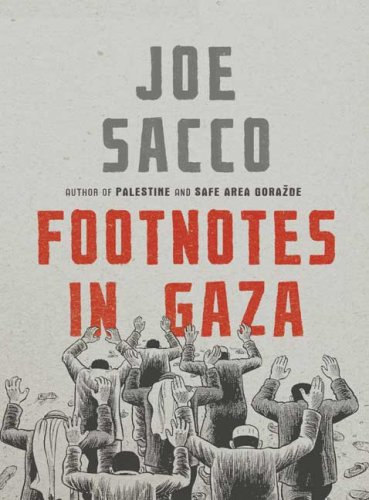
Joe Sacco’s gripping, important book about two long-forgotten mass killings of Palestinians in Gaza stands out as one of the few contemporary works on the Israeli-Palestinian struggle likely to outlive the era in which they were written.

Sacco will find readers for “Footnotes in Gaza” far into the future because of the unique format and style of his comic-book narrative. He stands alone as a reporter-cartoonist because his ability to tell a story through his art is combined with investigative reporting of the highest quality.

His subject in this case is two massacres that happened more than half a century ago, stirred up little international attention and were forgotten outside the immediate circle of the victims. The killings took place during the Suez crisis of 1956, when the Israeli Army swept into the Gaza Strip, the great majority of whose inhabitants were Palestinian refugees. According to figures from the United Nations, 275 Palestinians were killed in the town of Khan Younis at the southern end of the strip on Nov. 3, and 111 died in Rafah, a few miles away on the Egyptian border, during a Nov. 12 operation by Israeli troops. Israel insisted that the Palestinians were killed when Israeli forces were still facing armed resistance. The Palestinians said all resistance had ceased by then. [continued…]

Facebooktwittermail

Christmas in the Holy Land – 2009

Christmas in the Holy Land – 2009

Breaking Palestine’s peaceful protest

“Why,” I have often been asked, “haven’t the Palestinians established a peace movement like the Israeli Peace Now?”

The question itself is problematic, being based on many erroneous assumptions, such as the notion that there is symmetry between the two sides and that Peace Now has been a politically effective movement. Most important, though, is the false supposition that Palestinians have indeed failed to create a pro-peace popular movement.

In September 1967 – three months after the decisive war in which the West Bank, Gaza Strip and East Jerusalem were occupied – Palestinian leaders decided to launch a campaign against the introduction of new Israeli textbooks in Palestinian schools. They did not initiate terrorist attacks, as the prevailing narratives about Palestinian opposition would have one believe, but rather the Palestinian dissidents adopted Mahatma Gandhi-style methods and declared a general school strike: teachers did not show up for work, children took to the streets to protest against the occupation and many shopkeepers closed shop.

Israel’s response to that first strike was immediate and severe: it issued military orders categorising all forms of resistance as insurgency – including protests and political meetings, raising flags or other national symbols, publishing or distributing articles or pictures with political connotations, and even singing or listening to nationalist songs. [continued…]

Israeli repression wave targets activists

Danger: Popular struggle

There is an internal document that has not been leaked, or perhaps has not even been written, but all the forces are acting according to its inspiration: the Shin Bet, Israel Defense Forces, Border Police, police, and civil and military judges. They have found the true enemy who refuses to whither away: The popular struggle against the occupation.

Over the past few months, the efforts to suppress the struggle have increased. The target: Palestinians and Jewish Israelis unwilling to give up their right to resist reign of demographic separation and Jewish supremacy. The means: Dispersing demonstrations with live ammunition, late-night army raids and mass arrests. Since the beginning of the year, 29 Palestinians have been wounded by IDF snipers while demonstrating against the separation fence. The snipers fired expanding bullets, despite an explicit 2001 order from the Military Adjutant General not to use such ammunition to break up demonstrations. After soldiers killed A’kel Srour in June, the shooting stopped, but then resumed in November.

Since June, dozens of demonstrators have been arrested in a series of nighttime military raids. Most are from Na’alin and Bil’in, whose land has been stolen by the fence, and some are from the Nablus area, which is stricken by settlers’ abuse. Military judges have handed down short prison terms for incitement, throwing stones and endangering security. One union activist from Nablus was sent to administrative detention – imprisonment without a trial – while another activist is still being interrogated.

For a few weeks now, the police have refused to approve demonstrations against the settlement in Sheikh Jarrah, an abomination approved by the courts. On each of the last two Fridays, police arrested more than 20 protesters for 24 hours. Ten were held for half an hour in a cell filled with vomit and diarrhea in the Russian Compound in Jerusalem.

Israel also recently arrested two main activists from the Palestinian organization Stop the Wall, which is involved in research and international activity which calls for the boycott of Israel and companies profiting from the occupation. Mohammad Othman was arrested three months ago. After two months of interrogation did not yield any information, he was sent to administrative detention. The organization’s coordinator, Jamal Juma’a, a 47-year-old resident of Jerusalem, was arrested on December 15. His detention was extended two days ago for another four days, and not the 14 requested by the prosecutor.

The purpose of the coordinated oppression: To wear down the activists and deter others from joining the popular struggle, which has proven its efficacy in other countries at other times. What is dangerous about a popular struggle is that it is impossible to label it as terror and then use that as an excuse to strengthen the regime of privileges, as Israel has done for the past 20 years.

The popular struggle, even if it is limited, shows that the Palestinian public is learning from its past mistakes and from the use of arms, and is offering alternatives that even senior officials in the Palestinian Authority have been forced to support – at least on the level of public statements.

Yuval Diskin and Amos Yadlin, the respective heads of the Shin Bet security service and Military Intelligence, already have exposed their fears. During an intelligence briefing to the cabinet they said: “The Palestinians want to continue and build a state from the bottom up … and force an agreement on Israel from above … The quiet security [situation] in the West Bank and the fact that the [Palestinian] Authority is acting against terror in an efficient manner has caused the international community to turn to Israel and demand progress.”

The brutal repression of the first intifada, and the suppression of the first unarmed demonstrations of the second intifada with live fire, have proved to Palestinians that the Israelis do not listen. The repression left a vacuum that was filled by those who sanctified the use of arms.

Is that what the security establishment and its political superiors are trying to achieve today, too, in order to relieve us of the burden of a popular uprising?

Facebooktwittermail

Why war will take no holiday in 2010

Why war will take no holiday in 2010

Our endless wars are nightmares. Few enough would disagree with that, even, I suspect, among the supportive 58% in that poll or the 54% who “approve of the president’s performance as commander-in-chief.” If only we could wake up.

I was reminded of our strange dream-state recently when I reread the article that sparked the creation of what became TomDispatch. I first stumbled across it in the fall of 2001, after the Towers came down in my hometown, after that acrid smell of burning made its way to my neighborhood and into everything, after I traveled to “Ground Zero” (as it was already being called) to view those vast otherworldly shards of destruction via nearby side streets, after I spent weeks reading the ever narrower, ever more war-oriented news coverage in this country, and after I watched George W. Bush and Company mainlining fear directly into the American bloodstream, selling the eternal terror of terror and the president’s Global War on Terror that so conveniently went with it.

It was obvious that war was on the way, and that the men (and woman) who were leading us into it had expansive dreams and gargantuan plans. Somewhere in that period, probably in late October 2001, a friend sent me a piece by an Afghan-American living in California that spurred me to modest action. [continued…]

Facebooktwittermail

Strategic Balochistan becomes a target in war against Taliban

Strategic Balochistan becomes a target in war against Taliban

Look around Balochistan, and you may not see much. Pakistan’s largest province is also its poorest and least inhabited – an expanse of rocky deserts and ramshackle villages where hardy tribesmen live by ancient laws. But to outside eyes, Balochistan’s barren sands glisten with hidden value.

Mining companies eye its natural riches: vast and largely untapped reserves of copper, natural gas and possibly oil. Criminals see easy money: the world’s heroin superhighway, a network of smuggling trails, cuts through its lonely borders. Foreign governments consider its location: wedged between Iran and Afghanistan, and covering two-fifths of Pakistan, Balochistan occupies highly strategic real estate.

But for the black-turbaned clerics commanding the Afghan Taliban, the desolate province offers something else: a welcoming rear base. As the Taliban insurgency oozes across Afghanistan, Nato generals complain that the fighting is being directed from Balochistan. [continued…]

Troubling changes in Pakistan

n Thursday morning as Pakistan’s Defence Minister was preparing to board a flight to China for an official visit, he was detained by Pakistani security officials and was told he had been barred from leaving the country. An altercation ensued, but the country’s top civilian defence official was told by the police and soldiers that they take orders from senior generals and judges, not government ministers.

Minister Ahmad Mukhtar was told by the security officials that they were acting on instructions from the National Accountability Bureau, an arm of Pakistan’s intelligence service created by former military ruler Pervez Musharraf to harass political opponents with corruption charges. The Defence Minister was told his name was on an ‘Exit Control List’ even though he has never been convicted of a crime. Clearly, Pakistan has entered a decisive stage. Imagine the U.S. Defence Secretary being detained by U.S. marshals at JFK airport or the RCMP telling Peter MacKay, he cannot leave the country.

What was bizarre about this development is that although it was Pakistani’s Interior Ministry that was supposed to have issued the orders, the Interior Minister himself was named as someone not allowed to travel abroad without special permission. Clearly the administration of the government in Islamabad has been taken over by plainclothes military intelligence officials.

A coup by any other name is still a coup. [continued…]

Facebooktwittermail

The NYT’s view of “journalistic objectivity”

The NYT’s view of “journalistic objectivity”

I‘ve written many times before about Sami al-Hajj, the Al Jazeera cameraman who was abducted by the U.S. in late 2001, tortured at Bagram, sent to Guantanamo for seven years — where he was never charged with any crime and was interrogated overwhelmingly about Al Jazeera’s operations, not about Terrorism — and then suddenly released without explanation last year, as though the whole thing never happened. The due-process-free imprisonment of this journalist by the U.S. government was ignored almost completely by the American media (other than Nicholas Kristof), even as it righteously obsessed on the far shorter imprisonment of journalists by countries such as Iran and North Korea (hey, look over there at those tyrannical countries – they imprison our journalists!!!!!). Aside from al-Hajj, we’ve imprisoned numerous other journalists without charges in Iraq — and continue to this day to do so — including ones who work for Reuters and the Associated Press.

Today, The New York Times’ media reporter Brian Stelter profiles al-Hajj, who is now an on-air correspondent for Al Jazeera. The article recounts the details of al-Hajj’s detention, his description of his torture, and the physical and psychological wounds he still suffers from his treatment at the hands of his American captors. All things considered, the article is a decent effort to explain what happened, and Stelter deserves credit for bringing some desperately needed attention to this story. Nonetheless, the article contains some rather striking and revealing passages, beginning with this:

Among Al Jazeera’s viewers in the Arab world since the 9/11 attacks, perhaps nothing has damaged perceptions of America more than Guantánamo Bay. For that reason, Mr. Hajj, who did a six-part series on the prison after his release, is a potent weapon for the network, which does not always strive for journalistic objectivity on the subject of his treatment. In an interview, Ahmed Sheikh, the editor in chief of Al Jazeera, called Mr. Hajj “one of the victims of the human rights atrocities committed by the ex-U.S. administration.”

It’s amazing that the NYT would claim that Al Jazeera’s description of the Bush administration’s conduct as it concerns al-Hajj and other detainees — “one of the victims of the human rights atrocities committed by the ex-U.S. administration” — departs from precepts of “journalistic objectivity.” How can the lawless detention, brutal torture, numerous detainee deaths, obvious targeting of unfriendly media outlets, and explicit renunciation of the Gevena Conventions be described in any other way? The breach of “journalistic objectivity” comes not from calling this conduct what it is, but from refusing to do so — from obfuscating what took place by using soothing euphemisms and according equal deference to the plainly false denials of those who did it, such as what takes place in these passages Stelter wrote: [continued…]

Facebooktwittermail

Cleric’s funeral becomes protest of Iran leaders

Cleric’s funeral becomes protest of Iran leaders

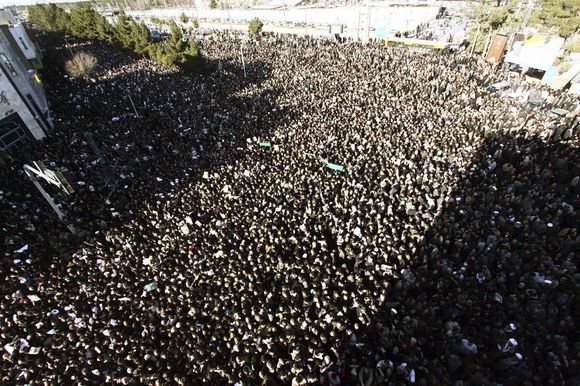
The funeral of a prominent dissident cleric in the holy Iranian city of Qum turned into a huge and furious antigovernment rally on Monday, raising the possibility that the cleric’s death could serve as a catalyst for an opposition movement that has been locked in a stalemate with the authorities.

As mourners carried the body of the cleric, Grand Ayatollah Hossein Ali Montazeri, tens of thousands of his supporters surged through the streets of Qum, chanting denunciations of the leadership in Tehran that would have been unthinkable only months ago: “Our shame, our shame, our idiot leader!” and “Dictator, this is your last message: The people of Iran are rising!” [continued…]

Karroubi: Iran’s problems should be solved by its own people

President Ahmadinejad has betrayed the Iranian Revolution, violated the country’s Constitution and may be unable to serve his full term, his most vocal opposition rival has told The Times.

In a surprising twist, however, Mehdi Karroubi warned the West against exploiting the regime’s weakness to strike a deal to halt a nuclear programme that was, he insisted, for peaceful purposes.

“Nuclear science and achieving peaceful nuclear technology is a right reserved for all NPT [Nuclear Proliferation Treaty] members,” he said. “We ask Western governments not to use this internal situation as a bargaining chip with the present Iranian Government to reach agreements which would undermine the rights of the Iranian people.”

He also urged the West against trying to help the opposition in its battle against the regime, saying that such efforts would “pave the way for suppression and accusations of dependency on foreigners”. He added: “The challenges in this country should be solved by its own people.” [continued…]

Facebooktwittermail

US forces mounted secret Pakistan raids in hunt for al-Qaida

US forces mounted secret Pakistan raids in hunt for al-Qaida

American special forces have conducted multiple clandestine raids into Pakistan’s tribal areas as part of a secret war in the border region where Washington is pressing to expand its drone assassination programme.

A former Nato officer said the incursions, only one of which has been previously reported, occurred between 2003 and 2008, involved helicopter-borne elite soldiers stealing across the border at night, and were never declared to the Pakistani government.

“The Pakistanis were kept entirely in the dark about it. It was one of those things we wouldn’t confirm officially with them,” said the source, who had detailed knowledge of the operations. [continued…]

Welcome to Pashtunistan: the aim of America’s secret war?

Few people by now can be unaware of Blackwater, later known as Blackwater Worldwide and now as Xe. The private security agency formed in 1997 and based in North Carolina is owned by Erik Prince, a former member of the US Navy Seal special forces, and has long-standing links with both the CIA and the FBI.

Its presence in Pakistan has been an open secret for some years. The investigative journalist and writer Jeremy Scahill, an authority on Blackwater and author of the bestselling Blackwater: the Rise of the World’s Most Powerful Mercenary Army, revealed last month that it has been there since 2006. He says Blackwater is being employed for covert ops, essentially intended to target high-value al Qa’eda leaders, including Osama bin Laden, but it has also assisted in providing information for drone attacks and has kidnapped suspects and transported them covertly to the US for interrogation.

In other words, it is an American agency with a licence to kill or kidnap, thus exonerating official American agencies that might one day be held accountable. (Although personally I doubt if the CIA will ever be held accountable. I continue to aver that it is the only real rogue intelligence agency in the world. Mossad might enjoy liberty of action for any operation, but it cannot undertake one without the approval of the Israeli prime minister: no such restriction applies to the CIA.) [continued…]

Facebooktwittermail

Gaza’s civilians still unable to rebuild one year after ‘Operation Cast Lead’

Gaza’s civilians still unable to rebuild one year after ‘Operation Cast Lead’

The international community has betrayed the people of Gaza by failing to back their words with effective action to secure the ending of the Israeli blockade which is preventing reconstruction and recovery, say a group of 16 leading humanitarian and human rights groups in a new report released today (22 December) ahead of the anniversary of the start of Israel’s military offensive in Gaza (27 December-18 January).

The Israeli authorities have allowed only 41 truckloads of all construction materials into Gaza since the end of the offensive in mid-January, warn the groups, which include Amnesty International, CAFOD, Christian Aid, Medical Aid for Palestinians, Mercy Corps and Oxfam International. The task of rebuilding and repairing thousands of homes alone will require thousands of truckloads of building materials, they add.

Little of the extensive damage the offensive caused to homes, civilian infrastructure, public services, farms and businesses has been repaired because the civilian population, and the UN and aid agencies who help them, are prohibited from importing materials like cement and glass in all but a handful of cases, says the report. [continued…]

Doctor admits Israeli pathologists harvested organs without consent

Israel has admitted pathologists harvested organs from dead Palestinians, and others, without the consent of their families – a practice it said ended in the 1990s – it emerged at the weekend.

The admission, by the former head of the country’s forensic institute, followed a furious row prompted by a Swedish newspaper reporting that Israel was killing Palestinians in order to use their organs – a charge that Israel denied and called “antisemitic”.

The revelation, in a television documentary, is likely to generate anger in the Arab and Muslim world and reinforce sinister stereotypes of Israel and its attitude to Palestinians. Iran’s state-run Press TV tonight reported the story, illustrated with photographs of dead or badly injured Palestinians. [continued…]

Challenge to the Jewish Taliban

A struggle for the character of the Western Wall, this city’s iconic Jewish holy site and central place of worship, is under way, and it is being fought with prayer shawls and Torah scrolls.

On Friday, sheets of rain obscured the Old City’s ancient domes. But by 7 a.m. about 150 Jewish women had gathered at the Western Wall to pray and to challenge the constraints imposed on them by traditional Jewish Orthodoxy and a ruling by the Israeli Supreme Court.

Under their coats many of the women, supporters of a group of religious activists called Women of the Wall, wore a tallit, or fringed prayer shawl, a ritual garment traditionally worn only by men. Some wore their prayer shawls openly, an illegal act in this particular setting that can incur a fine or several months in jail. [continued…]

MK Tibi: Israel is democratic for Jews, but Jewish for Arabs

he Knesset Law and Constitution Committee conducted a heated debate Tuesday on two parallel law proposals that would enable certain communities in Israel to handpick their residents.

The proposals come amid controversy over a number of Jewish communities in the north who have refused entry to Arabs wishing to reside there.

The laws proposed by MKs Israel Hasson and Shai Hermesh (Kadima) and the committee’s chairman MK David Rotem (Yisrael Beiteinu) circumvent the High Court decision that the reception committees are illegal.

MK Ahmed Tibi condemned the bills, which passed a preliminary vote a few weeks ago, claiming they would only allow systemic racism to take hold.

“This law is like pissing in mid-air,” said Tibi. “Racism is starting to be legislated in the statute book. There is an influx of racist law proposals; you aren’t even ashamed of yourselves.”

“This country is Jewish and democratic: Democratic towards Jews, and Jewish toward Arabs,” Tibi said, adding that that if Israel’s declaration of independence was to be voted on in the Knesset today, it would not pass.

The proposals were actually meant to enable communal settlements, like moshavim, to disqualify candidates on grounds of economic status or incompatibility with the settlement’s lifestyle. The debate quickly developed, however, to the fact that the committees would be able to prevent Arab landowners from building on community land.

Facebooktwittermail

Hamas using English law to demand arrest of Israeli leaders for war crimes

Hamas using English law to demand arrest of Israeli leaders for war crimes

The Islamist group Hamas is masterminding efforts to have senior Israeli leaders arrested for alleged war crimes when they visit European countries including Britain, a top Hamas official involved in the effort has told The Times.

The claim comes amid continuing diplomatic fallout after a British arrest warrant was issued last week against Tzipi Livni, who served as Foreign Minister during Israel’s Gaza offensive last winter. The warrant was withdrawn when it became clear that Ms Livni, now leader of the opposition, was not in the country. Its existence apparently prompted her to cancel a trip to attend a meeting in London.

President Peres described the incident as “one of the greatest political mistakes” that Britain could have made and calling for the law to be changed. “Everything is based on … a hostile majority public opinion,” he said last week. “The British promised they would fix this and it is time that they do so.” [continued…]

The democratic value of universal accountability

In important global dynamic today bridges the worlds of politics, morality and violence. Societies are grappling with the challenge of how to hold accountable the political leaders who are accused of various degrees of criminal behavior, including war crimes, torture — even genocide or crimes against humanity. The most outrageous cases are tried in special international tribunals or at the International Criminal Court. Other cases reflect more contested situations and raise critical issues of the universality of ethics and law.

Two cases last week in the United States and Israel are interesting in this respect, because these two countries remind us twice a week — and more often in war time and on patriotic national holidays — that they are democracies whose values should be spread around the world. Well, the world at the receiving end of their moral munificence frequently asks an important question to which it has yet to receive a clear answer:

Are the United States and Israel subject to the same standards of accountability for their behavior as everyone else in the world, or do they operate at a higher plane of impunity when it comes to using violence to kill, torture, and invade or occupy other peoples? [continued…]

Facebooktwittermail

Settler activist: ‘We are preparing a series of surprises’ for the army

Settler activist: ‘We are preparing a series of surprises’ for the army

ight-wing activists began preparing on Sunday for a fight against the planned demolition of structures built in contravention of the 10-month freeze on construction in West Bank settlements.

The demolition plans were described in an internal Israel Defense Forces memo detailing the intelligence-gathering methods to be used to detect freeze violations. The memo was leaked to the press on Sunday.

One of the issues that most concerns right-wing activists is the IDF’s plan to jam cell-phone signals, so as to prevent settlers from telling other protesters where to demonstrate against implementation of the freeze. Activists have begun consulting with experts on how to overcome the signal jamming.

The memo shows the IDF is focusing on how to deal with problems it has faced in the past, a right-wing activist said on Sunday.

“The army is preparing for yesterday’s war, but we won’t fight it on its turf,” he said. “We are preparing a series of surprises and events that it won’t be prepared for.” Continue reading

Facebooktwittermail

Likud MK: Annex West Bank, consider citizenship for Palestinians

Likud MK: Annex West Bank, consider citizenship for Palestinians

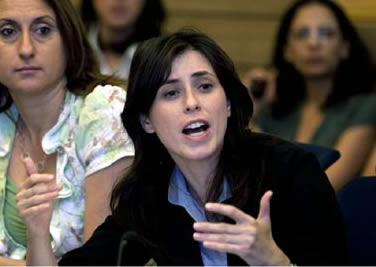
Knesset Member Tzipi Hotovely, one of the leading dissenting voices in the Likud faction opposing the policy adopted by Prime Minister Benjamin Netanyahu, said Sunday that the territories should be annexed to Israel.

“Israeli law should be applied on the Judea and Samaria region,” Hotovely said during a conference in the Interdisciplinary Center in Herzliya and stated she did not rule out granting citizenship to Palestinians.

The MK explained that “Judea and Samaria are a part of the land of Israel,” and blamed the Palestinians for the failure of the political process. “We strongly wish to get a divorce, but the other side doesn’t want to separate.”

Hotovely told Ynet later in the evening, “It’s unthinkable that Jews in Judea and Samaria would live under occupation and under a military regime. The distorted policy, which states that every construction permit must be approved by the defense minister harms the most basic rights.

“It’s time to lift the question mark over Judea and Samaria and view the people living there as citizens with an equal status. Thinking ahead, strategically, we should consider granting gradual citizenship to Palestinians based on loyalty tests.” [continued…]

Editor’s Comment — Tzipi Hotovely, at 31 the youngest member of the Knesset, is younger than the occupation. Small wonder that she regards Israel’s control of the West Bank as irreversible. Her proposal to consider granting Palestinians citizenship if they pass a “loyalty test” obviously bears no relationship to the one-state solution that many anti-Zionists favor. Indeed, the Jewish claim to Greater Israel she is expressing has embedded in it a hubris that goes beyond that of the average Zionist — she seems to be implying that Jews could still exercise control over a Jewish state even if they were in a minority. Old hands in the conflict will no doubt dismiss her views as naive, but I have to wonder whether or not she is simply saying what a majority of her generation of Jewish Israelis already think.

Israel continues its assault on Palestinian nonviolent leaders

Israel’s campaign against Palestinian nonviolent grassroots activists is continuing. The latest leader to be arrested is Jamal Juma’. Juma’ has been the coordinator of the Palestinian Grassroots Anti-Apartheid Wall Campaign since 2002. His arrests follows those of Mohammad Othman, who had been promoting BDS in Europe, and Abdallah Abu Rahmah a leader of the weekly nonviolent protests against the wall in Bil’in. [continued…]

Facebooktwittermail

Somalia is greatest victim of President Bush’s War on Terror

Somalia is greatest victim of President Bush’s War on Terror

AQfghanistan and Iraq have monopolised the headlines but Somalia is arguably an even greater victim of George W. Bush’s ill-conceived and lamentably executed War on Terror. America’s interventions have proved so catastrophic that its best hope of salvaging something from the wreckage is a president it chased from power three years ago, who controls a few square miles of a country three times the size of Britain.

It has delivered a people that practised a moderate form of Islam into the hands of religious extremists. Its efforts to combat terrorism have turned Somalia into a launchpad for global jihad. Somalia is now the ultimate failed state whose mayhem threatens to destabilise the region and whose pirates maraud the vital shipping lanes off its shores. Its people endure Africa’s worst humanitarian crisis.

During the Cold War, the US pumped arms into Somalia to counter Soviet support for neighbouring Ethiopia. In 1991 clan warlords ousted the dictator Siad Barre and turned that arsenal on each other. In 1992 President Bush Snr sent in the Marines to help its suffering people — a venture that ended in the Black Hawk Down debacle, a humiliating US withdrawal and a dozen more years of anarchy as the feuding warlords ran amok. [continued…]

Facebooktwittermail

Iran claims an oil field it seized

Iran claims an oil field it seized

The Iranian government said Saturday that an oil field that its troops occupied a day earlier was on its side of the border with Iraq, despite Iraqi claims to the contrary.

A group of about 11 Iranian soldiers seized a portion of the remote Fakka oil field in Maysan Province in southeastern Iraq early Friday, according to Iraq.

Government officials in Baghdad said they had summoned the Iranian ambassador to protest the military action, but diplomatic efforts had so far failed to resolve the dispute. [continued…]

Iraqi troops in standoff with Iran near oil well

Iraq deployed security forces Saturday near a remote oil well seized by Iran, officials said, and its government pressed Tehran to withdraw its forces from the area along their disputed southern border.

U.S. officials applauded Iraq for standing its ground against Iran — an uneasy ally that analysts said was aiming to remind its neighbor of its economic and political pull in its takeover of the oil well Thursday. The site is located in one of the largest oil fields in Iraq and has about 1.5 billion barrels in reserves.

The standoff was a dramatic display of the occasionally tense relations between the two oil-rich nations that fought an eight-year war in the 1980s but now share common ground in Shiite-led governments. [continued…]

Facebooktwittermail

U.S. companies shut out as Iraq auctions its oil fields

U.S. companies shut out as Iraq auctions its oil fields

Those who claim that the U.S. invaded Iraq in 2003 to get control of the country’s giant oil reserves will be left scratching their heads by the results of last weekend’s auction of Iraqi oil contracts: Not a single U.S. company secured a deal in the auction of contracts that will shape the Iraqi oil industry for the next couple of decades. Two of the most lucrative of the multi-billion-dollar oil contracts went to two countries which bitterly opposed the U.S. invasion — Russia and China — while even Total Oil of France, which led the charge to deny international approval for the war at the U.N. Security Council in 2003, won a bigger stake than the Americans in the most recent auction. “[The distribution of oil contracts] certainly answers the theory that the war was for the benefit of big U.S. oil interests,” says Alex Munton, Middle East oil analyst for the energy consultancy Wood Mackenzie, whose clients include major U.S. companies. “That has not been demonstrated by what has happened this week.”

In one of the biggest auctions held anywhere in the 150-year history of the oil industry, executives from across the world flew into Baghdad on Dec. 11 for a two-day, red-carpet ceremony at the Oil Ministry, broadcast live in Iraq. With U.S. military helicopters hovering overhead to help ward off a possible insurgent attack, Oil Minister Hussein Al-Shahrastani unsealed envelopes from each company, stating how much oil it would produce, and what it was willing to accept in payment from Iraq’s government. Rather than giving foreign oil companies control over Iraqi reserves, as the U.S. had hoped to do with the Oil Law it failed to get the Iraqi parliament to pass, the oil companies were awarded service contracts lasting 20 years for seven of the 10 oil fields on offer — the oil will remain the property of the Iraqi state, and the foreign companies will pump it for a fixed price per barrel. [continued…]

Channeling Sunni rage into Iraqi political clout

Sheik Abdul-Rahman Munshid al-Assi has been making up for the time he lost in an American prison, aggressively diving into Iraqi politics after being held nearly a year on charges of aiding the insurgency.

After his release last year, he formed the Arab Political Council to represent Sunni Arabs in Kirkuk. He recruited Sunni candidates to run in the coming national elections. He is forging a political bloc with Arab nationalists, other tribal leaders and former members of Saddam Hussein’s outlawed Baath Party as a counterweight to Kurds in the province.

At first glance, the fact that a vehement opponent of the Shiite-led government in Baghdad and Kurdish leaders next door is embracing democratic politics may seem to be a purely positive sign. After all, much of the American security effort of the past few years has been to channel Sunnis into just such a course.

But for Sheik Abdul-Rahman the political action is far from a concession. Rather, it is an attempt to tap into the simmering rage he says is still rampant among Sunni Arabs in Iraq. And he and many of his peers are far from becoming fully reformed democrats: he has yet to renounce the insurgency, though he denies directly supporting it, and warns that more violence could come. [continued…]

Facebooktwittermail

Viva Palestina convoy arriving in Turkey

Viva Palestina convoy arriving in Turkey

The Gaza I know

For most Americans, the Gaza Strip is, at best, unknown territory. At worst, it is a hostile land whose “terrorist infrastructure” must be dismantled, no matter what the cost to its million and a half residents.

The Gaza I have been visiting for the past twenty-one years bears little relation to the dehumanizing imagery to which it has been reduced by the mainstream media. The Gaza I know is home to friends and strangers who are as welcoming and humane as they are resilient and determined to achieve their freedom. They have maintained their humanity despite enduring a brutal forty-two-year-old Israeli occupation that has cost them the destruction of their homes, land, economy and future and the loss of more than 4,000 lives since the dawn of the twenty-first century.

For the past two and a half years, this spit of sand–just twenty-five miles long and a few miles wide–has been virtually a closed prison. Since June 2007 Israel’s blockade has prevented the entry of all but a handful of basic items, and the exit of patients who urgently need medical treatment and students with scholarships to study abroad. Then, a year ago, came the “shock and awe” of Israel’s “Operation Cast Lead,” intended as a knockout blow not just to the crude rockets fired from Gaza but to its life-sustaining infrastructure and the will of its people to resist. [continued…]

One Palestinian family’s story illustrates the absurdity, and intention, of Israeli policy

I am a Palestinian refugee, from the village of Fallujah which lies between Gaza, Hebron and Asqalan. I’ve never been allowed to visit Fallujah; my grandparents were exiled from there in 1949 (a year after the founding of Israel) and took refuge in the Gaza Strip. My father and I were both born in the Khan Younis refugee camp-he a few years before Gaza was occupied by Israel, and I in 1988, a month after the outbreak of the first intifada. My dad married a woman from the West Bank-they had met and fallen in love while they were both studying at Birzeit University, and when I was two years old we emigrated to the UK where he received his Phd.

Fourteen years later, in 2004, we all returned to Palestine to live in Ramallah. Now British citizens, my parents were determined that my three siblings and I would forge a stronger connection to our homeland than we ever could living abroad. At first, the transition was made easier by the fact that our foreign passports gave us the freedom of movement that was denied to other Palestinians in the West Bank and Gaza. For me, this reality was shattered when in late 2005 I attempted to cross the River Jordan from the West Bank to visit my aunt in Amman. The Israeli border agents told me that I could not pass, because I had an Israeli issued Gaza ID. Under Israeli military rules, this meant that I could not ‘legally’ be present in the West Bank because the Israeli occupation had mandated that Palestinians from Gaza could not enter the West Bank, and Palestinians from the West Bank could not enter Gaza. This policy had been in force since the early 1990’s, but was applied with increasing severity after the outbreak of the second intifada.

I lived the next four years under constant fear of arrest by the Israeli military, because that would have resulted in almost certain deportation to Gaza, and isolation from my family. For those four years, I never left the confines of Ramallah, so as to avoid the Israeli checkpoints on every one of the town’s entrances-but even this couldn’t give me a sense of security because I had to commute daily to Birzeit University, on a route frequently patrolled by Israeli forces from the nearby settlement of Bet El. [continued…]

Steps to create an Israel-Palestine

In recent years the idea of a one-state solution has been anathema to Israelis and their supporters worldwide. This has been fueled by the fear of the “demographic threat” posed by the high Palestinian birthrate. Indeed, many Israeli supporters of a two-state solution came to that position out of fear of this demographic threat rather than sympathy with Palestinian national aspirations.

At the root of their fear was the belief that despite Israel’s best efforts to push Palestinians from land and property and to import Jewish settlers in their stead, the Arab population would keep climbing. And that, when the Arabs reached the 51% mark, the state of Israel would collapse, its Jewish character would disappear and its population would dwindle into obscurity.

Yet that scenario is not necessarily the inevitable result of either demography or democracy. Religious and ethnic minorities have successfully thrived in many countries and managed to retain their distinctive culture and identity, and succeeded in being effective and sometimes even dominant influences in those countries. Those who believe in coexistence must begin to seriously think of the legal and constitutional mechanisms needed to safeguard the rights of a Jewish minority in Israel-Palestine. [continued…]

Facebooktwittermail