Category Archives: Issues

NEWS & OPINION: No refuge in Kabul

In Kabul, shattered illusions

“Well, at least we’re not in Baghdad,” we used to say when confronted by the vagaries of the Kabul winter. No heat, sporadic electricity and growing disaffection among the population might make us uncomfortable, but those of us living outside the smothering embrace of the embassies or the United Nations had relative freedom of movement and few security worries.

And of course we had the Serena hotel. Its spa offered solace, a gym and a hot shower; we could pretend for a few hours that we were in Dubai.

But a week ago last Monday, Taliban gunmen burst into the lobby, one exploding his ball-bearing vest, one running to the gym and spa area, spraying bullets as he went. Eight people died, and several more were wounded.

It was a rude shock for those of us who used to feel superior to those who cowered behind their reinforced walls, venturing out only in bulletproof glass surrounded by convoys of big men with big guns.

We shopped on Chicken Street for carpets and trinkets, we dined at the shrinking number of restaurants that still serve alcohol. We partied at L’Atmosphere, “L’Atmo” to its friends, the “in” spot for the international crowd, and had our hair and nails done at the Nova salon. And we patted ourselves on the back because we knew the real Kabul.

None of us was prepared for what happened at the Serena. The Taliban are following a new strategy, their spokesman announced. They will go after civilians specifically, and will bring their mayhem to places where foreigners congregate.

So much for L’Atmo. [complete article]

The mysterious Afghan warlord trusted to spread peace in a divided province

Britain’s last chance of securing this treacherous corner of Afghanistan lies in the hands of a piratical, black-turbaned figure with long beard, white cloak and silver-sequinned slippers with curled toes.

Mullah Abdul Salaam may not look much like a white knight. He served as a commander in the Taleban and even today his true loyalties remain suspect. The 45-year-old former Mujahidin guerrilla could, however, decide the fate of the British mission to stabilise the lawless province of Helmand, where this week he was put in charge of the key district of Musa Qala.

“He’s not just the best show in town,” one British officer remarked. “He’s the only show in town.”

Mullah Salaam’s rise to power in Musa Qala, the test case for British efforts to evict the Taleban and install central authority, is a classic Afghan tale of intrigue, bloodshed, farce and fate. In an interview with The Times the former warlord explained how last year he had severed relations with the Taleban, was courted secretly by a foreign diplomat and eventually swapped sides to join the British-led effort. [complete article]


Facebooktwittermail

NEWS: Getting out of Iraq; the Awakening under threat

Attacks imperil U.S.-backed militias in Iraq

American-backed Sunni militias who have fought Sunni extremists to a standstill in some of Iraq’s bloodiest battlegrounds are being hit with a wave of assassinations and bomb attacks, threatening a fragile linchpin of the military’s strategy to pacify the nation.

At least 100 predominantly Sunni militiamen, known as Awakening Council members or Concerned Local Citizens, have been killed in the past month, mostly around Baghdad and the provincial capital of Baquba, urban areas with mixed Sunni and Shiite populations, according to Interior Minister Jawad al-Bolani. At least six of the victims were senior Awakening leaders, Iraqi officials said.

Violence is also shaking up the Awakening movement, many of whose members are former insurgents, in its birthplace in the Sunni heartland of Anbar Province. On Sunday, a teenage suicide bomber exploded at a gathering of Awakening leaders, killing Hadi Hussein al-Issawi, a midlevel sheik, and three other tribesmen.

Born nearly two years ago in Iraq’s western deserts, the Awakening movement has grown to an 80,000-member nationwide force, four-fifths of whose members are Sunnis. American military officials credit that force, along with the surge in United States troops, the Mahdi Army’s self-imposed cease-fire and an increase in Iraqi security forces, for a precipitous drop in civilian and military fatalities since July.

But the recent onslaught is jeopardizing that relative security and raising the prospect that the groups’ members might disperse, with many rejoining the insurgency, American officials said. [complete article]

A lesson in how to create Iraqi orphans. And then how to make life worse for them

It’s not difficult to create orphans in Iraq. If you’re an insurgent, you can blow yourself up in a crowded market. If you’re an American air force pilot, you can bomb the wrong house in the wrong village. Or if you’re a Western mercenary, you can fire 40 bullets into the widowed mother of 14-year-old Alice Awanis and her sisters Karoon and Nora, the first just 20, the second a year older. But when the three girls landed at Amman airport from Baghdad last week they believed that they were free of the horrors of Baghdad and might travel to Northern Ireland to escape the terrible memory of their mother’s violent death.

Alas, the milk of human kindness does not necessarily extend to orphans from Iraq – the country we invaded for supposedly humanitarian reasons, not to mention weapons of mass destruction. For as their British uncle waited for them at Queen Alia airport, Jordanian security men – refusing him even a five-minute conversation with the girls – hustled the sisters back on to the plane for Iraq. [complete article]

Democrats attack Iraq security proposal

The leading Democratic presidential candidates and their allies on Capitol Hill have launched fierce attacks in recent days on a White House plan to forge a new, long-term security agreement with the Iraqi government, complaining that the administration is trying to lock in a lasting U.S. military presence in Iraq before the next president takes office.

Among the top critics is Sen. Hillary Rodham Clinton (D-N.Y.). She has used the past two Democratic presidential debates to blast President Bush for his effort, as she put it Monday in South Carolina, “to try to bind the United States government and his successor to his failed policy.”

Her concerns have been echoed by Sen. Barack Obama (Ill.) and other Democratic lawmakers who are focusing their fire on the administration’s plans for a long-term commitment to Iraq, after gaining little traction for their efforts to force a faster withdrawal of U.S. combat troops there. [complete article]

Facebooktwittermail

NEWS ROUNDUP: January 24

Afghanistan is the bad war, Iraq the good, says White House co-ordinator
Iraq may turn out to be America’s “good war” while Afghanistan goes “bad”, the Bush Administration official responsible for co-ordinating efforts in Baghdad has told The Times.

Death sentence for Afghan student
An Afghan court in northern Afghanistan sentenced a journalism student to death for blasphemy for distributing an article from the Internet that was considered an insult to the Prophet Muhammad, the judge in charge of the court said Wednesday.

10 die in mistaken Afghan firefight
At least nine Afghan police officers and a civilian were killed early Thursday in a firefight between American forces and the officers in the province of Ghazni just south of the capital, according to local officials.

Supporters at home and abroad backing away from Musharraf
As critical elections in Pakistan approach, President Pervez Musharraf is increasingly losing support from major constituencies, including his traditional military base, amid growing questions in both Pakistan and the United States about his ability to govern.

Canadian military has quit turning detainees over to Afghans
The Canadian military secretly stopped transferring prisoners to Afghanistan’s government in November after Canadian monitors found evidence that they were being abused and tortured.

Most reformists appear purged from Iran ballot
When voters go to the polls on March 14 to select members of Parliament, they may be able to choose only between conservative candidates and other conservative candidates, leaders of Iran’s main reform party said Wednesday.

Facebooktwittermail

OPINION: Escaping the Israeli siege

Hamas blows a hole in Bush’s plans

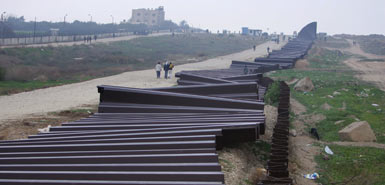
The hole blown by Hamas in the Gaza-Egypt border fence has finally punctured the bubble of delusion surrounding the U.S.-Israeli Middle East policy. In a moment reminiscent of the collapse of the Berlin Wall, gazawall.jpgthrough the breach surged some 350,000 Palestinians — fully one fifth of Gaza’s total population, as my friend and colleague Tim McGirk observed at the scene. And what did they do on the other side? They went shopping for the essentials of daily life, denied them by an Israeli siege imposed with the Wehrmacht logic of collective punishment. And the Egyptian security forces didn’t stop them, despite Washington and Israel urging them to, because U.S.-backed strongman Hosni Mubarak would provoke a mutiny among his citizenry and even his own security forces if they were to be ordered to stop hungry Palestinians from eating because Israel has decided that they should starve until they change their attitude. [complete article]

See also, Hamas exposes Israeli weakness in Gaza (Reuters) and Hamas ‘spent months cutting through Gaza wall in secret operation’ (The Times).

Facebooktwittermail

NEWS, ANALYSIS & FEATURE: Orchestrated deception on the path to war

False pretenses

President George W. Bush and seven of his administration’s top officials, including Vice President Dick Cheney, National Security Adviser Condoleezza Rice, and Defense Secretary Donald Rumsfeld, made at least 935 false statements in the two years following September 11, 2001, about the national security threat posed by Saddam Hussein’s Iraq. Nearly five years after the U.S. invasion of Iraq, an exhaustive examination of the record shows that the statements were part of an orchestrated campaign that effectively galvanized public opinion and, in the process, led the nation to war under decidedly false pretenses.

On at least 532 separate occasions (in speeches, briefings, interviews, testimony, and the like), Bush and these three key officials, along with Secretary of State Colin Powell, Deputy Defense Secretary Paul Wolfowitz, and White House press secretaries Ari Fleischer and Scott McClellan, stated unequivocally that Iraq had weapons of mass destruction (or was trying to produce or obtain them), links to Al Qaeda, or both. This concerted effort was the underpinning of the Bush administration’s case for war. [complete article]

See also, British government ordered to disclose draft Iraq dossier (The Guardian).

Troops felled by a ‘trust gap’

For many among the senior leadership at the Pentagon… the apparent successful spread of the “Awakening of the Tribes Movement” has been tempered by the realization that the initiative put in place in Fallujah and Ramadi and Babil could have been – and should have been – put into practice five years ago.

Pentagon officials are quick to blame former Iraq czar L Paul Bremer of the US Coalition Provisional Authority (CPA) for the failure. “We’re reconstituting the Iraqi military, that’s all this is” a Pentagon official notes. “A lot of these guys in Babil that we’re paying lost their salaries when Bremer disbanded the Republican Guard and broke up the Ba’ath Party. It was a stupid move. So this is a make-good.”

Another Pentagon official remembers the opening to Gaood in 2004: “This should have been done then,” he says, “and I don’t understand why it wasn’t. Think of the blood, the enormous loss of life, the lost prestige, the failures.” Pentagon officers are also quick to point out that, while Petraeus has taken credit for the shift in strategy in Iraq, the “Awakening of the Tribes Movement” actually began long before he recommended an increase in American troops levels in the country. [complete article]

Iraq’s new law on ex-Baathists could bring another purge

Maj. Gen. Hussein al-Awadi, a former official in Saddam Hussein’s Baath Party, became the commander of the Iraqi National Police despite a 2003 law barring the party from government.

But now, under new legislation promoted as way to return former Baathists to public life, the 56-year-old and thousands like him could be forced out of jobs they have been allowed to hold, according to Iraqi lawmakers and the government agency that oversees ex-Baathists.

“This new law is very confusing,” Awadi said. “I don’t really know what it means for me.”

He is not alone. More than a dozen Iraqi lawmakers, U.S. officials and former Baathists here and in exile expressed concern in interviews that the law could set off a new purge of ex-Baathists, the opposite of U.S. hopes for the legislation.

Approved by parliament this month under pressure from U.S. officials, the law was heralded by President Bush and Iraqi leaders as a way to soothe the deep anger of many ex-Baathists — primarily Sunnis but also many Shiites such as Awadi — toward the Shiite-led government.

Yet U.S. officials and even legislators who voted for the measure, which still requires approval by Iraq’s presidency council, acknowledge that its impact is hard to assess from its text and will depend on how it is implemented. Some say the law’s primary aim is not to return ex-Baathists to work, but to recognize and compensate those harmed by the party. Of the law’s eight stated justifications, none mentions reinstating ex-Baathists to their jobs. [complete article]

Facebooktwittermail

FEATURE: Sibel Edmonds’ claims demand investigation

FBI whistleblower Sibel Edmonds spills her secrets

Most Americans have never heard of Sibel Edmonds, and if the U.S. government has its way, they never will. The former FBI translator turned whistleblower tells a chilling story of corruption at Washington’s highest levels—sale of nuclear secrets, shielding of terrorist suspects, illegal arms transfers, narcotics trafficking, money laundering, espionage. She may be a first-rate fabulist, but Edmonds’s account is full of dates, places, and names. And if she is to be believed, a treasonous plot to embed moles in American military and nuclear installations and pass sensitive intelligence to Israeli, Pakistani, and Turkish sources was facilitated by figures in the upper echelons of the State and Defense Departments. Her charges could be easily confirmed or dismissed if classified government documents were made available to investigators.

But Congress has refused to act, and the Justice Department has shrouded Edmonds’s case in the state-secrets privilege, a rarely used measure so sweeping that it precludes even a closed hearing attended only by officials with top-secret security clearances. According to the Department of Justice, such an investigation “could reasonably be expected to cause serious damage to the foreign policy and national security of the United States.” [complete article]

Facebooktwittermail

NEWS: Cheney calls for permanent warrantless wiretapping

Cheney calls for permanent warrantless wiretapping

Vice President Cheney called on Congress today to permanently extend the Protect America Act as the White House launched a drive to secure the tools it says are needed to fight a continuing terrorist threat beyond the law’s Feb. 1 expiration.

In a speech to a sympathetic audience at the Heritage Foundation, a conservative Washington-based think tank, Cheney also said the law must include immunity from lawsuits for telecommunications companies that assisted the U.S. government’s electronic surveillance efforts after Sept. 11, 2001. [complete article]

Facebooktwittermail

FEATURE: U.S. military breaks ranks – part one

A salvo at the White House

The fact that the Iraq war has been pushed off the front pages of America’s newspapers has given the US military a seeming respite from the almost endless spate of disastrous stories coming out of the Middle East, as well as the almost endless round of embarrassing questions from the press about what they intend to do about it.

But military officers say that the American public should not be fooled: the relative quiet in Iraq – and it is, after all, only a “relative quiet” – does not mean the “surge” has worked, or that the problems facing the US military have somehow magically gone away. Quite the opposite. For while the American public is consumed by the campaign for the presidency, the American military is not. Instead, they are as obsessed now, in January of 2008, with the war in Iraq as they were then, in 2003 – except that now, many military officers admit, the host of problems they face may, in fact, be much more intractable.

“Don’t let the quiet fool you,” a senior defense official says. “There’s still a huge chasm between how the White House views Iraq and how we [in the Pentagon] view Iraq. The White House would like to have you believe the ‘surge’ has worked, that we somehow defeated the insurgency. That’s just ludicrous. There’s increasing quiet in Iraq, but that’s happened because of our shift in strategy – the ‘surge’ had nothing to do with it.” [complete article]

Facebooktwittermail

CAMPAIGN 08: Growing youth movement; Americans ready to elect black president

Candidates take note as young Americans re-embrace politics

America’s youth are undergoing a political rebirth, and politicians have noticed.

People under 30 are flocking to the polls and leaving their mark on the 2008 White House race. Long moribund activist groups are being revived. Nickelodeon, a television station geared to teens, is holding mock primaries.

“We’ve been hearing for years, ‘Where is the youth movement?’ Well, it’s been growing slowly and now it’s here,” said Samantha Miller, 22, who helped to revive Students for a Democratic Society (SDS), a left-wing group that has lain dormant since the late 1960s. [complete article]

White Americans ready to elect black president, poll shows

Barack Obama’s prospects of beating Hillary Clinton to the Democratic presidential nomination received a boost yesterday after 72% of white Americans told a CNN poll they believed the US was ready to have a black president.

The poll will make glum reading for Obama’s rival for the nomination, Hillary Clinton, however: fewer than two-thirds of respondents thought the country was ready for a female commander-in-chief.

The CNN/Opinion Research Corp poll, which was published on Martin Luther King day, found notably fewer black Americans (61%) than white believed the US was ready for a leader who shared their skin colour. [complete article]

Facebooktwittermail

OPINION: Challenging a unipolar world

Challenging a unipolar world

One of the more interesting phenomena to emerge from the U.S. debacle in Iraq is the demise of the unipolar world that rose from the ashes of the Cold War. A short decade ago the United States was the most powerful political, economic, and military force on the planet. Today its army is straining under the weight of an unpopular occupation, its economy is careening toward recession, and the only “allies” we can absolutely depend on in the United Nations are Israel, Palau, and the Marshall Islands.

Rather than the “American Century” the Bush administration neo-conservatives predicted, it is increasingly a world where regional alliances and trade associations in Europe and South America have risen to challenge Washington’s once undisputed domination. [complete article]

Facebooktwittermail

OPINION: Punishing Gaza

Where does it end?

Much of Gaza is once again in darkness, as Israel cut off the fuel to its only power plant. Hospital patients have reportedly died, communications are out, and movement and commerce in an already beleaguered economy have come to a near halt.

Michele Mercier, spokesperson for the the International Committee of the Red Cross, said Gaza hospitals still had medications “but it won’t last for more than two or three days.” Now, Gazans must also contend with the possibility of already scarce food supplies being cut off. Christopher Gunness of UNRWA, the UN relief agency, said the agency could be forced to suspend food distribution to 860,000 people because of the shortage of fuel and plastic bags.

The New York Times, always to be counted on to provide the right euphemisms, reported that “Israel’s defense minister, Ehud Barak, ordered a temporary halt on all imports into the Hamas-run Gaza Strip late last week. The measure, along with stepped-up military operations in Gaza, was meant to persuade Palestinian militants there to stop firing rockets at Israel.” (Isabel Kershner, “Fuel Shortage Shuts Gaza Power Plant, Leaving City Dark,” 21 January 2008.)

Terms like “measures” and “persuasion” sound so gentle. But they cover up a brutal reality that Israeli leaders are keen to boast about: they are acting with premeditation to inflict suffering on the Palestinian civilian population, and they display an extraordinary degree of callousness for their victims. [complete article]

Facebooktwittermail

NEWS & ANALYSIS: Iraq’s plundered heritage; tribal conflict

‘Ancient civilization . . . broken to pieces’

He works as a blacksmith in one of Baghdad’s swarming Shiite slums. But at least once a month, Abu Saif tucks a pistol into his belt, hops into a minibus taxi and speeds south.

His goal: to unearth ancient treasures from thousands of archaeological sites scattered across southern Iraq.

Images of Baghdad’s ransacked National Museum, custodian of a collection dating back to the beginning of civilization, provoked an international outcry in the early days of the war in 2003.

The ancient statues, intricately carved stone panels, delicate earthenware and glittering gold are now protected by locked gates and heavily armed guards. But U.S. and Iraqi experts say a tragedy on an even greater scale continues to unfold at more than 12,000 largely unguarded sites where illegal diggers like Abu Saif are chipping away at Iraq’s heritage. [complete article]

Tea and tribal conflict in Iraq

The meeting between the Marines and the power brokers of this border region began with pleasantries, an exchange of gifts, and the drinking of small cups of tea, very hot and very sweet.

But within a few minutes the subject turned to one of crucial importance to both sides: the possible rise of militias among Sunni tribes who feel disrespected and shut out of the mild economic upturn the region is enjoying.

The power brokers — the mayor, the sheiks, and the local Iraqi army general — are from the Albu Mahal tribe, the most powerful in the region.

The Mahals were the first of the tribes to join with the U.S. in fighting the insurgency while lesser tribes stayed neutral or assisted the insurgents.

Now that the insurgency has been largely suppressed, Mahal leaders feel it is their right to share in the benefits of peace, such as the flourishing downtown market in Husaybah and the recently opened port of entry that allows a free flow of goods to and from Syria. [complete article]

Facebooktwittermail

NEWS ROUNDUP: January 22

U.S. falls short on new Iran sanctions
The five permanent members of the U.N. Security Council and Germany agreed Tuesday to impose new sanctions on Iran over its suspect nuclear program, yet the measures appeared to fall short of what the Bush administration had wanted.

Budgetary spat in Iran
Supreme leader Khamenei sides with the parliament speaker in his standoff with President Ahmadinejad. What the move means is up for debate.

Padilla sentenced to more than 17 years in prison
Jose Padilla, the Brooklyn-born convert to Islam who was once accused by the government of plotting to detonate a “dirty bomb” in the United States, was sentenced on Tuesday to 17 years and four months in prison for his role in a conspiracy to help Islamic jihadist fighters abroad.

Tom Ridge: Waterboarding is torture
The first secretary of the Homeland Security Department says waterboarding is torture. “There’s just no doubt in my mind – under any set of rules – waterboarding is torture,” Tom Ridge said Friday in an interview with the Associated Press. Ridge had offered the same opinion earlier in the day to members of the American Bar Association at a homeland security conference.

Bush officials narrow foreign horizons
In the final year, Bush administration officials are scaling back ambitious diplomatic goals, and appear more intent on managing crises than on reaching legacy milestones.

Gazans fear crisis after four days of blockade
Four days into an Israeli blockade that has cut off food and fuel to the Gaza Strip, residents of the strip contemplated Monday how long it would be until disaster hit. One family of 13, shivering in the cold, counted its eight remaining candles. A bakery that normally feeds thousands had three days’ worth of flour.

Next target was US consulate: Bhutto killing suspect
A teenaged boy arrested last week on suspicion of involvement in former Pakistan premier Benazir Bhutto’s assassination has told investigators that his next target was the US consulate in the southern Pakistani city of Karachi.

U.S. commander in Pakistan as Taliban attack fort
A top U.S. commander met with Pakistan’s army chief General Ashfaq Kayani on Tuesday as the Pakistani military said it had repulsed an attack by Taliban fighters on a fort near the Afghan border, killing 37 of them.

Britain ‘as inept as US’ in failing to foresee postwar Iraq insurgency
The government’s top foreign policy advisers were as inept as their US counterparts in failing to see that removing Saddam Hussein in 2003 was likely to lead to a nationalist insurgency by Sunnis and Shias and an Islamist government in Baghdad, run by allies of Iran, the Guardian has learned.

Facebooktwittermail

CAMPAIGN 08: An inability to recognize ourselves in one another

Islamofascism’s ill political wind

In contrast to the way militant zealotries of other religions have been perceived, there is a broad conviction, especially among many conservative American Christians, that the inner logic of Islam and fascism go together. Political candidates appeal to those Christians by defining the ambition of Islamofascists in language that makes prior threats from, say, Hitler or Stalin seem benign. The point is that there is a deep religious prejudice at work, and when politicians adopt its code, they make it worse.

The Democrats gain little by shaping their rhetoric to appeal to the Republicans’ conservative religious base, but a readiness to denigrate Islam shows up on their side, too. In last week’s debate, moderator Brian Williams put to Barack Obama a question about Internet rumors that claim he is a Muslim. The tone of the question suggested that Obama was being accused of something heinous. He replied with a simple affirmation that he is a Christian. He did not then ask, “And what would be wrong if I were a Muslim?” Had he done so, it seems clear, he would have cost himself votes in the present climate. [complete article]

Obama reaches the mountaintop

… in his Sunday speech at the Rev. Martin Luther King Jr’s Ebenezer Baptist Church in Atlanta, Barack Obama went to a higher ground — to that mountaintop that King occupied until his death on April 4, 1968, and that Bobby Kennedy stood for a brief and remarkable political moment that played out between April and June of that fateful year.

“Unity is the great need of the hour – the great need of this hour. Not because it sounds pleasant or because it makes us feel good, but because it’s the only way we can overcome the essential deficit that exists in this country,” Obama told a audience that hung on the every word of the most emotionally-effective orator to seek the presidency since Kennedy.

“I’m not talking about a budget deficit. I’m not talking about a trade deficit. I’m not talking about a deficit of good ideas or new plans,” explained Obama. “I’m talking about a moral deficit. I’m talking about an empathy deficit. I’m taking about an inability to recognize ourselves in one another; to understand that we are our brother’s keeper; we are our sister’s keeper; that, in the words of Dr. King, we are all tied together in a single garment of destiny.” [complete article]

What does it mean to be the pro-Israel candidate?

The main reason that Democratic candidates are less frightening to a progressive Israeli worrying about his country’s future, as my progressive friends in Washington remind me, is that the Democrats may be jiving. That is, because they are sensible folks otherwise, we can assume they don’t really mean this stuff. They even hide small hints of moderation in their rhetoric. The Republicans’ sincerity is truly scary.

I suggest that it’s time to talk about what “pro-Israel” should mean. Not because the discussion will change campaign rhetoric: The candidates will stick to cliches. But after the election, one will have to govern. Members of Congress will need to decide how to vote on the usual strident resolutions backed by AIPAC. Debate now on what it means to support Israel might mean that a year from now, elected leaders will be able to refer to publicly recognized ideas to justify acting more sensibly. [complete article]

Facebooktwittermail

NEWS & OPINION: Collective punishment of Gaza

Strong in numbers

Here we have the yardstick for security success: the number of Palestinians killed. As in the most primeval wars, the heads of the defense establishment are boasting about the number of people Israel has killed. Their job is to ensure protection for the residents of the state. And, as we know, the residents of the “Gaza perimeter” are not receiving this protection. So the death toll has become the measure of their success.

Shin Bet head Yuval Diskin briefed the cabinet last week about the “achievements” of his organization: 810 Palestinians killed during the past two years. His predecessor, Avi Dichter, once appeared before the editorial board of Haaretz and proudly presented a sophisticated slideshow from his laptop computer: a pie chart of Palestinian casualties, in several colors. Last week, the brigade commander in Gaza, Colonel Ron Ashrov, defined the operation in the Zeitun neighborhood as “very successful.” Why? Because his troops killed 19 Palestinians in a single day and further inflamed the conflagration in the South. How depressing, morally and in practical terms, to think that this is the measure of success. [complete article]

Olmert: No fuel? Gazans can walk

“We won’t allow a situation in which people in Sderot walk around in fear day and night, while Gazans lead a completely normal life,” olmert told his faction members. “We won’t allow for a humanitarian crisis, but have no intention of making their lives easier. And the harder their lives, excluding humanitarian damage, we will not allow them to lead a pleasant life.

“As far as I am concerned, all of Gaza’s resident can walk and have no fuel for their cars, as they live under a murderous regime.” [complete article]

The poor and the sick suffer as Israel cuts power to Gaza

Mansour Rahal lay unconscious in the intensive care unit of Gaza City’s Shifa hospital, linked to an electrically powered ventilator, the coloured monitor above his head showing his heart, respiration and oxygen saturation rate.

On Thursday last week, he was driving his donkey cart through Beit Lahiya when it was destroyed by a missile which targeted militants in a nearby car – it also killed his mother and older brother. His hopes of survival yesterday depended on there being enough diesel to keep in operation the four generators which were Shifa’s only source of power.

His doctor, Kamal al-Geathny, said: “If the fuel runs out for the generators and we have no power, he and six other patients in this unit will die.”

This was the scene at the hospital before Israel authorised limited supplies of fuel and medicine to Gaza last night after a wave of international condemnation for its act of “collective punishment” in imposing a four-day total embargo, which had left much of the Strip without electricity. [complete article]

Defusing the Gaza time bomb

The Gaza Strip suffers from sky-rocketing unemployment and poverty, and lacks medicine, fuel, electricity, food, and other essential commodities. It is virtually cut off. It also is the most likely trigger for the next Arab-Israeli war.

In the past few weeks, Palestinian militant groups have fired rockets and mortars into Israel. Israeli incursions and aerial attacks have resulted in Palestinian casualties, including one that killed the son of one of Hamas’s senior leaders. The situation is untenable, and both sides know it. Israel is unlikely to stand idly by as Hamas’s arsenal grows and attacks continue. Hamas undoubtedly will retaliate for the deaths. Neither can afford to back down. [complete article]

Facebooktwittermail

NEWS: Turkish-Israeli network sold nuclear secrets

FBI denies file exposing nuclear secrets theft

The FBI has been accused of covering up a key case file detailing evidence against corrupt government officials and their dealings with a network stealing nuclear secrets.

The assertion follows allegations made in The Sunday Times two weeks ago by Sibel Edmonds, an FBI whistleblower, who worked on the agency’s investigation of the network.

Edmonds, a 37-year-old former Turkish language translator, listened into hundreds of sensitive intercepted conversations while based at the agency’s Washington field office.

She says the FBI was investigating a Turkish and Israeli-run network that paid high-ranking American officials to steal nuclear weapons secrets. These were then sold on the international black market to countries such as Pakistan and Saudi Arabia.

One of the documents relating to the case was marked 203A-WF-210023. Last week, however, the FBI responded to a freedom of information request for a file of exactly the same number by claiming that it did not exist. But The Sunday Times has obtained a document signed by an FBI official showing the existence of the file. [complete article]

Facebooktwittermail

NEWS: Eye on Iran

Israel launches advanced spy satellite

Israel launched an advanced spy satellite Monday that will be able to track events in Iran, the country it considers its top foe, even at night and in cloudy weather, defense officials said.

The TECSAR satellite is of particular importance for Israel because it can be used to keep tabs on Iran’s nuclear program, which the U.S. and Israel fear is a cover for pursuing nuclear weapons, they said. [complete article]

Iran’s supreme leader rebuffs Ahmadinejad in gas row

The political authority of the Iranian president, Mahmoud Ahmadinejad, suffered a serious blow today after the country’s most powerful figure sided with MPs by ordering him to supply cheap gas to villages undergoing power cuts amid an unexpectedly harsh winter.

In a humiliating rebuff, Ayatollah Ali Khamenei, Iran’s supreme leader who has the final say over all state matters, ordered the enactment of a law requiring the government to provide £500m of gas supplies from emergency reserve funds.

Ahmadinejad had refused to implement the measure, accusing parliament of exceeding its powers in passing the bill in response to plummeting temperatures and gas cuts, which have left many areas without heating during the country’s coldest winter in years.

At least 64 people are reported to have died after gas supplies were turned off in sub-zero temperatures. The cuts, belying Iran’s status as possessor of the world’s second biggest natural gas reserves, have provoked public outrage and threaten to turn a mood of rumbling unhappiness into a winter of discontent for Ahmadinejad. [complete article]

Iran sanctions ripple past those in power

Sanctions weren’t supposed to hurt Majid Taleghani. But the Iranian book publisher says they have forced him to increase prices and scale back the number of titles he issues.

“In the past few weeks, the price of South Korean paper has soared at least 25%,” Taleghani complained, chain-smoking nervously. “Why? South Korean banks refuse to open letters of credit. They won’t work with Iranian banks anymore.”

President Bush’s recent tour through the Middle East was meant in part to rally U.S. allies against Iran before talks Tuesday in Berlin by members of the U.N. Security Council and Germany over the possibility of imposing a third round of sanctions on Iran to pressure the government to halt its nuclear program.

A year after the Security Council first imposed sanctions, they clearly have begun to have an effect. But in an echo of the debate over sanctions against Iraq under Saddam Hussein in the 1990s, diplomats and economic analysts disagree sharply over whether such measures would pressure those in power to change their policies or merely hurt the Iranian people. [complete article]

Facebooktwittermail

NEWS: The foreign insurgent network; Sunni rivalries in Anbar

Papers paint new portrait of Iraq’s foreign insurgents

Muhammad Ayn-al-Nas, a 26-year-old Moroccan, started his journey in Casablanca. After flying to Turkey and then to Damascus, he reached his destination in a small Iraqi border town on Jan. 31, 2007. He was an economics student back home, he told the al-Qaeda clerk who interviewed him on arrival. Asked what sort of work he hoped to do in Iraq, Nas replied: “Martyr.”

Algerian Watsef Mussab, 29, who arrived in Iraq via Saudi Arabia and Syria, said he had come for combat. He complained that the Syrian smugglers who brought him to the border took his money, but he contributed what he had left to the insurgent cause — a watch, a ring and an MP3 player.

Hanni al-Sagheer, a computer technician from Yemen and aspiring suicide volunteer, gave the clerk his home telephone number and also that of his brother.

Their stories are among the individual records of 606 foreign fighters who entered Iraq between August 2006 and August 2007. The cache of documents was discovered last fall by U.S. forces in the northern Iraqi town of Sinjar.

Some include pictures — bearded men in a turban or kaffiyeh, some smiling and some scowling — in addition to names and aliases, home countries, birthdays and dates of entry into Iraq. Many list their occupations at home, whether plumber, laborer, policeman, lawyer, soldier or teacher. There is a “massage specialist,” a “weapons merchant,” a few “unemployed” and many students.

The youngest was 16 when he crossed into Iraq; the oldest was 54. Most expressed interest in a suicide mission.

The records [PDF] are “one of the deepest reservoirs of information we’ve ever obtained of the network going into Iraq,” according to a U.S. official closely familiar with intelligence on the insurgent group al-Qaeda in Iraq. [complete article]

In Anbar, Sunni rivalries surface

Hadi Hussein, a Sunni fighter working with U.S. and Iraqi forces, was receiving well-wishers Sunday when his 18-year-old cousin walked up with a box of chocolates. The teenager offered a candy, but didn’t wait for a response. He detonated hidden explosives, killing himself, Hussein and four others.

“This is life, we have two brothers, one is good, one is bad in the same family,” said Aftan Sadoun Aftan, the head of Hussein’s Sunni Arab paramilitary unit in the village of Ameriyat Fallouja in Anbar province.

Hussein had just been freed by the Americans after being wrongly detained for a week, said Aftan, who left the party a few minutes before the blast. About 20 clansmen were drinking juice and eating candies when the teen, Ali Abdullah Hussein, set off his explosives.

The bloodshed Sunday, one day after two suicide bombers killed a pair of policemen in nearby Ramadi, was a reminder of how complicated the dynamics remain in Anbar, where the violence is not just strictly a matter of tribesmen rising up against Islamic radicals. [complete article]

Facebooktwittermail