Category Archives: Issues

White House discovers ‘there are no good military options’ on North Korea

Fred Kaplan writes: If you had started to think that President Trump and his team might know something about diplomacy after all, that their firm talk and shows of strength might finally prod the Chinese and North Koreans to get rid of Kim Jung-un’s nuclear weapons, well, think again. Trump’s holsters are empty, and so is his brain trust. They’ve got nothing, up and down.

In recent days, Trump has sent an aircraft carrier battle group and a guided-missile submarine toward North Korea’s shores. Vice President Mike Pence has gone to the Demilitarized Zone and squinted through the binoculars at the North Korean guards, so they can see his resolve. Pence also declared, “The era of ‘strategic patience’ ”—President Obama’s policy of containment, as opposed to action, toward North Korea—“is over.” To lay the message on thick, Trump summoned all 100 U.S. senators to the Executive Office Building, next door to the White House, on Wednesday, for an urgent briefing on the subject from the secretaries of defense and state, the director of national intelligence, and the chairman of the Joint Chiefs of State. Buses were even chartered to take the lawmakers on their unusual field trip.

And what did these top advisers and cabinet secretaries say? Apparently, nothing.

Here’s Sen. Bob Corker, Republican of Tennessee and chairman of the Senate Foreign Relations Committee, when asked by a reporter about the briefing: “It was an OK briefing.” The reporter asked, “What do you mean, you didn’t really learn much?” Corker replied, “I—it was OK.”

Other senators, from both parties, told reporters the same thing: They learned nothing new, they wondered what the big deal was, why they were dragged down Pennsylvania Avenue for such a waste of time. [Continue reading…]

The Daily Beast reports: It’s not a sonic boom or bunker buster Pyongyang should most fear from the Trump administration. It’s the sound of cash registers falling silent, and doors to the outside world shutting, as the U.S. works to convince China and other allies to cut off the oil, access to money and perhaps even communication links to the outside world.

That was the word from Trump administration officials Wednesday, explaining a multipronged strategy to defang Kim Jong Un’s nuclear weapons and ballistic missile program to lawmakers at the White House and on Capitol Hill. Administration officials made clear that open military confrontation or toppling the Kim regime are the least desirable of all possible options—even as China appeared to hint that it wouldn’t oppose certain American military measures against Pyongyang.

“We want to solve this through political or economic measures,” a senior administration official told The Daily Beast. “There are no good military options.” The official said any unilateral strike would likely lead to a North Korean counter-strike on U.S. allies South Korea and Japan—both within artillery or missile range of North Korea—as well as threatening tens of thousands of U.S. troops stationed in the Pacific.

“We want to bring Kim Jong-Un to his senses, not to his knees,” said Adm. Harry Harris, Commander of U.S. Pacific Command, at a House Armed Services Committee hearing Wednesday. He repeated the administration mantra that “all options are on the table,” but the tone had decidedly shifted from President Donald Trump’s earlier provocative tweets. [Continue reading…]


Facebooktwittermail

Kim Jong Un is a survivor, not a madman

Andrei Lankov writes: Everyone loves thinking of North Korea as crazy. It threatens to consume the United States in nuclear fire on a semi-weekly basis, its leader brutally executes his own generals and had his brother murdered, and it wastes huge amount of money on nuclear weapons while sticking to a failed economic model. Tales of North Korean lunacy are never far from the front pages.

The problem is it’s not just the media that delights in depicting Pyongyang and Kim Jong Un, as irrational — U.S. policymakers indulge in the same behavior. In April, U.S. Congressman Bradley Burne (R-Ala.) said “I don’t believe the leadership in North Korea is rational. How do you deal with someone that is irrational?” He echoed prior remarks by U.N. Ambassador Nikki Haley who said, “We are not dealing with a rational person,” since, she claimed, Kim is a person “who has not had rational acts, who is not thinking clearly.”

As a guide for understanding North Korea, this analysis is just plain wrong. As a guide for crafting policy toward Pyongyang, it may be catastrophic. North Korea’s system might look bizarre to us from the outside, but the Kims are the ultimate political survivors, hard-edged rationalists whose actions have always had a clear purpose: keeping the family in power. Seeing them as madmen is not only wrong, but also dangerous; any successful policy should be based on understanding the logic of the opposite side, not on discarding it as “irrational” Seeing the Kim family as lunatics with nukes makes them more threatening, and raises the risk of war, but it can also promote unrealistic expectations of compromise — if only the North “comes to its senses.”

Back in the 1980s the Kim family was laughed at even inside the Eastern Bloc as an embodiment of Stalinist irrationality. They were mocked for clinging to their outdated personality cult and failed economics and it was suggested that they should follow the dynamic leaders of Eastern Europe, like the reformist communist leader Karoly Grosz of Hungary. Today, these leaders are in the waste bin of history — overthrown, disgraced, and forgotten — while the Kim family still enjoys not only power, but the luxury that goes with it and remains in full control of their country. [Continue reading…]

Facebooktwittermail

Scientists keep increasing their projections for how much the oceans will rise this century

The Washington Post reports: A report by a leading research body monitoring the Arctic has found that previous projections of global sea level rise for the end of the century could be too low, thanks in part to the pace of ice loss of Arctic glaciers and the vast ice sheet of Greenland.

It’s just the latest in a string of cases in which scientists have published numbers that suggest a grimmer picture than the one presented in 2013 by an influential United Nations body, the Intergovernmental Panel on Climate Change.

The new Snow, Water, Ice and Permafrost in the Arctic report presents minimum estimates for global sea level rise by the end of the century, but not a maximum. This reflects the fact that scientists keep uncovering new insights that force them to increase their sea level estimates further, said William Colgan, a glaciologist with the Geological Survey of Denmark and Greenland, who contributed to the sea level rise section.

“Because of emerging processes, especially related to the Greenland ice sheet and the Antarctic ice sheet, it now looks like the uncertainties are all biased positive,” Colgan said.

The assessment found that under a relatively moderate global warming scenario — one that slightly exceeds the temperature targets contained in the Paris climate agreement — seas could be expected to rise “at least” 52 centimeters, or 1.7 feet, by the year 2100. Under a more extreme, “business as usual” warming scenario, meanwhile, the minimum rise would be 74 centimeters, or 2.43 feet. [Continue reading…]

Facebooktwittermail

France says analysis shows Syria regime behind sarin attack

The Associated Press reports: France’s foreign minister said on Wednesday that the chemical analysis of samples taken from a deadly sarin gas attack in Syria earlier this month “bears the signature” of President Bashar Assad’s government and shows it was responsible for the deadly assault.

According to Foreign Minister Jean-Marc Ayrault, France came to this conclusion after comparing samples from a sarin attack in Syria from 2013 that matched the new ones. The findings came in a 6-page report published Wednesday.

The Kremlin promptly denounced the French report, saying the samples and the fact the nerve agent was used are not enough to prove who was behind it. Assad has repeatedly denied that his forces used chemical weapons and claimed that myriad evidence of a poison gas attack is made up.

But Ayrault said France knows “from sure sources” that “the manufacturing process of the sarin that was sampled is typical of the method developed in Syrian laboratories.”

“This method bears the signature of the regime and that is what allows us to establish its responsibility in this attack,” the top French diplomat added, saying that France is working to bring those behind the “criminal” atrocities to international justice.

France’s Foreign Ministry said blood samples were taken from a victim in Syria on the day of the April 4 attack in the opposition-held town of Khan Sheikhoun in Idlib province in which more than 80 people were killed.

Environmental samples, the French ministry said, show the weapons were made “according to the same production process as the one used in the sarin attack perpetrated by the Syrian regime in Saraqeb” on April 29, 2013.

Ayrault also said that French intelligence services showed that only Syrian government forces could have launched such an attack — by a bomber taking off from the Sharyat airbase. “The regime’s Air Force…. is the only one with these aerial capabilities,” Ayrault said. [Continue reading…]

Facebooktwittermail

Senate confirms Rosenstein as deputy attorney general

Politico reports: Rod Rosenstein was confirmed as the second-ranking official at the Justice Department on Tuesday, giving him the reins of the federal investigation into Russian interference in the 2016 election after Attorney General Jeff Sessions’ recusal last month.

The Senate backed the veteran federal prosecutor as the nation’s deputy attorney general with a 94-6 vote. The chief complaint among the small group of Democrats who opposed Rosenstein was his reluctance to promise to appoint an independent prosecutor to lead the Russia probe.

“He is, in some senses, what we value in the Department of Justice: someone committed to the rule of law,” said Sen. Richard Blumenthal (D-Conn.), the most vocal critic of Rosenstein’s nomination. “That’s why I have been surprised and disappointed that he has failed to heed my request.”

Though the duties of the deputy attorney general are broad, Rosenstein was catapulted into the spotlight after Sessions — a top ally of President Donald Trump — stepped aside from any federal probe of Trump’s campaign. Sessions had not disclosed previous communications with Russian Ambassador Sergey Kislyak despite testifying that he “did not have communications with the Russians” during his confirmation hearing in January. [Continue reading…]

Facebooktwittermail

Trump’s sanctuary cities order blocked by federal judge

Bloomberg reports: A judge in San Francisco blocked President Donald Trump from withholding funds from so-called sanctuary cities that give safe harbor to undocumented immigrants, marking the administration’s second major policy initiative declared likely unconstitutional.

San Francisco and its Silicon Valley neighbor, Santa Clara County, on Tuesday both won preliminary orders shelving the Jan. 25 edict by Trump, who threatened the budgets of cities nationwide that fail to comply with federal immigration demands.

Trump has declared that sanctuary jurisdictions cause “immeasurable harm to the American people and to the very fabric of our republic.” But U.S. District Judge William Orrick agreed with the city and county that the the president’s order violated the Constitution in threatening to deprive them of funding for local programs. The federal government may ask the U.S. Court of Appeals in San Francisco to overturn the ruling.

A victory for the city and county could reinforce similar policies in some of the nation’s largest cities, including New York, Los Angeles and Chicago. It’s another blow to Trump’s call to tighten U.S. borders and deport undocumented residents. He’s already lost multiple bids to impose a travel ban against citizens of six mostly Muslim countries, with courts finding that both his original directive and a revised version run afoul of the Constitution’s ban on religious bias. [Continue reading…]

Facebooktwittermail

Workers endured long hours, low pay at Chinese factory used by Ivanka Trump’s clothing-maker

The Washington Post reports: Workers at a factory in China used by the company that makes clothing for Ivanka Trump’s fashion line and other brands worked nearly 60 hours a week to earn wages of little more than $62 a week, according to a factory audit released Monday.

The factory’s 80 workers knit clothes for the contractor, G-III Apparel Group, which has held the exclusive license to make the Ivanka Trump brand’s $158 dresses, $79 blouses and other clothes since 2012. The company also makes clothes for Calvin Klein, Tommy Hilfiger and other brands.

Trump has no leadership role in G-III, and the report did not give the factory’s name or location, or say whether it was working on Ivanka-brand products at the time of the inspection.

Inspectors with the Fair Labor Association, an industry monitoring group whose members include Apple and Nike, found two dozen violations of international labor standards during a two-day tour of the factory in October, saying in a report that workers faced daunting hours, high turnover, and pay near or below China’s minimum wage.

The inspection offers a rare look at the working conditions of the global manufacturing machine that helped make Trump’s fashion brand a multimillion-dollar business.

Its release also comes as the president’s daughter has sought to cast herself as both a champion of workplace issues and a defender of her father’s “buy American, hire American” agenda. Trump, whose book “Women Who Work” debuts next week, was in Germany on Tuesday for public discussions about global entre­pre­neur­ship and empowerment. [Continue reading…]

The Washington Post reports: A German crowd booed Ivanka Trump on Tuesday after she called her father a “tremendous champion of supporting families.”

Trump was taking her first crack at diplomacy abroad in her new role as assistant to the president, vowing at a women’s economic conference in Berlin to create “positive change” for women in the United States. [Continue reading…]

Facebooktwittermail

Congress is trying to give even more power to Hollywood

Mike Masnick writes: On March 23rd, Reps. Bob Goodlatte and John Conyers introduced a controversial bipartisan bill with over 100 years of history behind it, though you wouldn’t know it from its boring name and seemingly boring topic. It’s called the Register of Copyrights Selection and Accountability Act of 2017 — the key part is that it makes the Register of Copyright a political position appointed by the President and approved by the Senate. That’s in contrast to the current state of affairs, which has been in existence since the creation of the Copyright Office in 1897.

Right now, the Copyright Office is a part of the Library of Congress, and the head of the office — known as the Register of Copyrights — is appointed by the Librarian of Congress, who, in turn is appointed by the president, and approved by the Senate.

Who cares? Well, you should. This seemingly small change could have a big impact on a variety of different issues concerning how the internet functions. The simple version is that the music and movie industries have always had an uneasy relationship with the internet, and they worry that the Library of Congress might appoint a Register of Copyrights who thinks expanding copyright protections might not be the best thing for the public or individual creators. And one of the best ways to prevent that from happening is to have much more control over who will be in charge of the Copyright Office. The new bill gives the copyright industry the means to do that by lobbying the president and Congress directly.

The long version is a fascinating glimpse at the collision of politics, the internet, and history. [Continue reading…]

Facebooktwittermail

As North Korea speeds its nuclear program, U.S. fears time will run out

The New York Times reports: Behind the Trump administration’s sudden urgency in dealing with the North Korean nuclear crisis lies a stark calculus: a growing body of expert studies and classified intelligence reports that conclude the country is capable of producing a nuclear bomb every six or seven weeks.

That acceleration in pace — impossible to verify until experts get beyond the limited access to North Korean facilities that ended years ago — explains why President Trump and his aides fear they are running out of time. For years, American presidents decided that each incremental improvement in the North’s program — another nuclear test, a new variant of a missile — was worrisome, but not worth a confrontation that could spill into open conflict.

Now those step-by-step advances have resulted in North Korean warheads that in a few years could reach Seattle. “They’ve learned a lot,” said Siegfried S. Hecker, a Stanford professor who directed the Los Alamos weapons laboratory in New Mexico, the birthplace of the atomic bomb, from 1986 to 1997, and whom the North Koreans have let into their facilities seven times.

North Korea is now threatening another nuclear test, which would be its sixth in 11 years. The last three tests — the most recent was in September — generated Hiroshima-size explosions. It is unclear how Mr. Trump would react to a test, but he told representatives of the United Nations Security Council at the White House on Monday that they should be prepared to pass far more restrictive sanctions, which American officials say should include cutting off energy supplies. [Continue reading…]

Facebooktwittermail

Understanding North Korea’s missile tests

Nuclear Threat Initiative reports: Since 2014, North Korea has dramatically altered its missile testing patterns, launching missiles much more frequently and from a variety of new locations. Recognizing the importance of understanding the proliferation implications of these patterns, the James Martin Center for Nonproliferation Studies (CNS) has created a database of every known North Korean missile launch.

The CNS database reveals more subtle changes than simply an increase in the number of missiles that North Korea has launched. The data reveals:

  • North Korea has created sites specifically dedicated to developmental testing of missiles
  • North Korea has largely abandoned its original missile test site dedicated to development and design verification tests, the Tonghae Satellite Launching Ground. The regime has shifted space launches to the Sohae Satellite Launch Center, and developmental missile tests to Wonsan
  • Many recent launches of extended range Scud and Nodong missiles, rather than being developmental in nature, have been undertaken as operational tests at relevant military units’ training grounds

Taken together, these trends make the clear and disturbing point that North Korea has been conducting launch exercises, consistent with the regime’s probable intent to deploy nuclear weapons to missile units throughout the country.

North Korea’s totalitarian regime releases propaganda rather than facts about its missile capabilities. Analysts at CNS estimate the evolution of the regime’s true capabilities by locating every test site and examining open source evidence about the tests, from regime propaganda to satellite imagery. This information helps to determine the purpose of each launch, and how well developed each missile system is. For example, if North Korea only tests a missile at a site from which it conducts developmental tests, it is highly likely the missile remains purely under development. Tests elsewhere suggest North Korea is trying to achieve some other goal than seeing whether the missile works.

North Korea established the Tonghae Satellite Launching Ground, near Musudan-ri, as its first missile testing site in 1984. Tonghae was North Korea’s primary developmental test site for its first generation of ballistic missiles. Because North Korea doesn’t disclose the names and types of its missiles, outside analysts named them after nearby locations – the villages of No-dong, Taepo-dong, and Musudan. Of the fifteen known missile launches carried out under Kim Il Sung, all but one was conducted at Tonghae. At least one-third of these developmental tests, in which North Korea experimented with different designs and attempted to perfect its reverse-engineered missile technology, ended in catastrophic failure.

Developmental testing of new missiles paused for four years after Kim Jong Il succeeded his father in 1994. Kim Jong Il restarted missile testing with an attempted Taepodong launch in 1998. The missile made it off the ground and over Japan before exploding spectacularly and splashing down into the Pacific. The immediate international outcry prompted talks between the United States and North Korea, which resulted in a ballistic missile testing moratorium.

After abandoning the moratorium in 2006, North Korea resumed missile testing. By then, it had converted the Tonghae facility entirely into a space launch facility, which the regime used for two more space launch attempts in 2006 and 2009 (both of which failed). North Korea moved developmental testing of new missiles to a new site near the city of Wonsan, usually called Kittaeryong. Of the 16 rockets that North Korea launched during Kim Jong Il’s rule, only 3 were launched from Tonghae and all of these were space launches – in 1998, 2006 and 2009. All other launches during this period occurred from the Wonsan area. This shift in behavior can clearly be seen in this interactive, which displays the test locations used by Kim Il Sung, Kim Jong Il, and Kim Jong Un. [Continue reading…]

Facebooktwittermail

North Korea isn’t testing its missiles. It’s preparing for a nuclear first strike

On March 9, Jeffrey Lewis wrote: On Monday morning, North Korea launched four missiles from the northwest corner of the country that traveled 620 miles before landing in the Sea of Japan.

While none of the launches were the long-awaited test of an intercontinental-range ballistic missile — the sort of weapon that could reach the United States — the salvo was a big deal in its own way. Pyongyang very vividly demonstrated the warnings from Thae Yong-ho, a high-ranking North Korean diplomat who defected last year and described how the country was taking the final steps to arm its missile units with nuclear weapons. North Korea is developing an offensive doctrine for the large-scale use of nuclear weapons in the early stages of a conflict. When combined with what we know about U.S. and South Korean war plans, this fact raises troubling questions about whether a crisis on the Korean peninsula might erupt into nuclear war before President Donald Trump has time to tweet about it.

In the past, North Korea tested all its No-dong missiles out of a single military test site near a village of the same name. (Why, yes, the U.S. analysts did name the missiles after the town. The emasculating quality was a pure coincidence, I am sure.) These tests were designed to demonstrate that the Scud and No-dong missiles worked. They were tests in the literal sense of the word.

In recent years, however, North Korea has started launching Scuds and No-dongs from different locations all over the damn country. These aren’t missile tests, they are military exercises. North Korea knows the missiles work. What the military units are doing now is practicing — practicing for a nuclear war.

The North Koreans haven’t exactly been coy about this. Last year, North Korea tested a No-dong missile. Afterward, North Korea published a map showing that the missile was fired to a point at sea that was the exact range as South Korea’s port city of Busan, with an arc running from the target into the ocean, down to Busan. In case you missed the map, the North Koreans spelled it out: “The drill was conducted by limiting the firing range under the simulated conditions of making preemptive strikes at ports and airfields in the operational theater in South Korea where the U.S. imperialists’ nuclear war hardware is to be hurled.”

This time, North Korea launched four “extended-range” Scud missiles that are capable of flying up to 620 miles. The map showed all four missiles landing on an arc that stretched down to the Marine Corps Air Station near Iwakuni, Japan. Once again, the North Korean statement doesn’t leave much to the imagination: “Involved in the drill were Hwasong artillery units of the KPA (Korean People’s Army) Strategic Force tasked to strike the bases of the U.S. imperialist aggressor forces in Japan in contingency.”

So why is North Korea practicing nuking U.S. forces in Japan?

The United States and South Korea are conducting their largest annual joint military exercise, known as Foal Eagle. The exercise, which is really a series of exercises, lasts two months and involves tens of thousands of U.S. and South Korean military personnel, as well as an aircraft carrier, bombers, and — guess what? — F-35 aircraft based out of Iwakuni. Foal Eagle is a rehearsal for the U.S.-Republic of Korea war plan, known as OPLAN 5015, which has been described as a pre-emptive strike against North Korea, including its leadership, as a retaliation for some provocation. Whether that’s a fair description or not, the North Koreans certainly think the annual exercise is a dress rehearsal for an invasion. This year’s menu of fun and games reportedly includes a U.S.-ROK special operations unit practicing an airborne assault on North Korea’s nuclear and missile facilities.

What North Korea is doing is simply counterprogramming the Foal Eagle with its own exercise. If we are practicing an invasion, they are practicing nuking us to repel that invasion. [Continue reading…]

Facebooktwittermail

State Department, U.S. embassies promoted Trump’s Mar-a-Lago

Politico reports: President Donald Trump isn’t the only one promoting his private Mar-a-Lago club as the “winter White House.” His foreign policy team has gotten in on it too.

The State Department and at least two U.S. embassies — the United Kingdom and Albania — earlier this month circulated a 400-word blog post detailing the long history of the president’s South Florida club, which has been open to dues-paying members since the mid-1990s and is now used by Trump for frequent weekend getaways. He has hosted foreign leaders there twice.

The blog post — written by the State Department-managed site Share America — described the “dream deferred” when Mar-a-Lago’s original builder, Marjorie Merriweather Post, willed the property to the federal government upon her death in 1973, with the stipulation it be used as a winter retreat for the president.

“Her plan didn’t work, however,” the post’s author, Leigh Hartman, wrote, explaining how the government returned the property to Post’s trust because it cost too much money to maintain. Trump bought the property and its furniture in 1985, and he opened it a decade later as a private club.

“Post’s dream of a winter White House came true with Trump’s election in 2016,” Hartman wrote.

Share America removed the post on Monday after the State Department’s efforts to share the article — originally published just before Trump hosted Chinese President Xi Jinping at Mar-a-Lago — drew criticism. “The intention of the article was to inform the public about where the President has been hosting world leaders. We regret any misperception and have removed the post,” read a statement on the site in place of the post. [Continue reading…]

Facebooktwittermail

UN documents Syrian war crimes, but prosecution moves slowly

The New York Times reports: The chairman of a United Nations commission investigating possible war crimes in Syria has met that country’s ambassador only once, he said. It happened during a chance encounter in a hallway after he had given a briefing to the General Assembly in New York.

“Then for 15 minutes, he gave me a lecture,” the commission chairman, Paulo Sérgio Pinheiro, said of his exchange with the Syrian envoy, Bashar al-Jaafari. “We don’t have any hope that the Syrians will cooperate with us.”

Members of the commission, created by the United Nations Human Rights Council in August 2011, have never been permitted to visit Syria by the government of President Bashar al-Assad, which appears to view them as accomplices of Mr. Assad’s enemies.

The commission, with a support staff of about 25 people, has collected an enormous volume of material, which could be used in courts, about the atrocities committed in the six-year-old civil war by both Mr. Assad’s side and the groups arrayed against him. [Continue reading…]

Facebooktwittermail

Egypt’s dictatorship: A war of Sisi’s own making

In an editorial, The Guardian says: The news that Egypt’s army shot dead up to eight unarmed detainees, including a minor, in the Sinai peninsula and tried to cover up the extrajudicial killings by claiming they had happened in combat should alarm all those interested in the cause of democracy in the Arab world. Back in December the Egyptian army posted on its Facebook page that the military had raided a militant outpost, killing eight and arresting four others. But a three-minute video that emerged this weekend raises serious questions over the army’s version of events. It shows no firefight but does record the cold-blooded murder of prisoners. In one instance a soldier casually shoots a man in the head. In another, soldiers escort a blindfolded man into a field, place him on his knees and shoot him repeatedly. Predictably, Cairo’s military dictatorship calls this propaganda by its opponents. Just as predictable is that there’s to be no investigation into alleged war crimes.

The video was leaked on the day the US defence secretary, Jim Mattis, sat down with Egypt’s ruler, Abdel Fatah al-Sisi, who seized power in a bloody coup in 2013. Possibly the most authoritarian leader in the Middle East, a title for which there is some competition, Mr Sisi bears responsibility for the deaths of hundreds of Egyptians, jailing thousands of others and running his country’s economy into the ground.

Instead of treating the Egyptian leader as a pariah, this month Donald Trump welcomed him to the White House after he had been cold-shouldered by Barack Obama for years. Cairo’s pro-Sisi press proclaimed human rights in Egypt were no longer an issue. This may be true. While Egypt remains a human rights “priority country” for Britain, the foreign secretary, Boris Johnson, did not focus on them when he visited the country in February. Perhaps Britain cannot afford such moral positions. British companies have extensive offshore gas interests in Egypt. The hypocrisy is not just ours. Following the coup, an EU arms embargo was brought in but it is honoured more in the breach. About £120m in British arms have been sold since the coup. [Continue reading…]

Facebooktwittermail

The French elections showed the strength of the European far-right — and its limits

Zack Beauchamp writes: To understand what France’s election means, and what it tells us about the rise of far-right movements around Europe, you need to understand two fundamental truths about the results.

The first is that it’s a historic victory for the far-right Marine Le Pen and her Front National party. Le Pen was one of two candidates who qualified for the second round, soundly beating the standard-bearers both of France’s traditional establishment parties — the center-right Republicans and center-left Socialists. The once-reviled Front has clearly entered the mainstream of French politics.

At the same time, the election seemed to demonstrate the very clear limits of Le Pen’s popularity — and, potentially, European far-right politics more broadly.

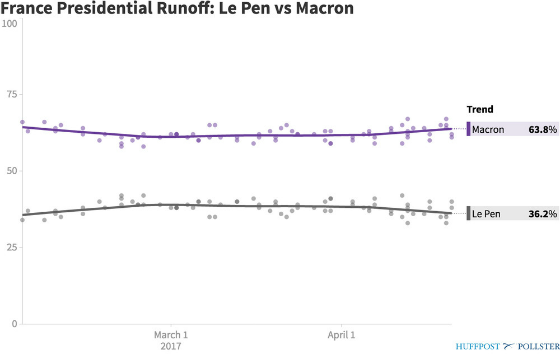
Le Pen came in second in Sunday’s election, with 21.7 percent of the vote. The plurality winner, upstart centrist Emmanuel Macron, won with 23.9 percent. He’s her polar opposite in virtually every respect. She wants to restrict immigration to France and pull France out of the EU; he supports keeping the borders open and proudly waved the EU flag at his final campaign rally. And when these two face each other one-on-one in a runoff in two weeks, he’s very likely to win — every poll that’s been taken so far has him up by massive margins:


The tolerant center, in France, appears likely to hold.

What we’re seeing in France mirrors what’s happening in much of Europe. After the twin shocks of Brexit and Trump, the far-right has seen a series of setbacks. From elections in Austria and the Netherlands to polls in all-important Germany, the far-right is performing far less well than many have expected.

What these numbers suggest is that the far-right has a political ceiling: That while its supporters may be hard-core, the majority of Europeans still recoil from its vision — at least for now. [Continue reading…]

Facebooktwittermail

Senate Trump-Russia probe has no full-time staff, no key witnesses

The Daily Beast reports: The Senate Intelligence Committee’s probe into Russia’s election interference is supposedly the best hope for getting the public credible answers about whether there was any coordination between the Kremlin and Trump Tower.

But there are serious reasons to doubt that it can accomplish this task, as currently configured.

More than three months after the committee announced that it had agreed on the scope of the investigation, the panel has not begun substantially investigating possible ties between the Trump campaign and Russia, three individuals with ties to the committee told The Daily Beast.

The investigation does not have a single staffer dedicated to it full-time, and those staff members working on it part-time do not have significant investigative experience. The probe currently appears to be moving at a pace slower than prior Senate Intelligence Committee investigations, such as the CIA torture inquiry, which took years to accomplish.

No interviews have been conducted with key individuals suspected of being in the Trump-Russia orbit: not Michael Flynn, not Roger Stone, not Carter Page, not Paul Manafort, and not Jared Kushner, according to two sources familiar with the committee’s procedures. [Continue reading…]

Facebooktwittermail

China’s leader urges restraint on North Korea in call with Trump

The New York Times reports: China’s president, Xi Jinping, has urged President Trump to show restraint toward North Korea despite signs that the North may be preparing a nuclear test. Mr. Xi made the appeal in a phone call with Mr. Trump on Monday that reflected growing alarm over North Korea’s plans, which could tip the region into crisis.

The phone conversation, on Monday morning in Beijing, came after Mr. Trump had already used a meeting with Mr. Xi in Florida, a follow-up phone call, interviews and Twitter messages to press Mr. Xi to do more to deter North Korea from holding additional nuclear and missile tests. The United States and its allies have been on alert for another atomic test by the North.

In the latest call, the third between the two leaders, Mr. Xi indicated to Mr. Trump that China opposed any such test by North Korea, but he also nudged Mr. Trump to avoid a tit-for-tat response to the North’s fiery threats, according to a report on Chinese television.

“China adamantly opposes any actions in contravention of the United Nations Security Council resolutions,” Mr. Xi said, according to the report, evidently referring to a series of decisions by the council to punish North Korea for its nuclear and missile programs.

“At the same time, it is hoped that all sides exercise restraint and avoid doing things that exacerbate tensions on the peninsula,” Mr. Xi said, referring to the Korean Peninsula. “Only if all sides live up to their responsibilities and come together from different directions can the nuclear issue on the peninsula be resolved as quickly as possible.”

The comments reflected growing Chinese fears that the tensions between North Korea and the United States and its Asian allies could spiral into outright military conflict. That widening rift is presenting China with confounding choices between its longstanding ties to North Korea and its hopes for steady relations with the United States. [Continue reading…]

Facebooktwittermail