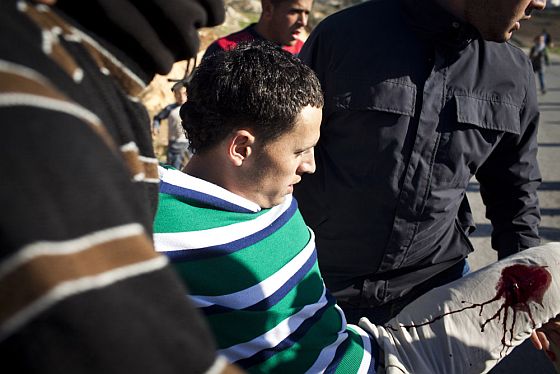
The Popular Struggle Coordination Committee reports: Earlier today, an Israeli military sniper opened fire at demonstrators in the village of Nabi Saleh, injuring one in the thigh. The wounded protester was evacuated by a Red Crescent ambulance to the Salfit hospital. The incident takes place only two weeks after the fatal shooting of Mustafa Tamimi at the very same spot. Additionally, a Palestinian journalist was injured in his leg by a tear-gas projectile shot directly at him, and two Israeli protesters were arrested.
The protester was hit by 0.22″ caliber munitions, which military regulations forbid using in the dispersal of demonstrations. Late in 2001, Judge Advocate General, Menachem Finkelstein, reclassified 0.22” munitions as live ammunition, and specifically forbade its use as a crowd control means. The reclassification was decided upon following numerous deaths of Palestinian demonstrators, mostly children.
Despite this fact, the Israeli military resumed using the 0.22” munitions to disperse demonstrations in the West Bank in the wake of Operation Cast Lead. Since then at least two Palestinian demonstrators have been killed by 0.22” fire:
Az a-Din al-Jamal, age 14, was killed on 13 February 2009, in Hebron,
Aqel Sror, age 35, was killed on 5 June 2009, in Ni’lin.
Following the death of Aqel Srour, JAG Brig. Gen. Avichai Mandelblit reasserted [PDF] that 0.22” munitions “are not classified by the IDF as means for dispersing demonstrations or public disturbances. The rules for use of these means in Judea and Samaria are stringent, and comparable to the rules for opening fire with ‘live’ ammunition.”
Contrary to the army’s official position, permissive use of 0.22” munitions against demonstrators continues in non life-threatening situations. [Continue reading for more background.]
Protester evacuated after being shot with live ammo in Nabi Saleh today. Picture credit: Oren Ziv/ActiveStills
io9.com reports: Palestinian artist Larissa Sansour uses science fictional imagery to discuss her people’s stateless condition, so her work was always bound to cause some controversy. She’s done a host of short films playing with science fiction movie themes, and commenting on Middle Eastern politics.
But after Sansour’s “sci-fi photo series” Nation Estate became one of the finalists for the Lacoste Elysée Prize 2011 — a prestigious award that carries a payment of over $30,000 — the contest’s sponsor, Lacoste, insisted that her work be disqualified. (Yes, the company that makes those funny alligator shirts.) Sansour’s name was removed from the prize’s website, and the photos were removed from an upcoming issue of the magazine ArtReview.
The Nation Estate Project imagines the entire Palestinian people living in one giant high-rise building, sort of like a J.G. Ballard novel, with each floor representing a different city. It’s an offshoot of one of her science fictional short films. Sansour told the Daily Star:
I think the most shocking thing about this development, is that I didn’t apply for this prize… They nominated [me] only to revoke my nomination later on grounds that my work is ‘too pro-Palestinian.’
The Swiss gallery hosting the prize later issued a statement [PDF] explaining its decision to suspend the contest and disassociate itself from Lacoste’s choice:
The Musée de l’Elysée has based its decision on the private partner’s wish to exclude Larissa Sansour, one of the prize nominees. We reaffirm our support to Larissa Sansour for the artistic quality of her work and her dedication. The Musée de l’Elysée has already proposed to her to present at the museum the series of photographs “Nation Estate”, which she submitted in the framework of the contest.
For 25 years, the Musée de l’Elysée has defended with strength artists, their work, freedom of the arts and of speech. With the decision it has taken today, the Musée de l’Elysée repeats its commitment to its fundamental values.
Noam Sheizaf writes: Following the killing of Mustafa Tamimi in his village Nabi Saleh, Spokesperson for the IDF presented pictures of a slingshot Tamimi had on him when he was brought to the hospital. This was to be the indicting evidence that the protester was taking part in hostile action against the army – i.e. throwing stones – and therefore responsible for his own death.
Only in the context of the occupation can throwing stones at a bullet-proof army jeep be seen as an offense deserving the death penalty, carried out on the spot (clearly, the soldiers weren’t acting in self-defense). Furthermore, as recent attacks by settlers on soldiers – including a brick thrown from close range on the IDF regional commander – demonstrated, the army’s treatment of Jews is very different (to be clear, I don’t call for shooting Jewish stone-throwers either). But there is a larger issue here, concerning the whole notion of “legitimate” resistance to the occupation.
Facts and context are important: Israel took over the West Bank and Gaza more than 44 years ago. Since then, the Palestinians have been under military occupation, which denies their basic human and civil rights. The Palestinians can’t vote. They are tried in military court, where the conviction rate is astonishing. They don’t enjoy due process. Their property rights are limited, and their lands – including private lands – are regularly seized by Israel. All this is well-known and well-documented.
As far as Israel is concerned, this situation can go on forever. Israel is not attempting to leave the West Bank – it actually strengthens its hold on the territory – and it doesn’t plan to give the Palestinians equal rights within the state of Israel.
The Palestinians therefore have a moral right to resist the occupation. It’s as simple as that.
Joseph Dana writes: Residents of Nabi Saleh in the West Bank have been demonstrating, each week for the past two years, against the slow encroachment on their land by Israeli settlers.
Gathering in the village centre on Friday afternoons, villagers along with Israeli and international activists attempt to march, under the watchful eye of soldiers, to a disputed agricultural spring which was confiscated recently by Israeli settlers.
Often protesters never even reach the edge of the village; crowd-control measures by the military regularly include barrages of tear gas and rubber bullets.
Palestinian villagers claim that hundreds of protesters have been injured, some seriously, in the Nabi Saleh demonstrations.
But no one had been killed there – until last week.
The death of 28-year-old Mustafa Tamimi may seem to have little in common with the more numerous deaths of protesters in Cairo over the past few days.
Indeed the demonstrations are different from each other in many ways. But in protests from Tunis to Cairo to little Nabi Saleh, the use of tear gas by authorities, and the increasing number of related fatalities, has become a common thread in recent months.
At the New Yorker, David Remnick comments on Newt Gingrich’s incendiary claim that the Palestinians are an “invented people.”
Gingrich and his fellow Republicans have sensed a potential softening in the Jewish vote. In 2008, only African-Americans were more solidly behind Barack Obama, who, according to exit polls, won seventy-eight per cent of the Jewish vote. But the Republicans are hoping to woo at least the more conservative sector of Jewish Americans—those who feel that Obama has been too hard on Benjamin Netanyahu. And, because Gingrich has a little learning and a darkly sophisticated memory for intellectual battle, he catered to his cause by employing the word “invented.” In this context, the word summons a 1984 bestseller that was once totemic on the Jewish right (and still is, for some): “From Time Immemorial: The Origins of the Arab-Jewish Conflict Over Palestine,” by Joan Peters.
Peters, who was not a historian, put forward a purportedly scholarly construction based on the notion, as Golda Meir famously put it, that there is “no such thing as a Palestinian people.” The book, which is an ideological tract disguised as history, made the demographic argument that most people who call themselves Palestinians have short roots in the territory and are Arabs who came from elsewhere. It suggests that the territory that is now Israel was all but “uninhabited” before the Zionist movement began. It was a book that implicitly made the argument that Palestine was a tabula rasa waiting for its Jewish revival; or, as the old slogan had it: “a land without a people for a people without a land.”
The book was not only a commercial success; it also won plaudits from Saul Bellow, Barbara Tuchman, Martin Peretz, Theodore H. White, Lucy Dawidowicz, Arthur Goldberg, and Elie Wiesel. For a time, it was wielded as a means to dismiss Palestinian claims on the land, and a means to be dismissive of Palestinians entirely. The book was thoroughly discredited by an Israeli historian, Yehoshua Porath, and many others who dismantled its pseudo-scholarship. Even some right-wing critics, like Daniel Pipes, who initially reviewed the book positively, later admitted that Peters’s work was shoddy and “ignores inconvenient facts.”
Philip Weiss, following a point that many of his readers seized on after he praised Remnick’s commentary yesterday, notes:
Remnick left out Norman Finkelstein’s role in exposing the fraud; he gave credit to an Israeli:
The book was thoroughly discredited by an Israeli historian, Yehoshua Porath, and many others who dismantled its pseudo-scholarship.
Remnick’s link was to Porath’s 1986 review of the book, “From Time Immemorial,” in the New York Review of Books.
This is a misrepresentation of intellectual history. The story of Norman Finkelstein’s exposure of Joan Peters is one of the great intellectual whodunnits of the Israel-Palestine issue. Finkelstein’s career began with this undertaking, which long preceded Porath’s– in fact, Porath actually cites Finkelstein’s work in his footnotes.
Here’s some of what Finkelstein has written on Peters’ work:
Having stirred outrage by calling Palestinians an “invented people,” in last night’s GOP presidential debate New Gingrich went even further by saying, “these people are terrorists.”
I guess if he becomes president, at least the United States will have to abandon the pretense that it has any role as a mediator between Israelis and Palestinians.
In a conference call organized by the National Council of Young Israel and broadcast on The Yeshiva World News on Friday, Gingrich took a question from Mort Klein, president of the Zionist Organization of America.
Klein is more forthright than some of Gingrich’s other Zionist friends might be — he unequivocally opposes a two-state solution.
Last year he said: “As much as we all want Israel to have peace with the Arabs, Israel can and will survive and thrive without it — as they have since 1948.”
Israel doesn’t need peace — this is the conviction that explains the Israeli intransigence that long ago turned the so-called peace process into a charade.
What those who don’t believe in peace do believe in, is the need for the United States to ensure that Israel maintains its “qualitative military edge” — a commitment that the Obama administration has supported even more strongly than its predecessors.
A nuclear-armed Iran would undermine Israel’s military hegemony in the Middle East and so many of Israel’s supporters are willing to back another war — usually on the pretext that it would prevent a second holocaust — rather than tolerate a significant shift in the regional balance of power.
In spite of the hysterical campaign propaganda that some American politicians are now using, “[f]ew in Netanyahu’s inner circle believe that Iran has any short-term plans to drop a nuclear weapon on Tel Aviv, should it find a means to deliver it,” according to Netanyahu confidant, Jeffery Goldberg.
Klein’s question for Gingrich was on the expansion of settlements, but the strategic perspective they share is that Israel can continue to exist and prosper in a permanent state of war. From that perspective, the two most important features of the relationship between Israel and the United States are that the U.S. continues to maintain a steady flow of military aid and it remains willing to engage in wars that Israel cannot fight alone. It comes down to blood and money.
Note too that a necessary condition that helps ensure that Americans will acquiesce in fulfilling this need is that we must also share the Zionist faith in the sustainability of permanent war.
The unshakable bond that unites Israel and the United States — a bond that in American politics has become an object of cultish devotion — is an absolute faith in war. Perhaps the only thing that will be able to shake that faith will be economic ruin.
Klein: What is your position about the right of Jews to live in Judea and Samaria [the West Bank] and the right of Jews to live in communities there at this present time?
Gingrich: Well, it depends on where exactly you define the boundaries. I do not oppose any development in the [Israeli occupied] areas, because I think that’s part of the negotiating process. To the degree that the Palestinians want to stop the developments they need to reach a deal in which they recognize the right of Israel to exist… As long as they are waging war on Israel, they are in no position to complain about developments. I think the whole peace process has been absurd and has created a psychologically almost impossible position for the average person because once you say there’s a peace process you wonder why the Israelis aren’t being more forthcoming. But if you say, look, we’re still in the middle of a war. They’re still trying to destroy the country — they’re still firing rockets, they still have terrorists coming in — then you all of a sudden understand what the real situation on the ground is, and in that setting, why would the Israelis slow down in maximizing their net bargaining advantage?
In other words, settlement expansion is a bargaining tool and thus the more Israelis there are living in the West Bank, the better Israel’s negotiating position.
As a Palestinian negotiator once said, this is like trying to divide a pizza with someone who is intent on eating the whole pie before it gets divided.
The Washington Post reports on responses to Gingrich’s claim that the Palestinians are an “invented people”:
Michigan Sen. Carl Levin sharply criticized Gingrich’s comments as cynical attempts to curry support with Jewish voters and unhelpful to the peace process.
“The vast majority of American Jews (including this one) and the Israeli Government itself are committed to a two-state solution in which Israelis and Palestinians live side-by-side as neighbors and in peace,” Levin said in a statement. “Gingrich offered no solutions — just a can of gasoline and a match.”
[Hanan] Ashrawi, a member of the Palestine Liberation Organisation Executive Committee, said Gingrich’s remarks harked back to days when the Palestinians’ existence as a people was denied by Israelis such as Golda Meir, prime minister from 1969 to 1974.
“It is certainly regressive,” she said. “This is certainly an invitation to further conflict rather than any contribution to peace.”
“This proves that in the hysterical atmosphere of American elections, people lose all touch with reality and make not just irresponsible and dangerous statements, but also very racist comments that betray not just their own ignorance but an unforgivable bias,” she said.
Fawzi Barhoum, a Hamas spokesman in Gaza, said the Gingrich remarks “were grave comments that represented an incitement for ethnic cleansing against the Palestinians.”
Joe Klein writes: My friend and colleague, the great war photographer Lynsey Addario, has been through a lot this year — kidnapped by the Libyans, difficult assignments in Afghanistan, Somalia and Gaza, and a much less taxing three weeks hanging with me on my annual road trip, all while pregnant… and now she has been utterly humiliated at a checkpoint by the Israeli army while on assignment for the New York Times.
Lynsey asked not to pass through the x-ray machine at the border, since she is nearly 8 months pregnant — and obviously so — but she was forced to pass through the machine 3 times while being verbally abused and then strip-searched for good measure.
This is completely outrageous, of course. It is another indication that Israel has been brutalized by its occupation of Arab territories since 1967. For those of us who feel strongly about the need for Israel to exist–especially those of us who love the place, warts and all–this incident is yet another reason to fear for Israel’s future.
There’s something not quite right about Klein’s phrasing: “Israel has been brutalized by its occupation of Arab territories since 1967.”
Israel, the eternal victim, is now the victim of its own behavior.
I doubt that this was Klein’s intention. To be more blunt and precise he should have said, Israel has brutalized itself by its occupation of Arab territories since 1967.
What Klein and Israel’s other friends still refuse to acknowledge is that this institutional brutality did not begin in 1967 but was already fully evident in 1948. The ethnic cleansing of Palestine was no accident.
Meanwhile, the New York Times itself apparently regards Addario’s treatment by Israeli soldiers as an issue more appropriately dealt with through written correspondence with Israeli officials than by giving it the weight of a front page news item (or even any page in print), nor deeming it worthy of editorial comment. (This has been its only coverage so far.)
Is this out of deference to the Palestinians? An implicit acknowledgment that the occasional affronts that foreign journalists suffer at the hands of Israelis are everyday occurrences for the population that for 44 years has lived under Israeli military rule?
Unlikely. Much more likely is that the New York Times wants to minimize the embarrassment of its friends and staff reporters in Israel.
After Lynsey Addario, a Pulitzer Prize-winning war photographer working for the New York Times, was forced by Israeli soldiers to pass through an X-ray machine three times in spite of her protests that it might harm her unborn child, Jerusalem bureau chief Ethan Bronner expresses shock:
The Times remains shocked at the treatment Lynsey Addario received and shocked at how long the investigation has taken since our complaint was lodged a month ago. The careless and mocking way in which she was handled should not be considered accepted security procedure.
What Bronner and everyone else knows is that there is nothing shocking about the brutal treatment Addario received — unless the shock is not at the treatment itself but the fact that it was dished out to a New York Times journalist. But Bronner makes it clear that that is not what he means. He goes on to say: “We welcome the announcement by the Defense Ministry of plans to hone that procedure.”
In a letter to the Israeli ministry last month, Ms. Addario wrote that soldiers at the Erez Crossing in northern Gaza had treated her with “blatant cruelty” when she arrived there on Oct. 24 and asked not to have to pass through the X-ray machine. Because she was seven months pregnant at the time, she had been advised by her obstetrician to avoid exposure to radiation.
Ms. Addario had phoned an official at the border crossing in advance to make her request and had been assured that there would be no problem. When she arrived at checkpoint, however, she was told that if she did not pass through the X-ray machine, she would have to remove all of her clothes down to her underwear for a search. To “avoid the humiliation,” Ms. Addario decided to pass through the X-ray machine.
“As I passed through,” she wrote, “a handful of soldiers watched from the glass above the machine smiling triumphantly. They proceeded to say there was a ‘problem’ with the initial scan, and made me pass through two additional times as they watched and laughed from above. I expressed each time that I was concerned with the effect the radiation would have on my pregnancy.”
She added:
After three passes through the X-ray, I was then brought into a room where a woman proceeded to ask me to take off my pants. She lifted up my shirt to expose my entire body while I stood in my underwear. I asked if this was necessary after the three machine checks, and she told me it was “procedure” — which I am quite sure it is not. They were unprofessional for soldiers from any nation.
In an e-mail to The Times on Monday, the Defense Ministry wrote that, after “a deep and serious investigation into the matter of Ms. Addario’s security check last month,” it had concluded that her request to avoid the machine had not been passed on to the security officials at the checkpoint because of “faulty coordination between the parties involved.”
So it was a bureaucratic mix-up. It was a “mishap in coordination,” the ministry says and now it has “sharpened” its inspection procedures. And at the same time, a vacuous apology was offered, the Jerusalem Postreports:
“The Defense Ministry employs strict security measures in order to prevent attacks by terrorist groups. We expect people to understand this. Nevertheless, we have apologized to the New York Times and the photographer,” the statement read.
But maybe the apology should not have come from the Israeli Defense Ministry and instead should be made by the New York Times to its readers.
Why go in search of a worthless apology instead of using the incident as an opportunity to provide a graphic, first-hand report on the way Israeli soldiers abuse the civilians under their control? The Times reporters seem to have been busier writing letters to Israeli officials than doing their own jobs: reporting.
Amos Schocken writes: Speaking in the Knesset in January 1993, Prime Minister Yitzhak Rabin said, “Iran is in the initial stages of an effort to acquire nonconventional capability in general, and nuclear capability in particular. Our assessment is that Iran today has the appropriate manpower and sufficient resources to acquire nuclear arms within 10 years. Together with others in the international community, we are monitoring Iran’s nuclear activity. They are not concealing the fact that the possibility that Iran will possess nuclear weapons is worrisome, and this is one of the reasons that we must take advantage of the window of opportunity and advance toward peace.”
At that time, Israel had a strategy – which began to be implemented in the Oslo accords, put an end to the priority granted the settlement project and aimed to improve the treatment of Israel’s Arab citizens.
If things had gone differently, the Iran issue might look different today. However, as it turned out, the Oslo strategy collided with another, stronger ideology: the ideology of Gush Emunim (Bloc of the Faithful ), which since the 1970s, apart from the Oslo period and the time of the withdrawal from Gaza, has established the concrete basis for the actions of Israel’s governments. Even governments that were ostensibly far removed from the Gush Emunim strategy implemented it in practice. Ehud Barak boasted that, in contrast to other prime ministers, he did not return territory to the Palestinians – and there’s no need to point out once again the increase in the number of settlers during his tenure. The government of Ehud Olmert, which declared its intention to move toward a policy of hitkansut (or “convergence,” another name for what Ariel Sharon termed “disengagement” ) in Judea and Samaria, held talks with senior Palestinians on an agreement but did not stop the settlement enterprise, which conflicts with the possibility of any agreement.
The strategy that follows from the ideology of Gush Emunim is clear and simple: It perceives of the Six-Day War as the continuation of the War of Independence, both in terms of seizure of territory, and in its impact on the Palestinian population. According to this strategy, the occupation boundaries of the Six-Day War are the borders that Israel must set for itself. And with regard to the Palestinians living in that territory – those who did not flee or were not expelled – they must be subjected to a harsh regime that will encourage their flight, eventuate in their expulsion, deprive them of their rights, and bring about a situation in which those who remain will not be even second-class citizens, and their fate will be of interest to no one. They will be like the Palestinian refugees of the War of Independence; that is their desired status. As for those who are not refugees, an attempt should be made to turn them into “absentees.” Unlike the Palestinians who remained in Israel after the War of Independence, the Palestinians in the territories should not receive Israeli citizenship, owing to their large number, but then this, too, should be of interest to no one.
The ideology of Gush Emunim springs from religious, not political motivations. It holds that Israel is for the Jews, and it is not only the Palestinians in the territories who are irrelevant: Israel’s Palestinian citizens are also exposed to discrimination with regard to their civil rights and the revocation of their citizenship.
This is a strategy of territorial seizure and apartheid. It ignores judicial aspects of territorial ownership and shuns human rights and the guarantees of equality enshrined in Israel’s Declaration of Independence. It is a strategy of unlimited patience; what is important is the unrelenting progress toward the goal. At the same time, it is a strategy that does not pass up any opportunity that comes its way, such as the composition of the present Knesset and the unclear positions of the prime minister. [Continue reading…]
TPM reports: In an exchange in Iowa on Friday, Rick Santorum defended Israel’s right to build settlements in the West Bank — saying that it is fully part of Israel, having been conquered in the 1967 war, and that as a result all of the people in the West Bank are Israelis, not “Palestinians.”
This would, however, differ from Israel’s actual policy in the West Bank since 1967, which does not extend Israeli citizenship to the territory’s Palestinian inhabitants.
Santorum likened the West Bank’s situation to how the United States gained the West in the Mexican-American War of the 1840s. “So we should have given it back — we should have given New Mexico and Texas back 150 years go?” Santorum asked defiantly in the CNN Web feed, picked up by Think Progress.
Nabi Saleh is a village in the middle of the West Bank. When Israeli soldiers wake up families in the middle of the night and photograph their children, does Santorum think these are Israeli families who are not being allowed to sleep and live in peace?
Sarah Schulman writes: “In dreams begin responsibilities,” wrote Yeats in 1914. These words resonate with lesbian, gay, bisexual and transgender people who have witnessed dramatic shifts in our relationship to power. After generations of sacrifice and organization, gay people in parts of the world have won protection from discrimination and relationship recognition. But these changes have given rise to a nefarious phenomenon: the co-opting of white gay people by anti-immigrant and anti-Muslim political forces in Western Europe and Israel.
In the Netherlands, some Dutch gay people have been drawn to the messages of Geert Wilders, who inherited many followers of the assassinated anti-immigration gay leader Pim Fortuyn, and whose Party for Freedom is now the country’s third largest political party. In Norway, Anders Behring Breivik, the extremist who massacred 77 people in July, cited Bruce Bawer, a gay American writer critical of Muslim immigration, as an influence. The Guardian reported last year that the racist English Defense League had 115 members in its gay wing. The German Lesbian and Gay Federation has issued statements citing Muslim immigrants as enemies of gay people.
These depictions of immigrants — usually Muslims of Arab, South Asian, Turkish or African origin — as “homophobic fanatics” opportunistically ignore the existence of Muslim gays and their allies within their communities. They also render invisible the role that fundamentalist Christians, the Roman Catholic Church and Orthodox Jews play in perpetuating fear and even hatred of gays. And that cynical message has now spread from its roots in European xenophobia to become a potent tool in the long-running Israeli-Palestinian conflict.
In 2005, with help from American marketing executives, the Israeli government began a marketing campaign, “Brand Israel,” aimed at men ages 18 to 34. The campaign, as reported by The Jewish Daily Forward, sought to depict Israel as “relevant and modern.” The government later expanded the marketing plan by harnessing the gay community to reposition its global image.
Last year, the Israeli news site Ynet reported that the Tel Aviv tourism board had begun a campaign of around $90 million to brand the city as “an international gay vacation destination.” The promotion, which received support from the Tourism Ministry and Israel’s overseas consulates, includes depictions of young same-sex couples and financing for pro-Israeli movie screenings at lesbian and gay film festivals in the United States. (The government isn’t alone; an Israeli pornography producer even shot a film, “Men of Israel,” on the site of a former Palestinian village.)
This message is being articulated at the highest levels. In May, Prime Minister Benjamin Netanyahu told Congress that the Middle East was “a region where women are stoned, gays are hanged, Christians are persecuted.”
The growing global gay movement against the Israeli occupation has named these tactics “pinkwashing”: a deliberate strategy to conceal the continuing violations of Palestinians’ human rights behind an image of modernity signified by Israeli gay life. Aeyal Gross, a professor of law at Tel Aviv University, argues that “gay rights have essentially become a public-relations tool,” even though “conservative and especially religious politicians remain fiercely homophobic.”
The Independent reports: Israel has closed down a dovish Israeli-Palestinian radio station in what its backers say is a politically-motivated decision to silence criticism of the Jewish state.
The Communications Ministry ordered the Kol Hashalom station, or All for Peace, to shut down earlier this month for broadcasting into Israel illegally. But Danny Danon, a member of Benjamin Netanyahu’s hawkish Likud party, boasted that he had instigated an investigation into the station for alleged incitement against Israel.
The attack on the radio station, which has broadcast for seven years, raises fresh concerns about press freedoms at a time when many of Israel’s liberals view the country’s democracy as under threat from the right wing.
Israel claims that All for Peace, established by Palestinian and Israeli activists, is a pirate radio station operating without a licence, but the station has countered that it has a licence from the Palestinian Authority, and does not require permission from Israel. The station has offices in East Jerusalem, but broadcasts from Ramallah in the West Bank.
Managers of the station, unique for its willingness to talk to far-right Israelis as much as to militant Palestinians, have been in regular contact with the Communications Ministry over the past seven years, said the Jewish co-director Mossi Raz, who insists that he has never in that time been told to seek an Israeli licence.
“It is a political decision,” said Mr Raz, a former politician with the left-wing party Meretz. “I am very concerned. There is no democracy here. People think that democracy is only the right to vote, but it’s not only that. You cannot have democracy without freedom of the press.” He added that he is preparing to challenge the decision in court.
Max Blumenthal writes: Yesterday, the New York Police Department deployed a strange new weapon against the tens of thousands of demonstrators who converged downtown for the largest protest in Occupy Wall Street’s two month history: the LRAD sound cannon. NYPD officers reportedly blasted Occupy protesters with rays from the LRAD cannon while they sang the American national anthem near Lower Manhattan’s Zuccotti Park (photos here), establishing an atmosphere of fear and intimidation that lasted throughout the evening.
Designed and manufactured by the San Diego-based LRAD Corporation, which was formerly known as the American Technology Corporation, the Long Range Acoustic Device sound weapon is the latest innovation in crowd suppression technology. It is portable and powerful, capable of transmitting a focused ray of 140 decibels of sound at a crowd of people, generating painful cranial vibrations so profound ear plugs become useless. According to LRAD promotional material, the sonic weapon “provides military personnel with a powerful, penetrating warning tone that can be followed by clear voice broadcasts in host nation languages to warn and shape the behavior of potential threats.”
In June, LRAD sold $293,000 worth of its 100X and 500X sound canon systems to the Israeli Ministry of Defense. The contract was part of Israeli Army Commander Maj. Gen. Avi Mizrahi’s investment in $35 million in suppression systems in anticipation of widespread unrest in the occupied West Bank that would supposedly be prompted by the Palestinian Authority’s statehood bid at the United Nations.
The Israeli Army has refined the use of LRAD systems on the civilian population of Palestinian villages engaged in the unarmed popular struggle against Israel’s illegal military occupation. Demonstrators in the village of Beit Ummar have been repeatedly assaulted by Israeli forces armed with LRAD systems, including on October 7, when the Israeli army used the LRAD to attack unarmed demonstrators protesting against the abuse and isolation of Palestinian prisoners held in Israeli jails.
The Washington Post reports: Evoking the nonviolent tactics of the American civil rights movement, six Palestinian activists boarded an Israeli commuter bus linking Jewish settlements in the West Bank to Jerusalem on Tuesday and were arrested as they tried to ride through an Israeli checkpoint on the outskirts of the city.
The group, part of a loose network of independent activists in the West Bank, called themselves “Freedom Riders,” taking the name of civil rights activists who in the 1960s challenged segregation on interstate buses in the southern United States and were attacked by violent mobs.
The Palestinian activists said they were demanding the right to travel freely to Jerusalem, to which access from the West Bank is restricted by Israel, and protesting against bus companies running lines serving Jewish settlements. Israel tightened restrictions on entry of Palestinians to Jerusalem after a string of suicide bombings in the city during a violent uprising that erupted in 2000.
“We are using civil disobedience to disrupt the status quo,” Fadi Quran, one of the activists, said before boarding a bus operated by the Israeli Egged company at a stop serving settlements several miles north of Jerusalem. An Arab headscarf on his shoulders, Quran wore a T-shirt that said: “We shall overcome.”
“As part of our struggle for freedom, justice and dignity, we demand the ability to be able to travel freely on our roads, on our own land, including the right to travel to Jerusalem,” said a statement read by Hurriyah Ziada, a spokeswoman for the activists, in Ramallah before the group set out for the bus stop on back roads to avoid army checkpoints.
At the Hizma checkpoint on Jerusalem’s northern outskirts, Israeli police boarded the bus for identity checks and asked one of the Palestinians, Badia Dweik of Hebron, whether he had a permit to enter Jerusalem.
“Why don’t you ask the settlers for a permit?” Dweik replied, referring to the Israeli passengers. “It’s my right to ride the bus. This is racism. I’m just like them.”
“No permit, no entry,” a military policewoman told him. After Dweik refused to get off the bus, a group of officers tried to drag him off, but he went limp at the narrow doorway, thwarting the initial attempt to arrest him.
Nadim Sharabati from Hebron, sitting next to Dweik, was also told to get off. “Do you demand permits from settlers who come to our area?” he asked. A policeman replied, “Those are the laws.”
“Those are racist laws,” Sharabati said. “Tell me, isn’t this racist discrimination between me and the settlers?”
After a standoff, a larger police contingent boarded the bus and hauled off the activists, arresting them for trying to enter Jerusalem without permits.
The bus protest, which organizers said would be followed by more, drew responses ranging from indifference to hostility from Israeli passengers on board.
“Terrorists!” snapped one man.
Esther Cohen, from the settlement of Maaleh Levonah, said that allowing Palestinians on Israeli buses in the West Bank was a security risk and that she feared one could get off and carry out an attack in a Jewish settlement. Tapping her finger on the bulletproof window of the armored bus, she said, “When we can ride in an ordinary bus, then they can get on as well.”
Watching the activists and a crowd of journalists gather at the bus stop near his settlement, a man who gave his name as Hananel said that Palestinians should ride their own buses. “This is a Jewish state here,” he said.
The Guardian reports: The Palestinians are resigned to losing their battle for majority backing within the United Nations security council for their application for full UN membership but may still press for a vote next week in an attempt to discomfort countries who abstain or vote against.
The security council is to meet in New York on Friday to consider a report on the Palestinian bid. However, the Palestinians have failed to muster the required two-thirds majority among its 15 members, thus sparing the US the need to use its veto to prevent the application being approved.
The Palestinians will also officially receive the report on Friday and the leadership will meet to decide future steps, according to a Palestinian official. “There will definitely be no vote [at the security council] tomorrow,” he said.
One of the options for the Palestinians to consider is to demand a vote next week, knowing they will lose. “Let these countries publicly justify why they will not support a Palestinian state,” said the official. The British foreign secretary, William Hague, looked “deeply uncomfortable” in the House of Commons this week when explaining Britain’s decision to abstain in any vote, he added.
Another option is to take their case to the UN general assembly without a security council vote. The Palestinians are expected to win the support of more than two-thirds of the UN’s 193 countries, but the general assembly can only approve upgraded observer status rather than full membership.
However, enhanced “non-member state” status may allow the Palestinians access to international bodies such as the international criminal court.
Noam Sheizaf writes: Palestinian activists are increasing their efforts to expose Israel’s segregation policy in the West Bank, as well as violations on their civil and human rights. In a message to the press, the Popular Struggle Committee announced that on November 15, Palestinian activists “will reenact the US Civil Rights Movement’s Freedom Rides to the American South by boarding segregated Israeli public buses in the West Bank to travel to occupied East Jerusalem.”
Palestinians in the West Bank have lived under Israeli military control since 1967. Among other restrictions, they can only vote in elections to the Palestinian Authority, which has very limited power on the ground. They cannot travel out of the West Bank or receive visitors without Israeli permits, and they are tried in military courts, which curtail the rights of defendants. Jews living in the West Bank enjoy full citizenship rights.
The occupation is often portrayed as a diplomatic problem of war and peace between two equal parties, Palestine and Israel. The Freedom Riders campaign is part of an effort to emphasize the nature of the Palestinian problem as a human rights issue.
Phyllis Bennis writes: The “Arab spring” may have started in early 2011 when a young Tunisian fruit seller, in a desperate response to disempowerment and despair, immolated himself in the streets of a small town. But its origins link directly to the first Palestinian intifada, the non-violent, society-wide mobilization that transformed Palestine’s national struggle beginning in the late 1980s. Palestinian activists chose “uprising” as the logical English equivalent, but Arabic speakers were clear that intifada didn’t really mean that. It meant something closer to “shake up” or “shaking out”–exactly what Occupy Wall Street has done to the US body politic, and what the Arab spring has set loose in a region long trapped in the morass of US-backed military dictatorships, absolute monarchies, and repressive nationalists.
So when US analysts or European journalists or World Bank bureaucrats ruminate about “when will there be a Palestinian spring?”, it’s generally because they have no historical context, no idea that Palestine’s first intifada spring in many ways set the stage for this Arab spring more than two decades later. For Palestine and Palestinians, the shaking up of the region has provided one of the most comprehensive–and positive–changes in a generation: the end (or at least the beginning of the end) of the era of US-dependent Arab regimes whose commitments to Palestinian liberation were limited to a few dollars and the rhetoric useful for distracting their own populations from state repression, lack of rights and inadequacies of their own lives.
Civil society has risen to become the most important component of the Palestinian national movement–and not only because of the 20 years of failure of the US-controlled “peace process”. It’s also because the most creative and strategic ideas for achieving Palestinian human rights have come from civil society, not from the leadership recognized (or not) by the world’s governments. Beginning with the 2005 call for a global mobilization for BDS (boycott, divestment and sanctions), Palestine’s civil society organizations have been at the centerpiece of the growing international movement to bring non-violent economic pressure to bear on Israel until it ends its violations of international law: ending the occupation of the 1967 territories, ending the legal discrimination against Palestinian citizens of Israel, and recognizing the right of return of Palestinian refugees.
This website or its third-party tools use cookies, which are necessary to its functioning. By closing this banner, you agree to the use of cookies.