Category Archives: Palestinians

Escalating Israeli settler violence in the West Bank

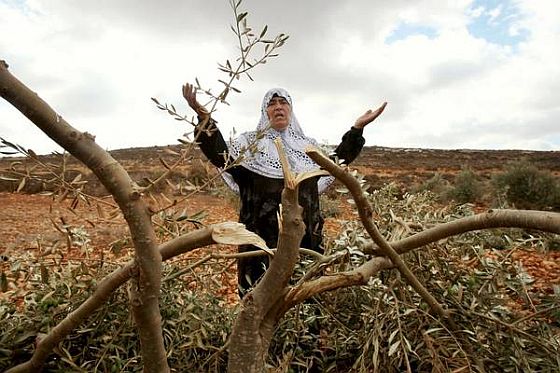
A Palestinian woman gestures next to a damaged olive tree in the village of Qusra in the northern West Bank, Thursday, Oct . 6, 2011

The United Nations Office for the Coordination of Humanitarian Affairs occupied Palestinian territory, says in its latest report [PDF]:

  • The weekly average of settler attacks resulting in Palestinian casualties and property damage has increased by 40% in 2011 compared to 2010, and by over 165% compared to 2009.
  • In 2011, three Palestinians have been killed and 167 injured by Israeli settlers. In addition, one Palestinian has been killed, and 101 others injured, by Israeli soldiers during clashes between Israeli settlers and Palestinians.
  • Eight Israeli settlers have been killed and 30 others injured by Palestinians in 2011, compared to five killed and 43 injured, during the same period in 2010.
  • In 2011, nearly 10,000 Palestinian-owned trees, primarily olive trees, have been damaged or destroyed by Israeli settlers, significantly undermining the livelihoods of hundreds of families.
  • In July 2011, a community of 127 people was displaced en masse due to repeated settler attacks, with some affected families re-locating to Areas A and B.
  • Over 90% of monitored complaints regarding settler violence filed by Palestinians with the Israeli police in recent years have been closed without indictment.
  • OCHA has identified over 80 communities with a combined population of nearly 250,000 Palestinians vulnerable to settler violence, including 76,000 who are at high-risk.

(H/t 972mag.com)

Facebooktwittermail

Israeli doctors ‘failing to report torture of Palestinian detainees’

The Guardian reports: Medical professionals in Israel are being accused of failing to document and report injuries caused by the ill-treatment and torture of detainees by security personnel in violation of their ethical code.

A report by two Israeli human rights organisations, the Public Committee Against Torture (PCAT) and Physicians for Human Rights (PHR), claims that medical staff are also failing to report suspicion of torture and ill-treatment, returning detainees to their interrogators and passing medical information to interrogators.

The report, Doctoring the Evidence, Abandoning the Victim, to be published later this month, is based on 100 cases of Palestinian detainees brought to PCAT since 2007. It says: “This report reveals significant evidence arousing the suspicion that many doctors ignore the complaints of their patients; that they allow Israeli Security Agency interrogators to use torture; approve the use of forbidden interrogation methods and the ill-treatment of helpless detainees; and conceal information, thereby allowing total immunity for the torturers.”

Alleged ill-treatment of detainees, some of whose cases are detailed in the 61-page report, includes beatings, being held for long periods in stress positions, hands being tightly tied with plastic cuffs, sleep deprivation and threats. Israel denies torturing or ill-treating prisoners.

Facebooktwittermail

‘New setback’ for Palestinian hopes on U.N. membership

BBC News reports: A UN diplomat says the UK, France and Colombia have told Security Council members they would abstain in any vote on Palestinian membership.

None of these countries have officially confirmed this yet.

But their decision is a setback for the Palestinians, who have been trying to win support from European states.

A Council committee is considering a Palestinian application to become a UN member state and is expected to present its report next week.

The UN diplomat said Britain, France and Colombia stated their positions in a private meeting of the Security Council committee dealing with the Palestinian application.

The diplomat said Germany also declared it could not support the Palestinian bid, without clarifying whether it would abstain or vote against.

Facebooktwittermail

Israel rushes settlement growth after Unesco accepts Palestinians

The Guardian reports: Israel is to expedite the construction of about 2,000 homes in Jewish settlements in the West Bank and East Jerusalem in response to the Palestinians’ successful bid to join Unesco.

Israel also imposed a temporary halt on the transfer of tax revenues which it collects on behalf of the Palestinian Authority (PA) pending a final decision on whether to impose a long-term freeze. Israel collects about £630m a year in VAT and customs revenues which it passes on to the PA.

A meeting of eight senior cabinet ministers agreed the punitive measures – which include a ban on Unesco missions to Israel – on Tuesday following the symbolically significant vote at the United Nations’ cultural and educational agency.

The ministers are to reconvene to discuss further actions which may include revoking the special status of Palestinian ministers and senior officials which allows them to pass through Israeli military checkpoints.

In response, the PA said the Israeli measures would “speed up the destruction of the peace process”. Nabil Abu Rdainah, spokesman for Palestinian president Mahmoud Abbas, described the decision to temporarily halt transfers of funds as “inhumane”.

Facebooktwittermail

Palestinians hit by cyber-attack following success at Unesco

The Guardian reports: Internet services in the West Bank and Gaza have come under “sustained attack” by unknown hackers in multiple locations, according to officials.

“There has been a sustained attack since the morning from many sources in many countries,” said Palestinian Authority spokesman Ghassan Khatib. “It is deliberate and continuous.”

Computer experts were trying to identify the sources of the attack and the authority would seek assistance from the governments of those countries involved, he said. The attack had interrupted services, causing internet connections to range from “very, very slow to completely stopped”.

The authority has no idea who was behind the cyber- attack and the reason for it, Khatib said.

The telecoms minister, Mashour Abu Daqqa, told Reuters that “all Palestinian IP addresses have been exposed to a focused, organised attack from abroad. I think this is organised by a state”.

Facebooktwittermail

The deal behind the “Shalit deal”: prisoners, power, racism

Toufic Haddad writes: Passing judgment on the Shalit deal cannot take place from a detached precipice of moral or political purity but, rather, must derive from an appreciation for the basic balance of forces at play between the contending parties and their historical precedents in relations between one another. There are no absolute criteria for judging such matters, with interests and needs within each negotiating party variegated, subject to shifts over time, and difficult to quantify to begin with.

For this reason, it is helpful to begin analyzing the Shalit deal by understanding that before Shalit’s capture, Israel refused to recognize Hamas as a legitimate political entity; this non-recognition continued despite the Hamas victory in democratic elections in 2006. Israel subsequently refused all formal interaction with Hamas, encouraging other countries to do the same. Soon after Shalit’s capture, Israel’s Prime Minister’s Bureau reiterated this stance, asserting, “There will be no negotiations to release prisoners…The government of Israel will not give in to extortion by the Palestinian Authority and the Hamas government, which are headed by murderous terror organizations. The Palestinian Authority bears full responsibility for the welfare of Gilad Shalit and for returning him to Israel in good condition.”

In this respect, the very sealing of a deal with Hamas was a major Israeli concession. Israel sought every possible way to retrieve Shalit without having to negotiate, but failed. The weeks after the capture of Shalit witnessed more than 400 Palestinians killed in Israel’s “Operation Summer Rains” in a failed effort to retrieve him. Israel’s massive offensive “Operation Cast lead” in December 2008/January 2009, which left 1400 Palestinians dead, also put the recovery of Shalit as a central objective of the mission. The siege of Gaza is still justified as necessary in the context of Shalit’s continued detention.

All of this was part and parcel of a broader Israeli strategy vis-à-vis Palestinians which entailed not only the historic rejection of all Palestinian political rights, but an on-the-ground military doctrine which holds that “might makes right,” Israel has a “long arm of justice,” and Israel will “burn into [Palestinian] consciousness” their own defeat.

Viewed in this context, Shalit’s capture and detention for five years, and Hamas’ ultimate successful negotiation for a prisoner release are all the more impressive.

Gideon Levy writes: [Gilad Shalit] will return not to a country but rather to a telenovela in which emotions are forever and always the only language. It must be hoped that he will return in good mental health, but he certainly won’t be returning to a healthy society. He will return to a society in psychosis. The national psychosis surrounding his fate began the day he was captured, and is now reaching its peak. The IDF readied a few sets of uniforms for him, it was reported, in the event that the national boy lost a great deal of weight – the main thing is to show him off in uniform, as befits a war hero.

Yedioth Ahronoth has already launched a sales campaign disguised under the banner of “Do you want to write to Gilad?” and the hundreds of thousands of yellow ribbons that fluttered from every tree and the side mirrors of every car will flutter for the last time in the autumn breeze. Israel will once again pat itself on the back in sticky solidarity, in brotherhood and in mutual responsibility – there’s no one like us.

Over the weekend a retired brigadier general already wrote, “That’s exactly the difference between us and them.” (What exactly is the difference? That wasn’t clear. ) And a general in the reserves declared: “Hamas has a heart of stone” (as if someone who detains tens of thousands of Palestinian prisoners, some of them political, some of them without trial, some of them held for years with no family visits, has a heart of gold ).

In the last five years not a single Israeli has remained apathetic about Shalit’s fate. That is how it should be, and it is cause for pride. That humanization of a single soldier, with a (pale ) face, with (noble ) parents and a (worried ) grandfather, and even his having been turned into a “boy,” is a sign of a humanitarian society. One can even somehow accept the frenetic nature of Israeli society, which goes from one extreme situation to another in a flash. The two soldiers who were killed during Shalit’s abduction are unknown soldiers, Shalit became an iconic hero; Yitzhak Rabin turned overnight from a despised prime minister into a saint. MIA soldiers have been forgotten, other captive soldiers never became national symbols, and only Shalit became what he became.

Five years with only a rare news broadcast that did not mention his existence. Apparently there was something about Shalit and about his parents that captured the nation’s heart. And this too is only for the good.

The problem starts with the ridiculous crowns we claimed for ourselves and with the hypocrisy, emptiness and blindness characterizing them. The campaign to free Shalit, which was not free of repellent aspects, such as the efforts to prevent visits to Palestinian prisoners, turned into a campaign of the state, a pressure release valve for the demonstration of caring and civil involvement – hollow and shallow, just like the “candle youth” who sobbed over Rabin’s murder and voted for Netanyahu in the next election.

Who isn’t against terror and for Shalit’s release? But that same sobbing society did not for a moment ask itself, with honesty and with courage, why Shalit was captured. It did not for a moment say to itself, with courage and with honesty, that if it continued along the same path there will be many more Gilad Shalits, dead or captured. In successive elections it voted, again and again, for centrist and right-wing governments, the kind that guarantee that Shalit will not be the last. It tied yellow ribbons and supported all of the black flags. And no one ever told it, with courage and with honesty: Shalit is the unavoidable price of a state that chooses to live by the sword forever.

Facebooktwittermail

Obama’s obsequiousness is shameful

Avraham Burg writes: It was depressing to see American President Barack Obama’s weak appearance at the United Nations. It was depressing to see this talented man, who brought such great hope to the world, presenting the pitiable position of a feeble empire. It was embarrassing to see him defending positions and people whom only a few months earlier he had attacked with fury. His obsequiousness is shameful, and this weakness is a real danger to the world. Therefore anyone who wants peace cannot make do merely with accusing Obama. One cannot allow his desperation to have veto power over our hope.

It is strange, but we no longer have anyone on whom to rely but the head of the Palestinian Authority, Mahmoud Abbas. If the current Palestinian move in the UN is successful, it will be wonderful. There will be two states between whom negotiations will be conducted – on an equal footing, and not as an occupying force and the vanquished – about their future and the relations between them. But if the move fails, because Obama has become a hostage in the hands of Prime Minister Benjamin Netanyahu, who himself is a hostage in the hands of the settlers and other Israeli extremists, we will be left merely to wonder what the next step will be.

In the past few years, there has been a change in the cast of players in the Middle East theater of the absurd. Israel has become big and clumsy, erring and intransigent. The Palestinians, or at least those among them who support the PA and the government in Ramallah, have taken over the role that was once ours: seeking peace, restraining violence, building a state, and initiating diplomacy. That is how things are in history – yesterday’s weak ones are today’s sated, decadent ones; the victim becomes the oppressor.

On the other hand, as has happened more than once in history, the hope for change lies with the weak. The weak side is the side that stands to gain most from change, and is therefore prepared to take great personal and political risks for change. Netanyahu is several times worse than former prime ministers – David Ben-Gurion, who established the state, or Menachem Begin who achieved peace with Egypt, or Yitzhak Rabin, who tried to follow the Oslo path and paid for it with his life. Abbas is several times better than PLO leader Yasser Arafat who preceded him. That is how things are. They are in a state of evolving and we are receding.

I realize that the commitment to democracy is an inseparable part of the PA’s leadership today. (It is not possible to say the same for the Israeli leadership ). I hope it is a path of no return. If the idea of realizing this aspiration in the framework of a democratic Palestinian state does not bear fruit, the Palestinians must embark on a worldwide initiative demanding that they be allowed to vote for the Knesset. Yes, Israel’s parliament.

This initiative must be accompanied by a non-violent civil rebellion. It will attract a great deal of attention and will cast the spotlight on the paradox of Israeli hypocrisy which claims that we are the only democracy in the Middle East but forgets to point out that we are a democracy for Jews alone. Because we are also the only colonialist conqueror that is left in the Western world.

In order to prove the seriousness of their intentions, the Palestinians need a pilot project, so here it is. The Palestinian leadership must ask the Arabs of East Jerusalem to get organized for the next municipal elections. Since 1967, there have been about one quarter of a million Arabs who have the right to vote in the municipality of Jerusalem alone. In protest against the offensive annexation of the eastern part of the city, they have never realized their democratic right. However this protest does not really help.

The time has come for the anger to be turned into a constructive step. I have no doubt that the moment that one third of the members of the city council of Israel’s capital represent the residents of East Jerusalem, everyone will start to wake up.

Even Netanyahu, who is always the last to wake up, will make sure to stay alert. Because Palestinian political partnership in Jerusalem means one city that belongs to all its residents. That will be very different from the disgraceful situation of discrimination that exists today. One city that belongs to all its residents is only the prologue to one state that belongs to all its citizens between the Jordan River and the sea. That is the real price of the refusal on the part of Netanyahu and the right.

Anyone who is not prepared to do anything to promote two states today – and who is not prepared to pay the price by evacuating the settlements – will, in the end, have to concede all of the state of Israel. That is to say, the Jewish and not so democratic state will be renounced in favor of a legitimate democratic process in which everyone between the Jordan River and the sea has one basic right – the human and civic equality to elect and to be elected. They will have at least the very same rights that are enjoyed by Obama and his new friend who knows just how to manipulate him, Netanyahu.

Avraham Burg is an Israeli author and a former Speaker of the Knesset.

Facebooktwittermail

Palestinian protesters accost U.S. diplomats during West Bank visit

The Associated Press reports:

A small crowd of Palestinian protesters accosted an American diplomatic delegation visiting the West Bank Tuesday, blocking a convoy of vehicles, chanting “shame on you” and hurling a shoe — a deeply insulting gesture in Arab culture.

The Americans, including employees of the consulate in Jerusalem, were on their way to a U.S. reception in town of Ramallah meant to reaffirm cultural and educational ties with the Palestinians.

But relations have grown strained recently, with Palestinians disappointed over President Barack Obama’s handling of Mideast peace efforts. They say he is not tough enough on Israel and are also upset over U.S. vows to block their attempt to receive full membership at the United Nations.

Members of Congress have already put a hold on $200 million in economic assistance to the Palestinians to dissuade them from pushing forward with the U.N. request. Officials have also hinted that aid could be cut altogether if the Palestinians proceed with their plans. The U.S. provides some $500 million a year to the Palestinians.

The activists involved in the demonstration, which was organized on Facebook, called for a boycott of the U.S. reception. They held banners reading, “No for the American funds,” ”Veto America” and “Obama, your vision is shortsighted.”

Facebooktwittermail

The U.S. is the main obstacle to Middle East peace

Henry Siegman writes:

Over the past few days, much has been written about the Palestinian bid for UN recognition of its statehood and Washington’s opposition to it. But the real importance of last week’s events at the UN does not lie with the US response itself, but with the effect that response has had on the international community. For now, the Palestinian bid must be reviewed by a special UN committee, a process that will take weeks or months, thus postponing any immediate reckoning with the veto threatened by the Obama Administration. But for the first time, there is a broad recognition of the emptiness of the American claim that the US is uniquely qualified to bring the Israel-Palestine conflict to an end, and awareness that it may instead be the main obstacle to peace.

This recognition marks a dramatic shift from only two years ago. In his speech in Cairo in June 2009, Obama seemed to announce a new American commitment to fairness, international law, and a two-state solution when he proclaimed that:

the Palestinian people—Muslims and Christians—have suffered in pursuit of a homeland. For more than 60 years they’ve endured the pain of dislocation. Many wait in refugee camps in the West Bank, Gaza, and neighboring lands for a life of peace and security that they have never been able to lead. They endure the daily humiliations—large and small—that come with occupation. So let there be no doubt: The situation for the Palestinian people is intolerable. And America will not turn our backs on the legitimate Palestinian aspiration for dignity, opportunity, and a state of their own.

In his speech at the UN General Assembly last week, however, Obama reserved his compassion for those responsible for the Palestinians’ misery. “Let’s be honest,” he said. “Israel is surrounded by neighbors that have waged repeated wars against it,” and Israeli citizens have been killed by suicide bombers on their buses. “These are facts, they can not be denied,” he said. As noted by The New York Times’s Ethan Bronner, the speech could have been written by an Israeli government official: “It said nothing about Israeli settlements, the 1967 lines, occupation, or Palestinian suffering, focusing instead on Israeli defense needs.”

Moreover, Obama’s depiction of today’s Israel was neither honest nor factual. Far from waging repeated wars on Israel, a decade ago its neighbors offered to establish full normal relations, including diplomatic recognition, trade and security—an offer Israel has to this day spurned and rejected. The earlier Arab hostility to Israel which Obama invoked is as relevant to Netanyahu’s policies as the Soviet Union’s hostility to America is to Obama’s policies.

Facebooktwittermail

Palestinians could pursue war crimes charges without full statehood: ICC prosecutor

The Toronto Star reports:

In the fierce debate over the Palestinian bid for UN membership, one unseen presence has cast a long shadow.

It’s that of Luis Moreno-Ocampo, the prosecutor of the International Criminal Court — the body Israel has long feared would take up Palestinian allegations of war crimes if its statehood bid is successful.

A few blocks away from the UN this week, the man at the centre of the controversy said if Palestine becomes a member state, or a lower-ranked non-member observer state, it could be eligible to pursue claims against Israel.

“If the General Assembly says they are an observer state, in accordance with the all-state formula, this should allow them . . . to be part of the International Criminal Court,” he told the Star.

Facebooktwittermail

Tony Blair’s job in jeopardy as Palestinians accuse him of bias

The Daily Telegraph reports:

Tony Blair’s future as Middle East peace envoy was in jeopardy after the Palestinian Authority said it was set to sever all contact with him because of his “bias” towards Israel.

The senior echelons of the Palestine Liberation Organisation are expected to meet in the coming days to discuss a proposal to declare Mr Blair persona non grata, officials said.

Predicting unanimous support for the motion from the entire Palestinian leadership, they said the intention was to isolate the former prime minister to such an extent that his position would become untenable.

Mr Blair has been viewed with an element of distrust by some Palestinians ever since his appointment as the envoy of the Quartet on the Middle East – the mediating body comprising the United States, the EU, the UN and Russia – on the day he left Downing Street in June 2007.

But antagonism has mounted over allegations that he lobbied European powers to vote against a Palestinian bid for statehood submitted to the United Nations in New York last week. “We have been extremely unhappy and dissatisfied with Mr Blair’s performance since he became envoy, but particularly in the past few weeks,” a senior Palestinian official said.

However, The Independent reports:

The Palestinian Authority has denied it plans to make a formal request to remove Tony Blair from his position as a Middle East envoy.

The former Prime Minister has held the position of special envoy for the Quartet, made up of the US, Russia, the EU and UN, for four years. However, some Palestinians believe he is biased towards the Israelis.

A spokesman for the PA said while there was great unhappiness with Mr Blair’s role as envoy, his removal was not a priority. He added there were no plans to formally ask for Mr Blair to be replaced. The Security Council is currently considering the request by the Palestinians for statehood, although the US has said it will use its position as a permanent member of the council to veto the bid. Mr Blair has said he was not against the Palestinians’ UN status being upgraded, possibly to non-member state. But he said such a move should be made alongside a return to negotiations.

Facebooktwittermail

Discrimination against Palestinian citizens of Israel

The Institute for Middle East Understanding lists the forms of institutionalized discrimination that target non-Jewish citizens of Israel.

  • There are more than 30 laws that discriminate against Palestinian citizens of Israel. directly or indirectly, based solely on their ethnicity, rendering them second or third class citizens in their own homeland.
  • 93% of the land in Israel is owned either by the state or by quasi-governmental agencies, such as the Jewish National Fund, that discriminate against non-Jews. Palestinian citizens of Israel face significant legal obstacles in gaining access to this land for agriculture, residence, or commercial development.
  • More than seventy Palestinian villages and communities in Israel, some of which pre-date the establishment of the state, are unrecognized by the government, receive no services, and are not even listed on official maps. Many other towns with a majority Palestinian population lack basic services and receive significantly less government funding than do majority-Jewish towns.
  • Since Israel’s founding in 1948, more than 600 Jewish municipalities have been established, while not a single new Arab town or community has been recognized by the state.
  • Israeli government resources are disproportionately directed to Jews and not to Arabs, one factor in causing the Palestinians of Israel to suffer the lowest living standards in Israeli society by all socio-economic indicators.
  • Government funding for Arab schools is far below that of Jewish schools. According to data published in 2004, the government provides three times as much funding to Jewish students than it does to Arab students.
  • According to the 2009 US State Department International Religious Freedom Report, “Many of the national and municipal policies in Jerusalem were designed to limit or diminish the non-Jewish population of Jerusalem.”
  • The Nationality and Entry into Israel Law prevents Palestinians from the occupied territories who are married to Palestinian citizens of Israel from gaining residency or citizenship status. The law forces thousands of Palestinian citizens of Israel to either leave Israel or live apart from their families.
  • In October 2010, the Knesset approved a bill allowing smaller Israeli towns to reject residents who do not suit "the community’s fundamental outlook", based on sex, religion, and socioeconomic status. Critics slammed the move as an attempt to allow Jewish towns to keep Arabs and other non-Jews out.
  • The so-called "Nakba Bill" bans state funding for groups that commemorate the tragedy that befell Palestinians during Israel’s creation in 1948, when approx. 725,000 Palestinian Arabs were ethnically cleansed to make way for a Jewish majority state.
  • The British Mandate-era Land (Acquisition for Public Purposes) Ordinance law allows the Finance Minster to confiscate land for "public purposes.” The state has used this law extensively, in conjunction with other laws such as the Land Acquisition Law and the Absentees’ Property Law, to confiscate Palestinian land in Israel. A new amendment, which was adopted in February 2010, confirms state ownership of land confiscated under this law, even where it has not been used to serve the original confiscation purpose. The amendment was designed to prevent Arab citizens from submitting lawsuits to reclaim confiscated land.
  • Over the entirety of its 63-year existence, there has been a period of only about one year (1966-1967) that Israel did not rule over large numbers of Palestinians to whom it granted no political rights.
  • Former Israeli prime ministers Ehud Barak and Ehud Olmert have both warned that a continuation of the occupation will lead to Israel becoming an "apartheid" state. Barak stated: "As long as in this territory west of the Jordan river there is only one political entity called Israel it is going to be either non-Jewish, or non-democratic… If this bloc of millions of Palestinians cannot vote, that will be an apartheid state."
  • Archbishop Desmond Tutu and Nelson Mandela, heroes of the struggle against apartheid in South Africa, have both compared Israel’s treatment of Palestinians to apartheid.
  • Today, there is a virtual caste system within the territories that Israel controls between the Jordan River and Mediterranean Sea, with Israeli Jews at the top and Muslim and Christian Palestinians in the occupied territories at the bottom. In between are Palestinians with Israeli citizenship and Palestinian residents of occupied East Jerusalem.
Facebooktwittermail

Palestine vote showcases the decline of American power

Juan Cole writes:

The United States, castigated by its critics as recently as a decade ago as a “hyper-power,” is now so weak and isolated on the world stage that it may cast an embarrassing and self-defeating veto of Palestinian membership in the United Nations. Beset by debt, mired in economic doldrums provoked by the cupidity and corruption of its business classes, and on the verge of withdrawing from Iraq and ultimately Afghanistan in defeat, the U.S. needs all the friends it can get. If he were the visionary we thought we elected in 2008, President Obama would surprise everyone by rethinking the issue and coming out in favor of a U.N. membership for Palestine. In so doing, he would help the U.S. recover some of its tarnished prestige and avoid a further descent into global isolation and opprobrium.

It is often the little things that trip up empires and send them spiraling into geopolitical feebleness. France’s decision to react brutally to the Algerian independence movement from 1954 arguably helped send its West African subjects running for the exits, much to the surprise and dismay of a puzzled Gen. Charles de Gaulle. Empires are always constructed out of a combination of coercion and loyalty, and post-colonial historians often would prefer not to remember the loyalty of compradors and collaborators. But arguably it is the desertion of the latter that contributes most decisively to imperial collapse.

Thus, it is highly significant that an influential Saudi prince warned the United States that a veto of Palestine at the U.N. could well cost the latter its alliance with Saudi Arabia. The kingdom is the world’s swing petroleum producer and has done Washington many favors in the oil markets, and although such favors were seldom altogether altruistic, Riyadh’s good will has been a key element in U.S. predominance.

The House of Saud has other options, after all. It has been thinking hard about whether its ideological differences with the Chinese Communist Party are not outweighed by common interests. Among these mutual goals is the preservation of a model of authoritarian, top-down governance combined with rapid economic advance to forestall popular demands for participation, as an alternative to Western liberalism. For its part, China has invested $15 billion in the Arab world in recent years and is an increasingly appealing destination for Arab capital. Beijing is supporting Palestinian Authority President Mahmoud Abbas’ initiative for recognition in the U.N.

Facebooktwittermail

The end of Oslo

Judith Butler writes:

Among the many astonishing claims that Barack Obama made in his recent speech opposing the Palestinian bid for statehood was that ‘peace will not come through statements and resolutions.’ This is, at best, an odd thing to say for a president whose ascendancy to power itself depended on the compelling use of rhetoric. Indeed, his argument against the power of statements and resolutions at the United Nations to achieve peace was a rhetorical ploy that sought to minimise the power of rhetorical ploys. More important, it was an effort to make sure that the United States government remains the custodian and broker of any peace negotiation, so his speech was effectively a way of trying to reassert that position of custodial power in response to the greatest challenge it has received in decades. And most important, his speech was an effort to counter and drain the rhetorical force of the very public statements that are seeking to expose the sham of the peace negotiations, to break with the Oslo framework, and to internationalise the political process to facilitate Palestinian statehood.

There are reasons to question whether the Palestinian bid for statehood at this time and on these terms is the right thing to do, but they are not the ones that Netanyahu put forward in his blustery and arrogant remarks. Within the Palestinian debates, many have questioned whether the present bid for statehood effectively abandons the right of return for diasporic Palestinians, leaves unaddressed the structural discrimination against Palestinians within the current borders of Israel, potentially abandons Gaza, delegitimises the Palestinian Liberation Organisation by elevating the Palestinian Authority into a state structure, takes off the table the one-state solution, and mistakenly relies on the UN as an arbiter rather than insisting that Palestinian self-determination form the basis of any future state. Critics like Ali Abunimah, the editor of the Electronic Intifada, argue that the UN has proven itself time and again to be a venue for paralysis, given the veto rules that govern the Security Council and secure the hegemony of major powers, making it likely that the present bid for statehood will be defeated by a US veto.

And yet, one effect that is already felt as a consequence of these ‘resolutions and statements’ is that the 1993 Oslo Accords can no longer be presumed to be the framework for future negotiations – indeed, we may see that framework crumble definitively in the coming days. Oslo not only gave the US a privileged position as broker of all ‘peace’ negotiations, but effectively sponsored the massive growth of Israeli settlements on Palestinian land by refusing to recognise their illegal status according to international law. In fact, the Oslo years have seen the number of settlers grow from 241,500 in 1992 to 490,000 in 2010 (including East Jerusalem), and the indefinite deferral of all ‘permanent status issues’ – effectively establishing the occupation as a regime without foreseeable end. The Oslo Accords also implemented the principle that any change of status of Occupied Palestine would depend on the ‘consent’ of Israel. Thus, the power of Israel to decide the future of Palestine pre-empted the international right of Palestinians to self-determination.

Facebooktwittermail

The Palestinians already knew about Obama’s hypocrisy

Robert Fisk writes:

So there I was, on the Via Dolorosa of course, chatting to a middle-aged guy in a red T-shirt and just a wisp of a beard with a prayer rug under his left arm.

And I asked him, of course, what he thought about Barack Obama’s speech. He grinned at me like he knew I had already guessed what he was going to say. “What did you expect?” he asked. Correct guess. After all, Haaretz had already referred this week to “President Barack Netanyahu” while the racist Israeli foreign minister said he would sign the speech with both hands. Maybe, I reflected in Jerusalem yesterday, Obama really is seeking election – to the Israeli Knesset.

But what was so striking about the streets of Jerusalem yesterday was the sense of resignation, of weary acceptance. The Israeli papers had warned of mass violence, but the crowds who turned up for morning prayers at Al-Aqsa simply laid out their prayer rugs on the highway outside the Damascus Gate or in the laneways behind the mosque and showed scarcely any interest in talking about Obama. Maybe America’s UN veto will rouse them to passion, but I have my doubts.

It’s a bit like the aftermath of the Abu Ghraib torture pictures, when the Americans restricted the number of photos to be released because they feared the pictures would enrage Iraqis. But I was in Baghdad that day and no one expressed any particular rage. What did I expect? After all, the Iraqis knew all about Abu Ghraib already – they were the ones who had been tortured there. So, too, Jerusalem yesterday. The Palestinians have watched America’s uncritical acceptance of Israeli occupation – the longest in the world – for 44 years. They knew all about it. It is only we Westerners who are horrified by torture pictures and by Obama’s hypocrisy.

Facebooktwittermail

September 23, 2011: A historic day for Israel-Palestine?

Daniel Levy writes:

Cynicism and skepticism always have their place, but today might just go down as an historic day on the Israeli-Palestinian front. No, there is no direct or quick fix move from the Palestinian application for U.N. membership to the actual realization of a Palestinian state (and certainly not when one factors in the Israeli response) but the Palestinian U.N. move does represent the most definitive break yet with the failed and structurally flawed strategies for advancing peace of many a year. Many Palestinians and others are now suggesting that the PLO leadership progress from the symbolism of September 23rd to a concerted struggle for their freedom centered on nonviolent resistance, diplomacy, and international legality, believing that this would finally deliver a breakthrough.

In its theatrics, today was rather predictable — other than the Quartet statement of the afternoon, on which more in a moment. The speeches of Abbas and Netanyahu held few, if any, surprises. Abbas played to the Palestinian community at home and around the world, and to the rest of the international community.

Abbas spoke to the refugee experience, including his own, while leaving wiggle room for a future solution and embracing the Arab Peace Initiative on this score. He clarified that the PLO would continue to represent all Palestinians until all issues are definitively resolved, urged that this not become a religious struggle (pushing back on Netanyahu’s attempt to make this about a Jewish state), and linked the Palestinian struggle for rights to the so-called Arab Spring, albeit something that will have to be born out in reality beyond the made-for-TV pictures from Ramallah’s town square.

Abbas could also not have been more explicit on this being a Palestine alongside Israel, on the 67 lines, on only 22% of Mandatory Palestine — and thus calling the lie on Netanyahu’s claim that Abbas wants to have a state that would come at Israel’s expense, replacing Israel.

Netanyahu was playing to the Israeli public and to the American and Jewish right. His speech represented a doubling down of the porcupine strategy that guides his government’s policy. He told the world body that its Security Council was being presided over by terrorists and posed as the champion of the “Clash of Civilizations” narrative. In reminding his audience of the sacrifices entailed by Israel’s withdrawal from Gaza six years ago, he somehow overlooked the fact that this was a withdrawal that he himself vociferously opposed. In referring several times to Israel’s peace with Egypt, Netanyahu may have left some reminiscing that in that agreement Israel withdrew to the last centimeter of the 67 lines, removed every settler and IDF position, and entrusted security to an international force — the MFO.

In response to their respective speeches, Abbas received overwhelming applause from the delegates in the GA hall while Netanyahu’s support came only from his own delegation and from the peanut gallery — perhaps that was filled with a U.S. congressional delegation on a daytrip to the U.N.!

Facebooktwittermail