Category Archives: war in Afghanistan

NEWS: The other safe haven for mercenaries

Nobody guarding Afghanistan’s guards

The Afghan government and its international partners are struggling to bolster the country’s security forces, fighting the twin problems of boosting the numbers of the national army and trying to disband illegal armed groups.

Yet, an unmonitored, unregulated and unauthorized force is on the streets, not just under the noses of authorities but also hired and legitimized by those working on building the security sector.

As many as 28,000 armed personnel are hired by private security companies (PSCs), which have been operating as a lucrative business in Afghanistan since the US-led invasion to oust the Taliban in 2001, providing protection to foreigners and elite Afghans, guarding institutions, homes and individuals.

The number of armed contractors is more than half the Afghan National Army, which is estimated at between 35,000 to 50,000, and could be larger if the numbers of “irregular” forces are added to the ranks of legal contractors. [complete article]

Facebooktwittermail

NEWS: U.S. considers military solution for Pakistan’s political crisis

U.S. considers enlisting tribes in Pakistan to fight al Qaeda

A new and classified American military proposal outlines an intensified effort to enlist tribal leaders in the frontier areas of Pakistan in the fight against Al Qaeda and the Taliban, as part of a broader effort to bolster Pakistani forces against an expanding militancy, American military officials said.

If adopted, the proposal would join elements of a shift in strategy that would also be likely to expand the presence of American military trainers in Pakistan, directly finance a separate tribal paramilitary force that until now has proved largely ineffective and pay militias that agree to fight Al Qaeda and foreign extremists, officials said. The United States now has only about 50 troops in Pakistan, a Pentagon spokesman said, a force that could grow by dozens under the new approach.

The new proposal is modeled in part on a similar effort by American forces in Anbar Province in Iraq that has been hailed as a great success in fighting foreign insurgents there. But it raises the question of whether such partnerships can be forged without a significant American military presence on the ground in Pakistan. And it is unclear whether enough support can be found among the tribes. [complete article]

Musharraf rejects U.S. pressure to lift emergency rule

President Pervez Musharraf on Saturday rebuffed pressure from a senior U.S. envoy to revoke emergency rule under the country’s current security situation, envoys said.

In a tense two-hour meeting, Deputy Secretary of State John D. Negroponte delivered a “very strong message” urging Musharraf to end the state of emergency, step down as head of the military and release of thousands of political prisoners.

“Emergency rule is not compatible with free, fair and credible elections,” Negroponte said at a news conference Sunday morning, referring to parliamentary elections set for early January. “The people of Pakistan deserve an opportunity to choose their leaders free from the restrictions that exist under a state of emergency.”

A diplomat characterized the meeting as “short of tough love, but still tough.” [complete article]

Musharraf widens his sphere of punishment

Two weeks into the crisis that began when Musharraf purged the judiciary, muzzled the media and clamped down on politicians who opposed his re-election, the full details of what the ‘state of emergency’ entails are emerging as human rights groups in Karachi, Islamabad and Lahore collect testimonies.

Retribution is being meted out on a massive scale and Pakistan’s powerful gossip mill has attributed a particular motive to Musharraf’s thinking – his aim is to ‘teach a lesson’ to those who have dared object to his belief that only he can save his country. The aim of the state of emergency has been largely to humiliate the opposition. [complete article]

See also, U.S. aims to reshape Pakistan aid (LAT), Pakistan court bulldozes through rulings for Musharraf (Reuters), and Threat to strip Benazir Bhutto of amnesty (The Sunday Times).

Facebooktwittermail

FEATURE: Is the return of the Taliban inevitable?

A mullah dies, and war comes knocking

The only reason Pakistan’s invasion-by-proxy has morphed into something even vaguely resembling an insurgency is that the Afghan people are at the limit of their endurance with a government that pillages and brutalizes them and lies to them barefaced. Judges demand fortunes for positive verdicts. Customs agents expect kickbacks for every transaction. Police officers shake people down or kidnap them for ransom. Six years of depredations by the government have led to its rejection — and to resentment of the international community that installed it and then refused to supervise it. From those feelings of anger have spread pools of collaboration with the Taliban.

Meanwhile, have the Taliban changed their approach to the exercise of power? Not in the least. They still seek to gain control via terror — by hanging bodies upside-down from trees, by placing pieces of men in gunny sacks like quarters of meat to horrify their neighbors.

So what has changed in six years, except the West’s failure to provide a palatable alternative? Is this to be the world’s response to that failure? “Oh, we weren’t able to do any better for the Afghans than the Taliban, so we may as well bring them back in and get the place off our hands.” [complete article]

Facebooktwittermail

NEWS: The Taliban continues to advance

Taliban stage a coup of their own

While the world’s attention focused on the troubles of President General Pervez Musharraf following his declaration of a state of emergency in Pakistan at the weekend, the Taliban have launched a coup of their own in Afghanistan and the Pashtun areas of Pakistan.

Pakistani troops had prevented the Taliban from launching their planned post-Ramadan (Muslim holy month) offensive into Afghanistan by invading the Pakistani North Waziristan and South Waziristan tribal areas on October 7.

The Taliban managed to set up a counter engagement by stirring their network in the Swat Valley in North-West Frontier Province, which took the pressure off the Waziristans. The November 4 declaration of an emergency and the preparations before it was enforced distracted the military. As a result, several villages and towns in the Swat Valley, only a drive of four hours from Islamabad, have fallen to the Taliban without a single bullet being fired – fearful Pakistani security forces simply surrendered their weapons. [complete article]

See also, Afghan suicide blast ‘kills 40’ (BBC).

Facebooktwittermail

NEWS: Taliban make territorial advances

Taliban capture third western Afghan district

Taliban insurgents have captured a third district in western Afghanistan, local officials said on Monday, defying Western assertions the rebels are unable to mount large military offensives.

The hardline Islamist Taliban relaunched their insurgency two years ago to topple the pro-Western Afghan government and eject the 50,000 foreign troops, expanding their operations further from the mainly Pashtun south where they are strongest.

Western forces say the Taliban’s greater reliance this year on suicide and roadside bombs is a result of heavy battlefield casualties they and Afghan troops have inflicted on the rebels and the insurgents’ inability to hold ground.

But in the last week, the Taliban have captured three districts in the western province of Farah, bordering Iran, forcing lightly armed Afghan police to flee and defying Afghan and foreign forces to retake the lost ground. [complete article]

Facebooktwittermail

NEWS: War profiteer hauled off in handcuffs

One down: Obscenely decadent war profiteer hauled off in handcuffs

America’s most ostentatious war profiteer is no longer a free man. In a long-anticipated move, FBI agents arrested bulletproof vest maker David H. Brooks in his Manhattan apartment at dawn on Thursday. In the tradition of Al Capone, Brooks was nabbed on allegations of financial shenanigans, despite strong suspicions that the defense contractor has much more serious crimes on his hands.

Brooks emerged as the poster boy for shameless war profiteering in November of 2005 when he blew some $10 million in profits from military contracts on a celebrity-studded party for his daughter. Leaked details of the bash drew national attention, including a description of Brooks’ pink suede suit and photos of his daughter on stage with the rapper 50 Cent. A New York Times editorial compared Brooks to the ill-fated Marie Antoinette.

And indeed, while Brooks won’t face a guillotine for his greed, he could spend up to 70 years in prison if convicted of all charges. The 71-page indictment alleges that while Brooks was chief executive of DHB Industries, a leading provider of military body armor, he pocketed more than $185 million from insider trading, fraud and tax evasion. He is also charged with using millions of dollars in DHB funds for personal expenses. [complete article]

Facebooktwittermail

NEWS: Adminstration of torture

General claims Bush gave ‘marching orders’ on aggressive interrogation at Guantanamo

More than 100,000 pages of newly released government documents demonstrate how US military interrogators “abused, tortured or killed” scores of prisoners rounded up since Sept. 11, 2001, including some who were not even suspected of having terrorist ties, according to a just-published book.

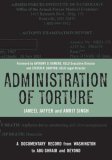
amazon-administrationoftorture.jpgIn Administration of Torture, two American Civil Liberties Union attorneys detail the findings of a years-long investigation and court battle with the administration that resulted in the release of massive amounts of data on prisoner treatment and the deaths of US-held prisoners.

“[T]he documents show unambiguously that the administration has adopted some of the methods of the most tyrannical regimes,” write Jameel Jaffer and Amrit Singh. “Documents from Guantanamo describe prisoners shackled in excruciating ‘stress positions,’ held in freezing-cold cells, forcibly stripped, hooded, terrorized with military dogs, and deprived of human contact for months.” [complete article]

Facebooktwittermail

NEWS: Use of contractors by State Dept. has soared

Use of contractors by State Dept. has soared

Over the past four years, the amount of money the State Department pays to private security and law enforcement contractors has soared to nearly $4 billion a year from $1 billion, administration officials said Tuesday, but they said that the department had added few new officials to oversee the contracts.

It was the first time that the administration had outlined the ballooning scope of the contracts, and it provided a new indication of how the State Department’s efforts to monitor private companies had not kept pace. Auditors and outside exerts say the results have been vast cost overruns, poor contract performance and, in some cases, violence that has so far gone unpunished.

A vast majority of the money goes to companies like DynCorp International and Blackwater USA to protect diplomats overseas, train foreign police forces and assist in drug eradication programs. There are only 17 contract compliance officers at the State Department’s management bureau overseeing spending of the billions of dollars on these programs, officials said. [complete article]

Facebooktwittermail

NEWS: U.S. tax dollars at work

2 reports assail State Dept. role in Iraq security

A pair of new reports have delivered sharply critical judgments about the State Department’s performance in overseeing work done by the private companies that the government relies on increasingly in Iraq and Afghanistan to carry out delicate security work and other missions.

A State Department review of its own security practices in Iraq assails the department for poor coordination, communication, oversight and accountability involving armed security companies like Blackwater USA, according to people who have been briefed on the report. In addition to Blackwater, the State Department’s two other security contractors in Iraq are DynCorp International and Triple Canopy.

At the same time, a government audit expected to be released Tuesday says that records documenting the work of DynCorp, the State Department’s largest contractor, are in such disarray that the department cannot say “specifically what it received” for most of the $1.2 billion it has paid the company since 2004 to train the police officers in Iraq. [complete article]

Bush’s request for wars increases to $196 billion

President Bush asked Congress on Monday to approve $196 billion to pay for the wars in Iraq and Afghanistan and other national security programs, setting the stage for a new confrontation with Democrats over the administration’s handling of Iraq.

Mr. Bush’s request increased the amount of the proposed spending by $46 billion over the $150 billion already requested this year. Much of the added spending would pay for new armored vehicles designed to withstand attacks by mines and roadside bombs, and a rise in operational costs because of the increase in the force in Iraq, now at more than 160,000 troops. [complete article]

Facebooktwittermail

FEATURE: The Taliban’s confederation of warlords

The new Taliban

The bomb was far from the biggest seen on the North-West Frontier but it did its job well. Placed in a water cooler, it ripped through the Nishtar Abad music market, sending shards of glass and splintered CDs in all directions. ‘Miraculously, no one was killed,’ said Mohammed Azam, who was shopping for presents for the Muslim holiday of Eid this weekend. Twenty people were injured, three seriously, and a dozen shops gutted.

For the police chief of Peshawar, the dusty Pakistan city 40 miles from the Afghan border, it was clear who planted last Tuesday’s bomb. ‘We suspect the involvement of those people who in recent months had sent letters to the CD and video shops, warning them to shut their businesses, saying it is against Islam,’ Abdul Majid Marwat said.

The ‘Pakistan Taliban’ – or one of the various groups claiming the name – had struck again. Within hours the debris was being cleared away and the blood wiped off the walls. ‘This is the life we lead,’ said Azam.’ We have no choice but to continue.’

The Pakistan Taliban’s campaigns go way beyond bombing music shops. Fifty miles south of Peshawar last week, a full-scale pitched battle, complete with air strikes and artillery barrages, raged between the Pakistani army and local and international militants dug into fortified positions in remote tribal villages. By the time a fragile calm had settled on the rocky hills, scattered palm trees and desiccated fields of Mir Ali, 50 soldiers, a 100 or so militants and around 100 civilians had died. Given the inaccessibility of the battlefield and the conflicting claims of the military and their opponents, accurate casualty figures are simply not available.

What is not in doubt is the scale of the fighting. It was a bloody week for everyone as half a dozen ragged conflicts raged across a stretch of land the size of Britain, from the Indus river to the central highlands of Pakistan. [complete article]

Terrorists in training head to Pakistan

As Al Qaeda regains strength in the badlands of the Pakistani-Afghan border, an increasing number of militants from mainland Europe are traveling to Pakistan to train and to plot attacks on the West, European and U.S. anti-terrorism officials say.

The emerging route, illuminated by alleged bomb plots dismantled in Germany and Denmark last month, represents a new and dangerous reconfiguration. In recent years, the global flow of Muslim fighters had shifted to the battlefields of Iraq after the loss of Al Qaeda’s Afghan sanctuary in late 2001. [complete article]

See also, Taliban use hostage cash to fund UK blitz (The Telegraph).

Facebooktwittermail

ANALYSIS: The impossible opening between Kabul and the Taliban

Afghanistan: necessity and impossibility

According to sources inside Afghanistan, Taliban leader ‘Mullah’ Mohammed Omar sent a secret envoy to President Hamid Karzai earlier this year to discuss his possible entrance into the Afghan government. This remarkable move culminated in Karzai’s recent offer of talks with the elusive cleric, followed by a Taliban announcement that the group would consider speaking with Kabul.

The moment is ripe for negotiations; diplomacy promises benefits to both Kabul and the Taliban’s political leadership. Unfortunately, this window of opportunity will most likely be squandered. For talks to succeed, Mullah Omar must play a central role in discussions between the Taliban and the Karzai government. But it is his centrality to any peace deal that sets a number of key external and internal actors against talking with the Taliban, making negotiations impossible. [complete article]

Facebooktwittermail

NEWS: War in Pakistan

Pakistan fighting kills 250, civilians flee

Pakistani jets pounded militant hideouts in a troubled tribal region Tuesday, taking the death toll to 250 from three of the heaviest days of fighting in the region since 2001.

The clashes have forced thousands to flee from Mir Ali, a town in lawless North Waziristan district that President Pervez Musharraf has previously pinpointed as a den of Osama bin Laden’s Al-Qaeda network.

Residents said dozens of people including women and children were killed in the latest air strikes in the rugged region bordering Afghanistan, but security officials insisted the dead were all Islamist fighters. [complete article]

Pakistan army’s tribal quagmire

At 11,000 feet, with the temperature dipping 10 degrees below freezing, an army pilot recalls how he was sweating from head to toe.

There was a fault in the engine and he might crash at any moment.

And while he could eject to safety, he would then be floating straight into the jaws of a death more dreadful than being charred inside a crashed jet.

“This is a country where soldiers are slaughtered,” he told me after his dramatic flight. “Their bodies may be found, but not their heads.”

He was over-flying North Waziristan, a Pakistani tribal district on the border with Afghanistan where the army is fighting a difficult war against Islamic militants. [complete article]

See also, Pakistan’s paradoxical and chaotic stability (Jason Burke) and New political deal angers Pakistanis (CSM).

Facebooktwittermail

NEWS: The opium or the people?

Afghans pressed by U.S. on plan to spray poppies

American officials thought they had the Karzai administration’s support late last year to begin a small-scale pilot program for ground spraying in several provinces. But that plan was derailed in January after an American-educated deputy minister of public health presented health and environmental concerns about glyphosate at a meeting of the Karzai cabinet, Afghan and American officials said.

Since then, Mr. Karzai has said he opposes spraying of any kind.

“President Karzai has categorically rejected that spraying will happen,” Farooq Wardak, Afghanistan’s minister of state for parliamentary affairs, said in a recent interview. “The collateral damage of that will be huge.”

Yet in the weeks since the latest United Nations drug report, the Bush administration’s lobbying appears to have made new headway. It has already won the backing of several members of Mr. Karzai’s government and the spray advocates here are now trying to swing other key Afghan officials and Mr. Karzai himself, one high-level Afghan official said.

“We are working to convince the key ministers and President Karzai to accept this strategy,” said the official, who supports spraying but asked not to be identified because of the issue’s political delicacy. “We want to convince them to show some power. The government has to show its power in the remote provinces.” [complete article]

Editor’s Comment — So a show of power — destroying farmers’ crops and livelihood — is going to win over the populations in the remote provinces is it?

Facebooktwittermail

NEWS & EDITOR’S COMMENT: When anthropologist becomes counter-insurgency technician

Army enlists anthropology in war zones

In this isolated Taliban stronghold in eastern Afghanistan, American paratroopers are fielding what they consider a crucial new weapon in counterinsurgency operations here: a soft-spoken civilian anthropologist named Tracy.

Tracy, who asked that her surname not be used for security reasons, is a member of the first Human Terrain Team, an experimental Pentagon program that assigns anthropologists and other social scientists to American combat units in Afghanistan and Iraq. Her team’s ability to understand subtle points of tribal relations — in one case spotting a land dispute that allowed the Taliban to bully parts of a major tribe — has won the praise of officers who say they are seeing concrete results.

Col. Martin Schweitzer, commander of the 82nd Airborne Division unit working with the anthropologists here, said that the unit’s combat operations had been reduced by 60 percent since the scientists arrived in February, and that the soldiers were now able to focus more on improving security, health care and education for the population. [complete article]

Editor’s Comment — Anthropologists can now save lives and help win the war on terrorism. “We’re not focused on the enemy. We’re focused on bringing governance down to the people,” says Col. Martin Schweitzer, commander of the 82nd Airborne Division. The Pentagon has turned into the Peace Corps! Right.

Not surprisingly, when it’s for internal consumption the story becomes a little different. In a presentation at the Pentagon earlier this year, an official reported that mapping the human terrain “enables the entire Kill Chain for the GWOT [Global War on Terrorism].” And as it applies to the US air force, here’s how the “kill chain” is described:

Because enemies have learned to limit the amount of time they and their weapons are in sight and thus vulnerable, these mobile targets require a different approach. The Air Force must compress its six-stage target cycle of Find, Fix, Track, Target, Engage, and Assess, also known as F2T2EA, or, more simply, the “kill chain.”

Concerned anthropologists such a Roberto Gonzalez are asking, “Where is the line that separates the professional anthropologist from the counter-insurgency technician?” By the Pentagon’s own admission there appears to be none. Instead of being deployed in Afghanistan and Iraq, perhaps anthropologists could do more useful work inside the Pentagon itself.

Facebooktwittermail

NEWS: War in Afghanistan – no end in sight

British troops face decades in Afghanistan

British troops face a 30-year “marathon mission” against the Taliban in Afghanistan, the commander of UK troops in Helmand has warned.

Brigadier John Lorimer revealed the challenge facing personnel as he disclosed that the Taliban are beginning to change their tactics and have started to recruit fighters from foreign countries in increasing -numbers. [complete article]

6 years later, U.S. expands Afghan base

“The Bush administration did not see Afghanistan as a long-term commitment, and its leaders deceived themselves into thinking they had won an irreversible victory. They did not consider Afghanistan important and always intended to focus on Iraq,” he said.

“Now the U.S. and international community have fallen way behind, and the Taliban are winning strategically, even if we defeat them in every tactical engagement,” he added. [complete article]

Facebooktwittermail

FEATURE: Roadside bombs

About left of boom: the fight against roadside bombs

Rick Atkinson describes the effort by the U.S. military to combat the improvised explosive devices used by insurgents in Afghanistan and Iraq from 2002 until now.

The series is drawn from more than 140 interviews over the past six months with military and congressional officials, contractors, scientists and defense analysts in Iraq, Afghanistan, Washington and elsewhere. Most agreed to speak candidly only on the condition of anonymity. Ten senior officers or retired officers, each of them intimately involved in the effort to combat IEDs, were asked to review the findings for accuracy and security considerations.

Part one
Part two
Part three

Facebooktwittermail

NEWS & ANALYSIS: Talking to the Taliban; Karzai loses friends; Al Qaeda’s coalition plans to take over Pakistan

Taleban ‘needed for Afghan peace’

The Taleban “will need to be involved” at some stage with a peace process in Afghanistan, UK Defence Secretary Des Browne has said.

At a fringe meeting at the Labour Party conference, he said a solution would have to be “Islamic based”.

Mr Browne said Taleban involvement would happen “because they are not going away” any more than Hamas was from the Palestinian territories. [complete article]

In Afghanistan, anger in parliament grows as Karzai defies majority’s wishes

In May, the lower house of the Afghan Parliament voted overwhelmingly to oust the country’s foreign minister on the grounds of incompetence. In a different time and place, the matter might have been over as quickly as it began.

But this is Afghanistan, still in the tense, halting infancy of a new democratic era. And more than four months after the vote, much to the anger of the parliamentary majority, the minister remains in his post, protected by the man who appointed him: President Hamid Karzai.

Mr. Karzai said the vote was illegal and motivated simply by politics. The legislators have accused the president of snubbing the Constitution and undermining the democratic foundations of the republic.

The dispute is the most serious manifestation of the long-simmering tension between the Karzai administration and the warlords and former mujahedeen in the legislature, who want more control over policy making. It threatens to bring Parliament to a halt and pitch Afghanistan into a political crisis. [complete article]

Military brains plot Pakistan’s downfall

The Saudis are concerned that should their erstwhile son bin Laden succeed in Pakistan, Saudi Arabia would be one of the next logical targets. So a joint strategy was devised to confront the threat.

According to a witness who spoke to Asia Times Online, last month a Saudi consul visited North Waziristan in the first such interaction with the al-Qaeda command since the US invasion on Afghanistan in 2001. The consul was meant to meet Zawahiri or bin Laden, but he was not allowed to see them and instead met second-tier al-Qaeda leaders. [complete article]

Facebooktwittermail