Category Archives: war in Afghanistan

NEWS & OPINION: No refuge in Kabul

In Kabul, shattered illusions

“Well, at least we’re not in Baghdad,” we used to say when confronted by the vagaries of the Kabul winter. No heat, sporadic electricity and growing disaffection among the population might make us uncomfortable, but those of us living outside the smothering embrace of the embassies or the United Nations had relative freedom of movement and few security worries.

And of course we had the Serena hotel. Its spa offered solace, a gym and a hot shower; we could pretend for a few hours that we were in Dubai.

But a week ago last Monday, Taliban gunmen burst into the lobby, one exploding his ball-bearing vest, one running to the gym and spa area, spraying bullets as he went. Eight people died, and several more were wounded.

It was a rude shock for those of us who used to feel superior to those who cowered behind their reinforced walls, venturing out only in bulletproof glass surrounded by convoys of big men with big guns.

We shopped on Chicken Street for carpets and trinkets, we dined at the shrinking number of restaurants that still serve alcohol. We partied at L’Atmosphere, “L’Atmo” to its friends, the “in” spot for the international crowd, and had our hair and nails done at the Nova salon. And we patted ourselves on the back because we knew the real Kabul.

None of us was prepared for what happened at the Serena. The Taliban are following a new strategy, their spokesman announced. They will go after civilians specifically, and will bring their mayhem to places where foreigners congregate.

So much for L’Atmo. [complete article]

The mysterious Afghan warlord trusted to spread peace in a divided province

Britain’s last chance of securing this treacherous corner of Afghanistan lies in the hands of a piratical, black-turbaned figure with long beard, white cloak and silver-sequinned slippers with curled toes.

Mullah Abdul Salaam may not look much like a white knight. He served as a commander in the Taleban and even today his true loyalties remain suspect. The 45-year-old former Mujahidin guerrilla could, however, decide the fate of the British mission to stabilise the lawless province of Helmand, where this week he was put in charge of the key district of Musa Qala.

“He’s not just the best show in town,” one British officer remarked. “He’s the only show in town.”

Mullah Salaam’s rise to power in Musa Qala, the test case for British efforts to evict the Taleban and install central authority, is a classic Afghan tale of intrigue, bloodshed, farce and fate. In an interview with The Times the former warlord explained how last year he had severed relations with the Taleban, was courted secretly by a foreign diplomat and eventually swapped sides to join the British-led effort. [complete article]

Facebooktwittermail

NEWS ROUNDUP: January 24

Afghanistan is the bad war, Iraq the good, says White House co-ordinator
Iraq may turn out to be America’s “good war” while Afghanistan goes “bad”, the Bush Administration official responsible for co-ordinating efforts in Baghdad has told The Times.

Death sentence for Afghan student
An Afghan court in northern Afghanistan sentenced a journalism student to death for blasphemy for distributing an article from the Internet that was considered an insult to the Prophet Muhammad, the judge in charge of the court said Wednesday.

10 die in mistaken Afghan firefight
At least nine Afghan police officers and a civilian were killed early Thursday in a firefight between American forces and the officers in the province of Ghazni just south of the capital, according to local officials.

Supporters at home and abroad backing away from Musharraf
As critical elections in Pakistan approach, President Pervez Musharraf is increasingly losing support from major constituencies, including his traditional military base, amid growing questions in both Pakistan and the United States about his ability to govern.

Canadian military has quit turning detainees over to Afghans
The Canadian military secretly stopped transferring prisoners to Afghanistan’s government in November after Canadian monitors found evidence that they were being abused and tortured.

Most reformists appear purged from Iran ballot
When voters go to the polls on March 14 to select members of Parliament, they may be able to choose only between conservative candidates and other conservative candidates, leaders of Iran’s main reform party said Wednesday.

Facebooktwittermail

NEWS & ANALYSIS: Developments in Pakistan and Afghanistan

Pakistan military retreats from Musharraf’s influence

As President Pervez Musharraf grows more unpopular in Pakistan, his newly named successor as army chief is seeking to distance the institution from the Musharraf regime and pull back its virtual occupation of the top senior ranks of civilian ministries and state corporations.

Gen. Ashfaq Parvez Kayani, who was named to the top military job in late November, took two steps this week. First, he barred all senior military officers from meeting directly with Musharraf without prior approval and prohibited officers from having any direct involvement in politics. Second, he recalled many army officers from civilian job assignments.

Kayani’s new path could help restore the image of a military that’s bruised by association with Musharraf’s excesses during eight years of rule since a 1999 coup and weakened by the worsening domestic security situation. [complete article]

Frontier insurgency spills Into Peshawar

At the core of the troubles here, many say, lie demands by the United States that the Pakistani military, generously financed by Washington, join in its campaign against terrorism, which means killing fellow Pakistanis in the tribal areas. Even if those Pakistanis are extremists, the people here say, they do not like a policy of killing fellow tribesmen, and fellow countrymen, particularly on behalf of the United States.

The Bush administration is convinced that Al Qaeda and the Taliban have gained new strength in the past two years, particularly in the tribal regions of North and South Waziristan and Bajaur. It has said it is considering sending American forces to help the Pakistani soldiers in those areas. Mr. Musharraf has scoffed at the idea.

Any direct intervention by American forces would only strengthen the backlash now under way against soldiers and the police in Peshawar, said Farook Adam Khan, a lawyer here. That reaction spread last week to Lahore, the capital of Punjab Province, where a suicide bomber killed almost two dozen policemen at a lawyers’ rally, he said.

“Pakistani soldiers never used to be targets,” Mr. Khan said. “Now we have the radicals antagonized by Musharraf and his politics of cozying up to the United States.” [complete article]

Militants make a claim for talks

Islamabad has tried to defuse the situation by negotiating with selected Taliban leaders. Most recently, a Pakistani Taliban shura (council) headed by Hafiz Gul Bahadur in North Waziristan responded positively to a government offer of a ceasefire, despite opposition from Takfiri elements who view non-practicing Muslims as infidels.

The backlash was immediate. Militants launched attacks in Mohmand Agency, followed by Wednesday’s mass assault.

This response is orchestrated by al-Qaeda from its camps around the town of Mir Ali in North Waziristan. Al-Qaeda views any peace agreements with the Pakistani Taliban as a government maneuver to split the militants, and also says Islamabad has been consistently intransigent over the years.

Al-Qaeda demands that it be the chief interlocutor in any peace talks, and it has set its bottom line: guarantees of the withdrawal of all security forces from the tribal areas; enforcement of sharia law, the release of Maulana Abdul Aziz of the radical Lal Masjid (Red Mosque), who was apprehended last year; and that President Pervez Musharraf step down. [complete article]

Talking to the wrong people

Throughout 2007, the British Embassy in Kabul under Sherard Cowper Coles made desperate overtures in southwestern Afghanistan to find a political solution with the Taliban, but without Mullah Omar. Multiple clandestine operations were launched and millions of dollars were funneled to the Taliban.

However, it all came to nothing and only caused serious differences between the two major allies – Britain and the US. And all the time the Taliban consolidated their position in the south.
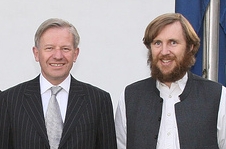
michael-semple-and-amb-sherard-cowper-coles.jpgThe case of Irishman Michael Semple, who was acting head of the European Union mission in Kabul, is instructive. The fluent Dari-speaking Semple had spent over 18 years in Afghanistan in various capacities, including with the United Nations and as an advisor to the British Embassy in Kabul, before being expelled last month after being accused of talking to the Taliban. [complete article]

See also, Pakistani forces say kill up to 90 militants (Reuters) and Taliban now seriously in the fight, war begins: NGO (AFP).

NATO hears ‘noise before defeat’

Ashdown’s real mission [– Paddy Ashdown is the UN’s newly appointed special envoy to Afghanistan –] lies elsewhere, in addressing the core issue: What do we do with the Taliban? No doubt, the Taliban’s exclusion from the Bonn conference seven years ago proved to be a horrible mistake. That was also how the Afghan and Pakistan problem came to be joined at the hips.

Pakistan President Pervez Musharraf made a valid point in his interview with the German weekly magazine Der Spiegel this week when he said al-Qaeda isn’t the real problem that faces Pakistan. “I don’t deny the fact that al-Qaeda is operating here [Pakistan]. They are carrying out terrorism in the tribal areas; they are the masterminds behind these suicide bombings. While all of this is true, one thing is for sure: the fanatics can never take over Pakistan. This is not possible. They are militarily not so strong they can defeat our army, with its 500,000 soldiers, nor politically – and they do not stand a chance of winning the elections. They are much too weak for that,” Musharraf said.

The heart of the matter is Pashtun alienation. The Taliban represent Pashtun aspirations. As long as Pashtuns are denied their historical role in Kabul, Afghanistan cannot be stabilized and Pakistan will remain in turmoil. Musharraf said, “There should be a change of strategy right away. You [NATO] should make political overtures to win the Pashtuns over.”

This may also be the raison d’etre of UN secretary general Ban Ki-moon’s intriguing choice of a Briton as his new special representative. Conceivably, the inscrutable Ban has been told by Washington that Ashdown is just the right man to walk on an upcoming secretive bridge, which will intricately connect New York, Washington, London, Riyadh, Islamabad and Kabul. [complete article]

Facebooktwittermail

NEWS: Pakistan and Afghanistan

Militants escape control of Pakistan, officials say

Pakistan’s premier military intelligence agency has lost control of some of the networks of Pakistani militants it has nurtured since the 1980s, and is now suffering the violent blowback of that policy, two former senior intelligence officials and other officials close to the agency say.

As the military has moved against them, the militants have turned on their former handlers, the officials said. Joining with other extremist groups, they have battled Pakistani security forces and helped militants carry out a record number of suicide attacks last year, including some aimed directly at army and intelligence units as well as prominent political figures, possibly even Benazir Bhutto.

The growing strength of the militants, many of whom now express support for Al Qaeda’s global jihad, presents a grave threat to Pakistan’s security, as well as NATO efforts to push back the Taliban in Afghanistan. American officials have begun to weigh more robust covert operations to go after Al Qaeda in the lawless border areas because they are so concerned that the Pakistani government is unable to do so. [complete article]

Many Pakistanis see leader as having reigned too long

Today, despite transforming himself from military dictator to civilian president, Musharraf has overstayed his welcome, according to critics including politicians, pollsters and citizens on the street. In a poll taken two months ago, 67 percent of those surveyed said he should resign.

“When he took power, we felt that he’d take us down the right path and then go after two or three years, but now he’s been here eight years, and who can question him, who can tell him to go?” said Abdul Rauf, 40, the owner of a men’s shop in Islamabad’s upper-class Jinnah Shopping Market.

For many, Musharraf’s greatest failure has been his inability to break Pakistan’s addiction to dynastic parties and personality cults, evidenced by the 10 years of corrupt, failed governments led by Benazir Bhutto and Nawaz Sharif, a pair of prime ministers whom Musharraf accused of presiding over an “era of sham democracy.” [complete article]

Allies feel strain of Afghan war

The U.S. plan to send an additional 3,200 Marines to troubled southern Afghanistan this spring reflects the Pentagon’s belief that if it can’t bully its recalcitrant NATO allies into sending more troops to the Afghan front, perhaps it can shame them into doing so, U.S. officials said.

But the immediate reaction to the proposed deployment from NATO partners fighting alongside U.S. forces was that it was about time the United States stepped up its own effort.

After more than six years of coalition warfare in Afghanistan, NATO is a bundle of frayed nerves and tension over nearly every aspect of the conflict, including troop levels and missions, reconstruction, anti-narcotics efforts, and even counterinsurgency strategy. Stress has grown along with casualties, domestic pressures and a sense that the war is not improving, according to a wide range of senior U.S. and NATO-member officials who agreed to discuss sensitive alliance issues on the condition of anonymity. [complete article]

US attacks UK plan to arm Afghan militias

The US general in charge of training the Afghan police has criticised British-backed plans to arm local militias in an attempt to defeat the Taliban. The remarks by Maj-Gen Robert Cone, the second most senior US soldier in Afghanistan, are likely to deepen the row between London and Washington over how to counter the insurgency. [complete article]

Westerners face new threat after suicide squad storms Kabul hotel

A Taleban suicide squad broke into the only luxury hotel in Kabul last night, killing at least seven people, including an American and a Norwegian journalist, and forcing hundreds more to take shelter in a basement as a firefight raged in the lobby.

The attack, by a bomber and at least three men armed with AK47s, appeared to be the first big assault against a civilian target in the Afghan capital since a Taleban resurgence began in 2005. Witnesses described scenes of carnage inside the hotel, as American special forces entered the building in pursuit of the attackers. [complete article]

Facebooktwittermail

FEATURE: Fighting over there, then killing back here

Across America, deadly echoes of foreign battles

Town by town across the country, headlines have been telling similar stories. Lakewood, Wash.: “Family Blames Iraq After Son Kills Wife.” Pierre, S.D.: “Soldier Charged With Murder Testifies About Postwar Stress.” Colorado Springs: “Iraq War Vets Suspected in Two Slayings, Crime Ring.”

Individually, these are stories of local crimes, gut-wrenching postscripts to the war for the military men, their victims and their communities. Taken together, they paint the patchwork picture of a quiet phenomenon, tracing a cross-country trail of death and heartbreak.

The New York Times found 121 cases in which veterans of Iraq and Afghanistan committed a killing in this country, or were charged with one, after their return from war. In many of those cases, combat trauma and the stress of deployment — along with alcohol abuse, family discord and other attendant problems — appear to have set the stage for a tragedy that was part destruction, part self-destruction. [complete article]

Facebooktwittermail

NEWS, ANALYSIS & OPINION: The unraveling of the War on Terrorism

The West has not just repressed democracy. It has aided terror

The Pakistani senator gazed at the headline in despair. It read: “US weighs new covert push in Pakistan”. Washington was authorising “enhanced CIA activity” in the country while US Democratic candidates declared they were all ready “to launch unilateral military strikes in [Pakistan] if they detected an imminent threat”. Hillary Clinton wanted “joint US-UK oversight” of Pakistan’s nuclear weapons. In a country where anti-Americanism is almost a religion, said the senator, this is “an answer to a Taliban prayer”.

I am convinced that those whom the gods wish to destroy they first curse with foreign policy. For the third time in 20 years, the west is meddling with the world’s sixth most populous state. It did so to promote the Afghan mujahideen against the Russians in the 1980s, then to attack al-Qaida after 9/11, and now to “guard” Pakistan’s bombs against a fantastical al-Qaida seizure. Needless to say, the sole beneficiaries are the Taliban and the forces of disorder. [complete article]

Pakistan warns US not to enter northwest

President Pervez Musharraf warned that U.S. troops would be regarded as invaders if they crossed into Pakistan’s border region with Afghanistan in the hunt for al-Qaida or Taliban militants, according to an interview published Friday. [complete article]

Pakistan takes a step backwards

At a time when Pakistan’s national decision-making institutions are suspicious of international plans to make the country’s nuclear program controversial, there is serious consideration for repositioning the country’s foreign policy as neutral in the United States-led “war on terror”.

This would mean non-interference in the restive tribal areas on the border with Afghanistan. These are virtually autonomous areas where Taliban and al-Qaeda militants have established bases and vital supply lines into Afghanistan.

Such a move would have devastating effects on the North Atlantic Treaty Organization’s (NATO) efforts to control the ever-growing insurgency in Afghanistan.

Following a meeting of the Pakistan corps commanders headed by the new chief of army staff, General Ashfaq Kiani, a press release said there would be a review of the situation in the tribal areas and, instead of citing any plans for military operations there against militants, the release said the military’s decisions would be based on “the wishes of the nation”. [complete article]

See also, Bomb kills at least 23 in Pakistan (NYT) and Baitullah Mehsud – the Taliban’s new leader in Pakistan (Jamestown Foundation).

Facebooktwittermail

NEWS & EDITOR’S COMMENT: The new Cambodia?

U.S. considers new covert push within Pakistan

President Bush’s senior national security advisers are debating whether to expand the authority of the Central Intelligence Agency and the military to conduct far more aggressive covert operations in the tribal areas of Pakistan.

The debate is a response to intelligence reports that Al Qaeda and the Taliban are intensifying efforts there to destabilize the Pakistani government, several senior administration officials said.

Vice President Dick Cheney, Secretary of State Condoleezza Rice and a number of President Bush’s top national security advisers met Friday at the White House to discuss the proposal, which is part of a broad reassessment of American strategy after the assassination 10 days ago of the Pakistani opposition leader Benazir Bhutto. There was also talk of how to handle the period from now to the Feb. 18 elections, and the aftermath of those elections. [complete article]

Editor’s Comment — It’s never enough just to know what was said; we need to know who was talking.

This is a report that illustrates well the need for newspapers to limit their use of anonymous sources. The key to unlocking the article’s significance is knowing who was talking to the New York Times. On that basis we could attempt to understand the sources’ motives for making this information public. For instance, if the sources are intelligence officials we’d have reason to think they might be talking to the press in an effort to kill a harebrained plan before it gains momentum. If on the other hand the sources are inside the White House, then we’d have to wonder whether a political agenda was trumping the need for operational security. Myers, Sanger, and Schmitt should know the answer, but of course their sacred duty to protect the confidentiality of their sources prevents them from adding meaning that currently only they are in a position to discern. Still, why call it reporting if the reporter is only willing to tell part of the story?

What’s more important? That the New York Times is able to protect the privilege of its access to those in power, or that it uses all its means to hold those in power accountable to the people they represent?

Since the Grey Lady is so firmly wedded to its institutional authority, what can we do but go back to parsing the Times as though we were reading Pravda.

This is what I’m able to glean. President Bush, who was in the White House on Friday, did not attend the meeting. The key players at the meeting are named in the article and since they didn’t include Bush, it seems reasonable to infer he wasn’t there. Too busy? We do know for sure that Defense Secretary Gates wasn’t there, so it looks like this was Cheney’s meeting.

Midway through the article, our steely reporters toss in an idle piece of speculation about why the discussions in the White House were taking place: “In part, the White House discussions may be driven by a desire for another effort to capture or kill Osama bin Laden and his deputy, Ayman al-Zawahri.” Does this mean that the Times was told by its sources, this was the main reason for the discussions, but you can’t attribute that to your sources, or was this just some journalistic day-dreaming? Let’s assume the former. And if that’s the case, this discussion may have more to do with domestic American politics than a desire to bring stability to Pakistan.

Perhaps the most revealing lines in the report are these: “The Bush administration has not formally presented any new proposals to Mr. Musharraf, who gave up his military role last month, or to his successor as the army chief, Gen. Ashfaq Parvez Kayani, who the White House thinks will be more sympathetic to the American position than Mr. Musharraf…. But at the White House and the Pentagon, officials see an opportunity in the changing power structure for the Americans to advocate for the expanded authority [of the CIA] in Pakistan, a nuclear-armed country.” In this changing power structure, the administration’s focus remains unchanged: its interest in working more closely with Pakistan’s military than with its civilians. At the same time, the administration appears to want to communicate indirectly with Pakistan’s military by getting its ideas floated in the press. Is this a case of putting the word out to see if it provokes civil unrest?

It’s starting to sound like Cheney might be on the war path again. Iran is off the table, but maybe Pakistan will provide the CIA with an opportunity to help the administration pull its chestnuts out of the fire before November ’08. If they haul in or kill America’s most-wanted men, the presidential race might be nudged back onto national security, and maybe Bush and Cheney won’t go down in history as the men who destroyed the Republican Party.

Could Pakistan go up in flames in the process, al Qaeda’s leaders elude capture and the war in Afghanistan expand into a full-fledged regional war? These are all risks the vice president might be willing to take.

But I digress. The reporters at Pravda — I mean the Times — could do a bit more to enlighten us, couldn’t they?

Facebooktwittermail

NEWS: U.S. blocked talks with the Taliban

Diplomats expelled ‘at behest of the U.S.’

Two European diplomats accused of holding secret talks with the Taliban in Afghanistan were thrown out of the country following a complaint by the US, intelligence officials in Kabul have told The Sunday Telegraph.

Mervyn Patterson, who is British, and Irish-born Michael Semple were flown out of Kabul on Thursday after the Afghan government accused them of “threatening national security”.

The pair had been working for the United Nations and the European Union respectively.

But according to a senior Afghan intelligence source, American officials had been unhappy about meetings between the men and high-level Taliban commanders in the volatile Helmand province.

The source claimed that the US alerted Afghan authorities after learning that the diplomats were providing direct financial and other support – including mobile phone cards – to the Taliban commanders, in the hope of persuading them to swap sides.

“This warning came from the Americans,” he said. “They were not happy with the support being provided to the Taliban. They gave the information to our intelligence services, who ordered the arrests.” [complete article]

Facebooktwittermail

NEWS: U.S. backs talks with Taliban

U.S. backs talks with Taliban as envoys expelled

The United States ambassador to Kabul has lent his support to attempts to talk to elements of the Taliban as two Western diplomats left the country after being declared persona non grata by the Afghan government.

Michael Semple, the Irish-born acting head of the EU mission, and Mervyn Patterson, a UN political adviser, left for Pakistan following a row over secret talks involving the Taliban.

The ambassador, Bill Woods, tried to defuse the row, describing such talks with the Taliban as “a particularly difficult field which requires particularly close communication, particularly close dialogue (with the government) and apparently that did not take place. [complete article]

Facebooktwittermail

NEWS: Talking to the Taliban

Britain in secret talks with the Taliban

Agents from MI6 entered secret talks with Taliban leaders despite Gordon Brown’s pledge that Britain would not negotiate with terrorists, The Daily Telegraph can disclose.

Officers from the Secret Intelligence Service staged discussions, known as “jirgas”, with senior insurgents on several occasions over the summer.

An intelligence source said: “The SIS officers were understood to have sought peace directly with the Taliban with them coming across as some sort of armed militia. The British would also provide ‘mentoring’ for the Taliban.”

The disclosure comes only a fortnight after the Prime Minister told the House of Commons: “We will not enter into any negotiations with these people.” [complete article]

Diplomats face expulsion from Afghanistan for ‘talking to the Taleban’

The United Nations is trying to reverse a decision by the Afghan government to expel two British and Irish diplomats who have been accused of negotiating with the Taleban.

Michael Semple, acting European Union mission head, and Mervyn Patterson, a senior UN official, are due to be deported tomorrow after the President’s office deemed that “their presence was detrimental to the national security of the country”. [complete article]

Murky world of Afghan negotiations

It now seems unlikely that frantic diplomatic efforts will prevent two European representatives from being expelled from Afghanistan.

Michael Semple, the acting head of the European Union mission, and Mervyn Patterson, who is British and is the UN’s political affairs officer, were in Helmand province talking to tribal elders.

But despite one arm of the Afghan government knowing about their trip, another arm appeared not to, and they were accused by a provincial official to talking to the Taleban. [complete article]

Facebooktwittermail

FEATURE: Afghanistan is falling apart

Into the valley of death

By many measures, Afghanistan is falling apart. The Afghan opium crop has flourished in the past two years and now represents 93 percent of the world’s supply, with an estimated street value of $38 billion in 2006. That money helps bankroll an insurgency that is now operating virtually within sight of the capital, Kabul. Suicide bombings have risen eightfold in the past two years, including several devastating attacks in Kabul, and as of October, coalition casualties had surpassed those of any previous year. The situation has gotten so bad, in fact, that ethnic and political factions in the northern part of the country have started stockpiling arms in preparation for when the international community decides to pull out. Afghans—who have seen two foreign powers on their soil in 20 years—are well aware of the limits of empire. They are well aware that everything has an end point, and that in their country end points are bloodier than most.

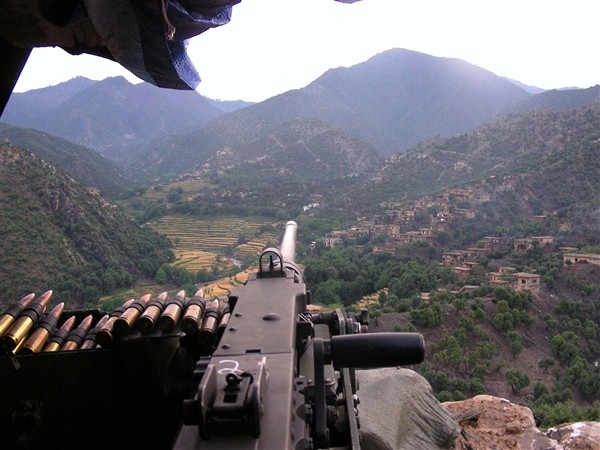
The Korengal is widely considered to be the most dangerous valley in northeastern Afghanistan, and Second Platoon is considered the tip of the spear for the American forces there. Nearly one-fifth of all combat in Afghanistan occurs in this valley, and nearly three-quarters of all the bombs dropped by nato forces in Afghanistan are dropped in the surrounding area. The fighting is on foot and it is deadly, and the zone of American control moves hilltop by hilltop, ridge by ridge, a hundred yards at a time. There is literally no safe place in the Korengal Valley. Men have been shot while asleep in their barracks tents.
korengal.jpg
[…]

The sun pries itself over the eastern ridges and half the platoon gets to work filling hescos while the other half mans the heavy weapons. The men work around the outpost in teams of three or four, one man hacking at the rock shelf with a pickax while another shovels the loose dirt into sandbags and a third drops the biggest chunks into an ammo can, then walks over to a half-full hesco, muscles the can over his head, and dumps the contents in.

“Prison labor is basically what I call it,” says a man I know only as Dave. Dave is a counter-insurgency specialist who spends his time at remote outposts, advising and trying to learn. He wears his hair longer than most soldiers, a blond tangle that after two weeks at Restrepo seems impressively styled with dirt. I ask him why the Korengal is so important.

“It’s important because of accessibility to Pakistan,” he says. “Ultimately, everything is going to Kabul. The Korengal is keeping the Pech River Valley safe, the Pech is keeping Kunar Province stable, and hence what we are hoping is all that takes the pressure off Kabul.”

While we are talking, some rounds come in, snapping over our heads and continuing on up the valley. They were aimed at a soldier who had exposed himself above a hesco. He drops back down, but otherwise, the men hardly seem to notice.

“The enemy doesn’t have to be good,” Dave adds. “They just have to be lucky from time to time.”

The Korengal is so desperately fought over because it is the first leg of a former mujahideen smuggling route that was used to bring in men and weapons from Pakistan during the 1980s. From the Korengal, the mujahideen were able to push west along the high ridges of the Hindu Kush to attack Soviet positions as far away as Kabul. It was called the Nuristan-Kunar corridor, and American military planners fear that al-Qaeda is trying to revive it. If the Americans simply seal off the valley and go around, Taliban and al-Qaeda fighters currently hiding near the Pakistani towns of Dir and Chitral could use the Korengal as a base of operations to strike deep into eastern Afghanistan. Osama bin Laden is rumored to be in the Chitral area, as are his second in command, Ayman Al-Zawahiri, and a clutch of other foreign fighters. While thousands of poorly trained Taliban recruits martyr themselves in southern Afghanistan, bin Laden’s most highly trained fighters ready themselves for the next war, which will happen in the East.

[…]

In my time in the Korengal, only one soldier told me that he joined the army because of September 11. The rest are here because they were curious or bored or because their fathers had been in the army or because the courts had given them the choice of combat or jail. No one I talked to seemed to have regretted the choice. “I joined the infantry to get out of people work and shit,” one soldier told me. “My main thing was partying. What was I going to do, keep partying and living with my mom?” [complete article]

Facebooktwittermail

NEWS: Afghanistan may pose a greater longer-term challenge than Iraq

Bush faces pressure to shift war priorities

With violence on the decline in Iraq but on the upswing in Afghanistan, President Bush is facing new pressure from the U.S. military to accelerate a troop drawdown in Iraq and bulk up force levels in Afghanistan, according to senior U.S. officials.

Administration officials said the White House could start to debate the future of the American military commitment in both Iraq and Afghanistan as early as next month. Some Pentagon officials are urging a further drawdown of forces in Iraq beyond that envisioned by the White House, which is set to reduce the number of combat brigades from 20 to 15 by the end of next summer. At the same time, commanders in Afghanistan are looking for several additional battalions, helicopters and other resources to confront a resurgent Taliban movement.

Bush’s decisions on Iraq and Afghanistan could heavily influence his ability to pass on to his successor stable situations in both countries, an objective his advisers describe as one of the president’s paramount goals for his final year in office. They say Bush will listen closely to his military commanders on the ground before making any decisions on troops but is unlikely to do anything he believes could jeopardize recent, hard-won security improvements in Iraq.

Administration officials say the White House has become more concerned in recent months about the situation in Afghanistan, where grinding poverty, rampant corruption, poor infrastructure and the growing challenge from the Taliban are hindering U.S. stabilization efforts. Senior administration officials now believe Afghanistan may pose a greater longer-term challenge than Iraq. [complete article]

Facebooktwittermail

NEWS: “Afghanistan has been the forgotten war”

Afghan mission is reviewed as concerns rise

Deeply concerned about the prospect of failure in Afghanistan, the Bush administration and NATO have begun three top-to-bottom reviews of the entire mission, from security and counterterrorism to political consolidation and economic development, according to American and alliance officials.

The reviews are an acknowledgment of the need for greater coordination in fighting the Taliban and Al Qaeda in Afghanistan, halting the rising opium production and trafficking that finances the insurgency and helping the Kabul government extend its legitimacy and control.

Taken together, these efforts reflect a growing apprehension that one of the administration’s most important legacies — the routing of Taliban and Qaeda forces in Afghanistan after the attacks of Sept. 11, 2001 — may slip away, according to senior administration officials.

Unlike the administration’s sweeping review of Iraq policy a year ago, which was announced with great fanfare and ultimately resulted in a large increase in troops, the American reviews of the Afghan strategy have not been announced and are not expected to result in a similar infusion of combat forces, mostly because there are no American troops readily available. [complete article]

Facebooktwittermail

NEWS: We will not talk to the Taliban who we won’t talk to, apart from those who we will talk to

We will not negotiate with the Taliban, insists Brown

Gordon Brown yesterday held out the hope that middle-ranking Taliban insurgents will renounce violence and join a political process of reconciliation with the Afghan leader, President Harmid Karzai.

The prime minister was setting out his long-awaited strategy for Afghanistan, including extra aid, military equipment and a drive against poppy production.

Denying that he was seeking to open direct talks with the Taliban, Brown claimed Nato was driving the insurgents and extremists out of their hiding places, preventing them from regrouping and attacking the areas around the provincial capitals where stability is taking hold. [complete article]

Facebooktwittermail

NEWS: Time to talk to the Taliban

Brown: ‘It’s time to talk to the Taliban’

As the deadliest year in Afghanistan since the US-led invasion in 2001 comes to a close, Gordon Brown is ready to talk to the Taliban in a major shift in strategy that is likely to cause consternation among hardliners in the White House.

Six years after British troops were first deployed to oust the Taliban regime, the Prime Minister believes the time has come to open a dialogue in the hope of moving from military action to consensus-building among the tribal leaders. Since 1 January, more than 6,200 people have been killed in violence related to the insurgency, including 40 British soldiers. In total, 86 British troops have died. The latest casualty was Sergeant Lee Johnson, whose vehicle hit a mine before the fall of Taliban-held town of Musa Qala.

The Cabinet yesterday approved a three-pronged plan that Mr Brown will outline for security to be provided by Nato’s International Security Assistance Force (Isaf) and the Afghan national army, followed by economic and political development in Afghanistan.

But the intention to engage Taliban leaders in a constructive dialogue, which Mr Brown will make clear in a parliamentary statement today, will be by far the most controversial element of the plan. A senior Downing Street source confirmed the move last night and one Brown aide who accompanied the Prime Minister on his recent visit to Kabul, said: “We need to ask who are we fighting? Do we need to fight them? Can we be talking to them?” [complete article]

Pentagon critical of NATO allies

Defense Secretary Robert M. Gates sharply criticized NATO countries yesterday for not supplying urgently needed trainers, helicopters and infantry for Afghanistan as violence escalates there, vowing not to let the alliance “off the hook.”

Gates called for overhauling the alliance’s Afghan strategy over the next three to five years, shifting NATO’s focus from primarily one of rebuilding to one of waging “a classic counterinsurgency” against a resurgent Taliban and growing influx of al-Qaeda fighters.

“I am not ready to let NATO off the hook in Afghanistan at this point,” Gates told the House Armed Services Committee. Ticking off a list of vital requirements — about 3,500 more military trainers, 20 helicopters and three infantry battalions — Gates voiced “frustration” at “our allies not being able to step up to the plate.” [complete article]

Facebooktwittermail

NEWS & ANALYSIS: Exchanging Musa Qala

Taliban loses grip on last major town

Afghan and NATO troops retook the town of Musa Qala in southern Afghanistan on Monday, forcing the Taliban to withdraw from the only sizable town they hold in the country, Afghan and NATO officials said. There was no clear picture of casualties, but the Taliban and civilians said there had been heavy bombardment overnight.

The news came as Prime Minister Gordon Brown of Britain made a surprise visit to Afghanistan and met with President Hamid Karzai. About 7,000 British troops are deployed in Helmand Province, in southern Afghanistan. Retaking Musa Qala, which they abandoned more than a year ago, has been one of their main objectives in the province, which has the highest level of Taliban activity as well as illicit opium production. [complete article]

The war in microcosm

The Taliban, the Afghan army and the Nato-led forces recognise there is a stalemate in the battle for Afghanistan. Neither side appears in a position to win and impose terms, so they search for a symbolic victory that will signify the course of the war.

Now that Musa Qala has been retaken, the international forces and the Kabul government can claim, once again, that victory is not far off – bolstering shaky domestic public support and encouraging locals to consider them as probable eventual winners.

The Taliban will wait to see what the spring brings. After all, they just have to avoid defeat. The losers, of course, are the villagers. Not much of Musa Qala is likely to have survived the fighting. [complete article]

Facebooktwittermail

NEWS: In Afghanistan “things are looking decent” for the Taliban

U.S. notes limited progress in Afghan war

A White House assessment of the war in Afghanistan has concluded that wide-ranging strategic goals that the Bush administration set for 2007 have not been met, even as U.S. and NATO forces have scored significant combat successes against resurgent Taliban fighters, according to U.S. officials.

The evaluation this month by the National Security Council followed an in-depth review in late 2006 that laid out a series of projected improvements for this year, including progress in security, governance and the economy. But the latest assessment concluded that only “the kinetic piece” — individual battles against Taliban fighters — has shown substantial progress, while improvements in the other areas continue to lag, a senior administration official said.

This judgment reflects sharp differences between U.S. military and intelligence officials on where the Afghan war is headed. Intelligence analysts acknowledge the battlefield victories, but they highlight the Taliban’s unchallenged expansion into new territory, an increase in opium poppy cultivation and the weakness of the government of President Hamid Karzai as signs that the war effort is deteriorating. [complete article]

Facebooktwittermail

NEWS: Taliban active in over half of Afghanistan

Afghanistan ‘falling into Taliban hands’

The Taliban has a permanent presence in 54% of Afghanistan and the country is in serious danger of falling into the group’s hands, according to a report by an independent thinktank with long experience in the area.

Despite the presence of tens of thousands of Nato-led troops and billions of dollars in aid, the insurgents, driven out by the US invasion in 2001, now control “vast swaths of unchallenged territory, including rural areas, some district centres, and important road arteries,” the Senlis Council says in a report released today.

On the basis of what it calls exclusive research, it warns that the insurgency is also exercising a “significant amount of psychological control, gaining more and more political legitimacy in the minds of the Afghan people, who have a long history of shifting alliances and regime change”. [complete article]

Facebooktwittermail