Category Archives: War on Terrorism

NEWS: American lessons on torture

Justice official defends rough CIA interrogations

The Bush administration allowed CIA interrogators to use tactics that were “quite distressing, uncomfortable, even frightening,” as long as they did not cause enough severe and lasting pain to constitute illegal torture, a senior Justice Department official said last week.

In testimony before a House subcommittee, Steven G. Bradbury, the acting chief of the Justice Department’s Office of Legal Counsel, spelled out how the administration regulated the CIA’s use of rough tactics and offered new details of how simulated drowning was used to compel disclosures by prisoners suspected of being al-Qaeda members.

The method was not, he said, like the “water torture” used during the Spanish Inquisition and by autocratic governments into the 20th century, but was subject to “strict time limits, safeguards, restrictions.” He added, “The only thing in common is, I think, the use of water.”

Bradbury indicated that no water entered the lungs of the three prisoners who were subjected to the practice, lending credence to previous accounts that the noses and mouths of CIA captives were covered in cloth or cellophane. Cellophane could pose a serious asphyxiation risk, torture experts said.

Bradbury’s unusually frank testimony Thursday before the House Judiciary Committee subcommittee stunned many civil liberties advocates and outside legal scholars who have long criticized the Bush administration’s secretive and aggressive interrogation policies.

Martin S. Lederman, a former Office of Legal Counsel official who teaches law at Georgetown University, called Bradbury’s testimony “chilling.” In an online posting, Lederman said that “to say that this is not severe physical suffering — is not torture — is absurd. And to invoke the defense that what the Spanish Inquisition did was worse and that we use a more benign, non-torture form of waterboarding . . . is obscene.” [complete article]

Facebooktwittermail

NEWS: CIA’s ambitious post-9/11 spy plan crumbles

CIA’s ambitious post-9/11 spy plan crumbles

The CIA set up a network of front companies in Europe and elsewhere after the Sept. 11 attacks as part of a constellation of “black stations” for a new generation of spies, according to current and former agency officials.

But after spending hundreds of millions of dollars setting up as many as 12 of the companies, the agency shut down all but two after concluding they were ill-conceived and poorly positioned for gathering intelligence on the CIA’s principal targets: terrorist groups and unconventional weapons proliferation networks.

The closures were a blow to two of the CIA’s most pressing priorities after the 2001 terrorist attacks: expanding its overseas presence and changing the way it deploys spies.

The companies were the centerpiece of an ambitious plan to increase the number of case officers sent overseas under what is known as “nonofficial cover,” meaning they would pose as employees of investment banks, consulting firms or other fictitious enterprises with no apparent ties to the U.S. government. [complete article]

Facebooktwittermail

NEWS, OPINION & EDITOR’S COMMENT: The atrophy of conscience

Anybody’s guess

It’s been a banner week for water-boarding. This centuries-old practice of simulated drowning to extract false confessions and false testimony has really benefited of late from a good old legal reassessment and a smoking-hot PR campaign. In the course of a few short years, water-boarding has morphed from torture that unquestionably violates both federal and international law to an indispensable tool in the fight against terror. [complete article]

Waterboarding should be prosecuted as torture: U.N.

The controversial interrogation technique known as waterboarding and used by the United States qualifies as torture, the U.N. human rights chief said on Friday.

“I would have no problems with describing this practice as falling under the prohibition of torture,” the U.N. High Commissioner for Human Rights, Louise Arbour, told a news conference in Mexico City. [complete article]

Cheney defends U.S. use of waterboarding

The debate over waterboarding flared Thursday on Capitol Hill, with the CIA director raising doubts about whether it’s currently legal and the attorney general refusing to investigate U.S. interrogators who have used the technique on terror detainees.

Vice President Dick Cheney, meanwhile, said “it’s a good thing” that top al Qaeda figures underwent the harsh interrogation tactic in 2002 and 2003, claiming they were forced to give up information that helped protect the country and saved “thousands” of American lives. [complete article]

Justice Dept. ‘cannot’ probe waterboarding, Mukasey says

The attorney general yesterday rejected growing congressional calls for a criminal investigation of the CIA’s use of simulated drownings to extract information from its detainees, as Vice President Cheney called it a “good thing” that the CIA was able to learn what it did from those subjected to the practice.

The remarks reflected a renewed effort by the Bush administration to defend its past approval of the interrogation tactic known as waterboarding, which some lawmakers, human rights experts and international lawyers have described as illegal torture. [complete article]

CIA chief doubts tactic to interrogate is still legal

Gen. Michael V. Hayden, the director of the Central Intelligence Agency, told a Congressional committee on Thursday that waterboarding may be illegal under current law, despite assertions this week from the director of national intelligence and the White House that the harsh interrogation method may be used in the future.

General Hayden said that while “all the techniques we’ve used have been deemed to be lawful,” laws have changed since waterboarding was last used nearly five years ago.

“It is not included in the current program, and in my own view, the view of my lawyers and the Department of Justice, it is not certain that the technique would be considered to be lawful under current statute,” General Hayden said before the House Intelligence Committee. [complete article]

Waterboarding: Two questions for Michael Hayden

My questions for Mr. Hayden are simple. Firstly, if it’s true that only three detainees were subjected to waterboarding, then why did a number of “former and current intelligence officers and supervisors” tell ABC News in November 2005 that “a dozen top al-Qaeda targets incarcerated in isolation at secret locations on military bases in regions from Asia to Eastern Europe” were subjected to six “Enhanced Interrogation Techniques,” instituted in mid-March 2002?

According to the ABC News account, the six techniques used by the CIA on the “dozen top al-Qaeda targets” were “The Attention Grab,” “Attention Slap,” “The Belly Slap” and three other techniques that are particularly worrying: “Long Time Standing,” “The Cold Cell,” and, of course, “Waterboarding.”

“Long Time Standing” was described as “among the most effective [techniques],” in which prisoners “are forced to stand, handcuffed and with their feet shackled to an eye bolt in the floor for more than 40 hours.” The ABC News report added, “Exhaustion and sleep deprivation are effective in yielding confessions.” In “The Cold Cell,” the prisoner “is left to stand naked in a cell kept near 50 degrees. Throughout the time in the cell the prisoner is doused with cold water.”

The description of “Waterboarding” was as follows: “The prisoner is bound to an inclined board, feet raised and head slightly below the feet. Cellophane is wrapped over the prisoner’s face and water is poured over him. Unavoidably, the gag reflex kicks in and a terrifying fear of drowning leads to almost instant pleas to bring the treatment to a halt.” [complete article]

Editor’s Comment — There’s a simple reason why the simple-minded don’t think that waterboarding is torture. In “real” torture, the person being tortured is the innocent victim; the torturer is the evil party. When Cheney ventured over to the dark side it was in order to give good people the freedom to do bad things to bad people. If the person being tortured is bad, then it can’t be torture. It’s perverse logic but it explains how a vice president with a twisted mind can have a “clean” conscience.

Facebooktwittermail

NEWS & ANALYSIS: The geopolitical turbulence centered in Pakistan

U.S. plays matchmaker to Pakistan, Israel

[A] geopolitical turbulence … is steadily enveloping the South Asian region. Much of the turbulence is being commonly attributed to the concerns of the international community over radical Islam and terrorism in the region or over the safety of Pakistan’s nuclear weapons or of the specter of the Pakistani state withering away into anarchy under the sheer weight of its current political difficulties. But the factors underlying the volatility go deeper than that.

What is becoming apparent is that a series of maneuvers by regional powers is gradually building up in the coming period. Arguably, the heightened tensions around Pakistan are as much a symptom of these geopolitical maneuvers as of an intrinsic nature. Democracy deficit, political assassination, ruling elites, misgovernance, corruption, popular alienation, poverty and economic disparity, religious fanaticism – these are common to almost all countries of the South Asian region. Pakistan is certainly not an exception.

At the epicenter of the geopolitical turbulence in the region lies the rapidly expanding strategic partnership between the United States and India. The developing US-India strategic axis is triggering a large-scale realignment among regional powers, especially involving Pakistan.

As a leading commentator of the official Russian news agency put it recently, “Not without help from the great powers, India has gone so far ahead in the sphere of arms that it is pursuing its national interests from the Persian Gulf to the Malacca archipelago. Islamabad justifiably believes that the United States is ready to support India’s claims to the status of a world power in exchange for its efforts to deter China and Iran … [while] Pakistan still remains the main partner of the United States and Western Europe in the region’s anti-terrorist coalition.” [complete article]

U.S. homes in on militants in Pakistan

Another piece of the United States’ regional jigsaw is in place with the completion of a military base in Afghanistan’s Kunar province, just three kilometers from Bajaur Agency in Pakistan’s Federally Administered Tribal Areas.

Pakistani intelligence quarters have confirmed to Asia Times Online that the base, on a mountain top in Ghakhi Pass overlooking Pakistan, is now operational. (This correspondent visited the area last July and could clearly see construction underway. See A fight to the death on Pakistan’s border Asia Times Online, July 17, 2007.)

The new US base is expected to serve as the center of clandestine special forces’ operations in the border region. The George W Bush administration is itching to take more positive action – including inside Pakistan – against Pakistani Taliban and al-Qaeda militants increasingly active in the area and bolstering the insurgency in Afghanistan. [complete article]

Pakistani Taliban grows bolder, taking fight to doorstep of frontier city

Islamic militants known as the Pakistani Taliban have extended their reach across all seven of Pakistan’s frontier tribal regions and have infiltrated Peshawar, the provincial capital, heightening U.S. concerns that an insurrection may be broadening in the nuclear-armed nation.

Fighting over the weekend spilled into previously peaceful parts of the tribal belt that borders Afghanistan and intensified in South Waziristan, Bajour and Mohmand. In Bannu, southwest of Peshawar, gunmen fleeing police took dozens of schoolchildren hostage for several hours Monday before tribal elders brokered a deal offering them safe passage, state-run television reported.

“It’s worsening day by day,” said Safraz Khan, a political scientist at the University of Peshawar. “People feel vulnerable. People feel scared.” [complete article]

See also, 12 die in missile attack in Pakistan (WP), Shootout echoes across Pakistan (Asia Times), and Ashdown withdrawal leaves hole in Afghan effort (Reuters).

Facebooktwittermail

OPINION: The false dichotomy of security versus privacy

What our top spy doesn’t get: Security and privacy aren’t opposites

We’ve been told we have to trade off security and privacy so often — in debates on security versus privacy, writing contests, polls, reasoned essays and political rhetoric — that most of us don’t even question the fundamental dichotomy.

But it’s a false one.

Security and privacy are not opposite ends of a seesaw; you don’t have to accept less of one to get more of the other. Think of a door lock, a burglar alarm and a tall fence. Think of guns, anti-counterfeiting measures on currency and that dumb liquid ban at airports. Security affects privacy only when it’s based on identity, and there are limitations to that sort of approach.

Since 9/11, two — or maybe three — things have potentially improved airline security: reinforcing the cockpit doors, passengers realizing they have to fight back and — possibly — sky marshals. Everything else — all the security measures that affect privacy — is just security theater and a waste of effort. [complete article]

Facebooktwittermail

OPINION & EDITOR’S COMMENT: How to lose the battle for hearts and minds

Rummy resurfaces, calls for U.S. propaganda agency

One of the many things I love about Donald Rumsfeld is that he’s totally unrepentant. Back in 2001, the Pentagon under his leadership created the controversial Office of Strategic Influence, which was closed down just a few months later after its existence became public. Rightly or wrongly, the Pentagon was accused of creating a propaganda office. Now, the former defense secretary has a bigger vision: he is advocating a “21st century agency for global communications.”

This was one of the major themes in one of Rumsfeld’s first post-Pentagon public comments at a conference today on network centric warfare sponsored by the Institute for Defense and Government Advancement. According to Rumsfeld, the United States is losing the war of ideas in the Muslim world, and the answer to that, in part, is through the creation of this new government agency. [complete article]

Editor’s Comment — The so-called battle for hearts and minds suffers from the same problem that afflicts all evangelical endeavors: it insults the intelligence of the people it aims to influence. Why would one group of people acquire mental flexibility in response to pressure from another group of people who lack mental flexibility?

Facebooktwittermail

NEWS: Cheney calls for permanent warrantless wiretapping

Cheney calls for permanent warrantless wiretapping

Vice President Cheney called on Congress today to permanently extend the Protect America Act as the White House launched a drive to secure the tools it says are needed to fight a continuing terrorist threat beyond the law’s Feb. 1 expiration.

In a speech to a sympathetic audience at the Heritage Foundation, a conservative Washington-based think tank, Cheney also said the law must include immunity from lawsuits for telecommunications companies that assisted the U.S. government’s electronic surveillance efforts after Sept. 11, 2001. [complete article]

Facebooktwittermail

NEWS ROUNDUP: January 22

U.S. falls short on new Iran sanctions
The five permanent members of the U.N. Security Council and Germany agreed Tuesday to impose new sanctions on Iran over its suspect nuclear program, yet the measures appeared to fall short of what the Bush administration had wanted.

Budgetary spat in Iran
Supreme leader Khamenei sides with the parliament speaker in his standoff with President Ahmadinejad. What the move means is up for debate.

Padilla sentenced to more than 17 years in prison
Jose Padilla, the Brooklyn-born convert to Islam who was once accused by the government of plotting to detonate a “dirty bomb” in the United States, was sentenced on Tuesday to 17 years and four months in prison for his role in a conspiracy to help Islamic jihadist fighters abroad.

Tom Ridge: Waterboarding is torture
The first secretary of the Homeland Security Department says waterboarding is torture. “There’s just no doubt in my mind – under any set of rules – waterboarding is torture,” Tom Ridge said Friday in an interview with the Associated Press. Ridge had offered the same opinion earlier in the day to members of the American Bar Association at a homeland security conference.

Bush officials narrow foreign horizons
In the final year, Bush administration officials are scaling back ambitious diplomatic goals, and appear more intent on managing crises than on reaching legacy milestones.

Gazans fear crisis after four days of blockade
Four days into an Israeli blockade that has cut off food and fuel to the Gaza Strip, residents of the strip contemplated Monday how long it would be until disaster hit. One family of 13, shivering in the cold, counted its eight remaining candles. A bakery that normally feeds thousands had three days’ worth of flour.

Next target was US consulate: Bhutto killing suspect
A teenaged boy arrested last week on suspicion of involvement in former Pakistan premier Benazir Bhutto’s assassination has told investigators that his next target was the US consulate in the southern Pakistani city of Karachi.

U.S. commander in Pakistan as Taliban attack fort
A top U.S. commander met with Pakistan’s army chief General Ashfaq Kayani on Tuesday as the Pakistani military said it had repulsed an attack by Taliban fighters on a fort near the Afghan border, killing 37 of them.

Britain ‘as inept as US’ in failing to foresee postwar Iraq insurgency
The government’s top foreign policy advisers were as inept as their US counterparts in failing to see that removing Saddam Hussein in 2003 was likely to lead to a nationalist insurgency by Sunnis and Shias and an Islamist government in Baghdad, run by allies of Iran, the Guardian has learned.

Facebooktwittermail

NEWS & ANALYSIS: Developments in Pakistan and Afghanistan

Pakistan military retreats from Musharraf’s influence

As President Pervez Musharraf grows more unpopular in Pakistan, his newly named successor as army chief is seeking to distance the institution from the Musharraf regime and pull back its virtual occupation of the top senior ranks of civilian ministries and state corporations.

Gen. Ashfaq Parvez Kayani, who was named to the top military job in late November, took two steps this week. First, he barred all senior military officers from meeting directly with Musharraf without prior approval and prohibited officers from having any direct involvement in politics. Second, he recalled many army officers from civilian job assignments.

Kayani’s new path could help restore the image of a military that’s bruised by association with Musharraf’s excesses during eight years of rule since a 1999 coup and weakened by the worsening domestic security situation. [complete article]

Frontier insurgency spills Into Peshawar

At the core of the troubles here, many say, lie demands by the United States that the Pakistani military, generously financed by Washington, join in its campaign against terrorism, which means killing fellow Pakistanis in the tribal areas. Even if those Pakistanis are extremists, the people here say, they do not like a policy of killing fellow tribesmen, and fellow countrymen, particularly on behalf of the United States.

The Bush administration is convinced that Al Qaeda and the Taliban have gained new strength in the past two years, particularly in the tribal regions of North and South Waziristan and Bajaur. It has said it is considering sending American forces to help the Pakistani soldiers in those areas. Mr. Musharraf has scoffed at the idea.

Any direct intervention by American forces would only strengthen the backlash now under way against soldiers and the police in Peshawar, said Farook Adam Khan, a lawyer here. That reaction spread last week to Lahore, the capital of Punjab Province, where a suicide bomber killed almost two dozen policemen at a lawyers’ rally, he said.

“Pakistani soldiers never used to be targets,” Mr. Khan said. “Now we have the radicals antagonized by Musharraf and his politics of cozying up to the United States.” [complete article]

Militants make a claim for talks

Islamabad has tried to defuse the situation by negotiating with selected Taliban leaders. Most recently, a Pakistani Taliban shura (council) headed by Hafiz Gul Bahadur in North Waziristan responded positively to a government offer of a ceasefire, despite opposition from Takfiri elements who view non-practicing Muslims as infidels.

The backlash was immediate. Militants launched attacks in Mohmand Agency, followed by Wednesday’s mass assault.

This response is orchestrated by al-Qaeda from its camps around the town of Mir Ali in North Waziristan. Al-Qaeda views any peace agreements with the Pakistani Taliban as a government maneuver to split the militants, and also says Islamabad has been consistently intransigent over the years.

Al-Qaeda demands that it be the chief interlocutor in any peace talks, and it has set its bottom line: guarantees of the withdrawal of all security forces from the tribal areas; enforcement of sharia law, the release of Maulana Abdul Aziz of the radical Lal Masjid (Red Mosque), who was apprehended last year; and that President Pervez Musharraf step down. [complete article]

Talking to the wrong people

Throughout 2007, the British Embassy in Kabul under Sherard Cowper Coles made desperate overtures in southwestern Afghanistan to find a political solution with the Taliban, but without Mullah Omar. Multiple clandestine operations were launched and millions of dollars were funneled to the Taliban.

However, it all came to nothing and only caused serious differences between the two major allies – Britain and the US. And all the time the Taliban consolidated their position in the south.

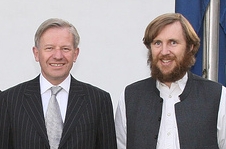
michael-semple-and-amb-sherard-cowper-coles.jpgThe case of Irishman Michael Semple, who was acting head of the European Union mission in Kabul, is instructive. The fluent Dari-speaking Semple had spent over 18 years in Afghanistan in various capacities, including with the United Nations and as an advisor to the British Embassy in Kabul, before being expelled last month after being accused of talking to the Taliban. [complete article]

See also, Pakistani forces say kill up to 90 militants (Reuters) and Taliban now seriously in the fight, war begins: NGO (AFP).

NATO hears ‘noise before defeat’

Ashdown’s real mission [– Paddy Ashdown is the UN’s newly appointed special envoy to Afghanistan –] lies elsewhere, in addressing the core issue: What do we do with the Taliban? No doubt, the Taliban’s exclusion from the Bonn conference seven years ago proved to be a horrible mistake. That was also how the Afghan and Pakistan problem came to be joined at the hips.

Pakistan President Pervez Musharraf made a valid point in his interview with the German weekly magazine Der Spiegel this week when he said al-Qaeda isn’t the real problem that faces Pakistan. “I don’t deny the fact that al-Qaeda is operating here [Pakistan]. They are carrying out terrorism in the tribal areas; they are the masterminds behind these suicide bombings. While all of this is true, one thing is for sure: the fanatics can never take over Pakistan. This is not possible. They are militarily not so strong they can defeat our army, with its 500,000 soldiers, nor politically – and they do not stand a chance of winning the elections. They are much too weak for that,” Musharraf said.

The heart of the matter is Pashtun alienation. The Taliban represent Pashtun aspirations. As long as Pashtuns are denied their historical role in Kabul, Afghanistan cannot be stabilized and Pakistan will remain in turmoil. Musharraf said, “There should be a change of strategy right away. You [NATO] should make political overtures to win the Pashtuns over.”

This may also be the raison d’etre of UN secretary general Ban Ki-moon’s intriguing choice of a Briton as his new special representative. Conceivably, the inscrutable Ban has been told by Washington that Ashdown is just the right man to walk on an upcoming secretive bridge, which will intricately connect New York, Washington, London, Riyadh, Islamabad and Kabul. [complete article]

Facebooktwittermail

NEWS & OPINION: New torture tapes?

Lawyers for detainee refer in filing to more CIA tapes

Attorneys for a former detainee at a secret CIA prison said in a court filing this week that intelligence officials had falsely claimed in public statements that his interrogations were not videotaped, that all videotaped interrogations stopped in 2002 and that only a small number of CIA detainees were subjected to unusually harsh interrogation techniques.

The basis of the assertions was redacted from the filing by the Bush administration, under an unusually stringent security order that blocks the attorneys for Majid Khan from disclosing evidence of the alleged falsehoods or detailing how Khan was treated while in CIA custody.

Khan, one of 14 detainees whom the CIA secretly imprisoned before transferring them last year to the U.S. military prison at Guantanamo Bay, Cuba, has said he was systematically tortured. His attorneys at the New York-based Center for Constitutional Rights have been pressing for a court order to prevent the government from destroying evidence of his treatment. [complete article]

The official story unfolds

The destruction of the CIA torture tapes is still a fairly young scandal as Washington scandals go. It hasn’t even acquired a “gate” suffix. But the Administration is already busily choreographing it, with the dozens of shiny metal parts clicking away in synchronicity, like a finely designed mechanical watch. There is an admirable efficiency to the political process. If only these people were a fraction as good at the work of government as they are at political shenanigans, I keep thinking. The Bush Administration plan is simple: let’s think of this as a movie–Abu Ghraib, The Sequel. Instead of offering up a group of young grunts for the sacrifice, this time it will be a retired senior management figure at the CIA and some of his subordinates. And this sacrifice will, in the White House’s view, divert attention from the real source of both scandals, which is high in the upper reaches of the Executive Branch. Inside the White House, in fact. [complete article]

Facebooktwittermail

GUEST CONTRIBUTOR – Roger Morris: Burials in the Sind

roger-morris.jpgPakistan has paid dearly for America’s most generous and tragic patronage
By Roger Morris, War in Context, January 17, 2008

Benazir Bhutto was a precocious 23-year-old in 1976 when she noticed Army Chief of Staff Mohammed Zia ul-Haq come and go at the office of her father, Pakistani prime minister Zulfikar Ali Bhutto. “A short, nervous, ineffectual-looking man,” she remembered the general, “whose pomaded hair was parted in the middle and lacquered to his head.” Along with the hair, Gen. Zia’s thick mustache and diffident manner seemed to Islamabad politicians a Punjabi version of English comedian Terry Thomas. “Bhutto’s butler” they called him.
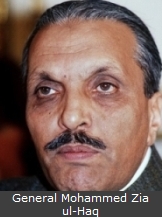
General Muhammad Zia-Ul-HaqThen, suddenly, in July 1977, Gen. Zia was no longer amusing when his junta arrested Mr. Bhutto and his cabinet, and imposed martial law. There followed more than a decade of military tyranny as Pakistan became, in Salman Rushdie’s phrase, “a nightmarish land.” That era and its sequels would be the setting of Benazir Bhutto’s political career, climaxing in her assassination Dec. 27. She was emblematic of her country’s nightmare, and of the tortuous role the United States played in it. It is a history – forgotten, denied – that haunts us all.

Benazir was a year old in 1954 as Washington adopted Pakistan as its Cold War client, lavishing the first of what would be billions of dollars on a military that by the end of the 1950s seized power amid the country’s chronic poverty and hostility with India. It was cozy, enduring patronage. Pentagon and CIA men shared with their Pakistani peers an occupational contempt for non-alignment and the hindrance of democratic politics.

By 1959, the CIA had stationed an agent in Karachi to advise Pakistani generals on public relations practices that would be enabling military dictatorships to claim legitimacy nearly a half-century later.
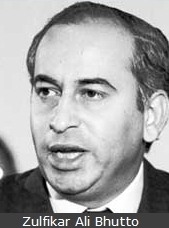
Zulfikar Ali BhuttoCanny, charismatic, irrepressibly ambitious, U.S.- and Oxford-educated Zulfikar Ali Bhutto was a young civilian minister for the junta in the 1960s, veering between complicity and enmity with the generals in the tangled pattern of Pakistan’s civilian-military politics. He then was an occasional nemesis of Washington, courting Communist China, fiercely bellicose on Kashmir and India. Breaking with the junta and founding his Pakistan Peoples Party in 1967, he inherited power in the 1971 breakaway of Bangladesh, when not even the U.S. could save the generals from the toll of secession, genocide, and another lost war with India.

While Benazir was driving her yellow MG at Radcliffe and Oxford, her father moved to restore his truncated nation and, in the process, seeded much of the 21st century predicament in South Asia – often in collusion with a heedless Washington. Grateful for Pakistan’s role as go-between in their 1971 opening to China, U.S. president Richard Nixon and secretary of state Henry Kissinger joined and financed Mr. Bhutto in his covert intervention against an Afghan regime he claimed was a pawn for Soviet expansion to the Arabian Sea and a menace to Pakistan’s ever-unruly northwest with its Afghan-kindred tribes. In 1973-75 they secretly mounted attacks in the Hindu Kush by radical Islamic Afghan exiles – whose anti-Western politics, terrorist tactics, and control by Pakistan prefigured the mujahedeen and Taliban years before the 1979 Russian invasion, the Afghan civil war, al-Qaeda and 9/11.

Meanwhile, in January 1972, under an awning on the broad lawn of an estate in Multan – an ancient city of Sufi shrines known as Pakistan’s “second heart” – Mr. Bhutto secretly gathered 70 of the country’s finest scientists and asked them to build a nuclear bomb. “They responded,” said one, “enthusiastically.” For years, Washington would look the other way. His foes sneered at Mr. Bhutto as the “Raja of Larkana,” after his estate in the Sind where he and his daughter would be buried. Both were seigniorial in their politics, the PPP family chattel, inherited now by Benazir’s son, Bilawal Bhutto Zardari. “Our feudals,” a CIA agent called them. But unlike Benazir, her father was a reformer as well as demagogue, nationalizing exploitative industries, insurance companies, and exclusive private schools, giving the poorest farmers tax relief and fixing ceilings on land ownership.

Despite periodic repression and no little corruption in his ranks, his constitution in 1973 recognized Islam as the national religion while establishing a parliamentary system to evolve into a secular democracy. He freed Pakistan from the fine-print fetters of the Commonwealth, negotiated the Simla Agreement with India accepting the line of control in Kashmir, recognized Bangladesh and, by 1977, was making peace with Afghanistan. It all won popular support – but challenged the oligarchy, religious right, and allies of both in the military, Pakistan’s ruling triad. Gen. Zia’s coup came with sanction from those forces – and, ultimately, Washington.

After a show trial, they hanged Mr. Bhutto at dawn at the old Rawalpindi prison, not far from where his daughter was murdered three decades later. The U.S. embassy referred to it delicately as “resolving the Bhutto problem,” and the American media made its peace with the winner; Newsweek taken with Gen. Zia’s “brooding eyes,” the Los Angeles Times finding him “low-key, direct, and polite,” an “incredibly canny man” who “talks with quiet sincerity about his country’s problems” – the latter the Times and others didn’t bother to explore. Gen. Zia was no stranger to the Pentagon and CIA, files plump with his 1950s study in the U.S. as a young officer, at the Command and General Staff School at Fort Leavenworth in 1964, and in highly secret Pentagon “command courses” not long before he seized power. Like most of his predecessors and successors, the pomaded general was, to some, Washington’s creature.

Two days after the April 1979 Bhutto hanging, U.S. president Jimmy Carter’s advisers formally approved a major covert intervention using the client Afghan religious radicals against the new Communist regime in Afghanistan – this, eight months before the Soviet invasion that the U.S.-armed and Pakistani-controlled insurgency was designed, in part, to provoke. The ensuing enormity came to seem familiar, though distorted to parody by versions like Charlie Wilson’s War and its Hollywood gloss. Hundreds of millions, ultimately billions, poured into the mujahedeen with their rampant drug trade and fulmination of al-Qaeda; Washington’s unstinting support of Gen. Zia, with more winking at his nuclear arsenal, and with as much as half the U.S. money siphoned off by Pakistan’s Inter-Services Intelligence, the notorious ISI already a state-within-a-state and now dominant in a black economy that eclipsed the open one. When he was assassinated in 1988 in the crash of Pak One, Gen. Zia was returning from a demonstration of a faulty tank the Pentagon was typically keen to sell him, and in tête-à-tête with a U.S. ambassador who knew him when he was still “Bhutto’s butler.”
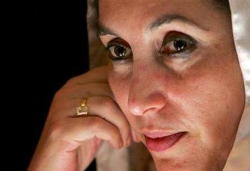
Benazir BhuttoBenazir Bhutto now joined the story, though in ugly anticlimax. While the CIA-Zia combine conducted its Afghan war and associated trade over the 1980s, she worked tirelessly as her father’s chosen successor. This included building furtive ties to the Americans, the CIA covering its bets with subsidies to Ms. Bhutto, some no doubt recycled in paying for her Washington lobbyists.

With Gen. Zia’s murder, she was ready and, like her father, inherited power in a moment of the military’s division. But her tenures as prime minister in 1988-90 and again in 1993-96 were hobbled by the massive power of the ISI, old habits of repression, including the murder of her own dissident brother, and blatant looting by her circle, not least by her husband Asif Zardari. Failure and corruption went unrelieved by any reforms approaching her father’s. It stood to be repeated had Ms. Bhutto held power again – the ISI manacling along with her own corruption – and is in the wings now with Mr. Zardari’s regency over the PPP.

Like her father, like Gen. Zia her nemesis, she was partly America’s creature as well, inserted by the Bush administration, with the blessing of congressional Democrats, to shore up Pakistani President Pervez Musharraf with some coalition manqué appeasing enough of the crowd as well as the triad. As always, there was even an underside to Ms. Bhutto’s vaunted defiance of the Islamic radicals; her own regimes had been instrumental in the rise of the Afghan Taliban and given to quiet accommodation and sharing of spoils with the internal Pakistani zealots.

She was dead only days when it became clear that the tragedy of her last 30 years would continue. In a U.S. presidential campaign that, otherwise, blares change, no candidate dares to change this most disastrous, most bipartisan, most bigoted of foreign policies, in which America’s meddling was so malignant and its ultimate control so illusory. In Pakistan, the old politics go on, including the security of the nuclear arms. None of the ruling triad wants that horror unleashed. The losers, as always, will be the more than hundred million Pakistanis in abject want or on the edge – the historic disgrace of the world’s longest running military despotism, and of America’s most generous and tragic patronage.

If only they buried in the Sind, along with Zulfikar Ali Bhutto and his beloved daughter, that sordid past. For now, we can only follow the poet Faiz Ahmed Faiz: “We will inter hope with appropriate mourning … Every gate of prayer throughout heaven is slammed shut today.”

© Roger Morris

Roger Morris, who served on the National Security Council staff under Lyndon Johnson and Richard Nixon, is the author of Shadows of the Eagle, a history of U.S. covert intervention and policy in the Middle East and South Asia, to be published this year.
This article first appeared in the Globe and Mail and is reprinted here with the author’s permission.

Facebooktwittermail

NEWS & EDITOR’S COMMENT: The torture cover-up

Station chief made appeal to destroy CIA tapes

Those known to have counseled against the tapes’ destruction include John B. Bellinger III, while serving as the National Security Council’s top legal adviser; Harriet E. Miers, while serving as the top White House counsel; George J. Tenet, while serving as CIA director; [Scott W.] Muller, while serving as the CIA’s general counsel; and John D. Negroponte, while serving as director of national intelligence.

Hayden, in an interview, said the advice expressed by administration lawyers was consistent. “To the degree this was discussed outside the agency, everyone counseled caution,” he said. But he said that, in 2005, it was “the agency’s view that there were no legal impediments” to the tapes’ destruction. There also was “genuine concern about agency people being identified,” were the tapes ever to be made public.

Hayden, who became CIA director last year, acknowledged that the questions raised about the tapes’ destruction, then and now, are legitimate. “One can ask if it was a good idea, or if there was a better way to do it,” he said. “We are very happy to let the facts take us where they will.” [complete article]

Editor’s Comment — The top officials here were either duplicitous or incompetant or both. The decision-making process carries the signature of the Bush-Cheney administration. It’s all about being able to act and evade responsibility. Under the leadership of a frat boy president, no one wants to carry the accountability that Bush himself refuses to bear.

Special counsel sought in CIA tapes case

The chairman of the House Judiciary Committee and 18 other House Democrats on Tuesday asked the attorney general to replace a government prosecutor with an outside lawyer to investigate the CIA’s destruction of interrogation videotapes. [complete article]

Facebooktwittermail

NEWS: Bagram – the other Gitmo

Bagram: The other Gitmo

As last week marked the sixth anniversary of the arrival of the first orange-jumpsuit-clad prisoners at the US naval base at Guantanamo Bay, Cuba, human-rights organizations are attempting to focus public and congressional scrutiny on what some are calling “the other Gitmo”.

This is a prison located on the US military base in the ancient city of Bagram near Charikar in Parvan, Afghanistan. The detention center was set up by the US military as a temporary screening site after the 2001 invasion of Afghanistan overthrew the Taliban. It currently houses about 630 prisoners – close to three times as many as are still held at Guantanamo.

In 2005, following well-documented accounts of detainee deaths, torture and “disappeared” prisoners, the US undertook efforts to turn the facility over to the Afghan government. But, thanks to a series of legal, bureaucratic and administrative missteps, the prison is still under American military control. And a recent confidential report from the International Committee of the Red Cross (ICRC) has reportedly complained about the continued mistreatment of prisoners.

The ICRC report is said to cite massive overcrowding, “harsh” conditions, lack of clarity about the legal basis for detention, prisoners held “incommunicado” in “a previously undisclosed warren of isolation cells”, and “sometimes subjected to cruel treatment in violation of the Geneva Conventions”. Some prisoners have been held without charges or lawyers for more than five years. The Red Cross said dozens of prisoners have been held incommunicado for weeks or even months, hidden from prison inspectors. [complete article]

Facebooktwittermail

OPINION: Less than human

Less than human

Friday marked the sixth anniversary of the arrival of the first detainees at the American GULAG constructed to house prisoners taken in the Bush Administration’s War on Terror in Guantánamo. Around the world, thousands gathered in public commemorations in London, Stockholm, Dublin, Brussels and Bahrain. More than twelve hundred parliamentarians signed a formal plea calling for the immediate closing of the base. The same plea had previously been issued by Pope Benedict, Chancellor Angela Merkel and more than two dozen other world leaders. Indeed, quite remarkably, on Sunday Admiral Mike Mullen, chairman of the Joint Chiefs of Staff essentially joined in with the protestors.

“More than anything else it’s been the image — how Gitmo has become around the world, in terms of representing the United States. … I believe that from the standpoint of how it reflects on us that it’s been pretty damaging.”

Mullen went on to say that he wanted the facility shut down. Sources inside the Pentagon say that has been the view of the Joint Chiefs of Staff for several years now. [complete article]

Facebooktwittermail

FEATURE: Fighting over there, then killing back here

Across America, deadly echoes of foreign battles

Town by town across the country, headlines have been telling similar stories. Lakewood, Wash.: “Family Blames Iraq After Son Kills Wife.” Pierre, S.D.: “Soldier Charged With Murder Testifies About Postwar Stress.” Colorado Springs: “Iraq War Vets Suspected in Two Slayings, Crime Ring.”

Individually, these are stories of local crimes, gut-wrenching postscripts to the war for the military men, their victims and their communities. Taken together, they paint the patchwork picture of a quiet phenomenon, tracing a cross-country trail of death and heartbreak.

The New York Times found 121 cases in which veterans of Iraq and Afghanistan committed a killing in this country, or were charged with one, after their return from war. In many of those cases, combat trauma and the stress of deployment — along with alcohol abuse, family discord and other attendant problems — appear to have set the stage for a tragedy that was part destruction, part self-destruction. [complete article]

Facebooktwittermail

NEWS, ANALYSIS & OPINION: The unraveling of the War on Terrorism

The West has not just repressed democracy. It has aided terror

The Pakistani senator gazed at the headline in despair. It read: “US weighs new covert push in Pakistan”. Washington was authorising “enhanced CIA activity” in the country while US Democratic candidates declared they were all ready “to launch unilateral military strikes in [Pakistan] if they detected an imminent threat”. Hillary Clinton wanted “joint US-UK oversight” of Pakistan’s nuclear weapons. In a country where anti-Americanism is almost a religion, said the senator, this is “an answer to a Taliban prayer”.

I am convinced that those whom the gods wish to destroy they first curse with foreign policy. For the third time in 20 years, the west is meddling with the world’s sixth most populous state. It did so to promote the Afghan mujahideen against the Russians in the 1980s, then to attack al-Qaida after 9/11, and now to “guard” Pakistan’s bombs against a fantastical al-Qaida seizure. Needless to say, the sole beneficiaries are the Taliban and the forces of disorder. [complete article]

Pakistan warns US not to enter northwest

President Pervez Musharraf warned that U.S. troops would be regarded as invaders if they crossed into Pakistan’s border region with Afghanistan in the hunt for al-Qaida or Taliban militants, according to an interview published Friday. [complete article]

Pakistan takes a step backwards

At a time when Pakistan’s national decision-making institutions are suspicious of international plans to make the country’s nuclear program controversial, there is serious consideration for repositioning the country’s foreign policy as neutral in the United States-led “war on terror”.

This would mean non-interference in the restive tribal areas on the border with Afghanistan. These are virtually autonomous areas where Taliban and al-Qaeda militants have established bases and vital supply lines into Afghanistan.

Such a move would have devastating effects on the North Atlantic Treaty Organization’s (NATO) efforts to control the ever-growing insurgency in Afghanistan.

Following a meeting of the Pakistan corps commanders headed by the new chief of army staff, General Ashfaq Kiani, a press release said there would be a review of the situation in the tribal areas and, instead of citing any plans for military operations there against militants, the release said the military’s decisions would be based on “the wishes of the nation”. [complete article]

See also, Bomb kills at least 23 in Pakistan (NYT) and Baitullah Mehsud – the Taliban’s new leader in Pakistan (Jamestown Foundation).

Facebooktwittermail

NEWS: The torture tapes cover-up

Ex-CIA aide won’t testify on tapes without immunity

A lawyer for Jose A. Rodriguez Jr., the former Central Intelligence Agency official who in 2005 ordered the destruction of videotapes of harsh interrogations of prisoners at a secret site overseas, has told Congress that Mr. Rodriguez will not testify about the tapes without a grant of immunity, a person familiar with the discussions said Wednesday.

The House Intelligence Committee has scheduled a closed hearing on the tapes’ destruction for next Wednesday, and John A. Rizzo, the C.I.A.’s acting general counsel, has agreed to testify.

The committee issued a subpoena last month for Mr. Rodriguez’s testimony. Since then, the Justice Department has opened a criminal investigation into the tapes’ destruction. Mr. Rodriguez’s lawyer, Robert S. Bennett, wrote to the committee last week, saying that in light of the investigation he would not allow Mr. Rodriguez to offer testimony that might subsequently be used against him, according to the person familiar with the discussions, who would not speak for attribution because of their confidential nature.

The immunity demand creates a quandary for the House committee, which rejected a request from Attorney General Michael B. Mukasey to postpone the Congressional inquiry. An offer of immunity for Mr. Rodriguez’s testimony could make prosecuting him difficult or impossible, legal experts say. [complete article]

Facebooktwittermail

OPINION & EDITOR’S COMMENT: If the GWOT were gone

The $100 barrel of oil vs. the Global War on Terror

Opinion polls indicate that, in this electoral season, terrorism is no longer at, or even near, the top of the American agenda of worries. Right now, it tends to fall far down lists of “the most important issue to face this country” (though significantly higher among Republicans than Democrats or independents). Nonetheless, don’t for a second think that the subject isn’t lodged deep in national consciousness. When asked recently by the pollsters of CNN/Opinion Research Corporation: “How worried are you that you or someone in your family will become a victim of terrorism,” a striking 39% of Americans were either “very worried” or “somewhat worried”; another 33% registered as “not too worried.” These figures might seem reasonable in New York City, but nationally? As the Democratic debate Saturday indicated, the politics of security and fear have been deeply implanted in our midst, as well as in media and political consciousness. Even candidates who proclaim themselves against “the politics of fear” (and many don’t) are repeatedly forced to take care of fear’s rhetorical business.

Imagining how a new president and a new administration might begin to make their way out of this mindset, out of a preoccupation guaranteed to solve no problems and exacerbate many, is almost as hard as imagining a world without al-Qaeda. After all, this particular obsession has been built into our institutions, from Guantanamo to the Department of Homeland Security. It’s had the time to sink its roots into fertile soil; it now has its own industries, lobbying groups, profit centers. Unbuilding it will be a formidable task indeed. Here, then — a year early — is a Bush legacy that no new president is likely to reverse soon.

Ask yourself honestly: Can you imagine a future America without a Department of Homeland Security? Can you imagine a new administration ending the global lockdown that has become synonymous with Americanism?

The Bush administration will go, but the job it’s done on us won’t. That is the sad truth of our presidential campaign moment. [complete article]

Editor’s Comment — That we acquire “the wisdom of insecurity” is one of our needs in these times. In the current populist rhetoric, fear is being contrasted with hope. But along with hope we also need courage. To be courageous is to take risks and see the limits of security. Whether the Bush legacy is so entrenched that it cannot be reversed by the next president will have a great deal to do with who puts the next president into office. This is what makes this election in so many ways, a generational watershed. The young see in risk, opportunity, while for the older generation, there, lurks danger. Yet like it or not, the older generation eventually has no choice but to resign itself to the fact that those it deems too inexperienced will necessarily be the ones who shape the future.

Why we both love and hate America

Immediately after the 9/11 attacks against the United States, President George W. Bush and many other perplexed, angry and often ignorant Americans asked a question: “Why do they hate us?” Then they made a statement: “You’re either with us or against us.” This week, those Americans who are actually interested in answering the question and exploring the validity of the statement have a very good opportunity to grasp precisely why most people around the world admire the US but also detest many aspects of its foreign policy. This revelatory moment comprises two simultaneous events this week: the competitive American party primaries, and Bush’s journey to the Middle East. The contrast between the two events is substantial, and very revealing of the best and worst of American political culture. [complete article]

Facebooktwittermail