Category Archives: War on Terrorism

Cheney’s plans for a military coup

Cheney’s plans for a military coup

On Saturday, Mark Mazetti and David Johnston of the New York Times, quoting sources close to former President Bush, revealed that former Vice President Dick Cheney had advocated deploying the military for domestic policing purposes. Bush apparently declined to take Cheney’s advice. The discussions occurred against the backdrop of the so-called “Lackawanna Six” case, involving a group of six Yemeni-Americans from the Buffalo area who later pleaded guilty to charges of providing material support to Al Qaeda and received prison sentences.

The disclosures shed considerable light on two memoranda prepared in the Justice Department’s Office of Legal Counsel by John Yoo (with the help of Robert J. Delahunty on the second memo) at the request of then-White House counsel Alberto Gonzales. The principal memo was part of a group published by the Obama Administration on May 16, provoking widespread public concern. In the memo, Yoo argued that the Fourth Amendment could be viewed as suspended in the event of domestic operations by the military in war time. The second memo, not yet released but discussed here by Prof. Kim Scheppele on the basis of references to it in other documents, apparently attempted to read the Posse Comitatus Act of 1878, which forbids the domestic deployment of the military for police functions, into oblivion. In “George W. Bush’s Disposable Constitution,” I argued that Yoo’s memo was the formula for a dictatorship. Yoo responded to this objection in the Wall Street Journal, arguing that the memo had been authored with a very narrow set of facts in mind, namely an invasion like the sort of attack that was launched on Mumbai on November 26, 2008. But the latest disclosures make clear, once more, that Yoo’s claims are dishonest. [continued…]

Facebooktwittermail

American forged own path into Al Qaeda

American forged own path into Al Qaeda

Bryant Neal Vinas’ unlikely odyssey from Long Island, N.Y., to Al Qaeda’s innermost circle of commanders in Pakistan was achieved without any help in the U.S. from the well-oiled “jihadist pipeline” that has guided so many militants from Europe and other countries — a fact that is cause for concern, current and former U.S. counter-terrorism officials said.

His case, which became public last week, showed that a U.S. convert to Islam bent on waging holy war could — without much difficulty — rely largely on friends and acquaintances to find his own way into the shadowy terrorist networks.

Current and former intelligence officials said that although they were able to at least partly track Vinas, they fear that the informal network of militants in Pakistan that he tapped into is widespread and below the radar of U.S. intelligence gathering.

Juan Zarate, the former deputy national security advisor for combating terrorism in the Bush administration, said that the Vinas case illustrated how difficult it was to follow young men who become radicalized and make their way to militant camps in Pakistan, as well as Afghanistan, Iraq and Somalia. [continued…]

Facebooktwittermail

The Cheney plan to deploy the U.S. military on U.S. soil

Bush weighed using military in arrests

Top Bush administration officials in 2002 debated testing the Constitution by sending American troops into the suburbs of Buffalo to arrest a group of men suspected of plotting with Al Qaeda, according to former administration officials.

Some of the advisers to President George W. Bush, including Vice President Dick Cheney, argued that a president had the power to use the military on domestic soil to sweep up the terrorism suspects, who came to be known as the Lackawanna Six, and declare them enemy combatants.[…]

Former officials said the 2002 debate arose partly from Justice Department concerns that there might not be enough evidence to arrest and successfully prosecute the suspects in Lackawanna. Mr. Cheney, the officials said, had argued that the administration would need a lower threshold of evidence to declare them enemy combatants and keep them in military custody. [continued…]

The Cheney plan to deploy the U.S. military on U.S. soil

This new report today from The New York Times’ Mark Mazzetti and David Johnston reveals an entirely unsurprising though still important event: in 2002, Dick Cheney and David Addington urged that U.S. military troops be used to arrest and detain American citizens, inside the U.S., who were suspected of involvement with Al Qaeda. That was done pursuant to a previously released DOJ memo (.pdf) authored by John Yoo and Robert Delahunty, addressed to Alberto Gonzales, dated October 23, 2001, and chillingly entitled “Authority for Use of Military Force to Combat Terrorist Activities Within the U.S.” That Memo had concluded that the President had authority to deploy the U.S. military against American citizens on U.S. soil. Far worse, it asserted that in exercising that power, the President could not bound either by Congressional statutes prohibiting such use (such as the Posse Comitatus Act) or even by the Constitution’s Fourth Amendment, which — the Memo concluded — was “inapplicable” to what it called “domestic military operations.”

Though it received very little press attention, it is not hyperbole to observe that this October 23 Memo was one of the most significant events in American politics in the last several decades, because it explicitly declared the U.S. Constitution — the Bill of Rights — inoperative inside the U.S., as applied to U.S. citizens. [continued…]

The alarming record of the FBI’s informant in the Bronx bomb plot

Last month, police and the FBI arrested four Newburgh men on charges that they had plotted to bomb synagogues in the Riverdale neighborhood of the Bronx and fire a missile at a military jet.

Mayor Michael Bloomberg and Police Commissioner Ray Kelly held press conferences at the synagogues to reassure New Yorkers about their safety. During Kelly’s remarks, it was startling to hear the commissioner refer to al-Qaeda by name, if only to say that the four purported home-grown terrorists had no ties to Osama Bin Laden’s organization.

As more details emerged, however, the less the four defendants sounded like men with the skills to plan a sophisticated terror plot. They were small-time crooks, felons with long criminal records whose previous activities revolved around smoking marijuana and playing video games. One defendant, Laguerre Payen, was arrested in a crack house surrounded by bottles of his own urine; his lawyer describes him as “mildly retarded.”

It seemed fairly astounding that, for a full calendar year, such a group could remain interested in and plan anything more complex than a backyard barbecue, let alone a multipronged paramilitary assault, as the indictment against them alleged. [continued…]

Facebooktwittermail

How the Bush administration tried to cover up mass murder

How the Bush administration tried to cover up mass murder


AfghanMassGrave.org

Dr. Jennifer Leaning, Nathaniel Raymond and Dr. Nizam Peerwani of Physicians for Human Rights discuss with Terry Gross their investigation of the alleged massacre of hundreds or possibly thousands of Taliban and Al Qaeda prisoners at Dasht-i-Leili in Afghanistan in December 2001.

Nathaniel Raymond [Physicians for Human Rights]: Our consuming fear from day one, Terry, was that any evidence there was going to be removed and/or destroyed. We were also deeply concerned about witnesses who had spoken to journalists such as Newsweek, to the United Nations and to others and now sadly we know two things: One, we know that there is clear evidence — our forensic team documented [this] in 2008 — of tampering at the site. And we also have satellite imagery which shows that in 2006, less than a month approximately after we filed a Freedom of Information Act request in US federal court, there is one large hole present at the site and what appears to be a hydrolic excavator and a truck digging what becomes the second large trench that our forensic team found in 2008. But for me, and I want to make this very clear, the great tragedy in this case has been the loss of the witnesses.

We now know through State Department documents we received through Freedom of Information Act request that at least four witnesses — innocent men who were bulldozer drivers and truck drivers — have been tortured, killed and disappeared.

Terry Gross: Nathaniel, your Freedom of Information Act files related to the mass grave — your request was made in June of 2006 — and I know you had a lot of trouble getting the Freedom of Information files, although you finally got them. What kind of trouble did you have?

NR: Well, the trouble that Physicians for Human Rights had was the Bush administration did not want to release any documents and so with the help of Ropes and Gray, a law firm in Washington, we were able to pressure them to release the documents and we started receiving them in 2008 and what we found was frankly jaw dropping.

In a November 2002 State Department intelligence report there was a body count and it was from a three-letter redacted intelligence source, which means we couldn’t see who was reporting it, but whoever was reporting it was identified by three letters [editor’s wild guess: possibly a combination of the letters “C”, “I” and “A”]. And this three-letter source said at least 1,500 to as many as 2,000 had died as part of the massacre.

And what we also learned, which was very hard for us at Physicians for Human Rights to see, is that the US government had confirmation that at least four witnesses had been tortured, killed and/or disappeared.

TG: What does it say to you that within these Freedom of Information Act files there was a source, whose name was redacted, who actually gave an estimated body count in this mass grave?

NR: Speaking with former Bush administration officials, that source was an agency. And we still do not have confirmation about what US intelligence agency that was, but it was absolutely outrageous. The fact that the US government would be saying there was no grounds for a US investigation, no grounds for security of the site, no grounds for protection of witnesses, but they had a body count for years, and they had clear evidence that people — innocent bystanders in this case — were being killed and they did nothing. [continued…]

Afghan massacre: the convoy of death (video)

Facebooktwittermail

How serial war became the American way of life

America’s wars

On July 16, in a speech to the Economic Club of Chicago, Secretary of Defense Robert Gates said that the “central question” for the defense of the United States was how the military should be “organized, equipped — and funded — in the years ahead, to win the wars we are in while being prepared for threats on or beyond the horizon.” The phrase beyond the horizon ought to sound ominous. Was Gates telling his audience of civic-minded business leaders to spend more money on defense in order to counter threats whose very existence no one could answer for? Given the public acceptance of American militarism, he could speak in the knowledge that the awkward challenge would never be posed.

We have begun to talk casually about our wars; and this should be surprising for several reasons. To begin with, in the history of the United States war has never been considered the normal state of things. For two centuries, Americans were taught to think war itself an aberration, and “wars” in the plural could only have seemed doubly aberrant. Younger generations of Americans, however, are now being taught to expect no end of war — and no end of wars. [continued…]

Facebooktwittermail

Pentagon seeks to overhaul prisons in Afghanistan

Pentagon seeks to overhaul prisons in Afghanistan

A sweeping United States military review calls for overhauling the troubled American-run prison here as well as the entire Afghan jail and judicial systems, a reaction to worries that abuses and militant recruiting within the prisons are helping to strengthen the Taliban.

In a further sign of high-level concern over detention practices, Adm. Mike Mullen, the chairman of the Joint Chiefs of Staff, sent a confidential message last week to all of the military service chiefs and senior field commanders asking them to redouble their efforts to alert troops to the importance of treating detainees properly.

The prison at this air base north of Kabul has become an ominous symbol for Afghans — a place where harsh interrogation methods and sleep deprivation were used routinely in its early years, and where two Afghan detainees died in 2002 after being beaten by American soldiers and hung by their arms from the ceiling of isolation cells. [continued…]

Facebooktwittermail

The counter-terrorists – 7/19

Internal rifts on road to torment

In April 2002, as the terrorism suspect known as Abu Zubaida lay in a Bangkok hospital bed, top U.S. counterterrorism officials gathered at CIA headquarters in Langley, Va., for a series of meetings on an urgent problem: how to get him to talk.

Put him in a cell filled with cadavers, was one suggestion, according to a former U.S. official with knowledge of the brainstorming sessions. Surround him with naked women, was another. Jolt him with electric shocks to the teeth, was a third.

One man’s certitude lanced through the debate, according to a participant in one of the meetings. James E. Mitchell, a retired clinical psychologist for the Air Force, had studied al-Qaeda resistance techniques.

“The thing that will make him talk,” the participant recalled Mitchell saying, “is fear.” [continued…]

A response to General Dostum

Dostum asserts that “it is impossible that Taliban or Al-Qaeda prisoners could have been abused.” In fact, preliminary investigations carried out shortly after the alleged killings by highly experienced and respected forensic analysts from Physicians for Human Rights established the presence of recently deceased human remains at Dasht-e Leili and suggested that they were the victims of homicide.

I was a human rights investigator in northwestern Afghanistan in February 2002. At the time, numerous witnesses spoke of seeing several trucks dumping what appeared to be human remains in Dasht-e Leili, while others told of detainees being held for days in overcrowded shipping containers without food, water, or medical care, and, in some instances, being shot while inside the containers. [continued…]

Afghan massacre: the convoy of death (video)

Facebooktwittermail

Britain’s police state

Police identify 200 children as potential terrorists

Two hundred schoolchildren in Britain, some as young as 13, have been identified as potential terrorists by a police scheme that aims to spot youngsters who are “vulnerable” to Islamic radicalisation.

The number was revealed to The Independent by Sir Norman Bettison, the chief constable of West Yorkshire Police and Britain’s most senior officer in charge of terror prevention.

He said the “Channel project” had intervened in the cases of at least 200 children who were thought to be at risk of extremism, since it began 18 months ago. The number has leapt from 10 children identified by June 2008. [continued…]

London cops reach new heights of anti-terror poster stupidity

The London police have bested their own impressive record for insane and stupid anti-terrorism posters with a new range of signs advising Londoners to go through each others’ trash-bins looking for “suspicious” chemical bottles, and to report on one another for “studying CCTV cameras.”

It’s hard to imagine a worse, more socially corrosive campaign. Telling people to rummage in one another’s trash and report on anything they don’t understand is a recipe for flooding the police with bad reports from ignorant people who end up bringing down anti-terror cops on their neighbors who keep tropical fish, paint in oils, are amateur chemists, or who just do something outside of the narrow experience of the least adventurous person on their street. Essentially, this redefines “suspicious” as anything outside of the direct experience of the most frightened, ignorant and foolish people in any neighborhood. [continued…]

Facebooktwittermail

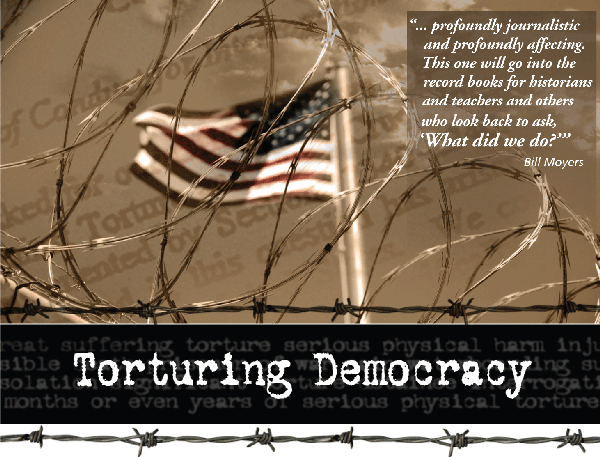
Torturing Democracy


Torturing Democracy, a major documentary film more than 18 months in the making, has been airing on individual public television stations around the US since October — although PBS has been reluctant to air it nationally.

The 90-minute film, from Emmy and DuPont awarding-winning producer Sherry Jones, relies on the documentary record to connect the dots in an investigation of interrogations of prisoners in U.S. custody that became “at a minimum, cruel and inhuman treatment and, at worst, torture,” in the words of the former general counsel of the United States Navy.

Up to date with the latest revelations, Torturing Democracy details how the government set aside the rule of law in its pursuit of harsh interrogations of suspected terrorists. It features in-depth interviews with numerous senior military and government officials.

Former Deputy Secretary of State Richard Armitage describes – for the first time on-camera – being waterboarded during military training before he was sent to Vietnam. When producer Jones asked Mr. Armitage if he considered waterboarding to be torture, he answered, “Absolutely. No question.” He added: “There is no question in my mind – there’s no question in any reasonable human being, that this is torture. I’m ashamed that we’re even having this discussion.”

Torturing Democracy can be viewed in three parts (part one, part two, part three).

Facebooktwittermail

GUEST CONTRIBUTOR – John Robertson: Is the US headed for a third war?

Is the US headed for a third war?
By John Robertson, War in Context, September 13, 2008

Don’t look now, but the US is perhaps heading for a third war – this one, with an ally (or so Mr. Bush has told us, and them, for the last eight years): Pakistan. The head of Pakistan’s army has reiterated his earlier warning to the US, that Pakistan cannot tolerate US ground and air forces (which killed another 12 people yesterday – some of them “bad guys,” but some of them reportedly women and children) repeatedly encroaching on Pakistan’s national sovereignty with such impunity.

Are al-Qaida and Taliban elements (including, most probably, Osama Bin Laden and Ayman al-Zawahiri) sheltering in Pakistan’s Northwest Frontier states and launching operations from there? Yes. Do most Pakistanis therefore believe that the US has the right to send in Navy Seal teams (that happened just a few days ago) and dispatch unmanned Predator planes to bomb people in Pakistani territory to smithereens? No.

Across Pakistan (to borrow the memorable line exclaimed by the actor Peter Finch in the movie Network more than 30 years ago), people are getting mad as hell, and are not going to take it anymore. The vast majority of Pakistanis never bought into Bush’s “war on Terror” as being their own fight (they see it as America’s war, not Pakistan’s), they resented how Bush continued to support Pakistan’s president Pervez Musharraf as his “guy” even while Musharraf undermined Pakistan’s democratic institutions (wasn’t the US committed to promoting democracy?) – and now they see the US killing people, fellow Muslims all, wantonly inside their country, after oh-so-many years of watching the US kill fellow Muslims in Iraq and Afghanistan, support Israel’s killing of them in the West Bank, Gaza, and Lebanon (and, for that matter, support its old ally Saddam Hussein’s killing of them in Iran between 1980 and 1988), and threaten the killing of them in Iran and Syria.

And at the same time, the US has been burnishing its relationship with the country that Pakistanis have seen as their most mortal enemy and most serious existential threat for 60 years. I mean India, of course – the same India that developed and tested a nuclear weapon completely under the radar of the US intelligence community, to be followed down that road by Pakistan, which felt compelled to develop its own nuclear deterrent against its larger, wealthier, more powerful neighbor. After a several-years-long fit of pique against India, the US in recent years has rushed to embrace India as an economic and strategic partner, even to the extent of pursuing an agreement that (in direct violation of internationally recognized nuclear-proliferation agreements) will provide India with advanced nuclear technology, and that more or less signals the nuclear-weapon wannabes of the world that (as Newsweek‘s Michael Hirsch has put it) “You too can rejoin the international community if you wait long enough! So keep at it.”

On the eve of his 2001 invasion of Afghanistan, most observers with any depth of awareness of that country’s historical and ethnic complexities warned Mr. Bush that he would be opening a Pandora’s box, and that US forces (like so many other invaders, from the phalanxes of Alexander the Great to the troopers sent there to maintain the British Raj in India) might be sucked into a black hole. We’ll never know if the US forces that were sent to Afghanistan might have broken that string. Mr. Bush’s poorly conceived and ill-fated digression, the hubristically and tragically misnamed “Operation Iraqi Freedom,” torched any momentum that the US had built up along any projected pathway to stability in Afghanistan.

The Bush administration may have once believed that by 2003 it had more or less closed Pandora’s box in Afghanistan. According to the ancient Greek myth, when Pandora opened her box (which was, actually, a large jar), she loosed all manner of evils into the world. But we tend to forget that she was able to clamp the lid back on quickly enough to keep one thing inside: hope. The chaos now brewing in Pakistan is surely one of the box’s escapees of 2001, nurtured to deadly maturity by its fellow escapees, the evils that have befallen the region over the past seven years. Mr. Bush (or more likely, his successor) must now find a way to get the lid back on – finally, firmly, and quickly – if he is to prevent full-blown civil war (or worse – remember, Pakistan is a state with nuclear capability). Otherwise, hope – for a stable Afghanistan, or even South Asia – may already have escaped that box as well.

John Robertson is a professor of Middle East history at Central Michigan University and has his own blog, Chippshots.

Facebooktwittermail

REVIEW: The Dark Side

Answering terror with terror

We can’t say we weren’t warned.

The very first Sunday after the 9/11 attacks, Vice President Dick Cheney descended like a cloud on “Meet the Press” to outline the Bush administration’s response. “We’ll have to work sort of the dark side, if you will. We’ve got to spend time in the shadows in the intelligence world. A lot of what needs to be done here will have to be done quietly, without any discussion, using sources and methods that are available to our intelligence agencies — if we are going to be successful. That’s the world these folks operate in. And, uh, so it’s going to be vital for us to use any means at our disposal basically, to achieve our objectives.”

Around the nation, one presumes, numbed heads were nodding in approval. Whatever it takes to get those bastards. The true nature of our Faustian bargain would not become clear until later, and maybe it needed a journalist as steely and tenacious as Jane Mayer to give us the full picture. “The Dark Side” is about how the war on terror became “a war on American ideals,” and Mayer gives this story all the weight and sorrow it deserves. Many books get tagged with the word “essential”; hers actually is.

Above all, it underscores one of the least remarked aspects of our nation’s counterterrorist policy: the degree to which it has been driven not by spies or generals but by pasty men in ties. “The first thing we do,” goes that crowd-pleasing line from Shakespeare’s “Henry VI,” “let’s kill all the lawyers.” Readers of “The Dark Side” might be moved to add: “Before they kill you.” Almost from the moment America was attacked, Mayer writes, Cheney “saw to it that some of the sharpest and best-trained lawyers in the country, working in secret in the White House and the United States Department of Justice, came up with legal justifications for a vast expansion of the government’s power in waging war on terror. As part of that process, for the first time in history, the United States sanctioned government officials to physically and psychologically torment U.S.-held captives, making torture the official law of the land in all but name.” This “extralegal counterterrorism program,” contends Mayer, “presented the most dramatic, sustained, and radical challenge to the rule of law in American history.” [complete article]

Facebooktwittermail

FEATURES & EDITOR’S COMMENT: Torture and propaganda

Behind TV analysts, Pentagon’s hidden hand

In the summer of 2005, the Bush administration confronted a fresh wave of criticism over Guantánamo Bay. The detention center had just been branded “the gulag of our times” by Amnesty International, there were new allegations of abuse from United Nations human rights experts and calls were mounting for its closure.

The administration’s communications experts responded swiftly. Early one Friday morning, they put a group of retired military officers on one of the jets normally used by Vice President Dick Cheney and flew them to Cuba for a carefully orchestrated tour of Guantánamo.

To the public, these men are members of a familiar fraternity, presented tens of thousands of times on television and radio as “military analysts” whose long service has equipped them to give authoritative and unfettered judgments about the most pressing issues of the post-Sept. 11 world.

Hidden behind that appearance of objectivity, though, is a Pentagon information apparatus that has used those analysts in a campaign to generate favorable news coverage of the administration’s wartime performance, an examination by The New York Times has found.

The effort, which began with the buildup to the Iraq war and continues to this day, has sought to exploit ideological and military allegiances, and also a powerful financial dynamic: Most of the analysts have ties to military contractors vested in the very war policies they are asked to assess on air. [complete article]

Editor’s Comment — This article describes a triangle of complicity comprising Pentagon officials, retired military leaders, and television news networks. The New York Times essentially gives the networks a free pass. The final paragraphs of the article summarize the perfunctory answers the paper received in response to questions about conflicts of interest, yet the mere fact that the networks might have been unaware about the Pentagon briefings their analysts were receiving or the way these generals were cashing in on their connections, does not explain away what was always glaringly obvious: the chasm separating war news reporting on the one hand, and the military analysis being presented by the networks’ prize generals on the other hand. The networks had no interest in closing this gap. That fact in and of itself merits another investigative report but that will only happen if mainstream journalism opens itself up to some critical self-examination — and what are the chances of that happening?!

Stress hooding noise nudity dogs

When the Haynes memo reached Guantánamo on December 2 [2002], Detainee 063 was in an isolated, plywood interrogation booth at Camp X-Ray. He was bolted to the floor and secured to a chair, his hands and legs cuffed. He had been held in isolation since August 8, nearly four months earlier. He was dehydrated and in need of regular hook-ups to an intravenous drip. His feet were swollen. He was urinating on himself.
amazon-tortureteam.jpgDuring Detainee 063’s first few months at Guantánamo, the interrogators had followed established practices for military and law enforcement interrogations. Building rapport is the overriding aim of the US Army Field Manual 34-52, the rule book for military interrogators, colloquially referred to as “FM 34-52”. Legality was also essential, which meant operating in accordance with the rules set out in the US military’s Uniform Code of Military Justice and international law, in particular the four Geneva conventions.

At the heart of them lies “Common Article 3”, which expressly prohibits cruel treatment and torture, as well as “outrages upon personal dignity, in particular, humiliating and degrading treatment”. Tactics that had conformed to these principles changed dramatically. The interrogation log describes what happened immediately after Rumsfeld signed the Haynes memo.

The pattern was always the same: 20-hour interrogation sessions, followed by four hours of sleep. Sleep deprivation appears as a central theme, along with stress positions and constant humiliation, including sexual humiliation. These techniques were supplemented by the use of water, regular bouts of dehydration, the use of IV tubes, loud noise (the music of Christina Aguilera was blasted out in the first days of the new regime), nudity, female contact, pin-ups. An interrogator even tied a leash to him, led him around the room and forced him to perform a series of dog tricks. He was forced to wear a woman’s bra and a thong was placed on his head.

Rumsfeld led the charge for war in Iraq; in part he did so because of Saddam Hussein’s contempt for human life. “Torture is systematic in Iraq, and the most senior officials in the regime are involved,” Rumsfeld said, a few months before Saddam was overthrown. “Electric shock, eye gouging, acid baths, lengthy confinement in small metal boxes are only some of the crimes committed by this regime.” He spoke those words one day after secretly signing the Haynes memo and approving his own techniques of aggressive interrogation at Guantánamo.

Ironically, it was the Iraq war – in particular, events at Abu Ghraib prison – that brought the Haynes memo into the open two years later. By the autumn of 2003, Abu Ghraib was being run by the US as a detention facility. On April 28 2004, a CBS television report revealed the nature and scale of abuse being inflicted upon Iraqi prisoners. Photographs taken by US military participants were published, including one, now notorious, showing a prisoner standing on a box with his head covered and wires attached to his fingers. Another showed Private Lynndie England holding a leash tied to the neck of a naked man on the floor.

Was there a connection between the abuses at Abu Ghraib and the Bush administration’s secret interrogation policies at other places, including Guantánamo? In June 2004, President Bush, hosting the G8 summit in Savannah, Georgia, was asked by the media if he had authorised any kind of interrogation techniques necessary to pursue the “war on terror”? No, he said, his authorisation was that anything the US did would conform to US law and be consistent with international treaty obligations. “We’re a nation of law. We adhere to laws. We have laws on the books.”

Four days later, the administration unexpectedly declassified and released a number of documents relating to interrogation in the belief that this would reflect the thorough process of deliberation that, it was claimed, took place, and demonstrate a commitment to the rule of law. At the briefing, conducted by three lawyers from Bush’s inner circle, Alberto Gonzales, the president’s counsel, Jim Haynes from the Defence Department, and his deputy, Dan Dell’Orto, it was made clear that particular documents were crucial: the Haynes memo, and a decision taken a few months previously by the president, on February 7 2002, that none of the detainees at Guantánamo, whether Taliban or al-Qaida, could rely on any of the protections granted by the Geneva conventions, not even Common Article 3.

The second set of documents were legal opinions issued on August 1 2002. One of these, by two senior lawyers at the Justice Department, concluded that physical torture occurred only when the pain was “equivalent in intensity to the pain accompanying serious physical injury, such as organ failure, impairment of bodily functions, or even death”. Mental torture required “lasting psychological harm”. The memo concluded that torture of suspected terrorists under interrogation would not be unlawful if it could be justified on grounds of necessity or self-defence.

On October 11 2002, Guantánamo had request that additional techniques beyond those in FM 34-52 be approved for use against high-value detainees, in particular a Saudi Arabian, Mohammed al-Qahtani – otherwise known as Detainee 063. The underlying message of the briefing was spelled out: Rumsfeld had merely responded to a request from Guantánamo, and in doing so had acted reasonably. By contrast, the abuses at Abu Ghraib were unauthorised and unconnected to actual policies.

Much later, in March 2006, Time magazine published on its website the interrogation log of Detainee 063. Some of the Abu Ghraib images bore a resemblance to what Detainee 063 had been through: humiliation, stress, hooding, nudity, female interrogators, shackles, dogs. Was this just a coincidence? [complete article]

Facebooktwittermail

FEATURE: Why Bush should reflect on Pinochet

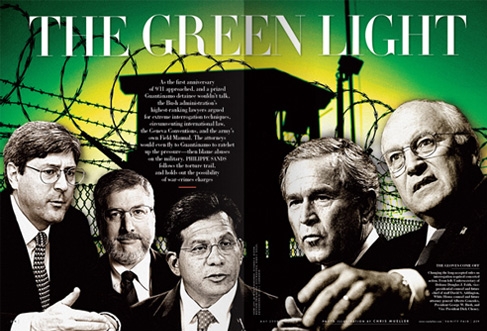
The green light

greenlight.jpg
The abuse, rising to the level of torture, of those captured and detained in the war on terror is a defining feature of the presidency of George W. Bush. Its military beginnings, however, lie not in Abu Ghraib, as is commonly thought, or in the “rendition” of prisoners to other countries for questioning, but in the treatment of the very first prisoners at Guantanamo. Starting in late 2002 a detainee bearing the number 063 was tortured over a period of more than seven weeks. In his story lies the answer to a crucial question: How was the decision made to let the U.S. military start using coercive interrogations at Guantanamo?

The Bush administration has always taken refuge behind a “trickle up” explanation: that is, the decision was generated by military commanders and interrogators on the ground. This explanation is false. The origins lie in actions taken at the very highest levels of the administration—by some of the most senior personal advisers to the president, the vice president, and the secretary of defense. At the heart of the matter stand several political appointees—lawyers—who, it can be argued, broke their ethical codes of conduct and took themselves into a zone of international criminality, where formal investigation is now a very real option. This is the story of how the torture at Guantanamo began, and how it spread. [complete article]

Facebooktwittermail

EDITORIAL: Taking the blood out of killing

Taking the blood out of killing

“If America wants to see itself clean of terrorists we also want that our villages and towns should not be bombed.”

This was the modest request issued by Nawaz Sharif after Deputy Secretary of State John Negroponte and Assistant Secretary Richard Boucher went to Pakistan this week to secure the new government’s commitment on fighting terrorism. Negroponte and the rest of his State Department contingent might have received a slightly warmer response if they had not barged in on Pakistan’s celebrations at the restoration of democracy.

The New York Times reported:

The timing of the American visit was harshly criticized by the news media for creating the appearance that the United States was trying to dictate policy to a government that was not even hours old. The two American diplomats met Mr. Sharif as President Musharraf was administering the oath of office to Mr. Gillani.

“I don’t think it is a good idea for them to be here on this particular day,” said Zaffar Abbas, the editor of the respected English language newspaper Dawn, in Islamabad. “Here are the Americans, right here in Islamabad, meeting with senior politicians in the new government, trying to dictate terms.”

And the article continued:

An independent analyst on the Pakistani military, Shuja Nawaz, who lives in Washington, said he had been told by Pakistani officials that they discouraged the American diplomats from coming this week.

But the Pakistanis had been informed that Mr. Negroponte was on a trip that included other already arranged stops and Tuesday was the only possible day for him. Mr. Nawaz called the visit “ham-handed,” and said it could be interpreted as Washington wanting to continue to act as the “political godfather behind Musharraf.”

Ironically, it was the Pakistanis who needed to give the Americans a little instruction on the meaning of democracy: “We told them that since 9/11 until now the decisions were made by an individual and therefore these did not reflect the aspiration of the people. The situation has been changed now because an independent parliament has come into being and all the decisions will be made by it.”

That was how Sharif explained to Negroponte and Boucher that the US government needs to get used to dealing with a government instead of a dictator. Unfortunately, this administration like so many others before it still finds dictators easier to work with as a matter of convenience. It’s the boneheaded mafia approach to international relations: make a deal with “the man” and then let his and your minions take care of the details.

The false premise upon which Negroponte and Boucher’s unannounced visit was based was that Pakistan is not as serious as the United States when it comes to dealing with terrorism. But they would do well to consider the following remarks from an editorial in today’s edition of Pakistan’s leading English-language daily, The News:

What Washington still does not seem to have grasped is that almost everyone in Pakistan, including its political leaders, is at least as keen as they are to see an end to terror. It is, after all, Pakistani men, women and children who die when bombs explode; it is their blood that stains roadsides; their screams that fill hospital emergency rooms. The US-directed policies of the past seven years have led only to an expansion in militancy, to more violence and to more hatred. It is indeed a mystery why, in the face of these facts, Washington considers Musharraf to have been a success in battling terror. The White House and its team must now restrain themselves in further meddling in Pakistan’s affairs. Its new leaders must be allowed to devise their own strategies without attempts at long-distance dictation or remote-controlled operations. Such dictation has brought disaster in the past and is likely to do so in future as well. The people of Pakistan and their elected representatives must now be left alone to chalk out a brighter future for everyone in the country.

Unfortunately for the people of Pakistan, when it comes to confronting terrorism in the tribal areas, Democrats and Republicans are largely in agreement that the US needs to pursue a “tough” approach. Very few Americans are willing to question the idea that if an opportunity arises, then “high value targets” should be “taken out.”

But consider for a moment this frequently used phrase: take out.

Whenever a command is issued that someone or some people should be “taken out,” the words connote executive power, wielded by unbloodied hands. All the way down from the command to the deed, taking out requires a sense of detachment and a comfortable distance from the fatal event. Absent that distance, the nature of the act becomes inescapable.

When Brutus stabbed Julius Caesar, he didn’t take him out. Brutus and his fellow assassins killed Caesar. They had blood on their hands. Brutus says, “let no man abide this deed, but we the doers.” He knew what he had done and he accepted full responsibility.

When we talk about taking out terrorists, we prefer not to know what has been done and we try to disperse responsibility. We imagine that if a greater good (“defeating terrorism”) is being served, then the loss of innocent life, though regrettable will also most likely be unavoidable. What we can and do avoid considering is the carnage. We mask it with a casual phrase.

The message from the new government of Pakistan to America is quite simple: our people are worth as much as yours. Should that not be seen as an indisputable truism?

Facebooktwittermail

NEWS: Locals hold key in Pakistan

Moderates hold key in Pakistan

One of the most significant results of Pakistan’s elections in February was the defeat of the religious parties that ran this critical border province for the last five years. In their place, voters elected moderates from a small regional party that may now wield big influence over Pakistan’s changing strategy toward its militants.

The victory of the Awami National Party, or A.N.P., was welcomed by Western officials and Pakistanis as a clear rejection of the Taliban and the religious parties that backed them here in North-West Frontier Province. The party will now be part of the governing coalition in the national Parliament, and sees itself as critically placed to begin a dialogue with the militants, something the Bush administration has regarded warily.

Not only has this province suffered most from the militants, who are based in the adjacent tribal areas, but most of the militants are from the same Pashtun ethnic group as the A.N.P. Pashtuns populate this region, on both sides of the Afghan border. The A.N.P., a Pashtun nationalist party, and Pakistan’s militants speak the same language. [complete article]

U.S. steps up unilateral strikes in Pakistan

The United States has escalated its unilateral strikes against al-Qaeda members and fighters operating in Pakistan’s tribal areas, partly because of anxieties that Pakistan’s new leaders will insist on scaling back military operations in that country, according to U.S. officials.

Washington is worried that pro-Western President Pervez Musharraf, who has generally supported the U.S. strikes, will almost certainly have reduced powers in the months ahead, and so it wants to inflict as much damage as it can to al-Qaeda’s network now, the officials said.

Over the past two months, U.S.-controlled Predator aircraft are known to have struck at least three sites used by al-Qaeda operatives. The moves followed a tacit understanding with Musharraf and Army chief Gen. Ashfaq Kiyani that allows U.S. strikes on foreign fighters operating in Pakistan, but not against the Pakistani Taliban, the officials said. [complete article]

Facebooktwittermail

FEATURE: Taking stock of the War on Terror

Taking stock of the War on Terror

To contemplate a prewar map of Baghdad — as I do the one before me, with sectarian neighborhoods traced out in blue and red and yellow — is to look back on a lost Baghdad, a Baghdad of our dreams. My map of 2003 is colored mostly a rather neutral yellow, indicating the “mixed” neighborhoods of the city, predominant just five years ago. To take up a contemporary map after this is to be confronted by a riot of bright color: Shia blue has moved in irrevocably from the East of the Tigris; Sunni red has fled before it, as Shia militias pushed the Sunnis inexorably west toward Abu Ghraib and Anbar province, and nearly out of the capital itself. And everywhere, it seems, the pale yellow of those mixed neighborhoods is gone, obliterated in the months and years of sectarian war.

I start with those maps out of a lust for something concrete, as I grope about in the abstract, struggling to quantify the unquantifiable. How indeed to “take stock” of the War on Terror? Such a strange beast it is, like one of those mythological creatures that is part goat, part lion, part man. Let us take a moment and identify each of these parts. For if we look closely at its misshapen contours, we can see in the War on Terror:

Part anti-guerrilla mountain struggle, as in Afghanistan;

Part shooting-war-cum-occupation-cum-counterinsurgency, as in Iraq;

Part intelligence, spy v. spy covert struggle, fought quietly — “on the dark side,” as Vice President Dick Cheney put it shortly after 9/11 — in a vast territory stretching from the southern Philippines to the Maghreb and the Straits of Gibraltar;

And finally the War on Terror is part, perhaps its largest part, Virtual War — an ongoing, permanent struggle, and in its ongoing political utility not wholly unlike Orwell’s famous world war between Eurasia, East Asia, and Oceania that is unbounded in space and in time, never ending, always expanding. [complete article]

Facebooktwittermail

NEWS: Talking to terrorists

Terror talks: would contacting al-Qaida be a step too far?

[Jonathan Powell was Tony Blair’s chief of staff for 12 years] Jonathan Powell’s candid reflections on talking to terrorists in his book revealing an insider’s view of the Northern Ireland peace process will ring true to anyone who has worked at the highest levels of government – in Britain dealing with Northern Ireland, in France with Algeria, in Israel with Palestinian Islamists. But is his call that we should be prepared to communicate with al-Qaida a step too far?

Experts make a clear distinction between territorial-based groups such as Hamas and Lebanon’s Hizbullah, the Taliban in Afghanistan and the jihadist movement inspired by Osama bin Laden, below. “Al-Qaida are what we call ‘incorrigible terrorists’,” said Peter Lehr of St Andrews University. “They have political demands but we cannot and should not meet them. We need oil so we can’t leave the Arabian peninsula and we can’t help them dismantle Israel. There’s nothing to discuss.”

Talking to Hamas and Hizbullah is a different matter, Lehr argues. “They are rational actors fighting for something negotiable, and with negotiations you start with maximum demands and whittle them down until you get agreement, or not.” [complete article]

Facebooktwittermail

NEWS: Unilateral strike called a model for U.S. operations in Pakistan

Unilateral strike called a model for U.S. operations in Pakistan

In the predawn hours of Jan. 29, a CIA Predator aircraft flew in a slow arc above the Pakistani town of Mir Ali. The drone’s operator, relying on information secretly passed to the CIA by local informants, clicked a computer mouse and sent the first of two Hellfire missiles hurtling toward a cluster of mud-brick buildings a few miles from the town center.

The missiles killed Abu Laith al-Libi, a senior al-Qaeda commander and a man who had repeatedly eluded the CIA’s dragnet. It was the first successful strike against al-Qaeda’s core leadership in two years, and it involved, U.S. officials say, an unusual degree of autonomy by the CIA inside Pakistan.

Having requested the Pakistani government’s official permission for such strikes on previous occasions, only to be put off or turned down, this time the U.S. spy agency did not seek approval. The government of Pakistani President Pervez Musharraf was notified only as the operation was underway, according to the officials, who insisted on anonymity because of diplomatic sensitivities. [complete article]

Facebooktwittermail