Category Archives: Egypt

A fight for control of Tahrir Square

Al Jazeera reports: Egyptian security forces are engaged in back-and-froth street battles in downtown Cairo’s Tahrir Square with thousands of defiant activists who filled the square for the second day of protests against the country’s interim military leaders.

Thick clouds of tear gas filled the air on Sunday as military police armed with batons and shields charged into the square, firing rubber bullets and forcibly clearing the area of protesters. The assault sparked panic among the estimated 5,000 protesters, many of whom had remained in Tahrir since early on Saturday.

A short time affter the offensive, however, a surge of protesters returned to the square, overwhelming security forces and retaking the area.

“This is what the Egyptian army calls protecting the revolution,” Salma Said, a democracy activist, told Al Jazeera. “We’ve lost so many people in the last nine months. We want Field Marshall Tantawi gone. We’re going to keep fighting, we don’t have any other options.”

At 5.50pm local time, Al-Masry Al-Youm reported: Protesters marching through Tahrir Square are chanting, “Tantawi is the enemy of God.” Another group is chanting Ultra football fan anti-security songs.

Meanwhile, EgyNews, an official state website, just announced that military police and security forces have completely cleared Tahrir Square of demonstrators. However, according to Al-Masry Al-Youm correspondents in the square, thousands of protesters remain.

Facebooktwittermail

In Egypt, revolution 2.0?

Ursula Lindsey writes: After the police violently cleared 100 or so demonstrators (including a group of the relatives of revolutionary martyrs and injured) from Tahrir Square today, thousands more poured into the square and began clashing with the security forces, burning one police truck and trying to reach the Ministry of Interior. The Ministry of Interior denies using any bullets, pellets or bird shot, but witnesses have widely documented their use. Hundreds are injured, and one dead confirmed so far. Tens of thousands have streamed into Downtown Cairo and are demonstrating in Alexandria, Suez and Mansoura. The fighting goes on, and people are saying that it feels like January 28 all over again.

These clashes feel almost unavoidable, given the military council’s terrible performance, the increasing vocal criticism it is facing, the rising tensions of all kinds surrounding the upcoming (poorly planned, utterly confusing) elections — given the terribly unclear transition process that has been put in place, and the fact that none of the revolution’s demands, including the reform of the security forces and real transitional justice, have been met.

Islamist leaders — the Salafist sheikh Hazem Salah Abu Ismail and the Islamist presidential candidate Mohammed Selim El Awwa — have gone to Tahrir. Mohammed El Baradei is once again calling for the creation of a “national salvation” government.

Facebooktwittermail

Egyptian police clash with protesters in Tahrir Square

The New York Times reports: Thousands of protesters chanting for an end to military rule battled riot police officers firing tear gas, rubber bullets and bird shot in Tahrir Square on Saturday, as the military-led interim government appeared to soften its demands for special powers and protections in the future Egyptian constitution.

Coming just nine days before the scheduled beginning of parliamentary elections, the clashes were the biggest outbreak of violence here since the ouster of President Hosni Mubarak in February, and the most violent manifestation yet of the growing anger at the ruling military council.

The clashes began midday Saturday after the police cleared out the last remnants of a large demonstration in Tahrir Square the day before. That demonstration, organized by Islamists but appearing to represent a far broader cross-section of Egyptians, drew tens of thousands of people calling for a swift end to military rule.

The fighting on Saturday began after news circulated that the security forces had moved into the square, the iconic heart of the Egyptian revolution, to force out a few hundred protesters who had spent the night. Hundreds and eventually thousands of other civilians stormed into the square to defend it, setting off battles that spread across downtown Cairo into the night.

Protesters threw rocks at police vehicles, capturing a police truck and passing out handcuffs, hats and other gear found inside. Others smashed the sidewalk into rocks to hurl at the police, and threw Molotov cocktails. Plumes of black smoke from a burning police truck wafted through the white clouds of tear gas.

Retreating riot police officers fired nonlethal weapons from their trucks to try to push back the crowd.

“Police and thugs and thieves,” the protesters chanted. Taking aim at Field Marshal Mohamed Hussein Tantawi, who leads the ruling military council, they adapted the signature chant of the Arab Spring revolts sweeping the region: “The people want to bring down the field marshal.”

Facebooktwittermail

Egypt Islamists demand the end of military rule

The New York Times reports: Tens of thousands of Islamists jammed Tahrir Square on Friday, demanding the swift exit of Egypt’s interim military rulers in the most significant challenge to their authority since the ouster of President Hosni Mubarak nine months ago.

The huge turnout was the first time that Egypt’s Islamists had so openly and aggressively challenged military rule, ending an uneasy truce that had prevailed as long as the military appeared willing to allow the Islamists as much of a say in Egypt’s future as they could win at the ballot box.

That truce fell apart, on the eve of parliamentary elections, after the military council spelled out for the first time its intention to preserve a decisive role for itself in Egyptian politics far into the future, elevating itself above civilian control and imposing rules to protect individual and minority rights. And after sitting out many of the protests organized by liberals since Mr. Mubarak’s ouster, Islamists took to the streets on Friday in a fierce backlash.

“The people didn’t sacrifice hundreds of lives in the revolution so that the military would jump over their will,” said Mohamed Ibrahim, a teacher at a religious school who traveled from Mansoura, about 75 miles away, to attend. “If they can do that, what is the point of parliamentary elections?”

The rally represented the beginning of a new battle between Egypt’s two most powerful political forces, the military and the once-outlawed Muslim Brotherhood, that leaves Egyptian liberals and leftists anxious and divided on the sidelines.

Al-Masry Al-Youm reports: A number of political forces and intellectuals have prepared a lengthy memorandum that includes a drastically reformed plan for the remainder of Egypt’s transitional period.

Al-Masry Al-Youm has obtained a copy of the document, which the drafters said they will submit to the ruling Supreme Council of the Armed Forces (SCAF) within days.

The memorandum suggests postponing parliamentary elections, and in their place forming a “national rescue cabinet,” having Egyptians elect a constituent assembly to draft the new constitution, holding presidential elections and fully transferring power to a civilian government. After all this, the memorandum reads, parliamentary elections should be held in accordance with the laws set out in the new constitution.

Among those involved in drafting the memorandum were former President of the Democratic Front Party Osama al-Ghazaly Harb, presidential hopeful Mohamed ElBaradei, Coordinator of the National Association for Change Abdel Galil Mostafa, writer Alaa al-Aswany and journalist Sakina Fouad.

Facebooktwittermail

U.S. warns Egypt as military stalls transition to democracy

The New York Times reports: Brazen attempts by Egypt’s interim military rulers to hold on to power long after elections have elicited a sharp reaction domestically and for the first time have prompted Washington to warn about the potential for new unrest.

After months of mixing gentle pressure with broad support for the ruling military council, the Obama administration has sharpened its tone, senior administration officials say, expressing concern that the failure to move to civilian control could undermine the defining revolt of the Arab Spring.

The shift in tone is part of a difficult balancing act for Washington, which is keen to preserve its ties to the military and its interests in the region, chiefly Egypt’s role in maintaining peace with Israel. But Washington also hopes to win favor with Egypt’s newly empowered political opposition while avoiding the appearance of endorsing the military’s stalled transition to democracy. All things considered, some here have suggested, the change in tone may be intended to placate Egyptian public opinion rather than actually press the military to give up power.

Facebooktwittermail

Egypt detains Sinai leader accused of Eilat attacks — no Gaza connection

Ma’an News Agency reports: Egyptian authorities detained the leader of a militant Islamist movement in the Sinai peninsula on Sunday morning, security sources told Ma’an.

Muhammad Eid Musleh Hamad, also known as Muhammad al-Teehi, is accused of planning the deadly attacks in Israeli border city Eilat in August, as well as a number of attacks in the Egyptian peninsula, a Ma’an correspondent reported.

Al-Teehi was detained in northern Sinai city El-Arish after a joint police and army operation, Egyptian security officials said.

He was found hiding in a tourist chalet in the town, and surrendered without resistance, before being moved to Cairo to face charges, they added.

Egyptian authorities said al-Teehi is leader of the “Jihadists and Takfiris” movement, founded after the January revolution which ousted former leader Hosni Mubarak.

Authorities say he masterminded attacks on police stations in the city and has topped a government “wanted” list, official news agency MENA said.

A Ma’an correspondent in El-Arish said that Egyptian authorities had also accused Hamad of being involved in planning the Aug. 18 assault on number of Israeli vehicles near Eilat, which killed eight Israelis.

Israel said it shot dead six gunmen and blamed the Gaza-based Popular Resistance Committees, who denied any involvement.

Within hours of the attack, Israeli forces struck back at targets in southern Gaza, leading to four days of cross border violence that killed 15 Palestinians, and wounded more than 50.

In September, Israeli daily Yedioth Ahronoth reported that an unreleased army investigation revealed the Eilat attacks were carried out by a group of Egyptians operating in Sinai.

Egyptian security told Ma’an al-Teehi’s “Jihadists and Takfiris” movement follows Al-Qaeda intellectually and demands an end to any military or foreign presence in the Sinai peninsula.

Facebooktwittermail

Egypt’s search for truth

Michael Hanna writes: When the deposed former president Hosni Mubarak was wheeled on a hospital bed into the makeshift Cairo courtroom hastily prepared for his trial, the process of transitional justice in Egypt appeared to have achieved an important symbolic victory. The sight of the former autocrat laid low before a court of law to be held accountable for his actions was undoubtedly an important marker of the fundamental changes that have convulsed Egypt following its eighteen-day uprising and the fall of the Mubarak regime. After numerous court proceedings against former Mubarak advisors and confidants, the start of the trial also appeared to fulfill a central demand of the uprising: that Mubarak and his cronies face justice for their past crimes. Yet, the outsized focus on the former president and the speed with which his trial was initiated also raised troubling questions about the future scope and trajectory of transitional justice efforts, converging with broader worries about the course of Egypt’s transition.

Much like the muddled political transition overseen by Egypt’s Supreme Council of the Armed Forces (SCAF), transitional justice has been characterized by ad hoc decision-making and suffered from a fundamental lack of transparency and popular participation. The outcome of Egypt’s extended struggle for political supremacy—parliamentary elections are due to take place in November 2011 and presidential balloting at a date still to be determined—will shape the depth and scope of transitional justice efforts. Based on the reactionary posture of the SCAF during its tenure as Egypt’s ruling authority, it is a near certainty that transitional justice efforts will remain rudimentary until such time as civilian authority is reinstated. The transition to civilian authority will provide an opportunity to revisit those areas that have been neglected during SCAF’s control. Renewed focus on justice, accountability, and equality before the law would also provide a significant link to the ethos that animated Egypt’s unexpected uprising and direct attention to those lofty goals at a time when prosaic and flawed politics are becoming the central focus of the country’s attention.

Transitional justice will be highly contested within Egyptian society. The goals of these efforts are not simply retributive, although punishment and deterrence through prosecutorial action are certainly important results. Addressing the claims of the former regime’s victims would help in establishing a credible basis for political reconciliation. The creation of an unimpeachable historical record of the excesses and abuses of the Mubarak regime would play a significant role in the difficult long-term task of forming an open and accountable political culture.

The normative value of transitional justice efforts would also have political utility if implemented judiciously, as efforts at increasing accountability for past regime crimes would be an important route to ensuring the supremacy of civilian governance and bolstering the country’s democratic infrastructure. This type of initiative could also play an important part in nurturing judicial independence as a check against future official abuse.

The Egyptian military would likely be much more comfortable with a discrete focus on the excesses of Egypt’s crony-capitalist economy and the violence associated with the repression of the January 25 uprising. The military has played a less pronounced political role in recent years, but a more probing initiative that sought to speak to the systematic crimes of the former regime and its predecessors would more directly implicate the military in light of its central role within Egypt’s authoritarian superstructure. This is particularly the case for earlier periods when Egypt could be described as a military state and society, and the military and its officer corps were implicated directly in day-to-day repression. As such, the military would be averse to broader efforts seeking to document state repression during the time of Gamal Abdel Nasser and Anwar Sadat, in addition to the years of Mubarak’s rule. Demonstrating credibly the repression that has characterized the Egyptian state since the Free Officers’ Movement and the toppling of King Farouk in 1952, however, would have the benefits of reinforcing the imperative to break with the past and lending legitimacy to civilian efforts to limit military interference in governance.

Facebooktwittermail

Occupy Wall Street sending envoys to Egypt

Megan Robertson, a digital producer for DylanRatigan.com, reports: At Thursday’s General Assembly of Occupy Wall Street in New York, a resolution was passed to allocate $29,000 to pay to send approximately 20 “OWS Ambassadors” to act as international observers in the Egyptian elections.

The Movement Building group of OWS brought this up to the GA after being contacted by a representative of a coalition of Egyptian civil society monitors, inviting the NY occupation to send representatives to help observe the elections.
[…]
While we don’t yet know what this means for Occupy Wall Street, it’s certainly a bold move — and one that could play out in several ways once they land in Egypt.

“It sounds like a brilliant move, in terms of Egyptian politics,” says Dr. Nathan Brown, professor of political science at George Washington University, and expert on Egyptian government and politics.

“Here’s the problem. Election monitoring in Egypt has always been a big issue. The country under the authoritarian regime has always been hostile to any kind of international monitoring role. After the revolution, essentially what the Egyptians brought in was a system of judicial monitoring of the elections. The judges themselves are not really interested in any international monitoring, and military rulers have been hostile to it as well,” says Dr. Borwn.

Strong nationalist sentiment within Egypt will also play a role, but could be a positive one.

“The world monitoring, in Arabic, can also mean”oversight” or “control.” “Monitors” sound like people who are coming in to take over. Now, there’s some sort of nationalist pride that can be set off — Egyptians may see it as, well, we’re teaching the Americans for a change. It can play into that very easily,” says Dr. Brown. “It’s a good political move because its an effective way to have a retort to the nationalist argument against monitoring.”

As far as the purpose of international monitors at the elections, they may not be able to play a huge role, but can still have an effect. “They can probably do a lot of seeing and watching the general atmosphere, but as far as being inside the polling places, there won’t be a lot of role for them. What groups of international monitors do, though, is provide a very effective cover for domestic monitoring efforts,” Dr. Brown explained.

Facebooktwittermail

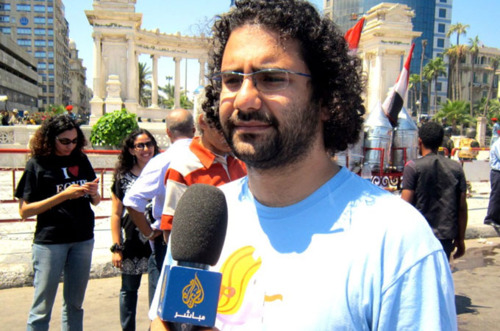
Egyptian activist Alaa Abd El Fattah accuses army of hijacking revolution

The jailed Egyptian revolutionary Alaa Abd El Fattah has written a secret letter from his prison cell, accusing the country’s military rulers of murder and lamenting what he views as the army’s hijacking of the revolution.

The letter, produced covertly from inside Bab el-Khalq prison where Abd El Fattah is being held, was handed to his pregnant wife, Manal, during a visit on Monday. It is being published in Arabic by the Egyptian newspaper al-Shorouk and in English by the Guardian, and is likely to intensify the growing divisions between Egypt’s increasingly repressive army junta and pro-change activists on the street.

Abd El Fattah, one of Egypt’s most prominent anti-regime voices and a former political prisoner under the Mubarak dictatorship, was taken into military custody on Sunday evening following public criticisms of the army’s conduct on the night of 9 October, when at least 27 people were killed during a Coptic Christian protest in downtown Cairo.

Like many other activists, Abd El Fattah accused the army of direct involvement in the bloodshed, a claim that appears to be supported by extensive witness reports and video footage. He was charged by military prosecutors with “inciting violence against the army”, and is being held initially for 15 days – a detention period that can be renewed indefinitely by the authorities. His arrest has provoked outrage across the Middle East and beyond.

Alaa Abd El Fattah’s letter begins: I never expected to repeat the experience of five years ago: after a revolution that deposed the tyrant, I go back to his jails?

The memories come back to me, all the details of imprisonment; the skills of sleeping on the floor, nine men in a six-by-12-foot (two-by-four-metre) cell, the songs of prison, the conversations. But I absolutely can’t remember how I used to keep my glasses safe while I slept.

They have been stepped on three times already today. I suddenly realise they’re the same glasses that were with me in my last imprisonment; the one for supporting the Egyptian judiciary in 2006. And that I am locked up, again pending trial, again on a set of loose and flimsy charges – the one difference is that instead of the state security prosecutor we have the military prosecutor – a change in keeping with the military moment we’re living now.

Last time my imprisonment was shared with 50 colleagues from the “Kifaya” movement. This time, I’m alone, in a cell with eight men who shouldn’t be here; poor, helpless, unjustly held – the guilty among them and the innocent.

As soon as they learned I was one of the “young people of the revolution” they started to curse out the revolution and how it had failed to clean up the ministry of the interior. I spend my first two days listening to stories of torture at the hands of a police force that insists on not being reformed; that takes out its defeat on the bodies of the poor and the helpless.

Facebooktwittermail

Egypt’s military may soon regret jailing Alaa Abd El Fattah

Brian Whitaker writes: Alaa Abd El Fattah is in jail. He was arrested on Sunday – accused of inciting violence against the Egyptian military – and on Monday was given 15 days’ detention for refusing to answer questions to a military court.

A campaign to secure his release has also got under way with extraordinary rapidity: protests in the streets, a Twitter hashtag (#FreeAlaa) and even graffiti appeared within the first 24 hours or so. That is not especially surprising as Alaa, besides being a pioneer of Egyptian blogging, belongs to one of the most famous families of leftist agitators.

By arresting him, the Supreme Council of the Armed Forces, which is currently running Egypt (and increasingly being referred to as “the junta”), has picked a fight with the core of the movement that toppled President Mubarak in January. Leftists, liberals and Islamists have all been rallying to Alaa’s support and it may not be long before the junta starts to regret its action.

Facebooktwittermail

Prominent Egyptian blogger in military detention

Al-Masry Al-Youm reports: Alaa Abd El Fattah, a prominent blogger and activist, will be held for 15 days of military interrogation, his lawyer said on Sunday. Meanwhile, Bahaa Saber, another activist and blogger, has been released but is still under investigation.

Abd El Fattah was called into the military prosecution office for questioning regarding his involvement in the clashes between mostly Coptic protesters and the military on 9 October in which 28 people were killed. Abd El Fattah is accused of assaulting military personnel, stealing machine guns that belong to the armed forces, and inciting violence against the military, his lawyer, Ahmed Saif al-Islam said.

Saber was released from detention because the military prosecutors believe he will not attempt to flee. Saber faces charges of inciting violence against the military and assaulting military personnel, but is not accused of stealing weapons, his lawyer, Ramy Ghanem, said. He may still face a military trial.

According to Saif al-Islam, a prominent human rights lawyer who is also Abd El Fattah’s father, his client refused to answer the military’s questions. Saif al-Islam believes Abd El Fattah is being punished for not cooperating.

Abd El Fattah would not cooperate because he believes the military is implicated in the crime of which he is accused, his lawyer said, adding that he believes the military hopes to send a message to other protesters that they should not opt to be uncooperative.

Facebooktwittermail

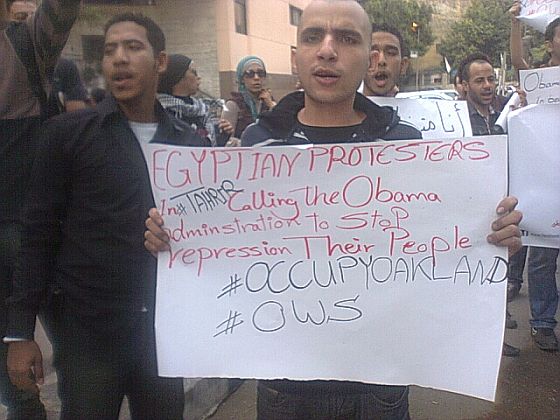
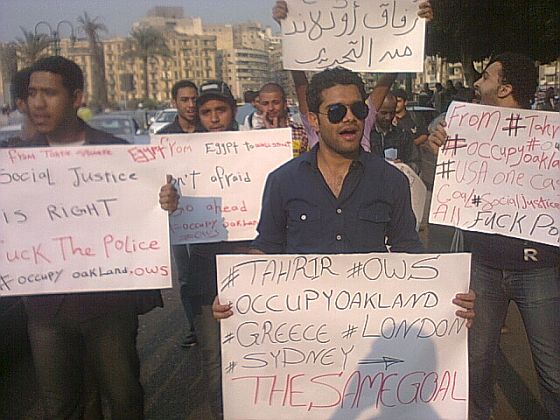
Egyptian protesters’ message to Obama: Stop repression of your own people

Xeni Jardin writes: As they vowed earlier this week to do, Egyptian pro-democracy protesters marched from Tahrir square to the U.S. Embassy today to march in support of Occupy Oakland—and against the type of police brutality witnessed in Oakland on Tuesday night, and commonly experienced in Egypt.

In this post, photos from Egyptian blogger Mohammed Maree, who is there at the march live-tweeting these snapshots. He is a journalist with Egytimes.org, a human rights activist, and a veterinarian; all photos are his.


Meanwhile, the New York Times reports on questions being raised about the violent tactics used by police in Oakland where the weapons being used are the same as those used lethally by Israeli soldiers against non-violent Palestinian protesters in the West Bank and by Egyptian security services against non-violent Egyptian protesters in Tahrir Square.


Two days after an Iraq war veteran suffered a serious head wound at a protest in Oakland, Calif., questions are being asked about the way police officers tried to disperse Occupy Oakland protesters with tear gas and other “less-lethal” munitions.

The condition of the wounded veteran, Scott Olsen, was upgraded to fair from critical at Highland Hospital in Oakland on Thursday The San Francisco Chronicle reported. On Friday morning, Mr. Olsen’s roommate, Keith Shannon, who served with him in the Marines, told CNN that doctors expect him to make a full recovery, although he is still unable to speak and still has some trouble writing.

Oakland’s mayor, Jean Quan, visited Mr. Olsen in the hospital to apologize for his injuries and promised an investigation, a hospital spokesman told The Chronicle. The mayor also tried to address protesters near City Hall late Thursday night but was “greeted with cries of ‘Go home!’ and ‘Citizen’s Arrest,’” The Bay Citizen, a local news site, reported.

Another spokesman told reporters that Mr. Olsen “responded with a very large smile” to a visit from his parents on Thursday.

As The Lede reported on Wednesday, Mr. Olsen is a 24-year-old former Marine and a member of two veterans peace groups. He works at a San Francisco software firm.

Video uploaded to YouTube on Thursday appeared to show that Mr. Olsen was standing peacefully in front on police lines just before he was struck in the head. This edit of clips from various sources by a video blogger named Raleigh Latham shows Mr. Olsen standing still as projectiles were fired into the crowd of protesters on Tuesday night:

Facebooktwittermail

Egyptian anger grows after latest case of death by torture

The Guardian reports: Egyptian officials have tortured a 24-year-old prisoner to death, provoking accusations that the increasingly unpopular junta is failing to dismantle Hosni Mubarak’s brutal security apparatus.

Essam Ali Atta, a civilian serving a two-year jail term in Cairo’s high-security Tora prison following his conviction in a military tribunal earlier this year for an apparently “common crime”, was reportedly attacked by prison guards after trying to smuggle a mobile phone sim card into his cell.

According to statements from other prisoners who witnessed the assault, Atta had large water hoses repeatedly forced into his mouth and anus on more than one occasion, causing severe internal bleeding. An officer then transferred Atta to a central Cairo hospital, but he died within an hour.

The death occurred less than 24 hours after two police officers in Alexandria were each sentenced to seven years in jail for their part in the murder of Khaled Said, a young businessman beaten to death by security forces in broad daylight last year. That incident led to the creation of the Facebook group “We are all Khaled Said” and helped mobilise a wave of protests which eventually toppled Mubarak in February.

On Friday, a new Facebook page entitled We are all Essam Atta appeared online, and quickly attracted thousands of supporters. Activists and human rights campaigners flocked to social media sites to express their fury at Egypt’s ruling generals, whom many now view as indistinguishable from the Mubarak regime they replaced.

Facebooktwittermail

Egypt’s military barrier to democracy

In an interview with the Egyptian English-language daily, Al-Masry Al-Youm, Robert Springborg, who has written extensively on the Egyptian military and the politics and political economy of the Middle East, spells out some of the reasons the military ended up supporting the ouster of Hosni Mubarak. They were not siding with the Egyptian people; instead they saw an opportunity to consolidate their own interests.

Al-Masry Al-Youm: A trend in the economy during the transitional phase is the re-nationalization of companies privatized under the Mubarak regime. How much is this in the military economy’s interests?

Robert Springborg: The military opposed privatization that intensified in 2004 under the government of former Prime Minister Ahmed Nazif, and that was overseen by former Investment Minister Mahmoud Mohie Eddin. It was upset at the increased pace of privatization. That said, the military was happy with privatization as long as it ended up [gaining from it]. It didn’t want the government to sell state-owned enterprises to Gamal Mubarak’s cronies. So under the Nazif government, some of the privatization in state-owned enterprises went to the military to mollify its leadership. Its interests in strategic areas, such as port facilities, ship repair and building, increased. The Alexandria Shipyard, for example, is owned by the military, and under Nazif they acquired a competitor company. There was also an unwritten rule under Mubarak that mid-ranking officers and generals would get senior positions within privatized companies. Aviation companies and construction companies do have senior generals working in them.

Al-Masry: How important are their business holdings given that strategic industries, such as cement, are not within their control?

Springborg: Well, they are unhappy about that state of affairs. The military is not strongly represented in energy-intensive industries. The compensation to that is that they do control a lot of land. The total asset value of their land holdings is not clear, but we know that much of the land allocated to the construction and tourism sectors was or remains under military control. Starting from the 1980s, under Mubarak, the military got the land and crony capitalists got the energy intensive production industries.

The military’s biggest interest is in the construction industry. This is because the military has its own, internal construction capacities; because of its influence over the allocation of land; and because construction depends heavily on relations with government, either because it is paying for it or because it must authorize it. Military officers have the governmental connections that facilitate contracts and approvals.

Al-Masry: From the perspective of protecting the military economy, is the military threatened by the upcoming parliamentary and presidential elections?

Springborg: Yes. What it wants is a weak parliament and a presidency that will not challenge its authority. As it now looks the parliament will be weak because it will be divided among various political forces and because it will not be based on any definitive constitutional authority. So it will not be strong enough to oversee the military, such as by examining its finances. So, any civilian control of the military by default will fall to the president.

That is why the apparent thinking now of the military is for the president to be someone from the military. The delay of the presidential election is due in part probably to the attempt to prepare the ground for a candidate either from the military or absolutely subordinate to it. In the meantime the military will look to expand its role in the economy, either through acquiring more companies or by assisting officer-owned companies gain more business.

The Washington Times reports: In the eight months since the overthrow of President Hosni Mubarak, Egypt’s ruling military has postponed presidential elections, extended a controversial emergency law, cracked down on peaceful demonstrators and arrested critics.

Pro-democracy activists and Middle East analysts worry that the Supreme Council of the Armed Forces (SCAF) is reversing a revolution that toppled the autocratic Mubarak regime after 30 years in power.

“We, the revolution, are not governing Egypt now,” said Ahmed Maher, co-founder of the April 6 Youth Movement, a Facebook group, and a prominent participant in the anti-Mubarak demonstrations

“The SCAF is governing Egypt. I think they want to keep the power, and they want to make a new regime … depending on the same behavior of the Mubarak regime,” Mr. Maher told the Arab American Institute on a visit to Washington last week.

The ruling council has accused Mr. Maher’s group of being foreign agents.

“The SCAF has made a number of very troubling moves that suggest it is not serious about giving up power,” Shadi Hamid, director of research at the Brookings Institution’s center in Doha, Qatar, said in a phone interview with The Times.

“It has become so clear as to be entirely self-evident that the SCAF is an autocratic force and, in my view, the foremost danger to Egyptian democracy right now.”

Facebooktwittermail

Islamist democratic victory in Tunisia

Reuters reports: Tunisian electoral officials confirmed the Islamist Ennahda party as winner of the North African country’s election, setting it up to form the first Islamist-led government in the wake of the Arab Spring uprisings.

But the election, which has so far confounded predictions it would tip the country into crisis, turned violent when protesters angry their fourth-placed party was eliminated from the poll set fire to the mayor’s office in a provincial town.

Ennahda has tried to reassure secularists nervous about the prospect of Islamist rule in one of the Arab world’s most liberal countries by saying it will respect women’s rights and not try to impose a Muslim moral code on society.

The Islamists won power 10 months after Mohamed Bouazizi, a Tunisian vegetable seller in the town of Sidi Bouzid, set fire to himself in an act of protest that led to the fall of Tunisia’s leader and inspired uprisings in Egypt and Libya.

“We salute Sidi Bouzid and its sons who launched the spark and we hope that God will have made Mohamed Bouazizi a martyr,” said Ennahda leader Rachid Ghannouchi, a soft-spoken Islamic scholar who spent 22 years in exile in Britain.

“We will continue this revolution to realize its aims of a Tunisia that is free, independent, developing and prosperous in which the rights of God, the Prophet, women, men, the religious and the non-religious are assured because Tunisia is for everyone,” Ghannouchi told a crowd of cheering supporters.

Announcing the results, election commission members said Ennahda had won 90 seats in the 217-seat assembly, which will draft a new constitution, form an interim government and schedule new elections, probably for early 2013.

The Islamists’ nearest rival, the secularist Congress for the Republic, won 30 seats, the commission members told a packed hall in the capital, ending a four-day wait since Sunday’s poll for the painstaking count to be completed.

Issandr El Amrani writes: Initially, Tunisia’s transition was extremely fragile. Ministers associated with the old regime remained in place, chaos was sown by remnants of the old ruling party, and a million grievances were expressed at the same time, overwhelming a fragile government. Over time, after revolutionary forces exercised concerted pressure, things stabilized: more acceptable ministers were appointed, a transition roadmap was agreed upon, and major political forces forged a consensus. At the same time, institutions of the state — old and new — maintained order and, most notably, prepared the ground for the election administratively and politically. This included months of preparations and training for election officials and putting together a remarkable get-out-the-vote campaign with the help of international election specialists.

Why Tunisia’s election is such a resounding success, in other words, is no mystery: the Tunisians worked very hard to ensure that it would be. The result is that while there are still cynics and some who are unhappy with the result, most Tunisians have bought into the new system and feel confident that, if the new assembly does not meet their aspirations, they will be able to pressure it on the street or through the ballot box at the next poll.

In comparison, the way the Egyptian elections have been handled is a disaster. The authorities repeatedly ignored the desire of the vast majority of political forces for a fully proportional, list-based system. They finally offered an agreement on a system that was two-thirds list-based and one-third single-winner-based, only two months before the poll, which was only reluctantly accepted by parties. The final delimitation of districts was still uncertain as candidate registration opened, making the parties’ electoral planning difficult, to say the least.

Moreover, the SCAF has continued the Mubarak-era policy of opposing foreign monitoring missions, despite this being a widespread practice around the world. In Tunisia, thousands of international monitors did not undermine national sovereignty; they added to the credibility of a well-run process. The concession made in Egypt to the Carter Center and other missions to allow “observers” rather than “monitors” is simply not good enough; it is only by beginning their work long before the actual poll is held and having unfettered access to the organizing agencies and every step of the voting process that monitoring agencies can truly certify the legitimacy of an election. It does not help that the international community currently seems to be placing more emphasis on the elections happening then on them being credible.

Facebooktwittermail