IRIN reports: Egyptian NGOs hoping for greater freedoms and more space to operate after the fall of Hosni Mubarak’s government say they have encountered just the opposite: an unprecedented clampdown by the post-revolution military rulers.
“Following Egypt’s historic protests calling for basic political freedoms, it is deeply disturbing that the Egyptian military has targeted Egypt’s democracy and human rights community in ways not even dared during Mubarak’s despotic rule,” wrote Stephen McInerney, executive director of the Washington-based Project on Middle East Democracy (POMED).
The first parliamentary elections since Mubarak’s fall are scheduled for 28 November, but NGO leaders say the transitional government led by the Supreme Council of the Armed Forces (SCAF) has mounted a “smear campaign” against them by accusing them of receiving millions of dollars from foreign donors to destabilize the country – going so far as to say the violence on the streets of Cairo during and after the revolution was supported by foreign funding channelled through NGOs.
Many of the local organizations being targeted intended to monitor the upcoming elections, but have been prevented from doing so by the Electoral Commission. SCAF has already banned foreign groups from monitoring the vote.
“This [smear campaign] is yet another episode in the suffering of NGOs in this country,” Maged Adeeb, the chairman of local NGO National Centre for Human Rights, told IRIN. “By accusing us of receiving funds and using them in weakening Egypt’s security, the government creates an unbridgeable gap between us and ordinary citizens.”
In a recent conference in Cairo, Negad Al Borae, a leading civil society activist, said the new government was collaborating with some political powers – namely members of the former ruling party – to destroy the nation’s NGOs.
Wendell Steavenson describes the complex rules that will operate in Egypt’s upcoming elections: Overall, this system seems to me to do its utmost to disconnect the voter from the consequence of his checked ballot paper.
All the way along, there will be Egypt’s traditional electoral mayhem: thugs, intimidation, cash handouts, ballot stuffing, strong-arm local families, clan and mosque. Most people think there is bound to be violence (there always is), and the obfuscation of lawsuits countering close or convoluted results (there always are). If people don’t understand what they are voting for, and if the results are obscured by irregularities, the Egyptian people will have no sense that they have participated in a free and fair election.
In any case, the mandate of the new parliament will be, as far as I can tell, to do one thing only. To elect, choose, or appoint (the mechanism remains totally unclear) within a given six month period, a hundred member constitutional committee that will then have a further six months to draft a new constitution. The new constitution will then be ratified (or maybe not) by national referendum. Subsequently, presidential elections will be held—perhaps some time in 2013.
Whatever shop-assembly version emerges, the Supreme Council of Armed Forces have made it clear they will retain control over the appointment of the Prime Minister and the cabinet as well as control over the budget. Egyptians will not be voting in a new government. The nasty irony may be that if the crowds in Tahrir Square had accepted Mubarak’s proposal to step down in September, they might have elected a new President by now. (How free those elections would be is another question.) Increasingly it has begun to appear that the Supreme Council of Armed Forces wants to stretch a transition out over the longest possible time frame, affording it, inevitably, greater control.
The Washington Post reports: Beginning two decades ago, the United States government bankrolled an Egyptian think tank dedicated to economic reform. A different outcome is only now becoming visible in the fallout from Egypt’s Arab Spring.
Formed with a $10 million endowment from the U.S. Agency for International Development, the Egyptian Center for Economic Studies gathered captains of industry in a small circle — with the president’s son Gamal Mubarak at the center. Over time, members of the group would assume top roles in Egypt’s ruling party and government.
Today, Gamal Mubarak and four of those think tank members are in jail, charged with squandering public funds in the sale of public resources, lands and government-run companies as part of a dramatic restructuring. Some have fled the country, pilloried amid the public outrage over insider deals and corruption that toppled President Hosni Mubarak.
“It became a crony capitalism,” Magda Kandil, the think tank’s new executive director, said of the privatization program advocated by its founders. Because of the corruption, the center now estimates, the assets that Egypt has sold off since 1991 have netted only about $10 billion, $90 billion less than their estimated worth.
The privatization saga is a cautionary tale about the power and perils of U.S. foreign aid — most notably the nearly $8 billion that the United States has provided to Egypt since the 1990s to push the country toward economic reforms.
Gamal Mubarak, 47, and the others deny any wrongdoing and are fighting corruption charges filed by the new Egyptian government, saying they have been trumped up to placate street protesters calling for retribution. The defendants also assert that the deals were legal under existing laws.
But the arc of the American-backed privatization effort in Egypt recalls years of questions from critics about the transparency and effectiveness of the more than $70 billion in military and economic assistance [PDF] to that country over the past six decades, the most aid given to any country other than Israel.
Al-Masry Al-Youm reports: The Interior Ministry’s prisons administration on Sunday ordered the admission of blogger and activist Maikel Nabil, who has been on a hunger strike for nearly 60 days, to the mental hospital in Abbasseya, according to security sources.
Nabil, a Coptic Christian, was arrested by military police on 28 March at his home in Cairo. He was later sentenced to three years in prison on charges of spreading false information about Egypt’s military in a case that drew criticism from rights groups around the world.
On Thursday, the European Union urged Egyptian authorities to ensure proper medical care for him and told them to respect international standards in protecting prisoners.
He went on hunger strike on 23 August in protest at his conviction.
His family told rights group Amnesty International this month that the activist’s health had deteriorated and the authorities had prevented him from taking his medication.
Nabil was the first Egyptian since the revolution to be sentenced to a prison term for expressing his opinion.
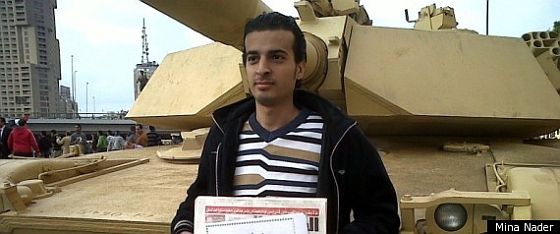
The Guardian reports: An Egyptian blogger jailed for criticising the country’s military junta has declared himself ready to die, as his hunger strike enters its 57th day.
“If the militarists thought that I would be tired of my hunger strike and accept imprisonment and enslavement, then they are dreamers,” said Maikel Nabil Sanad, in a statement announcing that he would boycott the latest court case against him, which began last Thursday. “It’s more honourable [for] me to die committing suicide than [it is] allowing a bunch of Nazi criminals to feel that they succeeded in restricting my freedom. I am bigger than that farce.”
Sanad, whom Amnesty International has declared to be a prisoner of conscience, was sentenced by a military tribunal in March to three years in jail after publishing a blog post entitled “The people and the army were never on one hand”. The online statement, which deliberately inverted a popular pro-military chant, infuriated Egypt’s ruling generals who took power after the ousting of former president Hosni Mubarak, and have since been accused of multiple human rights violations in an effort to shut down legitimate protest and stifle revolutionary change.
The 26-year-old was found guilty of “insulting the Egyptian army”. The case helped spark a nationwide opposition movement to military trials for civilians, and cast further doubt on the intentions of the Supreme Council of the Armed Forces (Scaf), whose promises regarding Egypt’s post-Mubarak transition to democracy appear increasingly hollow.
In mid-September, Saki Knafo wrote: Nabil is not the only civilian to have undergone a military trial since the revolution. An article from the Pulitzer Center for Crisis Reporting places the total number at 12,000, and says that suspects have been typically tried in three or four days and have been given sentences of between a few months to several years.
Earlier this year, Asmaa Mahfouz, a prominent Egyptian activist, wrote the following Tweet (translated from Arabic): “If the judiciary does not get us our rights, don’t be upset if armed groups carry out a series of assassinations as there is neither law nor justice.”
She was brought before the military prosecutor last month and charged with insulting the military. The case became a flashpoint in the growing movement to end the military trials, with presidential candidates and political groups criticizing the decision. The military council eventually ordered that the charges be dropped.
But Nabil is different from Mahfouz. He isn’t a star, for one thing. “Maikel isn’t a prominent public figure,” his father told the press during a recent demonstration in support of his son. “Maikel is a normal person and that is why they imprisoned him. Others who had a lot of public support and had similar charges were released. But Maikel is one of the general public and he doesn’t have anyone to defend him.”
There’s also the fact that Nabil supports Israel. He says he objected to military conscription in the first place because he refused to “point a gun at an Israeli youth who is defending his country’s right to exist,” and a section of his website is in Hebrew.
Several organizations are again calling for his release. A statement from Reporters Without Borders observed that Nabil “could very soon die” and warned that he could become “the symbol of a repressive and unjust post-Mubarak Egypt.”
In response, a military official was quoted as saying that what Nabil wrote on his blog was “a clear transgression of all boundaries of insult and libel.”
In April, shortly after Nabil’s arrest, a friend of Nabil’s and fellow blogger wrote an email to The Huffington Post in which he said that Nabil’s sentencing proved “every word Nabil has ever said about our regime.”
“The military council wants to annihilate anyone who questions what it does,” wrote the blogger, who calls himself Kefaya Punk. “That reminds me of how the Catholic church treated its opponents in the medieval ages.”

The New York Times reports: Egypt’s military rulers are moving to assert and extend their own power so broadly that a growing number of lawyers and activists are questioning their willingness to ultimately submit to civilian authority.
Two members of the military council that took power after the ouster of former President Hosni Mubarak said for the first time in interviews this week that they planned to retain full control of the Egyptian government even after the election of a new Parliament begins in November. The legislature will remain in a subordinate role similar to Mr. Mubarak’s former Parliament, they said, with the military council appointing the prime minister and cabinet.
“We will keep the power until we have a president,” Maj. Gen. Mahmoud Hegazy said. The military had pledged in formal communiqués last March to hold the presidential election by September. But the generals now say that will come only after the election of a Parliament, the formation of a constitutional assembly and the ratification of a new constitution — a process that could stretch into 2013 or longer.
A transition to civilian rule before and not after the drafting of a new constitution was also a core component of a national referendum on a “constitutional declaration” that passed in March as well. The declaration required that the military put in place democratic institutions and suspend a 30-year-old emergency law allowing arrests without trial before the drafting of the constitution to ensure a free debate. But by extending its mandate, the military will now preside over the constitutional process.
The military’s new plan “is a violation of the constitutional declaration,” Tarek el-Bishry, the jurist who led the writing of that declaration, wrote this week in the newspaper Al Sharouk, arguing that the now-defunct referendum had been the military’s only source of legitimacy.
The United States, where concerns run high that early elections could bring unfriendly Islamists to power and further strain relations with Israel, has so far signaled approval of the military’s slower approach to handing over authority. In an appearance this week with the Egyptian foreign minister, Secretary of State Hillary Rodham Clinton urged an early end to the emergency law but called the plan for elections “an appropriate timetable.”
As’ad AbuKhalil writes: There is a war on Copts in Egypt. It is unmistakable and state military and religious institutions are guilty in sponsoring and launching the war. It was no coincidence that the chief of Al-Azhar (a former puppet of Mubarak and his ruling party) was on an official visit to Saudi Arabia during the week of killing the Copts in the streets of Cairo.
The official statement about the visit by Al-Azhar chief and his meeting with Wahhabi clerics of the House of Saud was blatantly sectarian and spoke about protecting Sunnis, as if the majority of the world’s Muslims are under attack in the region from Muslim sects and non-Muslims. The meeting in Saudi Arabia is an example of the fanatical religious movement that leads and sponsors the industries of religious and sectarian hate in the region. But it is not only the Egyptian government which squarely bears the responsibility for the savage attacks on Copts on the streets, and for sponsoring the blatant sectarian agitation that filled Egyptian state airwaves.
The US and Saudi Arabia are also responsible. It is fair to say that the US was party to the Saudi-directed campaign of global religious fanaticism – in two stages. The first phase was during the Cold War when Saudi Arabia, in partnership with the US, unleashed international religious forces to undermine the cause of communism and leftism in general. The movement that produced Bin Laden and his terrorist organization was mid-wived by Saudi Arabia and the US during the war in Afghanistan. The goal was to defeat communism at any price, even if the regimes that followed were much worse than what prevailed under communism, especially if one cares about women’s rights. It can be argued for instance that the Soviet-supported regime in Kabul was far more reformist and enlightened than the reactionary regime that the US installed in Kabul in 2001.
The second wave of global fanaticism was unleashed by Saudi Arabia after the 2003 invasion of Iraq and with the full support of Israel and the US. The US wanted to divert the attention of Arabs from Israel and its crimes and demonized Iran, promoting it as the only danger to Arabs (only Muslims because non-Muslims don’t figure in US calculations and certainly not in the calculations of the Wahhabi clerics). Israel was not to be seen as the enemy, or so wanted the American government, and Saudi Arabia was more than happy to oblige.
Al-Masry Al-Youm reports: A day after Egypt’s military rulers provided their account of this week’s deadly clashes between soldiers and mostly Christian protesters, activists responded with an opposing narrative that accused the army of committing brutalities hitherto unseen under former President Hosni Mubarak.
Armed with videos of the clashes, human rights activists, lawyers and victims’ families who witnessed the incident told their side of the story on Thursday at a news conference. The clashes, which happened on Sunday, left at least 26 killed and more than 300 injured.
“The performance of the military, which always took pride in never firing a bullet at the revolutionaries, surpassed that of Mubarak’s mercenaries. It shed the blood of Egyptians in cold blood and with the cruelest of means, even throwing dead bodies in the Nile in an attempt to cover up their crimes,” read a statement signed by at least 12 political parties and youth groups and distributed to local and foreign media at the conference.
On the stage, Mary Daniel, sister of Mina Daniel, who was killed on Sunday, sat in her mourning black to describe what happened in the Coptic-led march which began in Shubra and ended in tragedy once demonstrators reached the Maspero area in downtown Cairo.
“I was with Mina,” said Daniel. “We marched from Shubra until we reached Maspero. It was a long distance. If we had been armed, people would have resisted us from the beginning. We were peaceful.”
After reaching Maspero, “We saw an influx of armored vehicles, bullets, tear gas bombs and stones,” said Daniel. “The scene was horrible. Even if we were in the middle of a war, things would not have been like that.”
Mariz Tadros writes: At first, it looked like a repeat of the worst state brutality during the January 25 uprisings that unseated the ex-president of Egypt, Husni Mubarak: On Sunday, October 9, security forces deployed tear gas, live bullets and armored vehicles in an effort to disperse peaceful protesters in downtown Cairo. Joined by Muslim sympathizers, thousands of Coptic Christians had gathered that afternoon in front of the capital’s state television and radio building, known as Maspero, and in many other parts of Egypt, to protest the burning of a church in the Upper Egyptian village of al-Marinab. A few days earlier, their initial demonstrations had also been met with violence.
What happened next, however, was worse than any single incident of state violence in January and February: Captured live by the cameras of the al-‘Arabiyya satellite channel, armored personnel carriers bearing army markings sped toward the protesters, at one point bumping cumbrously over curbs and a sidewalk, and crushed several people to death underneath their massive treads. By night’s end, 17 demonstrators were dead, and 300 more injured, some in critical condition. The death toll is now at least 25 and counting. Furthermore, the army’s claim to fame during the January-February popular uprising — that it would not, under any circumstances, harm Egyptian civilians — has now been given the definitive lie.
How it all started is hotly debated. At a press conference on October 12, representatives of the Supreme Council of the Armed Forces (SCAF), Egypt’s de facto ruling authority since Mubarak’s ouster, insisted that the army did not attack first or even engage the demonstrators. Some SCAF defenders put forward the notion that the army did engage, but only because it was provoked by the assaults of the protesters. Others argue that “thugs” of unknown provenance infiltrated the demonstration to foment chaos and invite the army’s retaliation. Yet the overwhelming thrust of eyewitness accounts, from both Muslims and Christians, is that the army initiated the violence, first throwing stones, then wielding batons, then firing live ammunition, before taking the grim final step of grinding protesters into the pavement. Certainly, several protesters threw stones as well, but eyewitnesses are adamant that they did so in response to the bullets being shot at them.
The Associated Press reports: A military official on Wednesday blamed a group of Christian protesters for starting violent clashes with armed troops, saying some attacked soldiers with swords and firebombs during a Christian rally earlier this week that turned into Egypt’s worst violence since Hosni Mubarak was ousted.
Gen. Adel Emara denied the troops opened fire with live ammunition on the protesters or intentionally ran over them with armored vehicles. The violence late Sunday left at least 26 people dead, most of whom where Christians and many of whom were crushed by vehicles or died from gunfire, according to forensic reports. State media said at least three soldiers were also killed.
Emara spoke at a press conference Wednesday that was clearly aimed at defending Egypt’s military rulers from heavy criticism they have come under for the violence at the protests. He gave a detailed account of the military’s version of the events, using video footage of the events culled from state TV and independent stations. One of the images showed a protester hurling a heavy stone at soldiers inside an armored vehicle.
And what about the armored vehicles which shocked the world as they were seen charging through crowds like raging bulls?
Haaretz reports: Israel and Hamas have reached a prisoner exchange deal that will secure the release of abducted Israel Defense Forces soldier Gilad Shalit, officials at Prime Minister Benjamin Netanyahu’s office said on Tuesday.
Officials in the Prime Minister’s Office said that “a brief window of opportunity has been opened that would possibly lead to Gilad Shalit’s homecoming,” adding: “The window appeared following fears that collapsing Mideast regimes and the rise of extremist forces would make Gilad Shalit’s return impossible.”
The officials’ comment came following a report by Al-Arabiya, according to which a deal has indeed been reached between Israel and Hamas geared at the release of the IDF soldier, in Hamas captivity in Gaza since 2006.
Netanyahu and Defense Minister Ehud Barak are meeting several ministers in the Prime Minister’s Office in order to pressure them into voting for the deal, with Netanyahu aides estimating that the deal will be approved by the cabinet,
Special attention is reportedly being given to Foreign Minister Avigdor Lieberman no to vote against the deal along with ministers from his Yisrael Beiteinu party. Several Likud ministers who have voiced opposition to freeing terrorists in exchange for Shalit are also being pushed to approve the deal.
Netanyahu called an emergency cabinet meeting scheduled for later Tuesday in which ministers are to discuss the status of talks geared at securing Shalit’s release.
Speaking with Haaertz, one Egyptian official said: “After 64 months of tough negotiations we were able to complete the deal. It was a very difficult task, which included thousands of hours of negotiations.”
Also on Tuesday, top Egyptian officials confimed to Haaretz that there had been significant progress in the attempts to strike a prisoner exchange deal that would lead to Shalit’s release.
The officials confirmed that an Israeli delegation, headed by the head of Shalit negotiations David Meidan, was in Cairo to indirectly discuss the details of a possible deal with the chief of Hamas’ military wing Ahmed Al-Jabari.
Similarly to previous rounds of Shalit talks, the indirect talks are overseen by Egyptian intelligence, headed by intelligence chief General Murad Muwafi and his aides.
Egyptian officials have also said that a the deal which has been reached in recent days also includes accused Israeli spy Ilan Garpal.
Activists linked to Palestinian prisoner rights in Israel have also indicated that a recent hunger strike amid those prisoners in Israeli jails was linked to the protest move, as well as the reason Hamas prisoners did not join the strike.
Marwan Barghouti, who has been referred to as “Palestine’s Mandela” and who has been imprisoned since 2002, is reported to be on the list of prisoners to be released.
Hani Bushra describes his experience of the violence in Cairo on Sunday night and points to evidence of the ways it was choreographed by state security services intent on fomenting sectarian conflict. “Christians where are you, Islam is here,” was the chant the mobs had been fed. And as these mobs hunted down their victims, innocent people were accused of carrying concealed weapons. (H/t Issandr El Amrani.)
The people marching were chanting “Christians and Muslims are one Hand” and I was leading them in saying that. I met with Alaa of manalaa.com and we continued to march towards Maspero.
The group was peaceful, and I was taking pictures using my Ipad. We reached the point where the 6th October bridge exits towards Maspero, and there was a large cordon of police who are members of the Central Security Forces (CSF). There, I was told not take pictures by people wearing civilian clothing and I fought back saying it was my right.
I began to walk back towards Hilton Ramsis, and suddenly 5 vehicles full of CSF soldiers showed up. People began to pelt them with rocks, destroying the wind shields, and the causing the drivers of the vehicles to panic, thereby hitting into each other and the sides of the road. I and some other people were trying to calm people down into not attacking the vehicles but the people were angry.
At that point, I was alone, and so I began to walk back to Tahrir. I was tweeting at that time. Someone saw me tweeting and came to me. He asked my name and so I said Hani Sobhi, he then grabbed my wrists to see if I had a cross tattoo, and when he did not find it, he asked for my full name. I said Hani Sobhi Bushra. He asked if I was a Muslim or a Christian, and I said that I was a Christian.
At that point he began to scream for others that he caught a Christian, and people began to gather. They wanted to search me and my bag, and I said that I will not let them, and that it was best to go to an officer. At that point there was about 30 people around me, with some of them punching me on my head.
I began to walk quickly to the cordon of the police that I had just came from. At that point, someone yanked my gold chain from across my neck and took the cross. All I did was to tell him “wow, you are such a man” and I clapped for him. That pissed the people who were with me, and so someone snatched my phone from my belt.
I kept shouting at the thief to give me my phone back, and he said that he will give it to me in front of the police officer. By that time, I was being hit from many people, my ankle was sprained and I was called a “Nossrani (Christian)” dog.
We reached the officer (rank of general), and the first thing that I did was to show him my U.S. passport and told him that I am now under his protection. I told him that I was attacked because I was a Christian. One of the men who is a policeman but wearing civilian clothing began to talk to the general that I was a Christian and that I institigated the mob to attack me and that I am carrying weapons in my bag. The officer, who had seen my passport, told him to shut up. This policeman in the civilian clothing seemed to be the coordinator between the mob and the police.
Sandmonkey writes: Today the mood in Cairo was wary & melancholic. With the reality of what went down yesterday at Maspero hitting them with its full might, the general population that yesterday found itself on the brinks of chaos is utterly terrified. The number of phone calls I received from people who were worried and horrified made me wish I could shut off my phone, with everyone looking at the future with an incredibly bleak outlook. It’s easy to fall into that mood — after all you have your army killing your people, a long oppressed minority of it at that — but if one looks beyond what happened, one sees a very different picture. What happened yesterday was the beginning of the end of the military rule over Egypt: The days of the SCAF ruling us are numbered. And not because they don’t want to, but because they will no longer have any other choice.
A quick recap over what has went down yesterday: a huge demo held by Coptic Christians & muslim supporters protesting against yet another fight over the building of a Church was attacked by the Egyptian armed forces there to protect it and plainclothed thugs. Shots were fired at protesters killing them, rocks were thrown by protesters in return, protesters were overrun by armored vehicles, the Egyptian State TV issued a plea asking Egyptian citizens to come to the Demo and “protect the army from Christian thugs”, and a street battle that resulted in over 24 dead and 150 injured. The street battle after a while turned into Egyptian citizens fighting each other, without any of them being able to figure out who was fighting who. Pandemonium, for a lack of a better word.
But the moment the dust settled the questions started presenting themselves: This was obviously planned, so what the hell was the SCAF thinking? How could they attack and kill Egyptians on the street so casually, while their sole purpose is to protect them from getting killed? How could they risk enflaming the country into a huge sectarian battle by having state Media so conscientiously attacking the Christians and promoting violence against them? How did they not see that the choice they made is an inherently flawed one that it could spell their doom? How do you explain last night?
Well, the easy explanation is that they — like every single political force in the country throughout this year — fell into the trap of thinking that they have won and asserted their power, only to have the whole thing blow up in their faces. After believing the political street to be dead, and that the revolution is almost dying, they figured they now have the power to put “people in their proper place” like the old days. So, they went down yesterday to terrorize the Christians, counting that they won’t put up a fight (because they never really did before), and that the sectarian rhetoric will cause them all to fear for their lives, stop them from causing trouble, and quite possibly scare them from participating in the elections. With every single respectable political party formed after the revolution having prominent Christians in their founders and as their candidates, they figured that threatening us with the possibility that the next election will turn into a Muslim vs. Christian election will discourage people from voting and participating, leaving the new parties with fewer seats, with the Christians being underrepresented as always in the parliament, and thus allowing the ex NDP people control of the Parliament as the only other choice against the “Islamists”. To basically return us to the pre-revolution status quo. But had they thought this through for more than 5 minutes, they might have seen the inherent flaws in their old-and-reliable plan. They, somehow, didn’t and now they have overplayed their hand and about to face the consequences.
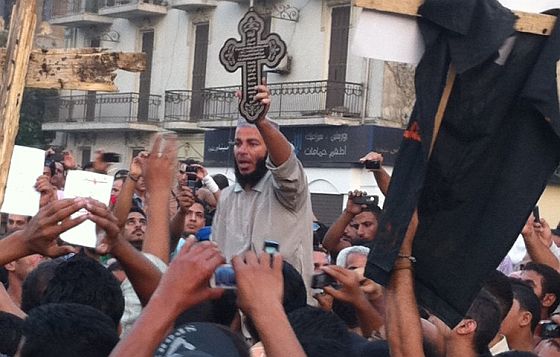
Muslims and Christians unite in protest against Egypt's military council
Al-Masry Al-Youm reports: In the wake of Sunday’s violence between Coptic demonstrators and military forces in Cairo, political party leaders and activists called for an immediate transfer of power to civilian authorities, the establishment of a civilian presidential council to help manage the transition period, and the dismissal of Prime Minister Essam Sharaf’s government.
In a conference Monday morning, politicians criticized the security vacuum as well as the state media’s deceptive coverage of the violence.
The conference drew public figures from across the political spectrum, from billionaire telecom tycoon-turned liberal politician Naguib Sawiris to Amin Iskandar, secretary general of the Nasserist Karama Party. Former Finance Minister Samir Radwan and Hossam Eissa, a constitutional law expert, were also present.
Twenty-five protesters died, according to the Health Ministry, when a march by Copts was attacked by thugs and military forces. The march started in the largely Christian neighborhood of Shubra to protest against attacks on Christians, most notably a recent attack on a church in the Upper Egyptian city of Aswan, which resulted from the construction of a dome.
The military prosecution began to investigate 25 suspects on Monday.
“We as Egyptians are facing a problem. It’s not a Coptic and Muslim problem. It’s not a military or civilians problem, but it’s a problem in Egypt’s flawed society and inter-relations. This could end up in a civil war,” said Amr Moussa, a potential presidential candidate and former foreign minister under Mubarak.
Moussa stressed the importance of ruling with an iron-fist in order to protect the country from looming chaos.
Meantime, Abdel Gelil Mostafa, leader of the National Association for Change, slammed the Mubarak-like rule of the Supreme Council of Armed Forces (SCAF), describing it as “semi-divine.”
Speakers at the conference issued calls for a civilian council to serve as Egypt’s executive authority, instead of SCAF, echoing demands made by Mohamed ElBaradei and other secular political figures shortly after Mubarak stepped down in February.
Ursula Lindsey writes: The automatic goverment agit-prop on this is almost as bad as the deaths. Every single (Arabic language) Egyptian newspaper with the exception of Tahrir newspaper led with stories and images today that emphasized the violence on the part of the demonstrators, not the army. Al Ahram’s disingenuous headine reads: “Twenty-Four Soldiers and Demonstrators Dead.” It really is a full return to the days of the revolution.

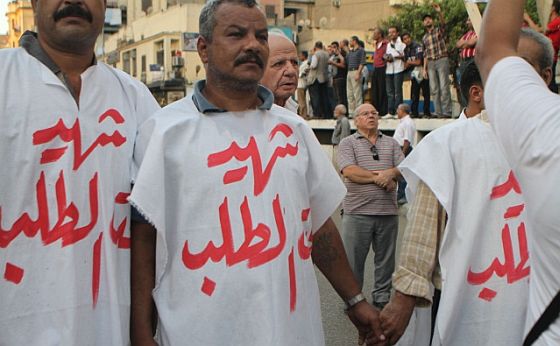
Sarah Carr writes: The march from the Cairo district of Shubra was huge, like the numbers on 28 January. In the front row was a group of men in long white bibs, “martyr upon demand” written on their chests. A tiny old lady walked among them, waving a large wooden cross: “God protect you my children, God protect you.”
The march started down Shubra Street around 4 pm, past its muddle of old apartment buildings, beat up and sad but still graceful compared with the constructions from the Mubarak era next to them – brutish and unfinished-looking.
A man explained why there were bigger numbers than the march last week in response to the attack on the St. George’s Church in Aswan: the army had hit a priest while violently dispersing Coptic protesters in front of the Maspiro state TV building on Wednesday. A video posted online showed a young man being brutally assaulted by army soldiers and riot police.
At a traffic underpass at the end of Shubra Street, at around 6 pm, there was the sudden sound of what sounded like gunfire. Protesters at the front told those behind to stop – the march was under attack. Rocks rained down from left and right and from the bridge, underneath which protesters were taking shelter.
Some threw stones back. Behind them, protesters chanted, “The people want the removal of the Field Commander.” The stone throwing eventually stopped sufficiently for the march to continue. A teenage boy crossed himself repeatedly as he moved forward toward the rocks.
Darkness fell just as the march reached Galaa Street. “This is our country,” protesters chanted, led by a man on a pickup truck full of speakers. An illuminated cross floated through the darkness. At the headquarters of state daily newspaper Al-Ahram, a single rock was thrown at the door, likely a comment on its coverage of violence against Copts.
Outside the Ramsis Hilton Hotel, the chanting stopped momentarily – the exuberance of having escaped the attack in Shubra faded as the march rounded the corner toward Maspiro.
It was immediately met with gunfire in the air. As protesters continued moving forwards, the gunfire continued.
Suddenly, there was a great surge of people moving back, and something strange happened. Two armored personnel carriers (APCs) began driving at frightening speed through protesters, who threw themselves out of its path. A soldier on top of each vehicle manned a gun, and spun it wildly, apparently shooting at random although the screams made it difficult to discern exactly where the sound of gunfire was coming from.
It was like some brutal perversion of the military show the armed forces put on for the 6th of October celebration three days before. The two vehicles zigzagged down the road outside Maspiro underneath the 6th of October Bridge and then back in synchronicity, the rhythm for this particular parade provided by the “tac tac tac” of never-ending gunfire, the music the screams of the protesters they drove directly at.
And then it happened: an APC mounted the island in the middle of the road, like a maddened animal on a rampage. I saw a group of people disappear, sucked underneath it. It drove over them. I wasn’t able to see what happened to them because it then started coming in my direction.
Later, as riot police fired tear gas at another small attempt at a demonstration and fires burned around Maspiro, I found on the floor part of one of the white “martyrs upon demand” bibs the men had been wearing, and took it home. It had been ripped in half.

The New York Times reports: A demonstration by Christians angry about a recent attack on a church touched off a night of violent protests here against the military council now ruling Egypt, leaving 24 people dead and more than 200 wounded in the worst spasm of violence since the ouster of President Hosni Mubarak in February.
The sectarian protest appeared to catch fire because it was aimed squarely at the military council that has ruled Egypt since the revolution, at a moment when the military’s latest delay in turning over power has led to a spike in public distrust of its authority.
When the clashes broke out, some Muslims ran into the streets to help defend the Christians against the police, while others said they had come out to help the army quell the protests in the name of stability, turning what started as a march about a church into a chaotic battle over military rule and Egypt’s future.
Nada el-Shazly, 27, who was wearing a surgical mask to deflect the tear gas, said she came out because she heard state television urge “honest Egyptians” to turn out to protect the soldiers from Christian protesters, even though she knew some of her fellow Muslims had marched with the Christians to protest the military’s continued hold on power.
“Muslims get what is happening,” she said. The military, she said, was “trying to start a civil war.”
Issandr El Amrani sees the turn of events as worrisome for multiple reasons.
This marks the first time that the army has taken such an aggressive posture against a predominantly Christian protest, which will easily lead the framing of today’s events as the first time that the military chooses to kill protesting Christians.
Worrisome because state television has behaved thus far tonight much as it did during the 18 days of the Egyptian uprising this winter. In other words, it has deployed propaganda, unverifiable allegations, talk of “foreign agendas” and “outside hands”, and extremely partial reporting. It has repeatedly used sectarian language, with presenters referring to protestors as “the Copts” and using sentences such as “The Copts have killed two soldiers.” On top of this, the military cut off the live TV feeds of several satellite TV stations, including 25TV, al-Hurra, and at a later point al-Jazeera, reducing the independent reporting of an unfolding event. And most of all because TV presenters were urging Egyptians to “protect the army from the Copts.”
Worrisome because many appear to have responded to that call, and tonight on one of Cairo’s main thoroughfares you could see young men marching to that chant of “There is no God but God”, or a woman being attacked simply because she was wearing a cross, or simply because sectarianism has reared its ugly head again after last May’s Imbaba church arson.
Worrisome because this is all happening at a time when the political class is in crisis, its confidence in the SCAF at an all-time low, and the general population is so fed up of all the uncertainty and chaos that it is having buyer’s remorse about the overthrow of Hosni Mubarak.
Most worrisome of all because, taken altogether, this paints a picture of the Egyptian military as resorting to sectarian impulses almost reflexively. It is the flipside of its continued unwillingness, after the sectarian clashes (between civilians as well as between police, military and civilians once fighting had already broken out) of earlier this year, to end once and for all the official discrimination that Copts face when building, expanding or renovating places of worship. SCAF, which rules by decree, could have acted, but did not — and acted weakly in the face of the arson of a church in Aswan last week, which was the cause of today’s protests. And because from so many sides we are getting the old passing of the buck to “foreign agendas” and “foreign hands” in what was.