Category Archives: Egypt

Egyptian military source: We’re considering modification of Egypt-Israel peace treaty

Al-Masry Al-Youm reports:

A well-placed source at the Supreme Council of the Armed Forces has said Egypt is currently studying the possibility of modifying the Camp David Agreement with regard to the number of military troops and equipment allowed into Sinai.

However, an Israeli source told the French news agency AFP that Egypt has not submitted a request in this regard.

At a ministerial meeting on Sunday, Israeli Prime Minister Binyamin Netanyahu said his country is willing to consider an Egyptian request to bolster its troops in Sinai, although he said earlier there was no reason for the treaty to be modified.

Israeli Defense Minister Ehud Barak said the government is not willing to grant Egypt such request.

Facebooktwittermail

Egypt mulls buffer zone on Gaza border

Al-Masry Al-Youm reports:

Egypt is currently considering a plan to set up a 5-kilometer wide buffer zone on its border with the Gaza Strip, senior security sources told Al-Masry Al-Youm on Saturday.

They said that security forces are finalizing a plan to destroy smuggling tunnels, adding that heavy digging equipment was recently transferred to border town of Rafah. The machinery, which uses modern vibration techniques, is meant to destroy the tunnels at a depth of 20 meters below the surface of the earth.

Facebooktwittermail

The muted impact of the Arab Awakening on Israel

Daniel Levy writes:

After decades of near-hegemonic Israeli strategic supremacy in the Middle East, the ground is shifting. For Israel’s leaders, the Arab Awakening and the removal of Mubarak represents the collapse of a key support structure in the edifice that maintains Israel’s regional posture. That edifice had been fraying for some time. Yet with Israel unwilling or unable to relinquish its control over and occupation of Palestine, it was a system of conflict management that had proven to be remarkably resilient. Undemocratic Egypt was that system’s linchpin. In fact, only an undemocratic Egypt could play this role, indifferent and dismissive as the regime was toward public opinion and able to pursue policies, both at home and abroad, widely perceived as being an affront to Egyptian dignity.

Every country needs a strategy for managing its external relations, especially in the near abroad. Israel’s predicament in this respect is especially challenging. Born as an unusual movement combining religious and historical claims to land with modern aspirations of state-building and communal preservation, Zionism was initially branded by most in the region as a colonial project, a sense that Israel has fed with its expansionist and expulsionist approach to the indigenous population. Unfortunately for Israel, that indigenous population has ethnic and religious ties to a large population throughout the surrounding region. Nevertheless, Israel managed to adapt, pursuing whatever great power or regional alliances were available, making itself useful to the United States as a cold war ally.

Long after it became clear that the Oslo peace process would not deliver Palestinian freedom, rights or sovereignty, the structures established by it and the opportunities they have forged for Israel have endured. They were kept afloat by donor assistance, by the difficulties entailed in dismantling the Palestinian Authority and, crucially, by the stamp of legitimacy that only Egypt could confer. The impact of the Arab Awakening on Israel’s leaders must be understood first and foremost against this backdrop.

But here’s the key statement Levy makes which defined Israel’s view of the region well before the Arab Awakening erupted:

Israel has erected a separation barrier between itself and the Palestinians in the West Bank and Gaza, is proceeding to do the same on the Egyptian border and has long had closed and militarily fortified borders with Lebanon and Syria. Trade with all of its Middle East neighbors, in fact, amounts to less than 5 percent of its total. Israelis rarely visit even those Arab countries it is possible to enter, and the Arab community inside Israel is treated as a fifth column rather than as a bridge to regional relations. Of course, this is a two-way street. Yet when the physical barriers are combined with what is often a striking lack of intellectual, cultural and social curiosity, Israel is in danger of being fundamentally incapable of interpreting developments in its immediate surroundings.

This incapacity is not just an impediment — it actually defines the core of Zionism.

Israel defines itself as a state by its desire to underline the otherness of the non-Jew and emphasize the necessity for Jewish solidarity and self-reliance. On this basis, how would it be possible to foster dynamic and creative relations between Jews and Arabs when the prevailing attitude among Israeli Jews is that they have little or no interest in having any relations with Arabs?

Facebooktwittermail

Israel agrees to joint investigation with Egypt on Eilat attacks

An Israel Army Radio report said that Israel’s domestic intelligence service, Shin Bet, recommended a preemptive attack against members of the Popular Resistance Committees in Gaza, prior to the attacks by gunmen near Eilat in southern Israel last week. The report said that the request was turned down by senior defense officials and political leaders.

In response, the IDF Spokesman’s Office said that “the report suffers from substantive factual inaccuracies, and due to operational and intelligence reasons we cannot elaborate on the matter.”

The Shin Bet declined to comment on the report.

Meanwhile, Haaretz reports:

[T]wo days after telling Army Radio that Israeli and Egyptian officers would not carry out a joint investigation into the attack in the south [near Eilat last week], National Security Adviser Ya’akov Amidror has changed his stance. In a special announcement Thursday afternoon, he said a joint investigation would indeed take place.

The reason for the change probably stems from the anger that his statements to Army Radio have stirred in Egypt’s Supreme Military Council. During the Tuesday morning interview, Amidror said no joint probe involving Israeli and Egyptian officers would take place into the incident near Eilat. But he said the two sides would carry out separate investigations and then compare their findings.

Amidror made the statement even though Barak had announced on Saturday that Israel sought to hold a joint investigation with Egypt into the incident. Earlier this week, the head of the Planning Directorate at the Israel Defense Forces, Maj. Gen. Amir Eshel, traveled to Cairo to discuss with the Egyptians ways of carrying out the joint probe.

The statements by the national security adviser were followed by a report Wednesday in the Egyptian daily Al-Masri Al-Yaum, which was highly critical.

“The Israeli side has not responded so far to our demand for a joint investigation and did not announce a timetable for the completion of the investigation,” the daily quoted a senior Egyptian government official as saying.

“If there is no joint investigation we will recall our ambassador from Tel Aviv.”

Thursday afternoon the Prime Minister’s Bureau issued an unusual statement in Amidror’s name. The national security adviser stressed that “Israel agrees to hold a joint investigation with Egypt on the events of the terrorist incident on the way to Eilat that took place last week.”

Amidror added that the details would be determined between the militaries of the two countries.

Explaining the reason for the two versions, the Prime Minister’s Bureau said that only during the past 24 hours had a final decision been made on a joint investigation.

Facebooktwittermail

Egypt’s #Flagman is honored

Al-Masry Al-Youm reports:

The governor of Zagazig on Tuesday honored Ahmed al-Shahat, the young man who pulled down the Israeli flag from the Israel Embassy and replaced it with the Egyptian flag during anti-Israel protests on Saturday.

Protesters have been staging demonstrations before the Israeli Embassy in Giza since last week, following the death of five Egyptian soldiers at the hands of Israeli forces.

Residents of the city cheered Shahat upon his arrival and held a big celebration for him.

“I did it to please millions of Egyptians and Arabs,” Shahat said.

Facebooktwittermail

The situation in Sinai and Egypt-Israel relations

Issandr El Amrani writes:

The events of the last week or so in Sinai have been overshadowed by the current diplomatic rift and public outrage over Israel’s shooting of at least three Egyptian border guards a few days ago. The question of security and state legitimacy in the Sinai, the attack that killed 17 Israelis in Eilat, Israel’s latest bombing campaign in Gaza (and the Palestinian rocket fire that came in response), the border incident and the future of the the Egyptian-Israel relationship has interwoven in complex ways. But there are also distinct issues worth separating to get a better understanding of the whole.

  1. The situation in Sinai: The raid on July 29 by some 100 gunmen of the al-Arish police station was a wake-up signal to the Egyptian government about how dire the situation is in North and Central Sinai. So were media reports and calls for a “Islamic Republic of Sinai” that Salafist Jihadist organizations — most notably Takfir wal Hijra, a group calling itself after the more famous group of the 1970s but that had hitherto been a low-intensity nuisance for the authorities. The security situation in Sinai is a mixture of tribal grievances and score-settling, banditry and violent ideological activity by Jihadists. Sometimes the interaction between these is uncertain.
    The military’s unleashing of Operation Eagle, aimed at breaking up violent groups, confiscating weapons and pacifying the region, is absolutely necessary. The Egyptian state has too long tolerated tribal bending of the law in Sinai, an ambiguity it used to replace legitimacy. The price it is paying is the current chaos. The question now is how to forcefully intervene (as it should, at times using force when necessary to disarm armeg groups) while repairing relations with locals. That Sami Enan, the chief of staff of the Armed Forces, is holding meetings with tribal leaders is a good first step, as is the creation of a new law for Sinai and an administrative body that will focus on its development.
    For a thorough look at this complicated situation in Sinai, including the presence of Palestinians affiliated with Muhammad Dahlan’s factions and the possibility of armed groups being manipulated by regional powers, you could do no better than to read this investigation by Lina Attalah in al-Masri al-Youm.

  2. The Eilat attack: Israel both immediately claimed that the perpetrators of the Eilat had come in from Gaza through Egypt and that Hamas were responsible for them, although Hamas denies this and Israel presented scant evidence. The Netanyahu government also used them as a diversion from protests against their economic policy, and used them to justify a new bombing campaign in Gaza that has already killed at least 15. It might very well be the case that the Eilat attackers came from Gaza into Egypt and then into Israel — but much of the coverage of the issue suggests this is a new phenomenon due to the situation in Sinai post-revolution. In fact, previous attacks in Israel’s south-west were probably also conducted via Sinai. So unlike Barry Rubin1 argues, this is not just “the bitter fruit of the U.S-backed downfall of the government of President Husni Mubarak in Egypt, opening the Egypt-Israel border as a new front in the war.”
    Of course, that it’s not the first time is little consolation to Israelis. But it means that has relatively little to do with the post-revolutionary situation. Egypt has a long border with Israel that has been porous to human and drug trafficking for a long time. It has a limited ability to deploy military personnel and helicopters. And it has a situation with smuggling and other illegal activities in Eastern Sinai that has been exarcebated by the blockade on Gaza. In other words, the core problem is not a temporary reduction in Egyptian control of Sinai. It’s the Israeli-Palestinian conflict, the pressures on neighbors created by the blockade on Gaza, and the international community’s endorsement of of it.

  3. The bombing campaign in Gaza: This brings us the point that, although it has scant evidence of who was behind the Eilat attacks, Israel bombarded Gaza, killing 15 so far, including at least five civilians, three of them children. In retaliation, Hamas fired rockets into southern Israel. But the truth is there would have probably been more rockets were it not for Israeli concern over the public mood in Egypt. This is one of the positive outcomes of the revolution: Israel will think twice about whether antagonizing Egyptian public opinion is worth it now that Mubarak is no longer around to deflect it.

Adam Shatz writes:

On Sunday night, Binyamin Netanyahu and Ehud Barak called a cabinet meeting to argue against going to war in Gaza. The meeting lasted four hours, as these unlikely doves made the case for ‘restraint’. They were, in a sense, arguing against themselves. After the attack in Eilat last Thursday, in which eight Israelis, five of them civilians, were killed, Netanyahu and Barak had immediately blamed the Popular Resistance Committee in Gaza, an armed movement of militants from different factions. If they had any evidence of PRC involvement, they didn’t share it: the best an IDF spokeswoman interviewed on the Real News could manage was that the attackers used Kalashnikovs. The PRC denied responsibility; Hamas was even more sheepish: the last thing it needed was another Operation Cast Lead.

A more likely story was that the attacks were carried out by Islamic militants in the Sinai, where relations between Bedouins and the Egyptian government have deteriorated, and where the pipeline that carries natural gas to Israel and Jordan has been blown up five times since February (as it happens, one of the charges against Mubarak is that he sold gas to Israel at below market prices). Earlier this month, more than a thousand Egyptian troops launched a ‘pacification’ campaign in the Sinai after Islamist insurgents attacked a police station, killing five people.

But Israel insisted that Gazan militants were to blame for Eilat, and carried out air strikes in Gaza that killed at least 14 people, including two children. The usual round of rocket attacks by armed groups in Gaza (though not by Hamas) followed, and the usual calls inside Israel for more blood. War looked imminent. As some left-wing Israelis noted, it looked like just what Netanyahu needed to distract attention from – and perhaps even crush – the tent protests against his economic policies. Who would dare to demonstrate against the government – or raise inconvenient questions about the recent announcement to build 1600 new homes in occupied East Jerusalem – if the nation went to war?

Yet here were Netanyahu and Barak, pleading with their cabinet for ‘restraint’ until the early hours of Monday morning. They were joined by defence officials who pointed out that Hamas hadn’t joined in the rocket attacks but had imposed a ceasefire on other militant groups. According to Haaretz, Netanyahu and Barak argued that Israel was too isolated internationally to go to war, and that its rocket interception system wasn’t fully prepared. But the decisive argument was that the price of war in Gaza could be the peace treaty with Egypt. Relations had already been jeopardised by Israel’s killing of at least three Egyptian security officers (five, according to Egypt) during its cross-border raid in search of the attackers in Eilat. The Egyptians were furious, and grew even more so when Israel chastised them for losing control of the Sinai.

Haaretz reports:

Chief of Staff Benny Gantz ordered on Wednesday that the Israel Defense Forces increase defensive measures along Israel’s border with Egypt due to intelligence that terrorist groups are planning attacks similar to the ones last Thursday in which eight Israelis were killed.

The new measures include putting in place additional means of electronic and visual intelligence gathering as well bolstering the Navy Command Center in the southern city of Eilat.

Also on Wednesday, security officials said that the Islamic Jihad operative who was killed in an IAF airstrike early Wednesday morning was responsible for transfer of funds used in last Thursday’s attacks.

The operative was identified as 34-year-old Ismael al-Asmar.

Security officials said that the decision was made to target al-Asmar due to intelligence that he was planning to initiate another attack from Sinai in the coming days.

Facebooktwittermail

A new hero for the Arab Street

Nicholas Noe and Walid Raad write:

The Arab Street has a new hero. Dubbed Flagman or the Egyptian Spiderman on Facebook and Twitter, young Ahmad Ash-Shahat scaled Israel‘s embassy in Cairo and replaced its flag with Egypt‘s.

This was in response to the death of three Egyptian policemen last week during clashes that followed a series of attacks by gunmen who killed eight Israelis near the Israeli resort city of Eilat. Egypt blames the Israeli military for killing the policemen in its pursuit of the gunmen, who fled into Egypt’s Sinai peninsula. Israel says the gunmen infiltrated Israel from the Sinai. Israel has expressed regret for the death of the policemen and has said it is investigating whether its forces may have been inadvertently to blame.

For most of the commentators who took up the matter in the Arabic media, Israel’s culpability is a given, the issue of whether the deaths were accidental an irrelevance. For them, Ahmad Ash-Shahat’s mounting of the Israeli embassy, during mass protests after the death of the Egyptian policemen, was an expression of triumph over a country that is a source of resentment. Wrote Abdel-Beri Atwan, the editor in chief of the Palestinian owned, London-based Al-Quds al-Arabi:

This young Egyptian man embodies the strong patriotic feelings of the Egyptians. This young man represents more than 80 million Egyptians, the Egyptian revolution at its best and even one and a half billion Arabs and Muslims spread throughout the five continents, since he conveyed the anger felt toward this violating state.

Under the rule of former Egyptian president Hosni Mubarak, a close ally of the U.S., popular criticism of Israel was muted in Egypt. But those days are over, as Makram Mohammad Ahmad noted in his column in the semi-official Egyptian daily Al-Ahram. Israelis, he wrote, have “failed to understand that Egypt has changed and that, in spite of its current keenness on preserving the peace in the region, it is now even keener on preserving the dignity of the nation.”

Facebooktwittermail

Evidence that Israel fabicated the link between the Eilat attacks and Gaza

Yossi Gurvitz examines the evidence around last weeks attacks in southern Israel and the claims made by Israeli officials that the gunmen came from Gaza.

Israel has never supplied any proof that the attack has indeed originated in the Gaza Strip. The PRC [Popular Resistance Committees] have denied involvement in the attack. An Israeli propaganda apparatus, the Intelligence and Terrorism Information Center, also claimed (Hebrew) the PRC was behind the attacks, but had to tautologically write “no terror organizations has publicly claimed responsibility for the attack and the Popular Resistance Committee has denied any involvement. However, the Israeli prime minister and other Israeli officials have pointed to the Popular Resistance Committee as the organization who carried out the attack. So, according to the ITIC, the fact that Netanyahu is proof enough, even if the other side completely denies it.

During the weekend, the news website Real News interviewed a senior IDF Spokesman officer, Lt. Col. Avital Leibovitz, who’s in charge of the IDF Spokesman with the international media. Leibowitz denied that the IDF connects the PRC to the attacks, said she was not responsible for that the prime minister said, but claimed that the attackers did come from Gaza, citing as proof the fact they were using Kalashnikov assault rifies (Sic! 2:28 and onwards in the video). I dunno how to put it to Col. Leibovitz, but Kalashnikovs are the most common light assault rifle in the world – a gift that keeps on giving from the defunct Soviet Union – and are rather easy to get all over the Middle East.

In a phone conversation with Leibovitz yesterday, she said “senior officials have already expressed themselves on the issue”, and declined to provide more information on the attackers, aside from insisting on them being Gazans. I asked her if she could provide me with the identity of the attackers killed by the IDF, which was until recently standard procedure, carried out within hours of an attack. She said this is unfortunately impossible, and repeatedly insisted they were Gazans. B’Tselem researchers in the Strip, contacted via B’Tselem today, were unaware of the identity of the attackers. Again, usually they are quickly identified and a mourners’ hut is rapidly constructed. They were killed on Thursday; if they resided in the Strip, their families would have heard of their deaths by now.

Yesterday evening the Egyptian newspaper Al Masry Al Youm reported that Egyptian security forces have identified three of the dead attackers. Egypt has a strong interest to claim the attackers were Gazans, since this would lessen its responsibility for the attacks; nevertheless, they say at least two of the attackers were known terrorists in the Sinai Peninsula. As far as I could find out, the rest of the bodies are in the hands of the IDF – which, again, does not reveal their identity.

Al-Masry Al-Youm reports:

Egyptian authorities have identified three of the people responsible for carrying out a terrorist attack in Israel, just north of Eilat, on Thursday, in which seven Israelis were killed, according to an Egyptian security source.

The same source added that one of the men identified is a leader of terrorist cells in Sinai, while another is a fugitive who owns an ammunition factory.

Al-Masry Al-Youm also reports:

Bin Laden’s doctor, Ramzy Moafy, who escaped from prison during the revolution, held military exercises south of Arish in Sinai, informed sources have said.

They said Moafy led the exercises for 40 armed men under the protection of 13 four-wheel-drive vehicles, of which four carried anti-aircraft guns.

An eyewitness has said he saw 15 of the gunmen carrying machine guns and sophisticated binoculars.

Security sources said a large number of extremist groups in and outside of Sinai have been identified and would be arrested soon, adding that those groups were joined by hundreds of gunmen coming form different governorates to carry out an order given to them in March to turn Sinai into an Islamic emirate.

They have arrived there with their families settled in different areas.

While a security source admitted that there are seven main camps to train militants in Sinai, he denied that Moafy was there, accusing Israel of spreading rumors.

Facebooktwittermail

Israel’s security strategy — when in doubt, hit Gaza

Three days after the attacks by gunmen outside Eilat in southern Israel, what do we know about the identities of the gunmen? Almost nothing.

In the mainstream media they are blithely referred to as “Palestinian gunmen” yet so far the only basis for this description is the unsubstantiated word of Israeli officials. Those officials have provided no real evidence to back up their claims.

Prime Minister Benjamin Netanyahu was quick to assign responsibility for the attacks with the Gaza-based Popular Resistance Committees yet both they and Hamas denied any involvement.

Generally speaking, Palestinian militant groups are not shy about claiming responsibility for attacks against Israelis — especially those that can be described as military operations where Israeli soldiers are killed or injured. Indeed, the problem is more often that too many groups — not too few — want to claim the honor.

This suggests a rather obvious explanation about why no Palestinian group announced that it directed the attacks: it wasn’t a Palestinian operation.

The Israeli Defense Forces spokesperson refused to endorse Netanyahu’s assertion about the PRC role and the only “proof” of Palestinian involvement the IDF presented was the use of Kalashnikovs — as though 100 million Kalashnikovs, 20% of the firearms available on the planet, are now stockpiled in Gaza!

What other evidence is there about the gunmen? They were wearing Egyptian military uniforms.

Just before the Eilat attacks, Egyptian security forces declared Operation Eagle — an effort to bring security to the lawless Sinai — a success.

Deputy Interior Minister Ahmad Gamal Eddin said at a press conference last week that the campaign has so far managed to arrest members of al-Takfeer wal-Hijra and to collect arms and illegally acquired military uniforms.

Militant Salafists based in the Sinai are believed to have been periodically blowing up the Egypt-Israel gas pipeline this year. They are well-armed and possess Egyptian military uniforms. Were they behind the Eilat attacks? It seems a bit more plausible than the IDF’s Kalashnikov-based analysis.

Meanwhile, Hamas has once again agreed to take the lead in enforcing a ceasefire with Israel.

A Hamas official in Gaza says that all of Gaza’s militant groups have agreed to a cease-fire aimed at ending a three-day round of violence with Israel.

The official says Egypt helped broker the cease-fire, which will go into effect this evening. He says Egypt told the groups that Israel would halt its airstrikes only if the Palestinian groups stopped shooting first, and that Hamas security personnel would enforce the agreement.

He spoke on condition of anonymity Sunday because the agreement had not officially been made public.

Earlier on Sunday, AP reported that Israeli officials arrived in Cairo. Moreover, Israeli sources confirmed that the reduced IDF strikes on Gaza in the last 24 hours was an intentional move aimed at allowing Egypt to mediate a cease-fire, as well as out of fear for the defense and diplomatic relationship with Egypt.

Meanwhile, Defense Minister Ehud Barak issued a harsh warning to those responsible for the latest rocket fire on southern Israel, saying those who act against Israel “will have their heads separated from their bodies.”

Thus speaks Israel’s own Salafist military commander.

Facebooktwittermail

Egyptians protesting outside the Israeli embassy in Cairo

On August 19-20, 2011 Egyptians mobilized for a demonstration in front of the Israeli Embassy demanding the removal of the flag and for the ambassador to leave as an Egyptian Army officer and 2 soldiers were killed at the Israeli-Egyptian border by Israeli helicopter the day before. A man called “Ahmed El-Shahat” managed to climb the embassy building and remove the Israeli flag and replace it with the Egyptian one.

Facebooktwittermail

Israeli army hasn’t the faintest idea who launched the Eilat attacks

The Real News Network‘s Lia Tarachansky asked IDF Spokesperson Lt. Colonel Avital Leibovitz how the IDF reached their conclusions about who was responsible for Thursday’s attacks near Eilat in southern Israel.

Tarachansky: On what are you basing your conclusion that this group [the Popular Resistance Committees] is responsible for the terror attacks?

IDF Spokesperson: We did not say that this group was responsible for the terror attack. We based this on intelligence information as well as some facts that [we] actually presented an hour ago to some wires and journalists. Some of the findings that were from the bodies of the terrorists, and they are using for example Kalashnikov bullets and Kalashnikov rifles are very common in Gaza —

Tarachansky: Many terrorist groups use Kalashnikovs —

IDF Spokesperson: No, not many terror groups. I’m not saying — I’m referring to the terrorists that came from Gaza.

Tarachansky: Prime Minister Netanyahu said today that the group that was responsible for the terror attack was the one that was eliminated [in Gaza] and you’re saying that’s not the case?

IDF Spokesperson: I don’t know what he said [when speaking on Israeli national television] — I’m not Prime Minister Netanyahu. I’m saying that the group came from Gaza and I’m giving you proof why it came from Gaza — how we know it came from Gaza. This is all I’m saying.

The Kalashnikov is the most widely available weapon on the planet. According to Jane’s Infantry Weapons 2009/2010 this rifle is in use in over 70 countries. An estimated 20% of all firearms available worldwide are of the Kalashnikov family.

So, the IDF says it “knows” the gunmen came from Gaza because they were using Kalashnikovs. That’s about as logical as saying they know they came from Gaza because they appeared to be Arabs.

Why then is Israel now bombing Gaza? Simply because it bombs Gaza every chance it gets. It bombs Gaza knowing that Washington will never object. It bombs Gaza because whenever Jews are killed the easiest form of revenge is to kill Palestinians — even when those particular Palestinians most likely have nothing whatsoever to do with the deaths that triggered this particular cycle of violence.

Facebooktwittermail

Out with Mubarak, in with Marx?

Austin Mackell writes:

In a recent TV discussion, Hossam el-Hamalawy, the prominent Egyptian leftist blogger, was asked: “So you’re the president of Egypt. You wake up, what’s the first thing you’re going to do to reorient the economy?”

Hamalawy’s answer was admirably concrete: raise the minimum wage to 1,200 Egyptian pounds ($198) per month, set a wage ceiling of 15,000 pounds ($2,480), renationalise the corruptly privatised factories, cut military spending and redirect those funds to health and education.

That a Marxist should suggest such steps is not surprising, but in Egypt they have now entered the mainstream. Neoliberal economic policies were thoroughly tried under the Mubarak regime, and demonstrably failed.

In 2008 the World Bank named Egypt as its “top reformer”. Mubarak’s adherence to the Washington Consensus strategies, however, delivered prosperity only for the already affluent elite. Meanwhile, the quality of life for the rest of the country deteriorated. This has not been lost on Egyptians.

In a recent conversation, Ahmed Attiya, a journalist for the Egyptian daily al-Shorouk – who describes his own politics as centre-right – put it to me that “even the conservative liberals nowadays support income taxes and minimum wages”, adding that “social justice measures are on the agenda of every Egyptian party I have heard of”.

Even the interim cabinet seems to get it. In March, as part his first TV address as interim prime minister, Essam Sharaf affirmed social justice, along with freedom and democracy, as one of the main principles of the revolution. These words have been accompanied by at least some action – one example being tentative moves to reform Egypt’s regressive income tax.

The old system (typical of tax policy in the region) was basically flat, with a top rate of 20%. This put an unfair burden on society’s lower ranks and allowed those at the top to accumulate massive fortunes. These fortunes in turn drove rampant inflation which, combined with a 10% sales tax, put an ever-increasing strain on the spending power of the poor. Meanwhile, the public health and education systems fell apart.

The changes made so far are small – the tax-free threshold has been lifted slightly and the top rate raised to 25% – but they are an indication that Egypt’s political class know which way they are supposed to be moving.

Facebooktwittermail

The context of the Eilat attacks and the threat to Gaza

Israelis who today for some reason feel safer because Gaza is getting bombed, might pause to consider this question: why would a member of the group that launched attacks outside Eilat yesterday — a group supposedly based in Gaza and sworn to the destruction of Israel — today blow himself up in an attack on Egyptian soldiers?

Many Israelis might avoid attempting to answer such a question and respond that it’s a jungle out there beyond Israel’s borders, as does commentator Yigal Walt, who writes:

The halcyon days of Oslo and dreams of a “New Middle East” and open borders between Israel and its neighbors are long gone; instead, we are facing a Mideast that is crueler and more dangerous than ever. As it did in the face of Palestinian murderousness in the past decade, Israel’s government must embark on a national project aimed at building large, effective fences around much of the country.

The notion of fences may be unsavory to many of us, but ignoring reality would not be a wise move. Should we fail to protect our villa by all means necessary, we shall find ourselves increasingly vulnerable to the Arab jungle around us.

As for those who have an interest in evidence, rather than taking comfort in deeply ingrained prejudice, the evidence suggests that the men who attacked Israelis yesterday and Egyptians today are in conflict with both states. More than likely, this has much less to do with Gaza or the Palestinian national cause than it has with the aspirations of radical groups based in the Sinai.

Those responsible for maintaining Israel’s security quickly claimed they knew exactly who was behind yesterday’s attacks in Eilat and duly dispatched the Israeli air force to rain down missiles on Gaza. No one explained why, if Israeli intelligence was so good, they had not prevented the attacks. Even so, the domestically perceived legitimacy of a security state depends less on its ability to thwart terrorism than its willingness to make a timely show of force. Indeed, the occasional tragedy has obvious political utility. The attacks in Eilat serve to remind Israelis that the state created as a safe haven for Jews can only remain safe so long as everyone remains afraid.

The problem with fear though, is that it inhibits curiosity — a population that lives in fear has a visceral need for security that overrides the cognitive need for understanding. Once hit, the reflex to hit back marginalizes the need to understand who, how and why.

In attempting to understand attacks that took place on the edge of the Sinai, the likelihood is that the explanation about who launched the attacks and why, would be found not elsewhere but in the Sinai itself.

The day before the attacks, CNN reported:

The Egyptian army and police are cracking down in an “anti-terror” operation in the Sinai area of Egypt, state-owned media reported on Tuesday, as reports emerge of Osama bin Laden’s doctor surfacing in the area.

Police said they found hand grenades, machine guns, rocket-propelled grenades and ammunition in the operation that targets Sinai “terror cells” suspected in attacks on a gas pipeline to Israel and a police station in the border town of el-Arish.

One person was killed and 12 were arrested on Monday, the first day of the operation, said Hazem al-Maadawi, a police officer involved in the offensive.

Citing an unnamed security official, state news agency EgyNews said authorities are targeting 15 more people who participated in attacks at an el-Arish police station — some of whom are members of the extremist Jaish el-Islam group, which is affiliated with al Qaeda.

The crackdown comes amid new developments on the whereabouts of a bin Laden associate.

Ramzi Mahmoud Al Mowafi, the doctor of the late al Qaeda leader, escaped from a Cairo prison during the Egyptian revolution earlier this year and has resurfaced in the country’s North Sinai area, an official said.

“Al Mowafi, also known among his fellow Jihadists as the ‘chemist,’ escaped from a maximum security prison in Cairo on January 30 while serving a life sentence,” Maj. Yaser Atia from Egyptian General Security told CNN Monday. According to prison records, Al Mowafi was sentenced to life for a “military case” — but more details were not immediately known.

Bin Laden’s longtime personal doctor and an explosives expert, Al Mowafi was born in Egypt in 1952. He left for Afghanistan to join al Qaeda, according to the data listed in his prison records.

“Al Mowafi was seen in Sinai by several Jihadist(s) according to witness testimonials,” Gen. Sameh Seif Al Yezen said. “I know he is very dangerous and that he had set up his own laboratory in Tora Bora with bin Laden. A full report will be published on this matter in the upcoming week.”

A general in Egypt’s intelligence service, who did not want to be identified because he is not authorized to speak with the media, told CNN that “Al Mowafi surfaced in el-Arish and communicated with several ‘terrorists’ from the Egyptian Takfir wal-Hijra and the Palestinian Islamic Army.”

Takfir wal-Hijra is a militant Islamist group.

The general added, “Al Qaeda is present in Sinai, mainly in the area of Sakaska close to Rafah.”

Andrew McGregor provides more historical background on the region.

As the meeting point of Asia and Africa, the Sinai has always been important to Egypt’s security. Though the Sinai has been, with brief interruptions, a part of Egypt in one form or another since the time of the First Egyptian Dynasty (c. 3100 – 2890 B.C.E.), it has also been regarded as something apart from the Egypt of the Nile and Delta, a remote wasteland useful for mineral exploitation and strategic reasons but otherwise best left (outside of Egyptian security outposts) to the unruly Semitic and Bedouin tribes that have called the Sinai home since ancient times. The effect of these policies is that the Sinai Bedouin form only a tiny minority of Egypt’s total population, but retain an absolute majority in the Sinai.

In recent decades, however, Cairo has attempted to impose the deeply infiltrated security regime that existed in the rest of the country up until last January’s revolution. Many Bedouin involved in traditional smuggling activities found themselves in Egyptian prisons serving long sentences in often brutal conditions. The attempt to impose a security regime on the freedom-minded Bedouin led to a greater alienation of the tribesmen from the state, and the Egyptian uprising presented an opportunity to quickly roll back decades of attempts to impose state control on life in the Sinai. Most importantly, it opened the door for those influenced by the Salafist movements of neighboring Gaza to begin operations.

There are roughly 15 Bedouin tribes in the Sinai. In the politically sensitive northeast region (including al-Arish and the border area) the most important are the Sawarka and Rumaylat. There are also significant Palestinian populations in al-Arish and the border towns of Rafah and Zuwaid.

Local Bedouin took the opportunity of storming the Sinai’s prisons, freeing an unknown number of Bedouin smugglers and Palestinian militants. In nearly all cases they were unopposed by prison staff. One of the escapees was Ali Abu Faris, who was convicted for involvement in the Sharm al-Shaykh bombings that killed 88 people in 2005. Others freed included Lebanese and Palestinian prisoners convicted more recently of planning terrorist operations in Egypt (see Terrorism Monitor, June 12, 2009). Since emptying the prisons the tribesmen have warned the police to stay out of the main smuggling centers on penalty of death and the region has been effectively operating without any type of government.

But even if Israel faces a threat emanating from Egypt, Gaza presents a more convenient target of retaliation — even if this now opens a new risk of escalation.

Tony Karon writes:

There was a time when attacks such as those in southern Israel on Thursday might have been assumed to be the work of Hamas, out to torpedo the peace process. But there is no peace process to torpedo; it sank without trace some years ago without any help from Hamas. And Hamas is facing a potential crisis because its Syrian patron, the regime of President Bashar al-Assad, may be on its way out of power, jeopardizing the status of the Hamas political leadership and headquarters in Damascus. The situation in Syria, and the new possibilities opened up by the overthrow of President Hosni Mubarak in Egypt and the growing influnence of Hamas’ Egyptian founding organization, the Muslim Brotherhood, give Hamas nothing to gain and much to lose by making life difficult for the military leadership in Cairo. Attacking Israel from Egyptian soil makes little sense for Hamas given its current political and diplomatic needs.

And a new crisis in Gaza hardly suits the agenda of President Abbas and the Palestinian Authority: They plan next month to seek U.N. recognition of Palestinian statehood on the 1967 lines, and it hardly helps their case to have the fact that they have no control over events in Gaza — a substantial part of the state they are claiming — so graphically demonstrated.

But for a bit player like the PRC [Popular Resistance Committees] — if, indeed, it was responsible — or any other smaller groups challenging Hamas’ authority and pressing their own claims, the fall of President Hosni Mubarak in February and the weakening of his police state created a new opportunity to slip the shackles of Hamas’ cease-fire by leaving Gaza and launching an attack from Sinai. As our own Abigail Hauslohner has reported, Sinai has become a playground for Bedouin smugglers and various jihadists since Mubarak’s fall, with salafist groups (who share an ideology with al-Qaeda) believed to have been behind repeat attacks on the natural gas pipeline that runs through Sinai to Israel.

Thursday’s attacks came just days after 1,000 Egyptian troops launched an operation in northern Sinai against Islamist cells believed to be inspired by al-Qaeda, which had challenged Hamas in Gaza. Israel gave its approval for the operation — the 1979 Camp David Agreement requires Israeli approval for Egypt to deploy significant numbers of troops in Sinai — and so did Hamas.

The fall of Mubarak had created a vacuum in Sinai into which some of Hamas’ rivals have been able to move to provoke a confrontation that Hamas had been trying to avoid. But once the Israelis are bombing Gaza, Hamas may find it difficult or impolitic to restrain its own armed wing, or other groups from firing at Israel. So the danger of escalation becomes more acute. On the Israeli side, too. Defense Minister Ehud Barak seemed to hint that Israel may be planning a more sustained attack on Gaza, warning on Thursday that Israel sees the territory as “a source of terror, and we will take full-force action against them.”

Facebooktwittermail

Al Qaeda in the Sinai Peninsula

In a report for The Jamestown Foundation, Andrew McGregor writes:

In the absence of police and government security forces, al-Qaeda-sympathetic movements, including al-Shabaab al-Islam (The Youth of Islam), have formed in the Sinai Peninsula. The demands of these Salafi-Jihadist groups reflect both local and regional concerns. Among their demands are calls for a full implementation of Shari’a, the revocation of Egypt’s treaties with Israel, the establishment of an Islamic Emirate in the Sinai and Egyptian military intervention against Israel on behalf of the Palestinians in Gaza. Despite a statement proclaiming the establishment of al-Qaeda in the Sinai Peninsula, core al-Qaeda has not yet acknowledged this new chapter of the movement. Sinai-based militants have repeatedly targeted a natural gas pipeline to Israel in a show of distaste for Arab-Israeli relations and to strike a symbol of the corruption of Mubarak’s regime. These attacks and the recent storming of a police station by armed militants in the regional capital of al-Arish have alarmed Cairo, which has lost control of the region since security forces fled Bedouin attacks in the January revolution. In response to these developments, Egyptian security forces have returned to the Sinai, though there are conflicting accounts of whether their mission will be solely defensive or directed at eliminating the militant threat. The size and armament of the deployment is limited by restrictions imposed by the Camp David Accords signed with Israel. The long standing alienation of the Sinai Bedouin from the rest of Egypt and the growth of a radical Salafist movement influenced by like-minded groups in Gaza have combined to pose a serious challenge to a regime that is handcuffed in its response.

The one area of Egypt that appeared ready to explode into violence during last January’s revolution was the Sinai. Unlike the unarmed, peaceful demonstrators that filled the streets of Cairo and Alexandria, the Bedouin tribesmen of the Sinai were well armed and already engaged in a low-level conflict with Egyptian authorities over a number of issues, including Bedouin smuggling activities, a traditional occupation that has lately become politicized through Bedouin interaction with radical Islamists in Gaza, the end-user of the weapons the desert dwellers are shipping to Sinai’s eastern border. Possibly the only reason a large-scale conflict did not break out in Sinai at the time was the flight or desertion of nearly all the police and security forces based in Sinai after a number of attacks on police stations. Now, however, after a growing number of acts of militancy and the release of an alarming video allegedly depicting the formation of an al-Qaeda-sympathetic movement in Sinai known as al-Shabaab al-Islam (The Youth of Islam), Egypt’s security forces are back, this time accompanied by a significant military presence. [1] The release of the video and a subsequent statement followed an attack on an al-Arish police station in northeast Sinai and the fifth attack this year on a pipeline supplying natural gas to Israel

An August 2 pamphlet distributed in al-Arish entitled “A Statement from al-Qaeda in the Sinai Peninsula” displayed a mix of local and regional concerns, demanding an Islamic Emirate in the Sinai, an end to the exploitation of Sinai’s wealth by non-residents, the full implementation of Shari’a, an end to discrimination against the Bedouin, the revocation of Egypt’s treaties with Israel and Egyptian military intervention on behalf of the Palestinians in Gaza.

Facebooktwittermail

Once untouchable, the old despot and his sons faced the wrath of the nation they had terrorised

Robert Fisk writes:

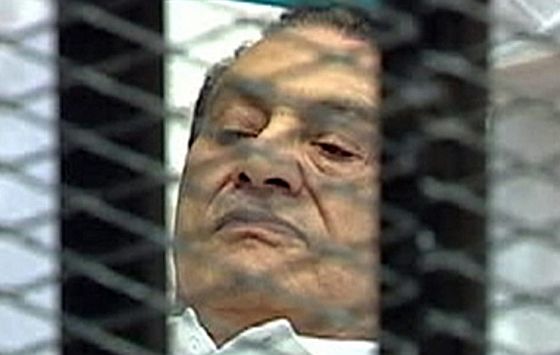
Just when the Arab dictators desperately need to drink the secure, cool waters of an Arab summer, along came the Egyptians yesterday to poison the well. Deep into its depths, those dictators could see a flickering enmeshed face, fragile, fingers playing over its nose and mouth, the arm of a man on a stretcher raised to prevent the light getting too close but – for just a few brief moments – with the same old arrogant eyes. Then the heavy black mike appeared in the man’s left hand. “I am here, your honour,” said a chillingly strong voice. “I have not committed any such crimes.”

Yes, the Egyptians really did put their wretched, ancient dictator on trial yesterday, along with his effete, sullen sons – both dressed in white as if heading for yet another summer tennis party, an illusion broken only by the green Koran under Alaa Mubarak’s arm. An encouragement to his dessicated, 83-year-old father, Hosni? Or an insult to the dead?

The lawyers screamed their clients’ pain; of torture, of snipers, of the murder of Egypt’s own people in the January-February uprising, of the brutality of the security forces, of corruption on a Mafia scale. And to whom else did these terrible charges apply? We thought about Damascus, of course. And Tripoli. And the Bahraini capital of Manama. And of Rabat and Amman and Algiers and Riyadh…

And across the vast, arid wastelands of the Arab despots, the government televisions continued to show game shows and cooking classes and domestic dramas and friendly crowds, all of whom loved their presidents and kings and potentates, who could never – could they? – be accused of these awful crimes. Outside Egypt itself, the only live coverage of the trial was broadcast by post-revolutionary Tunisia and that nemesis of the Mubarak regime and of the United States and of Israel: the Hezbollah’s Al-Manar television.

“Are you Mohamed Hosni Sayed Mubarak?” asked Judge Ahmed Refaat. Or Bachar al-Assad? Or Muammar Gaddafi? Or His Majesty King Hamad? Or even His Highness King Abdullah, Guardian of the Three Holy Places in a place called Saudi Arabia?

Facebooktwittermail

Inside Egypt’s Salafis

Lauren Bohn writes:

“All Americans think I’m a terrorist,” 34-year-old Salafi political organizer Mohammed Tolba exhales with his trademark belly laugh. He grips his gearshift and accelerates to 115 miles per hour down a winding overpass in Cairo. “But I only terrorize the highways.” Since the fall of Egyptian president Hosni Mubarak, Tolba has constantly been on the go. “The media says we all wear galabeyas (long Islamic dress), put our women in niqabs (a face veil), and will cut off people’s hands,” Tolba says, dramatically feigning a yawn. “We’re the new boogey-man, but people need to know we’re normal — that we drink lattes and laugh.”

To this end, the silver-tongued IT consultant shuttles regularly from the modish offices of popular television personality Bassem Youssef (he’s starring in a segment on the “Egyptian Jon Stewart’s” highly anticipated new show) to the considerably less shiny quarters of Cairo’s foremost Salafist centers. He’s been conducting leadership and media-training workshops for Salafis. “These guys don’t know how to talk to the public,” says Tolba, rubbing his eyes in exhaustion. “Once they open their mouths and face a camera, man, they ruin everything.”

The same might be said for their debut on Egypt’s main stage last Friday, as hundreds of thousands of Salafis joined other Islamist groups in Cairo’s Tahrir Square. Droves of people from governorates across Egypt got off buses near Tahrir Square, chanting “Islamic, Islamic, we don’t want secular.” One Salafi, Hisham al-Ashry, beamed with pride as he walked back from the square to his tailor shop downtown. “Today is a turning point, we finally showed our strength.” Meanwhile, “the liberals and the leftists are freaking out. God protect the nation and revolution,” noted popular blogger Zeinobia.

Who are the faces and voices of an oft-deemed bearded and veiled monolith that packed the square? And what exactly do they want?

“Salafi” has become something of a catchall name for any Muslim with a long beard, but Salafism is not a singular ideology or movement with one leader. As Stéphane Lacroix, a French scholar of Islamist movements, explains, it’s more a “label for a way of thinking” guided by a strict interpretation of religious text. Salafis aspire to emulate the ways of the first three generations of Islam. Many Salafis have cultivated a distinctive appearance and code of personal behavior, including untrimmed beards for men and the niqab for women.

The Salafi culture has been growing in Egypt for decades, but until the revolution had little formal political presence. “Satellite salafism” hit Egypt in 2003, with around 10 Salafi-themed TV channels broadcasting from Egypt on Nilesat. The intensely popular Al-Nas, Arabic for the People, began broadcasting in 2006. Its programming focuses on issues of social justice and sermons by prominent Salafi preachers, like Mohammed Yaqoub and Mohammed Hassan, whose tapes and books are common fixtures among street vendors throughout Cairo. Nobody knows exactly how many Salafis there now are in Egypt, but Abdel Moneim Abouel Fotouh, a presidential candidate formerly of the Muslim Brotherhood, recently estimated their number at around 20 times the number of Muslim Brotherhood members (unofficial reports estimate Muslim Brotherhood membership between 400,000 to 700,000 members).

Facebooktwittermail

Egyptians watch in disbelief as Mubarak goes on trial

Al-Masry Al-Youm reports:

In downtown Cairo on Wednesday morning, people huddled around television sets to watch an historical moment unfold as former President Hosni Mubarak, his two sons Gamal and Alaa, and former Interior Minister Habib al-Adly faced trial on charges of murder for killing protesters during the 18-day uprising that led to Mubarak’s resignation.

Their gazes were glued to the TV screens in disbelief as they watched the dictator who ruled them for 30 years lying on a hospital bed inside a cage, wearing the white uniform of a defendant.

In a car parts shop downtown, a dozen people stood chatting and waiting in anticipation. When the former president appeared on screen, the observers cheered. Then suddenly quiet fell on the shop. As the employees of the shop and passersby watched the trial, they demanded complete silence, asking anyone who talked to remain quiet.

Many around Cairo expressed joy that some kind of real justice is being served.

“This is a historic day,” said Islam Khalil, a 28-year-old lawyer. “It shows progress and development of our country. I feel that I took my right and the rights of all those who have been living under his suppression.”

Mostafa, who owns a clothing shop in Bab al-Louk, agreed. “Glimpses of justice are finally starting to show in the country. I do not feel sorry for him. If someone stole LE 100 from you, would you be sorry for that person? What if he stole a whole country?” he said.

Anthony Shadid reports:

The sheer symbolism of the day made it one of the most visceral episodes in modern Arab history. In a region whose destiny was so long determined by rulers who deemed their people unfit to rule, one of those rulers was being tried by his public. On this day, the aura of power — uncontested and distant — was made mundane, and Mr. Mubarak, dressed in white and bearing a look some read as disdain, was humbled.

“The first defendant, Mohammed Hosni al-Sayyid Mubarak,” the judge, Ahmed Rifaat, said, speaking in a wood-paneled courtroom to a cage holding Mr. Mubarak, his two sons, Gamal and Alaa, former Interior Minister Habib e-Adly and six other senior officers.

“Sir, I am present,” Mr. Mubarak replied into a microphone, from his bed.

“You heard the changes that the prosecutor made against you,” the judge said from the podium. “What do you say?”

“I deny all these accusations completely,” he replied, wearily waving his hand.

Then he handed the microphone to his son, Gamal.

The trial began precisely at its start time, 10 a.m. in Cairo. While the other defendants took a seat, Mr. Mubarak’s sons remained standing, the youngest, Gamal, seeming to block the view of his father from the cameras in the courtroom. Mr. Mubarak appeared tired but alert, occasionally speaking with his sons, who both held Korans.

As Mr. Mubarak denied the charges in the proceedings, which were broadcast on a large-screen television outside the police academy, his opponents gathered there roared in disapproval.

“Then who did it?” some asked.

The scene was tumultuous there on a sun-drenched parking lot, with a few dozen of Mr. Mubarak’s supporters sharing space with his opponents. At times, they scuffled; in intermittent clashes, the two sides threw rocks at each other. As Mr. Mubarak arrived at the courtroom, some of his supporters cried, waving pictures that read, “The insult to Mubarak is an insult to all honorable Egyptians.” Others shouted adulation at the screen.

“We love you, Mr. President,” some chanted.

Those sentiments were overwhelmed by the denunciations of his critics, in a trial that seemed to incarnate all the frustrations and degradations of a state that treated its people as rabble. Someone was finally being held to account, many said Wednesday.

Facebooktwittermail

Visions collide in a sweltering Tahrir Square

Sandy Tolan writes:

After midnight the Cairo heat finally broke. Mamdouh Hamza, an Egyptian civil engineer, businessman and longtime government critic, was sitting in a plastic chair in an outdoor café at Tahrir Square, puffing on a water pipe. The white-haired Hamza was holding court with his cadre of young revolutionaries, to whom he’d become a kind of beneficent godfather. My colleague Charlotte and I had met him an hour earlier, having interviewed him for a story on Egyptian agriculture and food issues we’re producing for US public radio and TV.

Hamza – builder of major Egyptian development projects but nevertheless a longtime critic of the regime – had been trying to keep a dialogue going between the military council and his “kids” But recently things had broken down, and that morning at 5am, he said, something disturbing and perhaps unrelated happened: Someone called Hamza to say he’d been hired to kill him. But the would-be hit man had changed his mind – “I like you,” he told Hamza – and so he had given the blood money back. Or so the story went.

Hamza seemed to think this was all a hoax, designed to rattle him, and he had no plans to heed the reluctant killer’s warning: that Hamza shouldn’t show up at the square the next day, lest he take a bullet.

Now came Wael Ghonim, he of the social media revolution, with his own followers, to say hello to Hamza. He engaged the older man about finding common ground with the Islamists. Charlotte caught the moment on camera – a young man in a purple pinstripe shirt and designer wire-rim glasses, talking to the shaggy haired professor nearly old enough to be his grandfather – but when Ghonim spotted Charlotte, he insisted she stop shooting. “If you use this,” he said, “I will sue you”. It wasn’t that he didn’t want to be seen speaking of reconciliation with the Islamists; rather, a friend reported, he said he didn’t want to be caught on camera being friendly with Hamza, a fellow secularist.

“If you use this, I will sue you,” the Google MBA repeated to Charlotte, a smile frozen onto his face, before moving off with his entourage.

Signs of strains between secular and Islamic forces have been showing for months. But both sides were expected to be represented in Friday’s mass demonstration. Hamza predicted between 800,000 and a million people would show up.

At two in the morning we headed back downtown to catch a few hours sleep. As we climbed into the taxi, the bearded Salafis, bussed in from all over the nation, were pouring single file into the square: a stream of white robes and skullcaps, part of a planned show of force by Islamists. They would be spending the night in the square, ready with their banners and chants as the sun rose on Cairo three hours later.

Facebooktwittermail