Not even Egypt’s interim military rulers know when they plan to relinquish power to a new civilian government, the United States ambassador to Egypt, Anne W. Patterson, said Tuesday.
Speaking at a news conference here with Defense Secretary Leon E. Panetta after he met with the Egyptian military leaders, Ms. Patterson offered an unusually candid assessment of the haze over Egypt’s path toward democracy after the revolution that ousted President Hosni Mubarak eight months ago.
Asked if American officials knew whether the Egyptian military council intended to turn over power at the seating of a newly elected Parliament in March, or the planned adoption of a new constitution later in 2012, or the election of a president some months beyond that, Ms. Patterson said, “I don’t think, frankly, the military knows or anyone else knows.”
“This process has really been fraught with uncertainty from the very beginning and decisions are often made on a day-to-day basis, so I would expect that to continue for a while,” she added.
Maikel Nabil, a blogger and activist imprisoned by a military court since late March, has entered day 41 of his open-ended hunger strike.
“Death is better than living in an oppressive country,” Maikel told his brother Mark the last time he saw him on his 26th birthday on Saturday.
Fearing that Maikel might die as his health deteriorates, Mark told Daily News Egypt his older brother might not live to make it to his court appeal on Tuesday, Oct. 4.
After being sentenced to three years in prison for “insulting” the army and “spreading lies” about Egypt’s armed forces, Maikel has refused food and is only drinking water.
Mark said Maikel went from weighing 60 kilograms to 47 since he went on hunger strike.
Currently approaching kidney failure, Maikel is having trouble speaking and walking. He has also vowed to stop drinking water if his upcoming court appeal does not go in his favor.
Civil society is an essential component of any democracy and it will be a key factor in determining the success of the democratic transitions now underway in the Middle East and North Africa. In his May 19 speech, President Barak Obama identified “a vibrant civil society” as one of four areas in which Egypt and Tunisia should set a strong example for the region. Speaking to a global forum in Sweden last month, Secretary Hillary Clinton described civil society as “a force for progress around the world,” while noting that “in too many places, governments are treating civil society activists as adversaries, rather than partners.” Sadly, nowhere is that now more true than in Egypt, where the ruling Supreme Council of the Armed Forces (SCAF) has steadily escalated a campaign against this community which is even more repressive than during the Mubarak era.
Unlike neighboring Libya and Tunisia, in which civil society was almost nonexistent prior to the revolutions of this year, Egypt has thousands of longstanding civil society organizations. Under Mubarak, the vast majority of these groups avoided any political issues, human rights concerns, or criticism of the Mubarak regime, instead focusing on issues such as health, education, and family welfare. The small subset of these groups that dared to work on political issues or human rights abuses were often the target of government harassment, interference, and intimidation. In the weeks following Mubarak’s fall, Egyptian NGOs were eager to play a broader role and to help guide the political processes during Egypt’s transition. Unfortunately, frustration set in quickly as the SCAF appeared to entirely ignore the views of civil society in its decision-making process. Tensions grew throughout the spring as the SCAF continued to ignore the demands and recommendations of civil society actors and increasingly sought to undermine their reputation with the Egyptian public, primarily through stories in the state-run media implying that Egyptian NGOs are working on behalf of foreign agendas.
In recent months, the SCAF has dramatically escalated these attacks on civil society. On July 12, Minister of International Cooperation Faiza Abul-Naga announced that the government would establish a commission of inquiry to investigate the funding of civil society organizations. Only two weeks later, state-owned October magazine ran a cover story — illustrated with a crude depiction of U.S. Ambassador to Egypt Anne Patterson burning Tahrir Square with flaming U.S. dollars — that accused the United States of undermining Egypt’s revolution by funding civil society organizations.
A newly assertive Turkey offered on Sunday a vision of a starkly realigned Middle East, where the country’s former allies in Syria and Israel fall into deeper isolation, and a burgeoning alliance with Egypt underpins a new order in a region roiled by revolt and revolution.
The portrait was described by Foreign Minister Ahmet Davutoglu of Turkey in an hourlong interview before he was to leave for the United Nations, where a contentious debate was expected this week over a Palestinian bid for recognition as a state. Viewed by many as the architect of a foreign policy that has made Turkey one of the most relevant players in the Muslim world, Mr. Davutoglu pointed to that issue and others to describe a region in the midst of a transformation. Turkey, he said, was “right at the center of everything.”
He declared that Israel was solely responsible for the near collapse in relations with Turkey, once an ally, and he accused Syria’s president of lying to him after Turkish officials offered the government there a “last chance” to salvage power by halting its brutal crackdown on dissent.
Strikingly, he predicted a partnership between Turkey and Egypt, two of the region’s militarily strongest and most populous and influential countries, which he said could create a new axis of power at a time when American influence in the Middle East seems to be diminishing.
“This is what we want,” Mr. Davutoglu said.
“This will not be an axis against any other country — not Israel, not Iran, not any other country, but this will be an axis of democracy, real democracy,” he added. “That will be an axis of democracy of the two biggest nations in our region, from the north to the south, from the Black Sea down to the Nile Valley in Sudan.”
Turkish Prime Minister Recep Tayyip Erdoğan has reiterated his response to Arabs who were discontent with the prime minister’s call to build a secular state, saying that his words were mistranslated and that secularism does not mean being against the religion.
Erdoğan’s ruling Justice and Development Party (AK Party), which was successful in marrying Islam and democracy, has become a model for much of the Egypt’s Muslim Brotherhood and other political groups such as Tunisia’s long banned Ennahda movement, as they prepare for the first free vote since decades-old rule in Egypt and Tunisia were ended earlier this year.
Erdoğan spoke about secularism in Egypt earlier this week, saying Turkey prefers a model of secularism that is not identical to the “Anglo-Saxon or Western model,” without elaborating. “Individuals cannot be secular, states are. A devout Muslim can successfully govern a secular state,” Erdoğan then said.
Erdoğan, while speaking in Tunisia about secularism, said his “secularism” term was translated as “irreligiousness” in Egypt that caused a confusion among Arabs. He offered an explanation for the Muslim Brotherhood’s anger at his words in Cairo and said his words were misunderstood because of a translation mistake.
Asked about his secularism remarks in Libya on Friday during a press conference with Libya’s National Transitional Council (NTC) leader Mustafa Abdel Jalil, Erdoğan reiterated that his remarks were mistranslated and that secularism is not about being an enemy of religion.
Tomorrow is is set to be the “Friday of Deafening Silence,” the latest in “million-man” protests to take place since Hosni Mubarak was deposed on February 11. Yes, it’s a silly name. But this could be one of the more important protests that has taken place in a while.
Unfortunately, the picture has been muddied by last week’s break-in at the Israeli embassy and the raids on interior ministry facilities, which are in part reported to have been attempts at destroying criminal records, etc. Considering the rather surprising reaction to the embassy incident — almost unanimous condemnation by political parties, activist groups, media figures, etc. including many Islamists of the embassy break-in and the other events of the day — the current atmosphere is somewhat confused. On the one hand, last week’s incidents have really driven home the need (and perhaps even more importantly, the public’s desire) for greater order, and the difficult task of simultaneously empowering the ministry of interior to do its job and reforming it.
The ruling SCAF’s reaction to the events, though, are a turn more dramatic and dangerous than the embassy break-in itself. The SCAF has decided not only to reinstate the full force of the Emergency Law Mubarak and his police used to rule for 30 years, but also Mubarak-like restrictions on media and other sundry measures, such as criminalizing (again, under the Emergency Law) “attacks on freedom of work”. At a time when workers’ movements are gathering in a steadily growing number of strikes (teachers, postal workers, etc.) to insure that the social part of the revolution makes gains, it is plain that SCAF is using the embassy incident to advance a draconian security agenda. Combined with the lingering debate over the electoral law, the lack of clarity on the transition process (notably suggestions that SCAF may handpick the members of a constituent assembly and the lack of a date for the presidential elections) and the unresolved question of the use of military tribunals (which may be replaced under the emergency law by “Emergency Courts” which are equally problematic), one gets the sense of “Mubarakism without Mubarak.”
The Egyptian military authorities’ expansion of the emergency law is the greatest erosion of human rights since the resignation of President Hosni Mubarak earlier this year, Amnesty International said today.
The Supreme Council of the Armed Forces (SCAF) broadened the application of the Mubarak-era emergency law early this week following clashes between demonstrators and security forces at the Israeli embassy last Friday. The confrontation resulted in three reported deaths and some 130 arrests.
Restricted in 2010 to terrorism and drug crimes, the emergency law has now reverted to its original scope, covering offences that include disturbing traffic, blocking roads, broadcasting rumours, possessing and trading in weapons, and “assault on freedom to work” according to official statements.
“These changes are a major threat to the rights to freedom of expression, association and assembly, and the right to strike,” Philip Luther, Amnesty International’s Deputy Director for the Middle East and North Africa. “We are looking at the most serious erosion of human rights in Egypt since Mubarak stepped down.”
“The military authorities have essentially taken Egypt’s laws back to the bad old days. Even President Mubarak limited the scope of the emergency law to terrorism and drug offences in May last year,” said Philip Luther.
“Which prosperous ally gets $3 billion a year in aid, and a veto power over America’s entire Mid-East foreign policy? Which ally refuses to cooperate with its military and political protector – even to the point of humiliating a duly elected American president? Which ally violates the Non-Proliferation treaty and manages to get its super-power protector to maintain total silence on this glaring fact? Which ally is threatening conventional warfare if its own nuclear monopoly in the region is in any way threatened?” asks Andrew Sullivan.
“Israel is the exception to every rule. And its intransigence is beginning to force the US toward a horrible choice between allying ourselves with the tectonic democratic forces in the region, or backing a fundamentalist-dominated state bent on expansion and war.”
Sullivan hasn’t turned into a fringe anti-Zionist blogger. He’s merely echoing views that are expressed much more freely in Washington than mainstream media reports generally reveal.
Robert Gates, having served as defense secretary for both presidents Bush and Obama, clearly wasn’t a political maverick when he ran the Pentagon, yet his assessment of Israel was no less blunt than Sullivan’s.
In a meeting of the National Security Council Principals Committee held not long before his retirement this summer, Gates coldly laid out the many steps the administration has taken to guarantee Israel’s security — access to top- quality weapons, assistance developing missile-defense systems, high-level intelligence sharing — and then stated bluntly that the U.S. has received nothing in return, particularly with regard to the peace process.
Senior administration officials told me that Gates argued to the president directly that Netanyahu is not only ungrateful, but also endangering his country by refusing to grapple with Israel’s growing isolation and with the demographic challenges it faces if it keeps control of the West Bank. According to these sources, Gates’s analysis met with no resistance from other members of the committee.
Gates has expressed his frustration with Netanyahu’s government before. Last year, when Vice President Joe Biden’s visit to Israel was marred by an announcement of plans to build new housing units for Jews in East Jerusalem, Gates told several people that if he had been Biden, he would have returned to Washington immediately and told the prime minister to call Obama when he was serious about negotiations.
Even so, having thoroughly alienated himself from the Obama administration, who does Netanyahu turn to in a desperate situation?
Former Director of the Mossad Efraim Halevy, speaking in New York on Monday night, described the predicament the Israeli prime minister found himself in on Friday as protesters in Cairo were storming the Israeli embassy and six Israelis remained trapped inside.
[Netanyahu] turned to one man, to the President of the United States, and he spoke to him. And the president of the United States, without having much time to consult with Congress, and with the media, and with the analysts and with all of the other people who have to be consulted on major and grave decisions. He took a decision to take up the telephone and get on the line with the powers that be in Egypt, and get them to order the release of these six people, and the detail of the Egyptian commando forces entered and saved them.
I think that this decision by President Obama was a unique decision in many ways. Because I don’t have to tell you, and this was just said time and time and over again this afternoon/this evening, that the United States is not in a position the way it was many years ago in the Middle East, it has its problems, it has its considerations, and rightly so. But I believe the leadership that the President of the United States showed on that night was a leadership of historic dimensions. It was he who took the ultimate decision that night which prevented what could have been a sad outcome—instead of six men coming home, the arrival in Israel of six body bags.
And I want to say to you very openly and very clearly that had there been six body bags, there would have been a much different Israel today than we have been used to seeing over recent years. This would not have been one more incident, one more operation, one event. And the man who brought this about was one man and that was President Barack Hussein Obama.
And I believe it is our duty as Israelis, as citizens of the free world, to say, not simply thank you President Obama, but also we respect you for the way and the manner in which you took this decision.
Note first the ominous way in which Halevy says that had these Israelis died this would not have been “one more incident” — unlike, say, the deaths of six Egyptian border guards shot by Israelis in late August, or the deaths of nine Turkish activists killed by Israeli commandos on board the Mavi Marmara just over a year ago.
But note also that Israel, while pursuing what a senior Israeli official describes as a “porcupine policy” to defend itself, when caught in this particular corner found its prickles of no use and instead was compelled to turn to its only reliable protector, the United States.
As Tzipi Livni, the head of the Kadima Party, told Goldberg: “For Israelis, when they wake up in the morning and ask themselves, what is the general situation today, the litmus test for them is the health of the relationship between Israel and the United States.”
And thus we see the contradiction which is Israel — forever pumping itself up, flexing its muscles and showing its neighbors that no one should risk messing with the mighty Zionist state, yet all the while knowing that without the protection of the United States, Israel’s survival would depend on a revolutionary transformation.
Absent American protection, Israel, for the first time, would have to seriously take on the challenge of getting along with its neighbors and not, as it has for the last two decades, simply use diplomacy as a facade behind which it can pursue its policies of territorial expansion.
Is the West’s spoiled child ready to grow up? And is the United States ready to see that its own patronage is what has allowed the Jewish state to trap itself in such a prolonged adolescence?
Turkish Prime Minister Recep Tayyip Erdogan on Monday called on Egyptians to adopt a secular constitution, noting that secularism does not mean renouncing religion.
A secular state respects all religions, Erdogan said in an interview with the private satellite TV channel Dream before heading to Egypt for a two-day visit.
“Do not be wary of secularism. I hope there will be a secular state in Egypt,” Erdogan said.
He stressed that people have the right to choose whether or not to be religious, adding that he is a Muslim prime minister for a secular state.
Erdogan said Egypt needs to meet some requirements for establishing a modern state, including better management of human resources, more attention to education, improved management of financial resources and eliminating corruption.
Erdoğan, visiting Egypt at the start of a North Africa tour, said Israel continued taking steps that undermine its own legitimacy, noting that it killed nine Turks on an aid ship trying to break the blockade of Gaza last year and more recently shot dead five Egyptian soldiers.
He reiterated that a UN report defending the Israeli blockade of Gaza as legal was “null and void” for Turkey and insisted that Turkey’s relations with Israel will not return to normal unless Israel apologizes for the 2010 raid, pay compensation for families of the victims and lifts the blockade of Gaza.
“Turkey does not recognize the Gaza blockade,” Erdoğan said, reiterating that Turkey will take measures to ensure freedom of navigation in the eastern Mediterranean and vowed that Turkey will press for an International Court of Justice review of the blockade.
“States, just like individuals, have to pay the price for murders, for acts of terrorism they committed so that we can live in a more just world,” he said.
The Turkish prime minister also said the Israeli-Palestinian conflict was a “matter of humanity” and added that the current status quo can no longer be maintained. He vowed support for Palestinian efforts for recognition at the UN General Assembly. “Our Palestinian brothers should be able to have their own state. It is time for the flag of Palestine to fly at the UN,” he said, calling on the Arab League countries to support the Palestinian bid.
Turkey’s Military Electronics Industry (ASELSAN) has produced a new identification friend or foe (IFF) system for Turkish jet fighters, warships and submarines and the new software, contrary to the older, US-made version, does not automatically identify Israeli planes and ships as friends, a news report said on Tuesday.
The new IFF has already been installed in Turkish F-16s and is expected to be installed in all Navy ships and submarines, the report, published in Turkish daily Star, said. It will be fully operational when it is installed in all military planes, warships and submarines.
The F-16 jet fighters, purchased from the US, came with pre-installed IFF software that automatically identifies Israeli fighters and warships as friends, disabling Turkish F-16s from targeting Israeli planes or ships. ASELSAN-made IFF will allow Turkish military commanders to identify friends and foes on the basis of national considerations.
Turkey was unable to make modifications to the friend or foe identification codes in US-made F-16s, while Israel was given a different version of the software allowing Israeli authorities to make modifications. Israel was also authorized to view the version given to Turkey, according to Star.
Egyptian activists and politicians accused the ruling military leaders of breaking a promise to end emergency law, after authorities said they would reintroduce special security courts following an attack on the Israeli embassy.
Eight months after protesters toppled President Hosni Mubarak and the military took power on an interim basis, many supporters of the protest movement say they are concerned that the military rulers are backsliding on reform pledges.
Ending emergency law, seen as a tool of Mubarak’s repression, has long been a key demand.
Israel pulled its ambassador out of Egypt after protesters stormed the building housing Israel’s embassy on Friday night.
Egypt’s military rulers said they would try suspects in emergency state security courts. Emergency law would now apply in cases such as blocking of roads, publishing false information and weapons possession, they said.
The measures add to a list of developments that activists say worry them, including the banning of cameras from important trials including that of Mubarak himself, and the army’s failure so far to set a firm date for a parliamentary election.
“The new procedure violate the constitutional decree that the military council issued after Mubarak, in which it pledged to end the state of emergency within six months and said a public referendum had to take place for it to be extended,” Mohamed Adel, leader of the April 6 youth group, told Reuters.
“Egyptian law has many rules against thugs and terrorism, so I still don’t see a reason to extend emergency law,” he added.
Presidential candidate Mohamed ElBaradei said: “It is the normal right of every Egyptian to be tried in front of an ordinary judge, but it is unfortunately not what we see as we are relying more on military and extraordinary courts.”
Emergency law was widely applied under Mubarak’s rule to stifle opposition. The law, in place for decades, gives the state ultimate powers to question or detain citizens.
It was due to be lifted before the parliamentary election which is expected anytime starting November. No poll date has yet been set, although the army has said procedures for a vote, such as voter registration, will start in September.
The Muslim Brotherhood, one of Egypt’s most organised political groups, condemned the use of emergency courts in one of its strongest statements against the military to date. The group, expected to benefit from an early vote, has tended to take a softer line than other activists in the past.
“We confirm our rejection of any attempt to abuse the events to issue martial laws or decrease the margin of freedoms,” the group’s political wing, the Freedom and Justice party, said.
The Islamist group condemned violence by protesters targeting the embassy and other police sites, but also blamed the army for not taking a tough enough stance against Israel.
Presidential hopeful and former Brotherhood leader Abdel Moneim Abul Futuh said he feared the new security measures were “part of a pre-prepared scenario to take over the revolution.”
“I warn the governing power in Egypt against moving forward in this path. And I hope everyone knows the Egyptian people will not allow such scenarios and will not allow their revolution to be aborted.”
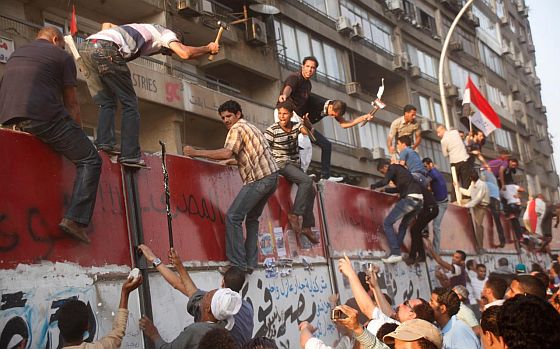
Egyptians marched on the Israeli embassy in Cairo on Friday, demolished a wall built around the embassy building to protect it and stormed the Nile tower block that houses the mission.
Egyptian security forces raided the offices of an Egyptian affiliate of the Al Jazeera news network known for attentive coverage of street protests, eliciting allegations on Sunday of a crackdown on the news media as the military-led transitional government seeks to ensure law and order after allowing an angry mob to invade the Israeli Embassy over the weekend.
The raid on the television network came as both the Egyptian and Israeli governments began tentative steps to repair the diplomatic breach between the awkward allies after the embassy attack on Friday night.
The raid also came after a warning last week by Egypt’s minister of media, Osama Heikal, that the government would take legal action against stations that “endanger the stability and security” of the nation, and some analysts said they feared the raid could signal a broader effort to curtail the new freedoms of expression experienced since the uprising that ousted former President Hosni Mubarak this year.
The network, Al Jazeera Live Egypt, was founded in the aftermath of the uprising and has become known for its attentive, if not sensational, coverage of street protests, including the Israeli Embassy attack on Friday. The raid forced the network to halt its programming for a period before it resumed broadcasting from Al Jazeera’s headquarters in Doha, Qatar.
Officials of the Interior Ministry said they had raided the network because it lacked a license, and that neighbors had complained about noise. Numerous satellite channels have sprung up since the revolution, and Mr. Heikal, the media minister, said in his statement last week that the government would stop issuing new permits because of concerns about broadcasts that endangered stability.
But Islam Lotfy, a lawyer for the channel, said the channel had applied for a license in March without a response.
According to identical accounts offered by Egyptian officials and foreign diplomats in Cairo, Egypt had asked Israel before the developments of last Friday to keep the Israeli ambassador in Tel Aviv and to reduce the volume of its staff to the minimum, but Netanyahu insisted on sending the ambassador back only a few days before the latest protest.
“We are not expelling him, but we thought a long holiday for the Israeli ambassador in Egypt would be useful for all of us now; unfortunately, Israel thought otherwise and when anger erupted on Friday evening they had to solicit the intervention of the Americans who sent a plane to carry him and the rest of the staff out of Egypt,” said one official.
Today, there is a tacit agreement between Egypt and Israel that the long holiday for the ambassador is in place and there are guarantees offered by Cairo to both Washington and Tel Aviv that stepped up security measures will be in place to prevent another attack on the embassy.
In the Islamist Al-Dawa Al-Salafiya (Salafist Call) reaction statement to the protesters’ storming of the Israeli embassy in Cairo on 9 September, they slammed the attack as “not thought-out,” which will work in the favour of Israel.
The Salafist movement claims that the 9 September mobbing of the embassy “will work in favour of Israel and will transform them from perpetrators to victims and the focus will shift from our demands to amend the Camp David agreement to Israel’s calls for help to protect their embassy in Egypt.”
The movement also pointed out that the “Egyptians are united in their hate for Israel (thank God). We must fight cultural normalisation [with Israel] and we should push for the international isolation of Israel.”
The group also condemned the statement released by President Obama in which he told Egypt to “honour its international obligations to safeguard the security of the Israeli embassy,” and reminded the US president that Egypt has changed after the January 25 Revolution.
The statement also claimed that most of the calls for violence are actually from a US-backed ex-police officer, Omar Afifi, who resides in the US and uses the internet to incite divisions in Egypt.
The Israeli government must be exhilarated that it is no longer being held responsible for the chaotic events taking place in Egypt. Instead they are now being portrayed as victims of a different “foreign hand,” which sponsored the storming of their embassy in Cairo.
Friday’s incident at the Israeli Embassy, in which thousands of angry protestors – surprisingly – managed to storm the embassy, is being portrayed by Egypt’s flagship newspaper Al-Ahram as fueled by elements of the “counter-revolution” that seeks the fall of the Egyptian state.
In its main headline, the paper speaks of “the involvement of a number of neighboring countries in providing ‘huge beyond imagination’ funds to Egyptian NGOs.”
Justice Minister Abdel Aziz al-Guindi told Al-Ahram that a country from the Gulf gave LE181 million to a small Egyptian NGO.
Guindi added that he has received a report that shows that several neighboring countries have offered million of pounds to Egyptian human rights and civil society organizations, some of which are not registered.
He also said that he has submitted a report to the head of the Supreme Council of the Armed Forces (SCAF) and the prime minister to take appropriate action against the inflow of funds, adding that the cabinet will announce the report’s findings within the next few days.
Guindi added that these “foreign hands” – and local ones – have been behind other incidents of violence in Egypt, seeking to sabotage state institutions, undermine national security, and intimidate citizens.
One might cast doubt over the relationship between the demonstrations in front of the Israeli Embassy and a small NGO receiving millions of pounds, but Al-Ahram doesn’t address such logical inconsistencies.
An editorial in the same paper echoes the article’s sinister tone, with a lead blaring, “The secrets of the plot facing Egypt.”
It reads, “Today, the details of the plot facing Egypt are appearing. The plot doesn’t challenge the Egyptian revolution only; more dangerously, it aims to make Egypt reel in chaos.”
Following the events at the Israeli Embassy, the Egyptian government announced its intent to fully implement the decades-old Emergency Law.
It’s easy to forget that the repeal of the state of emergency was a top demand of protesters who took the streets against former President Hosni Mubarak in January and February. That mood has clearly changed now, although the SCAF declared last month that they had begun the process of ending the state of emergency before parliamentary elections that are expected to be held in November.
Despite this very fact, state-run Al-Gomhurriya praised the move of fully implementing the exceptional measures enshrined in the widely-reviled law. The newspaper runs a lengthy feature quoting “legal experts” defending the re-implementation of the law, saying that such a move would restore the prestige of the state and its stability.
At some point, will it dawn on the Israelis that constructing walls is not the magic solution to all their security problems?
After Israel enraged many Egyptians by killing five border guards on August 18 (a sixth who was shot in the same incident died today), the Israeli government thought it would be prudent to install a 15-foot concrete barrier around its embassy in Cairo.
The construction of a wall outside the embassy was almost a provocation to people to come and bring it down. The symbolism of a wall was not lost on any one and merely angered people.
After protesters stormed the embassy on Friday night, Egyptian authorities only moved in to protect the Israeli staff after the Obama administration interceded on Israel’s behalf. Even then, it took two hours before U.S. Secretary of Defense Leon Panetta was able to speak to Supreme Military Council head Mohamed Hussein Tantawi.
“There’s no time to waste,” Panetta reportedly told Tantawi in the 1 A.M. call, warning of a tragic outcome that “would have very severe consequences.”
The U.S. source also said that Tantawi failed to answer incoming calls from U.S. officials throughout the evening, finally answering after more than two hours of attempts.
Nominally, Egypt is one of Israel’s only allies in the Middle East, but as Israelis are now acutely aware, there’s a big difference between an alliance with Hosni Mubarak and cordial relations with the Egyptian people.
Israel has now pulled out all its embassy staff and their families leaving behind just one diplomat, its deputy ambassador who has taken refuge at the US embassy.
The flight of the Israelis from Egypt comes just a few days before Turkish Prime Minister Recep Tayyep Erdogan is about to arrive in Cairo where he will address a meeting of Arab foreign ministers on Tuesday. Some reports say that he might travel from Cairo for a brief visit to Gaza.
The only surprising thing about the breach of the Israeli embassy in Cairo is that it never happened any time before in the past 30 years. In a city that abounds in isolated walled desert compounds, someone decided to put the most often marched-upon facility in Egypt in a quite ordinary apartment building in the heart of the city, whose defenses basically consist of however much force the security services/army choose to deploy on the street that particular day. Throughout the 1990s, at least once a year, students from nearby Cairo University staged a half-hearted attempt to storm the place. The hardcore “Ultra” football club fans who seemed to be a major contingent of yesterday’s crowd may simply have been more persistant than your usual Cairo demonstrators — partially because the self-styled “commandos of the revolution” (whose subculture is described by Ursula below) are used to fighting with police, and partially because they claimed to have one of their own dead to avenge, supposedly killed on Tuesday night post-match battle between Ahly club fans and police on Saleh Salem Road that started when police charged the stands in response to taunting chants.
So, rather than being satisfied with a few hours of melee with the police and military, they kept up the battle until late into the night, until eventually some got inside the building and up to the reception area. Meanwhile, other protesters tried to storm the Giza security directorate, reportedly after a police car leaving the scene ran down two demonstrators. The deaths were a tragedy, but I don’t think that this quite constitutes an international crisis.
I was at the Tahrir demo earlier in the day, and although the Ultras were a heavy presence, and although small groups approached the nearby Interior Ministry from time to time, most of them responded pretty quickly to the “Peacefully! Peacefully!” chants from the crowd. In fact, part of the reason that the Ultras were there seemed to be that they wanted to be taken seriously as an aggrieved constituency — a huge banner reading “Ultras are not criminals!” hung in the square. Ultras in the crowd said that while they were used to demonstrating, today they came specifically on account of their own grievances: specifically, police brutality, and the referral of civilians to military trials. (Activists following the military trials says that military prosecutors tend to pick on working class kids who aren’t connected to one of the mainstream movement, so I’m guessing that includes a lot of Ultras.). “I used to come to Tahrir for the sake of the nation, but now for the first time I’m here as an Ultra,” one Ahli fan said.
A group of about 30 protesters broke into the Israeli Embassy in Cairo Friday and dumped hundreds of documents out of the windows after a day of demonstrations outside the building in which crowds swinging sledge hammers and using their bare hands tore apart the embassy’s security wall.
Israel’s ambassador, Yitzhak Levanon, his family and other embassy staff rushed to Cairo airport and left on a military plane for Israel, said airport officials who spoke on condition of anonymity because they were not authorized to speak to the media.
Israeli officials refused to comment on the ambassador’s departure.
Hundreds of protesters converged on the embassy throughout the afternoon and into the night, tearing down large sections of the graffiti-covered security wall outside the 21-story building housing the embassy. Egyptian security forces made no attempt for hours to intervene.
Just before midnight, a group of protesters reached a room on one of the embassy’s lower floors at the top of the building and began dumping Hebrew-language documents from the windows, said an Egyptian security official who spoke on condition of anonymity because he was not authorized to speak to the media.
In Jerusalem, an Israeli official confirmed the embassy had been broken into, saying it appeared the group reached a waiting room on the lower floor. He spoke on condition of anonymity because he was not permitted to release the information.
No one answered the phone at the embassy late Friday.
Meanwhile, U.S. President Barak Obama spoke with Prime Minister Benjamin Netanyahu about the situation at the Israeli Embassy in Cairo.
The President’s office said in a statement that Obama expressed great concern about the situation at the Embassy, and the security of the Israelis serving there.
The statement said Obama “reviewed the steps that the United States is taking at all levels to help resolve the situation without further violence, and to call on the Government of Egypt to honor its international obligations to safeguard the security of the Israeli Embassy.”
Obama and Netanyahu agreed to stay in close touch until the situation is resolved.
A month after an unusual terror attack killed eight Israelis along a desert highway approaching the Red Sea, the incident remains shrouded in mystery, especially in Gaza, where Israeli officials insist the complex, military-style attack was orchestrated but where no group has taken responsibility. “Usually the problem is more than one group takes credit after a successful operation,” says Taheri Al-Nunu, a spokesman for Hamas, the militant group that governs Gaza. Hamas had immediately denied knowledge of the attack, and hurriedly surveyed the other militant groups operating in the enclave. “All of them denied it.”
Among them was the Popular Resistance Committees, the group Israel almost immediately blamed for the attack, and promptly launched what it called a reprisal strike. Before the fighting was finished in the desert outside the resort city of Eilat, a missile from an Israeli drone exploded outside a house in Rafah, near the Egyptian border. The PRC’s top commander and two aides were killed, as well as a two-year-old child.
Afterward, the group continued to deny responsibility — also unusual in a society that celebrates lives lost opposing the Israeli occupation. As a senior Hamas official put it, with a frown: “After their leaders were killed, you would expect people to be proud.”
Israeli security officials tell TIME that the link to the PRC was as clear as the orders they monitored in real time from Gaza to the Sinai Peninsula where the militants waited in ambush. In a new detail, one official states that two of the five bodies recovered after the fighting have been identified as Gaza residents. The official did not say how the identity was confirmed, which will do little to end speculation about the incident.
“If the Israelis have any proof, give it,” says Ahmed Yusuf, a former Hamas official who now runs a Gaza think tank. “I met with these people for the Popular Resistance. They said, ‘We want to distance ourselves from what happened in Eilat and wondered why they were threatening us.'”
The Israeli embassy in Cairo is tucked away on the top two levels of a twenty-one-floor residential tower ten minutes from Tahrir. It is flanked by graying buildings and a usually traffic-clogged bridge. Nearby are Cairo University and the National Zoo. In the past, its busy location served it well; it was inconspicuous, and under Mubarak, the security around the building was so tight that even reaching the barricades surrounding it felt like a feat. In one of the more revealing signs of change in the New Egypt, however, it has now become the focus of the public’s attention and the site of unobstructed demonstrations.
On August 18, when Israeli forces opened fire in the direction of Egypt’s border, killing five conscripts, hundreds of angered Egyptians spontaneously marched to the embassy in protest. The Israeli shooting had been triggered by an attack on two buses heading from Bersheeba to Eilat; Israeli authorities alleged that the fleeing assailants were Palestinians who had taken advantage of the security vacuum that has emerged in Egypt since the revolution to infiltrate Israeli territory from Gaza via the Sinai. The protesters were outraged; both at the “accidental” killing of the soldiers, and at the implication that it was Egypt’s fault. The army was swift to deploy additional force to protect the already high-security embassy when the news broke, and alongside the usual concrete barricades and corrugated metal shields, there were now tanks, riot police, and rows of armed soldiers. “Give us your guns and send us to Sinai,” the protesters shouted at them. “The blood of our soldiers will not be in vain. Egyptian blood is not cheap.” The soldiers simply stood by.
With Mubarak now gone, many of his business cronies (including his close friend Hussein Salem, who orchestrated the gas deal) behind bars, and the nation in the grips of a new kind of nationalism, the question of what will become of relations with Israel has become critical. For the ruling Military Council, adhering to Camp David comes at a cost, but until it finds a better alternative—one that includes strategic training, resources, and intelligence support, as well as regional security guarantees—it is worth the price.
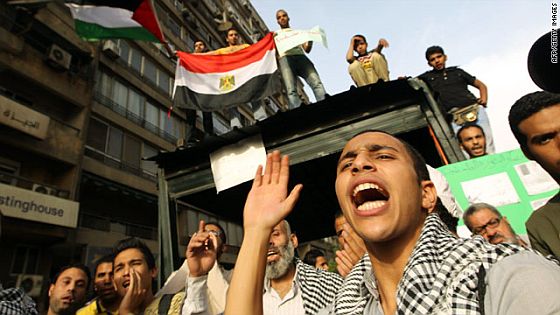
But for all the major contenders for Egypt’s new civilian leadership—including both secular and Islamist candidates—the status quo is as intolerable as Mubarak himself. Indeed, since the fall of Mubarak, almost every political question—from the referendum and the rules for forming parties to the new constitution—has been controversial and divisive. Yet on the Israel issue there has been a wide consensus. In front of the Israeli embassy last week, westernized, English-speaking activists stood side-by-side with Salafis, Muslim Brothers, working class Egyptians, and educated elite. As someone pointed out, this was a “mini-Tahrir.”
On August 20, even as the government was figuring out its own response to the killings, a group of political parties and presidential hopefuls met at the headquarters of the Islamist Al-Wasat party to discuss “how to handle the Israeli question.” The coalition was not only Islamist: it included Amr Moussa, Ayman Nour, Hisham Al-Bastawisi, George Ishaq, and representatives of the Al-Wafd, Al-Ghad, El-Hadara, El-Asala and El-Nahda Parties. After the meeting, the group announced that the Mubarak regime, which was a “strategic treasure” to Israel, is gone forever. “It has been replaced by a strong nation that doesn’t know weakness and knows how to get justice for the blood of its martyrs. In the face of this crime, the Egyptians have united across ideologies, political parties, police and army and put aside their differences for the sake of the nation.” The coalition announced a list of eight demands to be handed to SCAF. They include banning Israeli naval forces from passing through the Suez Canal, raising Egyptian armed forces presence in Sinai, and reconsidering the gas deal.
Government sources have since told me that SCAF and the interim cabinet are being “forced to seriously consider” public demands to reset its Israel policies and that “discussions are taking place.” Troop allowances in the Sinai are likely to be where the interim government presses for change, as well as re-examining the controversial gas deal. “What the Egyptian public wants is important, but many of the demands are too drastic—they would escalate a situation in ways nobody would want,” Major-General Badin told me by phone last week.
The Israeli embassy sit-in was suspended on August 27, one day after a “million man march” in which 8,000-odd protesters demonstrated in Cairo, Alexandria, and governorates across Egypt. Although the Israeli ambassador was not asked to leave and the Egyptian envoy to Israeli was not recalled, the protesters could claim a few successes. The Israelis had issued several statements of apology and regret, a joint investigation had reportedly begun, more Egyptian troops would be allowed into the Sinai’s Zone C (an area on the eastern border of Sinai where only limited and light-armed Egyptian police presence is allowed according to Camp David).
Perhaps most significantly (and despite general Badin’s insistence that it wouldn’t) the flag over the Israeli embassy had in fact been removed: a young Egyptian, Ahmad El-Shahat scaled the 21-story building and brought it down on the night of August 21, replacing it with an Egyptian one. The “Flagman,” as he came to be known, instantly became a national hero. Hamdeen Sabahi, the presidential hopeful and head of the Karama party, sent “a salute of pride to Ahmad El-Shahat, the public hero who burned the Zionist flag that spoiled the Egyptian air for 30 years.” The governor of Sharqiya, just east of Cairo, honored Shahat with an apartment and job. Across the Arab world too, he was hailed. For seven days, the army left the Egyptian flag on the building, but foreign ministry officials were quick to tell me that “it won’t last. The army is letting the protesters vent steam. Give it a week, the [Israeli] flag will be up again.”
On August 29, at 2:37 PM, it happened. A middle-aged man stuck his head out of the window of the Israeli embassy building’s twentieth floor, scanned the streets and bridge and horizon for possible protesters, and when the coast seemed clear replaced the by-then tattered Egyptian flag with a crisp new Israeli one. A security guard at a building next door who witnessed it said it took about seven minutes. It took about half that time for the news to spread. On Twitter and Facebook, Egyptians quickly started calling for El-Shahat to return to the embassy. “Get that damn flag down,” someone tweeted.
Soldiers arrive one mid-afternoon to break off a peaceful gathering in Tahrir Square. Days later, several young people recount scary ordeals and horror stories they claim they endured.
Amr, for example, a young Egyptian man who works in the TV and Radio Corporation, entered the Metro Station in Tahrir Square to take the train home around 2pm.
“On the stairs going into the station, three men in civilian clothes arrested me. They took my ID card and broke it into two pieces. They kicked and punched me around and then led me to a personnel carrier nearby,” Amr told El Nadeem Centre for the psychological rehabilitation of victims of violence and torture.
“In the crowded vehicle, soldiers cursed me and hit me all over my body repeatedly until I almost fainted. I found a few young men in the car who were also apparently beaten and we all had trouble breathing because it was inhumanely hot and stuffy in there. They drove us around for two hours until we arrived at the prison,” Amr continued, recounting his story as it appears on the Centre’s website.
“Soldiers welcomed us at the prison gate by hitting us with electric shock batons in sensitive parts of our bodies. They made us crawl on our stomachs into the jail yard while stepping down on us with their boots and lashing at us with their whips,” Amr recalled to El Nadeem.
Ahmed, a journalist, said that soldiers arrested him that same day as he headed towards a mosque near the square to perform his afternoon prayers.
“I told them that I am a journalist. They said they did not give a damn. They took us to a prison. They stripped us and made us crawl naked on the jail’s asphalt. My back is swollen and I might need surgery on my leg,” goes Ahmed’s account to El Nadeem Centre.
Zeinab, a young woman, said that soldiers abused her as she tried to help an elderly woman whom soldiers knocked down after she shouted at soldiers in defence of those being beaten.
“Some soldiers grabbed me, lifted my blouse and started slapping me straight on the flesh. They said that I was more or less a whore,” Zeinab told El Nadeem.
These stories are not of the horror and torture that Egyptians endured in the long years under the draconian rule of ousted president Hosni Mubarak. The peaceful gathering in question did not take place against one of the many facets of Mubarak’s repressive rule.
Moreover, the soldiers accused of brutality and torture were not members of the notorious State Security Intelligence core, which haunted and abused endless numbers of protesters and other ordinary citizens for decades to keep Mubarak safely in power.
The demonstration in question took place on 1 August 2011; seven months after Egyptians ousted Mubarak in a spectacular popular revolution.
This website or its third-party tools use cookies, which are necessary to its functioning. By closing this banner, you agree to the use of cookies.