Category Archives: Egypt

Egypt: revolution under threat from the army

Violent army crackdown on Cairo protesters shocks Egyptians
Morning broke on a scene that wasn’t supposed to be in the new Egypt: burned military trucks, skeins of barbed wire, blood in the dirt, one protester dead.

In a predawn raid Saturday that stunned the nation, Egyptian soldiers stormed Tahrir Square to disperse about 2,000 protesters angry at the ruling military council for failing to deliver democracy and bring corrupt officials to justice after the ouster of President Hosni Mubarak.

The capital’s central square, a scene of celebration two months ago when Mubarak fell from power, became a surprise battlefield as soldiers beat protesters and tore down tents. One demonstrator was shot dead and 71 others were injured. The military said its troops fired only blanks, but protesters said the air was peppered with live ammunition.

The city echoed with sustained gunfire as soldiers swept into the crowd shortly after 3 a.m. Many protesters were dragged toward trucks, and hundreds of others scattered as troops closed ranks and demonstrators hurled stones. Tensions were further heightened as protesters formed a line to protect at least eight junior military officers who had switched sides and joined the demonstrations hours earlier.

“We are starting to realize that unfortunately the military is our enemy,” said Mohamed Wagdy, a protester and unemployed engineer who witnessed the raid. “They were an integral part of Mubarak’s regime, and now their mask has fallen off. Now we can’t say that the army and the people are one hand anymore.” (Los Angeles Times)

Soldiers in Tahrir Square
No one is quite sure where the red lines are in Egypt these days. Over the past weeks, protesters have gathered and been dispersed, most notably a month ago, on March 8th, when dozens were detained and some were beaten by the military with electric cattle prods, while women among them were subjected to forced virginity tests. The Army seemed to step back from these heavy handed tactics over the past weeks. Then, at around 3AM on Saturday, an hour after a curfew that is routinely ignored, the Army moved in on a few hundred protesters still in the square—firing into the air, beating people with batons. The protesters clearly tried to fight back; at daybreak, burnt vans were visible, and a bloodied patch of trash.

The light fell, gold and then grey, on Tahrir Square Saturday evening. The vans still smoldered and set an acrid tang in the air which stung bitter in the back of the throat. The ground was littered with the detritus of fighting: rubble, the ammunition of the protesters; and the Army’s bullet casings. By a Kentucky Fried Chicken outlet that had been the gallery for the revolutionary cartoonist syndicate the day before, the patch of blood had been reverently cordoned off. The crowd—milling, chanting, angry, bruised, defiant—were almost entirely young men of the poorer classes. The families that one usually sees in the square were missing, and there few women present. The atmosphere was grim and tense and uncomfortable. There were no police or soldiers to be seen.

I found a young blond woman, a Moroccan called Faten; she was distraught, explaining to a group of people that she had come to the square the day before with her fiancé, Mohamed Tarek Al Wadie, an officer with three stars on his shoulders (between a captain and a major). He had arrived in civilian dress, she said, just to see what it was all about, and seen a fellow officer he knew, in uniform, addressing the crowd. There were several officers on the square Friday—I saw one of them, and tried to talk to him, but he dared not be seen speaking to a foreign reporter—even though the military had forbidden soldiers to attend in uniform on pain of mutiny charges. Her fiancé had been inspired to take the microphone, and had denounced Mubarak and his regime. Later, around midnight, he was arrested by the military police from his parents’ house. Faten told her story to several activists who wrote the details down: “They came in seven cars and took him away like a criminal.” She said she had tried to call her fiancé’s friends, also officers, but their phones were switched off, “which is something not normal at all.”

Nearby, a chanting mob paraded a uniform on a stick. “It’s all about Tantawi”—the defense minister and head of the Supreme Military Council—Nawra Mourad told me. She was picking up garbage, exhibiting a vestige of the spirit of the old, utopian Tahrir Square. “They are saying that seven people were killed last night. Someone else told me that two officers who were on the square yesterday were killed.” The crowd was young and brooding, and there looked like there would be trouble again. Mourad shrugged. She had been through the revolution, and “the fear barrier is already gone,” she said. “I don’t think I’ll go home today, a lot of us will stay. This is Tahrir, this is ours—this is for the rebels.” (Wendell Steavenson)

Hosni Mubarak breaks silence to deny corruption
Egypt’s deposed president Hosni Mubarak has denied he stole billions of dollars from his country’s coffers, in his first public address since he was removed from power by mass protests in February.

Mubarak said he would defend himself from any accusations of corruption, after a fresh wave of protests in Cairo in part to demand he be put on trial.

“I will uphold all my legal rights to defend my reputation as well as that of my family,” he said in a speech broadcast on an Arab satellite news channel. “I have been, and still am, pained by what I and my family are facing from fraudulent campaigns and unfounded allegations that seek to harm my reputation, my integrity and my military and political record.”

Mubarak said he held just one account with an Egyptian bank, and promised to co-operate with any investigation in order to prove that he did not have property or bank accounts abroad. He also denied similar accusations against his wealthy and once powerful sons, Alaa and Gamal. (The Guardian)

Egypt prosecutor alleges schemes by Mubarak family
Egypt’s top prosecutor has notified the United States and other governments around the world that former president Hosni Mubarak and his family may have hidden hundreds of billions of dollars worth of cash, gold and other state-owned valuables, according to a document obtained by The Washington Post.

Prosecutor General Abdel Meguid Mahmoud wrote in the document that Mubarak and his sons, Gamal and Alaa, may have violated laws prohibiting the “seizing of public funds and profiteering and abuse of power,” using complex business schemes to divert the assets to offshore companies and personal accounts.

The claims spelled out in the document are the most sweeping to date against Mubarak, a strategic ally of the United States for three decades until he was forced from power in February in the wake of national protests and international pressure. The sum of the assets alleged to be appropriated by the Mubarak family — more than $700 billion — far exceeds earlier estimates and might be wildly exaggerated. Previous figures for the amount allegedly stolen by the Mubaraks range from $1 billion to $70 billion.

The 12-page document, written in Arabic and titled “Request for Judicial Assistance,” is intended to provide the legal basis under civil law to recover assets belonging to the Egyptian people. The copy of the document obtained by The Post indicates it was prepared in February 2011 but does not provide a more precise date. An Egyptian official in Washington said the request was sent to countries where the Mubarak family might maintain assets. (Washington Post)

Mubarak threatens to sue over allegations against him
Former Egyptian President Hosni Mubarak on Sunday issued his first public remarks since his recent ouster, decrying corruption accusations against him.

In a brief audio message aired on Al-Arabiya television, Mubarak said the Egyptian government’s probe into his finances is aimed at tarnishing his reputation and undermining his “history.”

“I cannot keep silent facing this continued falsified campaign and the continued attempt to undermine my reputation and the reputation of my family,” he said.

He has agreed to allow the public prosecutor to contact governments around the world “to take all the proper legal steps to reveal” whether he and his family own any properties or real estate outside of Egypt. He also claimed he has no bank accounts abroad. (CNN)

A new era for US-Egypt relations?
The narrative whereby the West orchestrated a careful conspiracy to keep down the Arab world by imposing Mubaraks is no truer than the idea of that democracy and its promotion will suddenly become a priority for strategic planners in Washington, London or Paris. The truth is more humdrum: For a host of complicated reasons, ranging from their domestic politics to colonial legacy to the need for a stable oil-producing Middle East, the West preferred to deal with tyrants whose behavior was predictable and, at least most of the time, friendly. But it’s worth considering that the tyrants were often indigenously created, not the invention of an outside power. Lack of democracy in the region is partly related to outside intervention, but also fundamentally rooted in its own political, cultural and developmental dynamics.

The West and the United States in particular will continue to prefer dealing with a friendly and predictable regime. It will not take great risks to ensure that the next government of Egypt is a democratic one, but it will try to nudge things in that direction when possible. This, at least, is what appears to be the attitude of the Obama administration towards Egypt. We need only look at Washington’s tacit support for repression of the uprising in Bahrain to know that, in different circumstances, things would be different.

In Egypt, Washington sees many things: an influential power in the region; a military partner that can help reduce logistical headaches for the US military (for instance by granting overflight rights and refueling facilities, as it has done throughout the occupation of Iraq); a country with a combustible mix of social, economic and political ills; the host of the Suez Canal; and a place for which the American public has a certain fondness (for a variety of reasons ranging from the Pyramids to the infectious enthusiasm of Tahrir revolutionaries to the presence of a large Christian minority). It’s also worth remembering that America’s foreign policy system is complex and multi-layered, with the US-Egypt bilateral relationship having increasingly been dominated by military and security imperatives in recent years. Official attitudes in Washington today are shaped as much by the Pentagon and CIA as they are by Congress, the State Department and the White House.

Because Pentagon strategists tend to plan for everything, they also fear that Egypt might become another Iran, or even another Somalia. And they know from experience that the US will inevitably be drawn into Egyptian affairs, partly because of the logic of its imperial military posture towards the Middle East (secure oil routes, contain the rogue states, protect the Gulf monarchies, etc.), but also because the Egyptian government is already asking for help. Those who think Egypt can now, for instance, break off the Camp David agreement should be asking how receptive Washington will then be to supporting Egypt’s borrowing on the international markets or its requests for World Bank or IMF funding.

It will take time for Egypt to develop a new relationship with the United States. The patron-client relationship in which Egypt was increasingly pigeonholed over the last decades, in part because its foreign policy sought to defend a regime rather than advance the interests of a nation, will continue for some time. To re-balance it — hopefully so that Egypt can be more like Turkey, which has closer military ties to the United States (through NATO) but can afford to be more independent in its foreign policy (a good corrective to American hubris in recent years) — will take time, careful planning and a clever reinvention of what Egyptian foreign policy stands for. But it need not be couched in either reflexive hostility or naiveté. (Issandr El Amrani)

The rise and fall of Egypt’s most despised billionaire, Ahmed Ezz
With a curt wave of her hand, the wife of one of Egypt’s richest men poses a question she already knows the answer to. “Who is sympathetic to the billionaire?” Abla Ezz asks. “No one.”

Just a couple of months ago, her husband, the steel tycoon Ahmed Ezz, moved in Egypt’s most elite circles, a parliamentary leader and political enforcer for the ruling party and a close friend of Gamal Mubarak, the son of then-President Hosni Mubarak.

But since the regime-toppling revolution here, Ezz, 52, has been paraded through the streets like a common criminal, taunted by a mob and tossed into jail on charges of graft. (For good measure, pro-
democracy demonstrators also looted and torched the headquarters of Ezz Steel.)

Ezz, in a recent public letter from jail, says he did nothing illegal. But as Egypt purges elements of its old order and gropes to structure a new one, he has emerged as perhaps the most hated symbol of a system that rewarded the few and oppressed the many. Fairly or not, Ezz — the oligarch who cornered the market on steel production in the Arab world — represents for millions of Egyptians a pervasive crony capitalism that, before the revolution, was simply a fact of life. (Washington Post)


Facebooktwittermail

Intifada update

Friday protests erupt in Arab world
Protests erupted across much of the Arab world on Friday, the Muslim day of prayer, with demonstrators killed in Syria and Yemen while Egyptians staged one of the biggest rallies since President Hosni Mubarak’s fall.
Syrian security forces killed 17 pro-democracy demonstrators and two were shot dead in Yemen. In Saudi Arabia local Shi’ites protested in the oil-producing east to call for the withdrawal of Saudi troops from neighboring Bahrain.

In Cairo’s Tahrir Square, perhaps the spiritual home of the Arab protest movement, crowds demanded Mubarak’s prosecution as discontent with military rule grows; but in Oman heavy security prevented a planned demonstration after Friday prayers. (Reuters)

Egypt rallies swell against military
Protesters poured into Tahrir Square in one of Egypt’s largest marches in two months, marking growing frustration among many here at the military’s perceived slowness in removing and prosecuting officials from the deposed regime.

Friday’s “Day of Trial and Cleansing” drew several thousand protesters, one of the biggest gatherings since President Hosni Mubarak was replaced on Feb. 11 by an interim high council of military officers, a show of the abiding strength of Egypt’s youth-led protest movement.

The gathering also demonstrated how the prosecution of lingering elements of the old regime, such as Mr. Mubarak and his top aides and officials, will be a critical task for Egypt’s military officers if they hope to maintain their high standing among the public.

“People feel they are not doing enough—and if they are doing enough, it’s too slow,” said Ahmed Wahba, 41, referring to the Supreme Council of the Armed Forces, which is leading Egypt’s transition toward democracy. Mr. Wahba, who was protesting in the crowded square Friday, said the Egyptian public won’t be satisfied until they “see Mubarak in the middle of [Tahrir] Square, locked up or executed.” (Wall Street Journal)

U.S. was told of Yemen leader’s vulnerability
A billionaire Yemeni sheik met with a high-ranking officer from the U.S. Embassy in Sanaa less than two years ago and revealed a secret plan to overthrow President Ali Abdullah Saleh, the country’s longtime autocratic ruler.

Hamid al-Ahmar, an opposition party leader and a prominent businessman, vowed to trigger the revolt if Saleh did not guarantee the fairness of parliamentary elections scheduled for 2011, according to a classified U.S. diplomatic cable summarizing the meeting. The sheik said he would organize massive demonstrations modeled on protests that toppled Indonesia’s President Suharto a decade earlier.

“We cannot copy the Indonesians exactly, but the idea is controlled chaos,” Ahmar told the unnamed embassy official. The embassy, however, was dismissive of the sheik, concluding that his challenge posed nothing more than “a mild irritation” for Saleh.

Today, Saleh is barely clinging to power amid a popular uprising in Yemen that is unfolding more or less along the lines that Ahmar predicted. Several previously undisclosed U.S. diplomatic cables, provided by the anti-secrecy site WikiLeaks, show that influential Yemenis and U.S. allies repeatedly warned U.S. diplomats of Saleh’s growing weakness in 2009 and 2010. But despite those warnings, the Obama administration continued to embrace Saleh and became increasingly dependent on him to combat an al-Qaeda affiliate that was plotting attacks against the United States from the Arabian peninsula. (Washington Post)

Facebooktwittermail

Revolution or coup?

Patrick Cockburn writes:

Demonstrators fearful that the tide of revolution is on the ebb in Egypt staged a mass protest in Tahrir Square in Cairo last Friday to demand that a less authoritarian form of government be introduced.

The protesters appeared to sense that political power is drifting away from them and the old system is reasserting itself as they gathered after Friday prayers beside the blackened hulk of the old headquarters of the ruling National Democratic Party (NDP).

“I am worried that there are so many forces against the revolution, mainly in the army,” said Ahmed Maher, a 30-year-old civil engineer and coordinator of the 6 April Movement, a group that played a crucial role in organizing the street protests that ended the rule of President Hosni Mubarak. He added: “By demonstrating, we are showing our anger at what is happening.”

Egypt’s revolution is uncertain of its identity, or even if it really was a revolution. Maher would prefer radical change but does not expect it. “I realize the revolution will not bring a new Egypt,” he says. “We will have better people in charge and perhaps less corruption, but not a different system.”

Maher, who was jailed five times and tortured severely under the old regime, does not seem too downcast at present frustrations. The shadowy Supreme Council of the Armed Forces had failed to invite any of the radical groups to a dialogue, but he thought the political situation was fluid and the army would give ground under pressure. He said: “They don’t want a clash with us.”

Facebooktwittermail

Intifada update

As quiet returns, Syrians ponder the future
Syria experienced its first day of political calm in over two weeks on April 3. The tsunami of protest and youth awakening that swept over Syria as part of the earthquake that hit the Arab world over two months ago has profoundly shaken Syrians. So accustomed to being the “island of stability” in the Middle East, Syrians are now wondering how long the Assad regime can last.

The Baathist regime has presided over Syria for 48 years; Bashar al-Assad has been president for 11 since inheriting power from his father. Although badly bruised and shaken, both remain in firm control. Western accounts of the protest movement in Syria have been exaggerated. At no time was the regime in peril. No officials resigned or left the country as has happened in Libya. Unlike the Tunisian and Egyptian armies, the Syrian army remained loyal to the president, and the protest movement that grew large in the Syrian countryside failed to take root in the cities. The number of demonstrators that turned out in Damascus, Aleppo, and Hama, three of Syria’s four largest cities, counted in the hundreds and not the thousands.

Damascus was the only one of these three cities to have demonstrations. There were four in all. The two most significant protests occurred early in the process on March 16 and 17. Dozens of young demonstrators marched through the al-Hamidiyeh and Hariqa souqs on March 16 shouting, “God, Syria, Freedom — is enough,” a chant that became the standard slogan of the movement that spread to other parts of Syria in the following two weeks. The day after, scores of human rights activists and the relatives of political prisoners demonstrated in front of the Interior Ministry. After Deraa flared up, the citizens of Damascus fell quiet rather than jumped on the bandwagon.

Aleppo, a hotbed of Muslim Brotherhood support in the 1970s, was completely unaffected by the anti-government movement. Instead, Aleppines turned out in sizable numbers to support the government.

Hama was also unaffected. It was the city that the Muslim Brotherhood was able to take over in 1982 before having its old districts destroyed brutally by the regime. A friend from Hama was asked, “Why isn’t Hama rising against the regime and taking revenge?” He answered: “Syrians demonstrate for their own reasons. Don’t ever think anyone in Daraa will shed a tear for Hama or the other way around.” He said there is no great Syrian revolution — “just locals having internal issues.” (Joshua Landis)

Will Saleh’s resignation bring democratic reform to Yemen?
As the political battle for Yemen’s future unfolds, the country’s most immediate challenge is to avert a bloody civil war. Yet if Yemenis avoid this outcome by peacefully transitioning power, Yemeni President Ali Abdullah Saleh’s replacements will immediately face a daunting economic crisis, festering regional tensions, and an unstable security environment. Moreover, as Saleh negotiates with elites in the capital, powerful tribal and religious interest groups may drown out the youth and civil society protesters demanding far-reaching democratic reform.

Those currently aligned against Saleh represent a diverse group of unlikely allies. Youth and civil society activists originally initiated the anti-regime protests and stand at their symbolic core. But over time and for various reasons — including genuine support for democratic change, opposition to Saleh’s heavy-handed response to the protests, and political opportunism — established opposition parties, Huthis rebels, some southern separatists, religious leaders, prominent tribal sheikhs, businessmen, and army commanders have joined the protests. Although youth and civil society activists welcome assistance in ousting Saleh, they are legitimately skeptical of the role that some of these forces may play in the future. (April Longley Alley)

Salafists’ wrath turns violent in Egypt
The hostility between Sufis and Salafists, long suppressed in the minds and hearts of both parties, has revealed its fangs for all to see. The shrines built to commemorate and worship saints in the Sufi tradition is a very physical embodiment of the clash in ideology and faith of the two groups. For Sufis these are sacred sites at which to pray and worship through celebration, for Salafists they are an abomination against Islam and the teaching of the Prophet.

This fractious relationship has recently taken a violent turn with the destruction of shrines by Salafists across Egypt, attracting attention to the diverging paths of faith as the attacks spread. The latest act was the burning of the tomb of Sidi Izz El-Din in Qalioubiya, which sparked the crisis and confrontation between the two groups. (Ahram Online)

Facebooktwittermail

ElBaradei: We’ll fight back if Israel attacks Gaza

Ynet reports:

Former International Atomic Energy Agency chief Mohamed ElBaradei, who had previously announced his intetions to run for the presidency of Egypt, said Monday that “if Israel attacked Gaza we would declare war against the Zionist regime.”

In an interview with the Al-Watan newspaper he said: “In case of any future Israeli attack on Gaza – as the next president of Egypt – I will open the Rafah border crossing and will consider different ways to implement the joint Arab defense agreement.”

He also stated that “Israel controls Palestinian soil” adding that that “there has been no tangible breakthrough in reconciliation process because of the imbalance of power in the region – a situation that creates a kind of one way peace.”

Discussing his agenda for Egypt, ElBaradei said that distribution of income between the different classes in Egypt would be his most important priority if he were to win the upcoming elections.

Facebooktwittermail

Faces of the displaced

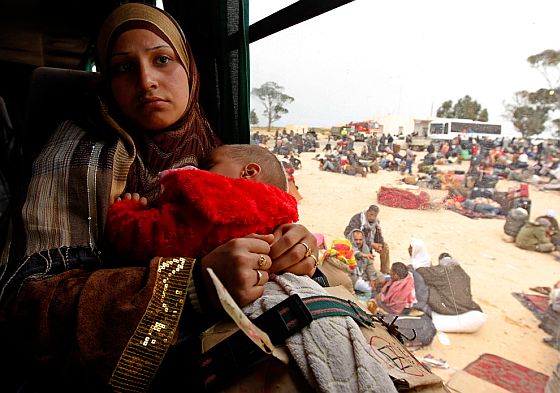
For more than a month, refugees have been fleeing the violence and uncertainty of Libya into Tunisia. The United Nations High Commission for Refugees has reported nearly 180,000 people have fled — a rate of 2,000 a day. Most end up at border transit camps, desperately trying to find a way home. Here are the faces of a few of them. (Boston Globe)

An Egyptian woman and child sit on a bus at a refugee camp near Ras Jdir on Feb. 28 after fleeing unrest. People in Tunisia and Egypt are driving to the border to help those arriving from Libya, with many hosting strangers in their homes, international aid groups have said.

Facebooktwittermail

Egypt: Israel must pay us back for cut-price gas

Ynet reports:

Egyptian Foreign Minister Nabil al-Arabi stated Sunday that his country would demand that Israel pay the price differences for the reduced gas it purchased during the Hosni Mubarak era.

“We will honor everything we signed on and we’ll demand that they uphold it too,” he was quoted as saying in an interview to the Dream TV channel.

According to the minister, clause No. 8 in the Israel-Egypt peace agreement allows the parties to appoint a joint committee to discuss settling financial disputes, “and we will demand from Israel the price differences of the gas exported to Israel during the previous regime.”

Al-Arabi noted that the Camp David Accords do not include a clause on selling gas and oil to Israel for a reduced price, and that those who interpreted it that way were “wrong” or “wanted to interpret it that way”.

Al-Arabi, who is considered hostile towards Israel, is the first official to raise the possibility that Egypt would demand that Israel pay for the gas retroactively. These comments contradict remarks made by the new oil minister, who said Egypt wanted to enter negotiations with Israel on the possibility of raising the gas prices from now on.

The Egyptian foreign minister added that former President Mubarak was a “strategic treasure” for Israel, implying that this would not be the situation from now on. He also said that Iran should not be considered an enemy state.

Tehran Times reports:

Iranian Foreign Minister Ali Akbar Salehi has welcomed a proposal by his Egyptian counterpart Nabil el-Arabi that Cairo is willing to reestablish diplomatic ties with the Islamic Republic of Iran.

“Good relationship between the two countries will definitely help stability, security, and development in the region,” Salehi noted.

Salehi again praised the Egyptian revolution and said, “The Egyptian people by taking steps toward realizing their just demands opened a new chapter in the history of the country and again I congratulate them on this victory.”

Facebooktwittermail

Egypt is still Mubarakstan

Amira Nowaira writes:

More than two months after the start of the popular uprising that overthrew President Hosni Mubarak, Egyptians are increasingly fearful that although he is gone, his regime is still alive and kicking.

Egyptians now realise that Mubarakstan, the virtual edifice created by Mubarak and his coterie to ensure the continued dominance of a closed circle of politicians and businessmen, hasn’t collapsed along with the fall of its head and protector.

It is also distressingly evident that Mubarak was nothing more than the visible tip of an iceberg of corruption, for Mubarakstan is in fact a full-fledged state – a colonial power in every sense of the word, a state with its own colonial discourse, its propaganda machine and its brutal militia. It even has its own capital in the city of Sharm el-Sheikh, where the ruling elite eat their imported dinners and lounge on sumptuous sandy beaches.

In Sharm el-Sheikh a parallel universe has been created, a lavish and elaborate underwater tank where the noises of the people can’t filter through. That’s why it has become the emblem of the rift between the decision-makers, whose decisions were taken only in support of their own interests, and the population they governed, whose angry shouts remained totally muted.

Mubarakstan has created its little Sharm el-Sheikhs in many other locations, small enclaves of gated communities in the most spectacular places in the country, leaving the rest of the “natives”, 40% of whom live way below any recognisable poverty line, to languish in a huge country-wide ghetto.

The state of Mubarakstan even boasts its own bank. The Arab International Bank, which stands on Egyptian soil, is nonetheless an offshore business enterprise that is completely outside the Egyptian government’s jurisdiction.

This was where Egypt’s billionaires deposited their loot without the possibility of ever being found out. How and when was such a bank established? Why is it still operating? These are questions that nobody is answering at the moment.

Facebooktwittermail

Egyptians approve constitutional amendments

Al Jazeera reports:

Egyptians have voted overwhelmingly in favour of a package of constitutional amendments, according to official results released on Sunday evening.

Slightly more than 77 per cent of voters endorsed the amendments, the country’s supreme judicial committee has announced.

Roughly 18 million Egyptians went to the polls on Saturday, a 41 per cent turnout. It’s a better result than many past elections: The country’s fraud-plagued parliamentary ballot last year had less than 25 per cent turnout, and possibly as low as 10 per cent, according to some sources.

Facebooktwittermail

Intifada update

Opposition leaders arrested in Bahrain as crackdown grows
Bahrain arrested six opposition leaders on Thursday, kept the main hospital surrounded by troops and tanks and imposed a nighttime curfew on the center of its capital as it moved to the next stage of its crackdown on reform-seeking protesters, sending the political opposition into crisis.

A day after troops drove demonstrators from the main square and destroyed a month-old tent city there, popular unrest had been reduced to a few minor skirmishes in villages known as opposition strongholds.

There was much defiant talk of keeping the struggle going, but also deep distress.

“We feel cornered and are trying to find our way out,” said Jalal Fairooz, a leader of the Wefaq opposition party in an interview at party headquarters.

A group of Bahraini human rights groups appealed to the United Nations for help. (New York Times)

Bahrain pulls a Qaddafi
It is heartbreaking to see a renegade country like Libya shoot pro-democracy protesters. But it’s even more wrenching to watch America’s ally, Bahrain, pull a Qaddafi and use American tanks, guns and tear gas as well as foreign mercenaries to crush a pro-democracy movement — as we stay mostly silent.

In Bahrain in recent weeks, I’ve seen corpses of protesters who were shot at close range, seen a teenage girl writhing in pain after being clubbed, seen ambulance workers beaten for trying to rescue protesters — and in the last few days it has gotten much worse. Saudi Arabia, in a slap at American efforts to defuse the crisis, dispatched troops to Bahrain to help crush the protesters. The result is five more deaths, by the count of The Associated Press.

One video from Bahrain appears to show security forces shooting an unarmed middle-aged man in the chest with a tear gas canister at a range of a few feet. The man collapses and struggles to get up. And then they shoot him with a canister in the head. Amazingly, he survived.

Today the United States is in a vise — caught between our allies and our values. And the problem with our pal Bahrain is not just that it is shooting protesters but also that it is something like an apartheid state. Sunni Muslims rule the country, and now they are systematically trying to crush an overwhelmingly Shiite protest movement. (Nicholas Kristof)

Brotherhood sticks to ban on Christians and women for presidency
A leading figure in the Muslim Brotherhood (MB), Egypt’s largest opposition group, said on Monday that the MB’s new “Freedom and Justice Party” would continue to stick by its view that Christians and women are unsuitable for the presidency.

Saad al-Husseini, a member of MB’s Guidance Bureau, the highest executive authority within the group, said the new party program will be announced late March after it is approved by the MB’s Guidance Office and Shura Council. Al-Husseini said that although they stick by this view, they “respect all opinions”.

“Our adherence to the jurisprudential opinion refusing the appointment of women or Christians as president does not mean we impose this opinion on the people, who have inherent jurisdiction in this regard,” he said.

“I personally accept for Copts to be appointed in hundreds of positions, including sensitive leadership positions in the country in accordance with the criterion of efficiency and competence, regardless of their proportion in society.”

Meanwhile, MB spokesman Mohamed Morsi said the group is pushing for a civil state, without the tutelage of the clergy. Morsi said the group does not call for a religious state. (almasryalyoum)

Facebooktwittermail

Egypt’s army cracks down

Rania Abouzeid reports:

The bare-chested 20-year-old Egyptian turns slowly to reveal a broad back that resembles a work of sadistic abstract art — a bloody, bruised composition of pink, red and purple. Long, deep gashes had been sliced through his skin; welts, pinker and more superficial, crisscross his body. His upper left arm is a mix of purples, a cufflike bruise that wraps all the way around his bicep. His right hand is bandaged, one of his fingers sprained. He runs his good hand over his closely shorn hair. His wavy locks, he says, were shaved off with glass shards by the same people who beat him.

On Wednesday, March 9, Khalid, who does not want his last name published, went down to Cairo’s Tahrir Square, concerned about reports that thugs were attacking protesters in the iconic site where he had previously joined hundreds of thousands of his compatriots in the protests that brought down President Hosni Mubarak. He wanted to check on several friends among the hundreds of activists still camped out in the square to press the military government to meet the revolution’s demands.

That afternoon, without warning, soldiers surged into the square behind what several witnesses said were lines of plainclothes thugs armed with metal pipes, electric cables and long, thick wooden rods. The uniformed and nonuniformed men reportedly worked in tandem, just like in Mubarak’s days, rounding up hundreds of young men and women in an attack that lasted several hours, according to multiple accounts.

ABC News reports:

A coalition of six youth groups that emerged from Egypt’s revolution last month has refused to meet with Secretary of State Hillary Clinton, who arrived in Cairo earlier today, in protest of the United States’ strong support for former Egyptian President Hosni Mubarak who was ousted by the uprising.

“There was an invitation for members of the coalition to meet Secretary of State Hillary Clinton but based on her negative position from the beginning of the revolution and the position of the US administration in the Middle East, we reject this invitation,” the January 25 Revolution Youth Coalition said in a statement posted on its Facebook page.

A spokesman for Clinton had no immediate response to the snub. Another State Department official, who would not speak for attribution, confirmed such a meeting had been slated for Tuesday and noted that she still plans to meet with members of civil society and transitional government officials during her visit, during which she will urge Egyptians to continue on the path towards democracy.

Facebooktwittermail

The fight for Libya

The Guardian reports:

Libya’s revolutionary leadership is pressing western powers to assassinate Muammar Gaddafi and launch military strikes against his forces to protect rebel-held cities from the threat of bloody assault.

Mustafa Gheriani, spokesman for the revolutionary national council in its stronghold of Benghazi, said the appeal was to be made by a delegation meeting the French president, Nicolas Sarkozy, and the US secretary of state, Hillary Clinton, in Paris on Monday, as G8 foreign ministers gathered there to consider whether to back French and British calls for a no-fly zone over Libya.

“We are telling the west we want a no-fly zone, we want tactical strikes against those tanks and rockets that are being used against us and we want a strike against Gaddafi’s compound,” said Gheriani. “This is the message from our delegation in Europe.”

Asked if that meant that the revolutionary council wanted the west to assassinate Gaddafi, Gheriani replied: “Why not? If he dies, nobody will shed a tear.”

But with diplomatic wrangling focused on the issue of the no-fly zone, there appeared to be little immediate prospect of a foreign military assault on Gaddafi’s forces, let alone an air strike against the Libyan dictator.

Christian Science Monitor reports:

On Libya’s eastern front, taking towns may be easy for Col. Muammar Qaddafi – but holding them is something else again.

After days of being pounded by rocket fire and bombing runs from forces loyal to Qaddafi, Libya’s rebel army piled into their pickup trucks yesterday afternoon and cut a ragged retreat from the oil town of Brega to Ajdabiya, 40 miles to the east. They left mounds of ammunition and supplies behind them as they fled, Qaddafi’s fighters surging behind.

That was all according to plan, says Mohammed el-Majbouli.

“We drew [Qaddafi’s forces] forward, and then we maneuvered behind them and trapped them,” says Mr. Majbouli, a former member of Qaddafi’s special forces who is now organizing rebel fighters.

He says a reserve force of rebels with military training had been hidden in homes in the eastern third of the sprawling petrochemical complex at Brega. After the Qaddafi men passed at about 8 p.m. last night, the rebels came out, retaking the town as well as about 20 prisoners from Qaddafi’s forces.

Majbouli’s claim of victory, which is also made by senior officers who have defected to the rebel cause, could not be independently confirmed. But if he is right, it would be the fourth time Brega has changed hands in less than two weeks, emphasizing the strange, shimmering nature of the conflict being fought in Libya’s coastal desert.

While it remains easy for Qaddafi to rain mortars and rockets on rebel checkpoints, he doesn’t appear to have more than a few thousand men, at most, committed to his eastward advance. Without indiscriminate fire on the cities of Ajdabiya or Benghazi – just the sort of act that might galvanize the international community into action, which Qaddafi is likely keen to avoid – it’s hard to see his forces advancing quickly much farther east.

On Saturday, The Guardian reported:

Muammar Gaddafi’s army won control of a strategic rebel-held Libyan town and laid siege to another as the revolutionary administration in Benghazi again appealed for foreign military help to prevent what it said would be the deaths of hundreds of thousands of people if the insurgents were to lose.

The rebels admitted retreating from the oil town of Ras Lanuf – captured a week ago – after two days of intense fighting and that the nearby town of Brega was now threatened.

The revolutionary army, in large part made up of inexperienced young volunteers, has been forced back by a sustained artillery, tank and air bombardment about 20 miles along the road to the rebel capital of Benghazi.

The head of Libya’s revolutionary council, Mustafa Abdel Jalil, claimed that if Gaddafi’s forces were to reach the country’s second-largest city it would result in “the death of half a million” people.

Robin Yassin-Kassab writes:

In 2003 America and Britain invaded Iraq without a United Nations mandate. Today NATO is emphasising that it won’t move without both a UN resolution and substantial political support from the Arabs. The Arab League has now called for a no-fly zone.

At the League meeting Omani foreign minister Yusuf bin Alawi warned that if the Arabs didn’t take a strong stance they would open the door to unwanted foreign interference. This may seem contradictory: at the same time he asked the UN to intervene. But his point is a good one. If NATO forces act under a UN resolution and responding to an Arab request, the Arabs will be well-placed to end the intervention at the right moment.

I understand the worries of those who fear Western intervention, after all the West’s crimes against the Arab world. I wish the Arabs were capable of moving by themselves (and I certainly hope that once the revolutions have run their course we will finally see an independent Arab world taking care of internal Arab problems). I like Asa’ad Abu Khalil’s idea of using Egypt and Tunisa as staging posts for volunteer Arab soldiers who wish to aid their brothers in Libya.

It’s a difficult, cloudy situation. The only clear thing is that the Libyans need immediate help. The Transitional National Council’s warning that half a million will be killed is not mere rhetoric, but an entirely logical and legitimate fear.

Ahram Online reports:

Thousands of Libyans march down the Corniche in Benghazi, chanting, “Free Libya,” “Revolutionaries,” “Beasts,” and other slogans. It is part of their military training. They are all volunteers, who chose to become fighters and join the rebel forces in areas like Ras Lanuf, Brega and Zawiyah , which are experiencing heavy air strikes by Gaddafi’s forces.
Among those is Ahmed, 25 years old, an Egyptian who has worked in construction in Libya for the past four years. In spite of his family’s pleas, he refuses to leave Libya. “I came to Libya and it was prosperous, I will leave it as prosperous as it was. I will stay here and fight with my friends until Libya is free, just like Egypt is free now,” said Ahmed who looked pale, but seemed very confident of victory and liberation.

Ahmed is one of many Egyptians who decided to stay and join the Libyan revolution. The volunteers are from both genders and all ages. Nada, 18, is a student who was born to an Egyptian mother and a Libyan father. She was born in Alexandria, but moved to Benghazi at the age of eight and has been living there ever since. She still visits Egypt every year.

“I love Egypt, it’s my second home, but I love Libya too, and I am going to stay and fight where I am needed,” said Nada passionately. Nada wears her hair short and she looks very practical in her suit and yellow shirt, which signifies that she is one of the organizers of the anti-Gaddafi sit-in. She joined the sit-in on February 18, along with her mother, another supervisor.

The Independent reports:

Four men have been arrested for the murder of an Al Jazeera journalist and evidence has emerged that Muammar Gaddafi’s regime is sending undercover squads to carry out a campaign of assassinations, rebel officials claimed yesterday.

The Independent was told that four men were caught in the city of Ajdabiya with evidence linking them to the death of Ali Hassaon Al Jaber, who was killed near Benghazi on Saturday. Under questioning, the suspects allegedly confessed they had been ordered to silence opposition figures and drive out international presence from territories of the protest movement.

Facebooktwittermail

Why the Egyptian revolution is more significant than the American revolution

Sam Haselby writes:

How does the revolution in Egypt compare with the American Revolution? There is no comparison. It is more impressive and more important. So far.

In the United States, the American Revolution is sacred history. As a result, Americans tend to associate its slogans and symbols with the whole concept of revolution. If the peculiarities of this habit help prevent Americans from recognising the significance of events in Egypt, both countries will pay a price.

For the leaders of the American Revolution, colonial North America had been a place of social mobility and prosperity. In a European context, the American patriots belonged to the minor gentry class.

No European society allowed members of the minor gentry the prominent roles in political life that the British colonies had offered Americans. When they rebelled against Great Britain, over taxes and in the name of freedom, they were the freest and least taxed people in the western world.

As to the much-noted hypocrisy of slaveholders rebelling in the name of freedom, the English writer Samuel Johnson gave the line for the ages, when he asked, “How is it that we hear the loudest yelps for liberty among the drivers of negroes?”

In contrast, the people of Egypt for decades lived under a cruel military dictatorship. The Mubarak regime almost destroyed a once vibrant Egyptian middle class. The Mubarak family, according to recent reports, accumulated as much as $70bn worth of assets, held mostly in foreign banks and real estate. In contrast to the free and prosperous American revolutionaries, Egyptian resistance broke out from an impoverished and oppressed people.

Facebooktwittermail

A long battle ahead for Egyptian women

Jumanah Younis writes:

A demonstration commemorating International Women’s Day was attacked on Tuesday afternoon in Cairo’s Tahrir Square. More than 200 men charged on the women – forcing some to the ground, dragging others out of the crowd, groping and sexually harassing them as police and military figures stood by and failed to act.

It was a shocking wake-up call. Even in Tahrir Square, the symbol of Egypt’s newfound freedom, it seems that it’s going to take much more than a revolution to overhaul the deep-seated misogyny that some Egyptian men so freely and openly impose on the country’s female population.

The female demonstrators – myself among them – had been protesting against Egypt’s chronic sexual harassment problem, against the many barriers women face in public life, and against the pervasive conservatism that curtails the freedom of women in society at large. The women chanted slogans that had been used in the revolution itself, calling for freedom, justice and equality. But their demonstration quickly attracted a counter-protest.

The women’s chants calling for an “Egypt for all Egyptians” were drowned out by retaliations such as “No to freedom!” shouted by the opposing group. The men charged at the female protesters, who had been standing on a raised platform in the middle of Tahrir Square, and shouted: “Get out of here.”

Fatma Naib adds:

On International Women’s Day, women rights activists in Egypt called for a one million women march at Cairo’s Tahrir Square.

I arrived in Tahrir around 2pm local time [12GMT] on Tuesday March 8, but was surprised to see the sheer volume of men who outnumbered the women, as if it was International Men’s Day!

However, as the crowd trickled in, it grew into hundreds but very far from the planned one million!

Ironically, the few women, I came across in the beginning, were oblivious of the fact that it was a women’s day march.

After negotiating through the maddening crowd I finally managed to meet Nehad Abo Alomsan, the organiser of the march.

Nehad, also the chair for Egyptian centre for women’s right, explained the concept behind the event, “We marked the celebration to salute all the martyrs, men and women, and to remind the society of the role the women played during the revolution.”

“Women stood shoulder to shoulder by the men, but post-revolution when it came to the decision-making process they were excluded.”

Emphasising the importance of participation of women in any democratic transition, Nehad expressed her disappointment at the lack of female experts in the constitutional committee.

“We just want to draw the attention of the decision makers and appeal to the women that if they keep silent now then they will lose everything. The involvement of women is not a demand it’s a principle,” she said.

Facebooktwittermail

Obama does not get it

Lamis Andoni writes:

Barack Obama, the US president, has still not fully grasped the essence of the revolutions underway in the Arab world. He genuinely seems to believe that the people rallying for democracy in the region are making a pro-Western, if not pro-Israeli, statement.

“All the forces that we’re seeing at work in Egypt are forces that naturally should be aligned with us, should be aligned with Israel – if we make good decisions now and we understand sort of the sweep of history,” Obama recently told a group of Democrats in Florida.

I am not sure how Obama drew this conclusion, but he is either terribly misinformed or engaged in a serious bout of wishful thinking.

His statements, however, echo the assessments of many American pundits, some of whom have been celebrating the fact that anti-Israeli or American slogans have not dominated the recent and ongoing uprisings.
It is true that the protesters are not focusing on Israel.

But to say that these forces could be natural allies of Israel and the West is to take a huge leap into a highly inaccurate assessment of the situation. The US president is misreading the message of the protesting Arab masses.

Facebooktwittermail

Egypt’s syndicalist future?

Nathan Brown writes:

What Egyptians have termed their “revolution” is now beginning to look like one. Seen from afar, it appears that the military rulers have struggled successfully to hold most state institutions intact and slow the pace of change, but the Egyptian political order is still being fundamentally rewritten. The core constitutional demands of a diverse opposition-for freer and more democratic politics-are not being silenced or diverted.

Yet if Egyptians will find their political system freer, it may not be in a fully liberal sense. There is already far greater pluralism and greater freedom of both expression and organization. Such trends are likely to entrench themselves more deeply. But from a purely institutional perspective, something else seems to be happening as well: a variety of strong actors are escaping from presidential control and finding their own voices. Egypt was always a state of strong institutions–when seen from the bottom up. From the top down, all those institutions have been dominated by a strong presidency. Labor unions, professional associations, parts of the judiciary, the parliament, large parts of the press, the military, the security apparatus, the ruling party, and even legal opposition parties have all been silenced, brought to heel, or remolded to serve presidential will. With the presidency vacant and Egypt now ruled by a military committee that governs by Facebook posts and short communiqués, all those institutions are now struggling to act on their own. And leaders within those bodies too associated with the old ways are coming under intense pressure and many may be tossed out. In many of Egypt’s institutions, mini-revolutions seem to be brewing against leaders who had been co-opted into cravenly serving the president.

The emerging outcome of Egypt’s revolution thus might be as much syndicalist as liberal. “Syndicalism” is a dimly remembered term at best, referring to a way of organizing society in strong and autonomous (generally class-based) constituencies; it was a leftist ideology that served as an alternative to communism and sometimes merged with anarchism. But Egypt’s syndicalism-as it is emerging-is neither fully leftist nor entirely class based. It is anything but anarchic. And its driving force is not a nineteenth century European ideology but a twenty-first century sense that those who have exercised political and economic power have done so only in their own personal interests; this is seen as a time to make them responsive instead to the needs of various groups in society.

Facebooktwittermail

Intifada update

Storming Egypt State Security
The video speaks for itself. We stormed into the notorious political police main HQ in Cairo after the authorities didn’t dismantle the apparatus. We did it ourselves.

The end of the video shows an former Islamist detainee who discovered an electric torture tool explaining how he was tortured on it.

Glory to the martyrs of the Egyptian Revolution. (Mohamed Abdelfattah)

Hamas makes first contact with new Egyptian leaders
Gaza’s Hamas rulers on Monday contacted Egypt’s new leadership for the first time since a popular revolt toppled Hosni Mubarak from power last month, a statement from the Islamist group said.

Hamas leader in Gaza Ismail Haniyeh telephoned Egypt’s new Prime Minister Essam Sharaf to congratulate him on his post and urged him to help lift an Israeli blockade of the coastal territory, a statement from Haniyeh’s office said.

Gaza shares a border with Israel and Egypt. Both countries have limited the movement of people and goods into and from Gaza since Hamas seized the territory in 2007, a policy which has crippled the enclave’s economic growth. (Reuters)

West Bank wind of change
The PLO leadership called for a Day of Rage across the occupied territories on 25 February, following the US veto of a United Nations Security Council resolution one week earlier condemning Israel’s continued settlement building. It sought thereby to deflect growing discontent at the Palestinian Authority (PA) and direct indignation at the US for protecting Israel. Though Hamas also condemned the veto, Gaza remained calm.

In Hebron, a thousand turned out to protest against the Jewish settlements in the heart of the city, clashing with Israeli soldiers (IDF); as the protests spread, the PA sent in their riot police to help the IDF. In Ramallah, the PA failed to mobilise support for their Day of Rage. A day earlier, Palestinian youth had already taken to its streets, in a separate protest, to demand national unity between the PA and Hamas. Scuffles broke out between supporters of PA president Mahmoud Abbas and Palestinians demanding an end to the Oslo accords.

After the regimes in Egypt and Tunisia fell, the PA had moved quickly to counter the spreading wave of people power. Al-Jazeera’s release of the leaked “Palestine papers” in January, exposing a relationship between the Palestinian leadership and Israel based on concessions to, and collusion with, the occupation, had already undermined PA legitimacy. The PA watched nervously as Egypt’s president Hosni Mubarak was forced from office, and adopted a policy of containment. The chief PLO negotiator Saeb Erekat resigned, Abbas declared there would be presidential and legislative elections by September, and prime minister Salam Fayyad dissolved his cabinet.

According to PA spokesman Ghassan Khatib, Erekat’s departure was in response to the Palestine papers, not the events in Egypt. Khatib explained that there was a vast difference between the Palestinian situation and the rest of the region: “The cabinet reshuffle was overdue but the events in Egypt sped it up. Here it’s not the same as elsewhere; there is a democratic process that has been disrupted by occupation and the internal division” between competing authorities in the West Bank and Gaza.

Though the call for elections suggests the PA’s concern to move with the winds of change, Khatib said it had other intentions: “President Abbas didn’t imagine elections in the West Bank without Gaza. For elections to happen in Gaza, it would require national unity, and I think the chances of that are very low.” The call for elections – a show of intent, not a decree – was “an attempt by the PLO to put pressure on Hamas to go ahead and allow elections in Gaza”. (Joseph Dana and Jesse Rosenfeld)

In Tunisia, political ambiguity breeds violence
Tunisia vibrated with palpable euphoria in the days after mass protests forced Zine El Abidine Ben Ali to decamp to Saudia Arabia.

A few short weeks on, utopic expectations of a sweeping break with the old regime are colliding with concerns that the country is edging towards political and economic crisis.

“There’s a big discussion underway between those that are concerned that genuine revolution be realised, and those that are really concerned that the power vacuum will lead to chaos,” says Michael Willis, a lecturer at Oxford University’s School of Oriental Studies.

Tunisians are split into two general camps: what might be called the ‘idealists,’ who refuse to rest until every last relic of the old regime has been stripped away, and the ‘realists” who fear that, however imperfect and in need of reform the existing institutions may be, instability and lack of governance could open the way for either the military or the barely-ousted regime to take power.

The idealist group includes a tactical alliance of Islamists, trade unionist and far-left groups, while the reformers include centre-left opposition parties, conservatives, former allies of Ben Ali and independents who have stepped into the political sphere for the first time.

Until the deadlock between the two sides is bridged, the country is floating in a state of limbo.

Lurking in the shadows, both groups are quick to say, are Ben Ali loyalists poised to profit from any ambiguity to re-establish their political might. Each side accuses the other of being infiltrated by former members of the recently disbanded RCD (Constitutional Democratic Rally) party. (Al Jazeera)

Facebooktwittermail