



Egypt and Tunisia’s unfinished revolutions
It’s been just seven weeks since President Zine el Abidine Ben Ali fled Tunisia, and just over three weeks since Hosni Mubarak was unceremoniously dumped from the presidency by the Egyptian military — but both countries have already unseated their interim prime ministers. Egypt’s Ahmed Shafiq on Wednesday followed last week’s decision by Tunisia’s Mohammed Ghannouchi to step down, heeding the will of those who had taken to the streets to oust the autocrats who had appointed them. The two countries have chosen different models for their transition to democracy: Tunisia has a civilian government supported by the military; in Egypt, a Supreme Council of the Armed Forces has taken charge and has suspended the constitution. But in both countries, the interim rulers face a crisis of legitimacy, with controversy surrounding some of the personalities now in charge and their transition plans contested by many of the same forces that took to the streets to demand political change. And at the same time, they must deal with the mountain of problems left behind by the dictators, from corruption and cronyism to collapsing state authority and anemic economic performance. (Issandr El Amrani)
Can the richest of all the Arab royal families stem the tide of reform?
The increasing disconnect between Saudi subjects and their rulers, growing stresses in Saudi society, and troubles inside the ruling family all point to turbulence ahead.
Whereas 70% of Saudis are under the age of 30, and their median age is 19, the Saudi cabinet ministers average 65. Some senior princes have held their jobs as ministers or provincial governors for decades; one has governed the Northern Borders Province since 1956. Whereas 40% of Saudi youths have no jobs and nearly half of those in work take home less than 3,000 riyals ($830) a month, every prince (of whom there are probably 7,000-8,000) gets a monthly stipend ranging from a few thousand dollars up to $250,000, according to an estimate in a WikiLeaks cable.
In forums where Saudis are able to express discontent, anger is rising. Out of 1,600 asked in a recent web poll to rate the credibility of statements by Saudi officials, 90% ticked “untrustworthy”. (The Economist)
Egypt security building stormed
Egyptian protesters have stormed the headquarters of Egypt’s state security force in Alexandria, with several people suffering injuries in scuffles with riot police.
Around 1,000 people encircled the State Security Agency building late on Friday, demanding that the officers inside come out or they would storm the building.
Protesters then entered into the building and scuffled with riot police before military forces intervened and took control of the building.
Demonstrators said officers inside had been shredding and burning documents that may have proven past abuses. (Al Jazeera)
Continued disappearance of Iran opposition figures raises concerns of torture
Iranian officials should immediately end the illegal, incommunicado detention of four leading opposition figures: Mehdi Karroubi; Mir Hossein Mousavi; Fatemeh Karroubi; and Zahra Rahnavard, the International Campaign for Human Rights in Iran said today.
The Campaign warns that the incommunicado nature of their eighteen day long detention in an undisclosed location increases the likelihood that the four are facing psychological and physical torture for the purposes of extracting false confessions.
“Arbitrary and incommunicado detention in unknown locations is often associated with torture and ill treatment, and even extrajudicial execution in Iran,” said Hadi Ghaemi, the Campaign’s spokesperson.
“Time and again opposition figures in Iran are detained without contact with their families or lawyers, only to undergo abuse and appear on TV weeks later confessing to baseless charges,” he said. (International Campaign for Human Rights in Iran)
Youths ‘attack Algerian protesters’
Anti-government protesters have been attacked in the Algerian capital and an attempt made to lynch a prominent opposition politician, local media have said.
The reports said that protests organised by the National Co-ordination for Democracy and Change (CNDC) in Algiers were violently suppressed on Saturday morning.
According to the the Algerian daily newspaper El Watan, a group of youths tried to lynch Said Sadi, the president of the Rally for Culture and Democracy (RCD).
Dozens of youths wearing banners supporting Abdelaziz Bouteflicka, the Algerian president, forced Sadi to flee in his car after they threatened to kill him in the al-Madania neighbourhood of Algiers, the publication said. (Al Jazeera)
Qatari blogger detained
Amnesty International says a blogger and human rights activist has been detained incommunicado in Qatar and is at risk of torture or other ill-treatment.
The UK-based human rights group said Sultan al-Khalaifi was arrested on March 2 by around eight individuals in plain clothes, believed to be members of the security forces.
According to information received by Amnesty International, al-Khalaifi had told his wife earlier that day that state security had contacted him, asking him to report to them, but that he did not know why.
The reasons for his detentions and his whereabouts are unknown, Amnesty said in a statement on Friday, adding that it is believed he is being held in the custody of state security. (Al Jazeera)
Bahrain protesters encircle state compound
Tens of thousands of Bahraini opposition protesters encircled a sprawling government compound on Sunday, forcing the cancellation of a meeting of senior lawmakers and further escalating pressure on the ruling Al-Khalifa family to accept sweeping reforms.
Protesters began assembling before 9 a.m., taking up positions at each of the complex’s four gates and repeating opposition calls for the fall of the government. Behind the compound’s gates, hundreds of riot police stood guard, while police helicopters circled overhead.
The protest forced government ministers to abandon their weekly council meeting, where Prime Minister Sheikh Khalifa bin Salman al-Khalifa coordinates policy with the heads of Bahrain’s top ministries. Opposition groups cite the resignation of the Prime Minister, who has been in his post for 41 years, as one of their top demands.
Opposition leaders said the demonstration expanded their strategy of escalating pressure on the ruling family by marching on politically sensitive locations across the capital.
“We are attacking peacefully all the institutions of state. This is really a regime change without overthrowing the monarchy,” said Ebrahim Sharif, a Sunni Muslim and former banker who heads the National Democratic Action Society, one of the groups tasked with unifying the opposition’s message. (Wall Street Journal)
Alain Gresh writes:
The fantasy that the Arabs are passive and unsuited to democracy has evaporated in weeks. Arabs have overthrown hated authoritarian regimes in Tunisia and Egypt. In Libya, they have fought a sclerotic regime in power for 42 years that has refused to listen to their demands, facing extraordinary violence, hundreds of deaths, untold injuries, mass exodus and generalised chaos. In Algeria, Morocco, Bahrain, Yemen, Jordan, Iraqi Kurdistan, the West Bank and Oman, Arabs have taken to the streets in vast numbers. This defiance has spread even to non-Arab Iran.
And where promises of reform have been made but were then found wanting, people have simply returned to the streets. In Egypt, protesters have demanded faster and further-reaching reform. In Tunisia, renewed demonstrations on 25-27 February led to five deaths but won a change of prime minister (Mohamed Ghannouchi stepped down in favour of Beji Caid-Essebsi). In Iraq, renewed protests led to a promise to sack unsatisfactory ministers. In Algeria, the 19-year emergency law was repealed amid continuing protests. The demands are growing throughout the region, and will not be silenced.
The revolutions in Tunisia and Egypt, the uprising in Libya, and all the other popular movements that have shaken the region are not just about how people want to live and develop, but about regional politics. For the first time since the 1970s, geopolitics cannot be analysed without taking into account, at least in part, the aspirations of people who have retaken control of their destinies.
Gilbert Achcar writes:
Egypt’s uprising, contrary to most predictions, was initiated and driven by coalitions – including political parties, associations and internet networks – which were dominated by secular and democratic forces. Islamic organisations or their individual members took part on an equal footing with groups of marginal importance before the uprising, and with groups closer to eastern European dissidents of 1989 than to the usual mass parties or revolutionary elites of social revolutions.
The discretion of Tunisia’s Islamist movement can be explained to a large extent by the harshness of its suppression under Ben Ali, impeding the ability of the Islamic Nahda party to act. However, the Muslim Brotherhood in Egypt was also discreet, but for the opposite reason: because it was a party tolerated by the military regime (although not legalised).
Anwar Sadat, when he came to power after Gamal Abdel Nasser’s death in 1970, favoured the Brotherhood’s return to the public stage and its enhanced position as a counterbalance to the Nasserist or radical left. The Brothers fully subscribed to the economic liberalisation (infitah) of Sadat when he embarked on dismantling Nasser’s legacy. This led to increased influence of members of the new Egyptian bourgeoisie within the Brotherhood. Even so, it continued to assert its piety against rampant corruption; this was a key argument for the petit bourgeois, the Brothers’ favourite constituency.
The Brotherhood built itself as a reactionary religious political movement, whose main concern was – and still is – the Islamisation of Egypt’s political and cultural institutions and the promotion of sharia as the basis for legislation. This programme is summed up by its main slogan: “Islam is the solution”. At the same time, the Brotherhood has served as a political antidote to extreme and violent fundamentalist groups.
The New York Times reports:
Carried on the shoulders of protesters who claimed him as their own, Egypt’s new prime minister waded into a crowd of tens of thousands in Tahrir Square on Friday, delivering a speech bereft of regal bombast that illustrated the reach of Egypt’s nascent revolution and the breadth of demonstrators’ demands that remain unanswered.
“I am here to draw my legitimacy from you,” Prime Minister Essam Sharaf told the raucous, flag-waving assembly. “You are the ones to whom legitimacy belongs.”
Some protesters dismissed the speech as the savvy move of an ambitious politician in a time fraught with anxiety. Yet it was perhaps the symbolism itself that said the most about Friday’s moment when, just a day after his appointment, an Egyptian leader chose to make his first stop the square that helped topple his predecessor.
Anti-Saleh protests sweep Yemen
A growing wave of protests across Yemen is mounting pressure on President Ali Abdullah Saleh to end his 32-year rule
Several thousand demonstrators turned out yet again in the capital Sanaa on Wednesday for what are now almost daily rallies against him and denied any links to the US.
“The people who come to the square are youths, free youths who have no connection whatsoever to any foreign entity, their only concern is to topple the regime,” Ali Al Sakkaf, a protester, said.
In the town of Sadr, in the country’s south, witnesses said that security forces fired tear gas and shot at hundreds of protesters, to which the demonstrators responded by setting police vehicles alight. (Al Jazeera)
Saleh accuses the US and Israel of destabilizing the Arab world
[O]n Tuesday, Saleh seemed to be turning on Washington. In a speech to about 500 students and lecturers at Sanaa University, he claimed the U.S., along with Israel, is behind the protest movement.
“I am going to reveal a secret,” he said. “There is an operations room in Tel Aviv with the aim of destabilizing the Arab world. The operations room is in Tel Aviv and run by the White House.”
Saleh also alleged that opposition figures meet regularly with the U.S. ambassador in Sanaa. “Regrettably those (opposition figures) are sitting day and night with the American ambassador where they hand him reports and he gives them instructions,” Saleh said.
The Obama administration rejected these claims. White House spokesman Jay Carney called on Saleh to focus on implementing the political reforms demanded by his people instead of “scapegoating.”
Saleh’s relationship with the U.S. has been ambivalent, and he has at times attempted to play down his military alliance with Washington. Anti-U.S. sentiment remains strong in Yemen, as elsewhere in the region, and Saleh’s comments appeared to be an attempt to discredit the protesters by suggesting they are serving foreign interests. (AP)
The looming threat of tribal war
Over the 32 years of his reign, Salih, who is a former tank commander, has paid keen attention to the tribal backgrounds of his general officers and field officers. The majority of the general officers are drawn from Salih’s tribe, the Sanhaan, and many are directly linked with his family and or extended family through marriage. Most notably, the Republican Guard and the Central Security Service, the most able and well equipped of Yemen’s armed forces, are commanded by Salih’s son and nephew respectively. The field officers’ backgrounds are more varied but are still thoroughly vetted in terms of tribal affiliations. The junior officer core is more of an unknown, but even within its ranks there are few southerners and most are still from the northern tribes from which Salih has traditionally drawn most of his support.
The tribal affiliations of Yemen’s general and field officers likely mean that Salih can expect continued loyalty from much of his armed forces, especially if threatened by a Hashid-backed alliance led by members of the al-Ahmar family. The loyalty of his general officers has been further buttressed by often exorbitant salaries that allow them to carve out fiefdoms of their own. Some of the more senior officers are in a position to guarantee the loyalty of their troops, if necessary, with cash bonuses and other perks. Many within the general and field officer cores have also sought to make sure that a majority of the enlisted men within their ranks are from their own tribes and clans, to further guarantee loyalty.
While the tribal affiliations of the Yemeni Army, especially within its officer core, are likely to guarantee a significant level of loyalty to the regime, it should be noted that the Yemeni Army’s morale suffers from poor pay and living conditions. In addition, it was dealt a blow by the prolonged war against the Houthis in northern Yemen. Salaries for enlisted men, despite Salih’s recent promise of an increase, remain low, with many soldiers owed months of back pay. Corruption is also endemic. During the last war against the Houthis (2009-2010), there were numerous reports of officers selling ammunition and supplies and leaving their troops with neither food nor bullets to fight with. (Jamestown Foundation)
Radical cleric demands ouster of Yemen leader
Yemen’s president, Ali Abdullah Saleh, maintained a tenuous hold on power on Tuesday, blaming the United States and Israel for protests across the Arab world, while a prominent radical cleric joined the growing crowds demanding his ouster and called for an Islamic state.
American officials expressed concern about the statement of the cleric, Abdul Majid al-Zindani, a one-time mentor of Osama bin Laden, which introduced a new Islamist element to the turmoil in a country where Al Qaeda is viewed as a grave threat. The protests that toppled leaders in Tunisia and Egypt and that now have spread to Libya, Bahrain and Oman have been largely secular in nature.
Mr. Zindani spoke on an open-air stage before several thousand antigovernment protesters, guarded by 10 men carrying AK-47s and shielded from the scorching sun by two umbrellas wielded by aides. “An Islamic state is coming,” he said, drawing cries of “God is great” from some in the crowd.
He said Mr. Saleh “came to power by force, and stayed in power by force, and the only way to get rid of him is through the force of the people.”
It was not clear how much support Mr. Zindani had among the protest movement. (New York Times)
Army appoints new Egyptian PM
Egypt’s governing military council has accepted the resignation of Ahmed Shafiq, the prime minister, and appointed a former transport minister, Essam Sharaf, to form a new government, according to an army announcement.
The statement was carried on the military’s Facebook page on Thursday and then confirmed by a military spokesman.
“The Supreme Council of the Armed Forces decided to accept the resignation of Prime Minister Ahmed Shafiq and appointed Essam Sharaf to form the new government,” the statement said.
The council said it had tasked Sharaf with forming a new caretaker cabinet that would oversee the country’s transition to civilian rule.
Sharaf took part in the mass rallies in Cairo’s Tahrir Square which brought down Hosni Mubarak, Egypt’s president, on February 11 after three decades in power. (Al Jazeera)
Mubarak to be questioned in corruption probe
Former Egyptian President Hosni Mubarak, who is still believed to be at his residence in Sharm el-Sheikh, will be brought to Cairo next week for questioning in his corruption case, said Mustafa Bakri, a former member of parliament.
Bakri, who brought the case against Mubarak and other officials, was told of the development by the Prosecutor General’s office on Thursday.
Attorney General Abdel Maguid Mahmoud issued an order freezing assets of Mubarak and his family on Monday and prohibited them from leaving the country. (CNN)
Iranian activists appeal to UN over missing opposition leaders
A number of prominent Iranian activists have written an open letter to United Nations Secretary-General Ban Ki-moon urging him to intervene in the case of detained opposition leaders Mir Hossein Musavi and Mehdi Karrubi, RFE/RL’s Radio Farda reports.
The letter, published on March 1 on opposition websites, calls on Ban to use all “international levers” at his disposal to ensure the welfare of Musavi and Karrubi and seek their release from detention.
Iranian officials have denied the men have been arrested or detained.
Their family, friends, and supporters along with the opposition website Kaleme, which is close to Musavi, say he and Karrubi and their wives, Zahra Rahnavard and Fatemeh Karrubi, were taken recently to Heshmatieh prison in Tehran. (RFE/RL)
Iran forces fire teargas at protesters
Iranian security forces fired teargas and clashed with anti-government protesters demonstrating against the treatment of opposition leaders, pro-reform websites reported on Tuesday.
Thousands of demonstrators poured into the streets of Tehran and other cities, chanting slogans against the government, Sahamnews reported.
“Security forces and plainclothes agents fired teargas and clashed with demonstrators in Tehran to disperse them,” another opposition website Kaleme reported. (Reuters)
Saudi Facebook activist planning protest shot dead
Saudi activists alleged Wednesday that state security shot dead a leading online activist, who was calling for a ‘Day of Rage’ on March 11 in the oil-rich kingdom.
Faisal Ahmed Abdul-Ahadwas, 27, was believed to be one of the main administrators of a Facebook group that is calling for protests similar to that have swept North Africa and the Middle East.
The Facebook group, which has over 17,000 members, is calling for nationwide protests and reforms, including that governors and members of the upper house of parliament be elected, the release of political prisoners, greater employment, and greater freedoms.
Online activists said they believe Abdul-Ahadwas was killed by state security and that his body was taken by authorities to ‘hide evidence of the crime.’ (DPA)
Tunisian ministers continue to quit
Three more ministers left Tunisia’s interim government, following the resignations of the prime minister and two others, after weeks of protests about the caretaker authority.
Ahmed Ibrahim, higher education and scientific research minister, told the Reuters news agency he had resigned on Tuesday, while the departure of Ahmed Nejib Chebbi, local development minister, was announced by the official TAP news agency.
Also on Tuesday, private Tunisian radio broadcaster Shems FM reported Elyes Jouini, minister of economic reform, had resigned.
These resignations come after three other high profile politicians quit Tunisia’s interim unity government since the weekend, including prime minister Mohamed Ghannouchi, who stepped down on Sunday. (Al Jazeera)
Oman deploys army units fearing more unrest
Oman deployed troops north of the capital Muscat and near the border with the United Arab Emirates on Tuesday, following three straight days of anti-government protests, a government official said.
Oman, ruled by a powerful family dynasty, is the latest Arab nation to be swept up in a wave of regional unrest that has already brought down two leaders and threatened the rule of others.
The center of protests in Oman has been the port town of Sohar, about 120 miles (200 kilometers) northwest of Muscat, where demonstrators demanding higher salaries and jobs have clashed with security forces.
Police killed a protester in Sohar on Saturday, after demonstrations turned violent. Several government buildings and a supermarket were set on fire, local media reported. (AP)
Hossam el-Hamalawy writes:
In the 1990s, one could only whisper Hosni Mubarak’s name. Political talk or jokes were avoided in phone calls. This year, millions of Egyptians fought for 18 days against their ageing tyrant, braving the police troops firing teargas, rubber bullets and live ammunition. People in Egypt have lost their fear, but it did not happen overnight. The Egyptian revolution, rather than coming out of the blue on 25 January 2011, is a result of a process that has been brewing over the previous decade – a chain reaction to the autumn 2000 protests in solidarity with the Palestinian intifada.
Mubarak’s iron-fist rule and the outbreak of the dirty war between the regime and Islamist militants in the 1990s meant the death of street dissent. Public gatherings and street protests were banned and if they did take place, confronted by force. Live ammunition was used on strikers. Trade unions were put under government control.
Only after the Palestinian intifada broke out in September 2000 did tens of thousands of Egyptians take to the streets in protest – probably for the first time since 1977. Although those demonstrations were in solidarity with the Palestinians, they soon gained an anti-regime dimension, and police showed up to quell the peaceful protests. The president, however, remained a taboo subject, and I rarely heard anti-Mubarak chants.
I recall the first time I heard protesters en masse chanting against the president in April 2002, during the pro-Palestinian riots around Cairo University. Battling the notorious central security forces, protesters were chanting in Arabic: “Hosni Mubarak is just like [Ariel] Sharon.” [Continue reading…]
Issandr El Amrani writes:
I’m not sure how long the general Egyptian public can maintain the bizarre idea that the army is so great. This is the army that took power in a coup in 1952 and ended political pluralism, lost tons of wars after that and continued to justify its predation on the national budget despite not having had to fight anyone since 1973 (if you exclude the Libyans very briefly in the late 1970s and those field hospitals sent to Iraq and Kosovo in the 1990s), that has absolutely no experience policing and yet is getting military police and military intelligence to carry out that function (when their primary job has been keeping an eye on rank and file). It is the army that put Mubarak in place in six days after the assassination of Sadat, and now runs things through a Supreme Council of the Armed Forces that is headed by Mubarak loyalist Mohammed Hussein Tantawi (in place since 1992) and a government headed by former chief of the Air Force Ahmed Chafiq (who considers Mubarak his “spiritual father.”) Not to mention, of course, the army that owned the land in Tagammu al-Khamiss outside of Cairo that was sold for the spectacular profits by several real estate developers, or the army that continues to employ conscripts as free labor in various places.
In answer to the question that started the preceding paragraph, I think actually the army can maintain that illusion for a long time. Eleven years in Egypt have taught me to never underestimate the power of the ERDF — the Egyptian Reality Distortion Field. It is a surprisingly flexible and adaptable weapon, even in the face of the most stubborn facts. Part of this is information manipulation, of course — it helps that the military has just appointed one of its own to run the Egyptian Radio and Television Union — but also a certain amount of political caution. Hossam el-Hamalawy, never one to hold on to illusions about power, wrote after the clash with the army:
Everyone is rightly upset about what the army did in Tahrir Square last night. Let’s remember, however, the military already moved against peaceful protesters in Suez, and is accused of involvement of torture and arrest of hundreds during the uprising. And almost everyday there is a statement from the army warning strikers and protesters, coupled with an orchestrated media campaign in both state and private TV channels discrediting labor strikes and renewed protests in Tahrir. What happened last night should not come as a shock.
If Mubarak’s regime was corrupt (and it was), then why do we treat the military institution, which provided the backbone of his dictatorship, as “neutral” or “pure”? The leadership of this institution, namely the generals of the Supreme Council of the Armed Forces are part of Mubarak’s regime. And any real change would affect their privileges and control.
We cannot and will not carry up arms against the army. I salute and support all the efforts for resuming the protests in Tahrir, including the one planned for today at 2pm. But still, the most effective weapon is the mass strikes.
Mass strikes is precisely what the army fears the most, along with the Egyptian elite for which it represents both economic disaster and the rise of mob rule.
Following overnight clash between protesters and the Egyptian army outside the cabinet office near Tahrir Square, Cairo, Jack Shenker reports:
The international press is reporting that the army has issued an apology for its brutality, which included demonstrators being beaten and tasered, but that’s not quite true. In fact it has posted a series of statements on its new Facebook page, one of which is entitled ‘apology’ but which actually says only that the overnight fracas was ‘unintentional’ – prompting scorn and anger from many activists on the ground.
The army is a highly-respected national institution in Egypt, but suspicions are now mounting about its willingness to tolerate – and even prop up – lasting remnants of the Mubarak regime, and its intolerance of any public dissent. Combined with fierce fighting last night in the Nile Delta town of Mansoura, where protesters did battle with central security forces (who hadn’t been deployed in large numbers since Mubarak’s downfall), the incidents outside parliament are amplifying the voices of those who believe the army cannot be trusted, either to build a meaningful and durable set of civilian-led democratic political institutions, or to see through the kind of root and branch economic reform which is needed to answer the legitimate aspirations of millions of poor Egyptians. (For more details on how Egypt’s poor have done so badly from the country’s neoliberal reform programme in recent years see this analysis piece by Walter Armbrust.)
Meanwhile, from Tunis, the BBC reports:
Security forces in the Tunisian capital have fired tear gas to try to disperse hundreds of demonstrators outside the interior ministry.
Police and masked men in civilian clothes, armed with sticks, moved through streets looking for protesters.
The renewed protest comes a day after police cleared huge crowds from the streets demanding the resignation of the interim prime minister.
That was the biggest rally since the president fled after weeks of unrest.
On Friday police fired tear gas and warning shots to disperse demonstrators.
The BBC’s Paul Moss in Tunis says the stench of tear gas is again filling the main shopping street in Tunis.
The trouble flared very suddenly – people out shopping found themselves caught up in the confrontation, women carrying heavy bags running for cover with handkerchiefs clutched to their mouths, our correspondent says.
Hundreds of thousands protest across Mideast
Hundreds of thousands of protesters turned out in cities across the Middle East on Friday to protest the unaccountability of their leaders and express solidarity with the uprising in Libya that Col. Muammar el-Qaddafi is trying to suppress with force.
The worst violence of the day appeared to be in Libya, where security forces shot at protesters as they left Friday prayers to try to launch the first major anti-government demonstration in the capital. Demonstrations in recent days have been in other cities, and several of those have fallen to armed rebels determined to oust Colonel Qaddafi.
Protests in Iraq also took a violent turn, with security forces firing on crowds in Baghdad, Mosul, Ramadi and in Salahuddin Province, killing at least ten people. Unlike in other Middle Eastern countries, the protesters in Iraq are not seeking to topple their leaders, but are demanding better government services after years of war and deprivation.
Religious leaders and the prime minister had pleaded with people not to take to the streets, with Moktada al-Sadr saying the new government needed a chance to improve services and Prime Minister Nuri Kamal al-Maliki warning that insurgents could target the gatherings. But on Friday, the deaths came at the hands of government forces.
Demonstrations elsewhere — in Bahrain, Yemen, Jordan, Egypt and Tunisia — were almost exclusively peaceful. (New York Times)
Tahrir protesters call on old guard to go
Thousands of workers strike in Saudi Arabia
Saudi Arabia is now being rocked by strikes as the mood of resistance spreads across the region. A socialist in Saudi Arabia reports on how struggles in the Middle East are even spreading to the most vicious dictatorship, which is sponsored by the US
‘I went to my workplace on Thursday of last week, and I found out that there were over 3,000 workers demanding their rights before they called a general strike in the construction site in Saudi Binladin Group. The workers were very angry. Their workplace is one of the largest construction projects in the country, which is worth SR.100 billion.
However, they live in a terrible conditions. One of the workers told me, “I live in a room four metres by three metres with eight people, and for every ten people there is only one toilet.” Another Egyptian worker told me about the working conditions and the restriction of religious freedom: “They are Zionists, they don’t even allow me to pray on time!” (Socialist Worker)
Egyptian workers strike for minimum wage and independent unions
Britain’s two-faced relationship with Middle-Eastern tyranny has to end
Have you been invited to Kate’s and Wills’s wedding at Westminster Abbey on 29 April? No? I didn’t think so. Nor have I.
But Hamad Bin Isa al-Khalifa has. He happens to be the king of Bahrain, where thousands of people have been peacefully protesting against his unelected royal regime since 14 February. His Majesty’s response? On 16 February, shortly before dawn, he ordered his security forces to storm Pearl Square in the heart of Bahrain’s capital, Manama, where the protesters – emulating those who had gathered in Cairo’s Liberation Square – were camping out. The police fired rubber bullets and tear gas at the king’s sleeping subjects, killing at least four, including a two-year-old girl, and injuring hundreds of others. The next day, they switched to live ammunition.
Nonetheless, the king of Bahrain has received his gilded invitation from Buckingham Palace, embossed with the Queen’s EIIR royal cypher. The Bahraini monarch is not the only Middle East tyrant to have made the cut. Invitations are reported to have gone out to King Abdullah of Saudi Arabia and King Abdullah of Jordan. Then again, given the pace of events in Tunisia and Egypt and the ongoing unrest in Libya, it is a matter of debate as to whether the two Abdullahs or Hamad will still be in power come 29 April. (Mehdi Hasan)
No real freedom without dismantling the secret political police
President Zine el Abbidin of Tunisia and President Mubarak of Egypt may have been ousted, but the terror and control of the secret political police continues unchecked and invisible to the eyes of the international community. Unless the domestic intelligence agencies: the state security investigations apparatus (SSI) in Egypt and its counterpart in Tunisia are immediately dismantled, not only will repression continue, but an underground witch-hunt against citizens who continue to press for genuine democracy will follow. There are signs that this is already happening in Tunisia where politically active citizens have once again felt the secret police force breathing down their necks.
Sihem Bensedrine, a prominent activist who was harassed under Ben Ali’s rule over attempts to set up an independent Internet newspaper and a satellite television channel, said that recently she has been again subject to surveillance by the secret police. Prior to the Jasmine revolution in Tunisia, the president’s party established a very complex and pervasive regime for monitoring ordinary citizens through the secret [political] police. According to Nadia Marzouki, a citizen had to avoid entanglements with the authorities, otherwise officials may “interfere with her enrolment at a university, her exams, her wedding or her desire to open a restaurant or shop, buy property, give birth in a hospital, obtain a passport or even buy a cellular phone: After 23 years of internalizing fear, Tunisians became their own censors.”
In post-Mubarak Egypt, the fear barrier over mentioning the SSI is now almost fully breached, but activists affirm that the officers are still in full force. The state security investigations apparatus has, since its establishment under British colonial rule, systematically served to protect the ruling regime by collecting intelligence information and using soft and brutal power against real, virtual or potential sources of dissidence. Since former Minister of Interior Habib al Adly came to power in 1997, he has worked to transform the apparatus into a parallel governance structure that uses repression, coercion and control mechanisms to remind citizens that the big SSI brother is always watching. When Mubarak announced the resignation of the government on the night of the January 28, Habib al Adly was removed from power. Technically, the SSI is supposed to be answerable to the Minister of Interior and it was assumed that the SSI would become redundant once Habib el Adly resigned. Yet what happened next suggested otherwise. Wael Saeed Abbas Ghoneim, one of the youth bloggers, was kidnapped by the State Security Investigations apparatus on January 27 and detained blindfolded for 12 days while everyone was oblivious to his whereabouts. It was assumed that he would be released shortly after January 28; but this was not the case. (Mariz Tadros)
Hamas: The US and Israel are the biggest losers in the Arab uprising
Member of Hamas’s political bureau Dr. Mahmoud Al-Zahhar said that the US and Israel are both the biggest losers in the changes taking place in the Arab world as a result of the popular revolutions.
In a press statement to Safa news agency on Saturday, Dr. Zahhar ruled out that the Egyptian revolution could immediately impact the situation in the besieged Gaza Strip due to the ruling military council’s preoccupation with its numerous and complex internal affairs.
Gaza police order male hairdressers to quit working
Hatem Ghoul was on his way to work at his hairdressing salon in Gaza City earlier this week when he got word that his employees had been paid a visit by the police.
They had left a message for Ghoul: could he drop by the police station; there was something they wanted to discuss. And, it turned out, not just him. The other four male hairdressers in the city had similar requests.
Ghoul had been expecting this for almost a year, since reports that Hamas was cracking down on men cutting and styling women’s hair. But Ghoul and his male colleagues in Gaza City continued to work, and no one stopped them.
This week he was left in no doubt. One by one, he told me, the men were called into a room where an unrelated detainee was chained to a wall by his wrists, and told to sign a pledge to give up their profession or face arrest and a 20,000 shekel (£3,400) fine. (The Guardian)
Issa Khalaf writes:
As soon as news emerged that the Libyan protestors were also planning to take to the streets, I was horror-struck. This wasn’t going to be Egypt or Tunisia, or even frightened emirs, sultans, and monarchs. Libya has neither Egypt’s vibrant civil society nor developed institutions, nor a military that can easily challenge Qadhafi’s rule. Colonel Mu’ammar al-Qadhafi – variously, Guide of the First of September Great Revolution of the Socialist People’s Arab Republic, great leader of the al-Jumhuriyya al-‘Arabiyya al-Libiyya, the General Commander of Libya’s Armed Forces, the Head of [every] Council of State and of the Arab Socialist Union, the learned author of the al-kitab al-akhdar (Green Book), the Brotherly leader and Guide of the Revolution, Africa’s King of Kings, Supreme Leader regally surveying his kingdom or majestically visiting abroad accompanied by an elite, armed female bodyguard corps, ubiquitously, honorifically titled leader without official state title – was not about to take rejection lightly. Nor is this eccentric megalomaniac, a caricature of himself, about to let go of power after four decades, his son essentially in the same breath raising the spectre of social disintegration without the Leader and unleashing the full, bloody fury of the state.
True, permanent rulers everywhere don’t easily let go of one of life’s foremost aphrodisiacs, power, and can’t conceive that anyone else can rule their subjects like them, with their benevolent patriarchy. They all crave the attention and revel in the whimsical arbitrariness that accompany being number one, including hobnobbing with world leaders. Qadhafi’s flamboyance, including his romanticized ‘tent’ outings and a costume for every occasion and genre, was once curious, with an air of populism about it. But his African-style personal rule has not been a laughing matter for decades, and his endless speeches on TV and lectures to foreign audiences, including western women on converting to Islam, have nauseated his people. This ageing, narcissistic, deluded man, ruling over merely 5-6 million people in a petroleum-rich country the size of Alaska, cannot possibly accept the reality of letting go of all this, or that his people don’t want him, hence his rage and violence against them.
Qadhafi, like his now absent Egyptian counterpart, is symptomatic of Arab rulers’ stunning, unenlightened failure to pay any regard to placing their people’s future and well-being, much less encourage institutional inter-Arab cooperation for the sake of social and economic development, over their own immediate self-interest. (Whatever criticism one reserves for Egypt’s Jamal ‘abd al-Nasir, his attempt to live by principle, humbly refusing to enrich himself or his family, is admirable by today’s kleptocratic standards.) The Libyan dictator is what old Arab nationalism-turned-authoritarianism – including its ‘radical’ versions found in the regimes of Algeria, Syria, Iraq and the now hapless PLO, or ‘socialist republics’ such as Tunisia or Egypt – has wrought. This amounts to bureaucratic or tyrannical one party or no party states, violently crushing civil society, suffocating public space, privately owning and enriching themselves on state resources.
That insistent, ancient character of élite Arab political culture – the reliance on narrow social groups and classes, those with wealth and economic power to sustain an unwritten contract maintaining the dictator’s rule and circulating power within the state – has not yet disappeared. If anything, it has been supplemented in the last fifty years by secretive, shadowy, Qadhafi- and Saddam-like personality cults and intelligence services. All Arab regimes, regardless of regime type, have essentially behaved like dynasties.
On Wednesday in Alexandria, a huge Egyptian flag was flown connecting the Coptic al-Qiddissin (Saints) Church to the adjacent mosque in a powerful display of religious and national unity.
On New Year’s Day, the church was the target of a bombing that killed 23 people. The attack was internationally condemned. The Interior Ministry blamed “foreign elements,” and the Alexandria governor accused al Qaida of being responsible, yet in a foretaste of the nationwide protests that were to erupt three weeks later Christians unleashed their rage at the authorities.
Former Interior Minister Habib el-Adly is now facing trial for his alleged role in organizing the bombing.
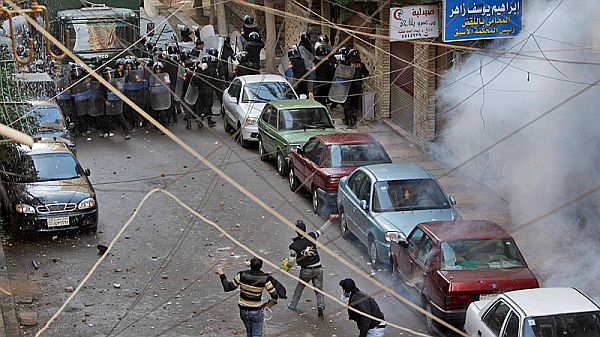

Abigail Hauslohner reports from “Free Libya”:
Tobruk is several hundred miles away from Benghazi, the first large epicenter of the revolt, and even farther from Tripoli, the Libyan capital. But local activists felt wired into the revolutions going on far beyond the borders of their nation, even though foreign newspapers were never for sale in Gaddafi’s Libya and websites were often blocked, says Gamal Shallouf, a marine biologist who has joined the newly fledged opposition. While the Internet has been down here since the revolution started, the regime’s inability to shut down new-media innovations entirely has been key to spreading Libya’s revolt.
“Generally, in Libya before this, there was no media,” explains Shallouf. “So if Tobruk made a revolution, [the government] would spend three to five days killing us and finish the revolution. Nobody in [larger nearby communities and cities] al-Baida or Darna or Benghazi would have heard about it. But now with al-Jazeera and Facebook and the media, all of Libya hears about the revolution and is with the revolution. They know about it. They think, ‘I am Libyan, this is my family, so I will go to the street to fight for them.’ ”
He and fellow Libyans had followed the Tunisian and Egyptian uprisings on al-Jazeera and satellite Arabic-language news channels. He did his best, along with other Libyan activists, to internally circulate the videos he saw so that other Libyans could get a glimpse of what was happening on either side of their closed-off country. “After I got videos from the Internet, we sent them from Bluetooth to Bluetooth. Mostly videos of fighting in Egypt. I felt two things when I saw these videos: I felt sad. And then I wanted to make a revolution!”
Arab solidarity demos in Egypt condemn Gaddafi
More interviews and reports at Frontline: Revolution in Cairo.
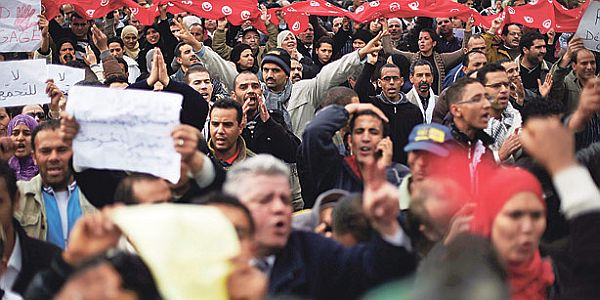
Robert Fisk writes:
Mubarak claimed that Islamists were behind the Egyptian revolution. Ben Ali said the same in Tunisia. King Abdullah of Jordan sees a dark and sinister hand – al-Qa’ida’s hand, the Muslim Brotherhood’s hand, an Islamist hand – behind the civil insurrection across the Arab world. Yesterday the Bahraini authorities discovered Hizbollah’s bloody hand behind the Shia uprising there. For Hizbollah, read Iran. How on earth do well-educated if singularly undemocratic men get this thing so wrong? Confronted by a series of secular explosions – Bahrain does not quite fit into this bracket – they blame radical Islam. The Shah made an identical mistake in reverse. Confronted by an obviously Islamic uprising, he blamed it on Communists.
Bobbysocks Obama and Clinton have managed an even weirder somersault. Having originally supported the “stable” dictatorships of the Middle East – when they should have stood by the forces of democracy – they decided to support civilian calls for democracy in the Arab world at a time when the Arabs were so utterly disenchanted with the West’s hypocrisy that they didn’t want America on their side. “The Americans interfered in our country for 30 years under Mubarak, supporting his regime, arming his soldiers,” an Egyptian student told me in Tahrir Square last week. “Now we would be grateful if they stopped interfering on our side.” At the end of the week, I heard identical voices in Bahrain. “We are getting shot by American weapons fired by American-trained Bahraini soldiers with American-made tanks,” a medical orderly told me on Friday. “And now Obama wants to be on our side?”
The events of the past two months and the spirit of anti-regime Arab insurrection – for dignity and justice, rather than any Islamic emirate – will remain in our history books for hundreds of years. And the failure of Islam’s strictest adherents will be discussed for decades. There was a special piquancy to the latest footage from al-Qa’ida yesterday, recorded before the overthrow of Mubarak, that emphasised the need for Islam to triumph in Egypt; yet a week earlier the forces of secular, nationalist, honourable Egypt, Muslim and Christian men and women, had got rid of the old man without any help from Bin Laden Inc. Even weirder was the reaction from Iran, whose supreme leader convinced himself that the Egyptian people’s success was a victory for Islam. It’s a sobering thought that only al-Qa’ida and Iran and their most loathed enemies, the anti-Islamist Arab dictators, believed that religion lay behind the mass rebellion of pro-democracy protesters.
Adam Shatz writes:
After the battle for Tahrir Square, the conceptual grid that Western officials have used to divide the Islamic world into friends and enemies, moderates and radicals, good Muslims and bad Muslims has never looked more inadequate, or more irrelevant. A ‘moderate’ and ‘stable’ Arab government, a pillar of US strategy in the Middle East, has been overthrown by a nationwide protest movement demanding democratic reform, transparent governance, freedom of assembly, a more equitable distribution of the country’s resources and a foreign policy more reflective of popular opinion. It has sent other Arab governments into a panic while raising the hopes of their young, frustrated populations. If the revolution in Egypt succeeds, it will have swept away not only a corrupt and autocratic regime, but the vocabulary, and the patterns of thought, that have underpinned Western policy in the greater Middle East for more than a half century.
The fate of Egypt’s revolution – brought to a pause by the military’s seizure of power on 11 February, after Mubarak’s non-resignation address to his ‘children’ – remains uncertain. Mubarak is gone, but the streets have been mostly cleared of protesters and the army has filled the vacuum: chastened, yet still in power and with considerable resources at its disposal. Until elections are held in six months, the Supreme Council of the Armed Forces will be ruling by decree, without the façade of parliamentary government. The parliament, voted into office in rigged elections, has been dissolved, a move that won wide support, and a new constitution is being drafted, but it’s not clear how much of a hand the opposition will have in shaping it. More ominously, the Supreme Council has vowed to punish anyone it can accuse of spreading ‘chaos and disorder’. The blunt rhetoric of its communiqués may be refreshing after the speeches of Mubarak, his son Gamal and the industrialists who dominated the ruling National Democratic Party, with their formulaic promises of reform and their talk of the nobility of the Egyptian people but ten days ago in Tahrir Square the protesters said – maybe even believed – that the army and the people stood together. Today the council’s communiqués are instructions, not proposals to be debated, and it has notably failed to answer the protesters’ two most urgent demands: the repeal of the Emergency Law and the release of thousands of political prisoners.
Nathan Brown writes:
The Egyptian revolution has captivated audiences and inspired a sense of endless new possibilities. Whether it is a “new dawn” or “a dividing point in history” (as I heard it described by Jordanians and Palestinians across the political spectrum), Egyptians are seen as having brought down a rotten system as they begin to write their own future. The only question is how other Arabs (and maybe even Iranians) can join them.
I am not yet so sure.
It is not that the old regime still remains (though it does; the junta and the cabinet are both still staffed by pre-revolutionary appointees and only vague hints of a cabinet reshuffle have been floated). It is clear that real change of some kind will take place. But the shape of the transition has not yet been defined. A more democratic, pluralistic, participatory, public-spirited, and responsive political system is a real possibility. But so is a kinder, gentler, presidentially-dominated, liberalized authoritarianism. In this post, I will discuss the state of play in Egypt; in future writings I hope to explore the implications for other regimes in the region.
The danger of indefinite military rule in Egypt is small. While pundits have often proclaimed the military to be the real political power in Egypt since 1952, in fact the political role for the military has been restricted for a generation. And there is no sign that the junta wants to change that for long. It is order, not power that they seem to seek. When the generals suspended the constitution, most opposition elements saw that as a positive step because it made possible far-reaching change, and I think that was a correct political judgment. (The suspension led to odd headlines in international press referring to Egypt as now being under martial law. But Egypt has been under martial law with only brief interruptions since 1939. It was not the generals who placed Egypt under martial law; that step was taken by King Faruq.)
But if the suspension of the constitution allowed the possibility of fundamental change, it did not require it. Indeed, the transition as defined by Egypt’s junta seems both extremely rushed and very limited.
Associated Press reports:
He organized his first demonstration while still a student in 1998, then got arrested and tortured by Egyptian police two years later at age 23. Now he has seen the fall of the president he spent his adult life struggling against.
For 33-year-old activist Hossam el-Hamalawy, though, Egypt’s three-week youth revolution is by no means over — there remains a repressive state to be dismantled and workers who need to get their rights.
“The job is unfinished, we got rid of (Hosni) Mubarak but we didn’t get rid of his dictatorship, we didn’t get rid of the state security police,” he told The Associated Press while sipping strong Arabic coffee in a traditional downtown cafe that weeks before had been the scene of street battles.
The activism career of el-Hamalawy typifies the long, and highly improbable, trajectory of the mass revolt that ousted Mubarak, Egypt’s long-entrenched leader. Once a dreamer organizing more or less on his own, el-Hamalawy’s dreams suddenly hardened into reality. The next step, he says, is the Egyptian people must press their advantage.
“This is phase two of the revolution,” said el-Hamalawy, who works as a journalist for an English-language online Egyptian paper and runs the Arabawy blog, a clearing house for information on the country’s fledgling independent labor movement — a campaign that has become increasingly assertive since the fall of the old government.
For years, activists in Egypt planted seeds — sometimes separately, sometimes in coordination — building networks and pushing campaigns on specific causes. They fought lonely fights: anti-war protests here, labor strikes there, an effort to raise awareness about police abuse, another to organize “Keep Our City Clean” trash collection.
Then one day in late January, it all came together for them. They were part of a movement, hundreds of thousands strong.
For three weeks, el-Hamalawy fought regime supporters and manned the barricades in Tahrir Square, but unlike the youth leaders who have come to prominence in the aftermath of the uprising, he refuses to talk to the generals now ruling Egypt and fears the uprising’s momentum is being lost as everyone waits for the military to transition the country to a new government.

View Protests across the Middle East in a larger map
Egypt revolution unfinished, Qaradawi tells Tahrir masses
Yusuf al-Qaradawi, a leading Egyptian Islamic theologian popularized by Al Jazeera, returned to Cairo today to deliver a stirring but overtly political sermon, calling on Egyptians to preserve national unity as they press for democratic progress.
“Don’t let anyone steal this revolution from you – those hypocrites who will put on a new face that suits them,” he said, speaking to at least 200,000 who gathered for Friday prayers in Tahrir Square, the epicenter of Egypt’s uprising. “The revolution isn’t over. It has just started to build Egypt … guard your revolution.”
The massive turnout and Mr. Qaradawi’s warning that the revolution is not complete demonstrate that if the military drags its feet on reform, another uprising could begin. And while his sermon was nonsectarian and broadly political, the turnout was also a reminder that political Islam is likely to play a larger role in Egypt than it has for decades. (Christian Science Monitor)
Among Egypt’s missing, tales of torture and prison
Ramadan Aboul Hassan left his house one night about three weeks ago to join a neighborhood watch group with two friends and did not return. The next time their relatives saw the three men they were emerging Wednesday night from a maximum security prison, 400 miles from home, run by Egypt’s military. Some family members said they bore signs of torture, though others denied it.
While many here have cheered the military for taking over after last week’s ouster of President Hosni Mubarak and for pledging to oversee a transition to democracy, human rights groups say that in the past three weeks the military has also played a documented role in dozens of disappearances and at least 12 cases of torture — trademark practices of the Mubarak government’s notorious security police that most here hoped would end with his exit.
Some, like Mr. Aboul Hassan and his two friends, were not released until several days after the revolution removed Mr. Mubarak.
Now human rights groups say the military’s continuing role in such abuses raises new questions about its ability to midwife Egyptian democracy. (New York Times)
Suez Canal workers join broad strikes in Egypt
Hundreds of workers went on strike on Thursday along the Suez Canal, one of the world’s strategic waterways, joining others across Egypt pressing demands for better wages and conditions. The protests have sent the economy reeling and defied the military’s attempt to restore a veneer of the ordinary after President Hosni Mubarak’s fall last week.
The labor unrest this week at textile mills, pharmaceutical plants, chemical industries, the Cairo airport, the transportation sector and banks has emerged as one of the most powerful dynamics in a country navigating the military-led transition that followed an 18-day popular uprising and the end of Mr. Mubarak’s three decades of rule.
Banks reopened last week, but amid a wave of protests over salaries and management abuses promptly shut again this week. The opening of schools was delayed another week, and a date has yet to be set for opening the stock market, which some fear may plummet over the economic reverberations and anxiety about the political transition.
The military has repeatedly urged workers to end their strikes, to no avail. (New York Times)
The pro-democracy rally at Bahrain’s Lulu Roundabout was brought to a violent end at 3am this morning when police launched a brutal assault against what at that time were mostly sleeping protesters.
Was this one of the “difficulties along the way” down “the democratic path that Bahrain is walking on” for the nation Hillary Clinton described as a “model partner” for the US less than three months ago?
When security forces launch a brutal crackdown on peaceful protesters, killing five, injuring hundreds and then the government prevents ambulances reaching the injured, there’s only one way this can be described: state terrorism.
And when the state in which this is occurring, Bahrain, is of preeminent importance to the US government because it serves as the base for the US Fifth Fleet and US naval operations in the Gulf, this becomes US-back state terrorism.
Mealy-mouthed statements from the White House on the need for “both sides” to exercise restraint and avoid violence, do nothing to disguise American complicity as yet again Washington attempts to shield one of its allies.
Here’s some of what the New York Times‘ Nicholas Kristof has reported in the last few hours:
Maryam Alkhawaja from the Bahrain Centre for Human Rights tweets that “several Bahraini officers are being prosecuted for refusing to take part in violence against peaceful protesters.”
Meanwhile, Amnesty International provides the following chilling account of torture conducted by the Egyptian army, just days before Hosni Mubarak stepped down:
An 18-year-old secondary school student from Cairo told Amnesty International that he was tortured after he was arrested at about 1500hrs on 3 February 2011 by soldiers near Tahrir Square:
“I was walking with a friend towards the square when soldiers stopped us and asked for our IDs. They seemed to be suspicious of my friend, because he holds a UK residence permit. They took us to the area museum which is controlled by the army and held us there in an outdoor area. After some while we were blindfolded and handcuffed and I could not see what happened to my friend. I could only hear him screaming and believe he was severely beaten. I was only slapped in the face but not severely beaten while held at the museum.
“That night we were transferred to another location about 30 minutes away from Tahrir Square. When we got out we had to lie down on the floor and were beaten. Then I was taken for interrogation where they insulted me and my family. They said things one should not say. They took off my handcuffs, because they ordered me to take off my clothes, except my underwear, but I remained blindfolded. Then they handcuffed me again and tied my legs. They put a chain or rope to my legs and lifted me up, so that my head was hanging down. From time to time they would let me down into a barrel that was filled with water. They told me to confess that I was trained by Israel or by Iran. They also put electric shocks to my body and I fainted. This continued for several hours. After the torture finished I was so exhausted that I slept for hours.
“The next day I was taken in a group of about 30 people to another location, which – as I learned later – was Sign al-Harbi [a military prison at El Heiksteb, northeast of Cairo]. When we got out of the vehicle our blindfolds were taken off and soldiers started beating us with whips and truncheons. There are still scares on my back from the beatings. We were lead to our cells where I soon fell asleep. They kept beating us, including when we went to the bathroom. The last days of my detention I refused to eat to protest against the treatment. Finally we were released. They left us on the road to Cairo and told us to walk back.”
He was released with hundreds of other detainees from the military prison on 10 February 2011. Amnesty International delegates interviewed him several days later when scars were still visible on his back.
During an era in which Americans have been told that the threat from terrorism should be preeminent among this nation’s national security concerns, the gravest omission in public debate on this issue has been consideration of the relationship between state-sanctioned brutality and terrorism.
We have been led to believe that terrorism arising in the Middle East is spawned by extremist Islamist ideology while overlooking its much more transparent secular roots: the willingness of autocratic rulers to use violence as an instrumental and indispensable tool through which they can exercise and sustain their power.
When the word “stability” gets bandied around as though it was describing a condition of civic calmness and social order, we should remember that when someone has a gun pointed to their head they are able to sit in perfect stillness — this is stability under the threat of violence, the condition in which most people in the Middle East have lived for generations.
Where violence provides the backbone of governance, should we be surprised that similar forms of brutality would be adopted by some individuals and groups that want to challenge their rulers? And should we imagine that when these rulers are counted as America’s friends, that the US could provide its support with impunity?
What we should really marvel at is the fact that people across the region are now rising in their thousands driven, in part, by the audacious idea that non-violence can overcome violence.
Philip Rizk writes:
When an online petition urged Egyptians to protest on January 25, the call was not only taken up by an internet savvy minority. The demonstrators who took to the streets on that day – many of whom remained there until they forced Hosni Mubarak, the country’s autocratic ruler, to step down – transcended the divisions of class, age, religion and political affiliation. The true force behind the Egyptian people’s uprising rested in its leaderless and spontaneous nature. A widely-felt wound had been poked and festering at the centre of that wound was decades of economic exploitation and corruption made tenable by police violence against any form of public dissent.
One sign held up by protesters in Cairo’s Tahrir Square read: “Tell them to remove the plague and price increases Mubarak.” It was signed: “A citizen that loves Egypt.” That simple message conveyed the essence of the uprising, for the 18 days of protests were, in many ways, the culmination of a wave of much smaller and more localised strikes and demonstrations that had been taking place across the country since 2006.
It all began on December 7, 2006 when workers in the industrial city of El-Mahalla El-Kubra broke the country’s 20-year strike hiatus over the government’s failure to fulfill promises it had made about bonuses. For three days the strikers occupied a factory, calling for the government-backed Labor Federation to be dismantled. The government buckled under the pressure and gave in to the workers’ demands, but the event opened a Pandora’s Box of strikes and protests across the country.
The strikers were responding to the fast-track imposition of neo-liberal economic policies by a cabinet led by Ahmed Nazif, the then prime minister who relentlessly implemented the demands of the World Bank and International Monetary Fund (IMF). These measures included the privatisation of public factories, the liberalisation of markets, decreasing tariffs and import taxes and the introduction of subsidies for agri-businesses in place of those for small farmers with the aim of increasing agricultural exports.
Such economic policies, which are by no means unique to Egypt, are the fruitful soil of neo-colonialism, whereby multi-national corporations are able to capitalise on economies run by regimes that impose low standards of corporate responsibility towards their labour force, have few environmental protection laws and, in the case of Egypt, subsidise natural resources for big industry. This is coupled with the shrinking of the public sector, which is precisely where most of the labour action in Egypt has been concentrated.
These policies benefitted a small Egyptian elite and foreign corporations, while condemning the country’s working class to a new form of labour-slavery – many public sector employees held up their wage slips during protests, showing meagre monthly earnings of $50 to $90 – and the broader population to the consequences of a shrinking public sector and increased commodity prices.
Samir Amin on the Egyptian challenge to neoliberalism
The Egyptian economist, Samir Amin, President of the World Forum for Alternatives, spoke to World Social Forum TV about the situation in Egypt. The interview was recorded on February 7. A partial transcript of Samir Amin’s remarks can be found here.