Reuters reports: Iranian President Hassan Rouhani’s historic phone call with U.S. President Barack Obama is likely to provoke resistance from powerful hardliners in the Islamic Republic who have built their support on enmity with the West.
The first thing Rouhani did on his return to Tehran at the weekend was to state that he had acted within guidelines set by Supreme Leader Ayatollah Ali Khamenei when he took part in the highest-level contact between Iran and the United States in three decades.
The brief mobile phone conversation led many to speculate that since the election of the moderate Rouhani relations between Washington and Tehran, in the deep freeze since the U.S. embassy hostage crisis, may be about to improve.
Rouhani’s invocation of Khamenei, the man at the top of Iran’s complex political system, looked like a bid to ward off a backlash from hardline power centres and their supporters, some of whom were already lying in wait to throw eggs at the president’s motorcade.
The demonstrators’ chants of “Death to America” were, however, likely to be only the opening shots of a campaign against Rouhani by a conservative political and military establishment opposed to the West in general and to the United States and Israel in particular.
Such is the mistrust between Iran and the United States that a big sticking point of negotiations over Tehran’s disputed nuclear programme has been who should make the first move. [Continue reading…]
Category Archives: Iran
Iranian media splits over diplomatic outreach
Tehran Bureau reports: Hossein Shariatmadari, the chief editor of Iran’s leading hardline newspaper, appears to be in quite a quandary. Long Kayhan’s primary editorial writer, he kept silent for weeks as Iran’s new president, Hassan Rouhani, and his diplomatic team made a series of statements and gestures indicating their willingness to engage in substantive negotiations with the United States and its western allies. Then came the historic telephone exchange last week between Rouhani and Barack Obama, the first direct contact between the presidents of the Islamic republic of Iran and the United States since the 1979 revolution and the takeover of the US embassy in Tehran. On Sunday, Shariatmadari, faced with a choice between continued silence and condemnation, picked the latter.
“The last act of the New York trip, which should be considered most disheartening, and the largest advantage that our nation’s respectful president handed [our] opponent, was the phone conversation of his with the president of the US”, he said of Rouhani’s visit to address the UN General Assembly.
Rather than deal with the content of the conversation, Shariatmadari focused on the announcement by US national security advisor Susan Rice that the Iranian delegation had requested the call. “Based on what analysis and interpretation did his eminence, Mr Rouhani, and the meritorious entourage feel it necessary to trust the Americans and then present the United States’ trust-building efforts in such expansive and loud propaganda as one of the fruits of the New York trip? Furthermore, what kind of a ‘trust-building step’ is this, which neither side is willing to take responsibility for [initiating]?”
“Just take a look at the volume of reviews, analyses, and reports published by the American media, and by American and Zionist officials to see how they reframe the aforementioned telephone conversation in terms of the ‘capitulation of Islamic Iran’ and its weakness and despair due to the strain of the sanctions”, he wrote, without naming any specific media outlets.
Discussing the Kayhan editorial, a senior editor at an Iranian reformist publication told Tehran Bureau, “Shariatmadari is considered an icon in the principlist media realm. For about 20 years, his has been the first and last words among right-wing publications, and his first and last words have always been that under no circumstances should we negotiate with the United States.
“Undoubtedly, Rouhani did not converse with Obama without the consent of [supreme leader Ayatollah Ali] Khamenei. This has put Shariatmadari in a frightful predicament.”
The depth of that predicament was brought into clearer focus when the state-controlled Islamic Republic of Iran Broadcasting, long a source of hardline views essentially identical to Kayhan’s, offered a very different perspective on the presidential phone call to its millions of viewers. In its Channel One news programming on Saturday, IRIB presented wall-to-wall coverage of Rouhani and his youthful entourage’s return to Iran. Even as it censored out any coverage of the protesters, including Basij militia members, who chanted anti-Rouhani slogans at the airport, the network’s reporters roamed the streets of Tehran asking apparently typical citizens for their opinions of the 15-minute conversation between Iran’s president and that of the nation which for years it had called “the Great Satan”.
Every single one of the people whose interviews were aired welcomed the event. [Continue reading…]

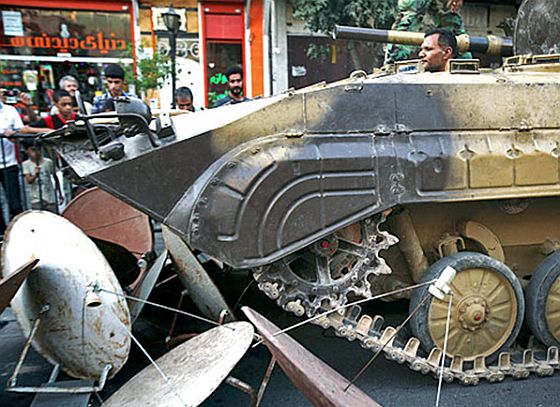
Rouhani promises free media access while the Revolutionary Guard sends in tanks

Satellite dishes in Shiraz being crushed by Iran's Revolutionary Guard tank.
IranWire reports: Just two days after President Hassan Rouhani laughed off a question about access to satellite television in Iran during a press conference in New York, the Revolutionary Guards’ Fajr Brigade sent a tank into Shiraz to crush 800 pieces of satellite equipment.
“The Iranian government’s objective is to provide free access to information for the people,” Rouhani said during his Asia Society press conference. “Presently even Iranian villages have access to satellite [television]; all you have to do is to look at their rooftops.”
While period sweeps on satellite dishes and more recently satellite dish workshops are a feature of life in the Islamic Republic, a costly cat and mouse game between the authorities and citizens who seek free access to global culture and information, the Revolutionary Guards’ tank pageant is unprecedented in its violent show of force.
The timing raises questions as to whether powerful regime forces like the Revolutionary Guards will seek to obstruct his reforms and tar the image of moderation he seeks to present to the world. [Continue reading…]
Video: Rouhani condemns the Holocaust but says crimes against Jews don’t justify crimes against Palestinians
American alleged spy hits back at Iranian captors
The Guardian reports: Amir Hekmati, a US citizen accused of espionage and jailed in Iran, has said his televised confession was forced and asserted that he is in fact being held hostage for use in a prisoner exchange and mistreated.
In a letter smuggled out of jail and obtained by the Guardian, the 29-year-old former US marine, who was arrested in Tehran two years ago for his alleged links to the CIA, said his confession aired on Iranian state television was made under duress and was used to implicate him in trial.
“For over two years I have been held on false charges based solely on confessions obtained by force, threats, miserable prison conditions and prolonged periods of solitary confinement,” he wrote earlier this month.
The letter, which has been authenticated by Hekmati’s family, is addressed to US secretary of state, John Kerry. Kerry urged Tehran leaders to release him from prison on the second anniversary of his arrest last month, saying Washington was “deeply concerned” about his detention.
Hekmati was picked up by Iranian security officials in August 2011, two weeks after arriving in Tehran from Dubai on a family visit. He holds both Iranian and American citizenship and served as a US marine between 2001 and 2005, at some point translating Persian and Arabic in Iraq.
In his letter, Hekmati accuses the Iranian authorities of employing “unlawful tactics” to keep him in prison with a view to swapping him for Iranian prisoners held in US custody. [Continue reading…]
Iran’s Rouhani using Twitter diplomacy
The National reports: Western social media sites are outlawed for ordinary Iranians, but Iran’s new government is using them keenly in a concerted drive to improve the Islamic republic’s image.
Spearheading the cyber charm offensive is the president, Hassan Rouhani, and his US-educated foreign minister, Mohammad Javad Zarif, who garnered global attention last week when he used his new English-language Twitter account to wish Jews a happy new year and to proclaim that his country does not deny the Holocaust.
A day earlier, a tweet from an account in Mr Rouhani’s name wished “all Jews” a “blessed” new year on the holiday of Rosh Hashanah.
Iran’s entire cabinet has also opened Facebook pages in recent weeks.
The public diplomacy drive is preparing the ground for key events. Tehran is due in coming weeks to resume talks on its nuclear programme with six world powers, including the United States.
Mr Rouhani, who is regarded as a moderate pragmatist, transferred the handling of those negotiations last week to Mr Zarif’s foreign ministry, taking the portfolio away from hardline officials.
And later this month, Mr Rouhani will make his debut on the international stage when he addresses the United Nations General Assembly in New York.
The Jewish new year greetings were clearly aimed at distancing his administration from that of his predecessor. Mahmoud Ahmadinejad’s denials of the Holocaust made him toxic to western public opinion, fuelled fears over Tehran’s nuclear ambitions and embarrassed many Iranians.
“The Rouhani team is eager to quickly undo the eight years of damage that the Ahmadinejad government did to Iran’s standing and image,” said Trita Parsi, the president of the National Iranian American Council, an advocacy group. “In this new age, you can at times reach more people through a tweet than through a press release, and Rouhani and Zarif have shown that they know that.” [Continue reading…]
Iranian parliament pursuing lawsuit against CIA for 1953 coup
The Los Angeles Times reports: A week after declassified CIA documents came to light verifying that the U.S. spy agency was behind a 1953 coup in Iran, parliamentarians in the Islamic Republic voted Tuesday to fast-track a lawsuit against Washington for interfering in Iranian domestic political affairs.
Sections of an internal CIA history of the operation that ousted Iranian Prime Minister Mohammad Mosaddeq and paved the way for the return of the exiled Shah Mohammed Reza Pahlavi were declassified two years ago but made public only Aug. 19 by the National Security Archive, an independent documentation research center in Washington.
The shah’s return was followed by years of brutal political reprisals and confrontation, leading to the 1979 Islamic Revolution and the shah’s second flight into exile. The deposed monarch took refuge in several countries before being granted a brief U.S. stay for medical treatment that poisoned to this day relations between Washington and the religious leadership in Tehran. The shah died in Egypt in 1980.
Iranian lawmakers will begin Wednesday debating how to take the U.S. government to international court following a vote by the 290-seat parliament that was broadcast on state radio and reported by Iran’s Press TV. The plan to fast-track a lawsuit received 173 votes. [Continue reading…]
The rise of the Iranian moderates
Seyed Hossein Mousavian, a former spokesman for Iran’s nuclear negotiators, writes: Political infighting and factionalism has become a cynical characteristic of Iranian politics since the 1979 Islamic Revolution, specifically in the last 16 years. This phenomenon escalated with the sweeping victory of the traditional left wing of the revolution relabeled as Islahtalaban, or “Reformists,” in the presidential election of 1997. During the eight years of President Mohammad Khatami’s administration from 1997 to 2005, the right wing of the revolution — relabeled as Usulgarayan, or “Principalists” or “Conservatives” — was progressively sidelined and replaced by Reformists. Khatami, while disapproving of factionalism, could not withstand the tide of change toward a Reformist-dominated administration. This left many Principalists alienated and bitter from the experience they faced at the hands of the Reformists.
The surprise win for the Principalist candidate, Mahmoud Ahmadinejad, in the 2005 presidential election turned the tide against the Reformists. This time around, the purge of Reformists from the administration was swift and almost total, ushering in a period of dominance in the administration by one faction for the next eight years.
During both periods of extreme political polarization and dominance by one faction, there existed moderates within Islahtalaban and Usulgarayan. Ayatollah Hashemi Rafsanjani — early on in Khatami’s presidency — voiced his concern over the growing trend toward factionalism. As one of the key founders of the Islamic Republic, he cautioned that such political infighting would ultimately endanger the whole establishment. Rafsanjani instead called for like-minded politicians in both camps to create a new political movement in Iran, under the banner of moderation or centrist. Subsequently, then-Deputy Foreign Minister Mahmoud Vaezi, MP Mohammad Bagher Nobakht, Deputy Cultural Minister Ali Jannati and I met with Rafsanjani to realize the initiative. In that meeting, Rafsanjani told us, “Ruling the country with one faction would be a disaster for the country, and instead all moderates within both major factions should unite and advance economic-political development to strengthen the pillars of the Islamic Republic.” In the same meeting, we decided to establish a party, the Hezbe Etedal va Tosehe, or “Moderate and Development Party.” The best candidate to lead the party, according to Rafsanjani’s advice, was Hassan Rouhani. In 1999, the party and its central committee was established and led by Rouhani. [Continue reading…]
Is Iran’s Supreme Leader really so supreme?
Gary Sick writes: With the surprising Iranian election over, and the moderate Hassan Rouhani elected by a clear majority, a new narrative is emerging. It asserts that absolutely nothing has changed, that Ayatollah Ali Khamenei, Iran’s supreme leader, let the election proceed for his own devious reasons, and that only he can make decisions about Iran’s strategic policies, regardless of who is president.
This is a facile and self-serving argument. After Friday’s election, which reversed all predictions, those of us who watch Iran closely should ask ourselves whether the supreme leader is as supreme as he pretends.
Despite witticisms about “one man, one vote — and that one man is Khamenei,” I am willing to bet that the leader’s vote very early last Friday morning was not for the winning candidate. After all, Rouhani had argued for changes in how Iran deals with political prisoners and particularly its treatment of the former Green candidates who are languishing in house arrest. Those are Khamenei’s policies.
But it is not only the election. Just look at the record. Over the past 15 years, Iran has pursued a series of quite different negotiating strategies with the West: from a temporary suspension of enrichment under the new president-elect, to an on-again-off-again offer to compromise on 20 percent enrichment that resulted in a formal offer via Turkey and Brazil, then a full court stall and “resistance” strategy under the stewardship of the now-forgettable Saeed Jalili. The one constant during all these episodes was the unquestioned supremacy of one man. [Continue reading…]
Rouhani: A survivor in the snake pit of Tehran
David Patrikarakos writes: Iran’s new president-elect Hassan Rohani is being praised as a “moderate” who might bring change to Iran and transform Tehran’s international relationships. ”What does he want?” is the question most analysts now ask, and, critically, “What can he achieve?”
The answer may be: a great deal. If he is given the right support — domestically and internationally.
For Rohani possesses the single most important qualification for any president in Tehran: He knows how to negotiate the pit of vipers that is Iranian politics.
Rohani has survived for more than 30 years in Tehran. He is the Beria of the Islamic Republic – as able as Laventy Beria to skillfully negotiate the whims of his autocratic masters to safeguard his position at all times.
As a cleric of the Islamic Republic, who followed its founder, Ayatollah Ruhollah Khomeini into exile in Paris, Rohani is a true child of the Islamic Revolution. Yet he is also, comparatively speaking, a “moderate.”
His first post-election promises to improve Iran’s image are positive — contrasting starkly to President Mahmoud Ahmadinejad’s 2005 arrival to the world stage with an offensively defiant speech at the United Nations.
Whether Rohani will deliver, however, is another matter.
But he has already vowed to release Mir Hussein Mousavi and Mehdi Karoubi, the two reformist leaders held under house arrest since 2011. Iran’s supreme leader, Ayatollah Ali Khamenei, is likely loathe to free the men he blames for the unrest that so badly shook the regime in 2009. So this will be Rohani’s first test — of his sincerity and, more importantly, his ability to get things done. [Continue reading…]
Trivial editorial point, but I hope that by the day he takes office, a winner will have emerged between Rohani, Ruhani, Rowhani, and Rouhani. Maybe the deciding factor will be URLs. That of the new president is rouhani.ir, whereas rohani.ir belongs to Grand Ayatollah Sayyed Mohammad Sadeq Hussaini Rohani.
Israel should give Rouhani a chance
Shlomi Eldar writes: It’s time we admitted the truth. Despite all the enormous efforts by the international intelligence community directed toward Iran in recent years, we really don’t know much about what is going on in the Land of the Ayatollahs.
The United States, Israel and other Western nations have launched sophisticated cyber-attacks against the nuclear reactor systems in Bushehr. Intelligence agencies know the exact role of every nuclear scientist in Iran, and where they can be found at any given moment. But despite all that abundant intelligence, there is one basic thing that they didn’t understand about this enormous country: the public state of mind.
Some 18.6 million Iranians (50.7% of all eligible voters!) proved this by casting their ballots for the moderate reformist, newly elected Iranian President Hassan Rouhani. The popular unrest over outgoing Iranian President Mahmoud Ahmadinejad’s policies was even greater than estimated, and it was this that motivated millions of Iranians to say “No” to the country’s spiritual leader, Ali Hosseini Khamenei, and to vote for what was good for them. By the way, this shows that there is something else we should admit, even if it ruins the image of Iran that we have long since etched in our minds: Despite everything else, the Land of the Ayatollahs has some modicum of democracy. True, Iran is not a liberal country. It receives no high marks for its record on human rights. Nevertheless, the elections there proved that the people exercised their right to replace their leaders. [Continue reading…]
Israeli leaders respond with scowls to Rouhani’s election
Marsha B Cohen writes: For most Israeli politicians, the news of the election of moderate cleric Hassan Rouhani as president of Iran, is not good. That it is considered good news by anyone else makes it that much worse.
In Poland last Wednesday, two days before Iranians went to the polls, Israeli Prime Minister Netanyahu declared that the results would bring about no meaningful change in Iran. Hours before reports of the election’s outcome began to be announced, Israeli Defense Minister Moshe Yaalon told the Washington Institute for Near East Policy (WINEP), a pro-Israel think tank, that Iran’s Supreme Leader, Ali Khamenei, would decide who the next Iranian president would be. The imminent Iranian election would change nothing.
As news of Rouhani’s garnering more than half the votes cast in Iran began to emerge, Israel’s Foreign Ministry spokesman, Yigal Palmor, echoed the widespread view that it is Khamenei who makes all the decisions concerning the Iranian nuclear program, not the Iranian president. “After the elections, Iran will continue to be judged by its actions, in the nuclear sphere as well as on the issue of terror,” Palmor said in a statement.” Iran must abide by the demands of the international community to stop its nuclear program and cease the dissemination of terror throughout the world.”
In a cabinet meeting on Sunday morning, Netanyahu derided not only the possible impact of a Rouhani-presidency on Iran’s policies, but also whether Rouhani even deserved to be considered a moderate since Khamenei had allowed him to run: [Continue reading…]
Video: Iran’s new president and the reformist movement
Why Rouhani won — and why Ayatollah Khamenei let him
Suzanne Maloney writes: One explanation is that the Ayatollah simply miscalculated and found himself, once again, overtaken by events when Rouhani’s candidacy surged with little forewarning. Indeed, it is likely that Khamenei really did expect Iranians to vote for the conservatives. After all, the conservatives have held all the cards in Iran since 2005; they dominate its institutions and dictate the terms of the debate. With the leading reformists imprisoned or in exile, no one expected that the forces of change could be revived so powerfully. When his expectations proved off base last Friday, Khamenei could have simply opted not to risk a repeat of 2009.
There is another possibility, however, and one that better explains Khamenei’s strangely permissive attitude toward Rouhani’s edgy campaign and toward the extraordinary debate that took place between the eight remaining presidential candidates on state television only a week before the election. In that discussion, an exchange about general foreign policy issues morphed unexpectedly into a mutiny on the nuclear issue. One candidate, Ali Akbar Velayati, a scion of the regime’s conservative base, attacked Jalili for failing to strike a nuclear deal and for permitting U.S.-backed sanctions on Iran to increase.
The amazingly candid discussion that followed Velayati’s charge betrayed the Iranian establishment’s awareness of the regime’s increasing vulnerability. It could only be understood as an intervention — one initiated by the regime’s most stalwart supporters and intended to rescue the system by acknowledging its precarious straits and appealing for pragmatism (rather than Jalili’s dogmatism). The discussion was also an acknowledgement that the sanctions-induced miseries of the Iranian public can no longer be soothed with nuclear pageantry or even appeals to religious nationalism.
It is therefore possible to imagine that Khamenei’s unexpected munificence, including his last-minute appeal for every Iranian — even those who don’t support the Islamic Republic — to vote, was planned. In this case, those who see Rouhani’s election as a replay of the shocking political upset that Khatami pulled off in 1997 are off base. Instead, Rouhani’s election is an echo of Khamenei’s sudden shift in 1988 and 1989, when he charged Rafsanjani, a pragmatist, with ending the war with Iraq, and then helped Rafsanjani win the presidency so that he could spearhead the post-war reconstruction program. Now, as then, Khamenei is not bent on infinite sacrifice. Perhaps allowing Rouhani’s victory is his way of empowering a conciliator to repair Iran’s frayed relations with the world and find some resolution to the nuclear dispute that enables the country to revive oil exports and resume normal trade. [Continue reading…]
The Iranian people challenge the West
Paul Pillar writes: Hassan Rouhani’s stunning and sweeping victory in the Iranian presidential election is already generating much debate among expert Iran-watchers about how to interpret this outcome. There are different views, for example, on what inference should be drawn regarding the posture of Supreme Leader Khamenei toward the election. Was this outcome one that the leader might have anticipated and is part of a skillful management of contending factions, or does the election result instead indicate that the leader’s control of Iranian politics is less than was often surmised? There also are different views on what role sanctions-induced economic strain may have had on the election. These are genuine questions on which objective and well-informed observers can disagree. Not genuine is the spin from some other fast-off-the-mark commentators who are endeavoring to deny any significance to Rouhani’s victory and to portray the Iranian regime as nothing but the same old recalcitrant adversary—a spin motivated by opposition to reaching agreements with Iran and the favoring of confrontation and even war with it.
Useful implications for policy toward Iran can be drawn without resolving all these analytical questions, even the genuine ones. Sometimes a particular course of action is the best course under any of several different interpretations of exactly what is going on in another nation’s capital. This is one of those instances. In particular, there are clear implications for approaching the next stage of negotiations on, and policy toward, Iran’s nuclear program—which, for better or for worse, is the subject dominating discussion of relations with the Islamic Republic.
One thing that the Iranian election would have changed no matter what the outcome on election day is that we soon will not have Mahmoud Ahmadinejad to kick around any more. The end of his distracting and annoying presence can only be to the good. Perhaps at least a little more serious attention will be devoted in the United States to policy and diplomacy when there is a little less energy allocated to expressing outrage over the outgoing Iranian president’s mistranslated quotes about wiping maps and his other intentionally inflammatory rhetoric. [Continue reading…]
How Rouhani won the Iranian presidential election
Mahmoud Reza Golshanpazhooh writes: Although some analysts are trying to argue that the vote for Mr. Hassan Rouhani was, in fact, a negative vote to the Islamic establishment’s policies, it was, in reality, a vote to moderation and foresight. These two concepts were major components of Mr. Rouhani’s election campaign as well. The high vote garnered by Mr. Rouhani was the result of the collective effect of a number of variables as follows:
– His fair – and at the same time categorical – criticism of certain policies followed by the incumbent administration;
– His finesse in defending his own viewpoints, track records, and policies in televised debates, especially in the second and third debates;
– The full and all-out support provided to Mr. Rouhani by former presidents, Akbar Hashemi Rafsanjani and Mohammad Khatami;
– The smart move by the other reformist candidate, Mohammad Reza Aref, in withdrawing his presidential bid without declaring his official support for Mr. Rouhani. As a result, the clear demarcation between Mr. Aref’s purely reformist attitude and Mr. Rouhani’s moderate views was maintained;
– Increased political understanding on the part of the Iranian people as they were well aware that they could only play a crucial part in determining their own fate through participating in the political process, not by boycotting it;
– The great effort made by Mr. Rouhani and his election campaign to carefully observe the rules of the political game and their clear commitment to pursuing any possible protests to election process through legal channels as specified by the Iranian Constitution. This was very important because it redirected the votes of the mostly traditional sectors of the Iranian society toward him as they were afraid that voting for the reformists would only increase conflicts and tension in the society.
– Another important factor was the clerical nature of Mr. Rouhani, which played an effective role in attracting the votes of a large part of the religious people to him as well as the votes cast by the ordinary people in villages and small towns. There were also many other, less significant factors at work. [Continue reading…]
Obama mustn’t waste the opportunity he has been handed by the Iranian people
Vali Nasr writes: Rowhani was widely excoriated in Iran for ostensibly betraying the national interest in 2003, when, as the country’s nuclear negotiator, he signed on to a voluntary suspension of uranium enrichment. That concession was meant as a confidence-building measure to build momentum for a broader nuclear deal, but the reformist hope turned into defeat when talks failed amid allegations that Iran had violated protocols laid out by the International Atomic Energy Agency. The supreme leader and his conservative coterie concluded that the suspension had been construed as Iranian weakness and only invited greater international pressure. They blamed Rowhani for having put Iran on its heels. The defeatist image became a stain on the reformists’ reputation and contributed to the conservative juggernaut that swept Mahmoud Ahmadinejad to power in 2005.
Ahmadinejad lost no time reversing the suspension. In a matter of days, the West offered Iran a new diplomatic package that reportedly included trade incentives, the promise of long-term access to nuclear supplies, and assurances of non-aggression. Rowhani’s boss, the reformist President Mohammad Khatami, complained that in doing so the West had rewarded Ahmadinejad’s brazen defiance over the reformists’ gesture of compromise.
Once bitten twice shy, Rowhani is unlikely to yet again risk being branded as soft on the West. He will venture concessions only if he is assured of tangible returns. This time it has to be Rowhani who gets more out of the United States than Ahmadinejad and Jalili did — and they had been offered spare aircraft parts and, in the last round of talks, relief from international sanctions on trade in gold and precious metals. Rowhani will be looking for real sanctions relief and a promise of recognition of Iran’s right to enrichment.
The dilemma for Washington is that, as a reformist, Rowhani is an outsider, weaker than Ahmadinejad when it comes to selling any compromise with the West to Iran’s suspicious conservative establishment. Rowhani’s electoral mandate gives him room to maneuver, but that is not enough to shield him from the backlash that would follow any rebuff at the negotiating table. So he will likely wait for a signal of American willingness to make serious concessions before he risks compromise. [Continue reading…]
How Iran’s Supreme Leader paved the way for Rouhani’s victory
Al-Monitor: Two days before Iranians voted for who would succeed Mahmoud Ahmadinejad as president of the Islamic Republic, Supreme Leader Ayatollah Ali Khamenei offered a rhetorical olive branch to the country’s opposition. He said that even those who “do not support the Islamic system” should come out and vote.
Khamenei’s message was a direct and unprecedented acknowledgement of the reformists and millions of silent secularists who comprise Iran’s “opposition” as stakeholders in the country. It was also a message to them that their votes would count.
This overture should be considered now that Hassan Rouhani — a candidate supported by reformists, and a reformist himself in all but name — has become the seventh president of the Islamic Republic of Iran.
The Supreme Leader’s comments actively contributed to the success of a candidate that is not within the conservative confines of his “principlist” political stable, in the process creating a more inclusive and pluralistic Iran. Contrary to endless punditry about Saeed Jalili being Khamenei’s favored candidate and even the front-runner, it now appears that the Supreme Leader made the calculated decision to acquiesce to the will of the Iranian people. [Continue reading…]