Category Archives: Iran

Iran’s new president hails ‘victory of moderation’

Reuters reports: Moderate cleric Hassan Rohani won Iran’s presidential election on Saturday with a resounding defeat of conservative hardliners, calling it a victory of moderation over extremism and pledging a new tone of respect in international affairs.

Though thousands of jubilant Iranians poured onto the streets in celebration of the victory, the outcome will not soon transform Iran’s tense relations with the West, resolve the row over its nuclear program or lessen its support of Syria’s president in the civil war there – matters of national security that remain the domain of Supreme Leader Ayatollah Ali Khamenei.

But the president runs the economy and wields broad influence in decision-making in other spheres. Rohani’s resounding mandate could provide latitude for a diplomatic thaw with the West and more social freedoms at home after eight years of belligerence and repression under President Mahmoud Ahmadinejad, who was legally barred from seeking a third consecutive term.

“This victory is a victory of wisdom, a victory of moderation, a victory of growth and awareness and a victory of commitment over extremism and ill-temper,” Rohani told state television, promising to work for all Iranians, including the hardline so-called “Principlists” whom he defeated at the poll.

“I warmly shake the hands of all moderates, reformists and Principlists,” he said.

The mid-ranking cleric seemed to strike a new tone in the way he talked about Iran’s relations with the rest of the world.

Rohani said there was a new chance “in the international arena” for “those who truly respect democracy and cooperation and free negotiation”.

Celebrating crowds sprang up near Rohani’s headquarters in downtown Tehran and across the city and country as his victory was confirmed.

Barbara Slavin writes: It is too soon to say whether the election results — which gave Rouhani 18.6 million of the 37 million votes cast — will cause a swift change in Iranian policy or negotiating strategy. However, the poor showing for more conservative candidates — particularly current chief nuclear negotiator Saeed Jalili, who came in third — is too strong a signal for Iran’s leader to ignore.

By entering the race, Jalili insured that the nuclear issue — which is normally taboo for public debate in Iran — would be discussed during the brief campaign. In a final televised debate a week before the elections, the other candidates harshly criticized Jalili’s stewardship of talks with the five permanent members of the UN Security Council plus Germany (P5+1).

Former Foreign Minister Ali Akbar Velayati, who might resume that post under Rouhani, was scathing:

“You want to take three steps and you expect the other side to take 100 steps, this means that you don’t want to make progress,” he said. “This is not diplomacy. … We can’t expect everything and give nothing.”

During the campaign, Rouhani repeatedly noted the connection between the lack of agreement on the nuclear front and Iran’s deteriorating economy. It was nice that more centrifuges are spinning, he said, but it would be better if they were gears in Iran’s shuttered factories.

Ali Vaez, Iran analyst for the International Crisis Group, told Al-Monitor in an email “the nuclear issue became — by design or accident — a central theme in the elections. As such, the outcome will inevitably impact the country’s nuclear policy.”

Vaez added, “The electoral defeat of Saeed Jalili and his narrative cannot be inconsequential. Khamenei’s bottom lines — recognition of Iran’s right to domestic enrichment and removal of sanctions — are unlikely to change. But Iran’s approach to nuclear diplomacy will.”


Facebooktwittermail

Landslide win for Rowhani in Iran elections

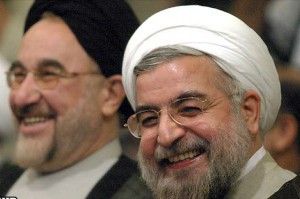
Hassan Rowhani with former president Mohammad Khatami

The Washington Post reports: Hassan Rouhani, a moderate Shiite cleric known as one of Iran’s leading foreign policy experts, has won the election to succeed Mahmoud Ahmadinejad as the Islamic Republic’s next president, Interior Minister Mostafa Mohammad-Najjar announced Saturday evening.

With results from all the precinct in, Rouhani had won 50.7 percent of the votes, avoiding a runoff, Mohammad-Najjar said.

Bloomberg reports: Support for Rohani swelled in the final days of the campaign after former presidents Ali Akbar Rafsanjani and Mohammad Khatami joined forces to endorse him.

Addressing a packed Tehran stadium last week, Rohani, who campaigned on the slogan “prudence and hope,” urged his young supporters to overcome political apathy and their frustration over the lack of jobs and vote for him. Rohani waved a giant key at his rallies as a symbol that he will unlock closed doors.

“Though hardliners remain in control of key aspects of Iran’s political system, the centrists and reformists have proven that even when the cards are stacked against them, they can still prevail due to their support among the population,” Trita Parsi, author of “A Single Roll of the Dice: Obama’s Diplomacy with Iran” and president of the National Iranian-American Council in Washington, wrote in an e-mail.

Long lines at polling stations yesterday led to voting being extended several times, to 11 p.m. local time. State-run Press TV estimated voter turnout at about 80 percent.

The departure of Mohammad Reza Aref from the campaign on June 10 meant Rohani had the reformist platform to himself against a field of five conservatives who failed to agree on a unity candidate.

Rohani has spoken in favor of increased freedom for the press and non-governmental organizations. He has also called for the easing of social restrictions, criticizing the government’s “unwarranted interventions” in Iranians’ lives.
Economy ‘Critical’

In April, Rohani promised that his government would pursue “dialogue and interaction with the world.” He also said the economy is in a “critical” situation and that sanctions can’t be blamed for the country’s “weaknesses.”

Still, he said sanctions must be tackled for the economy to take a new direction away from a 30 percent inflation rate and unemployment that left a quarter of Iranians age 15 to 29 without jobs in the year ended March 20.

Earlier this week, Farideh Farhi wrote: The decision by the reformist candidate Mohammadreza Aref to withdraw his candidacy — and in effect open the path for the centrist Hassan Rowhani to become the unified candidate of both the centrists and reformists — is an important development in Iranian politics. Its impact will reach beyond this election.

This isn’t only because the centrist and reformist forces, currently led by former presidents Akbar Hashemi Rafsanjani and Mohammad Khatami, respectively, have done what the conservative forces failed to do. After all, the conservatives — or the array of forces known as the “Principlists” in Iran, also began with the idea of coalition-building in mind. The trio – former foreign minister Ali Akbar Velayati, Tehran mayor Mohmmad Baqer Qalibaf, and former Parliament Speaker Gholamreza Haddad Adel — had agreed that only one of them would stand on Election Day. Today, however, only Haddad Adel has dropped out without specifying his preferred candidate.

Beyond Velayati and Qalibaf, other principlist candidates, including nuclear negotiator Saeed Jalili and former IRGC commander Mohsen Rezaie, remain in the race. So now a splintered principlist field faces a candidate that has the backing of significant political and social forces; a candidate who may, just may, become president if the Iranian electorate decides to vote in larger than expected numbers and, of course, there is no ballot box-tampering.

Just this thought, for me, represents an amazing turn of events in Iran’s ongoing election saga. But even if this form of strategizing does not yield success for whatever reason, the process that led to this alliance is an important one; one that may have a lasting impact on Iranian politics. [Continue reading…]

Facebooktwittermail

First round in Iran’s presidential election

The Los Angeles Times reports: Polls cited in state-run media and reported by Western news agencies suggested for the first time in the closing hours of the campaign that Rowhani would get about 15% of the vote. A survey by the Mehr Center for Opinion Polling projected Tehran Mayor Mohammed Baqer Qalibaf would garner about 18% and chief nuclear negotiator Saeed Jalili about 10%. A survey cited by the Fars News Agency two days earlier said Rowhani would come in third behind Qalibaf and Jalili.

Analysts note that the opportunity to derail the carefully orchestrated election could be as much of a lure for reformists to abandon their intended boycott as is the prospect of a moderate winning or at least making it into the runoff.

“The whole purpose of having Aref drop out and having Rowhani become the favorite son of the reform camp was deliberately and unquestionably intended to get people to come out and vote,” said Gary Sick, a senior research scholar at Columbia University and a former National Security Council member under presidents Ford, Carter and Reagan.

“What has happened in virtually every election is that, when given the least opportunity, the people of Iran vote against the regime,” said Sick, who was chief White House aide for Iran during the revolution and hostage crisis. “It is not at all inconceivable that the reformist camp, if enough people decide to vote, could come through this election in good shape.”

Trita Parsi writes: There are three factors that may create opportunities for resolving tensions with Iran if Mr. Rouhani wins the elections – and the regime is forced to respect that result.

First, it’s not just about Rouhani; it’s about the personnel that would follow him into government and populate key ministries and institutions and reconfigure the political makeup of the regime’s decision-making table. When Mahmoud Ahmadinejad came to power, within months he fired 80 of Iran’s most experienced ambassadors and foreign policy profiles. Many of these were Iran’s most pragmatic and competent foreign policy hands, often key players in Iran’s more conciliatory decisions, such as the collaboration with the United States in Afghanistan and the suspension of enrichment in 2004. They were replaced by inexperienced ideologues hired not for their capabilities but their loyalty to Mr. Ahmadinejad. A reversal of this trend can prove quite valuable.

Second, Mr. Rouhani and his entourage hold a different world view than those close to Mr. Ahmadinejad and the supreme leader. While still suspicious and distrustful of the West, and while still committed to Iran’s bottom line on the nuclear issue, the elite that associates with Mr. Rouhani does not see the world in Manichean black and white. The outside world may be seen as hostile, but common interests can still be found. Collaboration is still possible. Rather than emphasizing ideology and resistance, they pride themselves on being pragmatic and results-oriented (of course, within the context of the political spectrum of the Islamic republic). It is not a surprise that most of the sensitive arrangements Iran have entered into came about during periods that this current dominated Iran’s decision making.

Third is the difference in assessing the risks of peacemaking versus confrontation. The hardliners’ insistence on resistance at any cost combined with their hesitance about compromise, indicates far greater willingness to accept risks for escalation and confrontation than for compromise. A similar problem exists on the American side, where risks for confrontation are easier accepted and assessed to be smaller than the risks one inevitably has to take to strike a deal. This psychological dimension of Tehran’s cost-benefit analysis should not be discounted.

Facebooktwittermail

Iran’s sexual revolution

Afshin Shahi writes: When someone mentions Iran, what images leap into your mind? Ayatollahs, religious fanaticism, veiled women? How about sexual revolution? That’s right. Over the last 30 years, as the mainstream Western media has been preoccupied with the radical policies of the Islamic Republic, the country has undergone a fundamental social and cultural transformation.

While not necessarily positive or negative, Iran’s sexual revolution is certainly unprecedented. Social attitudes have changed so much in the last few decades that many members of the Iranian diaspora are shellshocked when they visit the country: “These days Tehran makes London look like a conservative city,” a British-Iranian acquaintance recently told me upon returning from Tehran. When it comes to sexual mores, Iran is indeed moving in the direction of Britain and the United States — and fast.

Good data on Iranian sexual habits are, not surprisingly, tough to come by. But a considerable amount can be gleaned from the official statistics compiled by the Islamic Republic. Declining birth rates, for example, signal a wider acceptance of contraceptives and other forms of family planning — as well as a deterioration of the traditional role of the family. Over the last two decades, the country has experienced the fastest drop in fertility ever recorded in human history. Iran’s annual population growth rate, meanwhile, has plunged to 1.2 percent in 2012 from 3.9 percent in 1986 — this despite the fact that more than half of Iranians are under age 35.

At the same time, the average marriage age for men has gone up from 20 to 28 years old in the last three decades, and Iranian women are now marrying at between 24 and 30 — five years later than a decade ago. Some 40 percent of adults who are of marriageable age are currently single, according to official statistics. The rate of divorce, meanwhile, has also skyrocketed, tripling from 50,000 registered divorces in the year 2000 to 150,000 in 2010. Currently, there is one divorce for every seven marriages nationwide, but in larger cities the rate gets significantly higher. In Tehran, for example, the ratio is one divorce to every 3.76 marriages — almost comparable to Britain, where 42 percent of marriages end in divorce. And there is no indication that the trend is slowing down. Over the last six months the divorce rate has increased, while the marriage rate has significantly dropped. [Continue reading…]

Facebooktwittermail

Iran presidential campaign begins without two big names

The Washington Post reports: Iran’s conservatives, who on Tuesday saw the two main moderate threats to their dominance barred from running in next month’s presidential election, face a new challenge: persuading shocked and skeptical Iranians to turn out to vote.

With the field of hopefuls clear, the mostly conservative nominees whose candidacies were approved by Iran’s Guardian Council officially launched their campaigns Wednesday, apparently free from the challenges of the most talked-about candidates, two-time former president Ali Akbar Hashemi Rafsanjani and the top aide to President Mahmoud Ahmadinejad, ­Esfandiar Rahim Mashaei.

Of the eight approved candidates, Iran’s lead nuclear negotiator, Saeed Jalili, who is a close adviser to the country’s supreme leader, appears to have mounting support among conservative politicians. But he cannot credibly claim popular backing, never having won an election, and his platform of “resistance” is unlikely to win votes from a populace eager for relief from the international economic sanctions imposed on Iran because of its nuclear activities.

Many Iranians seemed more interested in the fates of the two big names who were rejected than in those who were cleared to run, and it remained uncertain Wednesday how Iran’s leaders intend to try to revive the interest sparked by the surprise candidacies of Rafsanjani and Mashaei.

“I swear that every passenger who sat in this car in the past week said they would only vote for the old lion, Rafsanjani,” said a Tehran taxi driver who spoke on the condition of anonymity for fear of government reprisal. “I don’t think any of them will vote now.” [Continue reading…]

Facebooktwittermail

Khamenei’s plan to prevent the revival of Iran’s Green Movement

Mohsen Milani writes: In normal presidential elections, it is only the candidates and their platforms that matter. Not so in Iran. There, the key player in the upcoming presidential elections is the septuagenarian supreme leader, Ayatollah Ali Khamenei, who is constitutionally barred from running for the office. He recognizes that the election result will have a profound impact on his own rule and on the stability of the Islamic Republic. So behind the scenes, he has been doing everything in his power to make sure that the election serves his interests. But the eleventh-hour declarations of candidacy by Hashemi Rafsanjani, Iran’s president between 1989 and 1997, and by Esfandiar Rahim Mashaei, President Mahmoud Ahmadinejad’s chief of staff and close confidant, have made his task more difficult.

The first part of Khamenei’s four-pronged strategy is to conduct an orderly election. The nightmare scenario for Khamenei is a repeat of the June 2009 presidential election, in which allegations that Ahmadinejad had stolen victory from his challenger, Mir Hossein Mousavi, led to massive demonstrations and the birth of the popular reformist Green Movement.

Khamenei could have stayed above the fray, as elites expected him to do. Instead, he lost credibility as a neutral arbiter when he sided with Ahmadinejad, rejected all allegations of fraud, and blamed Ahmadinejad’s opponents for inciting violence. His offer of public support for the president opened a fissure among the elites that has never quite healed. It also preceded a massive crackdown on activists who were castigated as American stooges and arrested. Even more, the disputed election alienated millions who felt truly robbed of their voices.

Given that history, Khamenei has made a concerted effort this time around to discredit potential protesters before they take to the streets. The Revolutionary Guards and security forces have launched a propaganda campaign to link any interruption on election day or after to the United States and its purported plans to destabilize the regime. For example, Yadollah Javani, the head of the political bureau of the Revolutionary Guards, has warned that the slogan “free and fair election” is a U.S. code word for sedition.

All this comes at a time when the Revolutionary Guards and security forces have enjoyed even more impunity than usual as they arrest activists and bloggers and shutter hostile websites and newspapers. In March 2013, the government claimed that it discovered and shut down a network of some 600 anti-government journalists who were planning to disrupt the presidential election. In reality, they were placed under surveillance in order to cut off their links to journalists and activists outside of Iran. And although there has not yet been any increase of forces on the streets, one can be sure that in June, the police will be ready for action. [Continue reading…]

Facebooktwittermail

Two last-minute candidates stir up Iran presidential race

The Los Angeles Times reports: The run-up to Iran’s June presidential election took a dramatic turn Saturday with last-minute candidacy announcements by two controversial political figures: former President Ali Akbar Hashemi Rafsanjani and Esfandiar Rahim Mashaei, top aide to outgoing incumbent Mahmoud Ahmadinejad.

In the final moments before the five-day registration period expired, Rafsanjani and Mashaei arrived via separate entrances at the Interior Ministry, where all would-be candidates were required to sign up by 6 p.m. Saturday.

Their cinematic entrance prompted cheers from rival groups of supporters who had gathered outside. Scuffles then erupted between the two groups, and order was not restored until police responded.

Ahmadinejad accompanied Mashaei, and the longtime friends held their hands aloft in a show of mutual support. Mashaei thanked the departing president, barred by law from seeking a third four-year term, for encouraging him to run.

Despite the theatrics, neither of the two candidates is guaranteed a place on the June 14 ballot. The Guardian Council, composed of senior clerics and jurists, vets candidates to determine who is qualified to run based on a series of criteria.

Facebooktwittermail

Iran softens tune on Israel

Kaveh L Afrasiabi writes: With the Iranian presidential elections only two months away, foreign policy issues are hotly debated in the crowded field of candidates, and a chorus of prominent voices is aiming to lower the temperature with Israel.

The rising softer tone may reflect a new elite consensus that a revised approach toward Israel is in the nation’s interests, in light of Tel Aviv’s powerful influence in Western capitals, Turkey’s normalization of relations with Israel, and the Arab world’s indifference toward the Palestinian problem, compared with Iran’s traditional “overcommitment”.

Leading the march toward a new Israel policy, former president Ali Akbar Hashemi Rafsanjani, who has expressed interest in joining the presidential race, has flatly declared that Iran is not “at war” with Israel. Calling for a non-confrontational foreign policy, Rafsanjani has criticized President Mahmud Ahmadinejad for inflammatory rhetoric that has backfired on Iran. [Continue reading…]

Facebooktwittermail

The revolution in Iran and its consequences

Adam Shatz writes: At the end of the Second World War, an anonymous pamphlet surfaced in the seminaries of Qom, the bastion of Shia learning. The Unveiling of Secrets accused Iran’s monarchy of treason: ‘In your European hats, you strolled the boulevards, ogling the naked girls, and thought yourselves fine fellows, unaware that foreigners were carting off the country’s patrimony and resources.’ Iran, it proposed, should be ruled by an assembly of religious jurists headed by a wise man. In such a state, there would be no need for elections or a parliament, or even a standing army: a religious militia (basij) would ensure obedience to the law.

It’s unlikely that anyone outside Qom read The Unveiling of Secrets; even inside the seminaries few would have embraced its programme. Yet just three decades later the pamphlet’s author, Ruhollah Khomeini, helped launch a revolution against the monarchy and established himself as Iran’s supreme leader, with powers even the shah would have envied. The political landscape was transformed: the Shia of Iran, a minority in the house of Islam, had rewritten the script of revolution in the Middle East. James Buchan’s Days of God shows how a radicalised clergy took control of a popular uprising against a Western-backed dictator and set up the world’s first and only Islamic republic. Buchan tells that story as well as anyone has done, but Days of God is also an erudite reflection on three important questions: why there was a revolution, why it was Islamic and what its legacy has been. The Iranian Revolution was, Buchan argues, a revolt against Western-imposed modernisation in favour of an enchanted path to modernity. It had a spiritual aim that grew out of the history of Shiism, with its themes of martyrdom and redemption, but the attempt to infuse governance with divine authority ended up expanding – and ultimately sanctifying – the authoritarian state the clerics inherited from the shah. ‘In revolt against Pahlavism,’ Buchan writes, ‘the Islamic republic is also its continuation in turban and cloak.’

The Pahlavi dynasty was founded in 1926, when Reza Khan – a soldier in the Iranian Cossack Brigade who had come to power in a British-backed coup against the Qajar monarchy five years earlier – crowned himself shah. Although he and his son Mohammed styled themselves as heirs of Cyrus the Great, their dynasty was never more than a father-and-son operation, dependent on foreign patronage that they groaned about but could never quite shake off. Reza was an authoritarian moderniser in the Atatürk mould who forced nomads to become sedentary; disciplined rebellious ethnic minorities; built railways and roads; and created a modern army and bureaucracy. But his Westernising project, in particular his attacks on the veil, ran up against clerical opposition, and he could never overcome the perception that he was a stooge of the British. In fact he bristled at foreign interference and attempted to renegotiate the reviled 1919 agreement with the Anglo-Persian Oil Company, but was outmanoeuvred at every turn. Finally, having declared Iran neutral in the Second World War, he was deposed by Soviet and British troops in September 1941.

Mohammed, the pampered, fragile son, was no fonder than his father of his patrons in the West but learned never to cross them, especially after the CIA-orchestrated coup against his prime minister, Mossadegh, in 1953. Dashing, fluent in French and English, with a worldly sophistication acquired from his years at a Swiss boarding school, Mohammed was a nationalist of a kind, but he made the mistake of imagining he could buy popular support in the absence of national independence. After the 1953 coup, he signed a better deal with British Petroleum that gave Iran 50 per cent of the profits. Though this fell short of Mossadegh’s plans for nationalisation, it underwrote a massive boom, and big, garish projects his father would have admired: dams, hydro-electric schemes, even an enormous steel mill financed and built by the Soviets, a token declaration of independence that soothed his ego. Iran’s population grew from 19 to 30 million, and Tehran became a modern metropolis. Economic growth earned the shah applause in the West, but it failed to win him the love he felt he deserved from Iranians, who turned against modernisation itself: they saw it as a form of imperialism, an existential threat to Iran’s own traditions. Obsessed with plots against the throne, he leaned more and more on the Savak, his intelligence services, which the CIA, Mossad and MI6 had trained in surveillance and interrogation. Those who objected to his friendships with the US, Israel and apartheid South Africa had a choice of exile in Berlin or Paris; or imprisonment in one of Savak’s prisons. [Continue reading…]

Facebooktwittermail

A forgotten anniversary: Iran’s first revolution and constitution

Amir-Hussein Firouz Radjy writes: With the New Year came and passed the forgotten anniversary of a seminal event in Iranian and Asian history: the anniversary of Iran’s first revolution and Asia’s oldest parliament, whose centenary came and passed some years ago without a murmur. Remembering that event today would do much to elucidate Iran’s present situation, as well as the vexed relations of Iranians with both their government and the outside world.

The zero hour was late on the night of December 30, 1906, when the dying emperor of Iran, Muzaffar al-Din Shah Qajar, signed into law the country’s first constitution, launching a brave experiment in liberal and parliamentary government. Iran, which for the past century had been a plaything in the contest between the British and Russian empires known as the Great Game, shone as a beacon of hope for an Asia drowning in the high-tide of European imperialism.

The struggle for democracy in Iran – or more accurately, for responsible, progressive and independent leadership – is over one hundred years old and did not begin with the Green Movement in 2009, nor with the Islamic Revolution of 1979 or the 1950s nationalist movement under Musaddiq. These historical events marked not the birth, but the continuation of the Iranian people’s struggle for democracy that had begun in 1906. [Continue reading…]

Facebooktwittermail

A New World odyssey for the Cyrus Cylinder

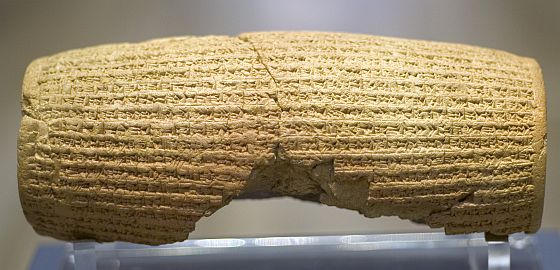
Roger Cohen writes: I wanted to test a theory about Iran, so the other evening I made my way to the British Museum, strolled past glass cases full of the sarcophagi and mummies of ancient Egypt, and found myself in a room whose centerpiece is a baked clay cylinder smaller than an American football.

The object, somewhat the worse for wear after two-and-a-half millennia, was dug up in what once was Babylon, now Iraq, in 1879 during a British Museum excavation. Made soon after Cyrus of Persia captured Babylon in 539 B.C., it is covered in the spiky characters of Babylonian cuneiform. Neil MacGregor, the director of the museum, has called it “the first real press release.” More dubiously, and more frequently, it has been called “the first bill of human rights.”

This, of course, is the much debated Cyrus Cylinder, which says that, aided by the chief Babylonian god Marduk, Cyrus (“King of the universe, the great king”) captured Babylon without a fight, repatriated deported people living in Babylonian exile, and, as the museum put it in 2010, “restored shrines dedicated to different gods.”

It has been widely interpreted as the decree of an enlightened ruler determined to allow diverse peoples to rebuild their altars and worship their gods in their own way in their own place with their own sacred images. Cyrus, in this reading, is a father of the multifaith society.

Among the peoples allowed by Cyrus to return — at least in a widely accepted reading recounted in the Bible — were the Jews, who went back to Jerusalem to rebuild the Temple. So did their exile end. Weeping beside the waters of Babylon ceased. Cyrus the Persian became a revered figure in the Hebrew Bible, a monarch from what is now Iran who ended the banishment of the Jews.

A small crowd had gathered around the Cylinder. They were there to wish it well. This week it departs for a nine-month stay in the United States, where it has not previously been seen, although presidents, including Thomas Jefferson (who owned two copies of the Cyropaedia, Xenophon’s description of a ruler’s ideal education), have been admirers of Cyrus.

The Cylinder will be displayed on the East Coast at the Smithsonian in Washington and the Metropolitan Museum in New York; and on the West Coast at the Asian Art Museum in San Francisco and the Getty Villa in Los Angeles. It will also make an appearance in Texas at Houston’s Museum of Fine Arts.

This New World odyssey of the Cyrus Cylinder is timely. It occurs with the United States and Iran still locked in the negative stereotypes the movie “Argo” has done nothing to assuage. As John Limbert, a former U.S. hostage in Iran, has observed, the Islamic Republic sees America as “belligerent, sanctimonious, godless and immoral.” America, in turn, sees Iran as “devious, mendacious, fanatical.” Or at least on the surface they do. Somewhere beneath that lurks mutual fascination.

The Cylinder will not resolve this antagonism. But, compact and mute, it carries a message of tolerance. It is a powerful antidote to belligerent certitudes and shrieking “truths” — an object packed with ambiguity and now freighted with a 2,500-year-old tale of human vanity and frailty. [Continue reading…]

Facebooktwittermail

Does Ahmadinejad pose an existential threat to the Islamic Republic?

Mohammad Ayatollahi Tabaar writes: Four months before the next presidential election, Iran’s conservative establishment is facing a security threat: Mahmoud Ahmadinejad. Four years ago, a controversial election that reinstated President Ahmadinejad brought millions of Iranians into a face-to-face confrontation with Supreme Leader Ayatollah Ali Khamenei. Now, it is Ahmadinejad who is coming face-to-face with the very man who lifted him out of obscurity and granted him worldwide fame and unparalleled support against all pillars of the Islamic Republic.

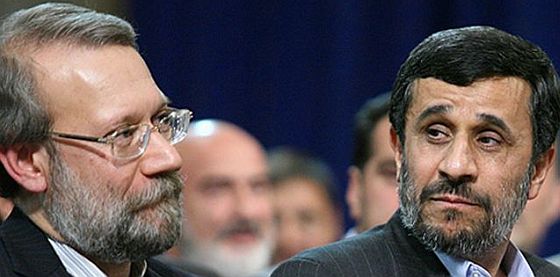
During an unprecedented debate at the parliament, which ended in mayhem and the dismissal of the labor minister, Ahmadinejad played a video that implicated the powerful Larijani brothers, two of whom head the judiciary and legislative bodies, of corruption and nepotism. Sunday’s impeachment put Ahmadinejad’s remaining presidency in danger since many of his allies in the cabinet have had similar fates. At this fiery session that was being broadcast live on state radio, he threatened and eventually played the video to prove a backroom deal that involved the Larijani family. In response, the speaker of the parliament accused Ahmadinejad of mafia type activities and did not allow him to continue. Ahmadinejad angrily left the parliament and moments later 192 out of 272 members of parliament voted in favor of the impeachment.

With the next election just around the corner, the supreme leader fears that these public exchanges may once again dangerously polarize the polity and the country. During a meeting to resolve the tensions between the president and the speaker of the parliament just a few weeks ago, Khamenei frustratingly asked them not to publicize their differences. In October 2012, he even warned: “From today until the election day, whoever uses people’s emotions to create conflicts, has definitely betrayed the country.” In a country where political campaigns have turned into massive social movements, normal elections are seen by the government as unusual security threats. Khamenei recalls the 1997 and 2005 presidential elections that gave rise to the Reform and Green Movements, respectively. Looking at the increasing intensity of the past upheavals, he has good reason to worry that the next election could lead to turmoil and obliterate his office. [Continue reading…]

Facebooktwittermail

Iran’s reactionary revolutionaries

Robin Yassin-Kassab writes: In August 2012 Egyptian President Muhammad Morsi attended a meeting of the Non-Aligned Movement (NAM) in Tehran. His presence at the conference was something of a diplomatic victory for the Iranian leadership, whose relations with Egypt, the pivotal Arab state, had been at the lowest of ebbs since the 1979 revolution.

Egypt’s President Sadat laid on a state funeral for the exiled Iranian shah. A Tehran street was later named after Khalid Islambouli, one of Sadat’s assassins. Like every Arab country except Syria, Egypt backed Iraq against Iran in the First Gulf War. Later, Hosni Mubarak opposed Iranian influence in Iraq, Syria, Lebanon and Palestine, worked with the US and Saudi Arabia against Iran’s nuclear program, and was one of the Arab dictators (alongside the Abdullahs of Jordan and Saudi Arabia) to warn darkly of a rising “Shi’ite cresent”. Not surprisingly, Iran was so overjoyed by the 2011 revolution in Egypt that it portrayed it as a replay of its own Islamic Revolution.

Iran also rhetorically supported the revolutions in Tunisia and Libya, the uprising in Yemen, and, most fervently, the uprising in Shia-majority Bahrain.

In Syria, however, Iran supported the Assad tyranny against a popular revolution even as Assad escalated repression from gunfire and torture to aerial bombardment and missile strikes. Iran provided Assad with a propaganda smokescreen, injections of money to keep regime militias afloat, arms and ammunition, military training, and tactical advice, particularly on neutralising cyber opponents. Many Syrians believe Iranian officers are also fighting on the ground.

Iran’s backing for al-Assad is ironic because at a certain point the Syrian revolution was the one that most resembled 1979 in Iran – the violent repression of demonstrations leading to angry funerals leading to still more in a constantly expanding circle of anger and defiance; the people chanting allahu akbar from their balconies at night; women in hijabs joining women with bouffant hair to protest against regime brutality. [Continue reading…]

Facebooktwittermail

Blogger’s death stirs political hornet’s nest in Iran

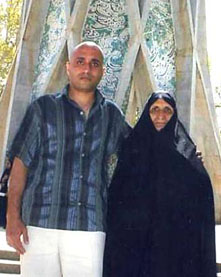
Reuters reports: There was little about Sattar Beheshti that made him stand out in a working-class suburb south of Tehran called Robat Karim.

Like many of his peers, the 35-year-old laborer was devout and lived at home with his mother. But his life changed when he started a blog called “My Life for Iran” last year.

His entries often focused on the struggles of the working class as well as the political restrictions in Iran, sometimes mixed with personal anecdotes from Beheshti’s daily life.

As months passed, the tone on the blog became sharper and more political, with unveiled criticism of the establishment and even the Supreme Leader, a red line in the Islamic Republic.

In one recent post, Beheshti criticized a speech made by the leader, Ayatollah Ali Khamenei, at a meeting of the Non-Aligned Movement in Tehran with the title “You presented a bunch of lies instead of a speech” superimposed over a picture of the cleric.

Other posts faulted Iran’s unwavering support for Hezbollah in Lebanon or highlighted the plight of human rights activists.

Retaliation quickly followed.

“Yesterday they threatened me and told me your mother will soon be wearing black,” Beheshti wrote in a post on October 29.

The next day security agents from Iran’s cyber police, known by the acronym FATA, arrested him. His bruised and battered body was handed to his family a week later, his death the result of torture, according to a smuggled letter from fellow prisoners.

The backlash was swift and furious, especially from other bloggers, even pro-government ones, disturbed at the fate of a pious young man with no known history of political activism.

Their most pointed criticism was directed at the cyber police and their campaign to stop any attempt at a “velvet revolution” in the Islamic Republic through the Internet.

Government officials have not denied the abuse.

“This individual was beaten but this beating was not in a manner that would result in his death,” Attorney-General Gholam Hossein Mohseni-Ejehi told a news conference on December 3.

Within a month of Beheshti’s death, seven policemen were arrested and the head of the cyber police was ousted, a dramatic turn of events in a divisive scandal that has shocked Iran.

As international pressure mounts over Iran’s disputed nuclear program and harsh economic sanctions bite, the leadership is wary of domestic turmoil, especially with a potentially turbulent presidential election due in June.

Beheshti’s death exposed Iran’s political fissures as a handful of lawmakers badgered President Mahmoud Ahmadinejad’s government and the judiciary into ordering an inquiry.

But the most effective tool in publicizing Beheshti’s unusual death was the one he had chosen – the Internet.

“I really do believe this is one of the great examples of the impact of the Internet in Iran,” said Mahmood Enayat, director of the Iran Media program at the University of Pennsylvania and the founder of Small Media, a non-profit group that focuses on improving information flows in closed societies.

The Internet had become a watchdog, forcing the government to react to anything gathering enough attention, he argued.

“They can’t just ignore it anymore.”

Although many of the details of Beheshti’s detention and death are murky, some are no longer in dispute. On the night of October 30, he was arrested at his home in Robat Karim and transferred to section 350 of Tehran’s notorious Evin prison.

Fellow prisoners there said he was hung from the ceiling of a cell and beaten. His arms and legs were then tied to a chair and he was beaten again. At times, his interrogators threw him on the ground and kicked him in the head and neck. [Continue reading…]

Facebooktwittermail

Iran’s activists jailed and beaten for speaking out

The Guardian reports: When the Iranian student activist Arash Sadeghi was temporarily released from Tehran’s Evin prison in November 2010, he anticipated a little respite from a year of harsh beatings and agony in jail.

Instead, within a few days, security officials had raided his home in middle of the night. As they broke their way into the house, Sadeghi’s mother, who was alone with her daughter, suffered a heart attack.

The officials continued their search as she laid unconscious on the floor, ransacking the house and trying to find Sadeghi, who was at his grandfather’s house that night. When the officials left, Farahnaz Dargahi was taken to hospital. She died within a few days.

“My father, my sister and my entire family and relatives blame me for her death,” Sadeghi told the news website Roozonline at the time. “Our house has become hell … My father tells me that you killed your mother and I don’t want you at home … I prefer to go back to jail.”

In no time, Sadeghi, a 26-year-old student of philosophy at Tehran’s Allameh Tabatabai University, was indeed taken back to prison. Since then he has spent all but one month in jail. For the past 11 months, Sadeghi has been held in solitary confinement without access to a lawyer.

His father, Hossein Sadeghi, works for the Iranian army and lives in a house given to his family by the state. Having initially blamed his son for what happened to their family, now that he has witnessed the injustices he has suffered Hossein is ready to risk his job and even arrest to speak out for the first time.

“I regret what I said about him in the past,” he told the Guardian on the phone from Tehran. “I haven’t been able to see him and tell him myself … but I’m sorry.” [Continue reading…]

Facebooktwittermail

Don’t abandon Iran’s internet generation to online oppression

A Green Movement supporter and activist in Tehran writes: Imagine you live in a country like the Oceania of George Orwell’s Nineteen Eighty-Four, where Big Brother seeks to control almost every aspect of your life, particularly your interaction with the media — determining the news and information to which you are permitted access and watching every move you make on the Internet. Imagine yourself struggling to open a small window in the invisible but all too real wall erected by the ruling system to take a peek at reality, or to scream out so others might hear that you exist and are hurting. You want to feel what it is like to live emancipated, if not in the real world at least in the cyber realm. You are aware that every time you make such an attempt, the government is likely to detect it, and if it feels threatened in any way by your activity will hunt you down and throw you in one of its grim prisons. You hold out hope that those who enjoy freedom on the “other side” do not forget you, and if they do not lend a hand in opening that little window, at least will not act, however unwittingly, in concert with Big Brother.

Yet that is the gist of what now confronts Iran’s Internet generation, the young people whose courageous defiance of the engineered presidential election of 2009 brought Iranians’ long-stifled aspirations for democracy and freedom to the world’s attention. The situation has been highlighted by the death last week of Sattar Beheshti, 35, a Green Movement supporter who maintained a blog in which he criticized the regime and its treatment of political prisoners. A laborer living in one of Tehran’s poorest suburbs, Beheshti — despite not using his full name on his blog page — was tracked down and arrested in early November by the Islamic Republic’s cyber police. His death was reportedly the result of torture he endured during interrogation.

Beheshti’s tragic death underlines the deeply besieged mentality of Iran’s theocratic regime and how far it will go to suppress any voice of popular opposition. The aftermath of the 2009 election impressed on the government the grave danger posed to it by a free flow of information and an informed citizenry. An enormous amount of money was allocated to the acquisition of some of the world’s most sophisticated systems for monitoring and tracking electronic communications, restricting the Internet, and jamming satellite broadcast signals. [Continue reading…]

Facebooktwittermail

Iran prosecutor: Blogger died in police custody

The Associated Press reports: Iran’s state prosecutor confirmed Monday that a jailed blogger died in police custody last week and that wounds were found on his body, the first official confirmation of his death while being held.

The U.S. State Department and a press freedom group have called for investigation of the “suspicious death.”

The prosecutor’s statement came a day after Iran’s parliament announced it would probe reports on the circumstances of Sattar Beheshti’s death.

Prosecutor Gholam Hossein Mohseni Ejehi told reporters that Beheshti was detained Oct. 30 for alleged cybercrimes and taken to Evin prison in north Tehran the next day. Beheshti was handed over to cyber police for interrogation the same day, He died Nov. 3.

“The coroner’s office has provided a detailed report saying that signs of wounds were found in five places on this person’s body, including foot, hand, back and one of his thighs, but no broken bones,” the semiofficial Mehr news agency quoted Ejehi as saying.

Ejehi said a final report on the cause of Beheshti’s death may take as long as 45 days to release. He said copy of a letter of complaint in Beheshti’s name against his interrogator was found.

The semiofficial ISNA news agency quoted Ejehi as saying that Beheshti charged in the letter that he was subject to “threats, insults and beatings.”

Ejehi said Iran’s judiciary chief, Ayatollah Sadeq Larijani, has ordered a full inquiry into the death.

The government-owned Iran Network news website said three interrogators involved in the case have been arrested.

Facebooktwittermail