



Reuters speculates: Seeing two of your children jailed in three days would not normally signal your luck is on the up. But for the great survivor of Iranian politics it could mean just that.
Few Iranians have wielded more influence than Akbar Hashemi Rafsanjani, president from 1989 to 1997 and a behind-the-scenes operator since the birth of the Islamic Republic in 1979.
But since voicing sympathy for the protesters who said President Mahmoud Ahmadinejad’s re-election in 2009 was rigged, Rafsanjani has come under intense criticism from hardliners and seen his power fade.
Ahmadinejad survived the protests thanks to a security crack-down and the support of Iran’s most powerful authority, Supreme Leader Ayatollah Ali Khamenei.
Three years on, with the leadership divided and under intense pressure from economic sanctions, there is growing talk of the need once again for some Rafsanjani pragmatism.
“The reformists have been closed out, conservatives have little attraction because of the situation Iran is in and there is potential for Rafsanjani,” said a well-informed Iranian source based in Europe.
“Since the 2009 election, the stature of the leader has diminished and Rafsanjani has gained credibility.”
On Saturday, his daughter Faezeh, who openly backed Ahmadinejad’s election rivals, was jailed for spreading “anti-government propaganda” and, two days later, her brother Mehdi was incarcerated on return from three years abroad.
But rather being the latest humiliation for Rafsanjani, 78, who was stopped from leading Friday prayers three years ago and lost his post at the top of an important state body, analysts say it may be a sign his fortunes are improving. [Continue reading…]
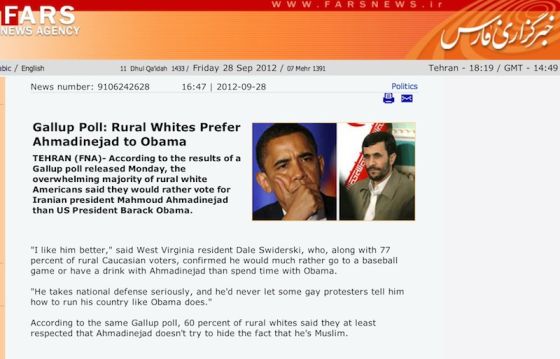
The Onion: According to the results of a Gallup poll released Monday, the overwhelming majority of rural white Americans said they would rather vote for Iranian president Mahmoud Ahmadinejad than U.S. president Barack Obama. “I like him better,” said West Virginia resident Dale Swiderski, who, along with 77 percent of rural Caucasian voters, confirmed he would much rather go to a baseball game or have a beer with Ahmadinejad, a man who has repeatedly denied the Holocaust and has had numerous political prisoners executed, than spend time with Obama. “He takes national defense seriously, and he’d never let some gay protesters tell him how to run his country like Obama does.” According to the same Gallup poll, 60 percent of rural whites said they at least respected that Ahmadinejad doesn’t try to hide the fact that he’s Muslim.
For more on this story, please visit our Iranian subsidiary organization, Fars😉

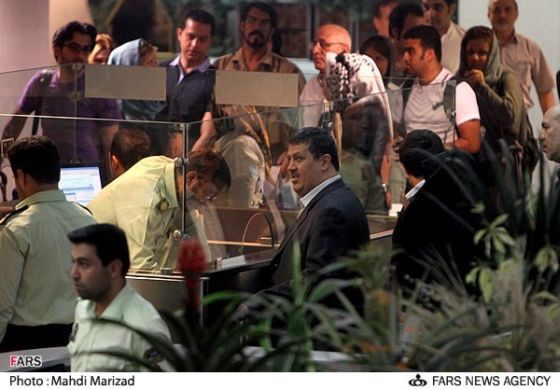
Mehdi Hashemi Rafsanjani passing through immigration at Tehran airport late on Sunday
Reuters reports: The son of former Iranian president Akbar Hashemi Rafsanjani returned to Iran from exile to answer charges of inciting unrest after a disputed election in 2009, fuelling speculation that Rafsanjani’s influence in Tehran may once again be growing.
Mehdi Hashemi Rafsanjani arrived in Tehran late on Sunday, Fars news agency reported, having spent three years in the United Kingdom following his alleged involvement in the widespread protests that followed the re-election of President Mahmoud Ahmadinejad.
Mehdi Rafsanjani had spent several days in Dubai and been expected to return to Iran on Sunday, an independent source told Reuters.
Analysts say his return indicates a deal has been agreed with authorities to resolve the charges he faces, and suggests his father’s political fortunes may be reviving.
Akbar Rafsanjani played a central role in the Non-Aligned Movement summit in Tehran last month, being photographed walking alongside Iran’s most powerful authority, Ayatollah Ali Khamenei, and sat next to U.N. Secretary General Ban-Ki Moon.
As oil sanctions continue to bite and with a presidential election set for next year, some are tipping the pragmatic yet conservative Rafsanjani as a surprise candidate.

The Guardian reports: Iran was set to block access to Google and Gmail in reaction to the anti-Islam film that has triggered protests across the Muslim world.
“Google and Gmail will be filtered throughout the country until further notice,” said Abdolsamad Khoramabadi, an Iranian official with the state-run body in charge of online censorship and computer crimes, according to the semi-official Ilna news agency. There was no indication as to whether the filtering would be temporary or permanent.
Khoramabadi claimed the decision was taken after Iranians pressed the authorities to filter the sites because of links to the film.
The Young Journalists Club, an Iranian semi-official news agency that broke the news, said the move was in reaction to YouTube’s refusal to take down the anti-Islam film, Innocence of Muslims.
Despite a series of regime-sponsored protests in Tehran over the film, many Iranians appear not to be bothered by it.
William Dameron writes: Recently I received an email from a filmmaker, Wajahat Ali Abbasi, who is filming a movie about the true story of two Iranian boys executed by public hanging in 2005 for the crime of loving each other.
My first thought after receiving this email was, This is another part of the world. It couldn’t happen here. But then I thought about our politicians who spew lies and hate about me; about the pastor from my home state of North Carolina who called for gays to be executed; about one of my own family members who called me sick and will not speak to me; about the former classmate who hurled a homophobic epithet at us during our high-school reunion.
Dehumanizing a population makes it possible to extinguish them. In eight countries, including Iran, being gay is punishable by death.
When I asked Wajahat what the motivation was for making this film, he told me of his friend, a bright, 20-year-old boy with a promising career. This boy came out to his friends and family and experienced relentless, daily bullying. He became afraid of leaving his home. One day, while returning from college, he disappeared. Two days later his body was found. His murder was declared a suicide.
The film, Sin, is Wajahat’s attempt to tell the personal story, to put a human face on the two boys who were blindfolded and hanged in July 2005. You can view his Kickstarter page here. The trailer is at the bottom of this post.
I learned some sobering facts while researching this post. One of them is that because I am gay, I am 41 times more likely to become a victim of a hate crime. The question is not whether I would die for love, but whether I will.
Golnaz Esfandiari writes: “I politely [told] her to cover herself up,” said Hojatoleslam Ali Beheshti, an Iranian cleric in the city of Shamirzad in Semnan Province, describing a recent encounter with a woman he believed was improperly veiled.
“She responded to me by saying: ‘You [should] close your eyes.'”
The cleric, who spoke to the semi-official Mehr news agency, said he repeated his warning to the “bad hijab” woman, which is a way of describing women who do not fully observe the Islamic dress code that became compulsory following the 1979 revolution.
“Not only didn’t she cover herself up, but she also insulted me. I asked her not to insult me anymore, but she started shouting and threatening me,” Beheshti said. “She pushed me and I fell to the ground on my back. From that point on, I don’t know what happened. I was just feeling the kicks of the woman who was beating me up and insulting me.”
He said he was hospitalized for three days following the attack.
I’m not a supporter of violence, but as a woman who grew up in Iran and was harassed many times for appearing in public in a way that was deemed un-Islamic, I understand the frustration that woman in Semnan must have felt and why she lashed out at the cleric. [Continue reading…]
Laura Rozen writes: Ali Akbar Velayati, the longtime foreign policy advisor to Iran’s Supreme Leader Ayatollah Ali Khamenei, is likely to run for Iran’s presidency next year, and if elected would take a more pragmatic stance to ease soaring tensions with the West that have isolated Iran and hurt its economy, a former Iranian diplomat told Al Monitor.
The former diplomat and academic, who plans to advise Velayati, a longtime family friend, if he does run, asked not to be named in a piece. He spoke to Al Monitor in an interview Friday, as Iranians were trying to analyze press reports showing the United States increasing its muscular rhetoric in an effort to stave off any possible Israeli unilateral strike against Iran. Iran does not fear an Israeli attack, the former diplomat said, but does feel the impact of economic sanctions and takes the prospect of possible future US military action more seriously.
The former diplomat expressed optimism that Iran would reach a negotiated solution with the West over its nuclear program by June of next year, when Iranian presidential elections are due to be held. He also said the Iranian foreign ministry may take a larger role in handling Iran’s negotiations with the P5+1 over its nuclear program in the future.
The larger message the former diplomat conveyed is that Khamenei, at 73, does not want the end of his legacy in Iranian history books to be having brought economic hardship to the Iranian people. The sanctions are hurting Iran and Iranians, including in the fall of the Iran’s currency, the rial, to 20,000 to the dollar last week. Iran also recognizes that Syria’s Bashar al-Assad will eventually be toppled in Syria, the former diplomat said, but said whatever future leadership comes to power in Syria will maintain ties with Tehran. (Among economic reasons he cited, Iranian pilgrims bring Syria $2 billion in annual revenues, and Syria needs Iranian oil and gas, he said.) [Continue reading…]
Pankaj Mishra reviews Patriot of Persia: Muhammad Mossadegh and a Very British Coup by Christopher de Bellaigue: In 1890, an itinerant Muslim activist called Jamal al-din al-Afghani was in Iran when its then ruler, Naser al-Din Shah Qajar, granted a tobacco concession to a British businessman called G.F. Talbot, effectively granting him a monopoly on its purchase, sale and export. Al-Afghani pointed out, to a chorus of approval from secular-minded intellectuals as well as conservative merchants, that tobacco growers would now be at the mercy of infidels, and the livelihoods of small dealers destroyed. He set up pressure groups in Tehran – a political innovation in the country – which sent anonymous letters to officials and distributed leaflets and placards calling on Iranians to revolt. Angry protests erupted in major cities the following spring. Helped by the recently introduced telegraph, the mass demonstrations of the Tobacco Protest, as it came to be called, were as carefully co-ordinated as they would be in Khomeini’s Islamic Revolution a hundred years later, when cassette-tapes played a similar role and women participated in large numbers.
Al-Afghani also wrote to Ayatollah Mirza Hassan Shirazi in Najaf, giving the greatly influential but apolitical Shiite cleric an early lesson in the ‘structural adjustments’ that Western financiers would come to enforce in poor countries: ‘What shall cause thee to understand what is the Bank?’ he asked. ‘It means the complete handing over of the reins of government to the enemy of Islam, the enslaving of the people to that enemy, the surrendering of them and of all dominion and authority into the hands of the foreign foe.’ Al-Afghani may have been exaggerating. But he knew from his experiences in India and Egypt how quickly the West’s seemingly innocuous traders and bankers could turn into diplomats and soldiers. The feckless shah had already compromised Iran’s relative immunity to Europe’s informal imperialists. In 1872, with the country starved of capital and suffering from a massive budget deficit, he had granted a monopoly in the construction of railways, roads, factories, dams and mines to another British citizen, Baron Reuter (founder of the news agency). Even Lord Curzon was appalled twenty years later when he was told the terms, describing it as ‘the most complete surrender of the entire resources of a kingdom into foreign hands that has ever been dreamed of much less accomplished in history’. Protests by Russia, Iran’s neighbour and Britain’s great rival in the region, sank this particular arrangement; Reuter anyway had other irons in the fire.
Coming only eight years after the British occupation of Egypt, the award of the tobacco concession struck al-Afghani as ominous. Expelled from Iran by the shah, he kept up a barrage of letters to leading Shiite clerics in the shrine cities of Mesopotamia, asking them to rouse themselves out of their apathy and move against the shah. A few months later, Shirazi wrote his first ever letter to the shah on a political subject, denouncing foreign banks and their growing power over the Muslim population as well as the commercial concessions given to Europeans. The shah, desperate to keep the ulema on his side, sent intermediaries to plead with Shirazi. Far from relenting, the cleric issued a fatwa effectively making it un-Islamic to smoke until the monopoly was withdrawn. He was astonishingly successful – even the shah’s palace became a smoke-free zone. Finally, the shah capitulated to an alliance between intellectuals, clergy and native merchants and, in January 1892, cancelled the tobacco concession.
Muhammad Mossadegh was at the time the precocious nine-year-old son of a high official working for the shah. Homa Katouzian, his previous biographer in English, ascribes his consistent opposition to ‘any concession to any foreign power’ to this early impression of popular anger at European encroachments on Iran’s sovereignty. Mossadegh, whose family belonged to the nobility and who was honoured as a child with the title, mussadiq al-saltaneh, ‘certifier of the monarchy’, was an unlikely leader of Iran’s transition from dynastic monarchy to mass politics. But then he grew up during a period of unprecedented political ferment across Asia.
Asian intellectuals and activists had begun to challenge the arbitrary power of Western imperialists and their native allies in the late 19th century. The first generation contained polemicists like al-Afghani, who gathered energetic but disorganised young anti-imperialists around him in Kabul, Istanbul, Cairo and Tehran. The next generation produced men like Mossadegh, who had been exposed to Western ways or trained in Western-style institutions and were better equipped to provide their increasingly restless compatriots with a coherent ideology and politics of anticolonial nationalism. [Continue reading…]
Christopher Thornton writes: Except for one day each year — the November 4 anniversary of the takeover of the U.S. embassy — the former American diplomatic compound on Taleqani Street is a lonely place. Now serving as offices of the Sepah militia, another branch of Iran’s security forces, the building is still surrounded by the same brick wall that irate students clambered over to seize the building and take its inhabitants hostage for what would become a 444-day standoff. Anti-American slogans and murals are painted on the brick — a Stars and Stripes silhouette of a handgun, the Statue of Liberty with its head replaced by a skull — and the freshness of the paint suggests that government tenders spruce them up from time to time, especially for the largely scripted, anti-American stage show held each year. But the pedestrians strolling by do not give them much notice, just as they dismiss the state-controlled media outlets. For most Iranians, the most reliable sources of information remain not Iranian but Western, and often American: Radio Farda, the Farsi-language service of Radio Liberty, funded by the U.S. congress and supervised by the U.S. Broadcasting Board of Governors; the BBC, with its new Farsi service; the Voice of America; and CNN, whenever the transmission can pierce the government filtering technology.
Probably no country in the world is more mischaracterized in Western eyes than Iran. Most Americans’ perceptions of Iran are limited to images of President Mahmoud Ahmedinejad delivering anti-American speeches and crowds chanting “Death to America!” with the blessing of Supreme Leader Ayatollah Khameini. Yet a 2009 World Public Opinion poll found that 51 percent of Iranians hold a favorable opinion of Americans, a number consistent with other polls, meaning that Americans are more widely liked in Iran than anywhere else in the Middle East. The U.S. favorability rating isn’t even that high in U.S. allies India or Turkey, and is two and half times as high as in Egypt. The same survey found that almost two-thirds of Iranians support restoring diplomatic ties with the U.S. (Iranians’ view of U.S. leadership is much worse, at 8 percent as of early this year.) But even these figures are likely on the low end of actual sentiment, as many Iranians might fear expressing such views to a strange pollster, out of fear of drawing the suspicion of the authorities, who sometimes monitor e-mails, phone conversations, and other forms of communication.
The appeal of the United States to ordinary Iranians goes almost entirely unnoticed, and therefore unexplained. Many Iranians regard the American ideal, at least as they perceive it, as a symbol of all they want their own society to be — free, prosperous, “great” — but isn’t. Iranians I’ve encountered from all strata of society express an eagerness to exalt the country they have been conditioned to view as the “Great Satan.” And yet, thousands of miles away, the vast majority of Americans are totally unaware of their Iranian admirers. [Continue reading…]
Paul McGeough writes: Grand Ayatollah Ali Sistani is rarely seen. The most revered spiritual leader for the world’s 170 million Shiite Muslims, he hardly ever speaks in public. Some 90 miles south of Baghdad, in Najaf, the seat of Shiite religious power, people say that in the last few years the 82-year-old Sistani has grown frail and relies increasingly on one of his sons to carry out his duties. “He’s a weak old man; soon he might have to go to London for more treatment,” a local student of religious politics says. (Like most who were interviewed for this report, the student wished to remain anonymous.)
As Sistani ages, a struggle to succeed him has begun, putting the spiritual leadership of one of the world’s foremost faiths in play. But with neighboring Iran moving to install its preferred candidate in the position, the secular political foundations of Iraq’s fledgling democracy are at risk. Consequently, what amounts to a spiritual showdown could pose a challenge to Washington’s hope for postwar Iraq to serve as a Western-allied, moderate, secular state in the heart of the Middle East.
Shia doctrine requires that an incumbent die before jockeying can begin in a succession process that is as opaque as it is informal. But Mahmoud Hashemi Shahroudi, the 64-year-old cleric who is widely seen as Tehran’s preferred choice, has jumped the gun by sending an advance party to open an office in Najaf. This cohort works from a dust-coated building, painted in banded tones of white and salmon, just a couple of blocks from Sistani’s office and home. On a recent visit, a scattering of shoes and sandals at the entrance suggested a gathering within, but a man who came to the door makes it clear: “We apologize, but we can’t meet any journalists.”
Without so much as setting foot in Najaf, Shahroudi is rolling out a sophisticated and expensive campaign — reputedly bankrolled by Tehran. Key to Shahroudi’s strategy has been luring Sistani and his followers into a costly bidding war for clerical loyalty. Clerics and seminarians are being offered an assortment of stipends, housing, and health services in the hope that they can be swayed.
A Najafi by birth, Shahroudi has lived much of his adult life in Iran. Under the patronage of Iran’s supreme leader, Ayatollah Ali Khamenei, he rose to the top tiers of Iran’s religious and political establishment. And in recent months Shahroudi has had several meetings with Iraqi Prime Minister Nouri al-Maliki, most recently in Tehran in April. According to sources close to the religious and political leadership in Baghdad, Shahroudi has already informed some key Iraqi officials that he is positioning himself to take the spiritual helm of Shia Islam.
“Without Khamenei’s support, he could not dream of doing this,” a diplomat from the region who is based in Baghdad, and who spoke on condition of anonymity, says. Because of Shahroudi’s stature in Iran, the diplomat says, he will always be seen as Tehran’s candidate: “It is [Iranian] money and authority that’ll make him Grand Ayatollah.”
Shahroudi’s challenge sets in conflict two opposing views of politics in Shiism. Iraqi Shiites have long held to the so-called quietist school of thought, a doctrine known more expansively as irshad wa tawjeeh, which translates as “guidance and direction” and is rooted in a sixteenth-century deal with the Persian monarchy by which the clerics of the day opted to remain above the political fray. Sistani’s interventions in the early days of the U.S. occupation of Iraq were arguably a glaring exception to quietest thinking, but the ayatollah’s singular objective at the time was to bend the will of the Americans in shaping a political process from which he and the clergy would ultimately step back. Now, Iraqis have had nearly a decade to judge contemporary application of Najaf’s quietist theory.
In Iran, however, the 1979 revolution gave holy men full control of the political process. Although more than three messy decades of Islamic rule have stripped the varnish from wilayat al-faqih, “guardianship of the Islamic jurists,” the revolutionary Ayatollah Ruhollah Khomeini’s constitutionally enshrined theory that God’s authority is vested in the supreme leader and senior religious scholars, Tehran continues to insist that politics be guided by faith. [Continue reading…]

The New York Times reports: As the top spiritual leader in the Shiite Muslim world, Grand Ayatollah Ali al-Sistani has instructed his followers on what to eat and how to wash, how to marry and to bury their dead. As a temporal guide, he has championed Iraqi democracy, insisting on direct elections from the earliest days of the occupation, and warned against Iranian-style clerical rule.
Frail at 81, he still greets visitors each morning at his home on a narrow and sooty side street here, only steps from the glimmering gold dome of the Imam Ali Shrine. But the jockeying to succeed him has quietly begun, and Iran is positioning its own candidate for the post, a hard-line cleric who would give Tehran a direct line of influence over the Iraqi people, heightening fears that Iran’s long-term goal is to transplant its Islamic Revolution to Iraq.
The succession, a lengthy and opaque process in which the outcome is by no means assured, could shape the interplay of Islam and democracy not only in Iraq, where Shiites are the majority, but also across a Shiite Muslim world that stretches from India to Iran, Lebanon and beyond. The ayatollah’s prescriptions for daily living are imbued with the force of law among the majority of the world’s 200 million or so Shiites who follow him, his religious teachings are sacrosanct and his political sway is powerful.
For Iraq, the contest adds another element of uncertainty in a fledgling democracy whose politics are in upheaval as its three main factions — the Shiites, Sunnis and Kurds — contend for power, a contest that analysts worry could help tilt the country back toward authoritarianism.
“Iraq does not need this now,” said Hussein Mohammad al-Eloum, a cleric from a prominent religious and political family; the ambassador to Kuwait and a former oil minister are his sons. “Sistani, may God protect him.”
Iran’s candidate, Ayatollah Mahmoud Hashemi Shahroudi, 63, is an Iraqi-born cleric who led the Iranian judiciary for a decade and remains a top official in the government there. With Iranian financing, his representatives have for months been building a patronage network across Iraq, underwriting scholarships for students at the many seminaries here and distributing information.
“He’s there to prepare himself for after Sistani,” said Mehdi Khalaji, a senior fellow at the Washington Institute for Near East Policy, who spent 14 years studying at seminaries in Qum, an Iranian holy city.
The move has raised fears that Iran is trying to extend its already extensive influence in the political and economic life of Iraq. A recent visit by Iraq’s prime minister, Nuri Kamal al-Maliki, to Tehran, where he met with Ayatollah Shahroudi, raised tensions further. Reidar Visser, a historian, wrote in his Iraqi politics blog that Mr. Maliki’s visit “did nothing to kill the rumors about some kind of Iranian design on the holiest center of Iraqi Shiism.”
The video below shows Iran’s President Mahmoud Ahmadinejad in a face to face encounter with a young Iranian woman in Bandar Abbas on April 10. Whatever she had to say to him, he seemed pretty unfazed by the situation.
Saeed Kamali Dehghan writes: When Mahmoud Ahmadinejad took office in 2005, he pledged to visit all 31 Iranian provinces at least twice during his presidential term. The plan drew criticism from the beginning; the opposition accused him of populism by trying to promote his own profile, and said he was wasting money and time.
But many people loved it. Pictures of thousands of people in provinces waiting for the presidential motorcade, desperately running after his car to catch a glimpse or shake a hand and, as it became popular later, to hand him a letter of request, became familiar in state TV’s rolling coverage of his visits.
When it became apparent that Ahmadinejad’s office actually responded to many of the letters – often requests for grants or loans – more and more people turned out to greet him. Agency pictures showed a hardworking Ahmadinejad taking a nap on the floor on tour and a documentary was even made called Letters to the President.
But as his popularity dwindled, especially in the aftermath of the 2009 disputed presidential elections, his provincial visits became less triumphant: pictures (such as this image from the western city of Tabriz) showed humiliatingly small crowds turning out to greet him.
This week, a dramatic video was posted on YouTube showing a young woman jumping on to Ahmadinejad’s car. The footage drew a great deal of attention, with the Times describing the woman as a “motorcade heroine”. Elsewhere, the Telegraph said Ahmadinejad had been mobbed by “hungry protesters”.
Watching the video, it’s impossible to make out what the woman is actually saying to the president, but there is nothing to suggest the incident was any different from previous occasions in which petitioners have mobbed Ahmadinejad. A similar incident happened earlier this year in Hormozgan province, in which another woman sat on his car.
One of the paradoxes of the way the U.S. media covers the rest of the world is that on the one hand, the only matters that merit attention are those which are deadly serious — wars, famine, catastrophes, and crises of one kind or another — and yet at the same time these stories are told with as much depth as a comic book cartoon strip.
Iran is ruled by “mad mullahs” plotting to get their hands on nuclear weapons. A “noose” of sanctions is being tightened around the country to force its leaders to back away from their diabolical efforts.
In this narrative the country of 70 million ordinary people and their everyday lives is lost.
In a new feature, “Iran Standard Time,” Tehran Bureau is offering some of the details of life and lives in their minute richness — the kind of details that get lost by a media which fixates on danger and ignores people.
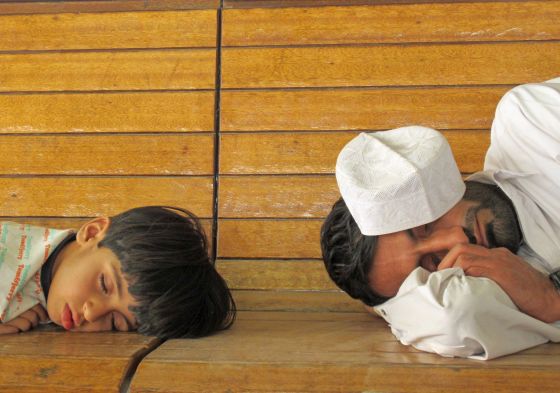
Tehran Bureau: “This weather is terrible for chicken farmers,” jokes Hossein, a dark, wiry man in his late 20s, as he looks at the sunrise over the Persian Gulf, largely blotted out by a dense sandstorm. “The sand gets caught in chicks’ throats and they suffocate.”
Hossein, who supplies Tehran’s jujeh kebab vendors by personally slaughtering 2,000 chicks every 45 days, is one of around 200 passengers aboard the Hormuz, a rusted ship docked in Iran’s biggest port, Bandar Abbas, waiting for the weather to clear to sail to the Emirati city of Sharjah. He is from Bastak, a tiny ancient Iranian town in the southern stretch of the Zagros mountain range. Its 6,000 inhabitants speak a Middle Persian dialect, and most of them move between these hot highlands to the even hotter irrigated deserts of the UAE for business or to see their migrant relatives.
Flanking Hussein on the sunny deck is his friend and hamshahri (town-fellow) Ali, a skinny onion farmer who is adroitly peeling a orange with his large cracked hands, and fortuitously, Farzin, a professor of water resources from Shahrekord University. The professor says that our current predicament is the result of winds sweeping across lands that have been affected by the region’s five-year drought. “The drought is strong in the southwest near Iraq and Saudi and in the northeast, near Afghanistan,” he explains with the aid of a map he carries around. “In Shahrekord, we are in the Zagros Mountains, which used to have a very snowy climate. Now we just get rain.”
We are on the last Iranian vessel to cross the now world-famous Strait of Hormuz before Nowruz, the Iranian New Year. It’s filled with people who were too late or too broke to find a flight during the notoriously busy final days of the Persian year, when Iran experiences an exodus for the two-week break. What the demob-happy passengers don’t know yet is that they will be spending Nowruz at sea, as a ten-hour delay stretches into a two-day waiting game.
I had spent the day before in Bandar Abbas, against the emphatic advice of my guidebook. Bandar, a sweltering town even in spring, is home to some of Iran’s best beaches — even if classical aesthetes might demur over everything aside from its clear water. Thronged with visitors from all over the country hitting the Persian Gulf for the holidays, the scene is a very Iranian affair: girls flying kites, boys on camels or quad bikes, men smoking, families picnicking, litter everywhere, women swimming in full hejab, and morality beach police enforcing strict swimwear rules (don’t wear it). The women of Bandar mostly forgo the chador and northern Iran’s stark black sartorial style, opting instead for colorful sari-like gowns, which drape over their heads and shoulders. [Continue reading…]

As parliamentary elections take place in Iran today, Ardeshir Amir-Arjomand, adviser to opposition leader, Mir Hussein Moussavi, writes: With Iran’s democratic opposition sitting on the sidelines, the race has been left wide open to two authoritarian factions — one led by the fraudulently elected president, Mahmoud Ahmadinejad, and another by an equally unscrupulous conservative group. Their previous “marriage of convenience” has now dissolved, opening the floodgates to an orgy of mutual mud-slinging and a naked stampede for power.
There are no genuine ideological differences between these factions; what motivates them is a lust for power and control of the country’s oil wealth. And they are competing in a polemical race to describe how they would “stamp out” what, in official spin, is labeled as the “remnants of the sedition” — officialese for Iran’s popular Green protest movement, which was brutally attacked three years ago but has nevertheless survived.
The Green movement was born out of spontaneous mass protests that questioned the validity of a fraudulent vote count. Mr. Moussavi and Mr. Karroubi, while still free, kept emphasizing their commitment to free and fair elections, independence of legal institutions, fully accountable governance and a responsible foreign policy — a far cry from what has come to haunt the country in recent years.
We are painfully aware of the tremendous challenges that lie ahead for Iran in its peaceful resistance to a deeply authoritarian power structure bent on the use of sheer hypocrisy, fear, intimidation and brute force to hold on to power.
This, we realize, is the same challenge that has been with us Iranians for over a century: the peaceful transition to a democratic, pluralistic, developed and prosperous Iran.
Several crucial tasks lie ahead of us. First, our peaceful movement has to survive the ruling authoritarian apparatus, and to build and empower the political organizations needed for the future democratic era. More urgently, though, it has to safeguard the country’s territory, its people and its political independence against the increasing perils of external threats, international adventurism and internal strife. We must oppose warmongering and jingoism, whether from foreigners or our fellow countrymen.
It is disheartening that in the midst of rising military threats against the country, certain hotheaded elements and currents within the ruling coalition appear to welcome the prospect of a military confrontation as a blessing.
Pepe Escobar writes: The supreme war-or-peace question regarding the Iran psychodrama has got to be: What game is Iran’s Supreme Leader Ayatollah Khamenei really playing?
Sharp wits among the lively Iranian global diaspora maintain that the Supreme Leader is the perfect US/Israel asset – as he incarnates Iran as “the enemy” (although in most cases in a much less strident way than Ahmadinejad).
In parallel, the military dictatorship of the mullahtariat in Tehran also needs “the enemy” – as in “the Great Satan” and assorted Zionists – to justify its monopoly of power.
The ultimate loser, voices of the diaspora sustain, is true Iranian democracy – as in the foundation for the country’s ability to resist empire. Especially now, after the immensely dodgy 2009 presidential election and the repression of the Green movement. Even former supporters swear the Islamic Republic is now neither a “republic” – nor “Islamic”.
For their part, another current of informed Iranian – and Western – critics of empire swear that the belligerent Likud-majority government of Israel is in fact the perfect Iranian asset. After all, Prime Minister Bibi Netanyahu and former Moldova bouncer turned Foreign Minister Avigdor Lieberman’s non-stop warmongering tends to rally Iranians of all persuasions – always proudly nationalistic – behind the flag.
The absolute majority of Iranians knows and feels they are targeted by a heavily weaponised foreign power – US/Israel. The leadership in Tehran has been wily enough to instrumentalise this foreign threat, and at the same time further smash the Green movement.
Parliamentary elections in Iran are only a few days away, on March 3. These are the first elections after the 2009 drama. In The Ayatollahs’ Democracy: An Iranian Challenge (Penguin Books), Hooman Majd makes a very strong case to detail how the election was “stolen”. And that’s the heart of the matter; millions of Iranians don’t believe in their Islamic democracy anymore.


