Category Archives: Iran

NEWS ROUNDUP: January 24

Afghanistan is the bad war, Iraq the good, says White House co-ordinator
Iraq may turn out to be America’s “good war” while Afghanistan goes “bad”, the Bush Administration official responsible for co-ordinating efforts in Baghdad has told The Times.

Death sentence for Afghan student
An Afghan court in northern Afghanistan sentenced a journalism student to death for blasphemy for distributing an article from the Internet that was considered an insult to the Prophet Muhammad, the judge in charge of the court said Wednesday.

10 die in mistaken Afghan firefight
At least nine Afghan police officers and a civilian were killed early Thursday in a firefight between American forces and the officers in the province of Ghazni just south of the capital, according to local officials.

Supporters at home and abroad backing away from Musharraf
As critical elections in Pakistan approach, President Pervez Musharraf is increasingly losing support from major constituencies, including his traditional military base, amid growing questions in both Pakistan and the United States about his ability to govern.

Canadian military has quit turning detainees over to Afghans
The Canadian military secretly stopped transferring prisoners to Afghanistan’s government in November after Canadian monitors found evidence that they were being abused and tortured.

Most reformists appear purged from Iran ballot
When voters go to the polls on March 14 to select members of Parliament, they may be able to choose only between conservative candidates and other conservative candidates, leaders of Iran’s main reform party said Wednesday.

Facebooktwittermail

NEWS ROUNDUP: January 22

U.S. falls short on new Iran sanctions
The five permanent members of the U.N. Security Council and Germany agreed Tuesday to impose new sanctions on Iran over its suspect nuclear program, yet the measures appeared to fall short of what the Bush administration had wanted.

Budgetary spat in Iran
Supreme leader Khamenei sides with the parliament speaker in his standoff with President Ahmadinejad. What the move means is up for debate.

Padilla sentenced to more than 17 years in prison
Jose Padilla, the Brooklyn-born convert to Islam who was once accused by the government of plotting to detonate a “dirty bomb” in the United States, was sentenced on Tuesday to 17 years and four months in prison for his role in a conspiracy to help Islamic jihadist fighters abroad.

Tom Ridge: Waterboarding is torture
The first secretary of the Homeland Security Department says waterboarding is torture. “There’s just no doubt in my mind – under any set of rules – waterboarding is torture,” Tom Ridge said Friday in an interview with the Associated Press. Ridge had offered the same opinion earlier in the day to members of the American Bar Association at a homeland security conference.

Bush officials narrow foreign horizons
In the final year, Bush administration officials are scaling back ambitious diplomatic goals, and appear more intent on managing crises than on reaching legacy milestones.

Gazans fear crisis after four days of blockade
Four days into an Israeli blockade that has cut off food and fuel to the Gaza Strip, residents of the strip contemplated Monday how long it would be until disaster hit. One family of 13, shivering in the cold, counted its eight remaining candles. A bakery that normally feeds thousands had three days’ worth of flour.

Next target was US consulate: Bhutto killing suspect
A teenaged boy arrested last week on suspicion of involvement in former Pakistan premier Benazir Bhutto’s assassination has told investigators that his next target was the US consulate in the southern Pakistani city of Karachi.

U.S. commander in Pakistan as Taliban attack fort
A top U.S. commander met with Pakistan’s army chief General Ashfaq Kayani on Tuesday as the Pakistani military said it had repulsed an attack by Taliban fighters on a fort near the Afghan border, killing 37 of them.

Britain ‘as inept as US’ in failing to foresee postwar Iraq insurgency
The government’s top foreign policy advisers were as inept as their US counterparts in failing to see that removing Saddam Hussein in 2003 was likely to lead to a nationalist insurgency by Sunnis and Shias and an Islamist government in Baghdad, run by allies of Iran, the Guardian has learned.

Facebooktwittermail

NEWS: Eye on Iran

Israel launches advanced spy satellite

Israel launched an advanced spy satellite Monday that will be able to track events in Iran, the country it considers its top foe, even at night and in cloudy weather, defense officials said.

The TECSAR satellite is of particular importance for Israel because it can be used to keep tabs on Iran’s nuclear program, which the U.S. and Israel fear is a cover for pursuing nuclear weapons, they said. [complete article]

Iran’s supreme leader rebuffs Ahmadinejad in gas row

The political authority of the Iranian president, Mahmoud Ahmadinejad, suffered a serious blow today after the country’s most powerful figure sided with MPs by ordering him to supply cheap gas to villages undergoing power cuts amid an unexpectedly harsh winter.

In a humiliating rebuff, Ayatollah Ali Khamenei, Iran’s supreme leader who has the final say over all state matters, ordered the enactment of a law requiring the government to provide £500m of gas supplies from emergency reserve funds.

Ahmadinejad had refused to implement the measure, accusing parliament of exceeding its powers in passing the bill in response to plummeting temperatures and gas cuts, which have left many areas without heating during the country’s coldest winter in years.

At least 64 people are reported to have died after gas supplies were turned off in sub-zero temperatures. The cuts, belying Iran’s status as possessor of the world’s second biggest natural gas reserves, have provoked public outrage and threaten to turn a mood of rumbling unhappiness into a winter of discontent for Ahmadinejad. [complete article]

Iran sanctions ripple past those in power

Sanctions weren’t supposed to hurt Majid Taleghani. But the Iranian book publisher says they have forced him to increase prices and scale back the number of titles he issues.

“In the past few weeks, the price of South Korean paper has soared at least 25%,” Taleghani complained, chain-smoking nervously. “Why? South Korean banks refuse to open letters of credit. They won’t work with Iranian banks anymore.”

President Bush’s recent tour through the Middle East was meant in part to rally U.S. allies against Iran before talks Tuesday in Berlin by members of the U.N. Security Council and Germany over the possibility of imposing a third round of sanctions on Iran to pressure the government to halt its nuclear program.

A year after the Security Council first imposed sanctions, they clearly have begun to have an effect. But in an echo of the debate over sanctions against Iraq under Saddam Hussein in the 1990s, diplomats and economic analysts disagree sharply over whether such measures would pressure those in power to change their policies or merely hurt the Iranian people. [complete article]

Facebooktwittermail

FEATURE: America’s Iranian invention

Bush’s Iran/Argentina terror frame-up

Although nukes and Iraq have been the main focus of the Bush Administration’s pressure campaign against Iran, US officials also seek to tar Iran as the world’s leading sponsor of terrorism. And Team Bush’s latest tactic is to play up a thirteen-year-old accusation that Iran was responsible for the notorious Buenos Aires bombing that destroyed the city’s Jewish Community Center, known as AMIA, killing eighty-six and injuring 300, in 1994. Unnamed senior Administration officials told the Wall Street Journal January 15 that the bombing in Argentina “serves as a model for how Tehran has used its overseas embassies and relationship with foreign militant groups, in particular Hezbollah, to strike at its enemies.”

This propaganda campaign depends heavily on a decision last November by the General Assembly of Interpol, which voted to put five former Iranian officials and a Hezbollah leader on the international police organization’s “red list” for allegedly having planned the July 1994 bombing. But the Wall Street Journal reports that it was pressure from the Bush Administration, along with Israeli and Argentine diplomats, that secured the Interpol vote. In fact, the Bush Administration’s manipulation of the Argentine bombing case is perfectly in line with its long practice of using distorting and manufactured evidence to build a case against its geopolitical enemies.

After spending several months interviewing officials at the US Embassy in Buenos Aires familiar with the Argentine investigation, the head of the FBI team that assisted it and the most knowledgeable independent Argentine investigator of the case, I found that no real evidence has ever been found to implicate Iran in the bombing. Based on these interviews and the documentary record of the investigation, it is impossible to avoid the conclusion that the case against Iran over the AMIA bombing has been driven from the beginning by US enmity toward Iran, not by a desire to find the real perpetrators. [complete article]

Facebooktwittermail

NEWS ROUNDUP: January 20

Israel test-fires ballistic missile after Iran warning
Israel successfully test-fired a long-range ballistic missile on Thursday, a senior official told AFP, days after warning “all options” were open to prevent archfoe Iran from obtaining atomic weapons.

U.S. plays down chance of Iran resolution soon
The United States on Friday played down the chance of major powers agreeing on new U.N. sanctions against Iran when ministers meet in Berlin next week, underlining discord over how to proceed with Tehran.

Discontent Surges in Iraq
In the depths of a strangely cold winter in the Middle East, Iraqis complain that the lights are not on, the kerosene heaters are without fuel and the water doesn’t flow — and they blame the government.

Violence increases and tensions rise among Iraqi Shiites
A police raid Saturday on an extremist Shiite Muslim mosque thought to be the headquarters of an extremist cult capped a weekend of violence in southern Iraq, while elsewhere tensions between Iraq’s Shiite-led government and renegade Shiite cleric Moqtada al Sadr continued to escalate.

Hamas police force recruits women in Gaza
The policemen of Hamas now have company: since the Islamic group took over here last June it has been recruiting policewomen as well.

Hezbollah taunts Israel with claims of soldiers’ remains
Hezbollah’s leader, Sheik Hassan Nasrallah, on Saturday made his first public appearance here since the 2006 war with Israel, restating his claim that the militant group possessed the remains of several Israeli soldiers left on the battlefields of southern Lebanon.

Israel closes all Gaza border crossings, citing Palestinian rocket attacks
Israel closed all border crossings with the Gaza Strip on Friday, cutting off at least one aid shipment, and bombed the empty Interior Ministry building of the Palestinian Authority, which was already a ruin after a previous Israeli bombing.

Right-wing party quits Israeli coalition
A right-wing party quit Israeli Prime Minister Ehud Olmert’s governing coalition Wednesday in protest of the revived peace talks with the Palestinians, but the move poses no immediate threat to his rule.

Facebooktwittermail

ANALYSIS: Pentagon’s Whitman spins a good yarn

How the Pentagon planted a false story

Senior Pentagon officials, evidently reflecting a broader administration policy decision, used an off-the-record Pentagon briefing to turn the Jan. 6 U.S.-Iranian incident in the Strait of Hormuz into a sensational story demonstrating Iran’s military aggressiveness, a reconstruction of the events following the incident shows.

The initial press stories on the incident, all of which can be traced to a briefing by deputy assistant secretary of defense for public affairs in charge of media operations Bryan Whitman, contained similar information that has since been repudiated by the Navy itself.

Then the Navy disseminated a short video into which was spliced the audio of a phone call warning that U.S. warships would “explode” in “a few seconds.” Although it was ostensibly a Navy production, IPS has learned that the ultimate decision on its content was made by top officials of the Defense Department. [complete article]

Facebooktwittermail

EDITORIAL: It’s not the end of times – just the end of Bush

It’s too late, baby

Yesterday, in an address to government and business leaders in Abu Dhabi, President Bush said, “Iran’s actions threaten the security of nations everywhere. So the United States is strengthening our longstanding security commitments with our friends in the Gulf — and rallying friends around the world to confront this danger before it is too late.”

Bush may take comfort in the knowledge that, according to Prime Minister Ehud Olmert’s spokesman Mark Regev and as the Jerusalem Post reports, “Israel and the US are ‘on the same page‘ regarding the gravity of the Iranian nuclear threat and their commitment to thwart it.” Even so, when Bush says “before its too late” to his Arab friends, most of them are probably taking comfort in completing that line with, “before its too late… for Bush to do anything about it.” He frets about only twelve months left on the clock — the rest of the world can’t wait for his term to end.

Witness the spectacle of an international “incident” that after a few days has devolved into a debate about a Filipino Monkey. The only comfort the White House can take from this drama is that the press never even noticed when the stage upon which it was set, came into question.

Iranian speedboats threatened US warships in international waters in the Straits of Hormuz. So far only one analyst — Kaveh L Afrasiabi, writing in Asia Times — has pointed out the most basic factual error in this account: there are no international waters in the Straits of Hormuz.

Let’s repeat that: there are no international waters in the Straits of Hormuz. The U.S. ships were in Iranian territorial waters exercising the “right of transit passage” afforded to them in international law by the UN Convention on the Law of the Sea (UNCLOS) which the United States has signed but which Congress has yet to ratify. This is why in the video of the incident, a U.S. naval officer can be heard saying, “I am engaged in transit passage in accordance with international law.”

However provocatively the Iranian speedboats might have been behaving, if from the outset, this incident had been reported as occurring inside Iranian territorial waters, the Pentagon’s first task would have been to educate the press and the public about some of the technicalities of international law as it applies to the Straits of Hormuz. That lesson would have sucked the air out of the story and Bush would have landed in Tel Aviv deprived of what he was clearly eager to employ in his latest round of fear-mongering rhetoric. Absent this rallying cry, there might have been a tiny possibility that he pay a bit of attention to the real concerns that resonate across the region.

Facebooktwittermail

OPINION: It’s not about Iran

It’s not about Iran

As President Bush travels through the Middle East, the prevailing assumption is that Arab states are primarily focused on the rising Iranian threat and that their attendance at the Annapolis conference with Israel in November was motivated by this threat. This assumption, reflected in the president’s speech in the United Arab Emirates yesterday, could be a costly mistake.

Israel and the Bush administration place great emphasis on confronting Iran’s nuclear potential and are prepared to engage in a peace process partly to build an anti-Iran coalition. Arabs see it differently. They use the Iran issue to lure Israel and the United States into serious Palestinian-Israeli peacemaking, having concluded that the perceived Iranian threats sell better in Washington and Tel Aviv than the pursuit of peace itself.

Many Arab governments are of course concerned about Iran and its role in Iraq, but not for the same reasons as Israel and the United States. Israel sees Iran’s nuclear potential as a direct threat to its security, and its support for Hezbollah and Hamas as a military challenge.

Arab governments are less worried about the military power of Hamas and Hezbollah than they are about support for them among their publics. They are less worried about a military confrontation with Iran than about Iran’s growing influence in the Arab world. In other words, what Arab governments truly fear is militancy and the public support for it that undermines their own popularity and stability.

In all this, they see Iran as a detrimental force but not as the primary cause of militant sentiment. Most Arab governments believe instead that the militancy is driven primarily by the absence of Arab-Israeli peace.

This argument has been a loser in Washington, rejected by many and not taken seriously by others. The issue of Iran gets more traction inside the Beltway. [complete article]

Facebooktwittermail

NEWS & ANALYSIS: The Iranian threat

Saudi cannot be launchpad for Iran attack: report

A leading Saudi newspaper on Saturday ruled out any attempt by the United States to use the oil-rich Gulf kingdom as a launchpad for a possible war on Iran over Tehran’s disputed nuclear programme.

Two days before a visit to Saudi Arabia by US President George W. Bush, the pro-government daily Al-Riyadh said: “We refuse to be used to launch wars or tensions with Iran. [complete article]

Iran’s Revolutionary Guard in secret Iraq talks with US

The head of the Iranian Revolutionary Guard Corps slipped into the green zone of Baghdad last month to press Tehran’s hardline position over the terms of the current talks with American officials, it was claimed last week.

Iraqi government sources say that Major-General Mohammed Ali Jafari, 50, travelled secretly from Tehran. Jafari appears to have passed through checkpoints on his way into the fortified enclave that contains the American embassy and Iraqi ministries, even though he is on Washington’s “most wanted” list. [complete article]

Iran encounter grimly echoes ’02 war game

There is a reason American military officers express grim concern over the tactics used by Iranian sailors last weekend: a classified, $250 million war game in which small, agile speedboats swarmed a naval convoy to inflict devastating damage on more powerful warships.

In the days since the encounter with five Iranian patrol boats in the Strait of Hormuz, American officers have acknowledged that they have been studying anew the lessons from a startling simulation conducted in August 2002. In that war game, the Blue Team navy, representing the United States, lost 16 major warships — an aircraft carrier, cruisers and amphibious vessels — when they were sunk to the bottom of the Persian Gulf in an attack that included swarming tactics by enemy speedboats. [complete article]

Iran urges agency to settle atomic case

Iran’s supreme leader, Ayatollah Ali Khamenei, told the visiting chief of the International Atomic Energy Agency on Saturday that Iran’s nuclear case should be handled by the I.A.E.A. and not the United Nations Security Council, which has imposed two rounds of sanctions on Tehran. [complete article]

Israel stressed to Bush that Iran is a nuclear ‘threat’: general

Iran poses a real nuclear threat and Israel made that point clear to US President George W. Bush during his visit this week, an Israeli defence official said Saturday. [complete article]

Facebooktwittermail

NEWS & EDITOR’S COMMENT: The unraveling of Israel’s nuclear ambiguity

CIA reveals: We said in 1974 that Israel had nuclear weapons

The Central Intelligence Agency, backed by bodies including the State Department’s Bureau of Intelligence and Research and the Defense Intelligence Agency, determined in August 1974 that Israel had nuclear “weapons in being,” a “small number” of which it “produced and stockpiled.”

Israel was also suspected of providing nuclear materials, equipment or technology to Iran, South Africa and other then-friendly countries.

This top secret document, consigned to the CIA’s vaults for almost 32 years, was suddenly released to the public this week, during U.S. President George W. Bush’s visit to Israel and on the eve of his trip to the Persian Gulf. [complete article]

Editor’s Comment — For several decades, Israel has adopted a position of so-called “nuclear ambiguity,” asserting that it would not be the first state to introduce atomic weapons to the Middle East. The United States has colluded in allowing this claim to rest unchallenged — even though it is widely understood that Israel does in fact possess a nuclear arsenal estimated to range from 70 to 400 warheads.

The first indications that the United States’ position might change occurred during Robert Gates’ confirmation hearings in which he included Israel among the nuclear states that surround Iran. Documents released by the Nixon Library a few weeks ago confirm that in 1969, Henry Kissinger warned President Nixon about Israel’s nuclear capabilities and that the “Israelis, who are one of the few peoples whose survival is genuinely threatened, are probably more likely than almost any other country to actually use their nuclear weapons.” A year ago, Ehud Olmert provoked a storm of criticism inside Israel by being the first Israeli prime minister to make reference to Israel’s nuclear arsenal.

It seems to be a matter of time (months or even weeks?) before Israel decides to unambiguously come out of the nuclear closet. If this happens, the nuclear equation changes across the whole region. Will it trigger a Middle East nuclear arms race? Will it help empower those who argue that the only effective way of challenging Iran’s nuclear program is through turning the whole region into a nuclear-weapon-free zone? Or will the United States attempt to contrive a policy that claims that Israel has a unique “right” to possess nuclear weapons and exempt itself from international treaties?

Facebooktwittermail

NEWS, OPINION & EDITOR’S COMMENT: Unscrambling Iranian-U.S. communications

What to make of the Iranian videotape

Iran has now aired a video of the incident in the Straits of Hormuz on Sunday, and according to the wire services (AP, AFP, Reuters) the video stresses routine and not confrontation.

As I said yesterday, the Iranians on Sunday wanted to send a not-so-subtle message to their Persian Gulf neighbors that they could disrupt the flow of oil and that any U.S.-Iranian confrontation would hurt the pocketbooks of the ruling sheiks. Now, by issuing a video that seems to call into question the authenticity of the Pentagon videotape, Iran seeks a bigger victory with international public opinion.

At this point, Washington has two choices: It can release every shred of intelligence and information it has in an attempt to show how the Iranians are lying. Or it can let the matter drop and focus instead averting these types of incidents in the future. If it chooses the latter, it may find that Iran is a more willing partner than it appears. What Tehran is saying, after all, is quite similar to what the U.S. Navy is saying. [complete article]

Editor’s Comment — Let’s suppose that the Pentagon had never released its own video (the one to which it added an audio track) — that it had simply issued a statement describing the Hormuz incident — and that the Iranian video that has now been broadcast came under critical scrutiny. Suppose the Pentagon then announced that after having analysed the Iranian videotape, they had determined that the audio came from a different source than the images. Would the Pentagon refrain from describing this as a “fabrication”? Almost certainly not — and neither would many news editors in the U.S. media be reluctant to run headlines referring to the “Fabricated Iranian Video.”

Official version of naval incident starts to unravel

Despite the official and media portrayal of the incident in the Strait of Hormuz early Monday morning as a serious threat to US ships from Iranian speedboats that nearly resulted in a “battle at sea,” new information over the past three days suggests that the incident did not involve such a threat and that no US commander was on the verge of firing at the Iranian boats.

The new information that appears to contradict the original version of the incident includes the revelation that US officials spliced the audio recording of an alleged Iranian threat onto to a videotape of the incident. That suggests that the threatening message may not have come in immediately after the initial warning to Iranian boats from a US warship, as it appears to do on the video. [complete article]

Forging ties with Iran

There is widespread feeling overseas that the consequences of the judgment that Tehran has suspended its nuclear weapons program should be positive, not punitive. To be sure, the Islamic Republic still has nuclear ambitions, and its expanded uranium enrichment capacity is certainly worrisome. Nonetheless, dialogue and diplomacy are still the best means of mitigating the Iranian challenge. And despite President Mahmoud Ahmadinejad’s odious rhetoric and the reckless behavior of Iranian speedboats, there is reason to believe that Tehran may be open to such an approach.

While some have depicted Iran as a rash, militant state imbued with messianic fervor, the clerical state today is an unexceptional opportunistic power seeking to exert preponderance in its immediate neighborhood. Gone are the heady revolutionary days when Iran viewed projection of influence as necessitating the subversion of the incumbent Arab regimes. [complete article]

See also, Iran shows its own video of vessels’ encounter in Gulf (NYT) and US protests Iran harassment of US ships (AP).

Facebooktwittermail

ANALYSIS: Pumping up the Iranian threat

Degrees of confidence on U.S.-Iran naval incident

The list of those who are less than fully confident in the Pentagon’s video/audio mashup of aggressive maneuvers by Iranian boats near American warships in the Strait of Hormuz now includes the Pentagon itself.

Unnamed Pentagon officials said on Wednesday that the threatening voice heard in the audio clip, which was released on Monday night with a disclaimer that it was recorded separately from the video images and merged with them later, is not directly traceable to the Iranian military.

That undercuts one of the most menacing elements from the Pentagon’s assertion that Iranian forces threatened the Navy ships: The voice on the radio saying, “I am coming to you. … You will explode after … minutes.” [complete article]

Captain Ahab and the Islamic whale

Filling a major void in the post-Cold War milieu, the “rogue” Iran plays a vital role for the US’s military-industrial complex that thrives on lucrative arms sales to the conservative oil sheikhs of the Persian Gulf, ostensibly threatened by the “hegemonic” and nuclear ambitious Iran.

But, whereas the capitalist logic of arms sales dictates heating up the furnace of Iran-bashing, on the other hand, certain geopolitical realities, eg, in Iraq and Afghanistan, spell out a diametrically different logic of action. This is reflected in the bilateral US-Iran dialogue on Iraq’s security; a fourth round of talks has been put on hold because of Bush’s trip and his stern anti-Iran agenda. This includes pressuring Gulf Cooperation Council (GCC)states such as the UAE to curtail their financial transactions with Iran, in tandem with US-led sanctions on the regime over its nuclear program.

While it remains to be seen if the UAE and other GCC states will appease the lame-duck president, who may be wishing a final grand adventure before he leaves office, what is already clear, and disturbing, is the White House’s persistent failure to impose even a modicum of pressure on Israel. Talking peace and acting war against Palestinians, Israel’s contradictory approach has augmented the US’s image problem in the Middle East. And, short of any major concession to the Palestinians, that approach is likely to receive a major boost from Washington now that Bush has set foot in Israel. [complete article]

Facebooktwittermail

NEWS, ANALYSIS, OPINION & EDITOR’S COMMENT: Bush’s trip notes

Bush’s last throw against Iran

The leitmotif of Bush’s high-profile tour of the Middle East is unmistakably Iran. But Washington’s Iran policy lies in tatters and it has no choice but to ratchet up anti-Iran rhetoric, though it realizes there are no takers in the Middle East for such rhetoric of fire and brimstone. The danger now is that Tehran may choose to hunker down and prefer to deal with the next US administration.

Tehran once heeded back-channel pleas from Ronald Reagan’s campaign managers not to negotiate the hostage crisis with the Carter administration in its final months in the White House so that Reagan could claim the credit for the denouement. Bush is certainly better placed than Carter insofar as presidential hopefuls such as Barack Obama and Mike Huckabee would never do such a Reaganite thing on him.

Actually, the danger to the Bush legacy comes from faraway places. Continued delay in constructively engaging Iran will only open the gateway wider for the international community to encroach into a region that until four years ago used to be the exclusive strategic preserve of the US. China is already wading deep into the region, and Russia too. The S-300 missiles from Russia are a sign that US dominance of the Middle East is in serious jeopardy. [complete article]

See also, Bush calls Iran ‘threat to world peace’ (CNN).

Israeli leaders greet Bush with warning for Iran

President Bush began an eight-day Middle East peace mission Wednesday as Israeli leaders warned him and the world not to forget about the regional threat that Iran poses.

Standing on the airport tarmac with Bush looking on shortly after his arrival, Israeli President Shimon Peres relegated peace talks with the Palestinians to secondary status and issued a warning to Iran.

“We take your advice not to underestimate the Iranian threat,” Peres said.

“Iran should not underestimate our resolve for self-defense.” [complete article]

Talking to Iran?

Shortly before Christmas, over dinner in his palace, one of the ruling sheiks of the United Arab Emirates told this reporter he had not been at all surprised by the release of the National Intelligence Estimate that said Iran had suspended its nuclear weapons program back in 2003.

“We were warned by Rafsanjani to expect a very big, very surprising announcement out of Washington,” the sheik said. “He knew it was coming.”

Akbar Hashemi Rafsanjani, former president of Iran and chairman of the country’s Assembly of Experts, also chairs the special council that mediates between the ayatollahs and the Parliament whenever there is a dispute. Derisively nicknamed “Akbar Shah” by his enemies, he is also the head of what is widely reckoned to be Iran’s richest family. Born into a prosperous family of pistachio farmers, he is the link between the ayatollahs, politics and the business community.

Seen as something of a moderate by Iranian standards, Rafsanjani is believed in the Gulf states to have long maintained his own back channels to Washington — hence his supposed advance knowledge of the NIE. [complete article]

Editor’s Comment — As an indication of the importance of President Bush’s trip to the Middle East, his press secretary, Dana Perino, is blogging the trip — though being too diffident to use the actual term “blog”, the White House is modestly calling her record, Trip Notes. Since she’s only two days into this bold new communications venture, I should perhaps refrain from passing judgment, but I was hoping to be able to find at least one — just one — memorable line. The best I could find was this: “As we descended into Tel Aviv, many of us looked out the window to see a country that some of us have only seen in pictures.” Perino was one of the many, but was she also one of the some? I guess divulging whether she’s been to Israel before or how many of her trip mates are on a return trip would be way too personal.

In light of the focus of the current trip, Perino might want embellish her “notes” a bit and see if she can make them at least as interesting as Mahmoud Ahmadinejad’s blog. Here’s a recent entry of his:

To read or to write, that is the question!‎ 2007/11/18
In the Name of Almighty God-the All-Knowing, the Most Lovingly ‎Compassionate

Since my last post on the blog, a few months have passed. But this doesn’t ‎mean that I have not been keeping my promise of spending fifteen minutes per week ‎on it. As a matter of fact, I have spent more than the allocated time on the blog. The ‎magnitude of the reception and acclamation from the viewers was beyond ‎expectations. So I had to decide how to spend the limited time that I have allocated ‎for the blog; should I write new notes or respect those viewers who kindly and ‎generously have shared their thoughts and opinions with me and sent messages and read ‎their numerous received messages. ‎

‎***‎

As you know, the purpose of running this blog is to have a direct and mutual ‎contact and communication with the viewers and even though I have received many ‎messages from the viewers to update the blog and write new notes, I preferred to write ‎less and spend more time on reading the viewers’ messages – and not let this ‎communication tool become just a one-way medium.‎

‎***‎

I personally have read those messages that are considered to be short. I even ‎have read those messages that have started with a sentence like “I know that the ‎president is not going to read this message, but….” ‎

Also some of my trusted students have shortened the long messages for me ‎and have prepared a statistical report regarding all of the messages which I have read ‎and studied those too. God willing, a portion of the overall analysis of the messages ‎and its interesting results will be posted on the blog in the future.‎

‎***‎

I am apologetic to those who have been waiting for my new posts, but ‎fortunately overall, the analysis of the messages has got to a point that I can start ‎writing here again. ‎

I would like to use this opportunity and ask those of you who intend to send ‎me messages through blog, to make it as brief as you can. Thank you.
Written by Mahmoud Ahmadinejad at 23:24

Now if the White House really wants to push the envelope and follow Ahmadinejad’s lead, the Trip Notes from the Middle East should include at least one entry from the president and also be open to comments. On Ahmadinejad’s blog, comments are not as strictly moderated as one might expect, such as the comment from one “John Jacobs” from the United States: “I hate you. you are retarted. that simple mentally retarted.” The remarks of an irate pastry chef?

Facebooktwittermail

NEWS: With fewer threats from U.S., Ahmadinejad gets weaker

Ahmadinejad’s defender keeps his distance

A rift is emerging between President Mahmoud Ahmadinejad and Iran’s supreme religious leader, Ayatollah Ali Khamenei, suggesting that the president no longer enjoys the ayatollah’s full backing, as he did in the years after his election in 2005.

In the past, when Mr. Ahmadinejad was attacked by his political opponents, criticisms were usually silenced by Ayatollah Khamenei, who has the final word on state matters and regularly endorsed the president in public speeches. But that public support has been conspicuously absent in recent months.

There are numerous possible reasons for Mr. Ahmadinejad’s loss of support, but analysts here all point to one overriding factor: the United States National Intelligence Estimate last month, which said Iran had suspended its nuclear weapons program in 2003 in response to international pressure. The intelligence estimate sharply reduced the threat of a military strike against Iran, allowing the Iranian authorities to focus on domestic issues, with important parliamentary elections looming in March.

“Now that Iran is not under the threat of a military attack, all contradictions within the establishment are surfacing,” said Saeed Leylaz, an economic and political analyst. “The biggest mistake that Americans have constantly made toward Iran was adopting radical approaches which provided the ground for radicals in the country to take control.” [complete article]

Facebooktwittermail

NEWS & OPINION: The American-Iranian communication gap

Dire straits

Just what were the Iranians up to Sunday, when five small Iranian gunboats reportedly came within a couple hundred yards of three U.S. Navy vessels, dropping “box-like objects” (naval mines?) in their path, while threatening messages were transmitted over the radio?

Was it a rogue operation? Were the Iranians seeking to undermine President Bush’s upcoming trip to the region? Testing U.S. reactions? Preparing for a future attack? Vice Adm. Kevin Cosgriff, commander of the U.S. Naval Forces Central Command, couldn’t say when briefing reporters yesterday, because the Navy honestly doesn’t know.

The 30-minute incident was far from the most serious altercation between U.S. and Iran in recent history. But, as long as there’s no dialogue between the two countries, even innocuous interactions can quickly become dangerous. [complete article]

Iranian boats press US ships

In a conference call with Pentagon reporters, Vice Admiral Kevin Cosgriff, commander of the US Fifth Fleet, said the transmissions were to the effect that the “US ships would explode” – sparking fears of a repeat of the suicide bombing of the USS Cole off the coast of Yemen in 2000 that killed 17 US sailors.

But Roughead said it was unclear whether the radio warning came from Iranian vessels or from shore along the Straits of Hormuz, a narrow, 34-mile opening into the Persian Gulf, through which an estimated 40 percent of the world’s oil supply is shipped. Sunday’s incident occurred at 8 a.m. local time when the three American vessels were entering the Persian Gulf through the straits.

“In that part of the Gulf, who was saying what [is] sometimes very difficult to determine,” Roughead said. [complete article]

See also, Bush assails Iran for naval confrontation (NYT).

Facebooktwittermail

NEWS: Iranians grab attention; Hormuz incident produces brief blip in the markets

U.S. describes confrontation with Iranian boats

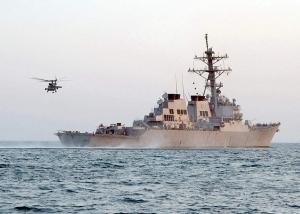
uss-hopper.jpgOne Defense Department official, who spoke on the condition of anonymity to describe early reports from the Navy’s regional headquarters in Bahrain, said that the Iranian boats made a radio threat that the American ships would explode.

“The five Iranian fast boats essentially came in and charged the ships,” the Defense Department official said. The verbal warnings heard in English over the internationally recognized bridge-to-bridge radio channel said, “I am coming at you, and you will explode in a few minutes,” the official said.

A few minutes later, one of the Iranian boats placed two white boxes, possibly meant to be taken for mines, in the wake of one of the Navy ships, which caused another of the American vessels to take evasive action.

“Whether they’re just testing us to learn about our procedures, or actually trying to initiate an incident, we don’t know,” the official said.

The five fast boats were identified by Defense Department officials as belonging to Iran’s Islamic Revolutionary Guards Corps. Traditionally, the Revolutionary Guards’ maritime forces have operated in a far more hostile manner than the regular Iranian Navy.

“We have found in the past that the regular Iranian Navy was a courteous and professional organization, and our relations are as we would have with any other navy in the world,” said one Pentagon official who has studied the issue. “The I.R.G.C. Navy has a tendency to act in these unprofessional ways, and to be very provocative at times.”

Last March, Revolutionary Guards sailors captured 15 British sailors in waters the British insisted were international, and held them for nearly two weeks. [complete article]

Hotdogs and brinkmanship

There’s a fair bit of speculation on Iranian motives today, from Blake Hounsell wondering if the IRGC commanders are doing some oil-market speculating to talk of a “Gulf of Tonkin” exersize and the inevitable Rightwing calls to bomb, bomb, bomb Iran. Others see this incident as being connected to the US nomination races (no, really – everything is about the races for some folk) or to Bush’s Mid-East visit.

While the latter is the most likely if this event – not unusual except for one Iranian redneck on a radio – was deliberately singled out for orders to that effect by some senior commander, I’m going with Dave Schuler’s take – dumb hotdogs playing brinkmanship games.

I think it’s more likely that it’s just a bunch of IRG’s horsing around, taunting the Great Satan. You can’t peddle that sort of stuff for a generation or more without it having some effects.

On both sides, Dave. [complete article]

Diplomatic two-step in Iran

Tehran in recent days reshuffled its diplomatic team in key Middle East posts. It has cut short the tenure of its ambassador to Syria after just a two-year stint, replacing him with another hard-core loyalist of President Mahmoud Ahmadinejad. The Tehran government has also announced the departure of its point man on Iraq to a post in far-flung Japan.

The moves have sparked speculation that Ahmadinejad wants more control over the country’s foreign policy on Iraq and Lebanon.

But they could also just be complicated maneuvers to consolidate power within the ruling elite’s treacherous factional politics. [complete article]

Oil shrugs off Iran-US bounce, falls below $97

Oil fell more than $1 to below $97 a barrel on Monday, handing back gains triggered by reports of fresh tensions between Iran and the United States. [complete article]

Facebooktwittermail

NEWS & OPINION: Mismeasuring regional dynamics

Why U.S. strategy on Iran is crumbling

‘Everywhere you turn, it is the policy of Iran to foment instability and chaos,” Defense Secretary Robert Gates warned Gulf dignitaries in Bahrain last month. But in reality, everywhere you turn, from Qatar to Saudi Arabia to Egypt, you now see Iranian leaders shattering longstanding taboos by meeting cordially with their Arab counterparts.

The Gulf has moved away from American arguments for isolating Iran. American policymakers need to do the same.

The states of the Gulf Cooperation Council (GCC) are accommodating themselves to Iran’s growing weight in the region’s politics. They remain key parts of America’s security architecture in the region, hosting massive US military bases and underwriting the American economy in exchange for protection. But as Saudi analyst Khalid al-Dakheel argues, they are no longer content sitting passively beneath the US security umbrella and want to avoid being a pawn in the US-Iranian struggle for power. Flush with cash, they are not interested in a war that would mess up business. [complete article]

Yo, anyone who fears Iran

The smart people are getting out of Jerusalem next week. Traffic mayhem is assured as George Bush and his entourage, about 800 souls, guarded by thousands of Israeli police, are whisked about in a fleet of armoured vehicles, complete with a bespoke helicopter brought in to fly the president to Capernaum, in northern Israel, where Jesus chose his apostles.

What is less clear is what Mr Bush will bring his hosts apart from gridlock. The man who hoped his invasion of Iraq in 2003 was going to bring peace to Palestine and democracy to the Arabs has not exactly over-achieved. So the main aims of the tour he begins on January 8th are more limited: to give a nudge to the Israeli-Palestinian peace talks he launched in Annapolis in November and to shore up America’s allies against Iran. [complete article]

Iran ‘could restore ties with U.S.’

Iran’s supreme leader, Ayatollah Ali Khamenei, has said relations with the US could be restored in the future.

In a speech to students, he said the time was not right to restore ties, but if it were ever in Iran’s interests he would endorse such a move. [complete article]

Hezbollah sets resolution terms

The Lebanese opposition group Hezbollah has said openly that it will not allow a president to be elected unless it gets a third of the cabinet seats.

This would give Hezbollah and its allies a veto over key decisions. The Hezbollah leader, Hassan Nasrallah, blamed the US for obstructing a solution to Lebanon’s political crisis by opposing such a move. [complete article]

Facebooktwittermail

NEWS: The existential threat to Iran

U.S. institute: Israel could survive nuclear war

If a nuclear war between Israel and Iran were to break out 16-20 million Iranians would lose their lives – as opposed to 200,000-800,000 Israelis, according to a report recently published by the Washington-based Center for Strategic and International Studies (CSIS), which is headed by Anthony H. Cordesman, formerly an analyst for the US Department of Defense. The document, which is largely theoretical due to the lack of verified knowledge in some areas – specifically in terms of Israel’s nuclear capability – paints various scenarios and attempts to predict the strategies of regional powers, as well as the US.

The report assesses that a nuclear war would last approximately three weeks and ultimately end with the annihilation of Iran, due to Israel’s alleged possession of weapons with a far larger yield. Israel, according to the assessment, would have a larger chance of survival. The report does not attempt to predict how many deaths would eventually be caused by possible nuclear fallout. [complete article]

See also, Iran needs no uranium enrichment: Russia’s Lavrov (Reuters) and Iran plans 19 more nuclear plants (AP).

Facebooktwittermail