Category Archives: Iran

Israeli war talk

Israel threatens military strike on Iran

President Shimon Peres has threatened that Israel will take military action against Iran if talks proposed by the US president Barack Obama fail to halt Iran’s nuclear programme. In an interview on the Israeli Kol Hai radio station on Sunday, Mr Peres warned that if the talks don’t soften the approach of the Iranian president, “we’ll strike him”.

Mr Peres ruled out the possibility of Israel engaging in a unilateral attack, and said: “We certainly cannot go it alone, without the US, and we definitely can’t go against the US. This would be unnecessary.”

The Israeli president’s statement comes just a few days after the US Vice President Joe Biden issued a high-level warning to Israel’s new government that it would be “ill advised” to launch a military strike against Iran.

Mr Peres also suggested that the arrest last week of 49 alleged agents of Hizbollah by Egyptian authorities was a blow to the Iranian president’s ambitions. [continued…]

Editor’s CommentIsrael threatens to attack Iran has become a dog-bites-man story. What’s significant here is that Peres went out of his way to say that Israel will not go it alone. An attack either gets US backing or it’s not going to happen.

The subtext here is that the Israelis are becoming genuinely afraid of a US-Israeli rift. And the driving force behind this rift is one that the Israel lobby is powerless to rein in: Avigdor Lieberman.

The diplomatic sleight of hand that the Israelis love to play is to gloss over disagreements and brush away criticisms by suggesting that the differences only exist in the eye of the beholder — that Israel and the US are of one heart, indivisible. But no one makes this posture more difficult than Lieberman, a man who is now too powerful to dismiss as a somewhat harmless embarrassment.

As Douglas Bloomfield wrote in the Jerusalem Post on Sunday, Lieberman “could do what the Arabs and their supporters could only dream of – drive a wedge between Americans and Israel.”

Netanyahu and threat of bombing Iran — the bluff that never stops giving?

Israel does not have the military capability to successfully eliminate Iran’s nuclear program. Even the most successful bombing campaign would only set back the known program for a few years — without affecting any potential clandestine program. This is not classified information. Military experts are well aware of Israel’s capabilities — and its limits.

Yet, the threat of military action, or rather the bluff, serves a purpose: Threats of military action militarizes the atmosphere. It creates an environment that renders diplomacy less likely to succeed — it may even prevent diplomacy from being pursued in the first place.

In the Iranian case, Netanyahu’s tough talk undermines the Obama administration’s prospects for diplomacy in the following ways.

Getting to the negotiating table has proven an arduous task for the US and Iran. Both sides are currently testing each other’s intentions, asking themselves if the other side is serious about diplomacy or if the perceived desire for talks is merely a tactical maneuver to either buy time or build greater international support for more confrontational policies down the road. From Tehran’s perspective, uncertainty about Washington’s intentions during the Bush administration was partly fueled by the insistence of the military option remaining on the table. Tehran seemed to fear entering negotiations that could have been designed to fail, since that could strengthen the case for military action against Iran. [continued…]

U.S. may drop key condition for talks with Iran

The Obama administration and its European allies are preparing proposals that would shift strategy toward Iran by dropping a longstanding American insistence that Tehran rapidly shut down nuclear facilities during the early phases of negotiations over its atomic program, according to officials involved in the discussions.

The proposals, exchanged in confidential strategy sessions with European allies, would press Tehran to open up its nuclear program gradually to wide-ranging inspection. But the proposals would also allow Iran to continue enriching uranium for some period during the talks. That would be a sharp break from the approach taken by the Bush administration, which had demanded that Iran halt its enrichment activities, at least briefly to initiate negotiations.

The proposals under consideration would go somewhat beyond President Obama’s promise, during the presidential campaign, to open negotiations with Iran “without preconditions.” Officials involved in the discussion said they were being fashioned to draw Iran into nuclear talks that it had so far shunned.

A review of Iran policy that Mr. Obama ordered after taking office is still under way, and aides say it is not clear how long he would be willing to allow Iran to continue its fuel production, and at what pace. But European officials said there was general agreement that Iran would not accept the kind of immediate shutdown of its facilities that the Bush administration had demanded. [continued…]

Iran says it controls entire nuclear fuel cycle

Iran now controls the entire cycle for producing nuclear fuel with the opening of a new facility to produce uranium fuel pellets, the Iranian president said Saturday.

Mahmoud Ahmadinejad made the speech two days after the inauguration of the facility which produces uranium oxide pellets for a planned 40-megawatt heavy-water nuclear reactor near the town of Arak, central Iran.

Production of nuclear fuel pellets is the final step in the long, complicated chain of nuclear fuel cycle. The U.S. and its allies have expressed concern over Iran’s developing nuclear program for fear it masks a nuclear weapons program — a charge Iran denies. [continued…]

Differences with US on Mideast ‘semantic’: Israel

Differences between Israel and the United States over the Middle East conflict are fundamentally semantic and will be harmonised within a few weeks, an Israeli minister said on Saturday.

“There are differences of approach toward the problems in the Middle East between our government and the administration of (US President Barack) Obama, but they point more to wording and semantics than to reality,” Transport Minister Israel Katz told public radio.

Israel’s hawkish new Prime Minister Benjamin Netanyahu “has already had meetings with American leaders, and our policies will converge,” he added. [continued…]

Israel lobbies Russia on Iranian arms sales

Israel has lobbied Russia to pull away from selling a strategic air-defense system to Iran but has received only vague assurances, Israeli defense sources said on Monday.

Last week Israel agreed to supply surveillance drones worth $50 million to Russia. The Israeli Haaretz newspaper said this followed a pledge by Moscow not to sell Iran the S-300, which could protect Iranian nuclear facilities against air strikes.

An Israeli defense official said he had no knowledge of such an undertaking by Russia in its talks with Israel on the matter. Moscow has given mixed messages on the prospects of Iran buying S-300s, a deal one Russian newspaper valued at $800 million. [continued…]

U.S. troops take part in Israel X-Band radar test

U.S. troops took part in a missile defense exercise in Israel last week that for the first time incorporated a U.S.-owned radar system deployed to the country in October.

About 100 Europe-based troops continue to operate the X-Band radar, which is intended to give Israel early warning in the event of a missile launch from Iran.

While it’s not a permanent assignment for U.S. troops, as long as the radar is in use, U.S. personnel will be there to operate it, U.S. European Command said. [continued…]


Facebooktwittermail

Israel’s threats

Israel expected to hold back on Iran

Robert Gates, US defence secretary, has said Israel is unlikely to attack Iran this year to prevent Tehran from developing a nuclear weapon.

In an interview with the Financial Times, Mr Gates said there was still enough time to persuade Iran to abandon what is widely perceived to be a nuclear weapons programme.

Mr Gates said he does not expect Israel – which believes the US estimate for when Iran could develop a nuclear weapon is too sanguine – to take military action this year.

“I guess I would say I would be surprised…if they did act this year,” said Mr Gates. [continued…]

Israel’s awful new government

Israeli leaders and their advocates have already promoted a full-court blitz demanding that the United States “stop” Iran, or Israel will be forced to do so on its own. In part, this is bluster, as few analysts believe Israel is able to attack Iran on its own, and no one believes that Iran wouldn’t retaliate, which would force the United States into the middle of the conflict. However, this emphasis on Iran serves another useful purpose for Netanyahu and Lieberman: Not only does it remove Palestinian independence and potential Israeli peace treaties with the Arab world from U.S. focus, but it sets the agenda for the U.S.-Israeli talks that are to take place this May.

So far, the Obama administration has kept its cards close to the vest — there’s little sign of how it will engage Israel’s new administration on such fundamental differences in policy. But one thing is certain. The longer the United States waits, the harder it will be for the Israeli government to back down from its positions. And it is clear, looking at the challenges facing the United States throughout the Middle East, that placing Israel’s occupation of the West Bank on the back burner is only going to add fuel to the many brush fires the United States is already fighting in the region. Dealing with a hostile and recalcitrant enemy in Afghanistan and Pakistan is hard enough, but the Obama administration may find that dealing with a hostile and recalcitrant ally brings its own set of challenges. [continued…]

Will Netanyahu attack Iran?

European governments are practicing evacuating their citizens from Iran in case a “third party” strikes the nuclear installations. Israel’s veiled threats “that no option should be lifted from the table,” which were meant to push the international community to intensify pressure and sanctions on Iran to prevent war, have had the opposite effect. The international community has become convinced that Israel will act on its own, so it does not need to do a thing. [continued…]

Editor’s Comment — Irrespective of whether Israel is ultimately a free agent, for Robert Gates to refer to Israeli intentions as though they are something about which Americans can only guess, does not seem to be in American interests. It burnishes Israel’s image of unpredictability and it implies that the US lacks the power to rein in its ally at a critical juncture.

It’s one thing for the Obama administration to want to show that Israeli interests and US interests don’t always coincide, but to suggest that the US has no leash strong enough to hold back the mad dog will merely have the effect of creating the appearance of complicity. If the US truly sees Israel as a maverick state that in the international arena is a law unto itself, then it’s time to question the basis of the US-Israeli alliance.

Facebooktwittermail

Israel targets Sudan — and Tehran or Washington?

Three Israeli airstrikes against Sudan

Israel has conducted three military strikes against targets in Sudan since January in an effort to prevent what were believed to be Iranian weapons shipments from reaching Hamas in the Gaza Strip, ABC News has learned.

Earlier this week, CBSNews.com was the first to report that Israel had conducted an airstrike in January against a convoy carrying weapons north into Egypt to be smuggled into the Hamas-controlled Gaza Strip.

But actually, since January, Israel has conducted a total of three military strikes against smugglers transporting what were believed to be Iranian weapons shipments destined for Gaza, a U.S. official told ABC News. [continued…]

Israel carried out 3 attacks on Sudan arms smugglers

Ehud Olmert hinted on Thursday at Israel’s suspected role in the reported air-strike.

“We operate everywhere where we can hit terror infrastructure – in close places, in places further away, everywhere where we can hit terror infrastructure, we hit them and we hit them in a way that increases deterrence,” said Olmert, speaking at a conference in Herzliya.

“It was true in the north in a series of incidents and it was true in the south, in a series of incidents,” he added. “There is no point in going into detail, and everybody can use their imagination. Those who need to know, know. And those who need to know, know that there is no place where Israel cannot operate. There is no such place.” [continued…]

Military clash with Iran

Iran is in fact forcing a direct military confrontation upon Israel. We are not only talking about President Mahmoud Ahmadinejad’s exaggerated verbal passion or the Iranian nuclear project.

Thus far, Iran conducted a war of attrition against Israel via its emissaries: Hizbullah, Hamas, and other Palestinian groups. At this time, the war is reaching new peaks; it will be impossible to continue ignoring them while only engaging with the emissaries.

Based on foreign reports, the Air Force bombed about two months ago, in Sudan, a shipment of medium-range rockets with a range of 70 kilometers (roughly 40 miles,) apparently the Fajar 3 model.

This is not a small missile. In fact, it is a missile that the Iranians are manufacturing especially for the Gaza Strip, so that it can be dismantled to several pieces and smuggled in through the Gaza tunnels. This is also the way they produced the special Grad rockets for Gaza: Disassembled models, made in Iran, and designated for smuggling. [continued…]

Editor’s Comment — I’m in no position to judge the credibility of the claims being made about an arms smuggling route through Sudan or the type of rockets said to be destined for Gaza. However, these air strikes do seem to signal a strategic escalation in hostilities between Israel and Iran.

Israeli commentator, Alex Fishman says:

    The “tight grip theory,” namely, clasping the State of Israel from both the north and south, turns Iran into a concrete enemy, rather than a theoretical one.

This is a significant shift in Israeli rhetoric. Instead of hyperventilating about the threat that Iran will pose if it acquires the ability to construct nuclear weapons, the Iranian threat is now being shunted into the present with the effect that intelligence assessments about Iran’s nuclear status become irrelevant.

Iran is being cast as posing a clear and present danger to Israel. In other words, for those who hold this position, nothing more needs to happen for Israel to justify an attack on Iran.

The question, as always, is this: where is Israel more intent on exerting pressure? In Tehran or Washington?

Is this about threatening Iran, or is it about undermining US-Iranian diplomacy?

An open hand and a fist

We should not underestimate the courage and self-confidence it took for Obama to make several gestures toward Iran since taking office. He reflects real strength, political realism and much humility in being able to reverse many aspects of the belligerent Bush approach.

Yet the flaw in the Obama approach is a lingering streak of arrogance that is reflected in both the tone and the substance of his messages.

This is most obvious in his insistence — after telling the Iranians that they are a great culture with proud traditions, which presumably they already knew — on lecturing Iran about the responsibilities that come with the right to assume its place in the “community of nations,” and then linking Iran’s behavior with “terror of arms” and a “capacity to destroy.”

It is difficult to see how Washington feels the positive gestures of reaching out can be reconciled with an irrepressible need to lecture others about the rules of righteous nationhood. [continued…]

Facebooktwittermail

GUEST CONTRIBUTOR – John Robertson: Obama’s outreach and the hierarchy of ‘enlightened nations’

Obama’s outreach and the hierarchy of ‘enlightened nations’

John Mearsheimer (of the University of Chicago, and co-author with Stephen Walt of the much-touted/much-reviled The Israel Lobby) has an important essay in the latest London Review of Books, in which he argues (as has Walt) that the Charles Freeman affair has exposed the Israel Lobby and created some new space for public debate about its excessive and harmful impact on the making of US foreign policy. Continue reading

Facebooktwittermail

EDITORIAL: Will Clinton allow Israel to violate US sovereignty?

Will Clinton allow Israel to violate US sovereignty?

A few weeks ago Ehud Olmert was bragging about his ability to dictate to President Bush how the US should vote in the UN Security Council. Now Israel is laying down “red lines” on how the US should negotiate with Iran.

What is surprising is not the degree of influence that Israel assumes it has over US foreign policy but that the Israelis choose to parade their power so publicly. Israel’s leaders are embarrassing the Israel lobby!

“I have no problem with what Olmert did,” Abraham Foxman, national director of the Anti-Defamation League, told The Forward in January. “I think the mistake was to talk about it in public.

“This is what friendships are about. He was not interfering in political issues. You have a relationship, and if you don’t like what is being done, then you go to the boss and tell him.”

And this is exactly how the lobby wants to frame US-Israeli relations: that they are based on a level of intimacy that allows Israel to discreetly petition its powerful friend.

Start telling “the boss” what to do and you risk becoming a cause of embarrassment. Keep doing it repeatedly and more and more Americans will understand why President Clinton once said in reference to then-Prime Minister Netanyahu: “Who the fuck does he think he is? Who’s the fucking superpower here?

If anyone should be laying down red lines at this particular time — a time when it’s not clear whether the two-state solution is being rushed to the emergency room or the morgue — it is the US that should unequivocally be telling the Israelis: no more settlements.

Instead, it’s being reported that Israel has plans to double the number of Jewish settlers in the occupied territories.

When Hillary Clinton should be threatening to withdraw the diplomatic cover that the US provides Israel by perpetuating a phony peace process, instead, the Israelis are attempting to set ground rules on how the US should approach Iran.

Ironically, there is so far little indication that Israel need harbor much fear of rapprochement between the US and Iran. Clinton has already made it known that she sees little chance of talks being productive and the Obama administration in spite of having successfully used diplomatic engagement as an effective campaign gambit, has yet to demonstrate that it has a radically different perspective from the Bush administration. How so?

Whereas Bush treated talks with Iran as a reward that must be withheld, Obama is treating them as a reward that can be offered. The presupposition that in and of itself an opportunity to talk directly to Washington has inherent value, has not been questioned.

If talks are used as a bait, when Iran refuses to swallow the bait, the US and its allies will turn around and declare that Iran is unwilling to negotiate. While that might serve Israel and the US in persisting to cast Iran as a rogue state, it will merely confirm to the Iranians that there has never been a genuine interest in diplomatic engagement.

Real engagement hinges on the US credibly offering Iran positive rewards — not merely the offer that it can avoid being punished.

Effective diplomacy is driven by the belief that talking has the power to yield positive results; not the idea that failed talks can provide useful leverage.

In Israel’s efforts to circumscribe the reach of US diplomacy, items three and four of its “red lines” are particularly interesting:

    3. A time limit must be set for the talks, to prevent Iran from merely buying time to complete its nuclear development. The talks should also be defined as a “one-time opportunity” for Tehran.
    4. Timing is critical, and the U.S. should consider whether it makes sense to begin the talks before Iran’s presidential election in June.

Israel is terrified that the clock is running out — but it’s not the clock leading to a nuclear Iran; it’s the horrific prospect that Mahmoud Ahmadinejad could lose his position as a president who is easy to demonize and be replaced by Mohammad Khatami — the face of moderation.

If Khatami returns to the presidency, Benjamin Netanyahu is going to find it incredibly difficult to persuade anyone that the world faces a greater threat from Iran than it does from Great Depression II. Time is indeed running out.

Facebooktwittermail

NEWS & EDITOR’S COMMENT: Does Israel want to prevent US diplomacy with Iran?

U.S. rejected aid for Israeli raid on Iranian nuclear site

President Bush deflected a secret request by Israel last year for specialized bunker-busting bombs it wanted for an attack on Iran’s main nuclear complex and told the Israelis that he had authorized new covert action intended to sabotage Iran’s suspected effort to develop nuclear weapons, according to senior American and foreign officials.

White House officials never conclusively determined whether Israel had decided to go ahead with the strike before the United States protested, or whether Prime Minister Ehud Olmert of Israel was trying to goad the White House into more decisive action before Mr. Bush left office. But the Bush administration was particularly alarmed by an Israeli request to fly over Iraq to reach Iran’s major nuclear complex at Natanz, where the country’s only known uranium enrichment plant is located.

The White House denied that request outright, American officials said, and the Israelis backed off their plans, at least temporarily. But the tense exchanges also prompted the White House to step up intelligence-sharing with Israel and brief Israeli officials on new American efforts to subtly sabotage Iran’s nuclear infrastructure, a major covert program that Mr. Bush is about to hand off to President-elect Barack Obama. [continued…]

Editor’s Comment — This report raises a host of questions but perhaps the most pressing one is this: Have the New York Times and its reporter, David Sanger, knowingly or unwittingly made themselves instruments in promoting an agenda by the CIA, elements inside the agency, the US government and/or the Israeli government?

To publicize the covert program described in this report would seem to be a way of forcing Obama’s hand as his administration attempts to lay the groundwork for a diplomatic approach to Iran. If George Bush thwarted Israel’s aim of bombing Iran’s nuclear facilities in 2008, is Israel now attempting to undermine any diplomatic initiative in 2009?

Facebooktwittermail

NEWS, ANALYSIS & EDITOR’S COMMENT: A structure for dealing with Iran

Why John Bolton is right on Iran

As usual, John Bolton is absolutely right. His policy prescriptions may be reckless to the point of foolishness (”When in doubt, bomb!”), but his understanding of what is happening in Washington policy (as outlined in his op-ed in the Wall Street Journal yesterday) is unerringly accurate.

While much of the world was hyper-ventilating over the possibility that the United States (and maybe Israel) were getting ready to launch a new war against Iran, Bolton was looking at the realities and concluding that far from bombing the US was preparing to do a deal with Iran. He had noticed that over the past two years the US had completely reversed its position that originally opposed European talks with Iran. [complete article]

A test of US flexibility toward Iran

Last week, when a member of the Senate foreign relations committee repeatedly asked US undersecretary of state for political affairs William Burns if Washington was considering sending a representative to international negotiations with Iran on its nuclear programme this month, the veteran diplomat and newly anointed number-three US state department official took pains to equivocate in his response and not say anything beyond what his cabinet-level superiors had previously stated publicly.

“My question is, has there been any discussion within the administration about having an American representative at the next meeting?” Senator Chuck Hagel, a moderate Republican, asked Burns at the July 9 hearing.

“Senator, as I said, our position remains that secretary [of state Condoleezza] Rice herself is prepared to sit down in negotiations along with the [permanent members of the UN security council plus Germany] along the basis of the ‘suspension for suspension’ proposal,” Burns responded, referring to an international proposal under which if Iran would agree to suspend its uranium enrichment activities, the international community would agree to suspend international sanctions against it. [complete article]

US plans to station diplomats in Iran for first time since 1979

The US plans to establish a diplomatic presence in Tehran for the first time in 30 years as part of a remarkable turnaround in policy by President George Bush.

The Guardian has learned that an announcement will be made in the next month to establish a US interests section – a halfway house to setting up a full embassy. The move will see US diplomats stationed in the country. [complete article]

See also, US will talk to Iran (Paul Woodward, The National).

Editor’s Comment — Back in early May, during his visit to Israel, Bush told the Jerusalem Post that “before leaving office he wants a structure in place for dealing with Iran.” It was one of the clearest indications he had given that in spite of all the pro forma declarations that military action was still on the table, it was not only an option that was firmly bolted down, but Bush had a tangible alternative in mind.

Expressions of his “commitment to a diplomatic solution” have always sounded a bit flimsy — especially coming out of the mouth of a president who seems to find the diplomatic process threatening. But let’s suppose that back in May, Bush had already started toying with an idea that would be as shocking to his critics as it would be to his supporters: that the structure he had in mind to put in place for dealing with Iran was a foundation stone for diplomatic relations.

As Bush contemplated his hopes to salvage some sort of legacy, maybe he took a lesson from Nixon and concluded that his predecessor’s mistake was that he didn’t save his trip to China until close to the end of his presidency. It’s not that I anticipate seeing George Bush shaking Supreme Leader Ayatollah Ali Khamenei’s hand some time in the next few months, but I do think it’s possible that Bush is angling to pull a non-explosive surprise out of his sleeve before he leaves office.

Facebooktwittermail

ANALYSIS & EDITOR’S COMMENT: Inbedded reporting

Israel is a long way from attacking Iran

Israeli leaders and officials have recently intensified their campaign against nuclearIran. The messages from Prime Minister Ehud Olmert to Ambassador to Washington Salai Meridor and Transportation Minister Shaul Mofaz is clear: Israel will not tolerate a nuclear Iran. Indeed Israel is very concerned by the likelihood that Iran, whose leadership has called for the Jewish state’s destruction, will be able to produce nuclear weapons.

These public statements, as well as closed talks between Israel’s leadership and leaders around the world, can be interpreted as “preparing the ground” for the possibility that Israel will attack Iran. It is also correct that all the bodies dealing with the “Iran case,” including the Mossad, Military Intelligence, Operations Directorate of the Israel Defense Forces, Israel Air Force and the Israeli Atomic Energy Commission, are planning for the worst-case scenario. This is their professional duty. But one cannot conclude, as many have following a report in The New York Times (June 19) that an Israeli attack is certainly around the corner. Not only has such a decision not been made in any relevant forum in Israel – the question has not even been discussed. [complete article]

Editor’s Comment — When an “inbedded” reporter like Michael Gordon not only performs a service for his government, but is internationally seen to be acting as a stooge, I wonder how he feels?

Last Friday, no-questions-asked, he got the Israeli-attack-on-Iran-rehearsal story out and it provoked lots of reaction. A bump in oil prices (yet another little windfall for Iran), a rebuke from the Iranian government, a threat that Mohamed ElBaradei would resign as director of the IAEA in such an event, and a carefully studied no-comment from the Israeli government. Even if this was an Israeli Air Force exercse, the consensus among Israeli commentators was that the story — courtesy of Pentagon-mouthpiece Michael Gordon — was an expression of American pressure.

The fact is, a military exercise of this nature is not really newsworthy. As Amos Harel noted in Haaretz: “There is little new in the fact that the IAF is preparing for the Iranian challenge. About six months ago, Channel 2 reported a similar exercise covering a radius that an operation against Iran would require. At the time the report received little attention.” Indeed, assuming that the IAF as an active and well-trained air force will periodically engage in major exercises, what would we expect them to be training to do? Attack France?

So why did the Pentagon/New York Times need to get the story out? The Iranians know that the Bush administration is a spent force and the antics of attention-seeking neocons are becoming increasingly easy to ignore, but mad-dog Israel — that’s always the wild card. Less than a year ago it burnished its image of unpredictability by bombing Syria. The idea that Israel is unpredictable is at this point the only thing that has any chance of keeping the Iranians on their toes.

Facebooktwittermail

NEWS & EDITOR’S COMMENT: New York Times sends signal to Iran

U.S. says exercise by Israel seemed directed at Iran

Israel carried out a major military exercise earlier this month that American officials say appeared to be a rehearsal for a potential bombing attack on Iran’s nuclear facilities.

Several American officials said the Israeli exercise appeared to be an effort to develop the military’s capacity to carry out long-range strikes and to demonstrate the seriousness with which Israel views Iran’s nuclear program.

More than 100 Israeli F-16 and F-15 fighters participated in the maneuvers, which were carried out over the eastern Mediterranean and over Greece during the first week of June, American officials said. [complete article]

Editor’s Comment — Does the New York Times have a vital role to play in defending Israel from an Iranian nuclear threat? If the answer is ‘yes’, then I can understand why the paper would run a report like this. But if the paper’s primary responsibility is to report, then it has no business turning itself into an adjunct of either the US government or the Israeli government as it is doing so in this case. Performing government service here means disseminating information that no government official is willing to disseminate openly.

A senior Pentagon official who has been briefed on the exercise, and who spoke on condition of anonymity because of the political delicacy of the matter, said the exercise appeared to serve multiple purposes.

One Israeli goal, the Pentagon official said, was to practice flight tactics, aerial refueling and all other details of a possible strike against Iran’s nuclear installations and its long-range conventional missiles.

A second, the official said, was to send a clear message to the United States and other countries that Israel was prepared to act militarily if diplomatic efforts to stop Iran from producing bomb-grade uranium continued to falter.

“They wanted us to know, they wanted the Europeans to know, and they wanted the Iranians to know,” the Pentagon official said. “There’s a lot of signaling going on at different levels.”

But the NYT isn’t just describing the signaling — it’s part of the signaling loop. It thereby in the most insidious way inserts itself into a political process wherein it serves a role in applying pressure on all the parties involved.

Anonymous sourcing is required in a story like this, not because of — as the NYT puts it — “the political delicacy of the matter.” It’s used because journalists willing to prostitute themselves to their sources give those sources complete freedom to pick and choose which questions they want to answer. Indeed, they hand the reporter the story on a plate and then the newspaper happily gets the message out.

How would this story be approached if it was real journalism? It would dig into some of the key political question here: To what degree are the United States and Israel pursuing a coordinated political and military strategy in confronting Iran? Is the Pentagon — with a nod and a wink — helping relay Israel’s signal to Iran, or is it signaling to all concerned that Israel is a free agent whose actions might conflict with American interests?

These are the kinds of questions that don’t get answered when journalists turn themselves into the mouthpieces of anonymous sources.

How Iran would retaliate if it comes to war

Pressure is building on Iran. This week Europe agreed to new sanctions and President Bush again suggested something more serious – possible military strikes – if the Islamic Republic doesn’t bend to the will of the international community on its nuclear program.

But increasingly military analysts are warning of severe consequences if the US begins a shooting war with Iran. While Iranian forces are no match for American technology on a conventional battlefield, Iran has shown that it can bite back in unconventional ways.

Iranian networks in Iraq and Afghanistan could imperil US interests there; American forces throughout the Gulf region could be targeted by asymmetric methods and lethal rocket barrages; and Iranian partners across the region – such as Hezbollah in Lebanon – could be mobilized to engage in an anti-US fight. [complete article]

Facebooktwittermail

NEWS, CAMPAIGN 08 & EDITOR’S COMMENT: Talking to Iran

Petraeus: diplomacy, not force, with Iran

Army Gen. David H. Petraeus, President Bush’s nominee to lead U.S. forces in the Middle East and Central Asia, supports continued U.S. engagement with international and regional partners to find the right mix of diplomatic, economic and military leverage to address the challenges posed by Iran.

In written answers to questions posed by the Senate Armed Services Committee, where he will testify today, Petraeus said the possibility of military action against Iran should be retained as a “last resort.” But he said the United States “should make every effort to engage by use of the whole of government, developing further leverage rather than simply targeting discrete threats.”

Petraeus’s views echoed those expressed by Defense Secretary Robert M. Gates, who this month said that talks with Iran could be useful if the right combination of incentives and pressures could be developed. [complete article]

Straw-man diplomacy

On the Friday before the 2004 presidential election, Osama bin Laden released a videotape slamming George W. Bush, which more than a few people took as a tacit endorsement of John Kerry. The CIA saw it differently, though. According to Ron Suskind’s fine book, The One Percent Doctrine, Deputy Director John McLaughlin said, “Bin Laden certainly did a nice favor today for the President.” It seemed obvious to the top CIA analysts that bin Laden wanted to keep Bush — who had let the terrorists off the hook in Afghanistan and launched the war in Iraq, a great recruiting tool for al-Qaeda — in power.

Which raises the question: Who are the bad guys rooting for in 2008? John McCain would have you believe the answer is clear. Barack Obama wants to meet with the leaders of enemy states, especially Iran, “which would increase their prestige,” McCain says, and convey the impression of American weakness. To punctuate the point, McCain persistently barks that Obama wants to meet with the Iranian President, Mahmoud Ahmadinejad, a flagrant anti-Semite but a relatively powerless figurehead. Obama did say during a debate last summer that he would meet with foreign leaders without preconditions. “He shorthanded the answer,” Senator Joe Biden recently said. Ever since, Obama has been creatively fuzzy when asked directly if he would meet with Ahmadinejad — and he has begun to point out that the real leaders of Iran are the clerics led by the Supreme Leader Ayatullah Ali Khamenei, who controls Iran’s foreign policy and its nuclear program. Obama has also been explicit about the need to start with lower-level talks, a presidential summit coming only if there were progress in those negotiations. In his previous, straight-talking incarnation, McCain would have allowed Obama the modifications to his shorthand answer and debated the issue on the merits. Not this year.

When I asked McCain on May 19 why he kept linking Obama to Ahmadinejad, he said that Ahmadinejad represents Iran at the U.N., which is a fair point, and that the “average American” thinks he’s the leader of Iran, which he isn’t. Indeed, it could be argued that McCain’s Ahmadinejad obsession “increases the prestige” of a relatively powerless loudmouth for domestic political gain. Linking Obama to the world’s most famous anti-Semite certainly doesn’t hurt McCain among Jewish retirees in Florida, a swing state. In any case, don’t be surprised if Ahmadinejad pulls a bin Laden and “denounces” McCain just before the election this year.

Why? Because the last thing Iran’s leaders want is an American President who doesn’t play the role of the Great Satan. They need the mirage of an implacable, saber-rattling foe to distract their population from the utter incompetence of their government. [complete article]

Editor’s Comment — The question about whether President Obama should or shouldn’t be willing to meet President Ahmadinejad is in large part a product of the trivialization of politics as practiced by George Bush.

Because Bush liked to make trite remarks like, “I was able to get a sense of his soul,” after meeting Vladamir Putin, and because Bush liked to suggest that a handshake could be worth as much as a treaty, we’ve been led to entertain the comic book notion that once the big guys get along then everything else can be worked out.

If the US engages Iran, the presidential photo-op will most likely come only after a lion’s share of the serious work has already been done. The real question is this: Is the United States ready to swallow its pride and engage with representatives of the Islamic Republic of Iran, thereby implicitly recognizing the legitimacy of the Islamic state? In other words, thirty years after the Shah’s ouster, is America able to come to terms with the fact that it no longer has any say in how Iran is governed?

If and when representatives of the two governments meet, initially the only issue each side should be trying to determine about the other, is whether these particular representatives have been duly empowered to speak for their government. This, perhaps more than anything else, is what the US government will have difficulty figuring out.

Joe Klein says, “the last thing Iran’s leaders want is an American President who doesn’t play the role of the Great Satan,” but Klein should know better than to talk about what “Iran’s leaders want” — as though there was a clear consensus. The Great Satan works well for Ahmadinejad but the same cannot be said of his strongest political adversary, Ayatollah Akbar Hashemi Rafsanjani. Indeed, whoever happens to wield the most political power in Iran by late 2009, their posture towards the United States is clearly going to be strongly influenced by how many thousand American troops remain in Iraq and how many US warships are cruising the Gulf.

If we can get past the comic book language and stop using the phrase, “talking to the enemy,” we might then be able to discuss the real but less catchy issue: diplomatic engagement with unfriendly states.

It really should be a non-issue. If diplomats aren’t employed to engage unfriendly states, what on earth is the function of diplomacy? Just to arrange cocktail parties for visiting dignitaries?

Facebooktwittermail

Updated – NEWS & EDITOR’S COMMENT: How to spot bullshit

The article linked to below has been updated. The White House has now issued a flat denial of the earlier JP report.

‘Bush intends to attack Iran before the end of his term’

US President George W. Bush intends to attack Iran in the upcoming months, before the end of his term, Army Radio quoted a senior official in Jerusalem as saying Tuesday.

The official claimed that a senior member of the president’s entourage, which concluded a trip to Israel last week, said during a closed meeting that Bush and Vice President Dick Cheney were of the opinion that military action was called for.

However, the official continued, “the hesitancy of Defense Secretary Robert Gates and Secretary of State Condoleezza Rice” was preventing the administration from deciding to launch such an attack on the Islamic Republic, for the time being.

The report stated that according to assessments in Israel, recent turmoil in Lebanon, where Hizbullah de facto established control of the country, was advancing an American attack.

Bush, the officials said, opined that Hizbullah’s show of strength was evidence of Iranian President Mahmoud Ahmadinejad’s growing influence. They said that according to Bush, “the disease must be treated – not its symptoms.”

In an address to the Knesset during his visit here last week, Bush said that “the president of Iran dreams of returning the Middle East to the Middle Ages.”

“America stands with you in firmly opposing Iran’s nuclear weapons ambitions,” Bush said. “Permitting the world’s leading sponsor of terror to possess the world’s deadliest weapon would be an unforgivable betrayal of future generations. For the sake of peace, the world must not allow Iran to have a nuclear weapon.” [complete article]

Editor’s Comment — This article requires careful reading. Here’s why I’d say it’s bullshit:

1. The headline. The statement is in quotes but the “quote” gets paraphrased in the article. If you’ve got a killer quote – even one from a nameless senior official – you don’t turn it into a paraphrase.

2. Straight after leading with the quoteless quote, the article pushes back by saying that Bush and Cheney are of “the opinion that military action is called for.” Being of the opinion its called for is not the same as saying its going to happen.

3. Is Ed Gillespie (or whoever this senior member of Bush’s entourage was) really going to say to the Israelis, “Bush and Cheney want to attack, but right now their hands are tied by Rice and Gates”? If that was the case, it sounds more like someone saying, “You know, we really want to help you, but we can’t.” More likely, the statement took a form something like this: “President Bush and Vice President Cheney are fully aware that military action may be called for before they leave office, but right now there’s a lot of debate going on between the White House and State and Defense on whether this is the right time to move ahead.”

4. When Bush stands up in front of the Knesset and says, “the world must not allow Iran to have a nuclear weapon,” he’s making it pretty clear that the US is not going to act unilaterally.

5. When Bush spoke directly to the Jerusalem Post a few days ago, he told them that “before leaving office he wants a structure in place for dealing with Iran.” That does not sound like a coded way of saying the US is going to attack Iran. It sounds very much like he saying that he’s going to make sure that the next president is hemmed in by the policies that the Bush administration has set.

Facebooktwittermail

NEWS & EDITOR’S COMMENT: Iran’s plausible denials

Doubting the evidence against Iran

American circles in Baghdad and Washington are probably not pleased with Iraqi Prime Minister Nouri al-Maliki’s plan for a special panel to investigate allegations of Iranian interference in Iraq. Many U.S. officials are already convinced of the worst and, for years, U.S. officials have now aired accusations against Iran, insisting that Tehran is stoking Iraq’s violence by keeping up a flow of money, weapons and trained fighters into the country. The Iraqi government, however, remains unconvinced — with good reason.

“We want to find really good evidence and not evidence made on speculations,” Ali al-Dabbagh, a spokesman for the Iraqi government, told reporters in Baghdad on Sunday. Last week an Iraqi government delegation went to Tehran to discuss the allegations of Iranian involvement in the Iraqi militias, the government said. Details of the evidence presented in Tehran remains hazy, but at the same time American officials in Baghdad and Washington have never offered a convincing case publicly to support their allegations. [complete article]

Iraqi government caught in the middle as US directs new accusations at Iran

In line with the American accusations, the Iraqi government has confirmed that it has “concrete evidence” that Iranian weapons are flowing into Iraq. Even so, Iraqi officials have been at pains to draw a distinction between saying that these weapons were produced in Iran without necessarily concluding that they were supplied by Iran.

In an interview with The Washington Post, the Iraqi government spokesman Ali al Dabbagh said: “The truth came out; there is evidence of Iranian weapons in Iraq. Now we need to document who sent them.”

The Christian Science Monitor noted that the Iraqi delegation’s visit to Tehran “coincided with the release of the annual US terrorism report, which declared Iran, as in years past, to be the ‘most significant’ state sponsor of terrorism.” The report added: “It also quietly raised the official number of US and Iraqi soldiers allegedly ‘killed’ by Iranian actions in Iraq from ‘hundreds’ to ‘thousands’ – a surprise to analysts sceptical even of the lower figure.” [complete article]

Editor’s Comment — If the Iranians are guilty as charged, there does seem to be something thoroughly American in their approach — the training and arming of a proxy force and studious application of the principle of “plausible deniability.” It has more than the aroma of Reagan-era support for the Contras. Shouldn’t Elliot Abrams, John Negroponte, Oliver North et al feel flattered?

Facebooktwittermail

FEATURE: Five ways to think about Iran under the gun

The Iranian chessboard

More than two years ago, Seymour Hersh disclosed in the New Yorker how George W. Bush was considering strategic nuclear strikes against Iran. Ever since, a campaign to demonize that country has proceeded in a relentless, Terminator-like way, applying the same techniques and semantic contortions that were so familiar in the period before the Bush administration launched its invasion of Iraq.

The campaign’s greatest hits are widely known: “The ayatollahs” are building a Shi’ite nuclear bomb; Iranian weapons are killing American soldiers in Iraq; Iranian gunboats are provoking U.S. warships in the Persian Gulf — Iran, in short, is the new al-Qaeda, a terror state aimed at the heart of the United States. It’s idle to expect the American mainstream media to offer any tools that might put this orchestrated blitzkrieg in context.

Here are just a few recent instances of the ongoing campaign: Secretary of Defense Robert Gates insists that Iran “is hell-bent on acquiring nuclear weapons.” Adm. Michael Mullen, chairman of the Joint Chiefs of Staff, admits that the Pentagon is planning for “potential military courses of action” when it comes to Iran. In tandem with U.S. commander in Iraq Gen. David Petraeus, Mullen denounces Iran’s “increasingly lethal and malign influence” in Iraq, although he claims to harbor “no expectations” of an attack on Iran “in the immediate future” and even admits he has “no smoking gun which could prove that the highest leadership [of Iran] is involved.” [complete article]

Facebooktwittermail

EDITORIAL: Who’s really special?

Who’s really special?

Is George Bush, ever so slowly, inching towards détente with Iran?

If so, it’s probably something he won’t brag about. But what on earth could hint at such a possibility?

Consider these few things:

First, an interesting piece of speculation recounted by Sami Moubayed a few days ago in Asia Times:

One theory says that Imad Mughniya, the Hezbollah commander who was assassinated in Damascus in February, had been charged by Iran to restructure the Mahdi Army. He had been one of the architects of Hezbollah in 1982 and was asked to do the same to professionalize the Sadrists. While all of this was being done, Muqtada was asked to return to his religious studies so he could rise to the rank of ayatollah and therefore gain a much stronger role in Shi’ite domestics. He would then be authorized to issue religious decrees and answer religious questions related to politics – just like Hakim.

Then suddenly something went wrong, and last week Maliki (who is now equally close to the Iranians) went to war against the Sadrists. Some claim that an under-the-table deal was hammered out in Baghdad in March between the Americans, Maliki and Iranian President Mahmud Ahmadinejad.

The Iranian leader would let the Americans have their way – and crush the Sadrists – in exchange for softening pressure on the Iranian regime. In return, Ahmadinejad would help them bring better security to Iraq through a variety of methods stemming from Iranian cooperation.

This would please the Americans, Maliki and the Iranians, who in exchange for Muqtada’s head would enter a new relationship with the Americans. This might explain why the only people who have been lobbying heavily with Maliki – to stop the war on Muqtada – have been those opposed to Iranian meddling in Iraqi affairs, mainly Sunni tribes, ex-prime minister Ibrahim al-Jaafari (who refused sanctuary in Tehran during the Iran-Iraq war) and the Sunni speaker of parliament, Mahmud Mashadani.

On Sunday, in an interview with CNN, Iraqi Prime Minister Nuri al-Maliki when questioned about Iran’s role in violence in Iraq said, “we understand this comes because of the background of the deep differences between Iran and the US and we are encouraging them to go back to the negotiating table with Iraqi mediation. We reject Iran using Iraq to attack the US and at the same time we reject the idea of the US using Iraq to attack Iran. We want to have peaceful positive relations with all sides.”

Maliki’s offer of mediation could be dismissed as political posturing, but it’s not hard to imagine that a prime minister who is not popular would be attracted by the idea of making himself indispensable. The role of mediation has never been dependent on strength, though if Iraq was to serve as a mediator between Iran and the US this would clearly benefit Iraq and especially the leader who had placed himself in such a pivotal position.

On Monday, Iran’s foreign ministry spokesman Mohammad Ali Hosseini told reporters, “We have received a new request from US officials through a formal note for holding talks on Iraq and we are looking into the issue.”

Then on Tuesday, after the main food market in Sadr City had burnt down and residents of the Shia district were fleeing American Hellfire missiles, Iran again issued another statement. Naturally it condemned US forces for indiscriminate bombardment of residential areas in Sadr City and Basra – but it didn’t stop there. It condemned attacks on the Green Zone and it praised “rightful measures taken by the Iraqi government to counter illegal armed groups.”

Could those illegal armed groups be the very same entities that have curiously been dubbed “special groups”?

What Maliki, Sadr and anyone else who might want a special relationship with Iran seems to discover sooner or later is that “special” does not mean “indispensable.” Iran, just like the United States, thinks first and foremost in terms of its national interest.

Facebooktwittermail

ANALYSIS: US moves towards engaging Iran

US moves towards engaging Iran

The coming few weeks are going to be critical in the standoff between the United States and Iran as the upheaval in the Middle East reaches a turning point. And all options do remain on the table, as the George W Bush administration likes to say, from military conflict to a de facto acceptance of Iran’s standing as the region’s dominant power.

One thing is clear. The time for oratorical exercises is ending. A phase of subtle, reciprocal, conceptual diplomatic actions may be beginning. An indication of this is available in the two radio interviews given by Bush last weekend and beamed into Iran, exclusively aimed at reaching out to the Iranian public on the Persian New Year Nauroz.

Significantly, ahead of Bush’s interviews, former secretary of state Henry Kissinger spoke. Kissinger, incidentally, is a foreign policy advisor to the Republican Party’s presidential nominee, Senator John McCain. For the first time, Kissinger called for unconditional talks with Iran. That is a remarkable shift in his position. Kissinger used to maintain that the legacy of the hostage crisis during the Iranian revolution in 1979 and “the messianic aspect of the Iranian regime” represented huge obstacles to diplomacy, and combining with “Persian imperial tradition” and “contemporary Islamic fervor”, a collision with the US became almost unavoidable. Interestingly, Kissinger’s call was also echoed by Dennis Ross, who used to be a key negotiator in the Middle East, and carries much respect in Israel. [complete article]

Facebooktwittermail

GUEST CONTRIBUTOR – John Robertson: The bullies converge

The bullies converge
By John Robertson, War in Context, March 3, 2008

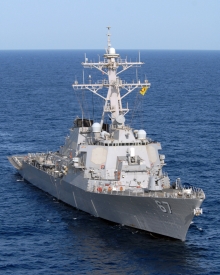
uss-cole.jpg28 and 29 February: the US parks the USS Cole off the shore of Lebanon. Uh-oh.

1 March: Israeli forces launch a major operation into Gaza, killing as many as 60 Palestinians, many of them civilians and children.

Senators Clinton, McCain, and Obama daily wage verbal slugfests on national security, the US’s proper role in the Middle East, and which of them will be best prepared to defend “our strong ally” Israel. OK, business as usual in an election year?

Er, . . . wait a minute.

The timing here ought to be raising antennae here in the US. You can bet that the Arab and Iranian “street” will be taking due note.

The arrival of a US Navy vessel off the coast of Lebanon had to send chills up the spines of many Lebanese. As Roger Morris recently reminded us in his chronicle of the life of Hezbollah “engineer” Imad Mugnieh, the US Navy has pumped shells into Lebanese villages on several occasions (even rolling out a World War II era battleship, the USS New Jersey, on one occasion to use its huge shells to get maximum killing and intimidation effect on the unfortunate villagers on whom they rained down ). That was in the context of the Lebanese civil war of 1975-1990, which featured ongoing deadly scrums involving the IDF, the PLO, and various Lebanese militias – Christian and Muslim, including the newly established Hezbollah. In the summer of 2006, Israel and Hezbollah got into it again, with horrific toll in life and infrastructure (especially on the Lebanese side) while US Secretary of State Condoleeza Rice, as a rather ghoulish birthing coach, urged on the IDF during what she then called the “birth pangs of a new Middle East.” Now, in March 2008, the Lebanese government is mired in a parliamentary impasse, unable to elect a new president. Not yet a full-fledged civil war in Lebanon, but the US Navy lies offshore again, this time, we’re told, to signal to Hezbollah (which is now a legitimately constituted, democratically elected political party in Lebanon’s political structure) that the US will tolerate no stronger interference from them (or from Syria or Hezbollah’s ally and patron, Iran) as Lebanon’s struggles continue.

Yet the very next day, the IDF launched its deadly raid into Gaza, knowing that Hamas forces would resist with whatever means they could muster but would be ultimately powerless to change the outcome. Might they assume (dare we say, hope?) that Hezbollah and Iran might find this an unacceptable provocation and wish to retaliate against Israel? Except that – gosh, wouldn’t you know it? – the US Navy is parked right offshore. And wouldn’t you know it? It’s the USS Cole, the same USS Cole in whose side an al-Qaeda suicide boat blew a hole in those distant days before 9-11. The irony is palpable – indeed, dare we say, intended? Certainly, from the US perspective, delicious.

So, with the US looming in the wings, Israel can do what it wants to in Gaza. And if Hezbollah (and, by implication, Iran) decide not to respond to Israel’s wanton holocaust of innocent Palestinians in Gaza (whose lives had already been made miserable by Israel’s US-approved blockade), they run the risk of accusations of cowardice in the face of the Zionist bullies. If they were to rise to the bait and retaliate, they run the risk of the bullies turning against them and trying to flatten them. Israeli prime minister Olmert will jump at the chance to atone for the disaster of the summer 2006 war, and George Bush may get the military confrontation with Iran that he well may have been hoping for all along.

And all the while, our senator-candidates must intone their often rehearsed mantra, “Israel has the right to defend itself against the terrorists.” The US Navy offshore, the US presidential candidates cowed by political realities in an election season — how much better cover could the bully have?

John Robertson is a professor of Middle East history at Central Michigan University and has his own blog, Chippshots.

Editor’s Comment — It’s worth recalling that less than two weeks before the beginning of the 2006 Lebanon War, Israel was in the middle of pounding Gaza in what Mahmoud Abbas described as an “unacceptable and barbaric collective punishment of civilians, including women, children and old people.”

Facebooktwittermail

NEWS & ANALYSIS: Iran’s permanent security headache and frail economy

Iran tries to make up lost ground

The conventional wisdom, particularly in the United States, is that Iran has gained from the US’s invasion of Iran’s neighbors since the events of September 11, 2001. Yet, a careful reading of the changing security calculus caused by the exponential increase in the US’s military presence in Iran’s vicinity leads to the opposite conclusion.

Sure, Iran has gained from the fall of the Taliban in Afghanistan and Saddam Hussein and his dreaded Sunni Ba’athist regime in Iraq, yet the problem with the standard analyses, for example by the US’s ambassador to the United Nations, Zalmay Khalilzad, is that even though they are couched in the language of “balance of power”, nonetheless these analyses are tainted by a major gap. That is, forgetting the US superpower’s role in the equation that, on balance, has tipped the scales away from Iran, in a word, amounting to a net loss for the country.

Until now, no one in the US has questioned what has become an article of faith in the US media and a kind of self-evident truth to so many US politicians, such as former secretary of state Henry Kissinger and former national security advisor Zbigniew Brzezinski. [complete article]

A frail economy raises pressure on Iran’s rulers

In one of the coldest winters Iranians have experienced in recent memory, the government is failing to provide natural gas to tens of thousands of people across the country, leaving some for days or even weeks with no heat at all. Here in the capital, rolling blackouts every night for a month have left people without electricity, and heat, for hours at a time.

The heating crisis in this oil-exporting nation is adding to Iranians’ increasing awareness of the contrast between their growing influence abroad and frailty at home, according to government officials, diplomats and political analysts interviewed here.

From fundamentalists to reformists, people here are talking more loudly about the need for a more pragmatic approach, one that tones down the anti-Western rhetoric, at least a bit, and focuses more on improving management of the country and restoring Iran’s economic health. [complete article]

Facebooktwittermail

ANALYSIS: Iran stays one step ahead

Race for sanctions on Iran speeds up

The next Iran report by the head of the International Atomic Energy Agency (IAEA) is due in early March, and even though Tehran has fully cooperated and there is no evidence of military diversion from its peaceful nuclear activities, the United Nations is about to impose severe new sanctions on Iran, deemed “punitive” by a US government spokesperson.

According to Iranian Foreign Minister Manouchehr Mottaki, the proposed third round of sanctions is really about “escaping answers to world public opinion” because the US and its allies “are worried about the agency report”. Mottaki has hinted at compromise and Iran’s willingness to show greater flexibility in nuclear negotiations, by calling on the US to “couch whatever it has to say in the Five plus One framework”. This refers to the US, Britain, France, Russia and China plus Germany, which have been debating Iran’s case. [complete article]

White House criticizes envoy over Iran

White House officials expressed anger on Tuesday about an appearance in which the United States ambassador to the United Nations, Zalmay Khalilzad, sat beside the Iranian foreign minister at a panel of the World Economic Forum in Davos, Switzerland, on Saturday.

The United States does not have diplomatic relations with Iran, and the Bush administration has limited its official high-level dealings with Iran to discussions about Iraq, primarily in Baghdad. Administration officials said that Mr. Khalilzad’s appearance beside Foreign Minister Manouchehr Mottaki in Davos at a panel on Iranian foreign policy surprised senior Bush administration officials, who became aware that Mr. Khalilzad had appeared with Mr. Mottaki only when a video of the discussion appeared on YouTube on Tuesday. [complete article]

A China base in Iran?

In the aftermath of President George W Bush’s recent tour of the Persian Gulf, coinciding with a similar trip by France’s President Nicolas Sarkozy, culminating in a deal with the United Arab Emirates (UAE) for a small French base, Iran’s security calculus has changed. It has almost reached the point of Tehran considering the option of reciprocating the perceived excess Western intrusion into its vicinity by allowing a military base for China at one of Iran’s Persian Gulf ports or on one of its islands. [complete article]

Facebooktwittermail