Category Archives: Iran

NEWS & EDITOR’S COMMENT: Israel can live with a nuclear Iran

Israel’s foreign minister: Iran nukes pose little threat to Israel

Foreign Minister Tzipi Livni said a few months ago in a series of closed discussions that in her opinion that Iranian nuclear weapons do not pose an existential threat to Israel, Haaretz magazine reveals in an article on Livni to be published Friday.

Livni also criticized the exaggerated use that Prime Minister Ehud Olmert is making of the issue of the Iranian bomb, claiming that he is attempting to rally the public around him by playing on its most basic fears. Last week, former Mossad chief Ephraim Halevy said similar things about Iran. [complete article]

Editor’s Comment — While George Bush warns the world that Iran’s pursuit of nuclear weapons could lead to World War III, Israel’s foreign minister says, behind closed doors — in other words in a situation where she means what she says — that Iranian nuclear weapons would not pose an existential threat to Israel.

This should be banner headline news. The Washington press corp should be hounding administration officials, demanding an explanation for this utterly glaring clash of perspectives. Instead, what do we get? Silence.

This is what things have come down to: We live in a state where the dissemination of information is controlled much more efficiently than it was in the Soviet Union. At least the Russians understood they were being lied to. Most Americans, on the other hand, are completely ignorant of the incestuous relationship between the press and the government. In this system shaped by unspoken agreements, there is no need for some clumsy Ministry of Information. All the managing editors of the major outlets can be relied upon to shape their products (within an acceptable latitude) in alignment with political and commercial power — even when that means that they knowingly makes themselves instruments of an altogether avoidable disaster. They will plead that they are merely messengers, yet they are no less culpable than the lunatics in political office. They choose what to report and what to ignore.

(Note: As of 10.00GMT 10/26/07, the Haaretz magazine article referred to above has not appeared. If/when it is posted (it might only be available in print), it should appear here.)

Facebooktwittermail

NEWS: Bush and Cheney drive up oil prices

Strike on Iran would roil oil markets, experts say

A U.S. military strike against Iran would have dire consequences in petroleum markets, say a variety of oil industry experts, many of whom think the prospect of pandemonium in those markets makes U.S. military action unlikely despite escalating economic sanctions imposed by the Bush administration.

The small amount of excess oil production capacity worldwide would provide an insufficient cushion if armed conflict disrupted supplies, oil experts say, and petroleum prices would skyrocket. Moreover, a wounded or angry Iran could easily retaliate against oil facilities from southern Iraq to the Strait of Hormuz.

Oil prices closed at a record $90.46 a barrel in New York yesterday as the Bush administration tightened U.S. financial sanctions on Iran over its alleged support for terrorism and issued new warnings about Tehran’s nuclear program. Tension between Turkey and Kurds in northern Iraq, and fresh doubts about OPEC output levels also helped drive the price of oil up $3.36 a barrel, or 3.8 percent. [complete article]

Facebooktwittermail

NEWS, ANALYSIS & EDITOR’S COMMENT: Targeting Iran

Attack Iran and you attack Russia

The apparent internal controversy on how exactly Putin and the Supreme Leader are on the same wavelength belies a serious rift in the higher spheres of the Islamic Republic. The replacement of Larijani, a realist hawk, by Jalili, an unknown quantity with an even more hawkish background, might spell an Ahmadinejad victory. It’s not that simple.

The powerful Ali Akbar Velayati, the diplomatic adviser to the Supreme Leader, said he didn’t like the replacement one bit. Even worse: regarding the appalling record of the Ahmadinejad presidency when it comes to the economy, all-out criticism is now the norm. Another former nuclear negotiator, Hassan Rowhani, told the Etemad-e Melli newspaper, “The effects of the [UN] sanctions are visible. Our situation gets worse day by day.”

Ahmadinejad for the past two months has been placing his former IRGC brothers-in-arms in key posts, like the presidency of the central bank and the Oil, Industry and Interior ministries. Internal repression is rife. On Sunday, hundreds of students protested at the Amir-Kabir University in Tehran, calling for “Death to the dictator”.

The wily, ultimate pragmatist Hashemi Rafsanjani, now leader of the Council of Experts and in practice a much more powerful figure than Ahmadinejad, took no time to publicly reflect that “we can’t bend people’s thoughts with dictatorial regimes”. [complete article]

Editor’s Comment — A possibility that doesn’t seem to fit into Washington’s calculations is that Ahmadinejad may go faster than they expect or would even want. Faced then with a more pragmatic Iranian government which may at the same time be just as unwilling to bow to American demands, Iran could score some major victories in the international arena, leaving the neocon rhinos with nothing more than can do than snort and kick up dust. (Semantic note: It’s time to stop applying the hawk metaphor to the Cheney gang. Hawks have excellent sight, superb flying skills and know how to launch a precision strike with perfect timing. Dick Cheney and Norman Podhoretz are not hawks.)

U.S. imposes new sanctions against Iran

The Bush administration announced an unprecedented package of unilateral sanctions against Iran today, including the long-awaited designations of its Revolutionary Guard Corps as a proliferator of weapons of mass destruction and of the elite Quds Force as a supporter of terrorism.

The package, announced jointly by Secretary of State Condoleezza Rice and Treasury Secretary Henry M. Paulson Jr., marks the first time that the United States has tried to isolate or punish another country’s military. It is the broadest set of punitive measures imposed on Tehran since the 1979 takeover of the U.S. Embassy, and included a call for other countries and firms to stop doing business with three major Iranian banks.

The sanctions recognize that financing for groups like the Revolutionary Guard have become closely entwined with Iran’s economy, making it difficult to disrupt the one without targeting the other. [complete article]

Bomb Iran? U.S. requests bunker-buster bombs

Tucked inside the White House’s $196 billion emergency funding request for the wars in Iraq and Afghanistan is an item that has some people wondering whether the administration is preparing for military action against Iran.

The item: $88 million to modify B-2 stealth bombers so they can carry a newly developed 30,000-pound bomb called the massive ordnance penetrator, or, in military-speak, the MOP.

The MOP is the the military’s largest conventional bomb, a super “bunker-buster” capable of destroying hardened targets deep underground. The one-line explanation for the request said it is in response to “an urgent operational need from theater commanders.” [complete article]

Iran becomes an issue in Democratic contest

Edwards, who, like Clinton, supported the 2002 Iraq war resolution, said she failed to learn a lesson from that episode. “I think it’s an enormous mistake to give George Bush the first step in the authority to move militarily on Iran,” Edwards said in a telephone interview from Iowa yesterday. “My view is that the resolution on the Iranian Revolutionary Guard did that.”

Biden, in a session with Washington Post editors and reporters yesterday, said labeling the IRGC as a terrorist group was a “serious, serious mistake” because it could force the United States to back up the designation with action. “Big nations can’t bluff,” he said.

Clinton has been steadfast in her contention that the amendment to the defense authorization bill was not a vote for war but, instead, a call for robust diplomatic action to deal with Iran. “I oppose any rush to war but also believe doing nothing is not acceptable — diplomacy is the right path,” she said in her campaign mailer. [complete article]

Facebooktwittermail

NEWS: Iran’s policy of nuclear ambiguity

Iran has new nuclear negotiator, but similar stance

Iran’s new chief nuclear negotiator made his international debut in Rome on Tuesday, to a chorus of unusually blunt criticism by politicians in Tehran that the departure of his predecessor was unwise.

Saeed Jalili, the negotiator, met with the European Union foreign policy chief, Javier Solana, who has been asked by the United States, Russia, China, Britain, France and Germany to find a formula to persuade Iran to suspend key nuclear activities.

Curiously, at Mr. Jalili’s side was Ali Larijani, his predecessor, who took the lead in the closed-door talks and in remarks afterward to reporters.

Mr. Solana described the talks as “constructive,” and Mr. Larijani called them “good.” But there was no movement on the one issue that matters, said participants in the meeting who spoke under normal diplomatic rules: Iran’s refusal to suspend uranium enrichment as required by the United Nations Security Council. [complete article]

Facebooktwittermail

NEWS & EDITOR’S COMMENT: The ambiguous missile threat

Administration diverges on missile defense

President Bush said yesterday that a missile defense system is urgently needed in Europe to guard against a possible attack on U.S. allies by Iran, while Defense Secretary Robert M. Gates suggested that the United States could delay activating such a system until there is “definitive proof” of such a threat.

The seemingly contrasting messages came as the Bush administration grappled with continuing Russian protests over Washington’s plan to deploy elements of a missile defense system in Eastern Europe. The Kremlin considers the program a potential threat to its own nuclear deterrent and has sought to play down any threat from Iran. [complete article]

Editor’s Comment — It’s always struck me as odd and transparently contradictory for the Bush administration to push the line that missile defense is essential for protection against Iran and at the same time to assert that Iran will never be allowed to develop nuclear weapons. But it now sounds like Gates is trying to inject an element of rationality into the equation — no doubt Bush and Cheney will regard his suggestion — that their policies should be commanded by reason — as an act of subordination.

Facebooktwittermail

ANALYSIS: The faultlines in Iranian power

Iran rocks its nuclear boat

Various commentators, especially in Europe and the United States, have been quick in interpreting Larijani’s resignation as a “bad omen” reflecting a triumph for hardliners led by Ahmadinejad. But that is simplistic and ignores a more complex reality in the Iran’s state affairs. The quest for greater centralization of nuclear decision-making has met a contradictory response in, on the one hand, the move for more direct input by Khamenei, and, on the other hand, a parallel effort by Ahmadinejad to gain greater control of decision-making.

Regarding the former, in the aftermath of Russian President Vladimir Putin’s recent Tehran visit, where he submitted a nuclear proposal not to his equal, Ahmadinejad, but rather to Khamenei [1] , thus belittling Iran’s president, Khamenei has reportedly held a meeting with all top officials of the regime and informed them for the first time that an American military attack on Iran is “a possibility” that “should be taken seriously”.

Khamenei has reportedly promised Putin to “study and consider” his proposal. Confusingly, though, while Larijani has announced that Putin did pass on a proposal for resolving the nuclear standoff, Ahmadinejad has insisted that Putin did not present any such proposal and limited himself to the expansion of bilateral and multilateral relations. [complete article]

Facebooktwittermail

NEWS: Kurds fighting on two fronts

In Iraq, conflict on a second Kurdish front

Deadly raids into Turkey by Kurdish militants holed up in northern Iraq are the focus of urgent diplomacy, with Turkey threatening invasion of Iraq and the United States begging for restraint while expressing solidarity with Turkish anger.

Yet out of the public eye, a chillingly similar battle has been under way on the Iraqi border with Iran. Kurdish guerrillas ambush and kill Iranian forces and retreat to their hide-outs in Iraq. The Americans offer Iran little sympathy. Tehran even says Washington aids the Iranian guerrillas, a charge the United States denies. True or not, that conflict, like the Turkish one, has explosive potential. [complete article]

Bush administration urges Iraqi Kurds to help end raids into Turkey

Scrambling to forestall a threatened Turkish retaliatory attack in northern Iraq, the Bush administration pressed Iraq’s Kurdish leaders on Monday to rein in the Kurdish group whose raids into Turkey have heightened tensions along the border.

But American officials acknowledged that neither the United States nor Iraq had done much recently to constrain the Kurdish group, known as the Kurdish Workers’ Party, or the P.K.K. Current and former Bush administration officials said a special envoy appointed by the Bush administration in 2006, Gen. Joseph W. Ralston, who had retired from the military after serving as NATO’s supreme allied commander, had recently stepped down in frustration over Iraqi and American inaction.

The United States lists the P.K.K. as a terrorist organization, but American military commanders in Baghdad have long resisted calls by Turkey to devote American military resources to going after the group in mountainous northern Iraq. The commanders say they have barely enough troops to deal with the insurgency in Iraq, so using them to contain the P.K.K. has never been a serious option. [complete article]

Facebooktwittermail

ANALYSIS: Larijani’s shock departure

Ali Larijani resigns

Ali Larijani, Iran’s chief nuclear negotiator and the secretary of the Supreme National Security Council, has resigned. This is a big deal!

The fact that Larijani had threatened to resign several times was an open secret in Iran; a fact that was even acknowledged by the government spokesman, Gholam-hossein Elham, in his announcement of Larijani’s resignation (Al Jazeera has good round up of some of Larijani’s conflicts with Ahmadinejad).

What is surprising is Ayatollah Khamenei’s agreement to this resignation and the reported replacement of Larijani by Saeed Jalili, a deputy foreign minister for European affairs who actually has very little diplomatic experience (Jalili’s experience at the foreign Ministry prior to being assigned as deputy minister by Ahmadinejad was in personnel matters). What Jalili does have is a very close relationship with Ahmadinejad. As such, the move, if it is confirmed, reflects yet another enhancement of Ahmadinejad’s fortunes in Iranian politics.

So far the Iranian system seems to be in a state of shock. Larijani was considered a successful handler of the Iranian nuclear file and his agreement with the IAEA regarding a work plan to resolve the remaining outstanding issues over Iran’s nuclear program an important step forward. [complete article]

Facebooktwittermail

NEWS: Iraqi contracts with Iran and China concern U.S.; Putin pledges to complete Iranian nuclear reactor

Iraqi contracts with Iran and China concern U.S.

Iraq has agreed to award $1.1 billion in contracts to Iranian and Chinese companies to build a pair of enormous power plants, the Iraqi electricity minister said Tuesday. Word of the project prompted serious concerns among American military officials, who fear that Iranian commercial investments can mask military activities at a time of heightened tension with Iran.

The Iraqi electricity minister, Karim Wahid, said that the Iranian project would be built in Sadr City, a Shiite enclave in Baghdad that is controlled by followers of the anti-American cleric Moktada al-Sadr. He added that Iran had also agreed to provide cheap electricity from its own grid to southern Iraq, and to build a large power plant essentially free of charge in an area between the two southern Shiite holy cities of Karbala and Najaf.

The expansion of ties between Iraq and Iran comes as the United States and Iran clash on nuclear issues and about what American officials have repeatedly said is Iranian support for armed groups in Iraq. American officials have charged that Iranians, through the international military wing known as the Quds Force, are particularly active in support of elite elements of the Mahdi Army, a militia largely controlled by Mr. Sadr. [complete article]

Vladimir Putin pledges to complete Iranian nuclear reactor

President Putin forged an alliance with Iran yesterday against any military action by the West and pledged to complete the controversial Iranian nuclear power plant at Bushehr.

A summit of Caspian Sea nations in Tehran agreed to bar foreign states from using their territory for military strikes against a member country. Mr Putin, the first Kremlin leader to visit Iran since the Second World War, insisted that the use of force was unacceptable.

“It is important… that we not only not use any kind of force but also do not even think about the possibility of using force,” he told the leaders of Iran, Azerbaijan, Kazakhstan and Turkmenistan. [complete article]

Putin calls war in Iraq ‘pointless’

President Vladimir Putin, in his latest jab at Washington, suggested Thursday that the U.S. military campaign in Iraq was a ”pointless” battle against the Iraqi people, aimed in part at seizing the country’s oil reserves.

Putin has increasingly confronted U.S. foreign policy in recent months, deepening the chill between Washington and Moscow. Among other things, he has questioned U.S. plans for a missile defense system in Europe and the U.S. push for sanctions against Iran for its nuclear programs. [complete article]

Olmert urges Putin to back new Iran sanctions

Prime Minister Ehud Olmert met Tuesday with President Vladimir Putin, pressing Moscow to support new sanctions on Tehran over its nuclear activities and urging Russia not to sell arms to Iran or Syria.

Hosting Olmert for a brief, abruptly announced visit, Putin promised to brief the Israeli leader on his talks with Iranian leaders this week and acknowledged his guest’s dismay over Tehran’s nuclear program, which Israel and the United States say is aimed at developing atomic weapons. [complete article]

Facebooktwittermail

NEWS & ANALYSIS: Iran and its neighbors

Caspian summit a triumph for Iran

Few regional summits have drawn closer attention, by both the media and world governments, than this week’s summit of leaders of Caspian littoral states in Tehran.

The two day summit, coinciding with twin nuclear crises and escalating US-Iran tensions relating to Iraq and the Middle East, is bound to be regarded as a milestone in regional cooperation, with serious ramifications for a broad array of issues transcending the Caspian Sea region.

Billed as a “great leap toward progress” by Mehdi Safari, Iran’s Deputy Foreign Minister in charge of Iran’s Caspian affairs, the summit has been a great success for Iran as well as Russia and the other participants (Azerbaijan, Kazakhstan and Turkmenistan), and Tehran is likely to capitalize on it as a stepping stone for full membership of the Shanghai Cooperation Organization (SCO), considered a security counterweight to NATO and US “hegemony”. [complete article]

Putin stands by Iran

Russian President Vladimir V. Putin, appearing side by side with his Iranian counterpart at a five-nation summit here Tuesday, made a powerful show of support for America’s regional archenemy, drawing the line against any attack on Iran and reaffirming Tehran’s right to a civilian nuclear program.

At the same time, Putin stopped short of unconditional support for the Iranian regime, although the tenor of his remarks appeared at odds with earlier suggestions from the Bush administration that Putin might take a more pro-Western stance. [complete article]

Facebooktwittermail

ANALYSIS: The sparks of a conflagration

Ticking clocks and ‘accidental’ war

Whilst Washington looks at the Iranian prospects through the prism of a binary, to bomb or to acquiesce decision, facing President Bush over the remainder of his presidency, the actors in the region see the conflict as imminent and arriving in a roundabout way, through the backdoor – either via escalation of Western and Israeli tension with Syria; or from events in Lebanon, or a combination of both interacting with each other. All these key actors are convinced that conflict, should it occur, will convulse the entire region. They see the Wursmer ‘engineered’ war that ultimately will extend to Iran, as almost upon them; and they wonder at the silence from Europe and from informed observers in the US. Is it, they speculate, that everyone is so focused on Iraq, and so convinced that Iraq will be the arena in which the decision on Iran will be shaped, that they have forgotten to attend to the backdoor that David Wurmser (until last month Dick Cheney’s Middle East adviser) already has a foot around? [complete article]

Facebooktwittermail

NEWS: It takes a liar to spot a liar

Rice cites ‘lying’ by Iran about nuclear program

Secretary of State Condoleezza Rice took issue Thursday with Russian President Vladimir Putin’s statement that there is no evidence Iran is trying to build nuclear weapons, asserting that Tehran has prevaricated about its nuclear activities. At the same time, she held out hope that the White House and the Kremlin might bridge their differences over U.S. plans to deploy a missile defense system in the heart of Eastern Europe.

“There’s an Iranian history of obfuscation and indeed lying” to international nuclear inspectors, Rice told reporters traveling on the plane with her to Moscow for meetings with Putin and other officials. “There’s a history of Iran not answering important questions about what is going on. And there is Iran pursuing nuclear technologies that can lead to nuclear weapons-grade material.” [complete article]

The IAEA escape route

following intense negotiations, the International Atomic Energy Agency (IAEA) announced in late August a new work plan reached with Iran, aimed at resolving all outstanding issues in Iran’s nuclear file by the end of the year.

The agreement was branded as “a significant step forward” by the Agency’s Director General, Dr Mohamed El-Baradei. It was also hailed as a move in the right direction by most of the 118 nations of the Non-Aligned Movement who have consistently recognised Iran’s right to a nuclear energy program. [complete article]

Facebooktwittermail

FEATURE: Bush administration strengths the regime they oppose

Meddling aggressively in Iran

Covert action to undermine the Tehran regime has already been under way intermittently for the past decade. Until now, however, the CIA has operated without a finding (authorisation for covert action) by using proxies. Pakistan and Israel, for example, provide weapons and money to insurgent groups in southeast and northwest Iran, where the Baluch and Kurdish ethnic minorities, both Sunni Muslim, have long fought against the repression of Shia-dominated Persian regimes.

The presidential finding [in April] was necessary to permit accelerated non-lethal activities by US agencies. Besides expanded propaganda broadcasts, a media disinformation campaign and the use of US and European-based Iranian exiles to promote political dissent, the programme focuses on economic warfare, especially currency rate manipulation and the disruption of Iran’s international banking and trade.

Although the finding was nominally secret, it did not stay secret for long after it was reported to the House and Senate Intelligence Committees, as required by law.

On a recent visit to Tehran, everyone was talking about it, and both conservatives and reformers agreed that it came at an unusually damaging moment of genuine opportunity for cooperation with the United States in Iraq and Afghanistan. Senior officials in the foreign ministry, the National Security Council, the office of President Mahmoud Ahmadinejad, and pro-government think tanks all said that stability in Iraq and Afghanistan is in Iran’s interest. Cooperation with the US is possible, they said, but only in return for a gradual accommodation between Washington and Tehran, starting with a complete cessation of covert and overt regime change policies.

“The United States is like a fox caught in a trap in Iraq,” said Amir Mohiebian, editor of the conservative daily Reselaat. “Why should we free the fox so he can eat us? Of course, if the US changes its policy, there is scope for cooperation.” [complete article]

Facebooktwittermail

NEWS: Democracy cannot be imported

Cut Iran democracy funding, groups tell U.S.

More than two dozen Iranian American and human rights groups have launched an appeal to Congress to reduce or eliminate new financial support of up to $75 million aimed at promoting democracy inside Iran.

The U.S. program, launched in 2006, backfired in its first year, undermining democracy efforts in Iran and leading to wider repression against activists as foreign agents or traitors, the groups said. Among those detained were four Iranian Americans, all charged with “crimes against national security” linked to the U.S. program. A second year of funding will further endanger democracy efforts, the groups added.

“Iranian reformers believe democracy cannot be imported and must be based on indigenous institutions and values. Intended beneficiaries of the funding — human rights advocates, civil society activists and others — uniformly denounce the program,” according to an open letter organized by the National Iranian American Council, the American Conservative Defense Alliance and the Center for Arms Control and Non-Proliferation. The letter was signed by 23 other liberal and conservative pro-democracy groups. [complete article]

Facebooktwittermail

ANALYSIS & EDITOR’S COMMENT: Iran – Israel’s enemy of convenience

Iran, the inflatable bogey

If Iran is, as Netanyahu and his allies in the U.S. suggest, irrationally aggressive, prone to a suicidal desire for apocalyptic confrontation, then both diplomacy and deterrence and containment are ruled out as policy options for Washington. The “Mad Mullahs,” as the neocons call them, are not capable of traditional balance of power realism. In the arguments of Netanyahu and such fellow travelers as Norman Podhortez and Newt Gingrich, to imagine that war against the regime in Tehran is avoidable is to be as naïve as Chamberlain was in 1938.

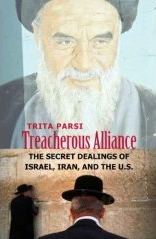
treaterousalliance.jpgHowever, as I discovered in the course of researching my book Treacherous Alliance – the Secret Dealings of Israel, Iran and the United States, not only does Netanyahu’s characterization of Iran have little relationship to reality; Netanyahu himself knows this better than most. Outside of the realm of cynical posturing by politicians, most Israeli strategists recognize that Iran represents a strategic challenge to the favorable balance of power enjoyed by Israel and the U.S. in the Middle East over the past 15 years, but it is no existential threat to the Israel, the U.S. or the Arab regimes.

And that was the view embraced by the Likud leader himself during his last term as prime minister of Israel. In the course of dozens of interviews with key players in the Israeli strategic establishment, a fascinating picture emerged of Netanyahu strongly pushing back against the orthodoxy of his Labor Party predecessors, Yitzhak Rabin and Shimon Peres, which treated Iran as one of Israel’s primary enemies. Not only that, he initiated an extensive discreet program of reaching out to the Islamic Republic. [complete article]

Editor’s Comment — Without wanting to understate Israel’s capacity for irrational behavior, it’s worth asking whether for the Israeli right there is one issue to which all others are subordinate. I would say that there is and that it is the consolidation of the territorial expansion that Israel has been engaged in for the last 40 years through building settlements in the West Bank. Even today, The Guardian reports on yet more seizure of Palestinian land that will allow a huge expansion of settlements. The greatest threat to this ongoing expansionist enterprise would come from the revival of the long-stalled peace process. The relentless construction of settlements, the construction of an apartheid road system separating Israeli and Palestinian traffic, and the construction of the so-called security barrier — these are all ways of making it clear, declarations to the contrary notwithstanding, that Israel has no intention of withdrawing to the 1967 borders.

And how does Iran fit into this equation? It presents a useful diversion through which in the shadow of a supposed existential threat, the development of the West Bank can continue all the way to the end of a window of opportunity — otherwise known as the Bush administration.

While Netanyahu’s neoconservative supporters in Washington can’t wait to see the bombs rain down on Iran, my suspicion (and it’s nothing more than that) is that Bibi will play the 1938 rhetoric for all it’s worth even while the prospect of a nuclear-armed Iran doesn’t cause him to loose a wink of sleep. Indeed, a silver-lining for Israel from a nuclear Iran is that that would provide the Jewish state with the perfect opportunity to come out of its own nuclear closet. It could claim that it was remaining true to its assertion that it would not have been the first state to “introduce” nuclear weapons to the region even if it was the first to deploy them — it simply didn’t make a fanfair about the fact; there was no declaration, no introduction. And with the balance of power having shifted towards Iran, the Israel lobby in Washington would have an easy time sustaining the United States’ financial commitment to Israel’s defense into perpetuity.

Having said that, a line that’s almost as popular as Netanyahu’s “1938”, is John McCain’s, “There is only one thing worse than the United States exercising a military option, that is a nuclear armed Iran.” The question thus remains, does the US and/or Israel truly believe that in such an attack the benefits outweigh the risks?

If Israel’s recent incursion into Syrian airspace was really as momentous an event as all the neocon chest-thumping would suggest, how come we still don’t know what happened? What might have been seen as a muscle-flexing exercise directed at Iran, at this point looks more like a very cautious dip of one toe in some icy water. While its success as a PR exercise is beyond question, its military significance remains in doubt.

And while the Iran-baiting rhetoric coming from American officials in Iraq has been escalating for months and months, it remains possible that the threshold will never be crossed from words to war. Everyone is playing an extremely dangerous game, yet the contest between those competing for the title, “master of destiny,” is a struggle between men, not one of whom has a clear view of the future.

Facebooktwittermail

NEWS & EDITOR’S COMMENT: The longer this goes on, the less we know

An Israeli strike on Syria kindles debate in the U.S

It has long been known that North Korean scientists have aided Damascus in developing sophisticated ballistic missile technology, and there appears to be little debate that North Koreans frequently visited a site in the Syrian desert that Israeli jets attacked Sept. 6. Where officials disagree is whether the accumulated evidence points to a Syrian nuclear program that poses a significant threat to the Middle East.

Mr. Cheney and his allies have expressed unease at the decision last week by President Bush and Ms. Rice to proceed with an agreement to supply North Korea with economic aid in return for the North’s disabling its nuclear reactor. Those officials argued that the Israeli intelligence demonstrates that North Korea cannot be trusted. They also argue that the United States should be prepared to scuttle the agreement unless North Korea admits to its dealing with the Syrians.

During a breakfast meeting on Oct. 2 at the White House, Ms. Rice and her chief North Korea negotiator, Christopher R. Hill, made the case to President Bush that the United States faced a choice: to continue with the nuclear pact with North Korea as a way to bring the secretive country back into the diplomatic fold and give it the incentive to stop proliferating nuclear material; or to return to the administration’s previous strategy of isolation, which detractors say left North Korea to its own devices and led it to test a nuclear device last October.

Mr. Cheney and Stephen J. Hadley, the national security adviser, also attended the meeting, administration officials said.

The Israeli strike occurred at a particularly delicate time for American diplomatic efforts. In addition to the North Korean nuclear negotiations, the White House is also trying to engineer a regional Middle East peace conference that would work toward a comprehensive peace accord between Arabs and Israelis.

The current and former American officials said Israel presented the United States with intelligence over the summer about what it described as nuclear activity in Syria. Officials have said Israel told the White House shortly in advance of the September raid that it was prepared to carry it out, but it is not clear whether the White House took a position then about whether the attack was justified. [complete article]

Editor’s Comment — Never has a story been told at such length while revealing so little.

Ever since this story broke, among the neocons, the engine that has kept it running is this bizarre proposition: the unprecedented Israeli veil of secrecy concerning the nature of its target is what “proves” that the target was so significant. But on the contrary, what the secrecy has done is create on open field for speculation ranging from this being a “dry run” in preparation for an attack on Iran (though since that would have undermined the element of surprise, a bit of Iran-directed saber rattling is more plausible); a demonstration of Israel’s ability to disable Syria’s air defenses (though it’s hard to understand why, if they could do this, Israel would want to publicize the fact and thereby give their adversaries a heads-up); and of course, an attack on a “nuclear facility.” And whereas last month it was being reported that Israeli commandos had gathered “samples” at the site providing forensic evidence of the connection to North Korea (North Korean mud off a North Korean boot?), we’re now told that “officials disagree … whether the accumulated evidence points to a Syrian nuclear program that poses a significant threat to the Middle East.” Strip away New York Times waffle, and that can be read as, there is no clear evidence that there is anything qualified to be called a Syrian nuclear program.

When it comes to the known facts, at this point we don’t actually know for a fact that Israel did anything more than penetrate Syrian air space. One of the few journalists who has actually attempted to report this story by visiting the location of the “strike” was told by locals that they heard sonic booms but no explosions.

How many more weeks do we have to wait before the neocon rumor mill runs out of steam and we can conclude what could have been assumed well before now: the reason the veil of secrecy has been held down so tight is because there’s nothing behind it!

As for my own theory about what happened, it is this: Israel’s new defense minister and would-be future prime minister, Ehud Barak, wanted to demonstrate that he’s a man of action who can restore Israel’s military pride after last year’s disastrous performance in Lebanon. The “strike” was a fake act of war in which the IAF gambled that Syria would not rise to the bait. The absolute secrecy was intended to hide this risky charade. Instead it provided an open season for neocon rumormongering about North Korea, Iran, the State Department and any other conceivable target of opportunity.

Facebooktwittermail

NEWS & ANALYSIS: Iran and the mirage of dictatorship

Iran terror label bites deep

In the aftermath of the US House of Representatives’ recent resolution branding the Iranian Revolutionary Guards Corps (IRGC) as terrorist, the White House is reportedly poised to formally place it on the terrorist list of the US State Department, with ramifications to follow, such as a freeze on the IRGC’s assets wherever the US can get its hands on them.

This is considered a small victory by anti-Iran hawks, who know the important side-effects of this initiative in inching the US closer to war against Iran. Veteran investigative reporter Seymour Hersh, meanwhile, has written about a “policy shift” in Washington. This involves a thirst for confrontation with Iran less on the grounds of Iran’s nuclear program and more as a result of the situation in Iraq, where Iran has gained substantial influence, to the detriment of US-led coalition forces.

Justifying the anti-IRGC resolution in the name of an attempt to protect US soldiers, various lawmakers, such as Senator Joe Lieberman and Congresman Tom Lantos have accused the IRGC of supporting terrorists in Iraq, Afghanistan, Lebanon and the Israeli-occupied territories. They dismiss the small yet loud dissent by fellow legislators, such as Senator Chuck Hagel and Congressman Dennis Kucinich, that this is a misguided initiative that could increase the possibility of war with Iran. [complete article]

See also, Iran says US too tied up to fight (BBC).

The myth of the all-powerful Ahmadinejad

In the wake of Mahmoud Ahmadinejad’s much-publicized visit to New York, we are hearing renewed calls for a “tough on Iran” agenda. But before Washington makes policy on the basis of his bizarre and often offensive statements, they should consider one important fact: his actual authority as Iranian president is very limited. Contrary to the assertions of Columbia President Lee Bollinger last week, Ahmadinejad is no “petty and cruel dictator.” He is an elected president with very little power, frequently at odds with the country’s religious leadership and its parliament. Even if Iran had a nuclear arsenal, which it does not, his finger would not be on the trigger. Ahmadinejad is extremely unpopular for a variety of reasons; if he runs for president again in 2009, he will almost certainly be defeated. He does not command the Iranian armed forces and he does not determine Iranian foreign policy. Far from being a belligerent expansionistic power, the last time Iran attacked a neighbor was in the seventeenth century. [complete article]

Four myths government and media use to scare us about ‘dictators’

We have a basic mythology: Appeasement of dictators leads to war. The historical basis for this narrative is the “appeasement” of Hitler at Munich. It encouraged him to believe the democracies — and the Soviets — were weak and would not oppose him. That led him to attempt more conquests and engulfed us all in the Second World War.

If the other countries had stood up to him right away, the theory goes, he would have backed down. If he hadn’t, they would have gone to war and nipped him in the bud, thereby preventing WWII, the Holocaust, the deaths of 60 million and all the rest of the horrors.

Now we are floating the story that Mahmoud Ahmenajad is a dictator (the new, new Hitler, after Saddam Hussein). If we “appease” him, it will only encourage him and that will engulf us in World War Three.

If we accept the myth as a gospel truth that should guide our political and military lives, and accept that description as true, it makes good sense — it is even necessary — to start another preventive war, like the one in Iraq, to stop him now! Let us examine the facts. [complete article]

Facebooktwittermail

OPINION: Negotiating with Iran

Sanctions won’t stop Tehran

Suppose that the Bush administration abandons its campaign for economic sanctions, tones down talk of war and opens direct negotiations with Iran about its nuclear program. Suppose also that it drops its insistence on the suspension of uranium enrichment as a precondition for dialogue.

Would Iran accept the terms for denuclearization accepted by North Korea in the direct negotiations that led to the Feb. 13 agreement with Pyongyang and that are now being implemented in fits and starts: a no-attack pledge, normalized economic and diplomatic relations, economic aid, and removal from the U.S. list of terrorist states?

Based on a week of high-level discussions in Tehran recently and on previous visits during earlier stages of the nuclear program, my assessment is that Iran would demand much tougher terms, including a freeze of Israel’s Dimona reactor and a ban on the U.S. use of nuclear weapons in the Persian Gulf. [complete article]

Facebooktwittermail