Category Archives: Iran

NEWS: Iran is ready to help the U.S. stabilise Iraq

Iran ready to work with U.S. on Iraq

Iran is ready to help the US stabilise Iraq if Washington presents a timetable for a withdrawal of its troops, Tehran’s top security official said on Sunday.

In an interview with the Financial Times, Ali Larijani, head of the Supreme National Security Council, which answers to Ali Khamenei, the supreme leader, rejected Washington’s accusations that Tehran is providing weapons to Iraqi militias, insisting the trouble with Iraq was that the US administration was pursuing a “dead-end strategy”.

Mr Larijani maintained it was time world powers realised Iran’s nuclear progress could not be reversed and that they should enter into negotiations with Tehran without preconditions. [complete article]

See also, Iran in deal to cut Iraq arms flow (LAT).

Facebooktwittermail

OPINION & EDITOR’S COMMENT: Israel and the world can live with a nuclear Iran

The world can live with a nuclear Iran

In case Bush does decide to attack Iran, it is questionable whether Iran’s large, well-dispersed and well-camouflaged nuclear program can really be knocked out. This is all the more doubtful because, in contrast to the Israeli attacks on Iraq back in 1981 and on Syria three weeks ago, the element of surprise will be lacking. And even if it can be done, whether doing so will serve a useful purpose is also questionable.

Since 1945 hardly one year has gone by in which some voices — mainly American ones concerned about preserving Washington’s monopoly over nuclear weapons to the greatest extent possible — did not decry the terrible consequences that would follow if additional countries went nuclear. So far, not one of those warnings has come true. To the contrary: in every place where nuclear weapons were introduced, large-scale wars between their owners have disappeared.

General John Abizaid, the former commander of United States Central Command, is only the latest in a long list of experts to argue that the world can live with a nuclear Iran. Their views deserve to be carefully considered, lest Ahmadinejad’s fear-driven posturing cause anybody to do something stupid. [complete article]

Editor’s CommentMartin van Creveld, a world-renowned professor of military history at the Hebrew University of Jerusalem, has a habit of being bluntly truthful. This is what he said in an interview earlier this year:

“We are in no danger at all of having an Iranian nuclear weapon dropped on us. We cannot say so too openly, however, because we have a history of using any threat in order to get weapons … thanks to the Iranian threat, we are getting weapons from the U.S. and Germany.”

“Our armed forces are not the 30th strongest in the world, but rather the second or third… We possess several hundred atomic warheads and rockets that can launch them at targets in all directions. Most European capitals are targets of our air force … We have the capability to take the world down with us. And I can assure you that this will happen before Israel goes under.”

Facebooktwittermail

NEWS & ANALYSIS: Iran – an enemy of convenience

Senate urges Bush to declare Iran Guard a terrorist group

The Senate approved a resolution on Wednesday urging the Bush administration to designate Iran’s Islamic Revolutionary Guard Corps as a foreign terrorist organization, and lawmakers briefly set aside partisan differences to approve a measure calling for stepped-up diplomacy to forge a political solution in Iraq.

Since last month, the White House has been weighing whether to declare the Revolutionary Guard Corps a terrorist group or to take a narrower step focusing on only the Guard’s elite Quds Force. Either approach would signal a more confrontational posture by declaring a part of the Iranian military a terrorist operation. [complete article]

The secret dealings of Israel, Iran, and the United States

TRITA PARSI: Israel has for a very long time been a critical factor in America’s formulation of a policy vis-à-vis Iran. But what’s really interesting is that the influence of Israel has gone in completely different directions, if we just go back fifteen years. During the 1980s, in spite of the Iranian Revolution, in spite of Ayatollah Khomeini’s many, many harsh remarks about Israel, far, far worse than what anything Ahmadinejad has said so far, Israel at the time was the country that was lobbying the United States to open up talks with Iran to try to rebuild the US-Iran relations, because of strategic imperatives that Israel had. Israel needed Iran, because it was fearing the Arab world and a potential war with the Arabs.

After 1991, ’92, that’s when you see the real shift in Israeli-Iranian relations, because that’s when the entire geopolitical map of the Middle East is redrawn. The Soviet Union collapses. The last standing army of the Arabs, that of Saddam Hussein, is defeated in the Persian Gulf War. And you have an entirely new security environment in the Middle East, in which the two factors, the Soviets and the Arabs, that had pushed Iran and Israel closer together suddenly evaporate. But as their security environment improves, they also start to realize that they may be ending up in a situation in which they can become potential threats to each other. And that’s when you see how the Israelis shift 180 degrees. Now the Israeli argument was that the United States should not talk to Iran, because there is no such thing as Iranian moderates.

And ever since, the Israelis and the pro-Israel interest in the United States have lobbied to make sure that there is no dialogue or there’s no rapprochement between the United States and Iran. And the Iranians have done similar things. They have undermined every US foreign policy initiative in the Middle East that they feared would be beneficial to Israel. So the real shift in Israeli-Iranian relations come after the Cold War, not with the revolution in 1979. [complete article]

Facebooktwittermail

EDITORIAL: Ahmadinejad’s free speech

Ahmadinejad’s free speech

Mahmoud Ahmadinejad did something yesterday that neither President Bush nor Vice-President Cheney have the courage to do: stand up and speak in front of an unfriendly college audience. How can America’s leaders claim that they are defending freedom when they are so clearly afraid of it?

In the Bush-Cheney lexicon, “free speech” is something that can be confined to a zone out of earshot and out of sight; it is something whose value is cathartic rather than political. They regard free speech as a form of free expression that serves the psychological needs of the individual rather than the political needs of a healthy democracy.

America has over the last six years become infected by this impoverished view of free speech. It is a right that seemingly only benefits those who exercise it, while society merely tolerates its performance. Thus, as he introduced President Ahmadinejad, Columbia president Lee Bollinger wanted to assure the nation that no one in his illustrious university was in jeopardy of being influenced by anything that Iran’s president might say. Continue reading

Facebooktwittermail

OPINION & NEWS: Listening to Iran

Ganji: “difficult days” for Iranian democracy activists

Far from helping the development of democracy, US policy over the past 50 years has consistently been to the detriment of the proponents of freedom and democracy in Iran. The 1953 coup against the nationalist government of Prime Minister Mohammad Mossadeq and the unwavering support for the despotic regime of the Shah, who acted as America’s gendarme in the Persian Gulf, are just two examples of these flawed policies. More recently the confrontation between various US Administrations and the Iranian state over the past three decades has made internal conditions very difficult for the proponents of freedom and human rights in Iran. Exploiting the danger posed by the US, the Iranian regime has put military-security forces in charge of the government, shut down all independent domestic media, and is imprisoning human rights activists on the pretext that they are all agents of a foreign enemy. The Bush Administration, for its part, by approving a fund for democracy assistance in Iran, which has in fact being largely spent on official institutions and media affiliated with the US government, has made it easy for the Iranian regime to describe its opponents as mercenaries of the US and to crush them with impunity. At the same time, even speaking about “the possibility” of a military attack on Iran makes things extremely difficult for human rights and pro-democracy activists in Iran. No Iranian wants to see what happened to Iraq or Afghanistan repeated in Iran. Iranian democrats also watch with deep concern the support in some American circles for separatist movements in Iran. Preserving Iran’s territorial integrity is important to all those who struggle for democracy and human rights in Iran. We want democracy for Iran and for all Iranians. We also believe that the dismemberment of Middle Eastern countries will fuel widespread and prolonged conflict in the region. In order to help the process of democratization in the Middle East, the US can best help by promoting a just peace between the Palestinians and Israelis, and pave the way for the creation of a truly independent Palestinian state alongside the State of Israel. A just resolution of the Arab-Israeli conflict and the establishment of a Palestinian state would inflict the heaviest blow on the forces of fundamentalism and terrorism in the Middle East. [complete article]

U.S. focus on Ahmadinejad puzzles Iranians

In demonizing Mr. Ahmadinejad, the West has served him well, elevating his status at home and in the region at a time when he is increasingly isolated politically because of his go-it-alone style and ineffective economic policies, according to Iranian politicians, officials and political experts.

Political analysts here say they are surprised at the degree to which the West focuses on their president, saying that it reflects a general misunderstanding of their system.

Unlike in the United States, in Iran the president is not the head of state nor the commander in chief. That status is held by Ayatollah Ali Khamenei, the supreme leader, whose role combines civil and religious authority. At the moment, this president’s power comes from two sources, they say: the unqualified support of the supreme leader, and the international condemnation he manages to generate when he speaks up.

“The United States pays too much attention to Ahmadinejad,” said an Iranian political scientist who spoke on the condition of anonymity for fear of reprisal. “He is not that consequential.” [complete article]

Facebooktwittermail

NEWS: Ahmadinejad, the flinty populist

Ahmadinejad hailed in Middle East

Iranian President Mahmoud Ahmadinejad, a flinty populist in a zip-up jacket whose scathing rhetoric and defiance of Washington are often caricatured in the Western media, has transcended national and religious divides to become a folk hero across the Middle East.

The diminutive, at times inscrutable, president is a wellspring of stinging sound-bites and swagger for Muslims who complain that their leaders are too beholden to or frightened of the Bush administration. Ahmadinejad, who arrived in New York Sunday ahead of a U.N. General Assembly meeting, is an easily marketable commodity:a streetwise politician with nuclear ambitions and an open microphone.

“I like him a lot,” said Mahmoud Ali, a medical student in Cairo. “He’s trying to protect himself and his nation from the dangers around him. He makes me feel proud. He’s a symbol of Islam. He seems the only person capable of taking a stand against Israel and the West. Unfortunately, Egypt has gotten too comfortable with Washington.” [complete article]

See also, 60 Minutes interview with President Ahmadinejad (CBS video) and Iran’s Ahmadinejad: No attack on Israel (AP interview).

Facebooktwittermail

NEWS & EDITOR’S COMMENT: Israel’s success story

Israeli air strike did not hit nuclear facility, intelligence officials say

Israel did not strike a nuclear weapons facility in Syria on Sept. 6, instead striking a cache of North Korean missiles, current and former intelligence officials say.

American intelligence sources familiar with key events leading up to the Israeli air raid tell RAW STORY that what the Syrians actually had were North Korean No-Dong missiles, possibly located at a site in either the city of Musalmiya in the northern part of Syria or further south around the city of Hama.

While reports have alleged the US provided intelligence to Israel or that Israel shared their intelligence with the US, sources interviewed for this article believe that neither is accurate. [complete article]

Editor’s Comment — If an explanation for the purpose of the Israeli attack could be derived from understanding the nature of the target, by this point I think that the veil of secrecy would have been lifted. The fact that it hasn’t may have more to do with how little rather than how much the veil conceals. Indeed, it suggests that the physical target in Syria may well have had much less to do with Israel’s political objectives than has been assumed.

As former Clinton administration Middle-East envoy, Dennis Ross notes:

Statecraft involves using all the tools of the state to affect the behavior of friends and foes alike. Israel’s raid against the Syrian plant reflects the use of a military instrument applied quite selectively to affect the psychologies of many different actors on the world stage. Whether it will have the affect [sic] the Israelis desire remains to be seen. But for now, the Israelis have made a statement without triggering a wider conflict in the process.

The statement seems to be: Israel can conduct a regional military operation at a time and place of its choosing and suffer no adverse consequences. As if to underline this sense of impunity, Israel announced today that it welcomes the US’s oblique invitation for Syria to join the upcoming Mideast peace conference. (How comforted Bashar al-Assad must feel, knowing that Olmert harbors no lingering hostility!)

As Ross points out, “had Israel taken credit for the raid, Arab states would have felt duty-bound to condemn it, Israel’s resort to force, and its unilateral effort to impose its will once again.” Not only that, but skepticism about the conference might then likely have led to non-cooperation.

But the message of Israel’s success — success deriving from what didn’t happen — also resonated clearly in Washington where:

…administration hawks had closely studied the international fallout from Israel’s clandestine raid on Syria… as a guide to how military action against Iran would be received.

“Their attitude is: where was the fuss? Some of them think they would get away with it in Iran,” the source said.

As for what conclusions Syria and Iran draw from this episode, neither the Israelis nor Americans seem to care — for as long, that is, that they can continue to spin their success story.

Facebooktwittermail

EDITORIAL: Deconstructing the neocon nuclear narrative

Deconstructing the neocon nuclear narrative

Why can the neocons never get their story straight?

Because they’ve figured out the ending but they’re still working on the plot.

The end is the end of the Islamic State of Iran, but the first draft of the narrative that was supposed to lead there — through Baghdad — took a major detour, providing Iran with the opportunity to become more powerful than ever.

Even so, a few lessons have been learned from the atrociously written Iraq story.

Don’t talk about “WMD,” is one such lesson. The only weapons worth talking about (as frequently as possible) are nuclear. Fortunately (if you’re a neocon) the press continues to be as obliging as ever in repeating whatever you say. Continue reading

Facebooktwittermail

OPINION: The face of American extremism

Iranophobia hits Ground Zero

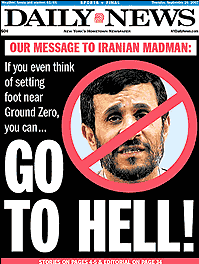
ahmadinejad-nydailynews1.gif…the US media have once again fallen victim to an orchestration of “enemy image” that aims to vilify, intimidate, deface and demonize a Middle Eastern leader who, ironically, has been unusually forthcoming in his expressions of warm feelings toward the American people (though not the US government and its policies).

Never mind that Ahmadinejad has released a few Iranian-Americans who were suspected of instigating a “velvet revolution”, or that he has broken the ice of diplomatic non-dialogue with the US by consenting to direct meetings between Iranian and US ambassadors in Iraq, or that he has made the most far-reaching Iranian cooperation with the International Atomic Energy Agency (IAEA) to date.

None of this matters the least to frenzied pundits and politicians who want to cash in on the feverish anti-Iran mood in the US, whose government has done nothing to quell this Iranophobic frenzy and, instead, is fanning the flames by escalating accusations against Tehran. [complete article]

Editor’s Comment — Televised images of street protests in Pakistan where effigies of George Bush are being burned and the US flag is being trampled on are standard fare when it comes to representations of anti-American Islamic extremism. The New York Daily News presents nothing less than a mirror image — our own xenophobic extremism.

Facebooktwittermail

NEWS: U.S. builds up pressure on Iran; Bolton backs Israeli strike; ElBaradei’s inconvenient deal

U.S. ramps up pressure on Iran

One year after the United States launched an intensified global economic campaign against Iran with the stated aim of halting Tehran’s nuclear work, the Bush administration is counting its successes — and calling for still more pressure.

In recent months, once-reluctant European countries have joined the effort, which some are calling a financial war, with more vigor.

Germany’s largest bank, Deutsche Bank AG, said recently that it would stop doing business in Iran. France has trimmed export credits that encourage business in Iran and advised French firms, including the oil and gas giant Total S.A., not to start new investments there. Even Japan, heavily dependent on Persian Gulf oil, has pulled back from energy projects in Iran. [complete article]

Bolton: US would support preemptive Israeli strike on Iran

President Bush’s former United Nations ambassador John Bolton said the United States would stand behind a pre-emptive strike by Israel against countries developing “WMD facilities.”

In his remark, printed in Tuesday’s edition of the Israeli daily Yediot Achronot, Bolton directly referenced Iran.

“The greatest concern is to prevent Iran and other countries in the region from acquiring nuclear weapons,” Bolton said, according to JTA.org, a Jewish news service. “We’re talking about a clear message to Iran — Israel has the right to self-defense –and that includes offensive operations against WMD facilities that pose a threat to Israel. The United States would justify such attacks.” [complete article]

Iran’s pact threatens to wrongfoot the West

Diplomats from the permanent five members of the United Nations Security Council and from Germany are to discuss Iran tomorrow, amid disagreement over whether to impose a new round of UN sanctions.

Although the US, UK and France are determined to renew pressure on Iran to suspend its uranium enrichment programme, this new drive in Washington for UN sanctions is unlikely to get far, as it will be blocked by Russia and China.

At the heart of the dispute is an accord between Iran and Mohamed ElBaradei, head of the International Atomic Energy Agency – the UN nuclear watchdog. [complete article]

Facebooktwittermail

OPINION & NEWS: Syria’s uranium mining capabilities pose little proliferation risk; Israel says can’t ignore regional efforts to acquire WMD

Extracting uranium from phosphates

Phosphate extraction is just another (uneconomical) form of uranium mining and milling. The resulting uranium would still need to be enriched, using a separation method such as gaseous diffusion or strong rotation. Doing so would require a facility such as the centrifuge plant that Iran is constructing near Natanz. That is, and always has been, the bottleneck that we worry about from a proliferation perspective. Otherwise countries like Kazakhstan, Niger, Naminbia and Uzbekistan would be major nuclear proliferation concerns. [complete article]

Israel says can’t ignore regional efforts to acquire weapons of mass destruction

The deputy chairman of the board of the Israel Atomic Energy Commission, Gideon Frank, warned delegates at the 51st International Atomic Energy Commission in Vienna Wednesday that Israel would not be able to ignore the efforts by various countries in the Middle East to develop weapons of mass destruction and the means to deliver them.

Even though Frank did not specify the countries in question, his statements hinted heavily at Iran and Syria.

Responding to the near permanent call by Arab states for Israel to agree to a nuclear weapons-free Middle East, Frank reiterated a series of preconditions for achieving what he described as “a noble goal,” stressing that this “cannot be advanced out of context.” Frank stressed that the manifestation of this “vision,” which is interpreted as a call on Israel to relinquish its nuclear capabilities, can only occur in stages. [complete article]

Facebooktwittermail

OPINION: Iraq – who wins?

The victor?

Iran’s role in Iraq is pervasive, but also subtle. When Iraq drafted its permanent constitution in 2005, the American ambassador energetically engaged in all parts of the process. But behind the scenes, the Iranian ambassador intervened to block provisions that Tehran did not like. As it happened, both the Americans and the Iranians wanted to strengthen Iraq’s central government. While the Bush administration clung to the mirage of a single Iraqi people, Tehran worked to give its proxies, the pro-Iranian Iraqis it supported — by then established as the government of Iraq — as much power as possible. (Thanks to Kurdish obstinacy, neither the U.S. nor Iran succeeded in its goal, but even now both the US and Iran want to see the central government strengthened.)

Since 2005, Iraq’s Shiite-led government has concluded numerous economic, political, and military agreements with Iran. The most important would link the two countries’ strategic oil reserves by building a pipeline from southern Iraq to Iran, while another commits Iran to providing extensive military assistance to the Iraqi government. According to a senior official in Iraq’s Oil Ministry, smugglers divert at least 150,000 barrels of Iraq’s daily oil exports through Iran, a figure that approaches 10 percent of Iraq’s production. Iran has yet to provide the military support it promised to the Iraqi army. With the U.S. supplying 160,000 troops and hundreds of billions of dollars to support a pro-Iranian Iraqi government, Iran has no reason to invest its own resources.

Of all the unintended consequences of the Iraq war, Iran’s strategic victory is the most far-reaching. In establishing the border between the Ottoman Empire and the Persian Empire in 1639, the Treaty of Qasr-i-Shirin demarcated the boundary between Sunni-ruled lands and Shiite-ruled lands. For eight years of brutal warfare in the 1980s, Iran tried to breach that line but could not. (At the time, the Reagan administration supported Saddam Hussein precisely because it feared the strategic consequences of an Iraq dominated by Iran’s allies.) The 2003 U.S. invasion of Iraq accomplished what Khomeini’s army could not. Today, the Shiite-controlled lands extend to the borders of Kuwait and Saudi Arabia. Bahrain, a Persian Gulf kingdom with a Shiite majority and a Sunni monarch, is most affected by these developments; but so is Saudi Arabia’s Eastern Province, which is home to most of the kingdom’s Shiites. (They may even be a majority in the province but this is unknown as Saudi Arabia has not dared to conduct a census.) The U.S. Navy has its most important Persian Gulf base in Bahrain while most of Saudi Arabia’s oil is under the Eastern Province. [complete article]

Facebooktwittermail

FEATURE: Mohamed ElBaradei

An indispensable irritant to Iran and its foes

While Dr. ElBaradei’s harshest detractors describe him as drunk with the power of his Nobel, what keeps him on center stage is a pragmatic truth: He is everyone’s best hope.

He has grown ever more indispensable as American credibility on atomic intelligence has nose-dived and European diplomacy with Tehran has stalled.

For the world powers, he is far and away the best source of knowledge about Iran’s nuclear progress — information Washington uses regularly to portray Tehran as an imminent global danger.

Even the Iranians need him (as he likes to remind them) because his maneuvers promise to lessen and perhaps end the sting of United Nations sanctions.

Dr. ElBaradei, who is 65, seems unfazed, even energized, by all the dissent. He alludes to a sense of destiny that has pressed him into the role of world peacemaker. He has called those who advocate war against Iran “crazies,” and in two long recent interviews described himself as a “secular pope” whose mission is to “make sure, frankly, that we do not end up killing each other.” [complete article]

Editor’s Comment — In their reference to ElBaradei’s “mangled metaphors,” his “naive grandiosity,” and his being “drunk with the power of his Nobel,” (references all conveniently ascribed to others), these reporters betray a subtle contempt reserved for UN officials which we rarely find directed at even some of the most moronic buffoons who sit in Congress or have been presidentially appointed in the executive branch of government. If, as reported, ElBaradei is “everyone’s best hope,” the Times seems intent on doing its best to undercut that hope. And is that for nothing more than the reason that as an Arab, as a Middle Easterner, and as an unelected non-American official, Mohamed ElBaradei’s political authority cannot be acknowledged by the newspaper that treasures its privileged access to the seat of American power?

Facebooktwittermail

NEWS: The coming war with Iran

Bush setting America up for war with Iran

Senior American intelligence and defence officials believe that President George W Bush and his inner circle are taking steps to place America on the path to war with Iran, The Sunday Telegraph has learnt.

Pentagon planners have developed a list of up to 2,000 bombing targets in Iran, amid growing fears among serving officers that diplomatic efforts to slow Iran’s nuclear weapons programme are doomed to fail.

Pentagon and CIA officers say they believe that the White House has begun a carefully calibrated programme of escalation that could lead to a military showdown with Iran. [complete article]

Editor’s Comment — Back on July 13, the New York Sun reported:

President Bush is set to instruct the Treasury Department to block assets associated with Iran’s revolutionary guard corps in a new executive order declaring financial war on foreign saboteurs of the Iraqi government.

The paperwork to designate Iran’s revolutionary guard corps, or IRGC, and Quds Force is now on the president’s desk awaiting his signature, according to three administration officials who requested anonymity. The designation of the IRGC and Quds Force would mark the first time the finance related executive order process, reserved usually for foreign terrorist organizations, would be used against a branch of a foreign military.

On August 15, a month later, the Washington Post reported:

The United States has decided to designate Iran’s Revolutionary Guard Corps, the country’s 125,000-strong elite military branch, as a “specially designated global terrorist,” according to U.S. officials, a move that allows Washington to target the group’s business operations and finances.

Today, in an article that refers to the “intensifying the debate over the Revolutionary Guard Corps,” the New York Times reports:

While some White House officials and some members of the vice president’s staff have been pushing to blacklist the entire Revolutionary Guard, administration officials said, officials at the State and Treasury Departments have been pushing a narrower approach that would list only the Revolutionary Guard’s elite Quds Force, or perhaps, only companies and organizations with financial ties to that group.

If either the Quds Force or the entire Revolutionary Guard fits the legal criteria for a “specially designated global terrorist,” why would President Bush have waited two months to sign the order? What the debate and the delay makes clear is that if and when this designation is made it will be done so for purely political reasons. Indeed, if the Iranians were guilty of everything about which they are being accused, the question would not be about when it becomes expedient to apply the force of the US Treasury Department; it would be how the United States is going to respond to acts of war.

We’ve been here before. Whenever this administration is bobbing and diving in the process of shaping its legal arguments, the political thrust is already evident. George Bush’s gut is telling him, it’s time to hit Iran. The legal, strategic, political, and purely rational arguments are being constructed after the fact.

And where in this is it possible to imagine that lessons learned from Iraq are being applied?

Inside Cheney’s brain, I imagine it runs something like this: Shock-and-awe works — it brought down Saddam; reconstruction doesn’t. So long as we don’t send in the army, the air force and the navy can take care of Iran.

And now that the British poodle is no longer available to provide Bush with some sycophantic “international support,” a French poodle has happily taken his place. The French Foreign Minister Bernard Kouchner today said, “We have to prepare for the worst, and the worst is war.”

Facebooktwittermail

NEWS: Has Iran paused its uranium enrichment program?

Has Iran paused its uranium enrichment program?
By Matthew Schofield, McClatchy, August 25, 2007

Iran appears not to have significantly expanded its uranium enrichment program this summer, a development that has many experts wondering whether the threat of sanctions finally has had an impact on the Iranian government.

Experts won’t know for sure if Iran has paused its program until a report this week from a team of International Atomic Energy Agency inspectors, who were in Iran last week for the third round of inspections this summer. A public debate on the report is scheduled for the IAEA’s Sept. 10 meeting.

But after five years of frustration at a lack of Iranian cooperation, those who closely follow Iran’s nuclear program believe that Iran’s resumption of IAEA inspections coupled with the apparent halt in expansion may signal that the Islamic Republic is willing to compromise. [complete article]

Facebooktwittermail

EDITORIAL: Iran isn’t scared

Iran isn’t scared

The latest move in the U.S.’s escalating rhetoric aimed at Iran is Maj. Gen. Rick Lynch’s claim — no evidence provided — that 50 members of Iran’s Revolutionary Guard Corps (IRGC) are training Shiite militias, south of Baghdad, the area under Lynch’s command. He hasn’t caught any of them but he knows they’re there. He also confirms that after spending two months patrolling a 125-mile stretch of the Iraq-Iran border, his troops haven’t once intercepted shipments of illegal weapons. I guess it just goes to show what a devilishly cunning enemy Iran is: it can sneak in sophisticated bombs and train militias how to use them, all without getting caught.

What the U.S. seems to be doing is providing “proof” (threadbare as usual) as to why the Revolutionary Guard needs to be labeled as an SDGT (“specially designated global terrorist”). I’m sure Joe Lieberman thinks the argument is iron-clad.

What seems much less clear is whether there is any real strategic thinking going on here. Robert Baer says he has been told by an administration official, “IRGC IED’s are a casus belli for this administration. There will be an attack on Iran.” It’s a simple as that. Baer writes, “The feeling in the Administration is that we should have taken care of the IRGC a long, long time ago.”

Nothing better optimizes American hubris than the expression “taking care” — as though the solution to any problem merely hinges on whether the all-powerful U.S. of A. gets around to deciding to fix it. Meanwhile the world — convinced that the United States is much better at breaking than fixing — shudders at the prospect that the Pentagon is getting ready to engage in another bout of Middle East problem-solving.

As for how Iran is reacting to the administration’s increasingly bellicose rhetoric? It seems to be eagerly lapping it up.

The Ayatollah’s are far too sophisticated to use an expression like “bring ’em on,” but in effect, that’s what they are saying. Associated Press reports that last week,

Ayatollah Ahmad Khatami [not to be confused with former president Mohammad Khatami], who does not hold a government post but once a month delivers the official Friday prayer sermon, told thousands of worshippers at Tehran University in a speech broadcast on radio that the designation [SDGT] showed that the Guards were doing something right.

“I believe the U.S. decision for including the Guards in the list of terrorist organizations is an honor and a golden card in their file,” he said. “Whenever your enemy is saying something bad about an organization, it shows that the organization has been effective,” he added.

Now, in a move that seems calculated to demonstrate who really holds greater political influence in Baghdad — Tehran or Washington — Iranian President Mahmoud Ahmadinejad has accepted an invitation to the Iraqi capital. I doubt that President Bush will be able to avail himself of a similar photo opportunity.

Facebooktwittermail

EDITORIAL: Who’s in the best position to play a constructive role in Iraq?

Who’s in the best position to play a constructive role in Iraq?

In his patronizing, familiar style, President Bush yesterday said he’d need to have a “heart-to-heart” with his “friend,” Prime Minister Maliki, if the latter continues to insist that Iran is playing a constructive role in Iraq. Then, to drive his message home, Bush switched from friendly to aggressive by saying, “Now, is he [Maliki] trying to get Iran to play a more constructive role? I presume he is. But that doesn’t – what my question is – well, my message to him is, is that when we catch you playing a non-constructive role there will be a price to pay.” Bush staffers were then forced to untangle Bush’s ambiguous syntax by saying that it was Iran — not Maliki — that will pay the price. Vice President Cheney has already volunteered that that price could include airstrikes against suspected training camps in Iran run by the Quds force.

With a casus belli such as “catching a truckload of fighters or weapons crossing into Iraq from Iran,” the long-feared war against Iran now seems unlikely to start with a shock-and-awe strike on Iran’s nuclear facilities. Instead, a series of “incidents” spread out over a period of months might escalate into a conflict from which neither side can back down. If this happens, I would argue that it reflects a Cheney-inspired political strategy for circumnavigating high level dissent inside the Pentagon.

For some time, rumors have been circulating in Washington that a significant number of generals would resign rather than support military action against Iran. Yet in the scenario I describe, it would only be after the fact (and too late for anyone to preemptively threaten resignation) before everyone agreed that the threshold of war had already been crossed. The window of opportunity for a principled rebellion is rapidly closing.

Meanwhile, the White House’s more immediate preoccupation seems to be whether it’s going to continue treating Maliki as a friend or turn him into a foe.

If and when Maliki has this promised/threatened heart-to-heart with the president, he might consider asking Bush how Iraqis should interpret the following two contrasting images.

To Iran’s west we see an American-led reconstruction process in Iraq that after four years has yielded meager results. Oil production remains below pre-war levels, electricity supply in Baghdad is under a third of what it was, unemployment is around 50%, and 70% of Iraqis lack adequate water supplies. Until quite recently, the U.S. was characterizing “terrorism” — not Iran — as the primary obstacle to Iraq’s progress.

To the east of Iran, Herat (Afghanistan’s western-most city) is now being hailed as a demonstration of “the positive influence of Iran” — those being the words of Mohammed Rafiq Shahir, president of Herat’s Council of Professionals. Since 2001, “Herat has attracted $350 million in private investment for industry – more than any other Afghan city, including Kabul, which is some 10 times larger. In total, 250 medium- and large-scale factories have been built.” The driving force behind this economic boom has been Iran. It has built a highway to the nearby border and it has hooked Herat into the Iranian power grid.

No wonder that — unlike Bush — Afghanistan’s president, Hamid Karzai, views his Persian neighbors positively. At the same time, Nuri al-Maliki might well look forward to the day that Iraq is able to purchase cheap electricity from nuclear-powered Iranian power stations.

At the end of the day, what should be more important? Having friendly relations with your immediate neighbors or pleasing a distant, unpredictable and unreliable superpower?

Facebooktwittermail