Category Archives: Iraq

Iran claims an oil field it seized

Iran claims an oil field it seized

The Iranian government said Saturday that an oil field that its troops occupied a day earlier was on its side of the border with Iraq, despite Iraqi claims to the contrary.

A group of about 11 Iranian soldiers seized a portion of the remote Fakka oil field in Maysan Province in southeastern Iraq early Friday, according to Iraq.

Government officials in Baghdad said they had summoned the Iranian ambassador to protest the military action, but diplomatic efforts had so far failed to resolve the dispute. [continued…]

Iraqi troops in standoff with Iran near oil well

Iraq deployed security forces Saturday near a remote oil well seized by Iran, officials said, and its government pressed Tehran to withdraw its forces from the area along their disputed southern border.

U.S. officials applauded Iraq for standing its ground against Iran — an uneasy ally that analysts said was aiming to remind its neighbor of its economic and political pull in its takeover of the oil well Thursday. The site is located in one of the largest oil fields in Iraq and has about 1.5 billion barrels in reserves.

The standoff was a dramatic display of the occasionally tense relations between the two oil-rich nations that fought an eight-year war in the 1980s but now share common ground in Shiite-led governments. [continued…]

Facebooktwittermail

U.S. companies shut out as Iraq auctions its oil fields

U.S. companies shut out as Iraq auctions its oil fields

Those who claim that the U.S. invaded Iraq in 2003 to get control of the country’s giant oil reserves will be left scratching their heads by the results of last weekend’s auction of Iraqi oil contracts: Not a single U.S. company secured a deal in the auction of contracts that will shape the Iraqi oil industry for the next couple of decades. Two of the most lucrative of the multi-billion-dollar oil contracts went to two countries which bitterly opposed the U.S. invasion — Russia and China — while even Total Oil of France, which led the charge to deny international approval for the war at the U.N. Security Council in 2003, won a bigger stake than the Americans in the most recent auction. “[The distribution of oil contracts] certainly answers the theory that the war was for the benefit of big U.S. oil interests,” says Alex Munton, Middle East oil analyst for the energy consultancy Wood Mackenzie, whose clients include major U.S. companies. “That has not been demonstrated by what has happened this week.”

In one of the biggest auctions held anywhere in the 150-year history of the oil industry, executives from across the world flew into Baghdad on Dec. 11 for a two-day, red-carpet ceremony at the Oil Ministry, broadcast live in Iraq. With U.S. military helicopters hovering overhead to help ward off a possible insurgent attack, Oil Minister Hussein Al-Shahrastani unsealed envelopes from each company, stating how much oil it would produce, and what it was willing to accept in payment from Iraq’s government. Rather than giving foreign oil companies control over Iraqi reserves, as the U.S. had hoped to do with the Oil Law it failed to get the Iraqi parliament to pass, the oil companies were awarded service contracts lasting 20 years for seven of the 10 oil fields on offer — the oil will remain the property of the Iraqi state, and the foreign companies will pump it for a fixed price per barrel. [continued…]

Channeling Sunni rage into Iraqi political clout

Sheik Abdul-Rahman Munshid al-Assi has been making up for the time he lost in an American prison, aggressively diving into Iraqi politics after being held nearly a year on charges of aiding the insurgency.

After his release last year, he formed the Arab Political Council to represent Sunni Arabs in Kirkuk. He recruited Sunni candidates to run in the coming national elections. He is forging a political bloc with Arab nationalists, other tribal leaders and former members of Saddam Hussein’s outlawed Baath Party as a counterweight to Kurds in the province.

At first glance, the fact that a vehement opponent of the Shiite-led government in Baghdad and Kurdish leaders next door is embracing democratic politics may seem to be a purely positive sign. After all, much of the American security effort of the past few years has been to channel Sunnis into just such a course.

But for Sheik Abdul-Rahman the political action is far from a concession. Rather, it is an attempt to tap into the simmering rage he says is still rampant among Sunni Arabs in Iraq. And he and many of his peers are far from becoming fully reformed democrats: he has yet to renounce the insurgency, though he denies directly supporting it, and warns that more violence could come. [continued…]

Facebooktwittermail

Are crippling droughts the next great threat to Iraq?

The dust bowl of Babylon

From his mud brick home on the edge of the Garden of Eden, Awda Khasaf has twice seen his country’s lifeblood seep away. The waters that once spread from his doorstep across a 20% slab of Iraq known as the Marshlands first disappeared in 1991, when Saddam Hussein diverted them east to punish the rebellious Marsh Arabs. The wetlands have been crucial to Iraq since the earliest days of civilization — sustaining the lives of up to half a million people who live in and around the area, while providing water for almost two million more.

The waters vanished after the First Gulf War due to a dictator’s wrath; over the next 16 years, they ebbed and flowed, but slowly started to return to their pre-Saddam levels. By 2007, with no more sabotage and average rains, almost 70% of the lost water had been recovered. Now it’s gone again. This time because of a crisis far more endemic: a devastating drought and the water policies of neighboring Turkey, Iran, and Syria. These three nations have effectively stopped most of the headwaters of the three rivers — the Tigris, Euphrates, and Karoon — that feed these marshes.

“Once in a generation was bad enough,” says Awda, a tribal head and local sheikh in the al-Akeryah Marshlands, who also advises the Nasiriyah governorate on water issues. “Twice could well be God’s vengeance.”

In a land where fundamental interpretations of monotheistic scripts often determine the tone of public discourse, particular attention is now being paid to the biblical Book of Revelation, in which the Euphrates River drying up was prophesized as a harbinger for the end of the world. It is not doomsday yet in Iraq, but the water shortage here has not been worse for at least the last two centuries — and possibly for several millennia more. Government estimates suggest close to two million Iraqis face severe drinking water shortages and extremely limited hydropower-generated electricity in a part of the country where most households get by on no more than eight hours of supplied power per day, in the best of times. [continued…]

U.S. firms lag in bids for Iraqi oil

Chinese, Russian and European companies won the right this weekend to develop major oil fields in Iraq, while U.S. firms made a paltry showing at auctions that represent the first major incursion of foreign oil companies into Iraq in four decades.

The companies that secured 10 contracts in auctions held over the weekend and in June stand to profit handsomely, but they are taking a significant gamble.

Iraq has the third-largest proven crude reserves in the world, but the country remains perilous; it suffers from chronic corruption and acrimonious politics that have prevented the passing of new laws to regulate the sector.

Of the seven U.S. companies that registered for the auctions, only one emerged as the leading partner in a consortium that won a contract. Another U.S. company has a minority stake in a contract. [continued…]

Facebooktwittermail

Beleaguered Iraqi leader puts off Gates meeting

Beleaguered Iraqi leader puts off Gates meeting

Defense Secretary Robert M. Gates arrived here on Thursday for talks with Prime Minister Nuri Kamal al-Maliki, but the prime minister said he was too busy to see Mr. Gates because he had to defend himself before a Parliament outraged by a recent series of bombings.

American defense officials insisted that Mr. Maliki had not rebuffed the defense secretary, but it was not until late on Thursday, hours after Mr. Gates landed in Baghdad, that they said that Mr. Maliki had agreed to see him on Friday morning. Mr. Gates’s aides scrambled to rearrange his schedule. [continued…]

Facebooktwittermail

After delays, deal set on Iraq election law

After delays, deal set on Iraq election law

Lawmakers pulled Iraq back from the brink of a constitutional crisis on Sunday night, brokering a last-minute compromise that will allow for the first national elections since 2005.

A deal on the election law has fallen apart before, underscoring the deep sectarian divide that remains in Iraq, despite a drop in violence. Fighting over the law also threatens to complicate the American withdrawal.

After months of wrangling, the Iraqi Parliament gathered just before midnight to approve a deal that had been secured only hours before in closed-door talks.

“It is a great achievement for Iraq,” said Khalid al-Attiya, a deputy speaker of Parliament, shortly after the vote. The deal had been approved Sunday by Shiite, Sunni and Kurdish leaders, according to government officials, so it was unlikely to collapse again. [continued…]

Facebooktwittermail

Iraq’s January elections face near certain delay

Iraq’s January elections face near certain delay

Iraq’s tortuous effort to hold its parliamentary election on schedule in January collapsed Monday, raising the prospect of a political and constitutional crisis next year as the United States begins withdrawing the majority of its combat troops.

After two days of divisive sessions and failed talks, Parliament disregarded a veto by one of the country’s vice presidents and approved new amendments that the vice president promptly indicated he would veto as well.

The moves deepened a crisis that had fleetingly seemed resolved after months of wrangling over how to set up the vote, widely seen as a barometer of Iraq’s progress toward democracy. [continued…]

British colonel’s scathing attack on ‘arrogant, bureaucratic’ Americans

Colonel J.K.Tanner: “We experienced real difficulty in dealing with the American military and civilian organisations who, partly through arrogance and partly through bureaucracy, dictate that there is only one way: the American way. As far as the Iraqis were concerned, here was a nation who could put people on the moon but who could not, or would not, fix the electricity supply. You need to have money in order to make things happen, to buy protection from the looters, to smooth out tribal problems and to have immediate and visible effect and we did not have that. Despite our so-called ‘special relationship’ I reckon that we were treated no differently to the Portugese…

“I realise now that I am a European, not an American. We managed to get on better militarily and administratively with our European partners and indeed at times with the Arabs than with the Americans. Europeans chat to each other whereas dialogue is alien to the US military.

“They need to reintroduce dialogue as a tool of command because, although it is easy to speak to Americans face-to-face and understand each other completely, dealing with them corporately is akin to dealing with a group of Martians.” [continued…]

Facebooktwittermail

Iraq sentences Sunni leader to death

Iraq sentences Sunni leader to death

A leader of a Sunni Awakening Council was sentenced to death for kidnapping and murder on Thursday, setting off charges that the Shiite-dominated Iraqi government was trying to weaken the Sunni movement, which is credited with much of the reduction of sectarian violence here since 2006.

The Sunni leader, Adil al-Mashhadani, who led the Awakening militia in the impoverished Fadhil neighborhood of Baghdad, was arrested in March on charges of terrorism. His arrest set off 24 hours of fighting between Awakening members and American and Iraqi security forces, after which the government dissolved the Fadhil council.

A spokesman for the Justice Ministry, Abdul-Sattar Bayrkdar, provided no further details about the crime.

The Awakening Councils, also known as the Sons of Iraq, are local groups, including former insurgents and Baathists, who turned against the insurgency and received pay, first from the Americans and now from the Iraqis. Under their agreement with the government, they have tacit amnesty for past acts of sectarian violence but not for crimes like murder. [continued…]

Facebooktwittermail

Is Iraq shifting to Iran?

Is Iraq shifting to Iran?

Are we witnessing a historic shift in the balance of power in the Persian Gulf, with Iran assuming dominance over Iraq? A recent fact-finding trip to Baghdad and Najaf suggests that such fears are exaggerated.

In 2003, the United States overturned the secular but predominantly Sunni Arab regime of Saddam Hussein and then presided over the installation of a more representative Shiite government in Baghdad. This was a huge gift to Iran—itself a Shiite state—and represented a historic shift. Although Iraq is a majority Shiite state, never in more than a thousand years had a predominantly Shiite government ruled there.

The U.S. invasion removed an implacably hostile enemy of Iran that had invaded it in 1980, fought a brutal eight-year war against it in the southern marshes, and created a Sunni Arab coalition with the intent of overturning the Iranian revolution. In an apparent fit of absentmindedness, the G.W. Bush administration succeeded in removing both of Iran’s key rivals—the Taliban was similarly routed in Afghanistan—effectively elevating Iran to the position of a regional superpower. [continued…]

Facebooktwittermail

Iraq passes crucial election law

Iraq passes crucial election law

After weeks of political stalemate, Iraq approved a law on Sunday to administer a critical national election in January, a significant milestone for its fragile democracy and a step that will allow the rapid withdrawal of American combat forces early next year.

The election, only the second national vote since the fall of Saddam Hussein, will be a crucial step toward popular sovereignty and stability in Iraq. But the election law had been stymied by a political battle over the northern province of Kirkuk, claimed by Kurds, Arabs and Turkmens, each of whom hoped electoral power would give them control of the region’s oil wealth.

The compromise reached Sunday, which satisfied all three groups, was hailed by Iraqi and American leaders as a triumph for Iraq’s emerging democracy and a demonstration of Parliament’s ability to resolve sticky sectarian disputes for the national benefit. [continued…]

Facebooktwittermail

Iraq on the edge

Iraq on the edge

Iraqis prefer checkpoints manned by Iraqis—as I observed time and again, they have learned how to navigate them. They often appear to know one of the security men—perhaps a distant relation or a friend of a friend. They know how to butter up the checkpoint guards with a kind word or humorous turn of phrase, and get past them even if they lack official permission. By contrast, they find American (or Peruvian) checkpoints, with their large signs in hortatory English and poorly rendered Arabic, bewildering, arbitrary, and humiliating. Over the years, many an altercation has occurred in these places owing to misunderstandings, impatience, or simply ill will.

Conversely, many Americans dislike, distrust, and resent Iraqi checkpoints. In a recent incident reported by Anthony Shadid in The Washington Post, Iraqi soldiers allegedly beat four American DynCorps contractors who refused to follow their orders at one of the entrances to the Green Zone[1] —a reminder that the tables are turning. I had flashed only two pieces of ID on my first visit to the Green Zone. But on my second day, Iraqi soldiers at the checkpoint one encounters when entering the Green Zone from the 14th of July Bridge insisted that I also produce an official bahtch or, failing that, procure a US Department of Defense escort, since I had told them I was on my way to meet General Raymond Odierno, who has succeeded David Petraeus as the US commanding officer in Iraq.

An American soldier lingering nearby, with no apparent mission other than to monitor the Iraqi soldiers, sauntered up to find out why I was being denied access to the Green Zone. After listening to my explanation that the Iraqis, now joined by an officer, required that I have an escort, he launched a verbal offensive that was as deeply insulting to the Iraqis’ national self-esteem (“This is why we were able to defeat them in two days”) as it was disrespectful and crude (“We could easily kill them all”).

The Iraqis, while knowing no English, could not possibly have misinterpreted the soldier’s abrasive body language, and I ended up trying to calm them down in the row that followed. When a DOD escort arrived, the American wandered off, leaving in his wake injured pride and burning anger over a relationship that had never worked. [continued…]

Facebooktwittermail

An ugly peace in Iraq

An ugly peace

In December 2008 I flew Royal Jordanian from Amman to Iraq’s southern city of Basra. Because of the Muslim holiday of Eid, embassies were closed; a contact in the British military promised to obtain visas for me and a colleague upon arrival. The Iraqi customs officials were offended that we did not follow procedure, but a letter from the British commander got us in. It might not have been necessary: when the five Iraqi policemen who examined luggage at the exit saw my colleague’s copy of Patrick Cockburn’s excellent book on the Shia cleric Muqtada al Sadr, they turned giddy. One of them kissed the picture of Muqtada’s face on the cover and asked if he could keep the book. It was not their sentiment that surprised me, but rather their comfort expressing it publicly.

Since the occupation began, Muqtada has been the most controversial public figure in Iraq. A populist anti-American leader, he came from a lineage of revolutionary Shia clerics who opposed the Saddam’s regime and who gave voice to Iraq’s poor Shia majority. Capitalizing on his slain father’s network of mosques and the family name, Muqtada and his followers, called Sadrists, seized control of Shia areas in Iraq when Baghdad fell, especially the slums of Basra and the capital. He rallied marginalized Shias against the occupation, its puppet government, and eventually against Sunni extremists as well. His movement provided social services, and his militia, Jeish al Mahdi—the Mahdi Army or JAM—fought the Americans and defended Shias from extremist Sunni terrorism.

But the Mahdi Army and its rivals eventually propagated sectarian violence, fighting in the civil war and expelling or killing innocent Sunnis. After the February 2006 bombing of the Samarra shrine, a Shia holy site, the two-year-old civil war intensified. With attacks against Sunnis escalating, the largely Shia Iraqi police often looked the other way. The bloodshed was indiscriminate. [continued…]

Facebooktwittermail

Iraq is safer – but by no means safe

Iraq is safer – but by no means safe

The savage suicide bombings in the heart of Baghdad yesterday show how far the violence in Iraq is from being over. It is as if those who order these bombings know that they only have to repeat these atrocities every couple of months to destabilise the country.

The government of Prime Minister Nouri al-Maliki makes itself even more vulnerable by boasting that it is improving security. Iraq is a safer place than it was three years ago, but it is still one of the more dangerous places in the world.

There is no need to imagine that the slaughter in Haifa Street yesterday was because American troops withdrew from the cities of Iraq three months ago. With or without US troops, the bombers have been able to get through in Baghdad ever since they destroyed the UN headquarters in 2003. [continued…]

Facebooktwittermail

Election law stalls in Iraqi parliament

Election law stalls in Iraqi parliament

The Iraqi parliament failed for a second time Monday to vote on an election law crucial for organizing elections in January that will choose a new parliament and serve as a milestone in American plans to withdraw combat troops from the country.

As is often the case in Iraq, deadlines come and go. But election officials face a logistical challenge ahead of the Jan. 16 vote, the first national election since 2005. They say they need the law passed now to give them roughly three months to prepare for the vote, although they could gain a week or two if the election is delayed. But after that, parliament’s term expires, throwing Iraq’s nascent political system into an unconstitutional limbo, just months before the U.S. military wants to begin withdrawing troops in earnest.

“If they don’t pass a new law, a curse is going to fall on the political parties,” warned Safia Sahhal, a secular lawmaker. “Why? Because this is what Iraqis want.” [continued…]

Facebooktwittermail

Awakening leader’s tale illustrates Iraq’s volatility

Awakening leader’s tale illustrates Iraq’s volatility

The Sunni Muslim paramilitary leader’s campaign slogan holds the promise of imminent rescue: “Hold on, we are coming.”

But the aspiring parliamentary candidate, Mustafa Kamal Shibeeb, may not be in a position to deliver on his slogan: He’s a fugitive, with murder charges hanging over his head from events at the height of the U.S. troop buildup two years ago.

Already, police commandos have tried to grab him twice, only to be blocked by an Iraqi army unit, with tacit support from U.S. forces.

Shibeeb’s story reveals the volatility of today’s Iraq, where Sunni-Shiite tensions are just one of the conflicts at play. His vulnerability illustrates how the Iraqi government and security forces remain subject to competing political and tribal pressures, and score-settling, that risk igniting new violence. [continued…]

Facebooktwittermail

Former US diplomat holds secret stake in Kurdish oil field

Former US diplomat holds secret stake in Kurdish oil field

It is widely known that the former US diplomat Peter Galbraith has been one of the most prominent figures in shaping the state structure of Iraq in the period after 2003, especially with his vocal advocacy of various forms of radical decentralisation and/or partition solutions for Iraq’s political problems that are reflected in his books and numerous articles in the New York Review of Books, especially in the period from 2004 to 2008. Until now, though, it has generally been assumed that Galbraith’s fervent pro-partition propaganda was rooted in an ideological belief in national self-determination and a principled view of radical federalism as the best option for Iraq’s Kurds. Many have highlighted Galbraith’s experience as a former US diplomat (especially in the Balkans in the 1990s) as key elements of his academic and policy-making credentials.

Today, however, it has emerged that the realities were probably rather different. For some time, Norway’s most respected financial newspaper, Dagens Næringsliv (DN), has been focusing on the operations of DNO, a small Norwegian private oil company in Kurdistan, especially reporting on unclear aspects concerning share ownership and its contractual partnerships related to the Tawke field in the Dahuk governorate. One particular goal has been to establish the identity of a hitherto unknown “third party” which participated with DNO in the initial production sharing agreement (PSA) for Tawke between 2004 and 2008, but was squeezed out when this deal was converted to a new contract in early 2008, prompting a huge financial claim of around 500 million US dollars against DNO which has yet to be settled. Today, DN claims to present proof that one of the two major “mystery stake-holders” involved in the claim was none other than Peter Galbraith, who allegedly held a five-percent share in the PSA for Tawke from June 2004 until 2008 through his Delaware-based company Porcupine. Galbraith’s partner was the Yemenite multi-millionaire Shahir Abd al-Haqq, whose identity was revealed by the same newspaper earlier this month. DN has published documents from Porcupine showing Galbraith’s personal signature, and today’s reports are complete with paparazzi photographs of Galbraith literally running away from reporters as they confront him in Bergen, where he is currently staying with his Norwegian wife. He refused to give any comment citing potential legal complications. [continued…]
(H/t to Helena Cobban.)

Facebooktwittermail

After six years, ‘we’re worthless’

After six years, ‘we’re worthless’

Weeks after the U.S.-led invasion of Iraq in the spring of 2003, as parts of the capital were still smoldering, American soldiers and diplomats turned to men like Hassan Shama and Omar Rahman Rahmani in their quest to plant the seeds of representative democracy.

In Baghdad, Iraq’s capital, they held impromptu neighborhood caucuses to appoint district and neighborhood advisory councils. The local government bodies were given no official charter, lawmaking power or public budget. In the years that followed, as the capital became a bloody battleground and the country descended into near-anarchy, council members were among the U.S. military’s staunchest allies. They provided information about extremists, offered insight into Iraqi society and gave American-imposed security measures a veneer of Iraqi legitimacy.

As U.S. troops have sharply disengaged from Baghdad in recent months, local representatives say they are feeling powerless and abandoned. The Iraqi government has taken no steps to hold elections for the councils, and the Baghdad provincial council is culling them of members it deems unqualified or unfit for service.

The looming demise of the local councils — at least as the Americans established them — is an ominous sign of the brand of democracy that is likely to reign in Iraq as the Americans depart, council members say. They worry that constituents will no longer have grass-roots representation and that power will become far more centralized in the hands of a few. [continued…]

Facebooktwittermail

Thoughts on Iran, mountains and winning without war

On mountains and metaphors

A few random thoughts and observations on the latest developments with Iran:

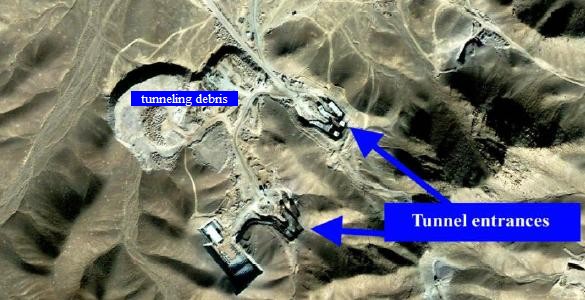
How big’s a mountain? It’s a clandestine nuclear facility under construction “inside a mountain“.

The only adjective that got left out was “deep,” yet knowing that detail might be the key to knowing exactly what “very heavily protected” means.

(This much we can already deduce about the extent of the tunneling: it has produced two very large adjoining flattened mounds of debris which are marked in the image above.)

Gary Sick seems to have been among the descriptively most precise in referring to “a small enrichment facility in an underground chamber on a Revolutionary Guards base.”

Inside an underground chamber it is; inside a mountain it is not — at least not unless one assumes a Lilliputian perspective and calls a 167ft tall hillock a mountain. That’s the difference in elevation between one of the tunnel entrances and the highest point along the ridge that the tunnel penetrates. (Use Google Earth to see specific elevations. For instance, the northern tunnel entrance is at 2,975ft. The adjacent ridge to the east is at 3,142ft.)


View Larger Map

Not so fast with the sanctions. When the president of a country sharing a 1,458km border with Iran says sanctions against Iran won’t work, there’s reason to think that he isn’t simply making a prediction; he might be making a promise.

Iraq’s President Jalal Talabani gave this warning on Saturday and no doubt it was warmly received in Tehran. China and Russia might be crucial when it comes to imposing sanctions. Iraq might turn out to be key when it comes to enforcing or being unable to enforce them.

Pity the IAEA. There it is — the world’s indispensable nuclear monitoring agency — but does anyone care to share their intelligence so that IAEA inspectors can do their work? Only when the powers that be deem it useful.

Bombs away. Maybe this isn’t the smoking gun Israel was waiting for. Evidence of a clandestine program may confirm some of Israel’s dire warnings, but how many other similarly well-concealed and hard-to-destroy facilities might there be? All that an Israeli attack might actually accomplish would be to legitimize Iran’s withdrawal from the NPT and a rush towards weaponization.

The meaning of a mountain. If “inside a mountain” might be a topographical stretch, it’s an image that serves multiple purposes:
1. It’s too good an image for any journalist to risk undermining with a skeptical question. (“And just how big is that mountain?”)
2. It tells the world that the Iranians are dastardly, sneaky fellows whose evil plans can only be hidden by something as big as a mountain.
3. It says the Americans are so smart that they can find anything, however well hidden.
4. It highlights the possibly insurmountable challenge Israel would face in launching an air strike against a target much harder to destroy than a reactor under construction in Syria, or a weapons convoy on the move in Sudan.
5. It says that Obama isn’t a daydream believer sending his representatives into a negotiating trap; he’s back in his superhero mode out to save the world.

What’s it all about? Once you get past the theatrics it comes down to the pursuit of national interests — it’s not (or at least should not be) about putting Iran in a box.

Every party has distinct national interests, but fruitful negotiations will hinge on identifying where these interests overlap — not simply the overlapping interests of the US and its allies, but also those that are shared by Iran.

Stepping off the war path requires that everyone, including the Iranians, can see a way of winning.

Facebooktwittermail

Why I threw the shoe

Why I threw the shoe

I am free. But my country is still a prisoner of war. There has been a lot of talk about the action and about the person who took it, and about the hero and the heroic act, and the symbol and the symbolic act. But, simply, I answer: what compelled me to act is the injustice that befell my people, and how the occupation wanted to humiliate my homeland by putting it under its boot.

Over recent years, more than a million martyrs have fallen by the bullets of the occupation and Iraq is now filled with more than five million orphans, a million widows and hundreds of thousands of maimed. Many millions are homeless inside and outside the country.

We used to be a nation in which the Arab would share with the Turkman and the Kurd and the Assyrian and the Sabean and the Yazid his daily bread. And the Shia would pray with the Sunni in one line. And the Muslim would celebrate with the Christian the birthday of Christ. This despite the fact that we shared hunger under sanctions for more than a decade.

Our patience and our solidarity did not make us forget the oppression. But the invasion divided brother from brother, neighbour from neighbour. It turned our homes into funeral tents. [continued…]

Facebooktwittermail