Reuters reports: France will recognise a Palestinian state if its efforts in coming weeks to try to break the deadlock between Israelis and Palestinians fail, Foreign Minister Laurent Fabius said on Friday.
“France will engage in the coming weeks in the preparation of an international conference bringing together the parties and their main partners, American, European, Arab, notably to preserve and make happen the solution of two states,” he said.
Fabius said that as a permanent member of the U.N. Security Council, France had a responsibility to try to keep up efforts to find a two-state solution between Israel and the Palestinians.
Category Archives: Israel
Israel feels the heat of U.S., EU and U.N. criticism
Reuters reports: The United States, European Union and the United Nations have issued unusually stern criticism of Israel, provoking a sharp response from Prime Minister Benjamin Netanyahu and raising Palestinians’ hopes of steps against their neighbor.
U.N. Secretary-General Ban Ki-moon on Tuesday described Israel’s settlements as “provocative acts” that raised questions about its commitment to a two-state solution, nearly 50 years after occupying lands the Palestinians seek for a state.
Ban also laid some of the blame for four months of stabbings and car rammings by Palestinians at Israel’s door, saying “as oppressed peoples have demonstrated throughout the ages, it is human nature to react to occupation, which often serves as a potent incubator of hate and extremism”.
Netanyahu’s response was quick and furious. Ban’s remarks “give a tailwind to terrorism”, he said, and ignore the fact “Palestinian murderers do not want to build a state”. [Continue reading…]
How to determine which Democratic presidential candidate is beholden to wealthy Jewish donors
Politico reports: If Bernie Sanders defeats Hillary Clinton to win the Democratic nomination, he’ll be the first Jewish presidential nominee of a major political party.
But when it comes to his views on Israel, some Jewish Democrats are scratching their heads in confusion.
“His voting record on Israel recently is fine, absolutely fine,” said Steve Rabinowitz, a media consultant and former Clinton White House aide who supports Clinton. “I haven’t heard him once talk about it on the campaign trail. It’s as though he doesn’t utter the word Israel. It just strikes me as odd.”
But over his career Sanders has cast some votes and made critical statements about Israel that unnerve some in the pro-Israel community. That’s all the more puzzling, some say, given his own heritage as the son of a Jewish immigrant father from Poland whose family was wiped out by the Nazis — and someone who spent time working on an Israeli kibbutz.
As Clinton has struggled in recent days to prevent Sanders from notching twin victories in Iowa and New Hampshire, she has zeroed in on what she calls his naive statements about Iran — a country that Israel happens to consider its greatest enemy.
How many Democratic primary voters might have qualms with Sanders is unclear, however. President Barack Obama himself has grown increasingly critical of Israeli policy toward Iran and the Palestinians. Many liberal voters agree: A recent poll by the Chicago Council on Global Affairs found that only 4 in 10 Democrats consider Israel to be playing a positive role in the Middle East.
“The faction of the Democratic base that supports a strongly pro-Israel point of view is shrinking,” said Matthew Duss, president of the left-leaning Foundation for Middle East Peace.
But the Democratic Party still features a strong network of wealthy Jewish donors, such as the Hollywood mogul Haim Saban and American Jewish Congress president Jack Rosen, who hold candidates to high standards when it comes to Israel. It also boasts better political organization than liberals who pressure Israel to take a more conciliatory line with the Palestinians and Iran. [Continue reading…]
Some Jewish Democrats are scratching their heads in confusion? If so, that’s probably because Sanders hasn’t offered himself to the highest bidder.
At the same time, there’s no evidence that Sanders has a progressive view of Israeli-Palestinian politics. As Joseph Dana writes:
The problematic and least radical aspect of the senator’s foreign policy is his unwavering support for Israel. When it comes to the Israel-Palestine conflict, Mr Sanders’s economic radicalism falls by the wayside.
He has endorsed continuing military aid to Israel along with economic aid to the Palestinians, which has proven to be an effective tool for both Israel and the United States to exercise undue influence over Palestinian decision-making, as evidenced by the withholding of aid after the PLO pursued statehood recognition at the United Nations. Additionally, the senator has seldom condemned the Israeli occupation of Palestinian land and said nothing of Israel’s aggression in Gaza over the last decade.
Some have argued that Mr Sanders’s support for Israel is because he is Jewish. Yet, he has barely spoken about a faith-based connection to Israel. He has only cited his religion as an inspiration for progressive activism, especially regarding the struggle for civil rights equality.
Instead of taking a progressive stance, Mr Sanders relies on the security-based narrative that Israel has spun over the international community for decades. Where is the passion and critical thinking that has captured the imagination of millions of Americans and has demonstrated that fresh conversations are possible?
For a politician running a campaign against the “rigged” political and economic system that continues to disenfranchise millions, he is surprisingly content with the prevailing Washington orthodoxy on Israel (and also gun control, but that is a separate issue altogether).
The perplexing part is that Mr Sanders’s orthodoxy comes at a time when American diplomats in Israel are signalling a readiness to chart a new course on the conflict, one that doesn’t accept Israeli PR at face value.
For American single-issue voters whose sole concern is the resolution of the Middle East conflict, the 2016 presidential election won’t be different from any other: there won’t be a single candidate who ranks this as their primary issue (or even top foreign policy issue).
Is this a failure to acknowledge the defining issue of our times? On the contrary, it’s a reminder to be wary of polemicists who pound their podiums when talking about “the defining issue of our times.”
Indeed, if it turns out that throughout this election season, the subject of Israel rarely comes up, on balance that’ll probably be a good thing.
After all, when the subject does get raised, more often than not it is simply for the purpose of finding out who has the least amount of shame in presenting him or herself as a loyal Zionist.
Let’s be thankful if we are subject to as few as possible of these obsequious and obscene exercises.
Israel spraying toxins over Palestinian crops in Gaza
Al Jazeera reports: On January 7, a low-flying agricultural aircraft sprayed herbicides on to Palestinian farmlands along the eastern border, eradicating or damaging up to 162 hectares of crops and farmland along the Israeli border fence.
“Herbicides are sprayed in high concentrations. Thus, they remain embedded in the soil, and then find their way to the water basin. This constitutes a real hazard for the population,” said Anwar Abu Assi, manager of the chemical laboratory at the Ministry of Agriculture.
The sprayed areas belong to Israel’s unilaterally imposed and poorly delineated “buffer” or “no-go zone”.
The zone, which amounts to an estimated 17 percent of the entire territory of the Gaza Strip and a third of its agricultural lands, erodes into the Strip’s most vital and fertile soils. [Continue reading…]
Behind disputed views of Jewish identity looms a much larger question about the future of inclusive societies
The Guardian reports: The US State Department has moved to back America’s ambassador to Israel in a febrile and escalating row over his remarks on Monday that Israel applied law in the occupied West Bank differently to Palestinians and Israelis.
Ambassador Daniel Shapiro’s unusually critical comments drew harsh criticism from ministers in Israel’s rightwing government – including from the Israeli prime minister, Binyamin Netanyahu.
Shapiro was also publicly lambasted on Israeli television on Tuesday by a former aide to Netanyahu who used the deeply offensive Hebrew word “yehudon” – which translates as “little Jew boy” – to disparage the ambassador. The term is used by rightwing Israelis against other Jews – particularly those in the diaspora – whom they regard as not being sufficiently Jewish or pro-Israel. [Continue reading…]
The remarks by Aviv Bushinsky, who served as Netanyahu’s chief of staff when he was finance minister in Ariel Sharon’s governmen, are reminiscent of an incident reported by the Washington Post in 1997.
U.S. Ambassador Martin Indyk, still seething at a two-week-old slur, ran into his accuser Thursday and fixed him with a glare. According to Ephraim Sneh, a Labor Party member of Israel’s legislature, this is what happened next:
“The last time someone called me a Jew boy,” Indyk said, harking back to school days in Australia, “I was 15 years old and he got a punch in the face.”
A right-wing legislator, Rehavam Zeevi, had indeed called Indyk a yehudon — Hebrew invective translated variously as “Jew boy,” “yid,” or “kike” — at a parliamentary caucus late last month. He looked up from his seat at a memorial service for the late Yitzhak Rabin and glared back at Indyk. “Try me,” Zeevi replied. Then, taunting Indyk, he added distinctly: “yehudon, yehudon.”
Zeevi, a retired general who is chief of the ultranationalist Moledet (Homeland) party, apparently meant to say that Indyk, the first Jewish U.S. ambassador here, betrayed his coreligionists by pressuring the Israeli government for concessions in peace talks with the Palestinian Authority. Zeevi’s political platform, the most extreme of any party in the parliament, calls for expulsion of Arabs from the West Bank to make room for Jews.
A.B. Yehoshua, one of Israel’s most famous novelists, has for many years been among the most vocal in promoting this view that Jews who remain living outside Israel are only, as he says, “partial Jews.”
But instead of being preoccupied with where Jews plant their bodies, he and those who share his views, might consider where the Jewish conscience may better thrive.
In 2003, Avraham Burg, former member of the Knesset, a chairman of the Jewish Agency for Israel and a Speaker of the Knesset, who was born in Jerusalem, wrote:
It turns out that the 2,000-year struggle for Jewish survival comes down to a state of settlements, run by an amoral clique of corrupt lawbreakers who are deaf both to their citizens and to their enemies. A state lacking justice cannot survive. More and more Israelis are coming to understand this as they ask their children where they expect to live in 25 years. Children who are honest admit, to their parents’ shock, that they do not know. The countdown to the end of Israeli society has begun.
It is very comfortable to be a Zionist in West Bank settlements such as Beit El and Ofra. The biblical landscape is charming. From the window you can gaze through the geraniums and bougainvilleas and not see the occupation. Traveling on the fast highway that takes you from Ramot on Jerusalem’s northern edge to Gilo on the southern edge, a 12-minute trip that skirts barely a half-mile west of the Palestinian roadblocks, it’s hard to comprehend the humiliating experience of the despised Arab who must creep for hours along the pocked, blockaded roads assigned to him. One road for the occupier, one road for the occupied.
This cannot work. Even if the Arabs lower their heads and swallow their shame and anger forever, it won’t work. A structure built on human callousness will inevitably collapse in on itself. Note this moment well: Zionism’s superstructure is already collapsing like a cheap Jerusalem wedding hall. Only madmen continue dancing on the top floor while the pillars below are collapsing.
As much as all of this might sound purely like a struggle over Jewish identity, it mirrors an affliction in which people across the globe withdraw into their various ethnic, religious, or ideological ghettos of identification and their cherished definitions of my people.
The testing ground for challenging this trend is now Europe.
Last year, Burg wrote:
In a generation in which we Israelis have forgotten how to be sensitive and empathetic to minorities, to those who are different, to the persecuted, and many American Jews are swallowed up in their comfort zones of white society and are abandoning their partnership with the “others,” in America, the “United States of Europe” is presenting a new model of identity – a union between those who are different, and the “other.” It’s a model no different from the American one which seeks to assimilate all into a monochromatic American democracy.
Further, Europe is the current meeting point between Islam and the West. Some of that encounter involves clashes, and some involves learning. The Christian continent is learning to make space for other, rich and varied identities. My friends, Ziya from Bangladesh, Shaida whose family is from Turkey and Rob from Jamaica, are impressive Europeans, and Europe is better off with them. Just like Shaul from Venice, Yoop from Amsterdam and Brian from London – there is no dissonance between their Jewish heritage and their European identity. The discourse between white, Christian Europe and those who are different is fascinating. More important is the dialogue between Western Europe and the Muslim forces in its midst.
The Muslim world and some of its members are embarking on a long journey toward the Western values of freedom, equality and brotherhood. The institutionalization of Western Islam in the heart of Europe – that which is absorbing values of democracy while remaining true to Muslim tradition – is where the strategic potential exists for bridging the gaps peacefully in the generations to come. It’s not happening in the Middle East or North America, but only in Europe. That is where the vanguard of humanity and humaneness is to be found.
Since Burg wrote this, the vision of Europe has become profoundly challenged by an expanding refugee crisis, acts of terrorism, growing nationalism, cultural protectionism, and the drumbeats of xenophobia and Islamophobia.
Both in Europe and the U.S., it often seems like the political momentum favors those who promote retreat in its various forms — through strengthening borders, heightened national security, and disengagement from foreign affairs.
At the same time, the inexorable global trends point in the opposite direction as populations expand and people choose or are compelled to cross borders.
In such a world, the task of building more inclusive societies is not an idealistic goal; it has become an urgent necessity.

‘Death to Christians, enemies of Israel’ — Hebrew graffiti defacing Jerusalem monastery

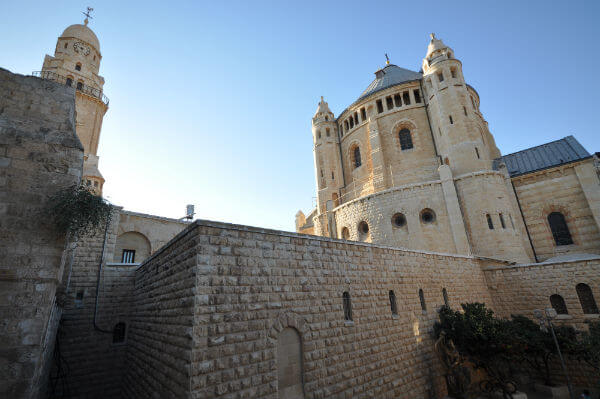
Reuters reports: Israel ordered a high-priority police investigation on Sunday into anti-Christian messages scrawled in Hebrew on the walls and doors of a Jerusalem monastery, saying they marked an assault on religious harmony.
“Idols will be extirpated” – a line lifted from the Jewish prayer service – and “Christians Go to Hell” were among graffiti left outside the Dormition Abbey with felt-tip pens. The varying handwriting suggested several vandals had been involved.
The Benedictine monastery, on Mount Zion in the Old City, is near a site where many Christians believe Jesus held the Last Supper as well as a tomb revered as the last resting place of the biblical King David and which draws many Jewish worshippers.
“We will not let anyone undermine religious coexistence in Israel,” Internal Security Minister Gilad Erdan said in a statement, adding that police would put a high priority on “nabbing those who carried out this despicable act”.
Israel has been struggling with a spate of hate crimes by suspected Jewish ultra-nationalists targeting Christian sites as well as Palestinians and Israeli human rights activists. [Continue reading…]
The Times of Israel: “Despite promises by the government, these incidents continue to happen,” Wadia Abu Nasser, the executive director of the Assembly of Catholic Bishops in the Holy Land, railed Sunday morning. “If we were to actually count all of these incidents, they’d be in the hundreds.
“We have limited resources at our disposal. It’s the state’s responsibility to not only apprehend these perpetrators, but to make the necessary changes in the education system to educate against this sort of thing,” he told Army Radio. [Continue reading…]
Ynet adds: “The inscriptions are not only against Jesus the Messiah, but also call to slaughter the Christians and send them to hell! How long will these acts of vandalism continue?” the church said.
“This is the area of our convent, which until today is not monitored by police cameras, although this has been promised to us in the summer of 2013 by the Israeli security authorities after the cars of the monastery were badly damaged and several hate graffiti were discovered.”
The Domition Abbey further complained of “aggressive gathering with loud music and chanting by Jewish right-wing radicals in our immediate neighborhood in the area of the Tomb of David” almost every weekend for the past three years. [Continue reading…]
In 2011, I posted a collection of articles under the headline, “Being spat at remains part of life for Christians in Jerusalem.” This included reports from Haaretz, the Jerusalem Post, and The Forward. Attacks on Christians were described by Eric J Greenberg in 2004 as what has been “Jerusalem’s dirty little secret for decades.”
Last month I received a message from a reader claiming that these incidents are being used “as a stick to beat all Jews,” to which I responded:
In none of the reports cited — all reports made by Jewish journalists — is the behavior of “young Jewish bigots” in Jerusalem portrayed as representative of Jews as a whole. At the same time, this phenomenon doesn’t sound like something that deserves being ignored — especially if the Jerusalem Post reports that the attacks on Christians are not rare but are in fact “habitual.”
Israel’s Minister of Public Security, Gilad Erdan, says:
“We will show zero tolerance to whomever harms the democratic foundations of Israel and its freedom of religion and we will apprehend those who carried out this heinous act.”
How can anyone take seriously this claim that the Israeli government has “zero tolerance” for these types of attacks on religious freedom when it has been clearly documented that they have been going on for decades?
This isn’t just a domestic political issue for Israel, or reason for Israeli leaders and business owners to be concerned about the impact on tourism.
If a blind eye has been turned towards these hate crimes, it most likely also includes that of American Christian Zionists who are more closely aligned with right-wing Israelis than they are with fellow Christians in the Holy Land.
Prime Minister Benjamin Netanyahu considers Christians United for Israel “to be a vital part of Israel’s national security.”
I guess for CUFI and Netanyahu, the latest anti-Christian incident in Jerusalem will be a cause for little more than mild and fleeting embarrassment.
Palestinian citizens in Israel: A fast-shrinking civic space
Nadim Nashif and Raya Naamneh write: Israel still portrays itself as a Jewish and democratic state. Yet in practice, as its Palestinian citizens can attest, it functions as a Jewish ethnocracy, leaving small margins of freedom for its Palestinian citizens that have been steadily shrinking in the past few years. Now the Israeli state has come under the complete control of the far right wing, which sees no need even for such limited margins of freedom. This is evident in the wave of discriminatory legislation and the use of the Emergency Regulations against established non-governmental organizations (NGOs) and movements such as the northern branch of the Islamic Movement in Israel.
The many laws that Israeli Knesset (parliament) and government have passed to constrain Palestinian citizens’ political participation and activism include, in 2011 alone, the “Anti-Boycott” law, which prohibits the public promotion of boycotts; the “Nakba” law, which prevents Palestinian commemoration of their catastrophe due to Israel’s creation in 1948; and the “Foreign Government Funding” law, which places onerous reporting requirements on NGOs. These laws have severely damaged the ability of Palestinian parties, NGOs, and activists to freely express their opinions and protest Israel’s crimes, both within and outside the Green Line.
More recently, a bill proposed by former foreign minister and current Member of Knesset (MK) Avigdor Lieberman would prohibit the Israeli Supreme Court from interfering in the Knesset’s Central Elections Committee decision to disqualify MKs based on their political stances. If approved, this bill would directly target Palestinian MKs, such as Haneen Zoubi and her party, “Balad – the National Democratic Alliance,” who have previously been faced with attempts to disqualify them.
In addition to targeting political participation at the government level, Israel has limited or prohibited the work of several NGOs at the municipal level. It is important to note that the NGOs impacted include both Palestinian and Israeli organizations fighting to expose Israel’s human rights violations and the apartheid regime it maintains in all of historic Palestine. [Continue reading…]
The war on freedom of expression across the Middle East
Rami G Khouri writes: It is useful to spot meaningful patterns that help us make sense of our bewildering world, and to acknowledge positive developments to be continued alongside negative ones to be avoided.
Applying this principle to the last year in the Middle East reveals several troubling trends that have made life difficult for hundreds of millions of people. One in particular stands out, and strikes me as a root cause of many other negative trends that plague our region. This is the tendency of governments to use increasingly harsh measures to restrict the freedoms of their citizens to express themselves and meaningfully to participate politically and hold power accountable.
Several aspects of this behavior make it especially onerous. It is practiced by all states in the region—Arab, Israeli, Iranian, and Turkish—leaving few people in this part of the world who can live as fully free and dignified human beings. It is justified on the basis of existing constitutional powers, so governments can jail tens of thousands of their citizens, rescind their nationality, or torture and kill them in the worst cases, simply because of the views they express, without any recourse to legal or political challenge. It shows no signs of abating, and indeed may be worsening in lands like Egypt, Turkey, and others. And, it is most often practiced as part of a “war on terror” that seeks to quell criminal terror attacks, but in practice achieves the opposite; the curtailment of citizen rights and freedoms exacerbates the indignities and humiliations that citizens feel against their government, which usually amplifies, rather than reduces, the threat of political violence. [Continue reading…]
Israel bans novel on Palestinian-Jewish romance, seen as threat to ‘national-ethnic identity’
Haaretz reports: Israel’s Education Ministry has disqualified a novel that describes a love story between an Israeli woman and a Palestinian man from use by high schools around the country. The move comes even though the official responsible for literature instruction in secular state schools recommended the book for use in advanced literature classes, as did a professional committee of academics and educators, at the request of a number of teachers.
Among the reasons stated for the disqualification of Dorit Rabinyan’s “Gader Haya” (literally “Hedgerow,” but known in English as “Borderlife”) is the need to maintain what was referred to as “the identity and the heritage of students in every sector,” and the belief that “intimate relations between Jews and non-Jews threatens the separate identity.” The Education Ministry also expressed concern that “young people of adolescent age don’t have the systemic view that includes considerations involving maintaining the national-ethnic identity of the people and the significance of miscegenation.”
The book, published in Hebrew by Am Oved about a year and a half ago, tells the story of Liat, an Israeli translator, and Hilmi, a Palestinian artist, who meet and fall in love in New York, until they part ways for her to return to Tel Aviv and he to the West Bank city of Ramallah. The book was among this year’s winners of the Bernstein Prize for young writers.
A source familiar with the ministry’s approach to the book said that in recent months a large number of literature teachers asked that “Borderlife” be included in advanced literature classes. After consideration of the request, a professional committee headed by Prof. Rafi Weichert from the University of Haifa approved the request. The committee included academics, Education Ministry representatives and veteran teachers. The panel’s role is to advise the ministry on various educational issues, including approval of curriculum.
According to the source, members of the professional committee, as well as the person in charge of literature studies, “thought that the book is appropriate for students in the upper grades of high schools – both from an artistic and literary standpoint and regarding the topic it raises. Another thing to remember is that the number of students who study advanced literature classes is anyhow low, and the choice of books is very wide.”
Another source in the Education Ministry said that the process took a number of weeks, and that “it’s hard to believe that we reached a stage where there’s a need to apologize for wanting to include a new and excellent book into the curriculum.” [Continue reading…]
Are most Jewish terrorists ‘crazy Americans’?
Haaretz reports: Laura Wharton, an American-born political scientist who represents the left-wing Meretz party on the Jerusalem city council, is not surprised by the large number of children of English-speaking families among the terror suspects, noting that immigrants from these countries tend to be highly ideologically motivated, and are more likely to have radical extremists among their ranks. “I think in general people who immigrate to Israel from English-speaking countries, in fact from all wealthy countries, need a stronger incentive to make the move,” she says. “They also want to make their mark when they come here, for better or for worse.”
Sara Yael Hirschhorn, who has spent many years studying American immigrants living in the West Bank, believes the radicalism could reflect a failure to integrate smoothly into Israeli society. “I think it has to do with the fact that these people are not assimilated in the way that their native Israeli or perhaps other immigrant peers have managed to be,” she observes.
In some cases, she says, these teens may be acting out against their parents for not doing enough to make their mark on Israeli society. “It could be a rebellion against parents they thought had come to do some great ideological pioneering, but instead, turned out to be average suburbanites in places like Ma’aleh Adumim,” notes Hirschhorn, who serves as the University Research Lecturer and Sidney Brichto Fellow in Israel Studies at the University of Oxford.
The author of the upcoming book “City on a Hilltop: Jewish-American Settlers in the Occupied Territories Since 1967,” Hirschhorn has concluded that roughly 60,000 American Jews live in West Bank settlements, where they account for 15 percent of the settler population.
The number of American immigrants living in Israel, including their children, has been estimated at about 170,000.
This is not the first time that U.S. citizens have been associated with or convicted of terror activities in Israel. In 1994, Brooklyn-born Baruch Goldstein, a physician from Kiryat Arba, massacred 29 Palestinians while they were worshipping in the Cave of the Patriarchs in Hebron. Yaakov Teitel, originally from Florida, has been convicted of various acts of terrorism and hate crimes against Palestinians, homosexuals, Messianic Jews and left-wingers. Boston-born Baruch Marzel, a Kahane disciple, has a criminal record that includes assaults on Palestinians, policemen and left-wingers. Former New Yorker Ira Rappaport, a member of the Jewish Underground that emerged in the 1980s, was found guilty of involvement in a car bombing that left the former mayor of Nablus maimed.
Already back then, American immigrants had acquired a reputation as potential extremists.
Chaim Waxman, a retired professor of sociology and Jewish studies at Rutgers University, who has published extensively on immigration to Israel from the United State, recalls teaching a course at Tel Aviv University in the 1980s when reports about the Jewish Underground first started surfacing. “I remember the students talking about those ‘crazy Americans,’ even though only one member of the Underground was an American,” he recounts. “But that is an impression that many Israelis have.” [Continue reading…]
Middle East still rocking from First World War pacts made 100 years ago

Ian Black writes: In an idle moment between cocktail parties in the Arab capital where they served, a British and French diplomat were chatting recently about their respective countries’ legacies in the Middle East: why not commemorate them with a new rock band? And they could call it Sykes-Picot and the Balfour Declaration.
It was just a joke. These first world war agreements cooked up in London and Paris in the dying days of the Ottoman empire paved the way for new Arab nation states, the creation of Israel and the continuing plight of the Palestinians. And if their memory has faded in the west as their centenaries approach, they are still widely blamed for the problems of the region at an unusually violent and troubled time.
“This is history that the Arab peoples will never forget because they see it as directly relevant to problems they face today,” argues Oxford University’s Eugene Rogan, author of several influential works on modern Middle Eastern history.
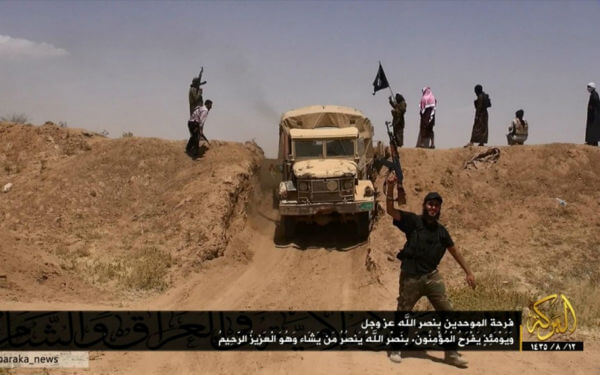
In 2014, when Islamic State fighters broke through the desert border between Iraq and Syria – flying black flags on their captured US-made Humvees – and announced the creation of a transnational caliphate, they triumphantly pronounced the death of Sykes-Picot. That gave a half-forgotten and much-misrepresented colonial-era deal a starring role in their propaganda war – and a new lease of life on Twitter. [Continue reading…]
NSA’s targeting of Israeli leaders also caught private conversations between U.S. lawmakers and Israel lobby
The Wall Street Journal reports: President Barack Obama announced two years ago he would curtail eavesdropping on friendly heads of state after the world learned the reach of long-secret U.S. surveillance programs.
But behind the scenes, the White House decided to keep certain allies under close watch, current and former U.S. officials said. Topping the list was Israeli Prime Minister Benjamin Netanyahu.
The U.S., pursuing a nuclear arms agreement with Iran at the time, captured communications between Mr. Netanyahu and his aides that inflamed mistrust between the two countries and planted a political minefield at home when Mr. Netanyahu later took his campaign against the deal to Capitol Hill.
The National Security Agency’s targeting of Israeli leaders and officials also swept up the contents of some of their private conversations with U.S. lawmakers and American-Jewish groups. That raised fears — an “Oh-shit moment,” one senior U.S. official said — that the executive branch would be accused of spying on Congress.
White House officials believed the intercepted information could be valuable to counter Mr. Netanyahu’s campaign. They also recognized that asking for it was politically risky. So, wary of a paper trail stemming from a request, the White House let the NSA decide what to share and what to withhold, officials said. “We didn’t say, ‘Do it,’ ” a senior U.S. official said. “We didn’t say, ‘Don’t do it.’ ”
Stepped-up NSA eavesdropping revealed to the White House how Mr. Netanyahu and his advisers had leaked details of the U.S.-Iran negotiations — learned through Israeli spying operations — to undermine the talks; coordinated talking points with Jewish-American groups against the deal; and asked undecided lawmakers what it would take to win their votes, according to current and former officials familiar with the intercepts. [Continue reading…]
Brazil rebuffs West Bank settler nominated as Israeli ambassador
Middle East Eye reports: Brazil has apparently rebuffed Israel’s nomination of a settler as its next ambassador in a move Israel says will damage diplomatic relations between the two countries.
Dani Dayan, a 60-year-old who lives in the West Bank settlement of Ma’ale Shomron, was nominated in August as Israel’s new ambassador to Brasilia.
However Brazil has yet to endorse the Argentina-born diplomat’s appointment, following lobbying in Brazil against his nomination and protests to President Dilma Rousseff about Dayan.
Ambassadorial appointments must be endorsed by the host nation – a process known as an agrément. However, if no endorsement is forthcoming within two months, it is understood that the choice has not been accepted.
Dayan was a senior member of the Yesha Council, an umbrella organisation of Jewish settlements in the West Bank, and Brazilian activists are worried that approving his selection would be seen as supporting Israel’s settlements, which are illegal under international law. [Continue reading…]
Israel warns Brazil faces diplomatic downgrade unless it accepts settler as ambassador
Reuters reports: Brazil’s reluctance to accept an Israeli ambassador who is a West Bank settler has led to a standoff with Israel now warning it could downgrade diplomatic relations.
The appointment four months ago of Dani Dayan, a former head of the Jewish settlement movement, did not go down well with Brazil’s left-leaning government, which has supported Palestinian statehood in recent years.
Most world powers deem the Jewish settlements illegal.
Israel’s previous ambassador, Reda Mansour, left Brasilia last week and the Israeli government said on Sunday Brazil risked degrading bilateral relations if Dayan were not allowed to succeed him. [Continue reading…]
Turkey sees no normalization of Israel ties without end to Gaza blockade
Reuters reports: Turkey sees no normalization in ties with Israel unless its conditions for ending the Gaza blockade and compensation for the deaths of 10 Turkish activists in 2010 are met, a presidential spokesman said on Monday.
Relations between Turkey and Israel soured when the activists were killed in a raid by Israeli commandos on a Turkish boat, the Mavi Marmara, which was trying to breach the blockade.
Expectations of a breakthrough were intensified after senior officials met this month to try to repair ties. The talks have raised hopes of progress in negotiations to import Israeli natural gas, particularly since Turkey’s relationship with major energy producer Russia has worsened over Syria.
But comments from Presidential spokesman Ibrahim Kalin suggest Turkey may be trying to play tough in the negotiations. [Continue reading…]
Israeli ministers approve new restrictions on human rights groups
The Associated Press reports: Israeli Cabinet ministers on Sunday gave preliminary approval to a bill that imposes new disclosure requirements on nonprofit groups that receive foreign funding — drawing accusations it is cracking down on pro-peace groups, rattling relations with Europe and deepening an increasingly toxic divide between liberal and hawkish Israelis.
Critics said the regulations are meant to stifle dovish organizations critical of Prime Minister Benjamin Netanyahu’s government policies toward the Palestinians, since such nonprofits tend to rely heavily on donations from European countries.
In contrast, pro-government and nationalistic nonprofit groups tend to rely on wealthy private donors, who are exempt from the measures under the bill. The legislature is expected to approve the bill as early as this week.
Opposition leader Isaac Herzog quickly blasted the bill as a “muzzling law” that would bring about “thought police.” [Continue reading…]
Did Erdogan give up Gaza in return for Israeli gas?
Kadri Gursel writes: Days before Israeli media broke the news of a preliminary Turkish-Israeli deal to normalize ties, Turkish President Recep Tayyip Erdogan had thrown a signal flare of impending moves to settle the Mavi Marmara crisis between the two countries.
Speaking to journalists on a flight back from Turkmenistan on Dec. 13, Erdogan broke with his usual hostile rhetoric against Israel, saying that “Turkish-Israeli rapprochement is vital for the region” and that normalizing ties would be “to the benefit of the whole region.” He then reiterated his three conditions for reconciliation: first, an Israeli apology for the killing of 10 Turks, including one with US citizenship, in the Israeli raid on the Mavi Marmara ferry on May 31, 2010, as it sailed in international waters in the Mediterranean with 590 activists aboard, mostly Turks, seeking to break the naval blockade of the Gaza Strip; second, the payment of compensation to the families of the victims; and third, the lifting of Israel’s naval blockade on Gaza.
Four days later, the Israeli daily Haaretz reported, “Israel and Turkey have reached understanding on the outlines of a reconciliation agreement that would put an end to the long crisis in relations between the two countries and normalize ties.” [Continue reading…]
Jewish extremists’ leader: Christians are ‘blood sucking vampires’ who should be expelled from Israel
Haaretz reports: Benzi Gopstein, leader of the extremist anti-assimilationist group Lehava, has called for the prevention of Christmas celebrations in Israel and the expulsion of Christians whom he compared to “vampires.”
“Christmas has no place in the Holy Land,” Gopstein wrote in an article posted a few days ago on the Haredi website Kooker.The Israel Movement for Reform and Progressive Judaism has called on the prosecutor and the police to launch an investigation.
Gopstein wrote in the article that he is disturbed by “the fall of the line of defense of the Jewish people against our deadly enemy for hundreds of years – the Christian Church.”
He said the Church had used “the maximum tools at its disposal to destroy the Jewish people,” and that today “the Church has been defeated roundly when the Jewish people has one of the strongest armies in the world and they have no chance any longer of destroying our body.”
However, Gopstein said, the Church has not given up. “A last hope remains to those vampires and blood suckers – the mission. If Jews cannot be killed, they can still be converted.”
Gopstein said “missionary bookstores offer their products in front of everyone on Jaffa Road in Jerusalem, whole communities are crawling with missionaries, many businesses are run by them and are used by the mission, many cases using camouflage and without the knowledge of the employees.”
Gopstein said that the “fear that every Jew felt, the disgust that we described above at Christianity – disgust that was the only thing that saved us from the dark days in Europe – has disappeared with the ‘good life’ of the democratic age…and the missionary is on the prowl for prey.”
Gopstein ends his article by writing: “I call on everyone to raise a cry and fight this corrupt phenomenon in the best tradition of Judaism, before we all, including those who observe the commandments among us, become a community of sycophants.”
“Christmas has no place in the Holy Land,” he wrote, adding “Let us remove the vampires before they once again drink our blood.”
The Israel Movement for Reform and Progressive Judaism and the Coalition Against Racism have asked the deputy prosecutor for special functions, as well as the police unit in charge of cybercrime, to investigate. The movements wrote: “The article calls for the prevention of celebration of Christmas, the most important Christian holiday, and to work to remove Christians from Israel.” The groups also noted that Gopstein’s description of Christians as “vampires and blood-suckers” contravenes the law prohibiting insult to religious feelings.
“This statement was not made in a vacuum but in the context of many acts of violence against Christian clergy in recent years,” the groups wrote.
Orly Erez-Likhovski, head of the Reform center’s legal department said: “Benzi Gopstein stops at nothing to incite against anyone who is not him – Arab Muslims, Christians and others, using harsh language and calling for violence. Unfortunately…in the face of this incitement…law enforcement is thunderously silent.” [Continue reading…]